
Is Benifuuki Green Tea Good for Hay Fever? Checking the Size and Funding of the Methylated Catechin Trials, What the Foods with Function Claims Notifications Say, and Caffeine and How to Brew, Against Papers and Government Documents

PR This article contains affiliate links to Rakuten Ichiba (“See on Rakuten”) and A8.net. What is written here is based on public agency documents and papers, regardless of whether there are ads. The “See on Amazon.co.jp” and “See on Yahoo! Shopping” links are also affiliate links.
When spring approaches, you often see claims such as “Benifuuki green tea is good for hay fever” and “methylated catechin calms the itchiness.” Benifuuki tea bags and powdered tea are lined up in supermarkets and online shops.
On the other hand, it is rarely explained what kind of people drank how much, for how long, in the trials behind these claims.
In this article, we check the following against papers and government documents (the Consumer Affairs Agency, MEXT, the Food Safety Commission of Japan, and MAFF’s plant variety registration database) and materials from an overseas assessment body (EFSA):
- What kind of cultivar Benifuuki is, and how methylated catechin was discovered
- How many people were in the human trials, what methods were used, and who paid for them
- What the Foods with Function Claims notifications actually say
- How it differs from ordinary green tea (Yabukita)
- How much caffeine it contains, and up to what amount stays within the guidelines
- How the amount changes depending on how you drink it, such as powdered or not, and water temperature
What this article cannot say Benifuuki green tea is a food. This article does not say that it cures or prevents hay fever. If your symptoms are bothering you, please consult a doctor about treatment. The researchers who ran the trials themselves write in their paper that Benifuuki is not a substitute for the drugs in the clinical practice guidelines.
Conclusions
- Benifuuki is a cultivar bred for black tea and semi-fermented tea (registered as a variety in 1995). Research from around 1999 found that methylated catechin (EGCG3”Me), which disappears when made into black tea, remains in large amounts when made into green tea. It is not contained in “Yabukita,” the standard ordinary green tea
- The human trials are trials of a few dozen people, targeting people with Japanese cedar pollinosis and similar conditions. In the largest double-blind trial (51 people), scores for itchy eyes, tears, runny nose, and so on were 10 to 20% lower than with Yabukita, but there was no difference in sneezing, nasal congestion, or sore throat
- Most of the trials come from the same research group (NARO and others), with a beverage maker (Asahi Soft Drinks) involved through funding or joint research. The research review in the notification itself says “all reports are from the same research group.” In this search, we found no human trials conducted outside Japan
- There are 42 Foods with Function Claims notifications (30 not withdrawn, as of September 30, 2026). The claim is “It has been reported to reduce discomfort of the eyes and nose caused by house dust and dust (and, since 2021, pollen)”, and the disease name “hay fever” is not used. The guideline amount per day is 30 to 49.5 mg of methylated catechin (34 mg for most)
- The caffeine content is about the same as ordinary green tea. The 700 ml of Benifuuki drink consumed in the trial contained about 147 mg, more than Yabukita (about 111 mg). Japan has no numerical guideline for caffeine, while EFSA says up to 200 mg per day during pregnancy and breastfeeding, and up to 400 mg for adults
- The amount of methylated catechin changes with the time of harvest, the water temperature, and processing (whether it is made into black tea). For products that are not Foods with Function Claims, the amount of methylated catechin is not known
Products featured in this article
Within the article, we introduce the following items to match each point.
| When it suits you | Product featured | Where in the article |
|---|---|---|
| You want a powdered tea you drink whole, with green tea as the only ingredient | Domestic Benifuuki powdered green tea (Kyoichiya) (not a Foods with Function Claims product) | Kyoichiya powdered green tea is not a Foods with Function Claims product |
| You want to try brewing Benifuuki from tea leaves | Benifuuki green tea leaves, 70 g (from Chiran, Kagoshima Prefecture) | Water temperature and how to brew |
| You also want to drink ordinary green tea (Yabukita) for comparison | Organic sencha Yabukita, 70 g (from Kakegawa City, Shizuoka Prefecture) | How it differs from ordinary green tea (Yabukita) |
| You want to choose your everyday green tea from a specialty shop | Yamamotoyama Online Shop (tea and nori) | How it differs from ordinary green tea (Yabukita) |
| You want matcha and green tea from an old Kyoto shop | Gion Tsujiri, a tea specialty shop | How it differs from ordinary green tea (Yabukita) |
| You want to cut caffeine, such as during pregnancy or in the evening | Decaffeinated green tea tea bags (Kokutaro) | Pregnancy, breastfeeding, and children |
What kind of tea is Benifuuki?
A cultivar born for black tea
Benifuuki is a tea cultivar bred by a national research institution. In the plant variety registration database of the Ministry of Agriculture, Forestry and Fisheries (MAFF), it is registered as follows:
- A cultivar bred by crossing “Benihomare” with “Makura Cd86”
- Applied for on March 24, 1993, and registered as a variety on August 17, 1995 (registration number 4591). The registrant is today’s NARO
- A cultivar for “good-quality black tea and semi-fermented tea,” with strong resistance to anthracnose and gray blight (tea diseases). Fermentability is high
- The 18-year period of the breeder’s right has expired
The Masuda 2014 paper also introduces Benifuuki as “a cultivar originally bred to make black tea.”
A cultivar that was originally for black tea came to attract attention as a green tea because of the methylated catechin described next.
How methylated catechin was discovered
Among the catechins that give green tea its astringency, the most abundant is EGCG (epigallocatechin gallate). A form in which a small part called a “methyl group” is attached to part of it is called methylated catechin. Its formal name is “epigallocatechin-3-O-(3-O-methyl)gallate,” abbreviated EGCG3”Me.
| Year | What was found | Type of study |
|---|---|---|
| 1998 | Comparing teas of various cultivars, infusions of “Benihomare” and Taiwanese cultivars strongly suppressed the release of histamine from mouse mast cells | Cells (test tube) |
| 1999 | From Taiwanese oolong tea, two catechins with a strong ability to suppress allergic reactions were isolated and their structures determined. One was EGCG3”Me. It was found in 13 of 15 green tea cultivars and was more abundant in Assam-type cultivars (0.50 to 0.82% of dry weight). It was not something produced in the fermentation process | Component analysis, mice |
| 2000 | EGCG3”Me isolated from “Benihomare” oolong tea suppressed the release of substances from human cells (basophils) more strongly than EGCG | Cells (test tube) |
| 2000 | An extract of “Benihomare” suppressed the delayed allergic reaction (type IV) in mice more strongly than “Yabukita,” which contains no EGCG3”Me | Mice |
| 2015 | The Foods with Function Claims system began, and a notification for Benifuuki green tea was accepted | ― |
(From Maeda-Yamamoto 1998, Sano 1999, Tachibana 2000, Suzuki 2000, and the Consumer Affairs Agency’s notification database)
Black tea is made by strongly oxidizing the tea leaves. In that process methylated catechin is destroyed, and it remains in large amounts when processed into green tea (Masuda 2014). It is a slightly unusual position: a cultivar for black tea that draws attention when made into green tea.
What is known from test tubes and animals
Allergy symptoms occur when mast cells in the mucous membranes of the nose and eyes react to pollen and the like and release substances such as histamine.
- In human basophil cells, EGCG3”Me reduced the receptors that catch pollen and the like (the high-affinity IgE receptor) and suppressed histamine release (Fujimura 2002)
- In mouse mast cells, it suppressed the activity of several enzymes that pass signals inside the cell (Maeda-Yamamoto 2004)
- When given by mouth to mice, it suppressed type I allergy (the immediate allergic reaction), and its effect was stronger than that of EGCG (Sano 1999, 5 to 50 mg per kg of body weight)
These are cell and animal studies. They alone do not tell us whether the same thing happens in the human body.
How it is taken up by the body
| Study | What was found |
|---|---|
| Humans (healthy people, Maeda-Yamamoto 2007) | When people drank Benifuuki green tea containing 43.5 mg of EGCG and 8.5 mg of EGCG3”Me, the total amount in the blood (AUC) was larger for EGCG3”Me, even though the EGCG amount was 5.1 times greater |
| Rats (Oritani 2013) | The proportion entering the blood when given by mouth was 0.38% for EGCG3”Me and 0.14% for EGCG |
| Minipigs (Wakamatsu 2019) | Even when fed a diet mixed with Benifuuki tea leaves, EGCG3”Me was not found in the blood; instead a different form with the methyl group in a different position (EGCG4”Me) was found |
In the human study, methylated catechin entered the blood more readily than EGCG. However, the proportions taken up are small for both, a few percent or less, and the results differ by animal species.
What the human trials found
List of trials
These are the trials in which people drank Benifuuki (methylated catechin), and whose content could be checked in papers or government documents.
| Trial | Participants | Method | What they drank | Result | Company involvement |
|---|---|---|---|---|---|
| Preliminary trial (a paper in Japanese; introduced in the text of Masuda 2014) | People with perennial allergic rhinitis | ― | Methylated catechin 34 mg and 17 mg per day | Nasal symptoms improved at 34 mg and did not improve at 17 mg | Not stated |
| Maeda-Yamamoto 2007 (Cytotechnology) | People with Japanese cedar pollinosis (a small number; as introduced in the text of Masuda 2014. The number is not given in the abstract) | Double-blind | Benifuuki green tea, Benifuuki plus ginger extract, placebo | In week 11, when pollen was at its peak, nose blowing and itchy eyes were milder than with placebo | 1 of 3 authors is affiliated with an Asahi Soft Drinks laboratory (affiliation field of the paper) |
| Maeda-Yamamoto 2009 (Allergol Int) | 38 people with Japanese cedar pollinosis | Randomized, open-label (participants know who drinks what) | Benifuuki drink (34 mg/day), in a group that started 1.5 months before pollen and a group that started after pollen began to fly | The early-start group had lower peak-time nasal symptom medication score, sore throat, nose blowing, and so on | 2 Asahi Soft Drinks employees among the researchers (Asahi Soft Drinks research results page) |
| Masuda 2014 (Allergol Int) | 51 adults with Japanese cedar pollinosis | Randomized double-blind | Benifuuki drink 700 ml/day (about 41 mg methylated catechin) or Yabukita drink 700 ml/day | Lower scores for itchy eyes, tears, runny nose, and so on. No difference in sneezing, nasal congestion, or sore throat (figure below) | “Supported by Asahi Soft Drinks” is stated in the paper |
| Asahi Soft Drinks notification documents (notification no. A69, 2015) | 90 adults with discomfort in eyes or nose from dust and house dust (75 analyzed) | Randomized, controlled comparison | Benifuuki drink 700 ml/day (34 mg) or Yabukita drink for 12 weeks | Differences in eye symptoms from week 3 and in nose symptoms from week 6 | A trial that Asahi Soft Drinks used for its own notification. In the notification abstract, conflict of interest is “none in particular” |
“Randomized” means dividing people into groups by a method like drawing lots, and “double-blind” means that neither the participants nor the doctors know which tea is being drunk. Both are methods to prevent results from being distorted by expectation or bias in how groups were divided.
The largest double-blind trial
Among trials published as papers, the largest double-blind trial is Masuda 2014, conducted at the National Hospital Organization Mie National Hospital.
- 51 people aged 20 to 65 with Japanese cedar pollinosis were divided into Benifuuki (26 people) and Yabukita (25 people), and drank two 350 ml bottles of tea a day from December 2007 to March 2008
- The Benifuuki drink had 5.83 mg of methylated catechin per 100 ml (about 41 mg per day). The Yabukita drink was matched in color and taste and had 0 methylated catechin
- The main outcome was the total symptom score from March 6 to 26, when pollen was at its peak
- Items with a difference: runny nose, itchy eyes, tears, the total of nose and eye symptoms, the score that adds the amount of medication used, and impact on daily life. The peak-time quality-of-life score was also better for Benifuuki
- Items with no difference: sneezing, nasal congestion, sore throat, and the nasal symptom score the participants recorded themselves (VAS)
- During the pollen season, the Benifuuki group showed suppression of the rise in blood eosinophils (white blood cells that increase with allergy)
- No side effects (adverse events) were reported in either group
In the discussion of the paper, the authors themselves write the following:
- The effect was statistically meaningful, but not strong enough to be a new drug for controlling hay fever
- Pollen counts were relatively low that year, and the effect in a year with heavy pollen has not been confirmed
- They do not say that Benifuuki can replace the antihistamines, nasal steroids, and other drugs in the clinical practice guidelines
This trial is described in the paper as “supported by Asahi Soft Drinks.”
Amount and when to start drinking
- Amount: The Masuda 2014 paper says the amount was decided based on a preliminary trial (published in Japanese) in people with perennial allergic rhinitis, in which 34 mg of methylated catechin per day improved nasal symptoms and 17 mg did not. This figure is the basis for most Foods with Function Claims being “34 mg per day”
- When to start: The group that started drinking 1.5 months before pollen began to fly had lower peak-time scores than the group that started after it began to fly (Maeda-Yamamoto 2009). However, this trial was an open trial, in which participants know when they started drinking. Also, both groups were drinking Benifuuki, so it is not a comparison with Yabukita or with drinking nothing
Most trials involve the same research group and a beverage maker
Of the trials in the table above, the three that can be checked in papers (2007, 2009, and 2014) are all from the same research group, which includes the same NARO researchers as authors (affiliation fields of the papers), and either Asahi Soft Drinks employees are among the authors or researchers, or Asahi Soft Drinks supported the work. The other one (A69) is Asahi Soft Drinks’ own notification.
The research review used for the Foods with Function Claims notifications (a review that collects and evaluates the literature) also states the following itself:
- Only 4 papers were adopted, and all are reports from the same research group (notification A67 by JA Kagoshima Tea)
- Because there are few papers, the possibility that only studies in which the tea worked were published (publication bias) cannot be ruled out. Some papers lack a description of the randomization or allocation method (notification D396 by Kotani Kokufun)
The source of funding does not determine the results. Still, the fact that no study by a different research group has confirmed (replicated) the same result is something worth knowing when you read these.
Research outside Japan
On October 1, 2026, we searched PubMed (the US medical literature database) combining “benifuuki” and “methylated catechin” with allergy, rhinitis, and hay fever. There were 15 hits, and all the human trials were from the Japanese research group above. We found no human trials conducted outside Japan.
Benifuuki is a cultivar bred in Japan, and in this search we also found no materials in which European or US assessment bodies evaluated Benifuuki or methylated catechin for effects on hay fever and the like.
What the Foods with Function Claims notifications say
Foods with Function Claims is a system in which a business operator, on its own responsibility, submits scientific evidence to the Consumer Affairs Agency and labels a function of the body (started in 2015). Unlike Foods for Specified Health Uses (FOSHU), they are not individually reviewed and approved by the government.
From the full data of the Consumer Affairs Agency’s notification database (obtained September 30, 2026), we counted the notifications that include methylated catechin as a functional ingredient.
What the label claims
| Content | |
|---|---|
| First notification | June 24, 2015, “Benifuuki green tea tea bags” by JA Kagoshima Tea (A67) |
| Claim text | “This product contains methylated catechin (epigallocatechin-3-O-(3-O-methyl)gallate). Methylated catechin has been reported to reduce discomfort of the eyes and nose caused by house dust and dust.” (A67) |
| Claims including “pollen” | From Yamato Kogyo’s notification on May 24, 2021 (G138), the claim “discomfort of the eyes and nose caused by pollen, dust, house dust, and so on” appeared. Of the 30 not withdrawn, 20 include “pollen” |
| The words “hay fever” | Not used in any of the 42 claims |
| Intended users | “Adult men and women who have discomfort in the eyes or nose,” and the like. Under the system, people with disease, minors, and pregnant or breastfeeding women are excluded |
| Precautions for intake | Almost all carry a caution about caffeine (such as “contains it in the same way as ordinary green tea”). Many notifications also say “taking it on an empty stomach may cause stomach pain” |
Foods with Function Claims are not intended for the treatment or prevention of disease, so the wording is “discomfort of the eyes and nose” rather than the disease name “hay fever.”
Number of notifications and their basis
| Item | Count |
|---|---|
| Methylated catechin notifications | 42 |
| Not withdrawn | 30 (12 withdrawn; reasons such as “sales ended” and “no plans to sell”) |
| Food category | All “processed foods (other).” There are no notifications for fresh foods or in supplement form |
| Type of evidence (the 30 not withdrawn) | All are “research reviews on the functional ingredient.” The only one notified with a clinical trial using the product itself was Asahi Soft Drinks’ “アサヒ めめはな茶” (Asahi Mememe-hana Tea) (A69), which has been withdrawn |
| Ingredient containing the functional ingredient | Mostly “green tea (Benifuuki)” |
In other words, most of the products now notified are based not on trials of their own products but on a research review that collects papers from the same research group introduced above.
Amount per day
| Form | Example of the guideline daily intake | Amount of methylated catechin |
|---|---|---|
| Tea bags | 1 bag (5 g) to 3 bags (9 g) | 30 to 49.5 mg (after extraction) |
| Tea leaves | 5.5 g | 34 mg (after extraction) |
| Powder, stick | 2 to 4.5 g | 32 to 40 mg |
(From the Consumer Affairs Agency’s notification database. For the 30 not withdrawn, the daily methylated catechin is 30 to 49.5 mg, and the most common is around 34 mg. The powder row excludes one notification for a matcha latte (22.5 g per day).)
Even for about the same amount, each product has been analyzed and its amount set individually: for tea bags, 5 to 9 g of tea leaves extracted with boiling water; for powder, 2 to 4.5 g dissolved and drunk.
Kyoichiya powdered green tea is not a Foods with Function Claims product
The domestic Benifuuki powdered green tea (Kyoichiya) featured in this article is Benifuuki from Kumamoto Prefecture ground into powder, and the only ingredient is “green tea.”
- It is not a Foods with Function Claims product. The amount of methylated catechin is not stated on the label
- For that reason, we do not know whether it contains the same amount of methylated catechin as the notified foods above, or whether it would give the same results
- One packet is 1 g. Compared with the daily amount of notified powdered teas (2 to 4.5 g), one packet alone is on the small side. However, the proportion of methylated catechin changes with harvest time and processing (later chapter), so it cannot be compared by weight alone
How it differs from ordinary green tea (Yabukita)
“Yabukita” is the most widely drunk green tea cultivar in Japan (Masuda 2014, Kurita 2010). In the trials it has been used as the “placebo” (the stand-in) against which Benifuuki is compared.
| Benifuuki | Yabukita | |
|---|---|---|
| Original use | Cultivar for both black tea and semi-fermented tea | Green tea cultivar |
| Methylated catechin (EGCG3”Me) | Contains | Does not contain |
| Total catechins per 100 ml of the trial drink | 89.27 mg | 94 mg |
| EGCG per 100 ml of the trial drink | 14.37 mg | 13.21 mg |
| Caffeine per 100 ml of the trial drink | 20.99 mg | 15.85 mg |
| Taste | Has a distinctive aroma and bitterness, and some people prefer other cultivars (Wakamatsu 2019) | ― |
(Catechins and caffeine are from Table 1 of Masuda 2014. These are values for drinks made for the trial, not for commercially sold tea.)
- In the trial drinks, the total catechins were about the same, and the difference was whether methylated catechin was present
- Yabukita also contains about the same amount of EGCG, the main catechin of green tea. EGCG has also been reported to have anti-allergic effects in test tubes and animals (in Sano 1999, a weaker result than methylated catechin)
- The trials compared “Benifuuki” with “Yabukita,” and are not comparisons with not drinking green tea
If you are choosing the green tea or matcha you drink every day from a specialty shop, without focusing on methylated catechin, there are also the following online shops.
Caffeine amounts and guidelines
Green tea contains caffeine. So does Benifuuki.
- In the food composition table, brewed sencha has 20 mg per 100 ml, hojicha and oolong tea also 20 mg, black tea 30 mg, coffee 60 mg, and gyokuro 160 mg
- The composition table does not separate cultivars, so there is no caffeine value for Benifuuki alone in the composition table
- In the drinks of the Masuda 2014 trial, Benifuuki (20.99 mg per 100 ml) had more than Yabukita (15.85 mg). On the other hand, a study of tea leaves from Kagoshima found that Yabukita had more caffeine (Wakamatsu 2019). You cannot say “Benifuuki has less caffeine” on the basis of cultivar alone. It also changes with harvest time, and Benifuuki picked late in autumn had somewhat less (same study)
Powdered tea that you drink whole
Powdered tea is dissolved in hot water and drunk with the leaf, so almost all of the caffeine also enters the body.
- In the composition table, the sencha leaf has 2.3 g of caffeine per 100 g, and matcha has 3.2 g. Converted to per 1 g of leaf, that is 23 mg for sencha and 32 mg for matcha
- The Food Safety Commission of Japan puts the caffeine in one cup of matcha (1.5 g) at 48 mg
- The caffeine in Benifuuki powdered tea is not in the composition table and is not stated on the labels of many products
Daily amount and overseas guidelines
| Organization | Guideline |
|---|---|
| Japan (Food Safety Commission of Japan, MHLW) | Because individual differences are large, no figure for mg per day has been set |
| EFSA (European Food Safety Authority, 2015) | Up to 400 mg per day and 200 mg per single intake for healthy adults. Up to 200 mg per day during pregnancy. During breastfeeding, up to 200 mg per intake and 200 mg per day. For children and adolescents, up to 3 mg per kg of body weight per day |
| Health Canada | Up to 400 mg per day for adults. Up to 300 mg for those who are pregnant, breastfeeding, or planning pregnancy. Up to 45 mg for ages 4 to 6, 62.5 mg for ages 7 to 9, and 85 mg for ages 10 to 12 |
| UK Food Standards Agency (FSA, 2008) | Up to 200 mg per day during pregnancy |
| WHO (2016) | Calls on pregnant women who take in more than 300 mg per day to reduce caffeine |
(From the Food Safety Commission of Japan fact sheet “Caffeine in foods,” the MHLW “Q&A on excessive intake of caffeine contained in foods,” and EFSA materials)
The 700 ml of Benifuuki drink consumed in the trial (about 147 mg) is within EFSA’s adult guideline (400 mg). However, you need to consider it together with other drinks such as coffee.
Pregnancy, breastfeeding, and children
- Under the system, Foods with Function Claims exclude pregnant and breastfeeding women and minors
- The trial also excluded pregnant and breastfeeding women (Masuda 2014)
- By EFSA’s guideline, 200 mg per day during pregnancy is about 950 ml of the trial Benifuuki drink. For a child weighing 20 kg, it is 60 mg per day (3 mg per kg of body weight)
- The fact sheet of the Food Safety Commission of Japan introduces an Austrian assessment that taking about 100 mg of caffeine just before bed can disturb sleep in some adults
When you want to cut caffeine, there is also green tea from which the caffeine has been removed. However, this does not mean that decaffeinated green tea contains the methylated catechin of Benifuuki.
How the amount changes with how you drink it
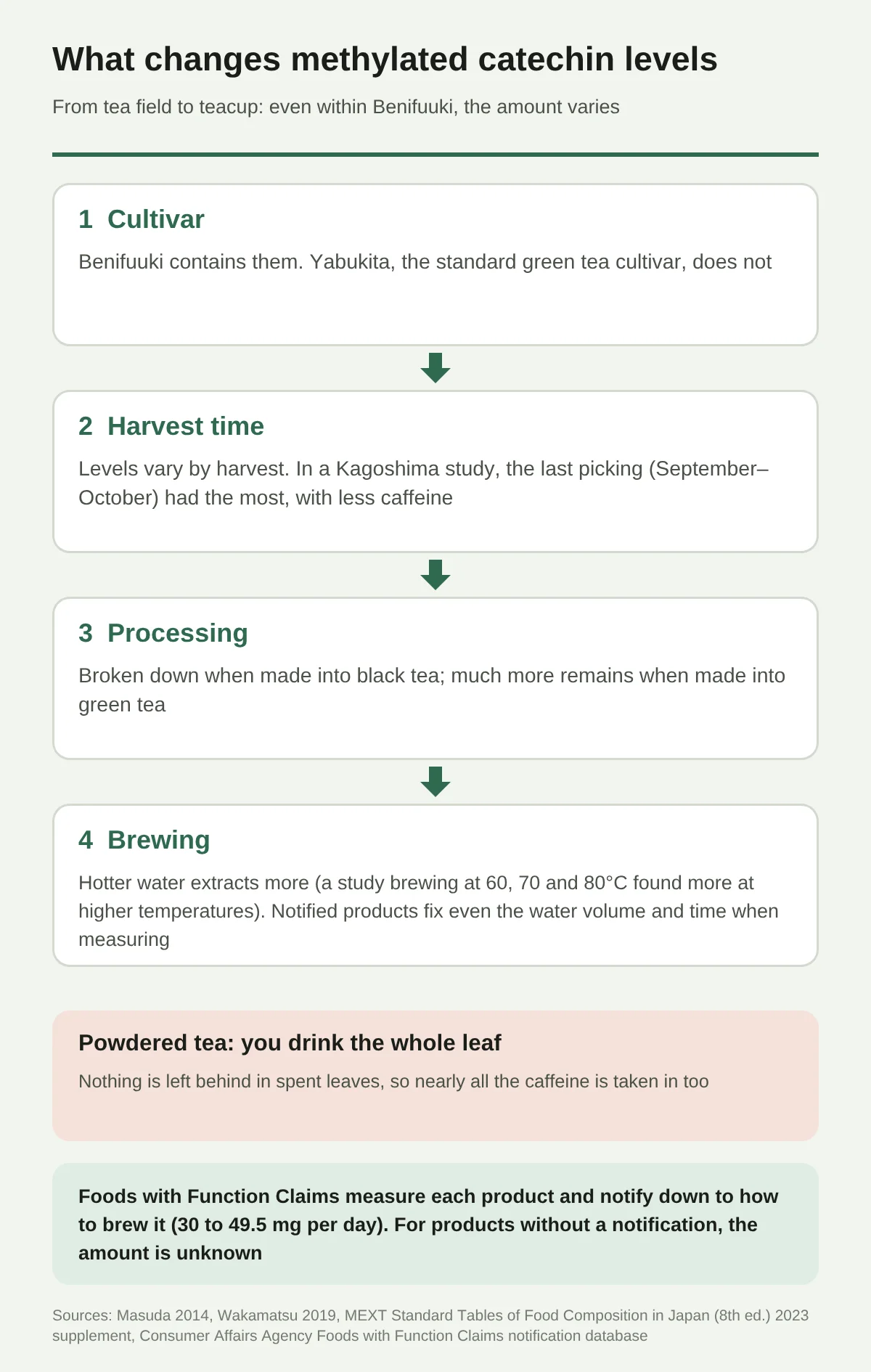
Even with the same Benifuuki, the amount of methylated catechin changes with how it is brewed, when it is picked, and how it is processed.
Water temperature and how to brew
- Methylated catechin is a component that dissolves more readily at high temperatures. In a study that brewed Benifuuki from Kagoshima at 60°C, 70°C, and 80°C, the higher the temperature, the more came out (Wakamatsu 2019)
- Notified tea-bag foods also have the brewing method set when measuring the amount, such as “extract by shaking up and down well for 2 minutes in 150 to 180 ml of boiling water” (A67). If you brew quickly in a teapot, the amount can be lower than the notified amount
- When an infusion of tea was heated at 90°C, part of the methylated catechin changed into a slightly different form, an “epimer” (GCG3”Me) (Suzuki 2003). In cell studies, GCG3”Me also suppressed histamine release, and its effect was stronger than that of EGCG3”Me (Maeda-Yamamoto 2012)
Powdered tea
- Powdered tea is drunk with the leaf, so there is no portion that stays behind in the spent leaves without being extracted
- In a rat study, making the powder particles finer (average 2.86 µm) increased the amount of EGCG and others entering the blood, but for methylated catechin it was about the same as with brewed tea (the extract) (Maeda-Yamamoto 2011)
Harvest time
- In a study of Kagoshima Benifuuki by harvest time, the amount of methylated catechin changed with harvest time, and leaves picked last, in September to October, had more methylated catechin and somewhat less caffeine (Wakamatsu 2019)
- A relative of methylated catechin (ECG3”Me) was highest in the third flush of Benifuuki (Maeda-Yamamoto 2012)
- Product labels usually do not say when the leaves were picked. For notified foods, the amount is measured for each product and notified
When made into black tea or hojicha
- In the process of making black tea, methylated catechin is destroyed (Masuda 2014). Benifuuki black tea (Japanese black tea) is a separate matter from the hay fever discussion
- The notifications also include “Benifuuki powdered hojicha” (I939), and even in hojicha form the amount is measured for each product and notified
Things to be careful about
- Stomach upset on an empty stomach: In the 2009 trial (15 weeks), some people had stomach problems, and the Asahi Soft Drinks research results page says caution is needed when drinking on an empty stomach. Many Foods with Function Claims notifications also carry the caution “taking it on an empty stomach may cause stomach pain”
- Interaction with drugs: In a rat study, Benifuuki tea did not affect CYP3A, one of the enzymes that break down drugs, but lowered the activity of CYP2D. The authors say interactions with drugs through CYP2D may occur (Hirai 2018). It has not yet been confirmed in humans. If you take medication, consult a doctor or pharmacist
- Too many catechins: In 2018, EFSA said that taking 800 mg or more of EGCG per day from supplements and the like may be associated with early signs of liver damage, while for ordinarily brewed green tea and bottled green tea there are largely no signs of liver damage even among heavy drinkers. EGCG taken from brewed green tea is generally 90 to 300 mg per day
- Treatment of hay fever: The author of Masuda 2014 writes that Benifuuki is not a substitute for drugs. If your symptoms are bothering you, consult an ENT clinic or similar
Summary
| Point | What is known | Strength of evidence and cautions |
|---|---|---|
| Cultivar | A cultivar for black tea and semi-fermented tea. Methylated catechin remains when made into green tea | Variety registration database, Masuda 2014 |
| Mechanism | Suppresses histamine release and more in mast cells and basophils | Cell and animal studies |
| Human trials | A few dozen people. Compared with Yabukita, scores for itchy eyes, tears, runny nose, and so on were lower. No difference in sneezing and nasal congestion | Randomized trials exist, but the same research group and a beverage maker were involved. No replication by other groups |
| Amount | A difference at 34 mg per day, none at 17 mg | From one trial |
| Function claim | 42 notifications (30 not withdrawn). The claim is “discomfort of the eyes and nose,” and the words “hay fever” do not appear | No individual government review. The basis is a research review of papers from the same group |
| Caffeine | About the same as ordinary green tea. Powder is drunk with the leaf | No numerical guideline in Japan. EFSA: 200 mg during pregnancy, 400 mg for adults |
| How you drink it | More dissolves at high temperatures. Destroyed in black tea. Changes with harvest time | The amount is not known for products that are not Foods with Function Claims |
Items featured in this article:
| Domestic Benifuuki powdered green tea (Kyoichiya) | Benifuuki green tea leaves 70 g | Organic sencha Yabukita 70 g | Decaffeinated green tea tea bags (Kokutaro) | |
|---|---|---|---|---|
| When it suits you | You want a powder you drink with the leaf | You want to brew from tea leaves | You want to compare with Yabukita | You want to cut caffeine |
| Ingredients, etc. | Only green tea (from Kumamoto Prefecture, Benifuuki). Not a Foods with Function Claims product | Benifuuki (from Chiran, Minamikyushu City, Kagoshima Prefecture). Not a Foods with Function Claims product | Organic green tea (from Kakegawa City, Shizuoka Prefecture, Yabukita, first flush) | Tea. Caffeine in the infusion from one bag is under 0.005 g (per the product page) |
| Price (tax included) | 1 g x 30 packets, 1,260 yen (shipping included) | 70 g, 1,382 yen (shipping included) | 70 g, 1,026 yen (shipping included) | 16 bags x 3, 1,781 yen (free shipping) |
| Purchase | See on Rakuten (京一屋 楽天市場店) PR See on Amazon.co.jp PR See on Yahoo! Shopping PR |
See on Rakuten (こちら南国便) PR See on Yahoo! Shopping PR |
See on Rakuten (お茶の山英) PR See on Yahoo! Shopping PR |
See on Rakuten (Smile Spoon) PR See on Amazon.co.jp PR See on Yahoo! Shopping PR |
(Checked on the Rakuten Ichiba product pages on October 1, 2026. Prices and shipping may change.)
The claim “Benifuuki green tea is good for hay fever” goes only as far as this: there are trials of a few dozen people in which some symptom scores were lower than with Yabukita. Those trials involved the same research group and a beverage maker, and the results do not show that it can replace drugs. If you drink it, it is realistic to think of it as one kind of ordinary green tea, including its caffeine content.
Sources
- Ministry of Agriculture, Forestry and Fisheries (MAFF), “Plant Variety Registration Database,” Benifuuki (registration no. 4591) https://www.hinshu2.maff.go.jp/vips/cmm/apCMM112.aspx?TOUROKU_NO=4591&LANGUAGE=Japanese
- Asahi Soft Drinks, “Research results, 2009 report” (Effect of the start time of ‘Benifuuki’ green tea drinking on the symptom-relieving effect for Japanese cedar pollinosis)
- Consumer Affairs Agency, “Search for Notified Information on Foods with Function Claims,” all-item output data (obtained September 30, 2026). Notification nos. A67, A69, D396, G138, H1359, and others https://www.fld.caa.go.jp/caaks/s/cssc01/
- MEXT, “Standard Tables of Food Composition in Japan 2020 (Eighth Revised Edition), Supplement 2023” (Beverages) https://www.mext.go.jp/a_menu/syokuhinseibun/mext_00001.html
- Food Safety Commission of Japan, Fact sheet “Caffeine in foods” (updated February 23, 2018) https://www.fsc.go.jp/factsheets/index.data/factsheets_caffeine.pdf
- Ministry of Health, Labour and Welfare, “Q&A on excessive intake of caffeine contained in foods” https://www.mhlw.go.jp/stf/seisakunitsuite/bunya/0000170477.html
- EFSA, “Caffeine” (explanation of the 2015 scientific opinion) https://www.efsa.europa.eu/en/topics/topic/caffeine
- EFSA, “EFSA assesses safety of green tea catechins” (April 18, 2018) https://www.efsa.europa.eu/en/press/news/180418
- Masuda S, Maeda-Yamamoto M, Usui S, Fujisawa T. ‘Benifuuki’ green tea containing O-methylated catechin reduces symptoms of Japanese cedar pollinosis: a randomized, double-blind, placebo-controlled trial. Allergol Int. 2014;63:211-217. https://pubmed.ncbi.nlm.nih.gov/24561771/
- Maeda-Yamamoto M et al. The efficacy of early treatment of seasonal allergic rhinitis with benifuuki green tea containing O-methylated catechin before pollen exposure: an open randomized study. Allergol Int. 2009;58:437-444. https://pubmed.ncbi.nlm.nih.gov/19542766/
- Maeda-Yamamoto M, Ema K, Shibuichi I. In vitro and in vivo anti-allergic effects of ‘benifuuki’ green tea containing O-methylated catechin and ginger extract enhancement. Cytotechnology. 2007;55:135-142. https://pubmed.ncbi.nlm.nih.gov/19003003/
- Maeda-Yamamoto M et al. Effects of tea infusions of various varieties or different manufacturing types on inhibition of mouse mast cell activation. Biosci Biotechnol Biochem. 1998. https://pubmed.ncbi.nlm.nih.gov/9972253/
- Suzuki M et al. Epimerization of tea catechins and O-methylated derivatives of (-)-epigallocatechin-3-O-gallate: relationship between epimerization and chemical structure. J Agric Food Chem. 2003. https://pubmed.ncbi.nlm.nih.gov/12517118/
- Maeda-Yamamoto M et al. Epicatechin-3-O-(3’’-O-methyl)-gallate content in various tea cultivars (Camellia sinensis L.) and its in vitro inhibitory effect on histamine release. J Agric Food Chem. 2012. https://pubmed.ncbi.nlm.nih.gov/22339247/
- Maeda-Yamamoto M. Human clinical studies of tea polyphenols in allergy or life style-related diseases. Curr Pharm Des. 2013. https://pubmed.ncbi.nlm.nih.gov/23448449/
- Maeda-Yamamoto M, Ohtani T. Development of functional agricultural products utilizing the new health claim labeling system in Japan. Biosci Biotechnol Biochem. 2018. https://pubmed.ncbi.nlm.nih.gov/29334323/
- Sano M et al. Novel antiallergic catechin derivatives isolated from oolong tea. J Agric Food Chem. 1999. https://pubmed.ncbi.nlm.nih.gov/10552469/
- Tachibana H et al. Identification of a methylated tea catechin as an inhibitor of degranulation in human basophilic KU812 cells. Biosci Biotechnol Biochem. 2000. https://pubmed.ncbi.nlm.nih.gov/10737211/
- Suzuki M et al. Inhibitory effects of tea catechins and O-methylated derivatives of (-)-epigallocatechin-3-O-gallate on mouse type IV allergy. J Agric Food Chem. 2000. https://pubmed.ncbi.nlm.nih.gov/11087533/
- Fujimura Y et al. Antiallergic tea catechin, (-)-epigallocatechin-3-O-(3-O-methyl)-gallate, suppresses FcepsilonRI expression in human basophilic KU812 cells. J Agric Food Chem. 2002. https://pubmed.ncbi.nlm.nih.gov/12236706/
- Maeda-Yamamoto M et al. O-methylated catechins from tea leaves inhibit multiple protein kinases in mast cells. J Immunol. 2004. https://pubmed.ncbi.nlm.nih.gov/15034065/
- Oritani Y et al. Comparison of (-)-epigallocatechin-3-O-gallate (EGCG) and O-methyl EGCG bioavailability in rats. Biol Pharm Bull. 2013. https://pubmed.ncbi.nlm.nih.gov/24088254/
- Maeda-Yamamoto M et al. Effect of green tea powder (Camellia sinensis L. cv. Benifuuki) particle size on O-methylated EGCG absorption in rats; The Kakegawa Study. Cytotechnology. 2011. https://pubmed.ncbi.nlm.nih.gov/21207145/
- Wakamatsu M et al. Catechin and caffeine contents in green tea at different harvest periods and their metabolism in miniature swine. Food Sci Nutr. 2019. https://pubmed.ncbi.nlm.nih.gov/31428365/
- Kurita I et al. Antihypertensive effect of Benifuuki tea containing O-methylated EGCG. J Agric Food Chem. 2010. https://pubmed.ncbi.nlm.nih.gov/20078079/
- Hirai T et al. Effect of Benifuuki tea on cytochrome P450-mediated metabolic activity in rats. In Vivo. 2018. https://pubmed.ncbi.nlm.nih.gov/29275296/
- Rakuten Ichiba product pages of 京一屋 楽天市場店, こちら南国便 楽天市場支店, お茶の山英 楽天市場店, and Smile Spoon 楽天市場店 (checked October 1, 2026)
Related articles and databases
- Are Blueberries Good for Your Eyes? Antioxidant Differences by Variety, Ways of Eating Them for Better Absorption, Whether Frozen Is Better, and Studies of People Who Kept Eating Them
- Is Vinegar Good for You? Rice, Pure Rice, Grain, Black, and Apple Cider Vinegar Compared, and the “Acetic Acid for Blood Pressure and Visceral Fat” Research Checked