
Ingredients A–Z
The words you see in the 原材料名 (ingredient list) on Japanese food packages, explained one by one. Each entry covers what it is and the rules for writing it on the label (Japan's Food Labeling Standards, the Ministerial Ordinance on Milk and Milk Products and industry fair competition codes), with food composition data and the products on this site that use it. We do not rate ingredients as good or bad.

How to read 原材料名
Before you use this list
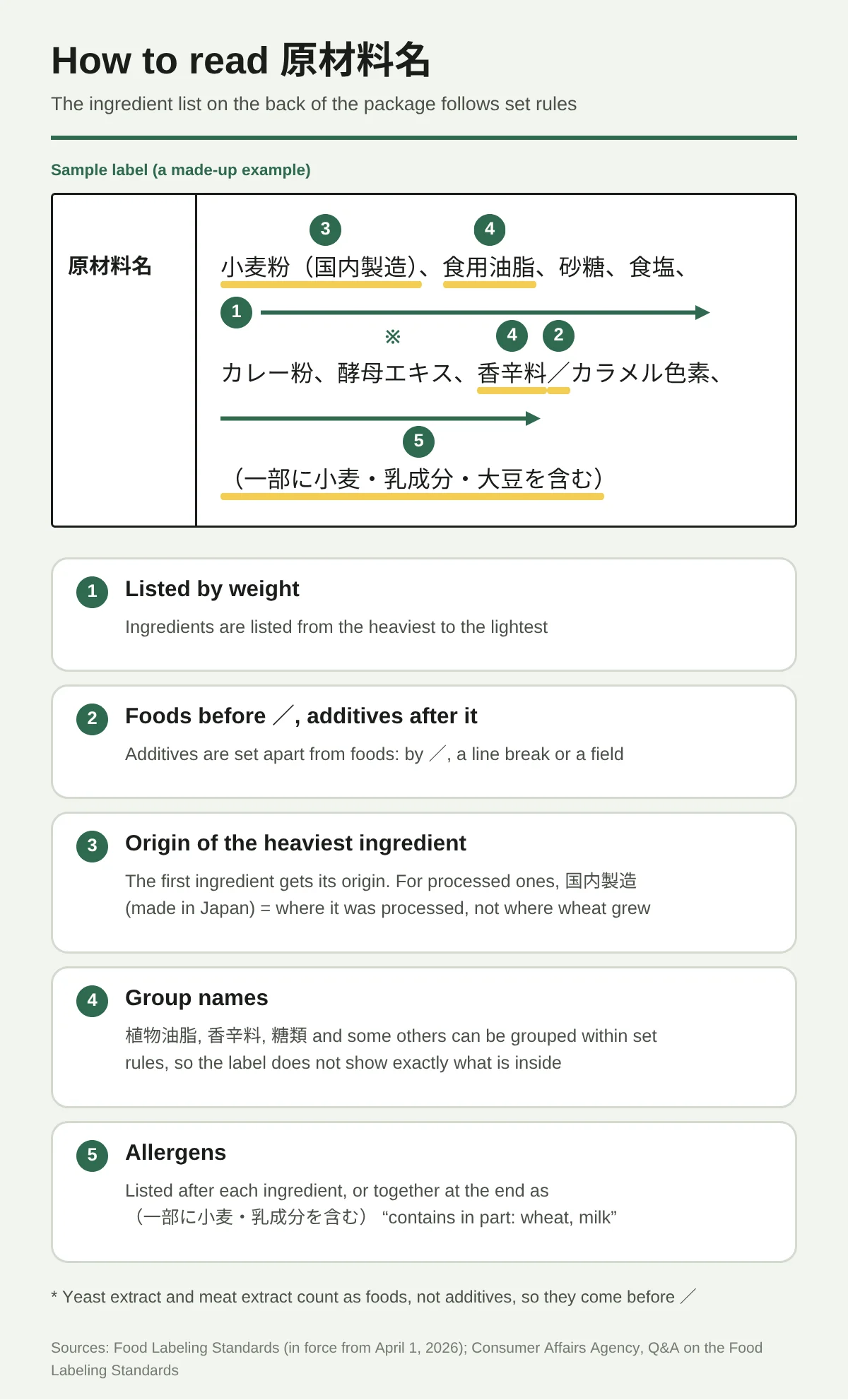
- Listed by weight: ingredients are listed from the heaviest to the lightest share of the ingredients (Food Labeling Standards, Article 3).
- Foods before /, additives after it: food additives must be clearly separated from foods — with a slash (/), a line break, or a separate 添加物 (additives) field (Consumer Affairs Agency Q&A, 加工-248).
- Origin of the main ingredient: the heaviest ingredient carries its place of origin. For a processed ingredient such as wheat flour, “国内製造” (made in Japan) means where it was processed (wheat flour).
- Group names: “植物油脂” (vegetable oils and fats), “香辛料” (spices), “糖類” (sugars) and some others can stand for several ingredients within set rules, so the label does not tell you exactly what is inside (oils and fats, spices, sugar and sugars).
- Extracts are foods: “酵母エキス” (yeast extract) and “肉エキス” (meat extract) are treated as foods, not additives, and are written before the slash (yeast extract).
Want to check a whole label at once? Paste it into the Ingredient Checker.
Flours, grains and beans
Wheat flour, rice flour, soybeans, starch and other basic ingredients.
Seasonings
Salt, sugar, spices and other ingredients that add taste and aroma.
- Salt食塩/塩/海水/天日塩48 products
- Sugar and sugars砂糖/糖類(砂糖、水あめ)/水あめ/果糖ぶどう糖液糖37 products
- Curry powder and spicesカレー粉/カレーパウダー/香辛料/香辛料(オニオンパウダー、ガーリックパウダー、唐辛子)32 products
- Fish sauce魚醤(イカを含む)/魚醤(魚介類)/いわし/ナンプラー3 products
- Soy sauceしょうゆ(本醸造)/粉末醤油/こいくちしょうゆ(本醸造)/しょう油加工品23 products
- Vinegar (brewed / rice vinegar)醸造酢/米酢/有機米酢/穀物酢20 products
- Mirin and fermented rice seasoningみりん/本みりん/有機米醗酵調味料/みりん風調味料8 products
- Sake / wine酒/清酒/料理酒/赤ワイン3 products
- Sesameごま/すり胡麻/有機白ごまいりごま/有機ごま9 products
- Misoみそ(大豆を含む、大豆:遺伝子組換えでない)/みそ/米みそ/麦みそ2 products
- Chinese seasonings (doubanjiang, tianmianjiang, douchi)豆板醤/トウバンジャン/甜麺醤/テンメンジャン1 product
- Honeyはちみつ/はちみつ(アルゼンチン、ハンガリー)/はちみつ(国産)/アカシアはちみつ3 products
Oils and fats
Oils and fats from plants and animals.
Milk
Ingredients made from cow’s milk. Many of them are defined in the Ministerial Ordinance on Milk and Milk Products.
Dashi and umami
Dried fish flakes, dried sardines, kombu, extracts and other sources of umami.
- Yeast extract酵母エキス/酵母エキス(小麦を含む)23 products
- Meat / seafood / vegetable extracts肉エキス/カキエキス/麦芽エキス/チキンエキス24 products
- Dried bonito (katsuobushi) and dried sardines鰹節/かつおふし/まぐろ節/いわしふし10 products
- Kombu (kelp)昆布/こんぶ/羅臼昆布9 products
- Shiitake mushroom乾しいたけ/椎茸/しいたけ/しいたけ(原木)4 products
- Acid-hydrolyzed vegetable protein (amino acid liquid)アミノ酸液2 products
- Dried shrimp干しえび/素干しえび1 product
- Nori (seaweed)焼きのり/のり/海苔/ほしのり1 product
Vegetables, fruits and their products
Vegetables and fruits, and grated, concentrated or processed forms of them. “Compound ingredients” made of several ingredients are also here.
Tea and coffee
Products made from tea leaves, such as green tea, and from coffee beans.
Eggs
Hen’s eggs, and yolk, white and dried egg white.
Added nutrients
Food additives added to infant formula and similar foods to supply vitamins and minerals.
Food additives
Additives explained individually here. Other additives are compared with overseas rules in the additive database.
Surfactants (household products)
The cleaning components of detergents and shampoos. Detergent labels list them under 界面活性剤 (surfactants) or 純石けん分 (pure soap content), with the type names.
Other household product components
Builders and other additives in detergents (stabilizers, enzymes and so on), and components in the full ingredient lists of cosmetics such as shampoo.
Sources
- Food Labeling Standards (Cabinet Office Ordinance No. 10 of 2015) (version in force from April 1, 2026) and the Q&A on the Food Labeling Standards (Consumer Affairs Agency, revised March 28, 2025)
- Ministerial Ordinance on Milk and Milk Products Concerning Compositional Standards, etc.
- Fair Competition Code for labeling of edible salt (Edible Salt Fair Trade Council)
- Guidelines on labeling of extracts (Japan Extract Seasonings Association, 2023)
- Standard Tables of Food Composition in Japan (8th revised edition, 2023 supplement) (MEXT)
All sources are in Japanese. These pages are translations of our Japanese ingredient dictionary.