Japanese food additives, compared with stricter rules abroad
Japan and other countries differ in which additives they allow and how they must be labeled. This database puts Japan's rules side by side with those of the EU and other stricter regulators and international bodies. Flag the additives you want to avoid, and the Ingredient Checker will mark them. If you choose nothing, the 18 items that stricter rules abroad single out are flagged by default.
Not permitted in the EUAllowed in Japan, but not in food in the EU or elsewhere
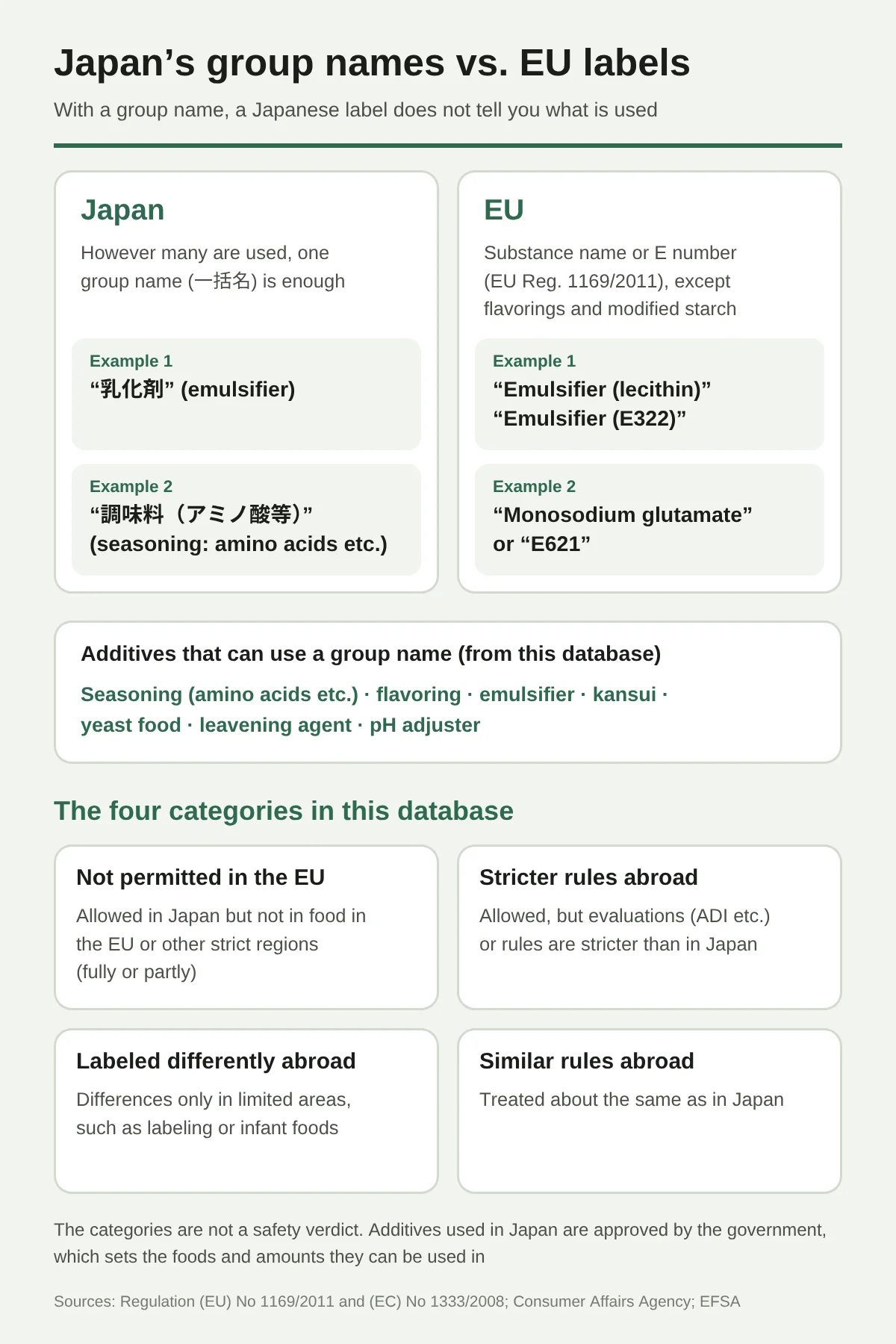
In the EU, an additive cannot be declared only by its purpose, such as “emulsifier” or “pH adjuster”: the substance name or E number must be given (except for flavorings and modified starch). With Japan's group names, the label does not tell you which substance was used.
Labeling differences and the four categories
Japan's group names, EU labels, and how to read the categories in this database
Japan's group-name labeling vs. EU labeling, and the four categories in this database
No matter how many substances are used, they can be written together as “調味料(アミノ酸等)” (seasoning (amino acids, etc.)) (a group name).
The main ingredient, sodium L-glutamate, is the same umami component found in kombu (kelp).
In 1987, JECFA evaluated glutamate salts and did not specify an ADI (acceptable daily intake).
Under stricter rules abroad
In its 2017 re-evaluation, EFSA newly set a group ADI for glutamates of 30 mg per kg of body weight per day. It said that high consumers, and infants and children, may exceed this ADI, and recommended reviewing the EU's maximum use levels.
In the EU, a group label like Japan's “調味料(アミノ酸等)” (seasoning (amino acids, etc.)) is not allowed. The label must say “monosodium glutamate” or “E621”.
An umami ingredient made by breaking down proteins such as soy and wheat. On labels it is treated as a food.
When hydrochloric acid is used to break down the protein, chloropropanols (such as 3-MCPD) can form, and efforts to reduce them are under way.
Under stricter rules abroad
The EU sets by law the maximum level of 3-MCPD allowed in hydrolyzed protein and soy sauce at 20 μg per kg (as a liquid with 40% dry matter) (EU Regulation 2023/915).
An amino acid and a designated additive (one designated by the government). There are no standards for use as a food additive (rules on which foods it may be used in and how much) (FSCJ evaluation report).
When used to adjust taste, it can be written together with other amino acids as “調味料(アミノ酸)” (seasoning (amino acids)) (a group name). It may also be written by its substance name, “グリシン” (glycine).
It is also used as a “shelf-life extender” (日持ち向上剤), which works more weakly than a preservative. There is no purpose name for shelf-life extenders, so only the substance name is written (Hiroshima Prefecture explanation).
In 2004, JECFA evaluated it as a flavoring and did not apply the safety-evaluation procedure for flavorings, because the amount people get from the protein in food is far larger.
On this site, the product “太鼓判中華そば” (Taikoban Chukasoba, Chinese-style noodles) lists it by the substance name “グリシン” (glycine), so the label does not tell you what it was used for.
Under stricter rules abroad
The EU also permits it as E640 (glycine and its sodium salt). It is in the group of additives that may be used in many foods at the amount needed (Group I) (Regulation (EC) No 1333/2008, Annex II).
The rule is to write the purpose and the substance name side by side, as in “保存料(ソルビン酸K)” (preservative (potassium sorbate)).
The FSCJ has evaluated the ADI for sorbic acids at 25 mg per kg of body weight per day.
Under stricter rules abroad
In 2019, based on new reproductive toxicity data, EFSA set the ADI for sorbic acid and potassium sorbate at 11 mg per kg of body weight per day (less than half of Japan's evaluation).
prevents microbial growth and extends shelf life (preservative)
On the label
“保存料(パラオキシ安息香酸ブチル)” (preservative (butyl parahydroxybenzoate)) and others
In Japan
Japan permits five kinds: isobutyl, isopropyl, ethyl, butyl, and propyl.
They may be used in soy sauce, fruit sauces, soft drinks, and so on.
Under stricter rules abroad
In the EU, only methyl and ethyl parabens may be used in food. Propyl paraben was withdrawn in 2006 because of its effects on the reproductive organs of young male rats (Directive 2006/52/EC).
In 2006, JECFA also removed propyl paraben from the group ADI.
From 2027, the US state of California bans the manufacture and sale of foods containing propyl paraben (AB 418).
An existing food additive whose main component is a basic protein taken from fish testes (shirako, milt). Its name in the List of Existing Food Additives is “しらこたん白抽出物” (shirako protein extract). It may also be written by the alternative names “しらこたん白” and “プロタミン” (protamine), or by the shorter names “しらこ” and “核たん白” (nucleoprotein).
Because it is a preservative, the rule is to write the purpose name alongside it, as in “保存料(しらこたん白)” (preservative (shirako protein)).
The raw material is the milt of salmon, trout, herring, and similar fish (Hiroshima Prefecture explanation). Salmon is an item for which allergen labeling is recommended, and for an additive it is written like “(さけ由来)” (derived from salmon) (Food Labeling Standards Q&A).
Existing food additives that are preservatives do not have standards for use (rules on which foods they may be used in and how much), unlike designated-additive preservatives (Hiroshima Prefecture explanation).
On this site, the product “太鼓判中華そば” (Taikoban Chukasoba, Chinese-style noodles) is labeled “保存料(しらこたん白:さけ由来)” (preservative (shirako protein: derived from salmon)).
Under stricter rules abroad
It is not on the EU list of food additives (Regulation (EC) No 1333/2008, Annex II) and has no E number. It is not permitted as a preservative in the EU.
Japan permits 12 tar dyes (Red Nos. 2, 3, 40, 102, 104, 105, and 106; Yellow Nos. 4 and 5; Green No. 3; Blue Nos. 1 and 2).
Under stricter rules abroad
Red Nos. 104, 105, and 106 and Green No. 3 cannot be used in food in the EU.
In the EU, foods that use Yellow No. 4, Yellow No. 5, Red No. 40, Red No. 102, and others must carry a label saying they “may have an adverse effect on activity and attention in children” (Regulation (EC) No 1333/2008, Annex V).
In January 2025, the US FDA revoked the authorization of Red No. 3 for use in food (with a grace period until January 2027). The FDA says there is no evidence that it poses a risk to humans at current intake levels.
From the end of 2027, the US state of California bans the use of Red No. 40, Yellow No. 4, Yellow No. 5, Blue No. 1, Blue No. 2, and Green No. 3 in public school meals (AB 2316).
Used in the white coating of white chocolate, gum, tablet candy, and so on.
Japan (FSCJ), the US FDA, and JECFA continue to allow its use, because among other reasons it is hardly absorbed by the body.
Under stricter rules abroad
In 2022 the EU banned its use in food (EU Regulation 2022/63), following EFSA's 2021 evaluation that a concern about genotoxicity could not be ruled out.
The IARC “2B” classification is mainly an evaluation of inhaling the dust.
Used in soy sauce, sauces, cola, confectionery, and so on.
There are four types (I to IV) depending on how it is made, but the Japanese label is only “カラメル色素” (caramel color), so you cannot tell which one it is.
Under stricter rules abroad
In the EU, types I to IV are labeled separately as E150a to E150d.
The US state of California has put 4-MEI, which forms when caramel III and IV are made, on its list of carcinogens (Prop 65), and requires a warning label on products that exceed a certain amount.
A natural pigment taken from an insect, the cochineal. Used in ham, kamaboko (fish paste), drinks, confectionery, and so on.
In 2012, the Consumer Affairs Agency (CAA) issued a warning about acute allergic reactions (anaphylaxis).
Under stricter rules abroad
It can also be used in the EU (E120) and the US. For people with allergies, the US FDA has since 2011 required it to be named specifically as “cochineal extract” or “carmine” (Japan also requires the substance name).
An existing food additive made from gardenia fruit. There are three kinds: yellow, blue, and red.
All three can be written simply as “クチナシ色素” (gardenia color) or “クチナシ” (gardenia), so the label does not tell you which one was used.
A coloring is normally written with its purpose name, as in “着色料(○○)” (coloring (○○)). But when the name already contains the character for “color” (色), as in “クチナシ色素” (gardenia color), “着色料” (coloring) may be omitted (Food Labeling Standards, Article 3).
On this site, the product “太鼓判中華そば” (Taikoban Chukasoba, Chinese-style noodles) is labeled “クチナシ色素” (gardenia color).
Under stricter rules abroad
It is not on the EU list of food additives (Regulation (EC) No 1333/2008, Annex II) and has no E number. It is not permitted as a coloring in the EU.
In July 2025, the US FDA approved “gardenia (genipin) blue”, a blue coloring made from gardenia fruit, for use only in sports drinks, fruit drinks, candy, and similar foods (effective August 29, 2025).
For people with phenylketonuria, there is a rule to add “L-フェニルアラニン化合物” (L-phenylalanine compound) to the label.
Under stricter rules abroad
In 2023, IARC classified it as “possibly carcinogenic to humans” (2B). At the same time, JECFA left the ADI (40 mg per kg of body weight per day) unchanged.
The EU also permits it as E951, with the same ADI as Japan.
In Japan it is treated as a food, not an additive.
In 1999, JECFA evaluated it as “ADI not specified”.
Under stricter rules abroad
In its 2023 re-evaluation, EFSA dropped “ADI not specified” and newly set an ADI of 0.5 g per kg of body weight per day. It says high consumers may exceed this.
In the EU, foods containing more than 10% polyols (sugar alcohols) must carry a label saying that eating too much may cause loose stools.
A liquid sugar made by breaking down starch. On labels it is treated as a food.
The name changes with the proportion of fructose (under 50% is “ぶどう糖果糖液糖” (glucose-fructose syrup); 50% or more is “果糖ぶどう糖液糖” (fructose-glucose syrup); 90% or more is “高果糖液糖” (high-fructose syrup)).
Under stricter rules abroad
It is also treated as a food in the EU and the US. WHO recommends keeping the intake of “free sugars,” which include liquid sugars, below 10% of daily energy (2015).
No matter how many aroma components are used, they can be written as just “香料” (flavoring) (a group name).
Flavorings taken from natural materials and synthetic flavorings are both labeled with the same “香料” (flavoring).
Under stricter rules abroad
The EU also allows the group label “flavouring.” At the same time, the EU flavoring regulation (1334/2008) prohibits adding some substances, such as coumarin and safrole, directly to food, and sets maximum levels in food.
Obtained by extraction or steam distillation from 73 kinds of spices, including pepper, chili pepper, ginger, and garlic. Together they make up a single existing food additive.
Whichever spice it comes from, the name is “香辛料抽出物” or “スパイス抽出物” (spice extract). It cannot be written with the name of the original spice, as in “コショウ抽出物” (pepper extract), so the label does not tell you which spice it is (Food Labeling Standards Q&A, Processing-82).
The short names “香辛料” and “スパイス” (spice) may also be used, so “香辛料” in the additives section can mean this (Food Labeling Standards Q&A, Processing-82).
In the List of Existing Food Additives its purpose is “苦味料等” (bittering agent, etc.), but it is not covered by the group name “苦味料” (bittering agent), and is written by its substance name.
On this site, the product “創味シャンタンやわらかタイプ” (Sohmi Shantan soft type, a seasoning paste) lists both “香辛料” (spice) as a food and “香辛料抽出物” (spice extract) as an additive.
Under stricter rules abroad
In the EU, a product extracted from food or similar material to add aroma or taste is a “flavouring preparation” under the flavoring regulation (1334/2008), and falls outside the food additives regulation (1333/2008). There is no additive with an E number called “spice extract.”
keeps the color of meat, prevents botulinum bacteria from growing
On the label
“発色剤(亜硝酸Na)” (color fixative (sodium nitrite))
In Japan
Used in ham, sausage, bacon, salmon roe (ikura), cod roe (tarako), and so on.
In 2015, IARC classified processed meat as “carcinogenic to humans” (Group 1). This is an evaluation of processed meat as a whole food, not of nitrite itself.
Meat products made without a color fixative are labeled “無塩せき” (muen-seki, “no curing salt”).
Under stricter rules abroad
To reduce the risk of forming carcinogenic nitrosamines, the EU lowered the limits for nitrite from October 2025. For many meat products, the amount that may be added is up to 80 mg per kg as nitrite ion (55 mg for heat-sterilized products), and the amount that may remain is up to 45 mg (25 mg for heat-sterilized products) (EU Regulation 2023/2108).
The previous limit (150 mg) was by weight of sodium nitrite, while today's 80 mg is by weight of nitrite ion. Converted to sodium nitrite, 80 mg is about 120 mg, so this is a reduction of about 20%, not a “halving.”
The “酸化防止剤(亜硫酸塩)” (antioxidant (sulfites)) on wine is this. It is also used in raisins, dried gourd strips (kanpyo), and so on.
Hypersensitive reactions have been reported in some people with asthma.
Under stricter rules abroad
The EU treats sulfites as one of the allergens. Foods containing more than 10 mg per kg (or per L) as sulphur dioxide must label them prominently as an allergen (EU Regulation 1169/2011).
Used in ham, sausage, fish paste products, Chinese noodles, and so on.
They may also be included within group names such as “かんすい” (kansui), “膨張剤” (leavening agent), and “pH調整剤” (pH adjuster).
Under stricter rules abroad
In its 2019 re-evaluation, EFSA set a group ADI for phosphates of 40 mg per kg of body weight per day, as phosphorus, and recommended reviewing the maximum use levels.
No matter how many are used, they can be written as just “乳化剤” (emulsifier) (a group name).
This includes natural ones such as lecithin, which is taken from soybeans or eggs.
Under stricter rules abroad
In the EU, a label with only the purpose name is not allowed. The substance name or E number must be written, for example “emulsifier (lecithin)” or “emulsifier (E322)”, so you can tell what was used (EU Regulation 1169/2011).
When two or more polysaccharides are used, they can be written together as “増粘多糖類” (polysaccharide thickeners).
Under stricter rules abroad
In the EU, a label with only the purpose name is not allowed. The substance name or E number must be written (EU Regulation 1169/2011).
To prevent choking accidents, the EU prohibits the use of thickeners such as carrageenan in mini jelly cups that can be sucked in whole in one bite (2006).
Starch that has been chemically processed. No matter how many kinds are used, it can be written as “加工デンプン” (modified starch).
Under stricter rules abroad
The EU also allows the group label “modified starch.” On the other hand, the types and amounts of modified starch that may be used in infant formula and baby food are separately limited.
“かんすい” (kansui, alkaline agent for Chinese noodles)
In Japan
A name (group name) that covers several substances, such as potassium carbonate.
Under stricter rules abroad
In the EU, a label with only the purpose name is not allowed. The substance name or E number must be written (EU Regulation 1169/2011). There is no group name like “かんすい” (kansui).
Includes baking soda (sodium bicarbonate). No matter how many are used, they can be written as “膨張剤” (leavening agent) (a group name).
Under stricter rules abroad
In the EU, a label with only the purpose name is not allowed. The substance name or E number must be written (EU Regulation 1169/2011). Baking soda is also permitted in the EU, as E500ii.
When the 24 designated items (including citric acid, lactic acid, malic acid, glacial acetic acid, and phosphoric acid) and existing food additives such as phytic acid are used to add sourness, they can be written as just “酸味料” (acidulant), no matter how many are used (a group name).
Even the same citric acid is written as “pH調整剤” (pH adjuster) if it is used to adjust pH. How it is written depends on the purpose of use.
You may add the contents, as in “酸味料(クエン酸等)” (acidulant (citric acid, etc.)), but they must be written in descending order by weight, and you must not write it as if only one was used when others are also used (Food Labeling Standards Q&A, Processing-79).
On this site, the product “創味シャンタンやわらかタイプ” (Sohmi Shantan soft type, a seasoning paste) is labeled with just “酸味料” (acidulant), so the contents are unknown.
Under stricter rules abroad
In the EU, a label with only the purpose name is not allowed. After the category name “acid,” the substance name or E number is written, such as citric acid (E330), lactic acid (E270), or malic acid (E296).
In 1970, JECFA evaluated silicon dioxide, calcium silicate, and others as “ADI not specified”.
Under stricter rules abroad
In its 2024 re-evaluation, EFSA concluded that silicon dioxide (E551) raises no safety concern as currently used, for all age groups including infants under 16 weeks.
The default flags are items that cannot be used, or are evaluated or regulated more strictly, in the EU and other strict jurisdictions, or that IARC has classified as possibly carcinogenic. This is not a safety verdict. Additives used in Japan are approved by the government, which sets the foods and amounts they can be used in. Choose what to flag based on your own judgment.
Sources
EU: Regulations (EC) No 1333/2008 (food additives), (EU) No 1169/2011 (food information), (EC) No 1334/2008 (flavorings), (EU) 2019/649 (trans fat), (EU) 2022/63 (titanium dioxide), (EU) 2023/915 (contaminants), (EU) 2023/2108 (nitrites and nitrates), Directive 2006/52/EC (EUR-Lex)
Last checked 2026-09-27. Rules change over time. These pages are translations of our Japanese additive database; if they differ, the Japanese pages are the reference.