
Is Vinegar Good for You? Rice, Pure Rice, Grain, Black, and Apple Cider Vinegar Compared, and the “Acetic Acid for Blood Pressure and Visceral Fat” Research Checked

PR This article contains affiliate links to Rakuten Ichiba (“See on Rakuten”). What is written here is based on documents from public agencies and on studies, regardless of whether there are ads. The “See on Amazon.co.jp” and “See on Yahoo! Shopping” links are also affiliate links.
“Vinegar is good for you.” “Black vinegar lowers blood pressure.” “Apple cider vinegar helps you lose weight.” You hear these often. On supermarket shelves, vinegars with different names sit side by side: rice vinegar, pure rice vinegar (junmai-su), grain vinegar, black vinegar (kurozu), and apple cider vinegar (りんご酢, literally “apple vinegar”).
In this article, we check the following against laws, national statistics, and studies:
- How does the law in Japan divide rice vinegar, pure rice vinegar, grain vinegar, black vinegar, and apple cider vinegar?
- What is the difference between “brewed vinegar” and “synthetic vinegar,” and what are the conditions for writing “pure,” “black vinegar,” or “static fermentation”?
- What percent of the sour component, acetic acid, is in vinegar, and how much is made in Japan?
- How do Foods with Function Claims and FOSHU work for “acetic acid for visceral fat and blood pressure”?
- What do human trials (randomized controlled trials) and the studies that pool them show?
- What happens to teeth, throat, and stomach when you drink too much?
Conclusions
- Under Japanese law (the Food Labeling Standards), vinegar is divided into “brewed vinegar” and “synthetic vinegar.” Brewed vinegar is made by fermenting grains, fruit, and the like; synthetic vinegar is made by diluting glacial acetic acid or acetic acid. Of the 412,300 kiloliters produced in fiscal 2024, synthetic vinegar was only 400 kL (0.1%)
- Rice vinegar needs “at least 40 g of rice per liter.” Rice black vinegar needs “at least 180 g of rice other than polished white rice, which turned brown to blackish through fermentation and aging.” “Pure rice vinegar” may be written only when rice is the sole ingredient. Some ordinary rice vinegars list “alcohol” among the ingredients
- Acetic acid per 100 g in the Food Composition Tables: rice vinegar 4.4 g, grain vinegar 4.2 g, black vinegar 4.0 g, apple cider vinegar 4.7 g. Black vinegar does not have more acetic acid
- There are 58 Foods with Function Claims with acetic acid (excluding withdrawn ones; as of September 30, 2026). Among notifications for this ingredient alone, the common functions are “visceral fat” (48), “fatigue” (29), and “blood pressure” (13). All of them were notified by companies submitting a summary of research; they were not reviewed by the government. In the EU, health claims for apple cider vinegar are not authorized
- A study (2026) pooling 38 vinegar trials found about 1 kg lower body weight and about 3 mmHg lower systolic blood pressure, with blood glucose markers also lower. However, most of the trials were rated low quality, and more than half were apple cider vinegar trials. One of the apple cider vinegar weight-loss trials, published in 2024, was retracted in 2025
- Cautions on drinking too much: inflammation and ulcers of the esophagus have been reported in people who kept drinking it undiluted. Test-tube experiments and a human survey also show that vinegar can dissolve tooth enamel
Products Featured in This Article
| Product | Why we chose it (ingredients, etc.) | Where |
|---|---|---|
| 河原酢造 老梅 有機純米酢 (Kawahara Suzo Robai Organic Pure Rice Vinegar) | The only ingredient is “organic rice (domestic).” A pure rice vinegar with no alcohol added | Ingredients of ordinary rice vinegar vs. pure rice vinegar |
| 内堀醸造 有機純玄米黒酢 360ml (Uchibori Jozo Organic Pure Brown Rice Black Vinegar, 360 ml) | Product name “organic rice black vinegar”; the only ingredient is organic brown rice (domestic) | To compare black vinegar and apple cider vinegar |
| 内堀醸造 純りんご酢 500ml (Uchibori Jozo Pure Apple Vinegar, 500 ml) | The only ingredient is “apple juice (made in Japan).” Acidity 4.5% | To compare black vinegar and apple cider vinegar |
Types of Vinegar: What the Law Says
Brewed Vinegar and Synthetic Vinegar
The names and contents of vinegar are set by the Consumer Affairs Agency’s Food Labeling Standards. First, vinegar is divided into two broad groups.
| Brewed vinegar (醸造酢) | Synthetic vinegar (合成酢) | |
|---|---|---|
| How it is made | Mash (moromi) of grains, fruit, vegetables, honey, etc., or alcohol, undergoes acetic acid fermentation | Glacial acetic acid or acetic acid is diluted with water, with sugars, acidulants, seasonings, etc. added. Vinegar blended with brewed vinegar also counts as synthetic vinegar |
| Glacial acetic acid / acetic acid | May not be used | Used |
| How it is written on the back | The words “醸造酢” (brewed vinegar) near the product name | The words “合成酢” (synthetic vinegar) near the product name |
| Production in fiscal 2024 | 411,900 kL (99.9%) | 400 kL (0.1%) |
(Food Labeling Standards, Appended Tables 3, 19, and 20. Production is an estimate by the National Vinegar Association Central Council.)
Acetic acid fermentation is fermentation in which bacteria called acetic acid bacteria turn alcohol into acetic acid. When vinegar is made from grains or fruit, sugar is first turned into alcohol (the sake stage), and then acetic acid bacteria turn that into vinegar.
Even brewed vinegar may be called “brewed vinegar” when small amounts of sugars, acidulants (other than glacial acetic acid and acetic acid), seasonings (amino acids, etc.), or salt are added, as long as they stay within the set amounts.
How Grain Vinegar, Rice Vinegar, Black Vinegar, and Fruit Vinegar Are Defined
Brewed vinegar is named in more detail by its ingredients and their amounts.
| Name | Conditions (per liter of brewed vinegar) |
|---|---|
| Grain vinegar (穀物酢) | Grains totaling at least 40 g (no agricultural products other than grains and fruit, and no honey) |
| Rice vinegar (米酢) | A grain vinegar with at least 40 g of rice (excluding rice black vinegar) |
| Rice black vinegar (米黒酢) | A grain vinegar whose ingredients are only rice other than white rice (or that plus wheat or barley), with at least 180 g of rice. Turned brown to blackish through fermentation and aging |
| Barley black vinegar (大麦黒酢) | A grain vinegar whose only ingredient is barley, at least 180 g. Turned brown to blackish through fermentation and aging |
| Fruit vinegar (果実酢) | Fruit juice totaling at least 300 g |
| Apple cider vinegar (りんご酢) | A fruit vinegar with at least 300 g of apple juice |
| Grape vinegar (ぶどう酢) | A fruit vinegar with at least 300 g of grape juice |
| Brewed vinegar (醸造酢) | Brewed vinegar that fits none of the above (for example, less than 40 g of grain, made mainly with alcohol) |
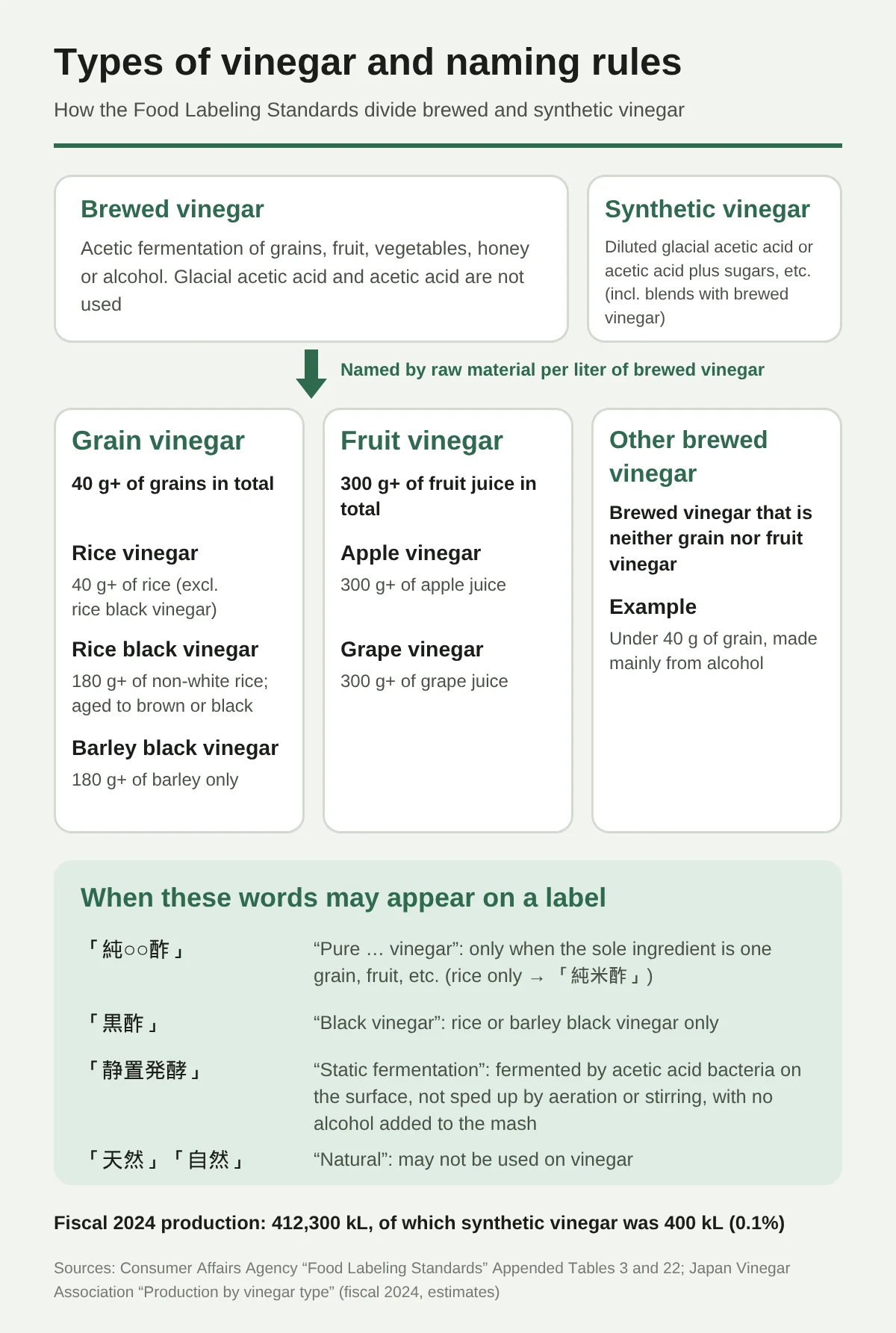
(Food Labeling Standards, Appended Tables 3 and 4. The Japanese Agricultural Standard (JAS) for brewed vinegar, JAS 0801:2024, uses the same definitions.)
The minimum amount of rice differs by a factor of 4.5 between rice vinegar and rice black vinegar (40 g versus 180 g). Also, rice black vinegar may not use polished white rice.
Conditions for Writing “Pure Rice Vinegar,” “Black Vinegar,” and “Static Fermentation”
The Food Labeling Standards also set words that may not be written on vinegar (Appended Table 22).
| Word | When it may be written |
|---|---|
| “天然” (natural), “自然” (nature) | May not be written on vinegar |
| “黒酢” (black vinegar), etc. | Only for rice black vinegar and barley black vinegar |
| “純○○酢” (pure ___ vinegar) | For vinegar whose ingredient is only one kind of grain, fruit, etc., with that ingredient’s name in the blank (rice only: “純米酢,” pure rice vinegar). Rice black vinegar made only of rice is “純米黒酢,” and that made only of brown rice is “純玄米黒酢” |
| “静置発酵” (static fermentation), etc. | Mainly for vinegar fermented by acetic acid bacteria on the surface of the mash, without blowing in air or stirring to speed fermentation, and with no alcohol added to the mash |
| Words that stress some of the ingredients | When one kind of grain is used at 40 g or more, or one kind of fruit juice at 300 g or more |
In other words, “pure rice vinegar” is made of rice only, and “pure apple vinegar” of apples only. If “黒酢” (black vinegar) is written, it is rice black vinegar or barley black vinegar.
Ingredients of Ordinary Rice Vinegar vs. Pure Rice Vinegar
Even among products called “rice vinegar,” the ingredient lists on the back differ.
| Example of ordinary rice vinegar (Mizkan “Rice Vinegar”) | Kawahara Suzo Robai Organic Pure Rice Vinegar | |
|---|---|---|
| Name | 米酢 (rice vinegar) | 有機米酢 (organic rice vinegar) |
| Ingredients (原材料名) | Rice (domestic), alcohol | Organic rice (domestic) |
| Additives | None listed | None listed |
| Acidity | ― | 4.5% |
(Mizkan’s official page and Kawahara Suzo’s product label. Checked September 30, 2026.)
The condition for rice vinegar is “at least 40 g of rice,” so a vinegar made with added alcohol can still be called rice vinegar. Alcohol is allowed as a raw material of brewed vinegar under the Food Labeling Standards, and it is not an additive. This is not a matter of which is better; it just means that whether the ingredients are rice only can be told from the ingredient list and the word “純” (pure).
For Robai Organic Pure Rice Vinegar, the only ingredient is organic rice, and the official website explains that it is made by “static fermentation,” in which a film of bacteria forms on the liquid surface and the vinegar is left quietly.
Acidity: How Much Acetic Acid Is in It?
“Acidity” on the Back Label
On the back of vinegar, “acidity” (酸度) must be written as a percentage to one decimal place (Food Labeling Standards). Acidity is the amount of acid in the vinegar converted to acetic acid.
The Japanese Agricultural Standard (JAS) sets minimum acidities for vinegar that carries the JAS mark.
| Type | Minimum acidity (JAS) |
|---|---|
| Grain vinegar (including rice vinegar and black vinegar) | 4.2% |
| Fruit vinegar (including apple cider vinegar and grape vinegar) | 4.5% |
| Other brewed vinegar | 4.0% |
(Japanese Agricultural Standard for brewed vinegar, JAS 0801:2024)
JAS is a voluntary standard, so not every vinegar without the JAS mark necessarily meets these numbers. You can check acidity on the back (Robai Organic Pure Rice Vinegar is 4.5%).
Acetic Acid in the Food Composition Tables
The MEXT Food Composition Tables list the amount of acetic acid in each type of vinegar.
| Per 100 g | Acetic acid | Energy | Carbohydrate | Potassium |
|---|---|---|---|---|
| Grain vinegar | 4.2 g | 25 kcal | 2.4 g | 4 mg |
| Rice vinegar | 4.4 g | 46 kcal | 7.4 g | 16 mg |
| Black vinegar | 4.0 g | 54 kcal | 9.0 g | 47 mg |
| Apple cider vinegar | 4.7 g | 26 kcal | 2.4 g | 59 mg |
| Grape vinegar | 4.8 g | 22 kcal | 1.2 g | 22 mg |
| Balsamic vinegar | 5.6 g | 99 kcal | 19.4 g | 140 mg |
(MEXT, Standard Tables of Food Composition in Japan (2020 Edition (Eighth Revised)), 2023 Supplement, main table and Carbohydrate Tables Appendix 2. Version updated March 27, 2026.)
- Every vinegar has 4 to 6 g of acetic acid per 100 g. Black vinegar is 4.0 g, not more than the others
- Black vinegar uses a lot of rice, so it has somewhat more carbohydrate and potassium than rice vinegar
- The values in the tables are representative values. The Robai Organic Pure Rice Vinegar label says 2 kcal and 0.3 g of carbohydrate per 100 g, which differs from rice vinegar in the tables (46 kcal, 7.4 g). Check the nutrition facts on the back for each product
The daily amount of acetic acid common in Foods with Function Claims (750 mg) corresponds to 15 to 19 g (a little over 1 tablespoon) of any of these vinegars.
To Compare Black Vinegar and Apple Cider Vinegar
For those who want to check the differences in taste and color among types, we chose products with only one ingredient.
How Much Is Made in Japan?
According to estimates by the National Vinegar Association Central Council, vinegar production in fiscal 2024 was 412,300 kiloliters.
| Production (kL) | FY2004 | FY2024 | Change |
|---|---|---|---|
| Rice vinegar | 60,000 | 36,700 | −39% |
| Rice black vinegar and barley black vinegar | 16,900 | 10,800 | −36% |
| Other grain vinegar | 140,300 | 89,100 | −36% |
| Fruit vinegar | 25,000 | 27,200 | +9% |
| Other brewed vinegar | 187,500 | 248,100 | +32% |
| Synthetic vinegar | 2,200 | 400 | −82% |
| Total | 431,900 | 412,300 | −4.5% |
(National Vinegar Association Central Council, “Trends in vinegar production by type,” Tables 1 and 2. Through fiscal 2008, a survey by MAFF; from fiscal 2009, estimates based on a survey by the industry association.)
- The total has stayed nearly flat over 20 years, but rice vinegar, black vinegar, and grain vinegar fell by 30 to 40%, while “other brewed vinegar,” which fits neither the grain nor the fruit vinegar category, grew
- Adding imports (24,400 kL) and subtracting exports (4,200 kL), the domestic supply was 392,100 kL, which is about 3.2 liters per person per year (3,167 ml). This amount includes vinegar used in processed foods such as mayonnaise, dressings, and sushi vinegar
- Household purchases in the Ministry of Internal Affairs and Communications’ Family Income and Expenditure Survey were 1,350 ml per year for households of two or more people (2024), down by about half from 2,576 ml in 2000
“Acetic Acid for Visceral Fat and Blood Pressure”: How Does the National System Treat It?
Foods with Function Claims: 58 Notifications
Some vinegar drinks and similar products are Foods with Function Claims that use “acetic acid” as the functional ingredient. Counting the Consumer Affairs Agency’s notification data (as of September 30, 2026) gives the following.
| Item | Count |
|---|---|
| Notifications for acetic acid (excluding withdrawn) | 58 |
| Of those, acetic acid only | 54 |
| Function “visceral fat” (counted among acetic-acid-only notifications; “body fat” in the database’s classification) | 48 |
| Function “fatigue” | 29 |
| Function “blood pressure” | 13 |
| Function “body weight/BMI” | 4 |
| First notification | 2017 |
| Common daily amount | Acetic acid 750 mg |
(Consumer Affairs Agency, “Notification information on Foods with Function Claims,” the CSV of all notifications, obtained September 30, 2026. The same tally as “Acetic acid (vinegar)” in Urayomi’s supplement ingredient database.)
- All 58 are based on a systematic review, a summary of research on the ingredient acetic acid. None is based on a trial of people using the product itself
- Among acetic-acid-only notifications, there is no “blood glucose” function (one of the 58 has a blood glucose function, but it is a notification combined with indigestible dextrin)
- 19 of the 58 are notifications by Mizkan (Mizkan Co., Ltd.)
- Foods with Function Claims are a system in which the company notifies its own evidence at its own responsibility; they are not reviewed or approved by the government
FOSHU: Two Products for Blood Pressure
Among Foods for Specified Health Uses (FOSHU), which the government reviews and approves product by product, two products have acetic acid as the ingredient involved, and both are for “people with slightly high blood pressure” (Consumer Affairs Agency, “List of permitted (approved) FOSHU products,” as of September 1, 2026).
EU: Apple Cider Vinegar Claims Are Not Authorized
In the EU’s register of health claims, claims such as “weight,” “bowel movements,” and “blood pressure” for apple cider vinegar are not authorized (based on opinions of the European Food Safety Authority in 2009–2011). The register has no health claim for acetic acid itself.
In Japan, some vinegar products can state “blood pressure” or “visceral fat” through the notification and approval systems, while in the EU they cannot. That is the difference.
In this article we do not feature vinegar drinks sold as Foods with Function Claims or FOSHU. We feature ordinary seasoning vinegars, on the assumption that they are used in cooking.
What the Studies Show
A Japanese Trial: Obese People Drank It for 12 Weeks
As a trial in Japanese people, there is a 2009 randomized controlled trial in which obese people drank vinegar for 12 weeks (Kondo et al.).
- Participants drank 500 ml of a drink containing 15 ml of vinegar (750 mg of acetic acid), 30 ml (1,500 mg of acetic acid), or 0 ml (placebo), every day for 12 weeks
- In the two vinegar groups, body weight, BMI, visceral fat area, waist circumference, and blood triglycerides were lower than in the placebo group
- The trial was double-blind (neither the participants nor the investigators knew which group was which)
The authors’ affiliation is the Central Research Institute of the Mizkan Group (from the PubMed bibliographic record). Please keep in mind, when reading, that this trial was run by a manufacturer’s research institute.
Studies That Pool Trials: About 1 kg of Weight, About 3 mmHg of Systolic Blood Pressure
Vinegar trials have been run around the world. An umbrella review published in 2026 (a study that pools the summaries of research) re-collected and recalculated 38 randomized controlled trials with 1,781 people included in 10 meta-analyses (Shahmohammadi et al.).
- Differences appeared in body weight (−1.06 kg), systolic blood pressure (−2.94 mmHg), fasting blood glucose, post-meal blood glucose, HbA1c (a measure of average blood glucose), and total cholesterol
- Triglycerides, LDL cholesterol, waist circumference, BMI, and diastolic blood pressure showed no clear difference
- The certainty of evidence (GRADE) was “high” for body weight and systolic blood pressure, “moderate” for blood glucose, and “very low” for total cholesterol
However, there are several cautions when reading this.
- Of the 38 trials, only 3 were rated “high” quality and 3 “fair”; the rest were “low.” The Japanese trial by Kondo et al. is “fair”
- 24 were trials of apple cider vinegar; the others were wine vinegar, white vinegar, date vinegar, pomegranate vinegar, and so on. No trial was described as rice vinegar or black vinegar (for 2, the type was not stated)
- 22 were trials in people with type 2 diabetes, and the trial durations ranged from 1 day to 12 weeks
- For systolic blood pressure, HbA1c, and total cholesterol, statistics suggest publication bias (the tendency for studies with good results to be published more often)
- Funding came from the Student Research Center of Tehran University of Medical Sciences in Iran, and the authors declared no conflicts of interest
Blood Pressure: Small Drops Up to 30 ml a Day
A 2022 meta-analysis (Shahinfar et al.) examined the relationship between the amount of vinegar and blood pressure and calculated that for every 30 ml a day, systolic blood pressure fell by 3.25 mmHg and diastolic by 3.33 mmHg. The certainty was rated “low” for both.
Blood Glucose: Taken With a Meal, Post-Meal Glucose Rises Less
In a 2017 meta-analysis of trials in which vinegar was taken with a meal (Shishehbor et al.), people who took vinegar had smaller rises in post-meal blood glucose and insulin.
One mechanism being considered is that food is sent from the stomach to the intestine more slowly. In a trial of 10 healthy people (1998), adding vinegar to white bread made the rise in post-meal blood glucose and insulin smaller and slowed the speed at which food left the stomach.
On the other hand, in a trial of 10 people with diabetes whose stomach already moves slowly (diabetic gastroparesis) (2007), 30 ml of apple cider vinegar slowed gastric emptying even further, and the researchers wrote that this might be unfavorable for blood glucose control.
The Retracted Apple Cider Vinegar Trial
In 2024, a trial in which 120 teenagers and young adults in Lebanon drank apple cider vinegar for 12 weeks and lost weight was published in a BMJ Group journal (BMJ Nutrition, Prevention & Health).
This paper was retracted in September 2025. According to the retraction notice, the reasons were that the journal could not reproduce the authors’ analysis and found multiple errors, that the data had patterns inconsistent with random allocation, and that the trial had not been registered in advance. The authors agreed to the retraction.
A 2025 meta-analysis of apple cider vinegar and body weight (Castagna et al., 10 studies) included this retracted trial in its calculation. Note that some of the evidence behind the claim that apple cider vinegar helps you lose weight includes a retracted trial.
Cautions on Drinking Too Much: Teeth, Throat, Stomach
Teeth: Dissolving the Enamel
Vinegar is acidic, so it can dissolve the enamel on the surface of teeth.
- Test-tube experiment (2014): When human tooth enamel was soaked in 5 kinds of vinegar, minerals dissolved out depending on the time and the type of vinegar. With one vinegar, minerals at a depth of 45 µm fell by about 20% in 8 hours
- Test-tube experiment (2021, Switzerland): A dressing made with balsamic vinegar wore down tooth enamel more than orange juice did. Dressings containing milk or cream caused less wear
- Human survey (1991, Finland): Comparing 106 people with dental erosion (teeth dissolved by acid) and 100 without, people who took apple cider vinegar every week had about 10 times the risk of dental erosion
Throat and Esophagus: Cases of Drinking It Undiluted
- A 15-year-old male drank a pomegranate vinegar drink without enough dilution, 100 to 150 ml every morning, for one month and developed ulcers along the whole esophagus (South Korea, 2020). The manufacturer recommended diluting it at 3 parts water to 1 part vinegar. The researchers wrote that vinegar drinks should also be treated as corrosive
- A 75-year-old woman with a habit of drinking vinegar had a hole in her esophagus and underwent surgery (Okayama, Japan, 2020). The reporting doctors wrote that long exposure to vinegar may have caused necrosis of the esophageal lining
- A case in which a person drank 1 tablespoon of white vinegar to “soften” a crab shell stuck in the throat and had inflammation and ulcers of the throat and esophagus (Hong Kong, 2002). The reporter wrote that this folk remedy should be stopped
- A report that, prompted by a case of esophageal injury from an apple cider vinegar tablet, examined 8 commercial tablet products and found that tablet size, pH, amount of acid, and labeling varied from product to product (United States, 2005)
Other
- A case has been reported of a person who took large amounts of apple cider vinegar and had low blood potassium and osteoporosis (Austria, 1998)
- Some notifications for Foods with Function Claims with acetic acid carry a caution such as “taking a large amount at once may loosen the stool in some people”
- The authors of the umbrella review also wrote that care is needed about stomach and intestinal irritation, tooth erosion, and worsening of acid reflux, and especially for people with chronic kidney disease and for people taking drugs that affect blood glucose or potassium
The cases of esophageal injury involved people who kept drinking it undiluted, or who drank it to dissolve something stuck in the throat. Some vinegar drinks carry manufacturer instructions to dilute with water. If you are under treatment, consult your doctor.
Back-Label Checkpoints
When choosing vinegar, look at these items on the back.
| Where to look | What it tells you |
|---|---|
| Name (名称) | Which it is: rice vinegar, rice black vinegar, barley black vinegar, grain vinegar, apple cider vinegar, grape vinegar, fruit vinegar, brewed vinegar, or synthetic vinegar |
| The words “醸造酢” (brewed vinegar) or “合成酢” (synthetic vinegar) | Whether it was made by fermentation or by diluting glacial acetic acid or acetic acid |
| Ingredients (原材料名) | Whether “アルコール” (alcohol) is included. If it is only rice or only apples, “純” (pure) may be written |
| Acidity (酸度) | The amount of acid (% converted to acetic acid). It is not something to drink undiluted |
| Additives | Whether “調味料(アミノ酸等)” (seasoning (amino acids, etc.)), acidulants, and the like have been added |
- “黒酢” (black vinegar) may be written only for rice black vinegar and barley black vinegar
- “天然” (natural) and “自然” (nature) are words that may not be written on vinegar
- Not vinegar itself, but “酢酸Na” (sodium acetate) on the back of bento boxes and prepared foods is an additive used for keeping quality. Details are in the article on preservatives
Summary
| Point | What we found | Certainty and source |
|---|---|---|
| Types | Brewed vinegar and synthetic vinegar. Rice vinegar: 40 g/L or more of rice; rice black vinegar: 180 g/L or more of rice other than white rice; apple cider vinegar: 300 g/L or more of apple juice | Food Labeling Standards (law) |
| Pure rice vinegar | Only vinegar whose ingredient is rice only may be written “純米酢” (pure rice vinegar). Some ordinary rice vinegars have alcohol added | Food Labeling Standards and each company’s labeling |
| Amount of acetic acid | 4 to 6 g per 100 g. Black vinegar (4.0 g) does not have more | Food Composition Tables |
| Production | 412,300 kL in fiscal 2024. Synthetic vinegar is 0.1% | Estimate by the industry association |
| Visceral fat and body weight | In a Japanese trial, visceral fat and body weight fell after 12 weeks. In the pooled study, body weight was about 1 kg lower | Randomized controlled trial (by a manufacturer’s research institute) / umbrella review (many trials of low quality) |
| Blood pressure | Systolic blood pressure about 3 mmHg lower | Umbrella review (publication bias suspected) |
| Blood glucose | Post-meal blood glucose, fasting blood glucose, and HbA1c fall | Certainty “moderate.” Mainly trials in people with diabetes |
| Systems | Japan: 58 Foods with Function Claims, 2 FOSHU products. EU: claims not authorized | Consumer Affairs Agency and EU register |
| Drinking too much | Tooth erosion; inflammation and ulcers of the esophagus (cases of drinking it undiluted) | Test-tube experiments, human survey, case reports |
The reported esophageal injuries were mainly cases of drinking it undiluted over time. On the other hand, the differences are not large enough to say that “drinking vinegar clearly lowers blood pressure or body weight,” and the quality of the trials also has problems. When choosing vinegar, it is reasonable to look first at the name and the ingredient list and choose by the ingredients and flavor you like.
Vinegars featured in this article:
Related: Preservatives article (sodium acetate, shelf-life improvers) / Article on the rules for “additive-free” labeling / Article on fructose in fruit (post-meal blood glucose and how you eat)
Sources
- Consumer Affairs Agency, “Food Labeling Standards” (Cabinet Office Order No. 10 of 2015), Appended Tables 3, 4, 19, and 22 (e-Gov Law Search) https://laws.e-gov.go.jp/law/427M60000002010
- MAFF, “Japanese Agricultural Standard for Brewed Vinegar,” JAS 0801:2024, and the comparison table of the revision https://www.maff.go.jp/j/jas/jas_kikaku/attach/pdf/kokujikaisei-538.pdf
- MEXT, “Standard Tables of Food Composition in Japan (2020 Edition (Eighth Revised)), 2023 Supplement,” main table and Carbohydrate Tables Appendix 2 (updated March 27, 2026) https://www.mext.go.jp/a_menu/syokuhinseibun/mext_00001.html
- National Vinegar Association Central Council (全国食酢協会中央会), “Trends in vinegar production,” Tables 1 and 2, and “Trends in vinegar consumption,” Table 9 http://www.shokusu.org/statistics/index.html
- Consumer Affairs Agency, “Notification information on Foods with Function Claims,” all notifications (obtained September 30, 2026) https://www.fld.caa.go.jp/caaks/s/cssc01/
- Consumer Affairs Agency, “List of permitted (approved) Foods for Specified Health Uses” (as of September 1, 2026) https://www.caa.go.jp/policies/policy/food_labeling/foods_for_specified_health_uses/
- European Commission, “EU Register on nutrition and health claims” (obtained September 30, 2026) https://ec.europa.eu/food/food-feed-portal/screen/health-claims/eu-register
- Urayomi Supplement Ingredient Database, “Acetic acid (vinegar)” https://urayomi.com/supplements/acetic/
- Shahmohammadi F et al. (2026) Food Sci Nutr (umbrella review). https://pubmed.ncbi.nlm.nih.gov/42110393/
- Kondo T et al. (2009) Biosci Biotechnol Biochem (trial in Japanese people with a tendency toward obesity). https://pubmed.ncbi.nlm.nih.gov/19661687/
- Shahinfar H et al. (2022) Complement Ther Med (dose-response meta-analysis of blood pressure). https://pubmed.ncbi.nlm.nih.gov/36152934/
- Shishehbor F et al. (2017) Diabetes Res Clin Pract (meta-analysis of post-meal blood glucose). https://pubmed.ncbi.nlm.nih.gov/28292654/
- Liljeberg H, Björck I (1998) Eur J Clin Nutr (vinegar and gastric emptying). https://pubmed.ncbi.nlm.nih.gov/9630389/
- Hlebowicz J et al. (2007) BMC Gastroenterol (diabetic gastroparesis and apple cider vinegar). https://pubmed.ncbi.nlm.nih.gov/18093343/
- Abou-Khalil R et al. (2024) BMJ Nutr Prev Health (retracted). https://pubmed.ncbi.nlm.nih.gov/38966098/ / Retraction notice (2025) https://pubmed.ncbi.nlm.nih.gov/41789013/
- Castagna A et al. (2025) Nutrients (meta-analysis of apple cider vinegar and body composition). https://pubmed.ncbi.nlm.nih.gov/41010525/
- Willershausen I et al. (2014) Clin Lab (vinegar and tooth enamel, test tube). https://pubmed.ncbi.nlm.nih.gov/24839821/
- Hartz JJ et al. (2021) Oral Health Prev Dent (dressings and tooth wear, test tube). https://pubmed.ncbi.nlm.nih.gov/33491378/
- Järvinen VK et al. (1991) J Dent Res (risk factors for dental erosion). https://pubmed.ncbi.nlm.nih.gov/2045572/
- Chang J et al. (2020) Clin Endosc (esophageal ulcer from a vinegar drink). https://pubmed.ncbi.nlm.nih.gov/31405264/
- Okura T et al. (2020) J Surg Case Rep (esophageal rupture from vinegar). https://pubmed.ncbi.nlm.nih.gov/33123342/
- Chung CH (2002) Hong Kong Med J (esophageal corrosion from vinegar). https://pubmed.ncbi.nlm.nih.gov/12376715/
- Hill LL et al. (2005) J Am Diet Assoc (apple cider vinegar tablets and the esophagus). https://pubmed.ncbi.nlm.nih.gov/15983536/
- Lhotta K et al. (1998) Nephron (large intake of apple cider vinegar and hypokalemia). https://pubmed.ncbi.nlm.nih.gov/9736833/
- Kawahara Suzo, “Mail-order products” and “Our vinegar making” https://robai.jp/product/ and https://robai.jp/making/
- Mizkan Group, “Rice Vinegar” product information https://www.mizkan.co.jp/product/group/?gid=01004
Related articles and databases
- Are preservatives bad for you? Types such as sorbic acid, what “preservative-free” hides, and how Japanese and overseas rules differ
- Were “無添加” (Additive-Free) Labels Banned? Reading the Consumer Affairs Agency Guideline’s 10 Types from the Back Label
- Does Fruit Fructose Make You Gain Weight? How It Differs from the Fructose in “果糖ぶどう糖液糖” (High-Fructose Corn Syrup), and a Comparison of Sugar and Fiber in 22 Fruits
- Does aluminum leach from aluminum pans and foil? How it is made, why it is used, what happens when it builds up in the body, and how to choose alternative pans
- What Is the Difference Between Mustard and Karashi? Seed Types, Why Mixing with Water Makes It Hot, and the Ingredients and Allergen Labeling of Dijon, Whole-Grain, and Japanese Karashi
- Are Chili Peppers Good for You? How Capsaicin Makes Food Hot, the Scoville Scale, and What the Research Says About “Living Longer,” “Losing Weight,” and “Bad for the Stomach”
- What Is Doubanjiang? How Sichuan’s Pixian Doubanjiang Differs from Japanese and Taiwanese Versions, with Salt, Mold Toxin, and Histamine Checked Against Official Sources
- Where Does “Too Much Salt” Begin? Checking Japan’s Salt Intake Trend, Target Amounts, and the Links to High Blood Pressure and Stomach Cancer Against National Surveys and Studies
- Is Benifuuki Green Tea Good for Hay Fever? Checking the Size and Funding of the Methylated Catechin Trials, What the Foods with Function Claims Notifications Say, and Caffeine and How to Brew, Against Papers and Government Documents