
Are preservatives bad for you? Types such as sorbic acid, what “preservative-free” hides, and how Japanese and overseas rules differ

Ham, kamaboko (fish cake), pickles, soy sauce, soft drinks. On the back label you will see entries such as “保存料(ソルビン酸K)” (preservative: potassium sorbate) or “保存料(安息香酸Na)” (preservative: sodium benzoate).
On the other hand, convenience-store bento and bread sometimes say “保存料不使用” (preservative-free) in big letters. But if no preservatives are used, why does the food keep for days?
This article sorts out the following, based on materials from Japanese and overseas public agencies:
- The difference between “preservatives” and “shelf-life extenders” (日持ち向上剤), and how to tell them apart on the back label
- How the preservatives allowed, and the ways of thinking about them, differ between Japan and overseas
- How research and public agencies view the claim that “preservatives are bad for you”
- What the national guideline treats as a problem in “preservative-free” labeling
Bottom line: even “preservative-free” foods may contain additives meant to extend shelf life
- Additives that keep food longer fall into the legal category of “preservatives” (保存料) and “shelf-life extenders” (日持ち向上剤), which are less strong than preservatives. There is no labeling rule for “shelf-life extenders”; they are written under names such as glycine, sodium acetate, and pH adjuster
- That is why even a “preservative-free” product may use other additives to extend shelf life. The Consumer Affairs Agency’s guideline (2022) lists this kind of labeling as an example highly likely to mislead consumers
- In Japan, preservatives have set foods they may be used in and set maximum amounts. Children’s (ages 1-6) intake is estimated at 0.4% of the acceptable amount even for sorbic acid, the highest
- Compared with overseas, the types allowed and the way of thinking about acceptable intake differ. For example, propylparaben cannot be used in the EU or South Korea but can be used in Japan. Conversely, methylparaben, which cannot be used in Japan, is permitted in the EU and the United States
The difference between “preservatives” and “shelf-life extenders”
| Type | Main examples | Usage rules | How it is written on the back label |
|---|---|---|---|
| Preservatives (designated additives) | Sorbic acid and potassium sorbate, benzoic acid and sodium benzoate, parahydroxybenzoic acid esters (parabens), propionic acid, sodium dehydroacetate, nisin, etc. (21 items) | All have set foods they may be used in and set maximum amounts | 保存料(ソルビン酸K) (preservative: potassium sorbate) |
| Preservatives (existing additives = naturally derived ones used for a long time) | Milt protein extract (protamine), polylysine (ε-polylysine), etc. (5 items) | No usage standards are set | 保存料(しらこたん白), 保存料(ポリリジン) (preservative: milt protein; preservative: polylysine) |
| Shelf-life extenders (not a legal term) | Glycine, sodium acetate, pH adjusters (citric acid, etc.), lysozyme, various extracts | Weaker than preservatives; used to keep food for a few days | Written by substance name (glycine, sodium acetate, etc.) or group name (pH adjuster), and not written as “preservative” |
(Number of items per the Hiroshima Prefectural Food Industry Technology Center explanation, as of October 2016)
How to tell them apart on the back label
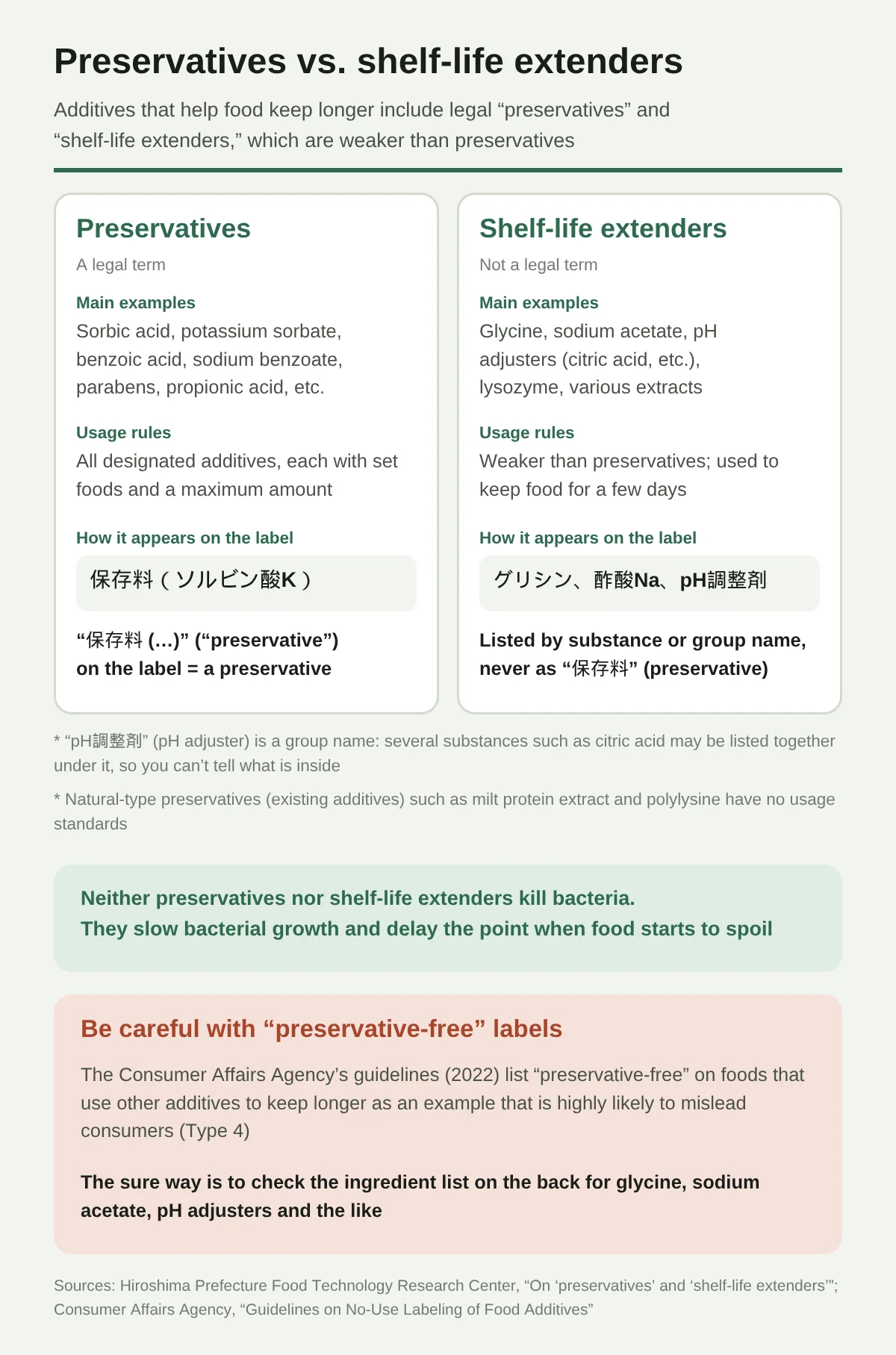
- If it says “保存料(○○)”, it is a preservative. For preservatives, the rule is to write the purpose name (保存料, preservative) alongside the substance name
- Shelf-life extenders are not written as “preservative.” “Glycine,” “sodium acetate,” and “pH adjuster” are commonly used in convenience-store bento, onigiri, side dishes, and sandwiches
- “pH adjuster” (pH調整剤) is a way of writing that does not reveal what is inside. This is because there is a rule (group name) allowing several substances, such as citric acid, to be written together as “pH adjuster”
- Preservatives are also subject to carryover. For example, a preservative that was in soy sauce may not be listed on senbei (rice crackers) made with that soy sauce (an example from the Consumer Affairs Agency) → Article on carryover
Neither preservatives nor shelf-life extenders kill bacteria. They slow the growth of bacteria and extend the time until food starts to spoil (Hiroshima Prefectural Food Industry Technology Center).
Japan’s rules: the foods and amounts are set
For Japan’s preservatives (designated additives), the foods they may be used in and the maximum amount are set one by one. Coloring agents (tar dyes) have no maximum amount, which is a difference (→ Article on food colorings).
| Preservative | Examples of foods allowed (maximum is per 1 kg) |
|---|---|
| Benzoic acid, sodium benzoate | Caviar (2.5 g), margarine (1.0 g), soft drinks, syrups, and soy sauce (0.60 g) |
| Parabens (5 types) | Soy sauce (0.25 g per 1 L), fruit sauces (0.20 g), vinegar (0.10 g per 1 L), soft drinks and syrups (0.10 g), fruit peel (0.012 g) |
| Sodium dehydroacetate | Cheese, butter, margarine (0.50 g) |
| Sorbic acid, potassium sorbate | Many foods, including ham and sausage, kamaboko, cheese, pickles, tsukudani (foods simmered in soy sauce), and jam |
| Propionic acid | Cheese, bread, Western-style sweets |
(From the Japan Food Chemical Research Foundation, “Standards for Use and Storage of Each Additive,” November 2024 edition)
How much do people in Japan eat?
In a survey the Consumer Affairs Agency conducted in fiscal 2022 (the market basket method, in which foods are actually bought and measured), the daily intake of children aged 1-6 was as follows.
| Preservative | Estimated daily intake | Share of the ADI (acceptable daily intake) |
|---|---|---|
| Sorbic acid | 1.5 mg | 0.4% |
| Benzoic acid | 1.0 mg | 0.3% |
| Dehydroacetic acid | 0 (less than a measurable amount) | ― |
- The ADI is the amount considered not to affect health even if eaten every day for a lifetime
- Benzoic acid is also naturally contained as a food component in fruit, dairy products, and so on, and the figure includes that portion
- There was no major change compared with the fiscal 2018 survey
Differences between Japan and overseas
Differences in the preservatives allowed
| Preservative | Japan | EU | US | South Korea |
|---|---|---|---|---|
| Sorbic acid, potassium sorbate | ○ | ○ | ○ | ○ |
| Calcium sorbate | ○ | ✕ (removed in 2018, because no data confirming its safety were submitted) | ― | ― |
| Benzoic acid, sodium benzoate | ○ | ○ | ○ | ○ |
| Methylparaben | ✕ | ○ | ○ | ○ |
| Ethylparaben | ○ | ○ | ― | ○ |
| Propylparaben | ○ | ✕ (removed in 2006) | ○ (under reassessment by the FDA; banned in California from 2027) | ✕ |
| Butyl-, isobutyl-, isopropylparaben | ○ | ✕ | ― | ✕ |
○ = allowed ✕ = cannot be used in food ― = not confirmed in this article (EU per Regulation 1333/2008 and its amendments; South Korea per the Ministry of Food and Drug Safety standards; US per the FDA)
For parabens, the types allowed in Japan and overseas are reversed. The only parabens allowed in food in the EU and South Korea are methyl and ethyl. Japan does not allow methyl but allows five types, including propyl and butyl.
Differences in the way of thinking about the acceptable intake (ADI)
| Preservative | Japan and JECFA (international body) | EU (EFSA) |
|---|---|---|
| Sorbic acid | 25 mg per kg of body weight per day (in Japan from the Food Safety Commission of Japan (FSCJ); JECFA gives the same value) | 11 mg (2019; set based on a new study examining effects on reproduction) |
| Benzoic acid | 20 mg (raised by JECFA in 2021 from 5 mg; Japan’s intake survey also uses this value) | 5 mg (2016) |
Even for the same substance, the acceptable amount differs by a factor of 2 to 4 depending on which studies are given more weight. However, the intake of Japanese children shown above stays within a few percent of the acceptable amount even when calculated with the EU’s stricter value (about 0.8% for sorbic acid and about 1.2% for benzoic acid; Urayomi’s own estimate).
EU: why propylparaben was removed
In 2004, EFSA (the European Food Safety Authority) judged that propylparaben could not be placed in the same acceptable intake group as the other parabens, because effects such as reduced sperm counts in young male rats fed propylparaben were seen even at the lowest dose tested (10 mg per kg of body weight per day). No dose without effect could be determined. At the same time, EFSA itself also stated that “intake of propylparaben from food is limited and is unlikely to be a risk to consumers,” but the EU decided in 2006 not to allow its use in food.
US: reassessment of preservatives and state regulation
- In the US, potassium sorbate, sodium benzoate, and others are used as GRAS (generally recognized as safe) substances
- The FDA (US Food and Drug Administration) has put propylparaben (from 2024) and BHA and BHT (from 2025), which prevent oils from oxidizing, on its list of chemicals in food under reassessment. It asked for information on BHA in February 2026 and on BHT in May 2026. As of September 2026, no conclusion has been reached on any of them
- California will ban the manufacture and sale of foods containing propylparaben from January 2027 (AB 418). West Virginia also passed a law banning BHA and propylparaben from 2028, but this part was blocked by a court in December 2025
In Japan, BHA and BHT are labeled as “antioxidants” (酸化防止剤). They are additives that prevent oils from spoiling, a different group from preservatives.
South Korea: detailed limits for each food
Like Japan, South Korea sets the foods and maximum amounts for each preservative. It also sets detailed limits for each food on the total amount when preservatives are used in combination (example: for jam, up to 1.0 g per kg in total of sorbic acid, benzoic acid, parabens, and propionic acid).
Are “preservatives bad for you”?
Benzene in soft drinks
In 2006, it was found overseas that in soft drinks containing both benzoic acid (a preservative) and vitamin C (ascorbic acid), trace amounts of benzene, a carcinogen, can form under certain conditions.
- When the Ministry of Health, Labour and Welfare (MHLW) examined 31 domestic soft drinks containing both, 1 product exceeded the drinking water standard (10 ppb), and the ministry requested a recall and improvement
- MHLW explains that this standard is a value based on risk from drinking for a lifetime, and that even if one drank a certain amount of a product that exceeded it, this would not mean any particular health effect would occur. Most of the benzene people take in comes not from food but from the air (exhaust fumes, etc.)
- Since then, industry groups have been reviewing manufacturing methods and ingredients based on international guidelines
Effects on children’s behavior (Southampton study)
In a study published in the UK in 2007, drinks mixing coloring agents and sodium benzoate slightly raised an indicator of hyperactivity in children. However, because dyes and the preservative were examined mixed together, it is not known whether the effect was due to sodium benzoate. The warning label the EU made mandatory covers only coloring agents; sodium benzoate is not included (for details → Article on food colorings).
Propionic acid and blood sugar
In 2019, a research team including Harvard University reported that in people who took 1 g of calcium propionate, which is used in bread and other foods, hormones that raise blood sugar (such as glucagon) increased. When mice were given small amounts over a long period, they gained weight and became less responsive to insulin. On the other hand, experts pointed out that “the human data are not as convincing as the mouse data” and that “further research in humans is needed to argue against its use as a food additive.”
In summary
- Japan’s preservatives are judged by the government’s evaluation to have no health effect when used within the set foods and amounts, and Japanese intake is far below the acceptable amount
- On the other hand, there are some on which countries’ judgments differ, such as propylparaben, and some on which research is continuing, such as propionic acid
- We must not forget that preservatives also have the role of preventing food poisoning and mold on food
Be careful with “preservative-free” labeling
The Consumer Affairs Agency’s “Guidelines on Labeling of Food Additives as Not Used” (drawn up in March 2022; the review period for businesses ended at the end of March 2024) lists the following kinds of labeling as examples highly likely to mislead consumers.
| Example in the guideline | What the problem is |
|---|---|
| “Preservative-free” on a food that uses additives other than preservatives to extend shelf life (type 4) | Even though shelf life is extended with glycine, sodium acetate, or pH adjuster, it looks as if no additives for shelf life are in it |
| “Sorbic acid-free” on a soft drink (type 3) | Using sorbic acid in soft drinks is not permitted in the first place |
| “Preservative-free” on mineral water (type 8) | It is a food that never uses preservatives to begin with, so it looks superior to other products |
| “Preservative-free, so please eat soon” without the words “after opening” (type 7) | It gives the impression that the food must be eaten sooner than the date shown |
| Labels that use the words “synthetic,” “artificial,” or “natural,” such as “synthetic preservative-free” (type 2) | The additive labeling rules have never distinguished between synthetic and natural |
| “Additive-free” (無添加) written large, with “preservatives and coloring” written small next to it (type 10) | It looks as if nothing is in it, even though additives other than preservatives and coloring are used |
Note that this guideline does not uniformly ban “additive-free” and “not used” labeling. Labeling that makes clear what is not used and does not mislead may be used. The full set of 10 types is introduced in the article on “additive-free” labeling rules.
“Preservative-free” does not equal “contains no additives for shelf life.” The surest way is to check the ingredient list (原材料名) on the back label for glycine, sodium acetate, pH adjuster, and the like.
Urayomi’s approach
To sum up so far:
- Japan’s preservatives have the foods and amounts set one by one, and Japanese intake is far below the acceptable amount
- On the other hand, there are substances like propylparaben that can be used in Japan but not overseas, and the way of thinking about acceptable intake also differs by country by a factor of 2 to 4
- Even a “preservative-free” product may be kept longer with shelf-life extenders. The national guideline also treats this as a problem
- For products that do not use preservatives, refrigeration and eating soon become that much more important
Urayomi does not write that preservatives are uniformly “dangerous.” Instead, on product pages we list, exactly as shown on the back label, not only preservatives but also shelf-life extenders (glycine, sodium acetate, pH adjuster, etc.). When a maker writes “preservative-free,” we quote it as is, and also show any shelf-life extenders that are used.
Back-label checkpoints
- Look after the “/” in the ingredient list (the additives section)
- If “保存料(○○)” is there, it is a preservative: sodium benzoate, potassium sorbate, parahydroxybenzoic acid ○○, etc.
- Even without the word “preservative,” look for shelf-life extenders: glycine, sodium acetate, pH adjuster, lysozyme, etc.
- Do not judge by the words “preservative-free” alone: shelf life may be extended with shelf-life extenders
- For products that do not use preservatives, check the storage method and date carefully: more of them need refrigeration or are meant to be eaten soon after opening
Also worth knowing
- Rules for “additive-free” and “not used” labeling (the 10 types in the guideline) → Article on “additive-free” labeling rules
- Preservatives carried over from ingredients may not be listed → Article on carryover
- The “color fixative (sodium nitrite)” in ham and sausage also has the role of preventing the growth of botulinum bacteria → Additives database
- Research on coloring agents and children’s behavior (Southampton study) → Article on food colorings
Sources
- Consumer Affairs Agency, “Results of the fiscal 2022 market basket survey of preservative intake” (May 2024)
- Consumer Affairs Agency, “Guidelines on Labeling of Food Additives as Not Used” (March 2022)
- Japan Food Chemical Research Foundation, “Standards for Use and Storage of Each Additive” (November 2024)
- Hiroshima Prefectural Food Industry Technology Center, “About ‘preservatives’ and ‘shelf-life extenders’” (February 2025)
- Consumer Affairs Agency, “Handy tips on food additive labeling” (example of carryover)
- Ministry of Health, Labour and Welfare, “Q&A on benzene in soft drinks” (July 2006)
- EFSA “EFSA advises on the safety of paraben usage in food” (2004)
- EFSA “Opinion on the follow-up of the re-evaluation of sorbic acid (E200) and potassium sorbate (E202)” (2019)
- EFSA “Scientific Opinion on the re-evaluation of benzoic acid (E 210)…” (2016)
- Commission Regulation (EU) 2018/98 (calcium sorbate)
- U.S. FDA “List of Select Chemicals in the Food Supply Under FDA Review” (updated July 29, 2026)
- HHS “FDA Launches Assessment of BHA” (February 2026)
- California AB 418 (California Food Safety Act)
- South Korea, Ministry of Food and Drug Safety, “Standards and Specifications for Food Additives,” usage standards by item
- Tirosh A, et al. Sci Transl Med 2019;11:eaav0120 (propionic acid) / Science Media Centre “expert reaction” (2019)
This article does not make definitive claims about the safety or danger of any particular food or additive. If you have a medical condition and are on a restricted diet, consult your doctor.
Related articles and databases
- Are Food Colorings (Red No. 102, Yellow No. 4) Bad for You? Cancer Assessments and Whether They Are Banned Abroad, Checked Against Rules in Japan and Overseas
- What is carryover? How it differs from processing aids, and the additives that are not listed on labels even on “additive-free” foods
- What Is Doubanjiang? How Sichuan’s Pixian Doubanjiang Differs from Japanese and Taiwanese Versions, with Salt, Mold Toxin, and Histamine Checked Against Official Sources
- Is Vinegar Good for You? Rice, Pure Rice, Grain, Black, and Apple Cider Vinegar Compared, and the “Acetic Acid for Blood Pressure and Visceral Fat” Research Checked
- Were “無添加” (Additive-Free) Labels Banned? Reading the Consumer Affairs Agency Guideline’s 10 Types from the Back Label
- Why Did “No Chemical Seasoning” Disappear? Is Yeast Extract a Chemical Seasoning? How to Read Umami Seasonings and Hydrolyzed Protein
- Reading Oisix’s Trial Set and Subscription Down to the Back Label: Vegetable Pesticide Standards, the Trial Set, and How Cancellation Works
- Are “transdermal toxins” (経皮毒) a myth or real? Do ingredients in shampoo and detergent enter through the skin, and what labels leave out
- Are Artificial Sweeteners Bad for You? Aspartame and Cancer, What “Zero Calorie” and “Zero Sugars” Really Mean, and Japanese vs. Overseas Rules
- Are Flavorings Bad for You? What “香料” (Flavoring) Contains, Why It Is Written as One Word, and Japanese vs. Overseas Rules
- Is the Color Fixer (Sodium Nitrite) Bad for You? Cancer Evaluations, Why Ham Is Red, and How Japanese and Overseas Rules Differ
- 添加物データベース