
Reading Oisix’s Trial Set and Subscription Down to the Back Label: Vegetable Pesticide Standards, the Trial Set, and How Cancellation Works

PR This article may contain affiliate links. What we introduce is decided regardless of whether there is an ad.
“Oisix (オイシックス)” delivers vegetables and other foods. Words such as “organic vegetables,” “specially cultivated,” and “additive standards” are lined up, but what rules does it actually use to choose vegetables, and how does the subscription work?
This article sorts out:
- Oisix’s standards for vegetables, and how they relate to Japan’s “specially cultivated produce” and “organic JAS”
- How to read those standards from the viewpoint of this site’s pesticide database
- Oisix’s additive standards for processed foods (what it uses, what it avoids where possible, and what it does not use)
- Prices, deadlines, pauses, and cancellation for the trial set and the subscription (Oisix Club, おいしっくすくらぶ)
using Oisix’s official pages and materials from the Ministry of Agriculture, Forestry and Fisheries (MAFF). This is not an article that judges whether Oisix is “safe.” It lays out material for choosing.
Conclusion: Look at “which label the vegetable carries” and “the deadline”
- Oisix’s vegetables are based on either organic JAS or pesticides and chemical fertilizers at 50% or less of the regional conventional level. This is the same level as Japan’s “specially cultivated produce,” and not all of it is organic or pesticide-free
- Each product has a label such as “薬無化無” (no pesticides, no chemical fertilizers) or “薬減化減(当地比)” (reduced pesticides, reduced chemical fertilizers (compared with the local area)). If you care, you can check product by product
- For imported fresh produce, it says it does not handle produce treated after harvest with fungicides and the like (postharvest treatment) (except fumigation under the Plant Protection Act)
- For processed foods, it says it does not use synthetic preservatives or synthetic colorants, but isomerized sugar (such as glucose-fructose syrup) is among the “items permitted for use”
- The trial set is a one-time delivery and does not automatically make you a subscriber
- With the subscription, the order is automatically confirmed at 10 a.m. on the deadline day. For weeks you do not want it, cancel before the deadline
Oisix’s standards for vegetables
Oisix publishes its own “Oisix standards” on its official pages. Here are the main points of what is written about vegetables (domestic).
| Item | Oisix standard (summary of the official page’s wording) |
|---|---|
| Amount of pesticides and chemical fertilizers | Organic JAS-certified cultivation, or 50% or less of conventional cultivation in that area during the growing period |
| Pesticides prohibited | Unregistered pesticides, pesticides not approved for the use, and pesticides suspected of being carcinogenic when residues remain |
| Herbicides | In principle prohibited, except for the minimum necessary use |
| Information from producers | For all crops, a cultivation record is collected showing the pesticide use date, name, ingredients, amount sprayed, dilution ratio, and so on |
| Pesticide residue testing | Done regularly; if a residue limit is exceeded, the cause is investigated, and if there is a problem in the cultivation method, trade is suspended |
| Citrus | Chemically synthesized wax is prohibited |
| Unplanned pesticides | When unavoidable because of poor weather and the like, the content is checked and accepted, and customers are notified |
(Oisix, “Oisix Safety Standards in Detail.” In what follows, “pesticides” in Oisix’s standards means, as defined within the standards, chemically synthesized pesticides.)
Imported fresh produce is “without postharvest treatment”
For imported crops, the following is written.
- No crops treated after harvest (postharvest) are handled at all (except fumigation under the national Plant Protection Act)
- Postharvest fungicides and preservatives, and chemically synthesized wax, are prohibited
- The number of pesticide and chemical fertilizer applications is handled to the same standard as domestic produce
- Genetically modified fresh vegetables and fruits are, in principle, not handled
How much postharvest fungicide has been detected in imported citrus and bananas is compiled in this site’s database → Article on postharvest treatment
Look at the “label” on each vegetable
Oisix’s vegetables carry labels showing how they were grown. These are the main ones on the official page.
| Label (abbreviation) | Meaning |
|---|---|
| 薬無化無 | No pesticides and no chemical fertilizers during the growing period |
| 薬無化減 | No pesticides, chemical fertilizers reduced by ○0% during the growing period |
| 薬減化無 | Pesticides reduced by ○0%, no chemical fertilizers during the growing period |
| 薬減化減 | Pesticides reduced by ○0%, chemical fertilizers reduced by ○0% during the growing period |
| 有機栽培 | JAS-certified organic cultivation |
| 輸入検査済・希少検査済 | Imported or rare crops that have undergone pesticide residue testing |
After “○0% reduced,” it is written what the reduction is compared with: “当地比” (compared with the local area) (compared with that production area’s conventional standard), “○○県比” (compared with ○○ Prefecture) (compared with the standard of another region), and so on.
In other words, Oisix’s vegetables include both “pesticide-free” and “reduced-pesticide” ones. If you want to avoid pesticides, you can choose “薬無” (no pesticides) by the label on each product.
How this relates to Japan’s “specially cultivated produce” and “organic JAS”
Oisix’s standards overlap with two national systems. Knowing the national rules first makes the labels easier to read.
| Specially cultivated produce | Organic produce (organic JAS) | |
|---|---|---|
| Pesticides | Number of uses of pesticides subject to reduction is 50% or less of the regional conventional level | Chemically synthesized pesticides are in principle not used (pesticides permitted under organic JAS may be used) |
| Chemical fertilizers | Nitrogen content is 50% or less of the regional conventional level | Chemically synthesized fertilizers are in principle not used |
| Period | The growing period (from after the previous crop’s harvest to the harvest of that crop) | 2 or more years before sowing or planting (3 or more years before the first harvest for perennial crops) |
| System | A national labeling guideline (not a third-party certification system) | Registered certification bodies inspect and certify. Labeling something without the mark as “organic” or “オーガニック” is prohibited by law |
| Labeling | Names and contact details of the person responsible for cultivation and the person responsible for verification, names, purposes, and number of pesticides used, etc. | The organic JAS mark |
(MAFF, “Labeling Guidelines for Specially Cultivated Produce” and its Q&A, “Organic Food Inspection and Certification System,” and “Organic Produce.”)
“Pesticide-free” does not mean zero pesticides
There are three points in the national rules that are easy to misread.
- You cannot write “無農薬” (no agrochemicals) or “減農薬” (reduced agrochemicals). “無農薬” would be taken to mean there is no pesticide residue whatsoever, including pesticides remaining in the soil or drifting in from nearby fields, which is misleading. Labeling it was banned in the 2003 (Heisei 15) revision of the guideline, and now it is written like “農薬:栽培期間中不使用” (pesticides: not used during the growing period)
- The “pesticides subject to reduction” counted in specially cultivated produce do not include pesticides usable under organic JAS. Even with “pesticides subject to reduction: not used during the growing period,” pesticides permitted under organic JAS may have been used
- The “50% reduction” standard differs by region. The “conventional level” being compared against is set by local governments such as prefectures
Oisix’s “薬無” and “薬減” are likewise labels about chemically synthesized pesticides.
MAFF also says that organic JAS is a set of cultivation rules, not a quality standard for the resulting produce.
How to read the standards from the pesticide database
This site’s “Vegetables and Pesticides” database compiles the results of national pesticide residue testing → Vegetables and Pesticides database
- In the Ministry of Health, Labour and Welfare (MHLW) testing (fiscal 2022), the share exceeding the residue limit was 0.001% for domestic and 0.018% for imported. Ordinary vegetables, too, are mostly within the limits
- However, even “within the limit,” there are detections. Dinotefuran, which had the highest detection rate in domestic testing, was detected in 120 of 910 tests (13.2%), and it is a pesticide not approved in the EU
Oisix’s standards center on reducing the number of pesticide uses and prohibiting some pesticides (unregistered, not approved for the use, or suspected of being carcinogenic). The official page does not state a rule of uniformly excluding pesticides not approved in the EU. If you want to avoid specific pesticides, choosing “薬無” or organic JAS products is the surer way.
Additive standards for processed foods
For processed foods, Oisix says that “foods using synthetic preservatives or synthetic colorants are not handled” and that “foods seasoned basically with chemical seasonings are not handled.” The official page has a list that divides additives into three groups.
| Category | Main additives (from the official page’s list) |
|---|---|
| Permitted for use | Vitamin C and vitamin E (antioxidants), citric acid, pectin, liquid smoke (くん液), sorbit, isomerized sugar (such as glucose-fructose syrup), trehalose, indigestible dextrin, ferric pyrophosphate |
| Used as little as possible | Amino acids, yeast extract, hydrolyzed protein, meat and seafood extracts, dextrin, guar gum and xanthan gum, yeast, natural colorants (caramel color, gardenia color, annatto color, etc.), stevia, sucralose, emulsifiers, kansui (alkaline noodle agent), yeast food (not used in bread), color-fixing agents (potassium pyrophosphate and iron sulfate; osechi (New Year’s dishes) only), etc. |
| Not used | Synthetic preservatives such as benzoic acid, sorbic acid, para-hydroxybenzoic acid esters, and propionic acid, and synthetic colorants such as Food Red No. 2 and Food Yellow No. 4 |
(Oisix, “Oisix Safety Standards in Detail.”)
Points to keep in mind when reading:
- “Used as little as possible” does not mean “not used.” For amino acids, for example, it says they are permitted, with labeling in the ingredient list, only for products whose price would rise extremely or which could not be offered without them
- Isomerized sugar is among the “items permitted for use.” For the corn ingredient and the labeling rules on genetic modification, see → Article on isomerized sugar
- It says that Oisix’s standards are basically not applied to additives used in ingredients (carry-over) (if the manufacturer has labeled them, they are judged against the standards). For how carry-over works, see → Article on carryover
- For Japanese and overseas rules on synthetic preservatives and synthetic colorants, see → Article on preservatives and Article on colorants. For sweeteners such as sucralose, see → Article on sweeteners
The end of the official page says “revised January 23, 2014,” and also says the standards will be “reviewed at least once a year.” Please check each product’s ingredients on its product page.
The trial set
For people using Oisix for the first time, there is a “trial set (おためしセット).”
| Item | Details (checked September 28, 2026) |
|---|---|
| Price | 1,980 yen (tax included), free shipping |
| Contents | 15 items (including a gift) such as the meal kit “Kit Oisix,” vegetables, fruit, and processed foods. May change without notice depending on weather and other factors |
| Number of times | Once per household |
| Whether you become a subscriber | You do not. It is a one-time delivery, and you are not automatically registered as a subscriber |
| Payment | Credit card, convenience store or post office deferred payment (no fee) |
| Cancellation | Cannot be canceled after ordering. If you refuse receipt and it is returned, you are charged an amount equal to the product price |
| Full refund guarantee | Condition: contact them by email within 1 week of arrival and return at least half of the products unopened. Once per person |
(Oisix, “Product Prices, Shipping, and Various Fees,” and the trial set application page.)
How the subscription (Oisix Club, おいしっくすくらぶ) works
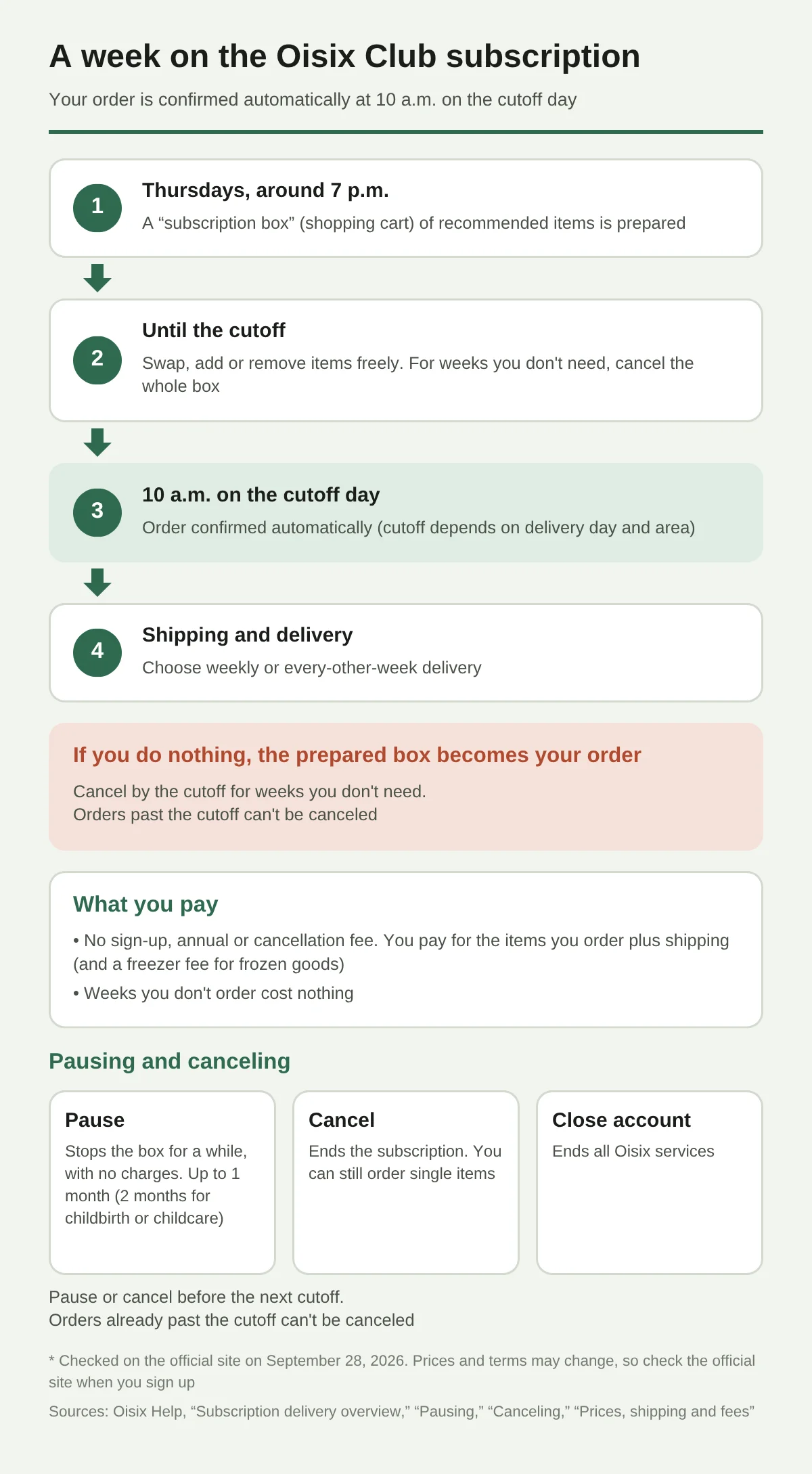
After the trial set, if you want to keep using it, you join the home delivery service “Oisix Club (おいしっくすくらぶ).”
How costs arise
- There is no joining fee, annual fee, or cancellation fee. You pay for the products you order and the shipping (plus a freezing fee for frozen items)
- In weeks you do not order, there is no charge
- You can order from a single item. Shipping is separate, however
The week’s flow: “automatic confirmation” at the deadline
- Around 7 p.m. every Thursday, a “subscription box” (shopping cart) containing recommended products is prepared
- Until the deadline, you can freely swap, add, or remove contents. In weeks you do not want it, you can cancel the whole box
- At 10 a.m. on the deadline day, the order is automatically confirmed (the deadline day depends on the delivery day of the week and the area)
- Shipping and delivery
The important one is 3. If you do nothing, the prepared box becomes your order as is. In weeks you do not want it, cancel before the deadline. Orders past the deadline cannot be canceled.
You can choose weekly or every-other-week delivery. The two subscription plans you can choose when joining are the “Kit Oisix Plan” and the “Oisix CookBox Plan” (other plans can be changed to after joining).
Shipping
Shipping depends on the order amount (before tax) and the area. Subscribers pay less. (As in the official page’s table.)
| Order amount (before tax) | Honshu | Hokkaido, Shikoku, Kyushu | Okinawa |
|---|---|---|---|
| 10,000 yen or more | 0 yen | 0 yen | 0 yen |
| 8,000 to 9,999 yen | 0 yen | 0 yen | 500 yen |
| 6,500 to 7,999 yen | 0 yen | 200 yen | 500 yen |
| 4,500 to 6,499 yen | 300 yen | 500 yen | 1,100 yen |
| 4,499 yen or less | 600 yen | 800 yen | 1,400 yen |
These are subscriber shipping fees. There is no difference between weekly and every-other-week. For non-subscribers, shipping is 0 yen at 8,000 yen or more on Honshu, and 1,000 yen at 4,499 yen or less.
The meal kit “Kit Oisix”
- A meal kit in which a main dish and a side dish can be made in as little as 10 minutes
- From 994 yen (tax included) for 2 servings, and from 1,566 yen (tax included) for 3 servings (the official page as of April 1, 2026)
- There is no 1-serving size (basically from 2 servings)
Pausing and canceling
| What you can do | Procedure | |
|---|---|---|
| Temporary pause | Temporarily stop the subscription box. No charge during the pause. Up to 1 month (up to 2 months for childbirth or childcare) | From My Account (registration information) |
| Cancellation | Stop the home delivery service. You can still order individual items after canceling | From “Procedure for canceling home delivery” in My Account (registration information) |
| Withdrawal | Stop all of Oisix’s services | A separate procedure |
In either case, orders already past the deadline cannot be canceled. Complete pausing or canceling before the next deadline.
(Oisix Help, “Home Delivery Service Overview,” “Temporary Pause,” and “Cancellation.”)
Who it seems suited to, and who it may not suit
| People it seems suited to | People it may not suit |
|---|---|
| Want to choose reduced-pesticide vegetables by looking at labels | Want all vegetables to be organic JAS (you need to choose product by product) |
| Concerned about postharvest fungicides on imported citrus and bananas | Want to uniformly avoid specific pesticides (such as those not approved in the EU) |
| Want to cut the effort of planning menus (meal kits) | Want just one serving (meal kits start from 2 servings) |
| Can review the order on a smartphone every week | Find managing the deadline a burden (if you do nothing, the order is confirmed) |
Checkpoints when choosing
- For vegetables, look at the label on each product: one of “薬無化無,” “薬減化減(当地比),” or “有機栽培”
- “Pesticide-free” is about chemically synthesized pesticides: pesticides permitted under organic JAS are separate. The same goes for the national labeling
- For processed foods, look at the ingredient list: some products do contain additives in the “used as little as possible” category
- For the subscription, check the deadline: it is automatically confirmed at 10 a.m. on the deadline day. Cancel in weeks you do not want it
- Start with the trial set: it is a one-time delivery and does not make you a subscriber
How Urayomi (ウラヨミ) approaches this
- This article does not judge whether Oisix’s vegetables and foods are “safe.” It lays out the standards Oisix publishes alongside the national systems
- Oisix’s standards are introduced as Oisix’s own statements. This site has not verified production sites or testing
- Prices, shipping, and the contents of the trial set may change. When you apply, please check the official page
Related reading
- Comparison with Radish Boya (らでぃっしゅぼーや), Daichi o Mamoru Kai (大地を守る会), Palsystem (パルシステム), and Seikatsu Club (生活クラブ) → Article comparing food delivery services
- What pesticides, and how much, are found in national testing → Vegetables and Pesticides database
- Postharvest pesticides on imported fruit and wheat → Article on postharvest treatment
- Why additives used in ingredients are not labeled → Article on carryover
- Glucose-fructose syrup and genetic modification → Article on isomerized sugar
Sources
- MAFF, “Labeling Guidelines for Specially Cultivated Produce” (revised March 23, 2007 (Heisei 19)) and its Q&A
- MAFF, “Organic Food Inspection and Certification System,” and the pamphlet “Organic Produce”
- MHLW, “Fiscal 2022 Results of Testing for Pesticide Residues and the Like in Foods” (via this site’s pesticide database)
- Oisix, “Oisix Safety Standards in Detail,” “Product Prices, Shipping, and Various Fees,” the trial set application page, and Oisix Help (checked September 28, 2026)
This article introduces public systems and information Oisix has published. It does not judge the safety or effects of any particular product or service.
Related articles and databases
- What is carryover? How it differs from processing aids, and the additives that are not listed on labels even on “additive-free” foods
- What Is “果糖ぶどう糖液糖” (High-Fructose Corn Syrup)? Is It Worse for You Than Sugar? How It Differs From Sugar, and Corn and Genetic Modification
- Are Artificial Sweeteners Bad for You? Aspartame and Cancer, What “Zero Calorie” and “Zero Sugars” Really Mean, and Japanese vs. Overseas Rules
- Are preservatives bad for you? Types such as sorbic acid, what “preservative-free” hides, and how Japanese and overseas rules differ
- Is Caramel Color Dangerous? The Carcinogen Claim About “4-MEI” and the Four Types, Checked Against Japan, EU, and US Assessments
- Comparing 5 additive-conscious grocery delivery services: trial sets, ongoing costs, and additive standards (2026)
- 農薬データベース
- ポストハーベスト農薬と輸入食品