

Where Are Organic School Lunches? Municipalities Serving Them and 168 Organic Villages, by Prefecture

PR This article contains affiliate links to Rakuten Ichiba, Amazon, Yahoo! Shopping and A8.net (“See on Rakuten”, etc.). What we write is based on public agency documents and research papers, whether or not ads are involved. The “See on Amazon.co.jp” links are also affiliate links.
“Which municipalities serve organic school lunches?” “Does my prefecture or city do it in its elementary schools?” “I want to see a list of Organic Villages.” These are questions we often see about organic school lunches (yuki kyushoku).
The short answer: in fiscal 2024, 328 municipalities across Japan used organic ingredients in school lunches. However, the government has not published a list of the 328 municipality names. So Urayomi went through the Ministry of Agriculture, Forestry and Fisheries (MAFF) pages and documents and arranged 146 municipalities whose names and details can be identified by prefecture. We also include the full list of the 168 Organic Villages, municipalities that work on organic farming as a whole community.
In this article we cover:
- Which municipalities serve organic school lunches: the situation in each prefecture, and a list of the municipalities we can name
- All 168 Organic Villages (with start year, declaration and organic acreage)
- What is inside the “328”: is it every day, or once a year?
- Is the “organic” in “organic school lunch” the same as organic JAS?
- Examples where we can see “what” and “how much” is organic, such as Isumi City and Kameoka City
- Who pays for the extra cost of going organic, and how it relates to the school lunch fee relief starting April 2026
- Targets and results for organic school lunches in France, Sweden, Denmark, South Korea and Brazil
- Do organic school lunches change children’s bodies?
- Challenges, and the official contacts and programs to use when starting this in your own city
We check these against documents from MAFF and the Ministry of Education, Culture, Sports, Science and Technology (MEXT), foreign government documents, and research papers (checked October 8, 2026). For how organic JAS works, see our article What Is Organic? (Standards and History). For research on organic diets and health, see Organic Food and Health. For organic markets and systems in Japan and the world, see Organic Around the World.
Conclusion
- 328 municipalities served organic school lunches in fiscal 2024 (about 19% of Japan’s 1,741), up 2.7 times from 123 in fiscal 2020. But no list of names has been published. MAFF publishes only a color-coded map by prefecture
- Nearly half of the 328 (46%) did it “5 times a year or fewer.” The count is “1 if organic food was used at least once a year, even at just one school in the municipality.” About 30% used organic food twice a month or more on average (21 or more times a year)
- The “organic” in “organic school lunch” is not always organic JAS. The national count includes organic farming without certification, and municipal programs include rice grown “with no pesticides during the growing period,” specially cultivated rice, and city or town certification schemes
- “How much” differs by orders of magnitude between municipalities. In Isumi City, Chiba, 100% of the rice in school lunches is organic; in Kameoka City, Kyoto, it is 52.4% of the rice at municipal elementary schools (fiscal 2024). Some municipalities do it only once a year
- There are Organic Villages in 168 municipalities across all 47 prefectures (as of August 31, 2026). Two municipalities in Okinawa joined in fiscal 2026, so every prefecture now has one. The national target is “200 by 2030,” 32 more to go
- In many cases, the municipality pays the extra cost of going organic (the price difference). National subsidies also cover “only the difference from regular ingredients.” The school lunch fee relief for public elementary schools from April 2026 uses a baseline of 5,200 yen a month, and the amount above that may be collected from parents
- Overseas, targets and results are far apart. France’s target is 20% organic in public catering, against 11.8% in 2024. Japan has no national target for the organic share of school lunches
- We found no study showing that organic school lunches reduced children’s illnesses. In a trial at elementary schools in Cyprus, urinary metabolites of pesticides (pyrethroids) were about 70% lower during the organic diet period, but the authors themselves write that this does not show a benefit to the body
Items featured in this article
| Item | When it helps | Where in the article |
|---|---|---|
| Delivery and direct-from-farm services for organic and pesticide-free vegetables (Oisix, Radish Boya, Sakanotsu, Coop Shizenha, Tabechoku) | When you want to bring organic vegetables into your child’s meals at home | 家でも子どもの食事を有機にしたいとき |
| “Yuki Kyushoku Start Book” and “How to Move Forward: Organic School Lunches” (Nobunkyo) | When you want to look into or discuss organic school lunches in your own city | うちの市でもオーガニック給食を始めるには |
Which municipalities serve organic school lunches?
In fiscal 2024, 328 municipalities used organic ingredients in school lunches, but no list of their names has been published. First, let’s look at the national figures and how they are counted.
| Fiscal year | Municipalities | Increase from previous year |
|---|---|---|
| FY2020 | 123 | ― |
| FY2021 | 137 | +14 |
| FY2022 | 193 | +56 |
| FY2023 | 278 | +85 |
| FY2024 | 328 | +50 |
Source: MAFF, “Circumstances Surrounding Organic Agriculture,” April 2026 edition, p. 13.
- How it is counted: municipalities that answered that they used organic food in school lunches “at least once a year.” If even one school in the municipality does it, it is counted
- The 328 in fiscal 2024 is about 19% of Japan’s 1,741 municipalities (including Tokyo’s 23 wards)
- We could not find the fiscal 2025 figure as of October 8, 2026
The biggest increases were in fiscal 2022 (+56) and fiscal 2023 (+85). This overlaps with the period when national support for Organic Villages began (from the fiscal 2021 supplementary budget) and efforts started moving in many places. However, no document examines the relationship between the two, so we cannot say that Village support increased organic school lunches.
December 8 is Organic Agriculture Day (yuki nogyo no hi) every year. Around that date, MAFF calls on municipalities nationwide to serve organic ingredients in school lunches, and it introduces the participating municipalities’ efforts on its page. As we will see later, the 328 includes municipalities that serve organic rice for just one day to coincide with this date.
The names of the “328 municipalities” are not published
MAFF’s “Circumstances Surrounding Organic Agriculture” does not include a list of the 328 municipality names. It has only a map color-coded by the number and share of municipalities in each prefecture.
There are three official sources where names can be found.
| Source | Municipalities listed | Contents |
|---|---|---|
| MAFF, “Use of Organic Agricultural Products in School Lunches,” 2024 | 64 municipalities | Plans for events around the December 8 Organic Agriculture Day, etc. (self-reported by municipalities) |
| Same, 2025 | 54 municipalities | Same (26 appear in both 2024 and 2025) |
| MAFF, “Organic Village Case Studies” (September 2026) | 102 municipalities with school lunch figures | Results and targets such as times per year, tons, and % |
When Urayomi combined these three, 146 municipalities (in 44 prefectures) had names and details we could identify. The prefecture-by-prefecture list is in the next section.
But these 146 are not the same group as the “328.” The years and counting methods differ, and the Village case studies also include efforts such as specially cultivated rice. “Not on the list” does not mean “not doing it,” so please check your own municipality through its board of education or school lunch center announcements.
By prefecture: Nagano, Aichi, Ibaraki, Hyogo and others lead
The MAFF map does not label prefecture names, so Urayomi read the prefectures from their positions on the map and made these tables (we may have misread some).
| Map category (FY2024) | Prefectures |
|---|---|
| 11 or more municipalities with organic school lunches | Hokkaido, Ibaraki, Chiba, Nagano, Aichi, Hyogo, Kagoshima |
| 6 to 10 | Yamagata, Fukushima, Tochigi, Gunma, Saitama, Tokyo, Kanagawa, Niigata, Toyama, Ishikawa, Gifu, Shizuoka, Nara, Shimane, Okayama, Tokushima, Kochi, Oita, Miyazaki |
| 1 to 5 | Aomori, Iwate, Miyagi, Akita, Fukui, Yamanashi, Mie, Shiga, Kyoto, Osaka, Wakayama, Tottori, Hiroshima, Yamaguchi, Kagawa, Ehime, Fukuoka, Saga, Nagasaki, Kumamoto |
| 0 | Okinawa |
| Share of municipalities (national average is about 19%) | Prefectures |
|---|---|
| 31% or more | Ibaraki, Toyama, Ishikawa, Nagano, Aichi, Hyogo, Shimane, Okayama, Oita |
| 16 to 30% | Yamagata, Tochigi, Gunma, Chiba, Kanagawa, Niigata, Fukui, Yamanashi, Gifu, Shizuoka, Tottori, Hiroshima, Yamaguchi, Tokushima, Kagawa, Kochi, Miyazaki, Kagoshima |
| 1 to 15% | Hokkaido, Aomori, Iwate, Miyagi, Akita, Fukushima, Saitama, Tokyo, Mie, Shiga, Kyoto, Osaka, Nara, Wakayama, Ehime, Fukuoka, Saga, Nagasaki, Kumamoto |
| 0% | Okinawa |
Source: Urayomi’s reading of the map in MAFF, “Circumstances Surrounding Organic Agriculture,” April 2026 edition, p. 13.
Combining the two categories with each prefecture’s number of municipalities lets us calculate the minimum number of municipalities. For example, Nagano is in the “31% or more” category and has 77 municipalities, so there are at least 24. In the same way, Aichi has at least 17, Ibaraki at least 14, and Hyogo at least 13.
The four prefectures near the top in both number and share were Nagano, Aichi, Ibaraki and Hyogo. Okinawa, which had 0 in fiscal 2024, saw Ishigaki City and Nakagusuku Village join as Organic Villages in fiscal 2026.
List by prefecture: Organic Villages and municipalities with organic school lunches
For each region, we give two tables.
- Organic Villages: municipalities that MAFF supports for promoting organic farming across the whole community, from production to consumption such as school lunches (see what Organic Villages are for details). This is MAFF’s list as of August 31, 2026. “Start” is the fiscal year the effort began; “Declared” of “Yes” means the municipality is on the list of declarations as of June 29, 2026, and “—” means it is not. Acreage is as of fiscal 2023, and the share of farmland is the figure in the case studies
- Organic school lunches: the map category above (number and share), the municipalities we can name, and notable examples among them. The fiscal year is the year the effort took place
Villages include some with no school lunch effort yet, or ones that are only now expanding organic farming. Being an Organic Village and serving organic school lunches are separate things.
Hokkaido and Tohoku
There are 29 Villages; Yamagata has 7, and Hokkaido and Miyagi have 6 each. On the school lunch map, Hokkaido is in the “11 or more” category and Yamagata and Fukushima are in “6 to 10.” In Osato Town, Miyagi, organic meals went from 0 to 18 in fiscal 2025, the year it started its Village efforts.
Organic Villages (29)
| Prefecture | Municipality | Start | Declared | Organic area (share of farmland) |
|---|---|---|---|---|
| Hokkaido | Abira (安平町) | FY2022 | Yes | 77.9 ha (1.0%) |
| Hokkaido | Asahikawa (旭川市) | FY2024 | Yes | Not stated |
| Hokkaido | Shintotsukawa (新十津川町) | FY2025 | Yes | 29.4 ha (0.6%) |
| Hokkaido | Akaigawa (赤井川村) | FY2025 | Yes | 38.7 ha (4.9%) |
| Hokkaido | Urahoro (浦幌町) | FY2025 | Yes | 25.6 ha (0.2%) |
| Hokkaido | Shimizu (清水町) | FY2026 | ― | Not stated |
| Aomori | Kuroishi (黒石市) | FY2022 | Yes | 30.1 ha (0.9%) |
| Aomori | Gonohe (五戸町) | FY2022 | Yes | 4.0 ha (0.1%) |
| Iwate | Hanamaki (花巻市) | FY2023 | Yes | 6.5 ha (0.0%) |
| Iwate | Ichinoseki (一関市) | FY2023 | Yes | 123.0 ha (0.7%) |
| Iwate | Tono (遠野市) | FY2025 | Yes | 7.4 ha (0.1%) |
| Miyagi | Tome (登米市) | FY2024 | Yes | 149.3 ha (0.8%) |
| Miyagi | Kurihara (栗原市) | FY2024 | Yes | 35.1 ha (0.2%) |
| Miyagi | Osaki (大崎市) | FY2024 | Yes | 62.0 ha (0.3%) |
| Miyagi | Kami (加美町) | FY2024 | Yes | 53.1 ha (0.9%) |
| Miyagi | Ishinomaki (石巻市) | FY2025 | Yes | 77.2 ha (0.8%) |
| Miyagi | Osato (大郷町) | FY2025 | Yes | 9.6 ha (0.5%) |
| Akita | Ogata (大潟村) | FY2022 | Yes | 297.7 ha (2.6%) |
| Yamagata | Yonezawa (米沢市) | FY2022 | Yes | 37.7 ha (0.9%) |
| Yamagata | Tsuruoka (鶴岡市) | FY2022 | Yes | 102.5 ha (0.6%) |
| Yamagata | Shinjo (新庄市) | FY2022 | Yes | 106.8 ha (2.0%) |
| Yamagata | Kawanishi (川西町) | FY2022 | Yes | 29.6 ha (0.6%) |
| Yamagata | Yamagata (山形市) | FY2023 | Yes | 0.1 ha (0.0%) |
| Yamagata | Sakata (酒田市) | FY2023 | Yes | 46.2 ha (0.4%) |
| Yamagata | Takahata (高畠町) | FY2023 | Yes | 93.4 ha (2.5%) |
| Fukushima | Nihonmatsu (二本松市) | FY2022 | Yes | 25.6 ha (0.5%) |
| Fukushima | Kitakata (喜多方市) | FY2023 | Yes | 46.0 ha (0.6%) |
| Fukushima | Aizuwakamatsu (会津若松市) | FY2025 | Yes | 35.5 ha (0.6%) |
| Fukushima | Samegawa (鮫川村) | FY2025 | Yes | 1.0 ha (0.1%) |
Source: MAFF, list of fiscal 2026 Organic Village districts (as of August 31, 2026), case studies (September 2026), links to declaring municipalities (June 29, 2026). Acreage is as of fiscal 2023.
Municipalities with organic school lunches (Hokkaido and Tohoku)
| Prefecture | Map category (number, share) | Municipalities we can name | Notable examples (what and how much) |
|---|---|---|---|
| Hokkaido | 11 or more, 1–15% | Asahikawa (旭川市), Setana (せたな町), Shintotsukawa (新十津川町), Tsubetsu (津別町), Abira (安平町), Makubetsu (幕別町), Kitahiroshima (北広島市), Urahoro (浦幌町) (8) | Makubetsu: plan to make all ingredients except seasonings organic or equivalent at all town elementary and junior high schools, etc. (December 9, 2025, 1 day; self-reported by the town). Tsubetsu: organic milk once a week in kodomo-en (centers for early childhood education and care) and school lunches |
| Aomori | 1–5, 1–15% | Kuroishi (黒石市), Gonohe (五戸町) (2) | Kuroishi: 19 times in total (FY2024). Gonohe: organic vegetables every month at the town’s 7 elementary and junior high schools since August 2024 (12 items, 2,769 kg) |
| Iwate | 1–5, 1–15% | Hanamaki (花巻市), Tono (遠野市), Ichinoseki (一関市) (3) | Ichinoseki: organic rice 3 times at all city elementary and junior high schools (FY2024) |
| Miyagi | 1–5, 1–15% | Tome (登米市), Osaki (大崎市), Kami (加美町), Ishinomaki (石巻市), Osato (大郷町) (5) | Osato: 0 times (FY2024) → 18 times (FY2025). Kami and Tome: once a year (FY2024). Osaki: also provided rice to all junior high schools in Taito Ward, Tokyo (December 2025) |
| Akita | 1–5, 1–15% | Ogata (大潟村) (1) | 57 organic meals (FY2024; 12 in FY2022) |
| Yamagata | 6–10, 16–30% | Yonezawa (米沢市), Kawanishi (川西町), Tsuruoka (鶴岡市), Shinjo (新庄市), Takahata (高畠町), Yamagata (山形市) (6) | Takahata: organic rice 3 times, organic vegetables 3 times, and specially cultivated rice (no chemical fertilizer; herbicide at most once early on) for 3 months (FY2024) |
| Fukushima | 6–10, 1–15% | Iwaki (いわき市), Kitakata (喜多方市), Samegawa (鮫川村), Aizuwakamatsu (会津若松市) (4) | Kitakata: organic rice at all elementary and junior high schools for one month in December 2025. Aizuwakamatsu: 10 schools used organic produce (FY2025; 7 in FY2024) |
Kanto
There are 29 Villages; Ibaraki and Chiba have 7 each. On the map, Ibaraki and Chiba are in the “11 or more” category, and Ibaraki is also in “31% or more” by share. Chiba has examples with large frequencies or shares, such as Isumi City, where 100% of the rice in school lunches is organic, and Kisarazu City, with 96 days a year.
Organic Villages (29)
| Prefecture | Municipality | Start | Declared | Organic area (share of farmland) |
|---|---|---|---|---|
| Ibaraki | Hitachiomiya (常陸大宮市) | FY2023 | Yes | 58.7 ha (1.7%) |
| Ibaraki | Ishioka (石岡市) | FY2024 | Yes | 69.2 ha (1.1%) |
| Ibaraki | Kasama (笠間市) | FY2024 | Yes | 14.0 ha (0.3%) |
| Ibaraki | Kasumigaura (かすみがうら市) | FY2024 | Yes | Not stated |
| Ibaraki | Mito (水戸市) | FY2026 | ― | Not stated |
| Ibaraki | Naka (那珂市) | FY2026 | ― | Not stated |
| Ibaraki | Ibaraki Town (茨城町) | FY2026 | ― | Not stated |
| Tochigi | Oyama (小山市) | FY2022 | Yes | 18.1 ha (0.2%) |
| Tochigi | Ichikai (市貝町) | FY2022 | Yes | 10.6 ha (0.6%) |
| Tochigi | Shioya (塩谷町) | FY2022 | Yes | 30.8 ha (1.2%) |
| Tochigi | Tochigi (栃木市) | FY2024 | Yes | 24.6 ha (0.3%) |
| Tochigi | Otawara (大田原市) | FY2025 | Yes | 109 ha (1.0%) |
| Gunma | Kanra (甘楽町) | FY2023 | Yes | 20.8 ha (2.4%) |
| Gunma | Takayama (高山村) | FY2023 | Yes | 8.8 ha (1.8%) |
| Gunma | Minakami (みなかみ町) | FY2024 | Yes | 0.5 ha (0.0%) |
| Saitama | Ogawa (小川町) | FY2022 | Yes | 57.9 ha (9.4%) |
| Saitama | Tokorozawa (所沢市) | FY2024 | Yes | 11.8 ha (0.8%) |
| Saitama | Saitama (さいたま市) | FY2025 | Yes | 5.5 ha (0.2%) |
| Saitama | Satte (幸手市) | FY2026 | ― | Not stated |
| Chiba | Kisarazu (木更津市) | FY2022 | Yes | 41.1 ha (1.8%) |
| Chiba | Sakura (佐倉市) | FY2022 | Yes | 43.6 ha (1.6%) |
| Chiba | Kozaki (神崎町) | FY2023 | Yes | 21.0 ha (2.8%) |
| Chiba | Narita (成田市) | FY2024 | Yes | Not stated |
| Chiba | Isumi (いすみ市) | FY2024 | Yes | 46.0 ha (1.4%) |
| Chiba | Tako (多古町) | FY2024 | Yes | 31.0 ha (1.0%) |
| Chiba | Sosa (匝瑳市) | FY2025 | Yes | 31.5 ha (0.6%) |
| Tokyo | Taito (台東区) | FY2025 (estimated) | ― | Not stated |
| Kanagawa | Sagamihara (相模原市) | FY2022 | Yes | 7.4 ha (0.5%) |
| Kanagawa | Odawara (小田原市) | FY2023 | Yes | 114 ha (6.6%) |
Source: MAFF, list of fiscal 2026 Organic Village districts (as of August 31, 2026), case studies (September 2026), links to declaring municipalities (June 29, 2026). Acreage is as of fiscal 2023.
Municipalities with organic school lunches (Kanto)
| Prefecture | Map category (number, share) | Municipalities we can name | Notable examples (what and how much) |
|---|---|---|---|
| Ibaraki | 11 or more, 31% or more | Ishioka (石岡市), Kasama (笠間市), Hitachiomiya (常陸大宮市), Kasumigaura (かすみがうら市) (4) | Hitachiomiya: 171 times (FY2024; 78 in FY2022), at all elementary and junior high schools. Ishioka: seasonal organic produce every month except September (FY2025) |
| Tochigi | 6–10, 16–30% | Shioya (塩谷町), Nasu (那須町), Oyama (小山市), Ichikai (市貝町), Tochigi (栃木市), Otawara (大田原市) (6) | Shioya: all rice meals use organic rice (FY2024; 96 times in FY2023), year-round at all elementary and junior high schools, kodomo-en and nursery schools. Tashiro Yuai Elementary School in Nasu: a monthly “Organic School Lunch Day” |
| Gunma | 6–10, 16–30% | Maebashi (前橋市), Kanra (甘楽町), Takayama (高山村), Minakami (みなかみ町) (4) | Kanra: 98 times (FY2024) |
| Saitama | 6–10, 1–15% | Tokorozawa (所沢市), Satte (幸手市), Chichibu (秩父市) (3) | Tokorozawa: twice a year at all municipal elementary and junior high schools (FY2024). Chichibu: organic rice at all elementary and junior high schools from December 2024 to February 2025 |
| Chiba | 11 or more, 16–30% | Narita (成田市), Isumi (いすみ市), Kisarazu (木更津市), Sakura (佐倉市), Kozaki (神崎町), Tako (多古町), Sosa (匝瑳市) (7) | Isumi: the rice in school lunches is 100% organic. Kisarazu: 96 days (FY2024). Kozaki: 40 times a year (FY2024). Sosa: organically grown rice 11 times a year |
| Tokyo | 6–10, 1–15% | Setagaya (世田谷区), Minato (港区) (2) | Setagaya: organic rice 11 times a year and organic vegetables 3 times a year at all ward elementary and junior high schools (FY2025). Minato: 1 day at some elementary and junior high schools (December 2024) |
| Kanagawa | 6–10, 16–30% | Sagamihara (相模原市), Kamakura (鎌倉市), Odawara (小田原市) (3) | Kamakura: organic vegetables at some elementary schools and all junior high schools (December 2024 to January 2025). Odawara: organic rice at some elementary schools |
In Tokyo, besides Setagaya and Minato, Taito Ward, an Organic Village, received organically farmed rice from its sister city Osaki in Miyagi and served it in all the ward’s junior high school lunches in December 2025. As for Shinagawa Ward, a distributor’s document submitted to a MAFF exchange meeting described a plan to use “organic JAS-certified and specially cultivated produce” at 46 ward elementary and junior high schools from October 2025 (we could not confirm this in an official ward document; the plan also includes specially cultivated produce).
In Saitama, besides Tokorozawa, Satte and Chichibu, there are the Villages of Ogawa (where organic acreage is 9.4% of farmland) and Saitama City.
Hokuriku and Koshin’etsu
There are 22 Villages; Nagano has 8. Nagano is also near the top on the school lunch map in both number and share, and calculation shows organic school lunches in at least 24 municipalities (fiscal 2024). Toyama and Ishikawa are also in the “31% or more” category by share.
Organic Villages (22)
| Prefecture | Municipality | Start | Declared | Organic area (share of farmland) |
|---|---|---|---|---|
| Niigata | Sado (佐渡市) | FY2022 | Yes | 60.0 ha (0.6%) |
| Niigata | Shibata (新発田市) | FY2022 | Yes | 13.7 ha (0.1%) |
| Niigata | Gosen (五泉市) | FY2024 | Yes | 1.2 ha (0.0%) |
| Niigata | Agano (阿賀野市) | FY2024 | Yes | 22.0 ha (0.3%) |
| Niigata | Tsunan (津南町) | FY2025 | Yes | 27.9 ha (0.9%) |
| Niigata | Murakami (村上市) | FY2026 | ― | Not stated |
| Toyama | Nanto (南砺市) | FY2022 | Yes | Not stated |
| Toyama | Toyama (富山市) | FY2023 | Yes | Not stated |
| Ishikawa | Suzu (珠洲市) | FY2023 | Yes | 1.9 ha (0.1%) |
| Ishikawa | Hakui (羽咋市) | FY2023 | Yes | 28.2 ha (1.3%) |
| Ishikawa | Hakusan (白山市) | FY2025 | Yes | 45.1 ha (1.0%) |
| Fukui | Echizen (越前市) | FY2023 | Yes | 276.0 ha (7.7%) |
| Fukui | Obama (小浜市) | FY2026 | ― | Not stated |
| Yamanashi | Hokuto (北杜市) | FY2022 | Yes | 99.0 ha (1.9%) |
| Nagano | Tatsuno (辰野町) | FY2022 | Yes | 0.0 ha (0.0%) |
| Nagano | Matsukawa (松川町) | FY2022 | Yes | 9.8 ha (1.0%) |
| Nagano | Iida (飯田市) | FY2023 | Yes | 2.0 ha (0.1%) |
| Nagano | Iizuna (飯綱町) | FY2023 | Yes | 0.0 ha (0.0%) |
| Nagano | Ina (伊那市) | FY2024 | Yes | 32.1 ha (0.6%) |
| Nagano | Saku (佐久市) | FY2024 | Yes | Not stated |
| Nagano | Nagawa (長和町) | FY2025 | Yes | 40 ha (4.6%) |
| Nagano | Shinano (信濃町) | FY2026 | ― | Not stated |
Source: MAFF, list of fiscal 2026 Organic Village districts (as of August 31, 2026), case studies (September 2026), links to declaring municipalities (June 29, 2026). Acreage is as of fiscal 2023.
Municipalities with organic school lunches (Hokuriku and Koshin’etsu)
| Prefecture | Map category (number, share) | Municipalities we can name | Notable examples (what and how much) |
|---|---|---|---|
| Niigata | 6–10, 16–30% | Agano (阿賀野市), Gosen (五泉市), Sado (佐渡市), Tsunan (津南町) (4) | Agano: organic rice and vegetables at all elementary and junior high schools from November 2025 to February 2026. Tsunan: 3 times in the town’s school lunches (FY2024) |
| Toyama | 6–10, 31% or more | Toyama (富山市), Nanto (南砺市) (2) | Nanto: 9 times a year at all 15 elementary and junior high schools and 12 nursery schools. Toyama: once at each school on the “School Lunch Organic Day” (December 2025). Organic rice was also served for the first time at 4 prefectural special-needs schools (FY2025) |
| Ishikawa | 6–10, 31% or more | Hakui (羽咋市), Hakusan (白山市) (2) | Hakui: 8 times (FY2024; 6 in FY2022). Hakusan: 0 times (FY2024) → 5 times (FY2025) |
| Fukui | 1–5, 16–30% | Could not be confirmed | Villages are Echizen and Obama |
| Yamanashi | 1–5, 16–30% | Yamanashi (山梨市), Hokuto (北杜市) (2) | Hokuto: organic rice and 10 types of vegetables at some elementary schools since December 2024 |
| Nagano | 11 or more, 31% or more | Nagano (長野市), Tatsuno (辰野町), Matsukawa (松川町), Iizuna (飯綱町), Iida (飯田市), Ina (伊那市), Nagawa (長和町) (7) | Nagawa: 38 times (FY2025; 30 in FY2024). Matsukawa: amount provided rose from 1.8 t (FY2020) to 8.8 t (FY2024), year-round. Ina: 1.8 t of organic rice (FY2024) |
Tokai
There are 21 Villages; Shizuoka has 8. Aichi is near the top on the school lunch map in both number and share, with organic school lunches in at least 17 municipalities (fiscal 2024). There are also examples like Nabari City, Mie, which has set vegetable days using produce grown “without pesticides or chemical fertilizers during the growing period.”
Organic Villages (21)
| Prefecture | Municipality | Start | Declared | Organic area (share of farmland) |
|---|---|---|---|---|
| Gifu | Shirakawa (白川町) | FY2022 | Yes | Not stated |
| Gifu | Hida (飛騨市) | FY2024 | Yes | 10.8 ha (0.8%) |
| Gifu | Yamagata (山県市) | FY2025 | Yes | 1.9 ha (0.2%) |
| Shizuoka | Kakegawa (掛川市) | FY2022 | Yes | 65.3 ha (1.5%) |
| Shizuoka | Fujieda (藤枝市) | FY2022 | Yes | 60.5 ha (2.9%) |
| Shizuoka | Kawanehon (川根本町) | FY2023 | Yes | 43.6 ha (8.7%) |
| Shizuoka | Shizuoka (静岡市) | FY2024 | Yes | 34.4 ha (0.8%) |
| Shizuoka | Fujinomiya (富士宮市) | FY2024 | Yes | 30.8 ha (1.1%) |
| Shizuoka | Shimada (島田市) | FY2024 | Yes | 42.4 ha (1.6%) |
| Shizuoka | Izunokuni (伊豆の国市) | FY2024 | Yes | 38.5 ha (4.0%) |
| Shizuoka | Oyama (小山町) | FY2025 | Yes | Not stated |
| Aichi | Togo (東郷町) | FY2022 | Yes | 9.2 ha (2.8%) |
| Aichi | Minamichita (南知多町) | FY2022 | Yes | 37.4 ha (5.0%) |
| Aichi | Okazaki (岡崎市) | FY2023 | Yes | 82.0 ha (2.6%) |
| Aichi | Obu (大府市) | FY2024 | Yes | 2.0 ha (0.3%) |
| Aichi | Mihama (美浜町) (joint with Taketoyo (武豊町)) | FY2024 | Yes | Not stated |
| Aichi | Taketoyo (武豊町) (joint with Mihama (美浜町)) | FY2024 | Yes | Not stated |
| Mie | Owase (尾鷲市) | FY2022 | Yes | 6.7 ha (10.2%) |
| Mie | Nabari (名張市) | FY2023 | Yes | 10.8 ha (1.0%) |
| Mie | Iga (伊賀市) | FY2023 | Yes | 10.6 ha (0.1%) |
| Mie | Taki (多気町) | FY2026 | Yes | Not stated |
Source: MAFF, list of fiscal 2026 Organic Village districts (as of August 31, 2026), case studies (September 2026), links to declaring municipalities (June 29, 2026). Acreage is as of fiscal 2023.
Municipalities with organic school lunches (Tokai)
| Prefecture | Map category (number, share) | Municipalities we can name | Notable examples (what and how much) |
|---|---|---|---|
| Gifu | 6–10, 16–30% | Hida (飛騨市) (1) | 3 times a year (FY2023 and FY2024) |
| Shizuoka | 6–10, 16–30% | Kakegawa (掛川市), Shizuoka (静岡市), Fujieda (藤枝市), Izunokuni (伊豆の国市), Shimada (島田市), Oyama (小山町) (6) | Fujieda: 3 times a year (2023) → 5 times a year (2024). Izunokuni: organically grown rice 3 times a year (FY2024) |
| Aichi | 11 or more, 31% or more | Okazaki (岡崎市), Obu (大府市), Ama (あま市), Togo (東郷町) (4) | Obu: rice 18 times, and vegetables planned 8 times at elementary and junior high schools (FY2025). Okazaki: organic carrots once a month from December 2025 to February 2026 |
| Mie | 1–5, 1–15% | Owase (尾鷲市), Nabari (名張市), Iga (伊賀市) (3) | Nabari: a vegetable day grown “without pesticides or chemical fertilizers during the growing period” once a month from December to March at the city’s 14 elementary schools. Iga: once a year (FY2024) |
Kinki
There are 23 Villages; Hyogo’s 10 is the most of any prefecture. Hyogo is also near the top on the school lunch map in both number and share, with at least 13 municipalities (fiscal 2024). Kameoka City, Kyoto, with “52.4% of the rice at municipal elementary schools,” has a high value among the examples where the share is known.
Organic Villages (23)
| Prefecture | Municipality | Start | Declared | Organic area (share of farmland) |
|---|---|---|---|---|
| Shiga | Koka (甲賀市) | FY2022 | Yes | 20.2 ha (0.4%) |
| Shiga | Omihachiman (近江八幡市) | FY2024 | Yes | 35.1 ha (0.8%) |
| Shiga | Hino (日野町) | FY2024 | Yes | 8.3 ha (0.4%) |
| Shiga | Higashiomi (東近江市) | FY2025 | Yes | 38.4 ha (0.5%) |
| Shiga | Takashima (高島市) | FY2026 | ― | Not stated |
| Kyoto | Kameoka (亀岡市) | FY2022 | Yes | 44.6 ha (1.7%) |
| Kyoto | Kyotango (京丹後市) | FY2024 | Yes | 56.1 ha (1.2%) |
| Osaka | Sakai (堺市) | FY2023 | Yes | Not stated |
| Osaka | Izumiotsu (泉大津市) | FY2024 or earlier (estimated) | Yes | Not stated |
| Hyogo | Toyooka (豊岡市) | FY2022 | Yes | 313.0 ha (6.4%) |
| Hyogo | Tambasasayama (丹波篠山市) | FY2022 | Yes | 67.6 ha (1.6%) |
| Hyogo | Yabu (養父市) | FY2022 | Yes | 36.1 ha (2.5%) |
| Hyogo | Tamba (丹波市) | FY2022 | Yes | 191.9 ha (3.5%) |
| Hyogo | Awaji (淡路市) | FY2022 | Yes | 5.9 ha (0.2%) |
| Hyogo | Kobe (神戸市) | FY2023 | Yes | 28.0 ha (0.6%) |
| Hyogo | Asago (朝来市) | FY2023 | Yes | 21.5 ha (1.3%) |
| Hyogo | Kato (加東市) | FY2023 | Yes | 18.3 ha (0.7%) |
| Hyogo | Kamigori (上郡町) | FY2023 | Yes | 11.9 ha (1.3%) |
| Hyogo | Inami (稲美町) | FY2025 | Yes | 3.7 ha (0.2%) |
| Nara | Uda (宇陀市) | FY2022 | Yes | 22.8 ha (1.4%) |
| Nara | Tenri (天理市) | FY2023 | Yes | 2.5 ha (0.2%) |
| Nara | Soeda (山添村) | FY2024 | Yes | 9.3 ha (1.8%) |
| Wakayama | Katsuragi (かつらぎ町) | FY2023 | Yes | 10.0 ha (0.6%) |
Source: MAFF, list of fiscal 2026 Organic Village districts (as of August 31, 2026), case studies (September 2026), links to declaring municipalities (June 29, 2026). Acreage is as of fiscal 2023.
Municipalities with organic school lunches (Kinki)
| Prefecture | Map category (number, share) | Municipalities we can name | Notable examples (what and how much) |
|---|---|---|---|
| Shiga | 1–5, 1–15% | Hino (日野町) (1) | Trial introduction of organic rice expanded from 1 elementary school to 5 (October 2024) |
| Kyoto | 1–5, 1–15% | Kameoka (亀岡市), Kyotango (京丹後市) (2) | Kameoka: 52.4% of the rice in municipal elementary school lunches is organic (FY2024). Kyotango: organic rice on 5 days (FY2024) |
| Osaka | 1–5, 1–15% | Izumiotsu (泉大津市), Izumisano (泉佐野市) (2) | Izumisano: organic vegetables and bread made from domestic organic wheat at all elementary and junior high schools (FY2024; self-reported as being served). Izumiotsu: komatsuna and spinach at all junior high schools (November–December 2024) |
| Hyogo | 11 or more, 31% or more | Itami (伊丹市), Kasai (加西市), Kato (加東市), Taka (多可町), Toyooka (豊岡市), Tamba (丹波市), Yabu (養父市), Asago (朝来市), Kamigori (上郡町), Inami (稲美町) (10) | Yabu: 2,796.9 kg (FY2024). Asago: rice grown “without pesticides during the growing period” 3 times a month. Toyooka: reduced-pesticide rice grown with the “Kounotori-Hagukumu farming method” 5 times a week |
| Nara | 6–10, 1–15% | Kashihara (橿原市), Soeda (山添村), Uda (宇陀市), Tenri (天理市) (4) | Uda: 15 times (FY2023) → 114 times (FY2024; combined total for the school lunch center, nursery schools and kodomo-en) |
| Wakayama | 1–5, 1–15% | Katsuragi (かつらぎ町) (1) | Twice a year (FY2024). Organic persimmons, etc. |
Chugoku and Shikoku
There are 17 Villages; Shimane has 5. About a quarter of Shimane’s municipalities (5 of 19) are Villages, and it is in the “31% or more” category for the share of organic school lunches. Yoshika Town serves 100% organic rice in school lunches, and Ohnan Town serves organic rice 12 times a year.
Organic Villages (17)
| Prefecture | Municipality | Start | Declared | Organic area (share of farmland) |
|---|---|---|---|---|
| Tottori | Nichinan (日南町) | FY2023 | Yes | 2.8 ha (0.2%) |
| Tottori | Yazu (八頭町) | FY2025 | Yes | 15.5 ha (0.9%) |
| Shimane | Hamada (浜田市) | FY2022 | Yes | 48.4 ha (2.1%) |
| Shimane | Ota (大田市) | FY2022 | Yes | 9.1 ha (0.4%) |
| Shimane | Ohnan (邑南町) | FY2022 | Yes | 10.9 ha (0.6%) |
| Shimane | Yoshika (吉賀町) | FY2022 | Yes | 49.5 ha (5.7%) |
| Shimane | Gotsu (江津市) | FY2023 | Yes | 53.0 ha (8.8%) |
| Okayama | Wake (和気町) | FY2023 | Yes | 1.7 ha (0.2%) |
| Okayama | Shinjo (新庄村) | FY2025 | Yes | 3.8 ha (2.1%) |
| Hiroshima | Jinsekikogen (神石高原町) | FY2022 | Yes | 14.1 ha (0.8%) |
| Yamaguchi | Nagato (長門市) | FY2022 | Yes | 4.3 ha (0.1%) |
| Tokushima | Komatsushima (小松島市) | FY2022 | Yes | 23.6 ha (1.6%) |
| Tokushima | Kaiyo (海陽町) | FY2023 | Yes | 3.1 ha (0.4%) |
| Kagawa | Mitoyo (三豊市) | FY2023 | Yes | 4.8 ha (0.1%) |
| Ehime | Imabari (今治市) | FY2023 | Yes | 54.8 ha (1.3%) |
| Kochi | Umaji (馬路村) | FY2023 | Yes | 52.0 ha (83.9%) |
| Kochi | Konan (香南市) | FY2026 | ― | Not stated |
Source: MAFF, list of fiscal 2026 Organic Village districts (as of August 31, 2026), case studies (September 2026), links to declaring municipalities (June 29, 2026). Acreage is as of fiscal 2023.
Municipalities with organic school lunches (Chugoku and Shikoku)
| Prefecture | Map category (number, share) | Municipalities we can name | Notable examples (what and how much) |
|---|---|---|---|
| Tottori | 1–5, 16–30% | Nichinan (日南町), Yazu (八頭町) (2) | Nichinan: once (FY2023) → 3 times (FY2024). Yazu: organic rice on 5 days, 450 kg (FY2025) |
| Shimane | 6–10, 31% or more | Gotsu (江津市), Hamada (浜田市), Yoshika (吉賀町), Ota (大田市), Ohnan (邑南町) (5) | Yoshika: all rice in school lunches is organic, and 3 days a year when vegetables are organic too (2024). Ohnan: organic rice 12 times a year (FY2024) |
| Okayama | 6–10, 31% or more | Wake (和気町) (1) | Specially cultivated rice grown with only organic fertilizer, 64 times at 8 schools and centers in the town (FY2024, limited period; 50 times in FY2023) |
| Hiroshima | 1–5, 16–30% | Jinsekikogen (神石高原町) (1) | Organic green onions at all elementary and junior high schools (November 2024) |
| Yamaguchi | 1–5, 16–30% | Shimonoseki (下関市) (1) | Organically grown rice from aigamo (duck-assisted) farming at Hoto Elementary School (December 2025) |
| Tokushima | 6–10, 16–30% | Awa (阿波市), Komatsushima (小松島市) (2) | Komatsushima: organic komatsuna at all elementary and junior high schools from November 2024 to March 2025 |
| Kagawa | 1–5, 16–30% | Could not be confirmed | Village is Mitoyo |
| Ehime | 1–5, 1–15% | Imabari (今治市) (1) | 4 times a year (FY2024). 10.7 t used in school lunches (FY2022) |
| Kochi | 6–10, 16–30% | Umaji (馬路村) (1) | Organic school lunches and food education (number of times not stated) |
Kyushu and Okinawa
There are 27 Villages; Miyazaki and Kagoshima have 6 each. Kagoshima is in the “11 or more” category on the school lunch map. Aya Town, Miyazaki, made an ordinance on organic school lunches in 2023. Okinawa had 0 organic school lunches in fiscal 2024, but two Villages were added in fiscal 2026.
Organic Villages (27)
| Prefecture | Municipality | Start | Declared | Organic area (share of farmland) |
|---|---|---|---|---|
| Fukuoka | Ukiha (うきは市) | FY2023 | Yes | 12.0 ha (0.5%) |
| Fukuoka | Sasaguri (篠栗町) | FY2024 | Yes | 0.0 ha (0.0%) |
| Saga | Kamimine (上峰町) (joint with Miyaki (みやき町)) | FY2024 | Yes | Not stated |
| Saga | Miyaki (みやき町) (joint with Kamimine (上峰町)) | FY2024 | Yes | Not stated |
| Nagasaki | Minamishimabara (南島原市) | FY2022 | Yes | 15.2 ha (0.3%) |
| Nagasaki | Unzen (雲仙市) | FY2024 | Yes | 42.7 ha (0.9%) |
| Nagasaki | Goto (五島市) | FY2025 | Yes | 72.8 ha (1.5%) |
| Kumamoto | Minamiaso (南阿蘇村) | FY2022 | Yes | 57.8 ha (1.8%) |
| Kumamoto | Yamato (山都町) | FY2022 | Yes | 163.9 ha (3.4%) |
| Kumamoto | Kikuchi (菊池市) | FY2024 | Yes | 203.2 ha (3.5%) |
| Oita | Saiki (佐伯市) | FY2022 | Yes | 18.0 ha (1.0%) |
| Oita | Usuki (臼杵市) | FY2022 | Yes | 97.0 ha (4.1%) |
| Oita | Bungotakada (豊後高田市) | FY2023 | Yes | 66.5 ha (2.2%) |
| Miyazaki | Aya (綾町) | FY2022 | Yes | 63.5 ha (2.2%) |
| Miyazaki | Takanabe (高鍋町) (joint with Kijo (木城町)) | FY2022 | Yes | 31.7 ha (1.5%) *One value for the two towns |
| Miyazaki | Kijo (木城町) (joint with Takanabe (高鍋町)) | FY2022 | Yes | 31.7 ha (1.5%) *One value for the two towns |
| Miyazaki | Ebino (えびの市) | FY2023 | Yes | 46.0 ha (1.3%) |
| Miyazaki | Miyazaki (宮崎市) | FY2024 | Yes | 97.3 ha (1.2%) |
| Miyazaki | Takachiho (高千穂町) | FY2025 | ― | 6.7 ha (0.4%) |
| Kagoshima | Minamisatsuma (南さつま市) | FY2022 | Yes | Not stated |
| Kagoshima | Yusui (湧水町) | FY2022 | Yes | 85.9 ha (5.1%) |
| Kagoshima | Minamitane (南種子町) | FY2022 | Yes | 12.2 ha (0.6%) |
| Kagoshima | Tokunoshima (徳之島町) | FY2022 | Yes | Not stated |
| Kagoshima | Aira (姶良市) | FY2024 | Yes | 26 ha (1.7%) |
| Kagoshima | Isen (伊仙町) | FY2026 | ― | Not stated |
| Okinawa | Nakagusuku (中城村) | FY2026 | ― | Not stated |
| Okinawa | Ishigaki (石垣市) | FY2026 | ― | Not stated |
Source: MAFF, list of fiscal 2026 Organic Village districts (as of August 31, 2026), case studies (September 2026), links to declaring municipalities (June 29, 2026). Acreage is as of fiscal 2023.
Municipalities with organic school lunches (Kyushu and Okinawa)
| Prefecture | Map category (number, share) | Municipalities we can name | Notable examples (what and how much) |
|---|---|---|---|
| Fukuoka | 1–5, 1–15% | Sasaguri (篠栗町) (1) | Promotes its Village with the aim of serving local farm produce in school lunches (organic acreage 0.0 ha, as of fiscal 2023) |
| Saga | 1–5, 1–15% | Kamimine (上峰町), Miyaki (みやき町) (2) | Kamimine: potatoes and lotus root (December 8, 2025). The case studies state an aim of “100% eco-friendly free school lunches” |
| Nagasaki | 1–5, 1–15% | Minamishimabara (南島原市), Unzen (雲仙市), Goto (五島市) (3) | Unzen: about 3,400 meals’ worth (FY2024, once; one case study entry also states twice and 90 kg) |
| Kumamoto | 1–5, 1–15% | Kikuchi (菊池市), Yamato (山都町), Minamiaso (南阿蘇村) (3) | Yamato: organic rice and vegetables at all elementary and junior high schools on the 19th of every month (Food Education Day). Kikuchi: organic rice for one week at 15 elementary and junior high schools |
| Oita | 6–10, 31% or more | Usuki (臼杵市), Bungotakada (豊後高田市), Saiki (佐伯市) (3) | Bungotakada: usage share 13.7% (FY2024; 9.2% in FY2022). Usuki: vegetables under the city’s own certification “Honmamono Nosanbutsu (ほんまもん農産物)” 19.3% and organically grown rice 9.2% (FY2024; vegetables were 11.4% in FY2021). Saiki: about 20.5 t of organically grown rice (about 4 months’ worth) and about 2.5 t of organic vegetables (FY2024) |
| Miyazaki | 6–10, 16–30% | Kijo (木城町), Ebino (えびの市), Aya (綾町), Takanabe (高鍋町) (4) | Aya: the 2023 “Ordinance on Promoting Organic School Lunches in Aya Town.” Takanabe and Kijo: 9.52 t of organic rice (FY2024; 1.32 t in FY2022) |
| Kagoshima | 11 or more, 16–30% | Ichikikushikino (いちき串木野市), Minamikyushu (南九州市), Minamitane (南種子町), Minamisatsuma (南さつま市), Yusui (湧水町), Tokunoshima (徳之島町), Aira (姶良市) (7) | Yusui: 14 times (FY2023) → 39 times (FY2024). Minamitane: organic vegetables on the 8th of every month. Minamisatsuma: once a year, on December 8 each year |
| Okinawa | 0, 0% | Could not be confirmed | 0 in FY2024. Nakagusuku and Ishigaki became Villages in FY2026 |
Source: MAFF, “Use of Organic Agricultural Products in School Lunches” (2024, 2025), “Organic Village Case Studies” (September 2026), and the map in “Circumstances Surrounding Organic Agriculture,” April 2026 edition (read by Urayomi). The map categories are for FY2024; the fiscal year for each notable example is in its parentheses.
What about private and national schools?
The national count is by municipality, but MAFF’s Organic Agriculture Day page lists some individual schools and early childhood centers.
| School or center | Contents (as stated on the MAFF page) |
|---|---|
| Kamakura Elementary School attached to the Faculty of Education, Yokohama National University (Kanagawa) | School lunches using organic seasonings, dried foods and vegetables since 2015. On December 8, 2025, 10 items including organic rice, organic vegetables and organic seasonings |
| Yokohama Elementary School attached to the Faculty of Education, Yokohama National University (Kanagawa) | School lunch with vegetables grown by organic farming (December 5, 2025) |
| Tsuzuki Ikuei Gakuen, Linden Hall School (listed in the Kyushu and Okinawa section) | School lunches with 100% organic rice and vegetables year-round. In August 2024, the first school lunch in Japan to obtain the JAS for “management methods of restaurants serving organic dishes” (JAS 0004) |
| Isohara Kindergarten, a certified kodomo-en (Ibaraki) | Sweet potatoes, partly grown organically in its own field, served in school lunches (November–December 2025) |
Inside the “328”: 46% serve organic food 5 times a year or fewer
Nearly half of the “municipalities serving organic school lunches” do it only a few times a year. MAFF also asked the 328 municipalities about the number of times, items and origin.
| Times per year | Municipalities | Share (of 318 valid responses) |
|---|---|---|
| 101 or more | 36 | 11% |
| 51–100 | 35 | 11% |
| 21–50 | 33 | 10% |
| 6–20 | 69 | 22% |
| 5 or fewer | 145 | 46% |
Source: MAFF, “Circumstances Surrounding Organic Agriculture,” April 2026 edition, p. 14.
- The largest group is “5 times a year or fewer,” at 145 (46%). Municipalities that serve organic food for just one day to coincide with Organic Agriculture Day on December 8 are included here
- 21 or more times a year (roughly twice a month or more on average) is 104, about 30%
- Where the number of times differs by school, the municipality is counted by the school with the most. It does not mean every school in the municipality does it the same number of times
What is used? Where does it come from?
| Item (multiple answers) | FY2024 | FY2023 |
|---|---|---|
| Vegetables | 233 | 189 |
| Cooked rice | 164 | 127 |
| Seasonings and processed foods | 32 | 20 |
| Fruit | 20 | 18 |
| Other (bread, milk, tea, mushrooms, etc.) | 19 | 10 |
| Beans | 11 | 12 |
| Origin (FY2024, multiple answers) | Municipalities | Share of the 328 |
|---|---|---|
| Within the same municipality | 275 | 84% |
| Other municipalities in the same prefecture | 54 | 16% |
| Other prefectures | 27 | 9% |
| Imported | 7 | 2% |
Source: same, p. 14.
Vegetables and rice are mostly what is used, and over 80% comes from local sources. This shows that organic school lunches are being advanced as “chisan-chisho” (local production for local consumption) efforts, using crops from local organic farmers in schools.
“Number of municipalities” and “share of children” are different things
All the numbers so far are numbers of municipalities. “About 19% of municipalities nationwide” does not mean “19% of children’s school lunches are organic.” We could not find any official national figure for the number of children eating organic ingredients or the organic share of all school lunches.
If you live in an “organic school lunch municipality,” is it organic every day?
Not necessarily. About 30% of the 328 serve organic food 21 or more times a year, and just 36 municipalities, about 10%, do so close to every day (101 or more times a year). Even within the same municipality, the number of times can differ by school, and the national count uses the number from “the school with the most.”
Many municipalities make only the rice organic. For example, even in a municipality where “all the rice is organic,” the vegetables and side dishes may mostly be regular ones. When you are thinking about a new home or your child’s school, the surest way is to check the items (rice, vegetables, etc.), the number of times, and the schools covered in announcements from the municipality’s board of education or school lunch center.
The “organic” in “organic school lunch” is not always organic JAS
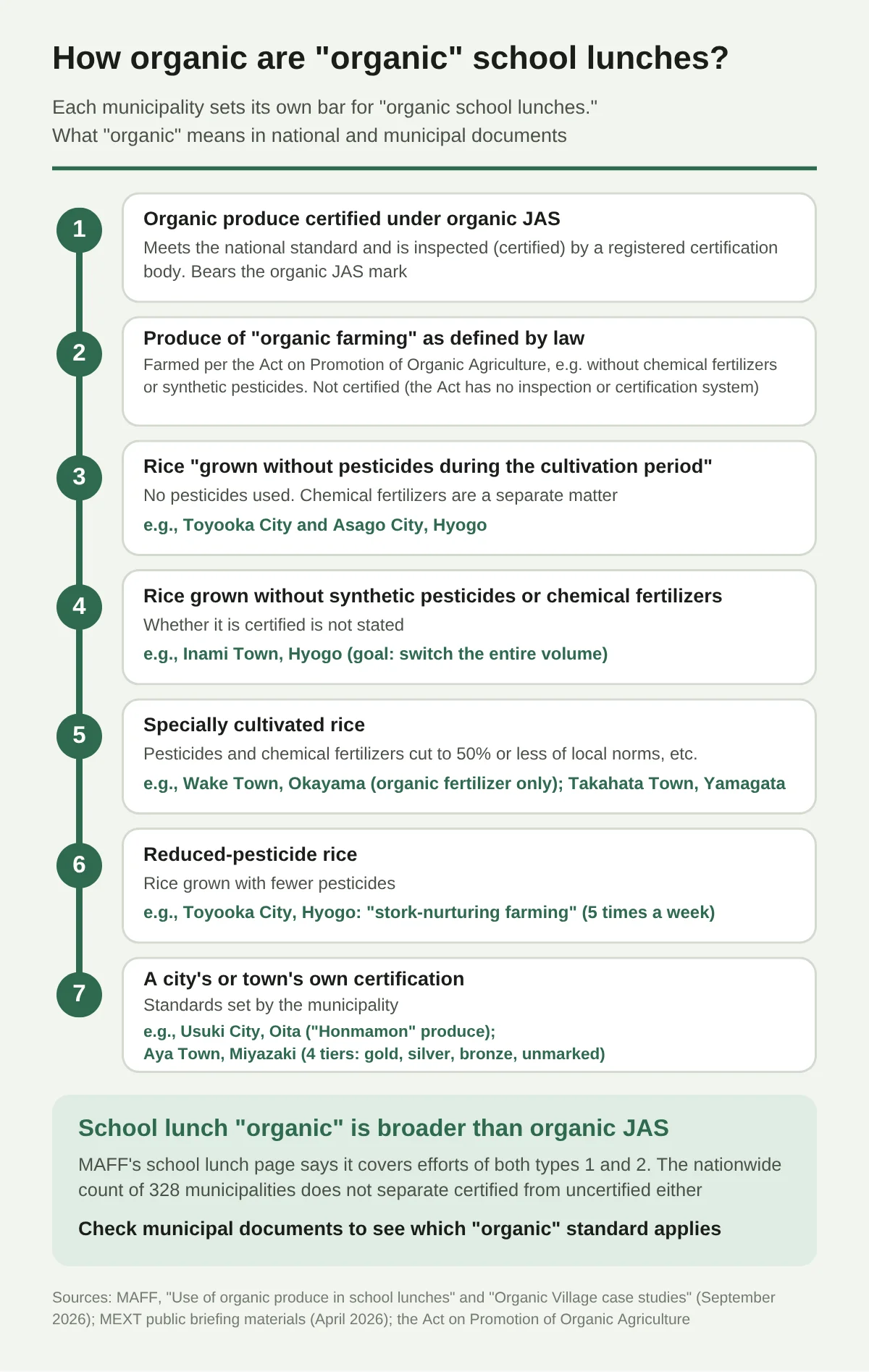
Even among things called “organic school lunches,” the standards vary by municipality.
“Organic” with the organic JAS mark means only food that follows the standards set by law and has been inspected by a registered certification body (see What Is Organic? (Standards and History) for details). In school lunches, however, “organic” is used in a broader sense.
| What is used in “organic school lunches” | Contents | Examples |
|---|---|---|
| Organic JAS-certified organic produce | Meets the national standard and is certified | ― |
| Produce grown by “organic farming” under the Act on Promotion of Organic Agriculture | Methods such as not using chemical fertilizers or synthetic pesticides. Not certified | MAFF’s school lunch page states that it counts both organic JAS and this |
| Rice grown “with no pesticides during the growing period” | No pesticides used. Handling of chemical fertilizer is separate | Toyooka and Asago, Hyogo |
| Rice grown without synthetic pesticides or chemical fertilizers | Whether it is certified is not stated | Inami, Hyogo (aim to switch everything) |
| Specially cultivated rice | Rice grown with pesticides and chemical fertilizers reduced to 50% or less of what is customary in the area, etc. | Wake, Okayama (specially cultivated rice grown with only organic fertilizer); Takahata, Yamagata |
| Reduced-pesticide rice | Rice grown with fewer pesticides | Toyooka, Hyogo, “Kounotori-Hagukumu farming method” (5 times a week) |
| A city or town’s own certification | Standards set by the municipality | Usuki, Oita, “Honmamono Nosanbutsu (ほんまもん農産物)”; Aya, Miyazaki, gold, silver and bronze certification |
Source: MAFF, “Use of Organic Agricultural Products in School Lunches”; “Organic Village Case Studies” (September 2026); MEXT briefing session materials for applicants (April 2026).
The Act on Promotion of Organic Agriculture (Act on the Promotion of Organic Agriculture, 2006) defines organic farming as “agriculture carried out using agricultural production methods that reduce the environmental burden arising from agricultural production as much as possible, on the basis of not using chemically synthesized fertilizers and pesticides and not using genetic engineering technology.” The idea of the methods is close to organic JAS, but this law has no inspection or certification system. As a result, vegetables grown by “organic farming” in the sense of this law cannot be sold labeled “organic” unless they have organic JAS certification.
MAFF’s school lunch page says it posts efforts using both “organic produce with organic JAS certification” and “produce cultivated by organic farming as defined in the Act on Promotion of Organic Agriculture.” The count of 328 is also of “use of organic food,” and does not separate certified from uncertified.
Aya Town, Miyazaki, certifies produce in 4 grades of its own (gold, silver, bronze and none), and says it uses “gold” as much as possible in school lunches (MEXT materials).
The difference between specially cultivated produce and organic JAS is also explained in our Oisix article. When you hear “organic school lunch,” the surest way is to check which standard’s “organic” it is in the municipality’s documents.
How organic is it? Examples showing “what” and “how much,” such as Isumi City and Kameoka City
The share of organic food ranges by orders of magnitude, from “all the rice” to “once a year.” From MAFF and MEXT documents, we arranged examples where the number of times, amount or share is known, in descending order.
| Municipality | What | How much | Fiscal year |
|---|---|---|---|
| Isumi City, Chiba | Rice, vegetables | Rice is 100% organic (4 days a week). Organic vegetables are a little over 10%, and 37% by weight for the main 5 items (June and December) | Rice: all organic since October 2017. Vegetables: FY2024 |
| Yoshika Town, Shimane | Rice, vegetables | All rice is organic. 3 days a year when vegetables are organic too | 2024 |
| Shioya Town, Tochigi | Rice | All rice meals use organic rice. Year-round at all elementary and junior high schools, kodomo-en and nursery schools (96 rice meals in FY2023) | FY2024 |
| Kameoka City, Kyoto | Rice | 52.4% of the rice in municipal elementary school lunches (0% in FY2021; target 75% in FY2027) | FY2024 |
| Hitachiomiya City, Ibaraki | Rice, vegetables, tofu, soy milk, miso | 171 times, at all elementary and junior high schools (78 times in FY2022) | FY2024 |
| Uda City, Nara | ― | 114 times (combined total for the school lunch center, nursery schools and kodomo-en; 15 times in FY2023) | FY2024 |
| Kanra Town, Gunma | Rice, vegetables | 98 times | FY2024 |
| Kisarazu City, Chiba | Rice | 96 days (3 days in FY2019) | FY2024 |
| Toyooka City, Hyogo | Rice | Reduced-pesticide rice 5 times a week. Switching to rice grown “with no pesticides during the growing period” | Case studies (2026) |
| Wake Town, Okayama | Specially cultivated rice | 64 times at 8 schools and centers in the town (limited period; 50 times in FY2023) | FY2024 |
| Ogata Village, Akita | ― | 57 times (12 times in FY2022) | FY2024 |
| Kozaki Town, Chiba | ― | 40 times a year (0 times in FY2023) | FY2024 |
| Yusui Town, Kagoshima | Vegetables | 39 times (about twice a month; 14 times in FY2023) | FY2024 |
| Nagawa Town, Nagano | ― | 38 times (30 times in FY2024) | FY2025 |
| Asago City, Hyogo | Rice grown “with no pesticides during the growing period” | 3 times a month | FY2024 |
| Setagaya Ward, Tokyo | Rice, vegetables | Rice 11 times a year, vegetables 3 times a year (all ward elementary and junior high schools) | FY2025 |
| Usuki City, Oita | Vegetables, rice (city’s own certification) | Vegetables under “Honmamono Nosanbutsu (ほんまもん農産物)” 19.3%, organically grown rice 9.2% (vegetables were 11.4% in FY2021) | FY2024 |
| Bungotakada City, Oita | ― | Usage share 13.7% (9.2% in FY2022) | FY2024 |
| Saiki City, Oita | Rice, vegetables | About 20.5 t of organically grown rice (about 4 months’ worth), about 2.5 t of organic vegetables | FY2024 |
| Sakura City, Chiba | Rice | 9,000 kg (FY2025). An average of 8 days at all 34 schools in the city (FY2024) | FY2024–2025 |
| Matsukawa Town, Nagano | Vegetables, rice | 8.8 t (1.8 t in FY2020) | FY2024 |
| Yabu City, Hyogo | ― | 2,796.9 kg (367 kg in FY2022) | FY2024 |
| Narita City, Chiba | Rice, vegetables | Organic rice for 10 days in total at 4 schools (first time), organic vegetables 2.3% | FY2024 |
| Unzen City, Nagasaki | Vegetables | About 3,400 meals’ worth (once; one case study entry also states twice and 90 kg) | FY2024 |
| Makubetsu Town, Hokkaido | All ingredients except seasonings | Planned for 1 day (December 9, 2025, self-reported by the town) | FY2025 |
| Kami Town and Tome City, Miyagi; Iga City, Mie | Rice | Once a year | FY2024 |
| Minamisatsuma City, Kagoshima | ― | Once a year, on December 8 each year | Since FY2020 |
Source: MAFF, “Organic Village Case Studies” (September 2026); “Use of Organic Agricultural Products in School Lunches” (2025); MEXT briefing session materials for applicants (April 2026); MAFF, examples of food education.
The way of counting differs by municipality for number of times, amount and share. “96 times” and “52.4%” cannot be compared, and the meaning also changes depending on whether it is “rice only” or “vegetables too.” When reading the table, we recommend lining up the three points of item, way of counting and fiscal year.
Isumi City: all the rice in school lunches is organic
Isumi City, Chiba, is often introduced as a leading example of organic school lunches.
| Year | What happened | Source |
|---|---|---|
| 2015 | Started introducing organic rice into school lunches | MAFF, examples of food education |
| October 2017 | All rice in municipal elementary and junior high school lunches became organic rice | Same |
| 2018 onward | Triggered by its introduction in school lunches, also worked on building an organic vegetable production area | Case studies |
| FY2024 | Organic vegetables were 37% by weight for the main 5 items (June and December) | Case studies |
| 2026 | 100% organic rice (4 days a week), a little over 10% organic vegetables. 10 elementary and 3 junior high schools | MEXT briefing session materials for applicants |
According to a city official (in a Japan Finance Corporation publication, January 2022), the organic rice harvest was 16 t in 2015 (40% of school lunches), 28 t in 2016 (70%) and 50 t in 2017, of which 42 t was used in school lunches.
- The year all-organic began and the number of schools differ by source. MAFF’s food education example says “from October 2017, all rice in municipal elementary and junior high school lunches is organic rice,” while the official’s interview in the Finance Corporation publication says “from 2018, all rice at 12 schools in the city, 9 elementary and 3 junior high schools.” MEXT’s 2026 document gives the current number of schools as “10 elementary, 3 junior high”
- In this article we use “October 2017” from the national document as the year, and present the 42 t as “what a city official said”
Who pays? The extra cost of organic, and the school lunch fee relief from April 2026
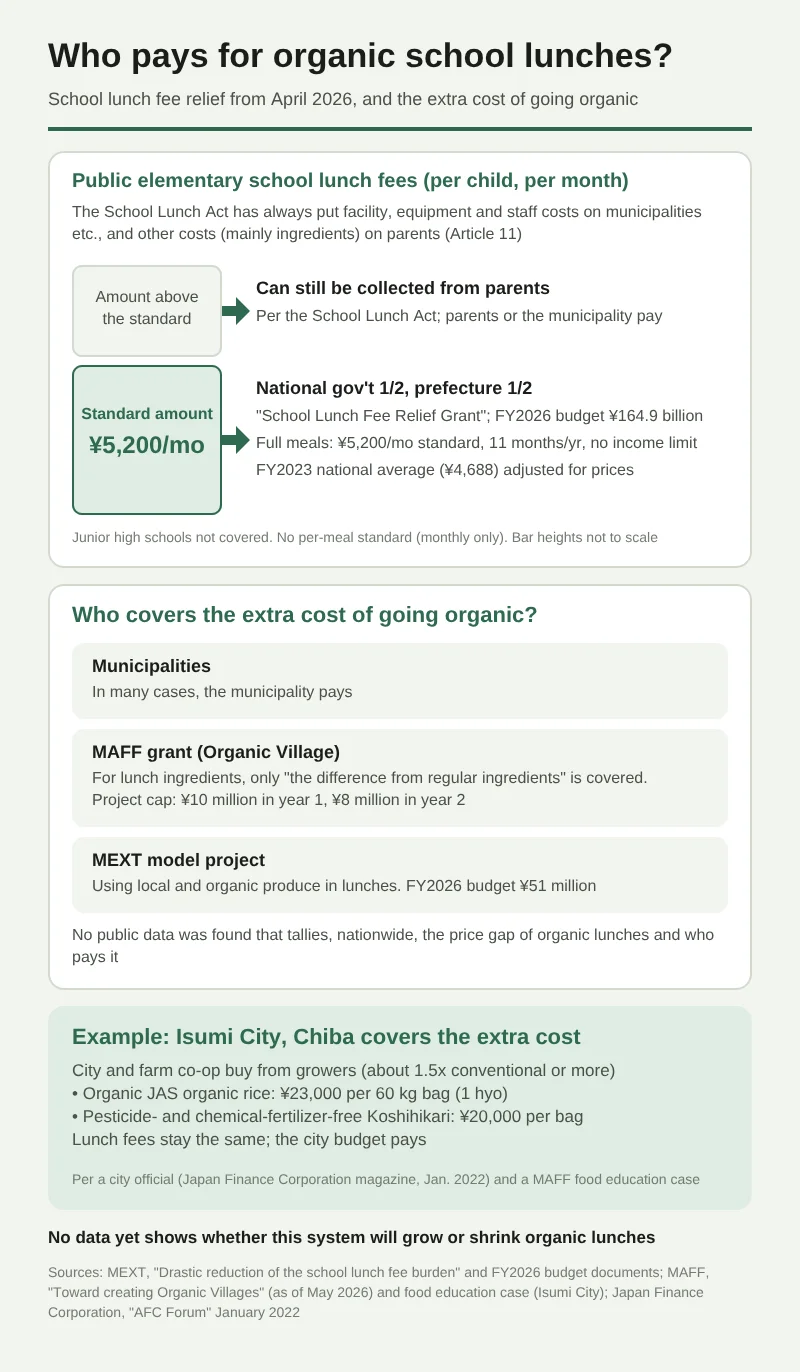
Organic ingredients are often more expensive than regular ones, and in many cases the municipality pays the difference. National support also covers the “difference.”
The difference: the national subsidy covers “only the difference from regular ingredients”
| Support | Contents | Source |
|---|---|---|
| MAFF subsidy (Organic Village) | The “Project to Accelerate Creation and Expansion of Organic Farming Hubs” under the Green Food System Strategy Promotion Subsidy. Carried out by a municipality or a council that includes municipalities. Fixed amount (up to one half for buying or leasing machinery), with a cap of 10 million yen in year 1 and 8 million yen in year 2. An additional 2 million yen if expanding consumption in partnership with consumer areas. For school lunch ingredient costs, “only the difference from regular ingredients” is covered | MAFF, “Toward Creating Organic Villages” (as of May 2026) |
| MEXT model project | “Model Creation Project for Enhancing Food Instruction by Promoting the Use of Local and Organic Produce in School Lunches.” Fiscal 2026 budget of 51 million yen (59 million yen the previous year). In fiscal 2025 it was run under the name “… research project,” with organizations such as the Toyama Prefectural Board of Education commissioned | MEXT briefing session materials for applicants (April 2026) |
| National totals | We could not find any official national data on the price difference of organic school lunches and who pays it | ― |
The Isumi City example: the city pays, and school lunch fees were not raised
- MAFF’s food education example states that the city bears the increased cost
- According to a city official (Finance Corporation publication, January 2022), the city and the agricultural cooperative buy organic JAS organic rice from producers at 23,000 yen per hyo (60 kg) and pesticide-free, chemical-fertilizer-free Koshihikari at 20,000 yen per hyo (about 1.5 times or more the conventional price), and the city covers this from its budget without raising school lunch fees
- Because organic vegetables have no wholesale price, Isumi City researched retail prices and distribution costs and set the price itself, and asked producers about next year’s delivery plans and included them in the budget (MEXT materials)
From April 2026: “drastic reduction of school lunch fee burden” at public elementary schools
The School Lunch Act has always specified that the municipality or other body that establishes the school bears the cost of school lunch facilities, equipment and staff, while other costs (mainly ingredient costs) are borne by parents (Article 11). The “school lunch fees” parents pay now are almost entirely ingredient costs.
From April 2026, a system began in which the national government and prefectures support school lunch fees at public elementary schools. This is what is commonly called “free school lunches.” MEXT calls it a “drastic reduction of the school lunch fee burden,” out of concern that the image of “completely free” could lead to higher burdens for municipalities wanting to raise quality and lower quality in municipalities wanting to hold down costs.
| Item | Contents |
|---|---|
| Coverage | Children at public elementary schools (including the first stage of compulsory education schools and the elementary division of special-needs schools). No income limit. Junior high schools are not covered |
| Baseline amount (per child, per month) | Full school lunch 5,200 yen (6,200 yen for the elementary division of special-needs schools), supplementary school lunch 4,800 yen (5,800 yen), milk-only lunch 1,200 yen. 11 months a year |
| Basis of the baseline | The fiscal 2023 national average (4,688 yen for a full lunch at elementary schools), plus price movements |
| Cost sharing | As the “School Lunch Fee Burden Reduction Subsidy,” one half by the national government and one half by the prefecture. Fiscal 2026 budget of 164.9 billion yen |
| Amount above the baseline | Under the School Lunch Act, it can continue to be collected from parents |
| Per meal | No per-meal baseline amount is given (monthly amount only) |
Source: MEXT, “Drastic Reduction of the School Lunch Fee Burden”; fiscal 2026 budget materials; agreement document (December 2025).
Stating only the facts of the system, the relationship with organic school lunches is as follows.
- If you use organic ingredients and the ingredient cost exceeds the baseline amount, the excess falls on parents or the municipality
- The national budget materials say that projects of various ministries can be flexibly used for “distinctive school lunches.” For the organic difference, the MAFF subsidy above (difference only) and the MEXT model project can be used
- The agreement document that set up the system gives as the reason for allowing amounts above the baseline to be collected from parents that “many municipalities are actively working on local production for local consumption and providing distinctive school lunches.” On the quality of school lunches, it says “rather than the national government setting a uniform policy, the efforts of each municipality are respected”
There is not yet any document showing whether this system will increase or decrease organic school lunches.
What are Organic Villages? 168 municipalities in all 47 prefectures
Organic Villages are municipalities that advance organic farming across the whole community, from “growing” to “eating” (school lunches, etc.). As of August 31, 2026, 168 municipalities in 47 prefectures are working on this.
| Item | Contents |
|---|---|
| Definition | Municipalities that, to expand organic farming, advance an integrated effort from production (such as consolidating fields into blocks) to consumption (such as use in school lunches), with farmers, businesses, and residents inside and outside the area taking part, across the community (MAFF) |
| National target | 100 municipalities by 2025, 200 by 2030 |
| Latest count | 168 municipalities, 47 prefectures (as of August 31, 2026). 14 municipalities joined in fiscal 2026, on top of 154 through fiscal 2025 |
| Declaration | A municipality makes an “organic farming implementation plan” with the subsidy, and when it is settled, makes an “Organic Village declaration.” A route has also opened to declare after having the implementation plan certified, without using the subsidy. 153 municipalities have declared (list as of June 29, 2026) |
| Start of support | From the fiscal 2021 supplementary budget |
What do Villages do?
A Village municipality forms a council with farmers, distribution and school lunch people and others, and uses the subsidy to make an “organic farming implementation plan.” Many plans include school lunch targets in addition to organic acreage and the number of farmers. For example, Kameoka City, Kyoto, has set a target of 75% organic rice in municipal elementary school lunches by fiscal 2027, and Matsukawa Town, Nagano, a target of 9.4 t provided to school lunches by fiscal 2027.
When the plan is settled, the municipality makes an “Organic Village declaration” and continues its efforts based on the plan. The 15 municipalities not on the declaration list (as of June 29, 2026) are the 13 that started in fiscal 2026, plus Taito Ward, Tokyo, and Takachiho Town, Miyazaki.
How many were added in which fiscal year?
| Start fiscal year | Newly started | Cumulative |
|---|---|---|
| FY2022 | 55 | 55 |
| FY2023 | 38 | 93 |
| FY2024 | 38 | 131 |
| FY2025 | 23 | 154 |
| FY2026 (through August 31) | 14 | 168 |
Source: Urayomi’s count from the “R○ start” on each page of MAFF’s Organic Village case studies (September 2026) and the fiscal 2026 list of districts. Izumiotsu City, Osaka, and Taito Ward, Tokyo, are not in the case studies, so their years are Urayomi’s estimates.
- The target of “100 by 2025” was passed during fiscal 2024
- “200 by 2030” is 32 away. 23 were added in fiscal 2025, and 14 in fiscal 2026 through the end of August
- The 14 that joined in fiscal 2026 are Shimizu Town (Hokkaido), Mito City, Naka City and Ibaraki Town (Ibaraki), Satte City (Saitama), Shinano Town (Nagano), Murakami City (Niigata), Obama City (Fukui), Taki Town (Mie), Takashima City (Shiga), Konan City (Kochi), Isen Town (Kagoshima), and Nakagusuku Village and Ishigaki City (Okinawa). With Okinawa joining, all 47 prefectures are now represented
- “Mihama and Taketoyo” (Aichi), “Kamimine and Miyaki” (Saga), and “Takanabe and Kijo” (Miyazaki) are each one effort by two towns, but MAFF’s count by prefecture counts them as 2. The 168 uses this way of counting
In Organic Around the World we wrote “154 municipalities in 46 prefectures,” but that was the figure from an April 2026 document (as of December 2025).
Which prefectures have the most?
| Prefecture | Villages / municipalities | Share |
|---|---|---|
| Shiga | 5/19 | 26.3% |
| Shimane | 5/19 | 26.3% |
| Hyogo | 10/41 | 24.4% |
| Miyazaki | 6/26 | 23.1% |
| Shizuoka | 8/35 | 22.9% |
| Yamagata | 7/35 | 20.0% |
| Tochigi | 5/25 | 20.0% |
| Niigata | 6/30 | 20.0% |
| (Fewest) Tokyo | 1/62 | 1.6% |
| (Fewest) Fukuoka and Wakayama | 2/60 and 1/30 | 3.3% |
| (Fewest) Hokkaido | 6/179 | 3.4% |
| Nationwide | 168/1,741 | 9.6% |
Urayomi’s calculation. The number of municipalities is the national 1,741, including Tokyo’s 23 wards.
Hyogo has the most, at 10, followed by Nagano and Shizuoka at 8.
Organic acreage is typically “around 1% of farmland”
Being a Village does not mean most of a town’s fields are organic. We tallied the 136 municipalities in the case studies where organic acreage is known (as of fiscal 2023).
| Item | Value |
|---|---|
| Total | 5,888 ha |
| Median | 29.9 ha |
| High share of farmland | Umaji Village, Kochi 83.9% (52.0 ha, yuzu); Owase City, Mie 10.2%; Ogawa Town, Saitama 9.4%; Gotsu City, Shimane 8.8%; Kawanehon Town, Shizuoka 8.7% (tea); Echizen City, Fukui 7.7%; Odawara City, Kanagawa 6.6%; Toyooka City, Hyogo 6.4% |
| Large acreage | Toyooka City, Hyogo 313.0 ha; Ogata Village, Akita 297.7 ha; Echizen City, Fukui 276.0 ha; Kikuchi City, Kumamoto 203.2 ha; Tamba City, Hyogo 191.9 ha |
| Towns with 0.0 ha | Tatsuno Town and Iizuna Town (Nagano), Sasaguri Town (Fukuoka) |
Urayomi’s tally from MAFF, “Organic Village Case Studies” (September 2026). The case studies say they are “based on a survey conducted in fiscal 2024 (values for fiscal 2023).”
Organic farming’s share nationwide is around 0.9% (see Organic Around the World for details), and we can see that many Villages are at about the same level. The places with 0.0 ha are regions just starting organic farming.
School lunches are the Villages’ “standard menu item”
Of the 149 case studies (municipalities), 127 (85%) have “school lunches” marked among their efforts, and 138 (93%) mention school lunches in the text (Urayomi’s tally). However, in the case studies many have “0 times” or “0 t” for the baseline year, and many of the municipalities have only just started their school lunch efforts.
Taito Ward, Tokyo, and Izumiotsu City, Osaka, are Villages on the “consumption area” side, partnering with producing municipalities that grow the crops. Taito Ward received organically farmed rice from its sister city Osaki, Miyagi, and served it in all the ward’s junior high school lunches in December 2025.
Organic school lunches around the world: targets and results
Some countries and cities overseas set targets for the organic share of school lunches. But not many are on track to meet them. To line them up with Japan’s system, we separated targets from results.
| Country or region | Target or system | Result (latest) | Notes |
|---|---|---|---|
| France | EGalim Act (2018): in public collective catering, 50% “sustainable and high-quality,” of which 20% organic. Deadline: January 1, 2022 | In 2024 purchases, 11.8% organic, 29.5% sustainable and high-quality | A tally of canteens that reported to ma cantine. In 2025, 40% of the country’s canteens reported |
| Denmark (City of Copenhagen) | 90% or more organic in meals at city facilities | 85% in 2018 → 88% in 2024 | A figure for all city facilities |
| Sweden | 60% organic in the public sector in 2030 (a directional target of the previous government) | 37% in 2022 (by value; 41% by weight). Down about 1 point a year from 39% in 2019 | A private survey. Not a figure for schools only |
| Italy | The “Organic School Meals Fund” in 2017. A ministerial decree set the minimum share needed to call a lunch an “organic school lunch” | We could not confirm the results | Original source not confirmed |
| South Korea (Seoul) | Began “eco-friendly free school lunches” in 2011, fully implemented through high school in 2021. Costs split: city 30%, districts 20%, Office of Education 50% | We could not confirm an official current figure | “Eco-friendly” includes organic and pesticide-free. The recommended share was lowered in 2013 from 70% for elementary and 60% for junior high schools to 50% or more (press reports) |
| Brazil | At least 30% of the national school meal budget must be spent buying directly from family farming (2009 law). At least 45% from January 2026 | ― | Organic and agroecological products are given “priority” by a resolution of FNDE (the national fund that runs school meals), but this is not an obligation for an organic share |
| United States (California) | We could not confirm a national or state target for an organic share | In a survey of 430 school food service operators in the state, 34% use organic food | Peer-reviewed paper (2025) |
| Japan | No national target for the organic share of school lunches (the national target is 200 Villages) | 328 municipalities with organic school lunches (FY2024), about 30% of them twice a month or more | Counts municipalities, not the share of ingredients |
Source: French Ministry of Agriculture and Food Sovereignty press release (November 26, 2025); City of Copenhagen Economy Department response document (June 29, 2026); Ekomatcentrum “Marknadsrapport 2023”; Brazil Laws 11.947 and 15.226 and FNDE Resolution 06/2020; Légifrance (EGalim Act); Zuercher et al. 2025; Seoul and Korean press (newsis 2021, Kyunghyang Shinmun 2013).
- Even in countries with targets for the share, there are few figures for schools alone. The figures for France, Sweden and Copenhagen are for all public canteens, including hospitals and care facilities
- Some press reports put the organic share of France’s school sector at “17%,” but we could not confirm this in official documents
- We cannot say “organic school lunches are the norm around the world.” It is more accurate to say that some countries and cities set targets and measure them
France: a target set by law, but not reached
In its 2018 EGalim Act (the law of October 30, 2018; Article L230-5-1 of the Rural and Maritime Fishing Code), France required public collective catering such as schools and hospitals to use 50% “sustainable and high-quality” ingredients, of which 20% organic. The deadline was January 1, 2022.
According to a tally published by the French Ministry of Agriculture and Food Sovereignty in November 2025, organic was 11.8% and sustainable and high-quality was 29.5% of 2024 purchases. It combines figures that canteens reported on a dedicated site, “ma cantine”; looking only at canteens that reported for three years in a row, organic was over 15% and sustainable and high-quality over 32%. Two years after the deadline, it is about half the target.
Northern Europe: Copenhagen near 90%, Sweden fell
The City of Copenhagen, Denmark, targets 90% or more organic in meals at city facilities. In the city’s June 2026 response document, the organic share rose from 85% in 2018 to 88% in 2024.
In Sweden, the previous government set a directional target of “60% organic in the public sector in 2030.” According to the private Ekomatcentrum’s tally, the public sector’s organic share fell about 1 point a year from 39% in 2019 to 37% in 2022. Differences between municipalities are large, and the highest, Örebro, was 70%.
South Korea and Brazil: not an “organic” obligation
Seoul’s “eco-friendly free school lunches,” as the name says, combine free school meals with eco-friendly ingredients. “Eco-friendly produce” includes pesticide-free produce as well as organic, and according to press reports, the recommended share was lowered in 2013 from 70% for elementary and 60% for junior high schools to “50% or more.” We could not confirm an official figure for the current share.
Brazil’s National School Feeding Program (PNAE) is required by law to buy at least 30% of the school meal budget it distributes directly from family farming, and raised this to at least 45% from January 2026. Organic and agroecological (agriculture that makes use of ecosystems) products are to be “given priority as much as possible” when buying ingredients under a 2020 resolution of the national fund that runs school meals (FNDE), but this is not an obligation for an organic share.
Kamimine Town, Saga, writes in its case study that it aims for “100% eco-friendly free school lunches.” The words are the same as the Korean system, but we could not confirm in the case studies what the town’s standard consists of.
Do organic school lunches change children’s bodies?
In trials where school meals were made organic, urinary pesticide metabolites decreased. But we found no study showing that illnesses decreased.
A trial at elementary schools in Cyprus (ORGANIKO)
This is a randomized trial in which organic meals were served school by school.
| Item | Contents |
|---|---|
| Type of study | Cluster-randomized crossover trial (each school switched between an organic period and a usual-diet period) |
| People and duration | 6 elementary schools in Cyprus, ages 11 to 12, 149 analyzed. 40 days of an organic diet vs. 40 days of the usual diet |
| Food | In the organic period, one restaurant prepared not only school lunches but all meals |
| Results | In the organic period, urinary metabolites of pyrethroid insecticides were about 70% lower (geometric mean ratio 0.297). The probability of detecting neonicotinoids was also lower (odds ratio 0.651). A marker of oxidative stress (8-OHdG) was also slightly lower (0.888) |
| Authors’ cautions | Body size (BMI) also fell in the organic period, but the authors themselves write that this cannot be separated from reduced calorie intake and lifestyle changes, so a causal benefit to the body cannot be claimed. For 72% of neonicotinoids, the level was below the detectable amount |
| Funding | EU LIFE+ project. No conflicts of interest declared |
Source: Makris KC et al., PLoS One 2019 (PMID 31483785).
In additional analyses using the same 149 people’s data, the inflammation marker (CRP) was or was not significant depending on how it was calculated (2024); lead fell over time, and cadmium showed the same trend but was not significant (2023).
Other studies
| Study | Contents | Notes |
|---|---|---|
| Nimako et al. 2022 (Japan) | 103 adults and children. In groups that ate an organic diet for 5 days and 30 days, urinary neonicotinoid detection rates and concentrations were lower. Estimated intake was under 1% of the reference dose (1.32% for clothianidin in children) | Not school lunches. A co-author is affiliated with an organic farming group in Fukushima. It is unclear from the abstract whether assignment was randomized |
| Surveys of Danish schools (2012, 2014) | Schools serving organic school meals had higher scores on indicators of a “healthy food environment” | A survey at one point in time (cross-sectional study), so cause and effect cannot be stated |
A US trial that made home meals organic, and others, are introduced in Organic Food and Health.
Where the claims that “children’s health improved” come from
- We found no intervention study or cohort study showing that organic school lunches reduced children’s illnesses (atopic dermatitis, developmental conditions, etc.) (as far as searching PubMed for related papers went)
- The claims that “children became healthier with organic school lunches” came from remarks by mayors and officials, and from personal accounts. For example, a city official in Isumi has said that “leftover food decreased,” but no figures backing it have been published. We also could not find a primary source for the often-cited “leftovers fell by 10%”
What can be said is limited to this: an organic diet lowers some pesticide metabolites in urine. Whether that reduces children’s illnesses is still unknown.
Urinary metabolites are a marker of “how much has recently entered the body” and are not themselves a marker of disease. Japan’s pesticide residue standards for food are set on the basis of the ADI (acceptable daily intake), the amount considered not to affect health even if consumed every day for a lifetime, and what percentage of that amount people take in from ordinary meals is calculated in Organic Food and Health. There is still an unconfirmed step between “urinary pesticides fall” and “illnesses fall”, and that is the reading that fits current research.
The meaning of organic school lunches also need not be measured by health alone. In national and municipal documents, organic school lunches are described in connection with creating markets for local organic farmers, food education in which children learn about agriculture and the environment, and local production for local consumption. The case studies and the Organic Agriculture Day page also described many visiting classes by producers and exchange lunches eaten together with producers.
When you want to make your child’s meals organic at home too
Even if school lunches are organic only a few times a year, you can choose organic ingredients for meals at home. The Cyprus trial also made all meals organic, not just school lunches.
There are three labels to look for when choosing.
| Label | Meaning |
|---|---|
| Organic JAS mark | Organic that meets the national standard and is certified |
| “Pesticides: not used during the growing period” (農薬:栽培期間中不使用) | A label under the specially cultivated produce guidelines. No pesticides used. Separate from organic certification |
| A company’s own standard | A standard set by each delivery company. The contents differ by company |
There are delivery and direct-from-farm services that bring organic JAS or “pesticides: not used during the growing period” vegetables to your home. Standards differ by company, so choose after checking the wording on the official pages. Where to start going organic and the costs are covered in Organic Food and Health, and a comparison of trial sets is in Our comparison of meal delivery services.
What are the challenges of organic school lunches?
The challenges listed in national documents center on three things: “quantity,” “price” and “standards.”
| Challenge | Contents | Source |
|---|---|---|
| Quantity | It is hard to secure the needed amount within the region. Checking the production situation and talks among those involved are needed | MEXT briefing session materials for applicants |
| Price | Cost is an issue compared with ingredients in general distribution | Same |
| Standards | Items that are uneven in size or oddly shaped do not meet school lunch delivery standards. They need to be processed before delivery, or the kitchen needs equipment | Same |
| Little besides rice | “We can only deliver to elementary schools that cook on site,” and “a production volume that can be swapped in month by month is needed, but production other than rice is small” | MAFF, “Hints for Building Communities Around Organic Farming” |
| Delivery | A burden on producers. There are examples where delivery was entrusted to a contractor and consolidated | Same |
| Hygiene | In response to worries such as “are there insects or animal droppings on it?”: “wash well as with conventional produce and thoroughly manage hygiene” | Same, Q&A |
| Cooking sites | The cooking side wants large sizes (2L) for work efficiency and does not need items during holiday periods, while producers want to supply all sizes year-round | A distributor’s document submitted to a MAFF exchange meeting |
| Few producers | In the case studies, many start with organic school lunches at “0 times” or “0 t.” Some towns have 0.0 ha of organic acreage | Organic Village case studies |
We could not find any official document dealing with whether there is an effect on allergy management.
How are different places working around this?
The case studies and MEXT materials also describe responses to the challenges.
- The municipality sets the price: Because organic vegetables have no wholesale price, Isumi City, Chiba, researched retail prices and distribution costs and set the price itself, and asked producers about next year’s delivery plans and included them in the budget
- Keep talking with those involved: Tokorozawa City, Saitama, kept discussing with those involved the shape, delivery method, allocation of quantities, timing of use and coordination of farm produce for school lunches, and through joint shipping held organic school lunches twice a year at all municipal elementary and junior high schools (FY2024)
- Reduce the burden on cooking sites: Ohnan Town, Shimane, served organic rice 12 times a year (FY2024) while devising ways to introduce it with as little burden as possible on the school lunch center
- Adjust supply and price first: Izunokuni City, Shizuoka (3 times a year), Owase City, Mie (3 times a year), Imabari City, Ehime (4 times a year), Iga City, Mie (once a year) and others say they went ahead after adjusting supply volume and price with those involved
- Decide standards and price at meetings: Saiki City, Oita, holds a school lunch meeting twice a year on standards and the prices of the main 4 items in order to supply organic produce for school lunches
Many examples start with rice or a few vegetable items. MAFF’s “Hints for Building Communities Around Organic Farming” also recommends trying it in school lunches even a few times first to grasp the challenges (for example around Organic Agriculture Day on December 8), creating a place for producers and school lunch people to talk directly, and starting with items where standards matter little even in organic farming (such as rice).
Starting organic school lunches in your own city
When you want to learn about organic school lunches in your own municipality, first check the municipality’s contact office and the national programs. Here we summarize only the facts about official contacts and programs.
| What you want to know | Contact or program |
|---|---|
| How much organic food is used now | The municipality’s board of education and school lunch center (menus and ingredient announcements). The prefecture tables in this article can also help |
| How to expand organic farming locally | The municipality’s agriculture department. The implementing body of an Organic Village is the municipality, or a council that includes municipalities |
| National support | MAFF subsidy (Project to Accelerate Creation and Expansion of Organic Farming Hubs; for school lunch ingredients, only the difference is covered), MEXT model project (open call) |
| A route without the subsidy | You can declare an Organic Village after having an organic farming implementation plan certified |
| Examples and hints | MAFF, “Organic Village Case Studies” and “Hints for Building Communities Around Organic Farming” |
| A yearly occasion | December 8, Organic Agriculture Day. MAFF calls on municipalities nationwide to serve organic food in school lunches around that date and introduces the efforts on its page. Some individual schools and early childhood centers are also listed |
MEXT’s model project is carried out by boards of education and others to test how to advance instruction about food while using local and organic produce in school lunches. In the fiscal 2025 research project of the same aim, the Toyama Prefectural Board of Education worked on organic rice school lunches at 4 prefectural special-needs schools, and a report was published in July 2026. The report says that because the harvest of organic produce in the prefecture is small and it is hard to supply it to school lunches reliably, it aimed to continue using it starting from small schools.
As a national event, there is the “Organic School Lunch Forum.” The 5th was held online on February 26, 2026, and the “3rd Organic School Lunch Best Practice Awards (Japan Organic Lunch Cup)” were also held (organized by the Organic School Lunch Forum Executive Committee, according to a press release).
There are also books that gather ideas on organic school lunches and examples from across Japan. Both are from the Rural Culture Association Japan (Nobunkyo): one covers examples from across Japan and frequently asked questions, and the other covers trends in France and elsewhere in the world and the challenges for Japan.
Items featured in this article (summary)
Here are the items featured in the article once more. The reasons and ingredients are written in each section.
| Item | Where to buy |
|---|---|
| Coop Shizenha delivery: request materials | 取り扱い青果の60%以上がオーガニック!生協の宅配コープ自然派 PR PR |
| Oisix trial set | おためしセットを見る(Oisix 公式)  PR PR |
| Tabechoku (direct-from-farm online marketplace where you can buy from farmers) | 食べチョクで生産者の野菜を見る |
| “Yuki Kyushoku Start Book: Ideas, Examples from Across Japan, and Q&A” (有機給食スタートブック 考え方・全国の事例・Q&A), edited by Rieko Tsuru and Yoshimitsu Taniguchi (Nobunkyo) | See on Rakuten (楽天ブックス) PR See on Amazon.co.jp PR |
| “How to Move Forward: Organic School Lunches, Global Trends and Japan’s Future” (どう進める?オーガニック給食 世界の動向と日本のこれから), by Kae Sekine (Nobunkyo Booklet 24) | See on Rakuten (楽天ブックス) PR See on Amazon.co.jp PR |
Summary
| Question | What we found |
|---|---|
| Which municipalities serve organic school lunches? | 328 municipalities in FY2024 (about 19% of Japan). The list of names is not published. We arranged the 146 municipalities whose names and details we can identify by prefecture |
| Which prefectures have the most? | On the map categories, Nagano, Aichi, Ibaraki and Hyogo are near the top in both number and share. Okinawa was the one with 0 in FY2024 |
| Is it organic every day? | 46% of the 328 do it 5 times a year or fewer. About 30% do it twice a month or more. A municipality counts even if it is only one school, once a year |
| Is “organic” organic JAS? | Not necessarily. It also includes organic farming without certification, rice with no pesticides during the growing period, specially cultivated produce, and municipalities’ own certification |
| How organic is it? | Isumi City: 100% of the rice; Kameoka City: 52.4% of the rice at municipal elementary schools. Some municipalities do it once a year |
| Who pays? | The difference is often borne by the municipality. The national subsidy also covers only the difference. The fee relief from April 2026 has a baseline of 5,200 yen a month, and the amount above it may be collected from parents |
| Organic Villages? | 168 municipalities in 47 prefectures (August 31, 2026). 153 have declared. 32 more to reach the target of 200 |
| Overseas? | France: 11.8% (2024) against a 20% organic target; City of Copenhagen: 88%. Japan has no target for the organic share of school lunches |
| Do children’s bodies change? | Some urinary pesticide metabolites fell. We found no study showing fewer illnesses |
Sources
Organic school lunches: numbers and examples
- MAFF, “Circumstances Surrounding Organic Agriculture,” April 2026 edition (pp. 13–14) https://www.maff.go.jp/j/seisan/kankyo/yuuki/attach/pdf/index-37.pdf
- MAFF, “Use of Organic Agricultural Products in School Lunches,” 2024 https://www.maff.go.jp/j/seisan/kankyo/yuuki/yuki1208/schoolefforts.html ; 2025 https://www.maff.go.jp/j/seisan/kankyo/yuuki/yuki2025/school2025.html
- MAFF, “Organic Village Case Studies” (September 2026) https://www.maff.go.jp/j/seisan/kankyo/yuuki/attach/pdf/organic_village-134.pdf
- MAFF, examples of food education (Isumi City, Chiba) https://www.maff.go.jp/j/syokuiku/jirei/attach/pdf/farm-9.pdf
- Japan Finance Corporation, “AFC Forum,” January 2022 issue, “Change Is in the People” (interview with the Isumi City Agriculture and Forestry Division) https://www.jfc.go.jp/n/findings/afc-month/pdf/afc_forum202201_6.pdf
- MEXT, “Model Creation Project for Enhancing Food Instruction by Promoting the Use of Local and Organic Produce in School Lunches,” briefing session materials for applicants (April 2026) https://www.mext.go.jp/content/20260427-mxt_kenshoku-000049537_10.pdf ; same, report (July 2026)
- MAFF, “Hints for Building Communities Around Organic Farming”; “Exchange Meeting on Organic Farming” (September 5, 2025), Materials 1–8
Organic Villages
- MAFF, “Organic Village” https://www.maff.go.jp/j/seisan/kankyo/yuuki/organic_village.html
- Same, “Fiscal 2026 List of Organic Village Districts” (as of August 31) https://www.maff.go.jp/j/seisan/kankyo/yuuki/attach/pdf/organic_village-131.pdf
- Same, “Links to Organic Village Declaring Municipalities” (June 29, 2026) https://www.maff.go.jp/j/seisan/kankyo/yuuki/attach/pdf/organic_village-130.pdf
- Same, “Toward Creating Organic Villages” (as of May 2026) https://www.maff.go.jp/j/seisan/kankyo/yuuki/attach/pdf/organic_village-126.pdf
School lunch fee relief
- MEXT, “Drastic Reduction of the School Lunch Fee Burden” https://www.mext.go.jp/a_menu/sports/syokuiku/kyu-lighten.html
- MEXT, fiscal 2026 budget materials; agreement document (December 19, 2025) https://www.mext.go.jp/content/20251219-mxt_soseisk01-000046461_12.pdf
Overseas
- Légifrance, “LOI n° 2018-938 du 30 octobre 2018” (EGalim Act), Article 24 (creating Article L230-5-1 of the Rural and Maritime Fishing Code) https://www.legifrance.gouv.fr/jorf/id/JORFTEXT000037547946
- French Ministry of Agriculture and Food Sovereignty, press release (November 26, 2025) https://agriculture.gouv.fr/telecharger/152125
- City of Copenhagen Economy Department, response document (June 29, 2026)
- Ekomatcentrum, “Marknadsrapport 2023” https://kommunrankning.miljobarometern.se/content/emc-marknadsrapport-2023-fardigstalld-1-1.pdf
- Brazil Law 11.947 (2009) https://www.planalto.gov.br/ccivil_03/_ato2007-2010/2009/lei/l11947.htm ; Law 15.226 (2025) https://www.planalto.gov.br/ccivil_03/_ato2023-2026/2025/lei/L15226.htm
- Brazil FNDE Resolution CD/FNDE nº 06 (May 8, 2020), Article 23 (included in FAO’s legislation database FAOLEX) https://faolex.fao.org/docs/pdf/bra214671.pdf
- newsis (February 10, 2021), Kyunghyang Shinmun (2013), Seoul Metropolitan Government mediahub (2011)
- Zuercher MD, et al. J Sch Health 2025 (PMID 39763015)
Research
- Makris KC, et al. PLoS One 2019, e0219420 (PMID 31483785; the ORGANIKO trial)
- Additional ORGANIKO analyses: PMID 38493848 (2024, CRP), PMID 36367505 (2023, lead and cadmium), PMID 34991267 (2022, metabolome)
- Nimako C, et al. Environ Int 2022 (PMID 35289289)
- He C, et al. 2012; He C, Mikkelsen BE. 2014 (surveys of organic school meals in Danish schools)
Related articles and databases
- What Is Organic (有機)? Organic JAS Standards, History, and How It Differs from “Pesticide-Free,” “Additive-Free,” and Shizen Saibai (Natural Farming), Explained with Official Sources
- Is organic food better for your health? Nutrition, pesticide residues and cancer studies checked against the papers — where to switch first, and what it costs
- Organic in Japan and the World: Why Is Japan’s Organic Share Only 0.9%? Markets, Farmland, Rules, and Fraud Compared with the US, EU, China, and South Korea
- Pesticides Allowed Under Organic JAS: Full List of 42 Items (What Works on Aphids, Stink Bugs and Diseases? Any Herbicides? Antibiotics Too?)
- Is organic cotton gentle on skin? Why people call it a “lie”, and how to tell GOTS from OCS (menstrual pads, underwear, towels)
- Comparing 5 additive-conscious grocery delivery services: trial sets, ongoing costs, and additive standards (2026)
- Reading Oisix’s Trial Set and Subscription Down to the Back Label: Vegetable Pesticide Standards, the Trial Set, and How Cancellation Works