
Is organic food better for your health? Nutrition, pesticide residues and cancer studies checked against the papers — where to switch first, and what it costs

PR This article contains affiliate links to Rakuten Ichiba, Amazon, Yahoo! Shopping and A8.net (“See on Rakuten”, etc.). What is written here is based on public-agency materials and papers, whether or not ads are present.
“Organic vegetables are more nutritious.” “Organic means zero pesticides.” “Eating organic food lowers cancer.” You hear these claims, but you also hear the opposite: “It just costs more, and it means nothing.”
The level of interest shows up in the numbers. When we collected Google search suggestions (autocomplete) on October 3, 2026, there were 664 Japanese suggestions about organic (オーガニック・有機), of which 73 were about pesticides and 50 were about children, pregnancy and baby food. In English, the combination “oats glyphosate” alone came up in 9 variations. Meanwhile, in a survey by MAFF (2025, 3,000 people), only 8.6% of people correctly knew the farming methods and labeling rules behind “有機” and “オーガニック”.
This article checks the following against public-agency test data and papers:
- Are organic vegetables higher in nutrients? Do they taste different?
- Does organic mean zero pesticide residues? How much pesticide remains on ordinary vegetables in Japan?
- If you switch to an organic diet, do the pesticides in your body go down?
- Do people who eat organic food get less cancer?
- Should you go organic during pregnancy, for baby food, and for children?
- Can organic avoid glyphosate (a herbicide) and neonicotinoids (an insecticide class)?
- Can you trust the US “Dirty Dozen” (the 12 items with the most pesticide residues)?
- Are there cautions specific to organic food?
- If you switch, where do you start, and how much more does it cost?
For each study, we state the type (observational study or comparison trial), the number of people, the duration, and even who funded it.
This series has three articles.
- What is organic?: the organic JAS standards, how to tell the marks apart, origins and history, and how it differs from “additive-free” and natural farming → What is organic? (standards and history)
- Organic and health: this article
- Organic in Japan and the world: market, acreage and systems compared with the US, EU, China and South Korea → Organic in Japan and the world
Key conclusions
- “Organic is more nutritious” is split in the research. A review funded by a UK government agency (2009) and a review from Stanford University in the US (2012) found “no clear difference”, while a review funded by the EU and an organic-promoting foundation (2014) found “more antioxidants (polyphenols)”. The same paper also found that protein is 15% lower in organic food
- Organic food is not free of pesticide residues. In the EU’s official testing in 2024, about 80% of organic samples had no pesticides detected, and about 20% had something found (about 40% across all food, including conventional). What is found most often in organic food is “copper”, which is permitted in organic farming
- The pesticide you take in most from an ordinary Japanese diet is 0.477% of its ADI (the amount considered to cause no health effect if consumed every day for a lifetime) (fiscal 2024). That is about 1/210. Of about 1.09 million tests of domestic produce, 14 exceeded the standard value
- Switching to an organic diet lowers pesticides in urine within days (a drop of 25–95%). But every trial involved a dozen to a few dozen people for a few days to 2 weeks, and no trial has yet tested whether disease goes down
- “Eating organic food cuts cancer by 25%” is not causation. That figure comes from a French observational study (2018); the absolute risk difference was 0.6 percentage points. A UK study of 620,000 people found no difference in overall cancer, and the same French research team’s 2026 analysis found only a small difference: 2% lower per 100 g replaced
- Glyphosate and neonicotinoids are pesticides that cannot be used under the organic JAS. Still, in some trials urinary glyphosate did not change much even on an organic diet. In Japan’s testing of domestic produce, the pesticide found at the highest rate was dinotefuran, a neonicotinoid (12.7%, with 0 exceeding the standard value)
- The US “Dirty Dozen” is based on US data, and its method has been criticized. Japan’s public data cannot produce a similar “priority list of items to switch”
- If you switch, start where the research shows the biggest differences. Ways to think about it: fruits and leafy vegetables eaten with the skin, staples and seasonings you eat in large amounts every day, and the diet of pregnant women and small children. Organic vegetables cost 1.4–1.9 times as much as ordinary ones (2016)
Items covered in this article
| Item featured | When it helps | Where in this article |
|---|---|---|
| Organic JAS oatmeal | When you want organic oats, grown without glyphosate | Can you avoid glyphosate with organic? Wheat and oats |
| Organic JAS baby food | When you want to choose organic ingredients for baby food | Pesticide residues in baby food |
| Organic vegetable delivery and direct-from-farm services (Oisix, Radish Boya, Sakanotsugi, Coop Shizen-ha, Tabechoku) | When you can’t find organic vegetables at nearby stores | Where to buy? Delivery and direct-from-farm |
| Organic JAS frozen vegetables | When you want to keep organic vegetables on hand | How much more does it cost? Organic prices and “what you’re willing to pay” |
Where does the image of “organic is good for you” come from?
It was the “movement” that spoke about health; the “law” promises no health benefit. Keeping this difference in mind makes the studies that follow easier to read.
The movement has talked about “health”
- The UK organic-movement group the Soil Association (founded 1946) says in its own history that it has held the view that “the health of soil, plants, animals and people is one and cannot be separated”
- Japan’s organic farming movement began with the founding of the Japan Organic Agriculture Association in October 1971. In that same year, 1971, the pesticide registrations for DDT and BHC (organochlorine insecticides) lapsed. In a survey by the Ministry of Health and Welfare in 1971–72, β-BHC and DDT were found in all of the breast milk samples examined (Environment White Paper, Showa 47 edition)
The movement started from alarm about pesticide contamination. The fuller history is in What is organic? (standards and history).
The law is “rules for how it is made”
| Rule | What it says |
|---|---|
| Japan’s organic JAS (MAFF explanation) | “The organic JAS sets rules for cultivation; it is not a standard for the quality of the finished produce.” |
| US organic regulation (final rule of 2000) | Certification is “a process claim, not a product claim.” Organic must not be interpreted as safer than conventional |
| International standard (Codex guidelines, 1999) | Even in organic farming, there is contamination of the whole environment, so it cannot guarantee that no residues are present at all |
Buyers expect “health”
| Survey | Result |
|---|---|
| Japan (MAFF, 2025, 1,856 people who buy organic) | Image of organic food: “safe” about 77%, “good for health” about 74% (total of “agree” and “somewhat agree”) |
| Japan (MAFF, 2019, 1,099 people) | Reason for first trying organic food: “so that I or my family don’t get sick” 22.6%, “to protect the environment” 7.6% |
| US (Pew Research Center, 2016) | 76% of those who bought organic food in the past month did so “to get healthier food” |
What people expect is “health”, but what the system sets is “how it is made”. So what difference does the way of growing make to what is in the food and to the body? From here we check with the research.
Is “organic means nothing” true? Studies comparing nutrition and taste
We cannot say flatly that there is a nutritional difference, or that there isn’t. That is because large reviews that answer the same question reach split conclusions.
The search suggestions include “organic nutritional value” and “organic meaningless”. In a US survey too (Pew, 2016), 55% said “organic fruits and vegetables are healthier than ordinary ones” and 41% said “there is no difference”, so opinion is divided.
Three large reviews, with split conclusions
| Review | Studies examined | Conclusion | Funder and conflicts of interest |
|---|---|---|---|
| Dangour et al. 2009 (UK, Am J Clin Nutr) | 162 studies from 1958–2008 (137 crops, 25 livestock products). 55 of sufficient quality were analyzed | “No evidence of a difference in nutritional quality.” Organic had less nitrogen (−6.7%) and more phosphorus (+8.1%). The other 8 of 11 items showed no difference | UK Food Standards Agency (FSA). All authors declared “no conflicts of interest” |
| Smith-Spangler et al. 2012 (Stanford University, US, Ann Intern Med) | 17 human studies and 223 studies of food nutrients and contamination | “No strong evidence that organic is more nutritious.” | The paper’s funding section says “none”. Two corrections issued |
| Barański et al. 2014 (UK, Br J Nutr) | 343 papers | “More antioxidants (polyphenols), less cadmium, and pesticides detected less often” | EU research funds and a UK foundation that supports organic farming research (Sheepdrove Trust). Details below |
All three answer the same question: “Do crops differ in content between organic and conventional (ordinary) farming?” The conclusions still differ because which studies were chosen and how they were weighted and combined differ.
Components higher and lower in organic food
Here are the numbers from Barański 2014, the review that found the most “difference”, showing both the higher and the lower items.
| Component | Difference in organic (vs. conventional) | How to read it |
|---|---|---|
| Flavanones | +69% | A type of polyphenol |
| Anthocyanins | +51% | Same (pigments) |
| Flavonols | +50% | Same |
| Stilbenes | +28% | Same |
| Flavones | +26% | Same |
| Phenolic acids | +19% | Same |
| Carotenoids (total) | +17% | Confidence interval 0 to 34% |
| Vitamin C | +6% | Confidence interval −3 to 15%. The percentage difference cannot be said to differ, but another analysis in the paper found it significantly higher |
| Protein | −15% | Confidence interval −27 to −3% |
| Amino acids | −11% | |
| Nitrogen | −10% | |
| Dietary fiber | −8% |
Source: main text of Barański et al. 2014 (Br J Nutr 112:794).
- The lower protein is explained by less nitrogen fertilizer. In Dangour 2009 too, nitrogen was higher in conventional crops
- “High in polyphenols” and “good for your health when eaten” are separate things. The latter is the paper’s inference; it is not something shown by disease going down on an organic diet
- For milk and meat, another review (Średnicka-Tober et al. 2016, the same research group and the same funding as Barański) reported that organic milk has more n-3 fatty acids. The reason is more grazing and pasture feeding. A European Parliament report (2016) judged that switching to organic milk and meat raises n-3 intake by only about 4–6%, and that there are other ways, such as fish and rapeseed oil. On the other hand, the same paper also found that organic milk has less iodine and selenium, and the same report says “this should be interpreted with caution because there are few studies”
Funding and conflicts of interest in the “more antioxidants” study
Barański 2014 is often cited as evidence for “organic is good for you”. The funding and conflicts of interest stated in the paper are as follows.
- Funding was EU research funds and the Sheepdrove Trust, a foundation that supports research on organic and sustainable agriculture. The paper says the funding was unconditional and did not affect the research
- The last author discloses owning conventional farmland in Germany and a small organic farm in Greece
- The acknowledgments say the manuscript was read by the policy director of the UK organic-promoting group the Soil Association
- After publication, a letter in the same journal questioned “whether organic food should be recommended on the basis of health benefits” (Mulet 2014)
A conflict of interest does not mean the result is wrong. But among studies with split conclusions, citing only the side that says “there is a difference” is biased.
What about nitrates, cadmium and mold toxins?
| Component | What is known |
|---|---|
| Nitrates | In a US retail survey (194 samples), spinach was 2,797 mg/kg conventional vs. 1,318 organic and broccoli 394 vs. 204, so organic was lower. But cabbage was the reverse, 418 vs. 552. The authors write “further research is needed” (Nuñez de González 2015) |
| Cadmium | Barański 2014 reports “organic is lower (−48%)”, but the confidence interval is wide, −112 to 16%. Cadmium contamination of chemical phosphate fertilizers is given as a reason (European Parliament report) |
| Mold toxins (mycotoxins) | No systematic review was found. A Norwegian survey of 602 grain samples found lower levels in organic (Bernhoft 2012), but it is unclear whether this applies to other countries |
Does it taste different?
In our research for this article we did not find a large study comparing taste. Consumer perceptions are as follows.
- US (Pew, 2016): organic fruits and vegetables “taste better” 32%, “the same” 59%, “worse” 5%
- Japan (MAFF, 2025, 3,000 people): among things people emphasize when buying organic food (up to 3 answers), “tastes good” was about 32%, ranking near the top alongside “safe” about 31%, “reassuring” about 29% and “healthy” about 27%
Does organic mean zero pesticide residues? Comparing the pesticides in food
Organic is not zero either, but in every data set the share where residues are found is lowest for organic.
The 73 “pesticide” combinations in the search suggestions include “is organic using pesticides” and “organic vs. pesticide-free farming difference”. It is not widely known that some pesticides may be used even in organic farming.
| Data | Conventional (ordinary farming) | Organic |
|---|---|---|
| Pooled studies (Barański 2014) | Detected in 46% | Detected in 11% (about 1/4) |
| Pooled studies (Smith-Spangler 2012) | ― | Detection rate 30 percentage points lower. The difference in the share exceeding the standard value is small |
| Three US data sets (Baker 2002) | ― | Residues about 1/3 of conventional |
About 20% of organic samples still have something found (EU official testing)
The European Food Safety Authority (EFSA) compiles each EU country’s test results every year. In the 2024 report (published 2026), of 86,449 samples, 5,939 samples (6.9%) were organic.
| All samples (including organic) | Organic samples | |
|---|---|---|
| No pesticides detected | 58.4% | 80.4% |
| Detected, at or below the standard value | 38.3% | 18.8% |
| Exceeded the standard value | 3.3% | 0.9% |
| Of those, judged a violation | 1.8% | 0.4% |
- The same residue standard values are applied to organic as to conventional food
- The most frequently found in organic food was copper, detected in 148 wheat samples, 82 lentil samples, 72 chicken egg samples and so on. Copper is a pesticide permitted in organic farming and is also used in fertilizers and feed. For this reason, only for animal-derived foods, detection was more frequent in organic
- Next most frequent was spinosad (5.1%), which is also an insecticide permitted in organic farming
- Pesticides that organic farming may not use were also found (acetamiprid 2.0%, boscalid 2.0%, fludioxonil 1.4%). EFSA cites as possible reasons drift from surrounding fields, contamination during distribution and processing, and conventional food mislabeled as organic
In US Department of Agriculture testing in 2024 (9,872 samples, including 620 organic), residues were not detected in 42.3%, and over 99% were at or below the standard value. Of the 76 samples exceeding the standard value, 63 (82.9%) were imports.
Data comparing organic, specially cultivated and conventional in Japan (Tokyo)
In Japan, there is not much public data that compares organic, specially cultivated and conventional produce by the same method. What we found was the annual reports for fiscal 2002–2007 from the Tokyo Metropolitan Institute of Public Health, which tested domestic vegetables and fruit bought in Tokyo.
| Fiscal year | Conventional | Specially cultivated | Organic |
|---|---|---|---|
| Fiscal 2007 (Heisei 19) | 64% (14 of 22 crops) | 26% (6 of 23 crops) | 17% (3 of 18 crops) |
| Fiscal 2005 (Heisei 17) | 48% | 25% | 17% |
| Fiscal 2003 (Heisei 15, vegetables) | 36% (17 of 47 crops) | ― | 11% (4 of 37 crops) |
The numbers are “the share of crops in which pesticides were found”.
- What was found in organic produce in fiscal 2007 was procymidone in eggplant (0.03 ppm), methomyl in melon, and tebufenpyrad in strawberry calyxes (0.06 ppm). All were at or below the standard value. For the tebufenpyrad in strawberry calyxes, the report says “it was suspected that pesticides may have been used during organic cultivation”; for the eggplant and melon, it says it could not distinguish this from drift or contamination during distribution
- In fiscal 2002, fosthiazate in potatoes labeled “organic cultivation” exceeded the standard value
- The report says that, while the small number of organic crops precludes statistical comparison, “pesticides are detected every year from crops bearing the JAS organic label, which goes against consumers’ expectations and leads to distrust of the system” (fiscal 2005)
This data is nearly 20 years old. We have not checked the later annual reports in this article.
Do Japanese farm products exceed the standard values?
Domestic farm products rarely exceed the standard values.
| Testing | Result |
|---|---|
| Testing of distributed goods by local governments and others (fiscal 2024) | Of 1,092,421 domestic farm product tests, 2,610 detections (0.24%) and 14 exceedances of the standard value (0.001%). Of 659,661 imported farm product tests, 5,598 detections (0.85%) and 148 exceedances (0.022%) |
| MAFF survey collected directly from farmers (fiscal 2024) | 237 farms and 1,331 combinations: 0 exceedances of the standard value. 170 detections (12.8%); the highest was pyridalyl in shungiku (garland chrysanthemum) at 8.00 mg/kg (standard value 25 mg/kg) |
A “test” is a cumulative count in which one pesticide in one sample counts as one. How standard values are set is summarized in “How are standard values set?” in the Pesticide Database.
What percentage of the ADI do we take in from daily food?
The government buys food at supermarkets and other stores in 8 regions of Japan to match what people usually eat, cooks it, divides it into 14 food groups and analyzes it (the market basket survey). The results are compared with the ADI (the amount considered to cause no health effect if consumed every day for a lifetime).
- In fiscal 2024, 47 pesticides and similar substances were tested and 19 could be quantified. Their share of the ADI ranged from 0.003 to 0.477%. Even the highest, procymidone, was about 1/210
- Glyphosate was 0.009 to 0.111%
- Only in fiscal 2020 was imazalil high, at a maximum of 31.58%. The report gives no explanation of why it was high. In Japan, imazalil is designated a “food additive” as a post-harvest antifungal agent for citrus fruit and bananas (post-harvest pesticides)
- This calculation is per pesticide and does not include the combined effect of several pesticides
Some pesticides can be used in organic farming (copper, spinosad and others)
The organic JAS standard has a list of pesticides that may be used. Counting them gives about 40 items (details in What is organic? (standards and history)). They may be used only “when there is an imminent danger of serious damage to the produce that cannot be prevented by other means”.
Of the 183 pesticides and similar substances listed in Urayomi’s Pesticide Database, 11 can be used under the organic JAS (2 of them with conditions).
| Pesticides usable under organic JAS (examples) | What they are | Japanese testing (fiscal 2024, domestic) |
|---|---|---|
| Spinosad | An insecticide made from a substance produced by soil actinomycetes. ADI 0.024 mg/kg body weight/day | Detected in 8 of 1,600 tests (0.5%), 0 exceedances |
| Milbemectin | An acaricide made from a substance produced by actinomycetes | 0 of 379 tests |
| Pyrethrum extract (pyrethrins) | A component of pyrethrum flowers. Limited to products without synergists | 0 of 64 tests |
| Copper preparations | Basic copper chloride, cupric hydroxide, copper sulfate and so on. Conditional | ― |
| Sulfur | A “non-subject substance” for which no residue standard is set | ― |
| Kasugamycin | A fungicide for rice blast made from an antibiotic produced by actinomycetes | ― |
| BT agents, rapeseed oil, sodium bicarbonate and others | Bacteria, oils, baking soda and so on | ― |
Source: Urayomi Pesticide Database (compiled from MHLW “Fiscal 2024 Results of Testing for Pesticide Residues in Food”, FAMIC pesticide registration information, and Food Safety Commission of Japan evaluation reports).
We cannot say that “pesticides usable in organic farming are safer”, because in this article’s research we did not collect material comparing toxicity on the same scale. What we can say, as facts, is only that “pesticides are sometimes used even in organic farming” and “in EU testing, the most frequently found in organic food is copper”.
Do pesticides in your body really go down if you switch to organic? Studies that tested urine
Pesticides in urine fall within days of switching to an organic diet. Several trials agree on this. But all of them are small, short trials.
Trials in which urinary pesticides fell on an organic diet
| Study | Who and how many | Result | Funding and conflicts of interest |
|---|---|---|---|
| Oates 2014 (Australia) | 13 adults. A diet over 80% organic for 7 days (randomized crossover) | Metabolites of organophosphate insecticides (total) −89% | Could not be confirmed |
| Bradman 2015 (US) | 40 children of Mexican heritage. Conventional 4 days → organic 7 days → conventional 5 days | Organophosphate metabolites −40%, herbicide 2,4-D −25% | US Environmental Protection Agency and others. The first author is on the scientific advisory board of The Organic Center, a US organic research group |
| Hyland 2019 (US) | 16 people in 4 families, 158 urine samples | 13 pesticides (metabolites) significantly lower. Clothianidin −82.7%, malathion metabolite −95.0%, chlorpyrifos metabolite −60.7% | The funding section lists an environmental NGO (Friends of the Earth U.S.) |
| Rempelos 2022 | 27 adults. A Mediterranean diet, all organic or all conventional, for 2 weeks (randomized) | Total urinary pesticides −91% (180 → 17 μg/day) | The last author is the same as for Barański 2014 |
| González 2023 (Spain) | Adults. Organic diet intervention (randomized) | Organophosphate metabolites significantly lower | No conflicts of interest |
There is also a trial in which switching the diet of 23 elementary school children to organic for 5 days lowered malathion and chlorpyrifos metabolites to undetectable levels (Lu 2006, funded by US Environmental Protection Agency research funds).
Glyphosate fell by less
Only for the herbicide glyphosate was the story different. In a trial in which 39 pregnant women ate a conventional and an organic diet for one week each (Hyland 2023, funded by the US National Institute of Environmental Health Sciences, no conflicts of interest), the urinary median was 0.19 μg/L in the conventional week and 0.16 μg/L in the organic week, a small difference, and there was no difference for people living within 0.5 km of farmland. Influences other than diet (such as drift from fields) may be large.
Between “pesticides in urine fall” and “disease falls”
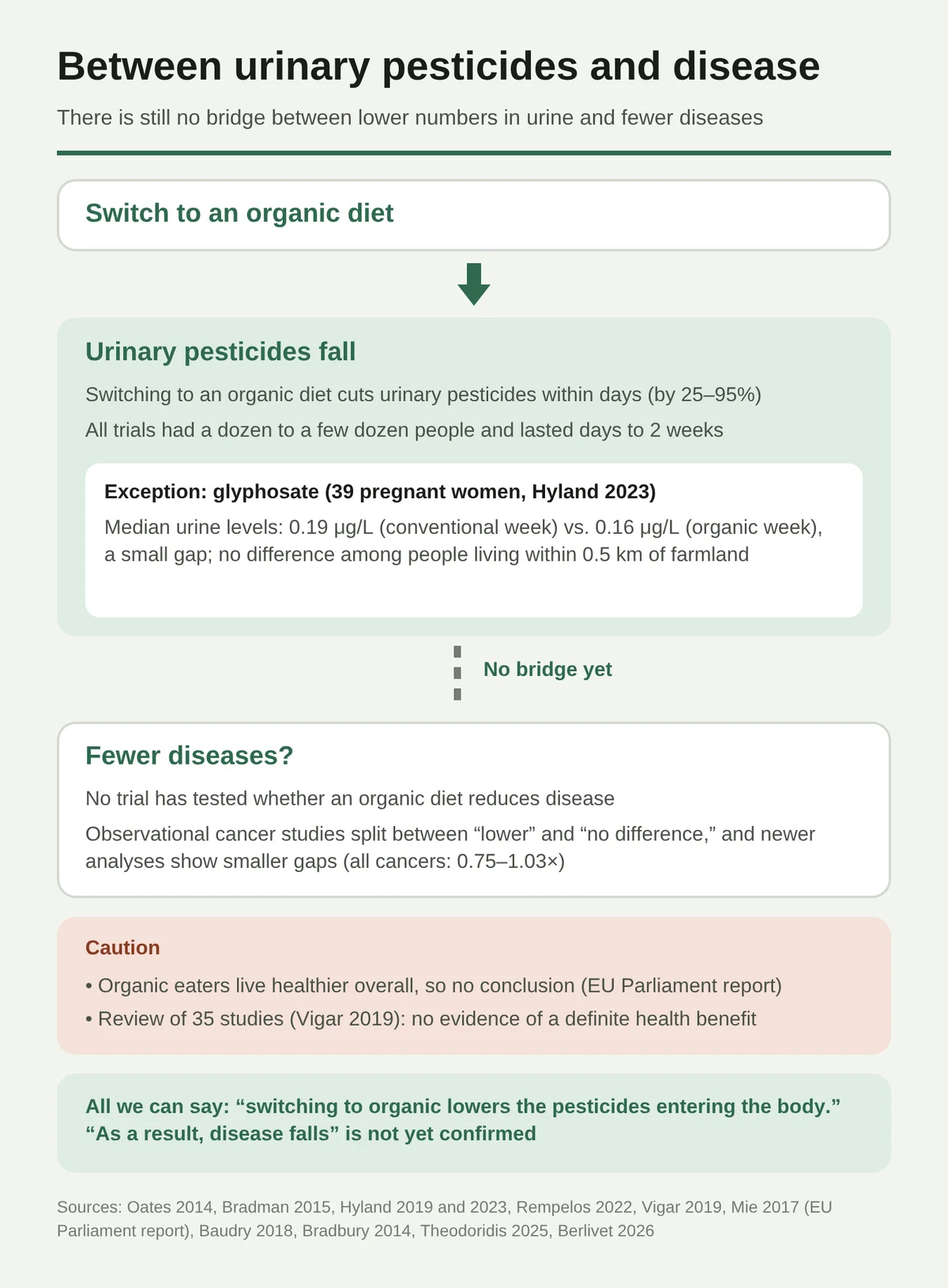
No bridge has yet been built between urinary numbers going down and disease going down.
- A systematic review pooling 35 studies (Vigar 2019) concludes that “there is no evidence to assert a health benefit” and that “trials that replace the whole diet over a long period are needed”. The authors of this review include researchers from an organic research center, and the paper states so
- A report prepared at the request of the European Parliament (2016; academic version Mie 2017) says that “allergies and obesity may fall, but conclusions cannot be drawn because people who choose organic have healthier lifestyles overall”
- Smith-Spangler 2012 says there were only 3 human studies that examined disease or symptoms (allergy and Campylobacter infection), and there was no difference
So what can be said is only that “if you switch to organic, the pesticides entering your body fall”. “As a result, disease falls” has not yet been confirmed.
Does eating organic food reduce cancer? Three cohort studies side by side
For all cancers combined, studies split between “lower” and “no difference”, and newer analyses show smaller differences.
“Organic good for health” and “organic food cancer” are topics often covered in the news. We line up the large studies.
| Study | Who and how many | All cancers | By site |
|---|---|---|---|
| Baudry 2018 (France, NutriNet-Santé) | 68,946 people (78% women, mean age 44). 2009–2016, 1,340 cancers | 0.75 times among frequent organic eaters (0.63–0.88) | Lower for postmenopausal breast cancer and non-Hodgkin lymphoma. No clear difference for breast cancer overall |
| Bradbury 2014 (UK, Million Women Study) | 623,080 middle-aged women. 9.3 years, 53,769 cancers | 1.03 times (0.99–1.07) = no difference | Non-Hodgkin lymphoma 0.79 times; breast cancer 1.09 times, i.e., higher |
| Theodoridis 2025 (meta-analysis) | Pooled several studies | 0.93 times (0.78–1.12) = no association | No association for breast or colorectal cancer either |
| Berlivet 2026 (France, NutriNet-Santé) | 31,179 people. Mean 7.3 years, 1,718 cancers | Replacing 100 g/day of vegetables and fruit with organic gives 0.98 times (0.95–1.00) | Only postmenopausal breast cancer, 0.90 times |
Figures in parentheses are 95% confidence intervals. If an interval crosses 1, read it as “no clear difference”.
How to read the most eye-catching “25% lower”
The source of the headline “organic food cuts cancer by 25%” is Baudry 2018. Cautions for reading it:
- It is an observational study. It only compared people who eat a lot of organic food with people who eat little, so we cannot say cancer fell because they ate organic
- The participants were volunteers: a group that is 80% women, well educated and health-conscious. The paper itself lists residual confounding (differences in other lifestyle habits) as a limitation
- The absolute risk difference is 0.6 percentage points. Even if the relative figure is “25%”, the share of people in whom a difference actually appeared is small
- The amount of organic food is a score from people’s own answers on “how often they choose organic” for 16 items; the amount actually eaten is unknown
- A correction was later issued for the paper (rewording of the conclusion and a correction to the data in Table 1)
- One of the authors discloses serving unpaid as a scientific expert for two foundations connected with organic food companies
How the same research team’s numbers moved afterward
This is Urayomi’s own way of re-lining up the data. Looking in time order at how the most eye-catching number moved afterward gives the following.
| Year | Study | Number for all cancers |
|---|---|---|
| 2014 | UK, 620,000 people (Bradbury) | 1.03 times (no difference) |
| 2018 | France, 69,000 people (Baudry) | 0.75 times (reported in the news as “25% lower”) |
| 2025 | Meta-analysis (Theodoridis) | 0.93 times (no association) |
| 2026 | France, 31,000 people (Berlivet, the same study as Baudry) | 0.98 times (0.95–1.00) for each 100 g/day of vegetables and fruit replaced with organic. A very small difference. Only postmenopausal breast cancer 0.90 times |
The ways of comparing (an organic score vs. an amount replaced) and the participants differ, so the yardsticks differ, and even numbers from the same French study cannot simply be compared. Still, eye-catching numbers can look smaller in later analyses. It seems better not to judge from the “first eye-catching number” alone.
Should you go organic during pregnancy, for baby food, and for children?
No trial has tested whether “organic improves children’s health”. Some observational studies have reported associations, but the numbers of people are small or they did not examine organic food itself.
The search suggestions had 50 about children and pregnancy, such as “organic during pregnancy”, “organic baby food” and “organic infant formula”. In a German national survey (2024) too, 47% of organic buyers gave “for the diet of children and during pregnancy” as a reason.
Pregnancy and birth studies
| Study | Who | Result | Cautions |
|---|---|---|---|
| Torjusen 2014 (Norway, MoBa) | 28,192 women having a first birth | Less preeclampsia (0.79 times) among those who often ate organic vegetables (2,493 women) | Questionnaire. No association for organic fruit, grains, eggs or milk |
| Brantsæter 2016 (same) | 35,107 mothers of boys | Less hypospadias in boys (0.42 times) among mothers who ate organic | Only 74 cases of hypospadias, of which 21 were among mothers who ate organic. The authors themselves write that “replication is needed”. One author is a former employee of an organic food organization |
| Kesse-Guyot 2017, 2020 (France, NutriNet-Santé) | 62,000 and 33,000 people | Less obesity and type 2 diabetes among frequent organic eaters | Observational studies. The association was stronger among people with high diet quality |
| Pernin-Schneider 2025 (France, Paris cohort) | 1,258 children aged 8 | Less sensitization to dust mites, pollen and so on (0.64 times) among children with high organic intake | No association with asthma, eczema or rhinitis |
Studies of pesticides in children
- Among preschoolers in Seattle, US (18 organic, 21 conventional), the median of organophosphate (dimethyl) metabolites was about 6 times higher in the conventionally fed children (Curl 2003)
- In a birth cohort in an agricultural area of California, US (329 people), the group with higher organophosphate metabolites in the mother’s urine during pregnancy had a 7.0-point lower IQ at age 7 (Bouchard 2011). But this was a study in an area with many farming families, and it did not look only at pesticides from diet
Fertility treatment and “fruits and vegetables with high residues”
There are also studies often cited on “pesticides and pregnancy”.
- Among 325 women receiving fertility treatment (Chiu 2018), those who ate fruits and vegetables with high pesticide residues at 2.3 or more servings a day had 18% fewer clinical pregnancies and 26% fewer births than those eating less than 1 serving
- A study of 244 men (Kazemi 2025) reported a similar association
These two are not studies of “whether food is organic”. They used US Department of Agriculture data to divide items into “high residue / low residue” and examined intake of those. The participants were also limited to people receiving fertility treatment, and the authors write that “the meaning for natural conception is unknown”.
Pesticide residues in baby food
In EU testing in 2024, 1,546 samples of food for infants and young children (29.4% of them organic) were examined, and pesticides were not detected in 83.4%. In the EU, the residue standard value for infant and young child food is set low, in principle 0.01 mg/kg. The substance most often exceeding the standard value was copper; EFSA explains that this is because copper is permitted to be added as a nutrient to infant formula and similar products. Glyphosate was not detected in any of the 429 samples.
For food for infants and young children in Japan, we found no public data comparing pesticide residues between organic and conventional in this article’s research.
If you want to choose organic ingredients for baby food, Japan has baby food bearing the organic JAS mark. Food without the mark may not be labeled “有機” or “オーガニック” (organic). However, we have found no study examining whether organic baby food makes a difference to children’s health.
Can you avoid glyphosate with organic? Wheat and oats
Glyphosate is a herbicide that cannot be used under the organic JAS, but in some trials urinary levels did not change much even on an organic diet.
Glyphosate is a pesticide of especially high interest overseas. In English search suggestions, 9 variations of “glyphosate oats” appear, and the English Wikipedia article “Glyphosate” was viewed 310,000 to 410,000 times a year (2023–2025). The Japanese-language article “グリホサート” is viewed only about 1,000 to 1,200 times a year, so it is not much discussed in Japan.
| Item | Details |
|---|---|
| Carcinogenicity assessment | The International Agency for Research on Cancer (IARC) classified it in 2015 as “probably carcinogenic” (Group 2A). The European Food Safety Authority (EFSA) assessed in 2023 that there are “no critical concerns”. Assessments differ by agency |
| EU | Approval renewed in 2023 (until December 15, 2033) |
| Japan | ADI is 1 mg/kg body weight/day. The residue standard value for wheat was changed from 5 ppm to 30 ppm in 2017 |
| Pre-harvest spraying | In North America and elsewhere, there is a practice of spraying wheat and other crops before harvest to dry down the crop and even out the harvest (pre-harvest use) |
| Organic | Glyphosate is not on the list of pesticides usable under the organic JAS |
How much is actually found?
| Testing | Result |
|---|---|
| Japan’s imported farm products (MHLW, fiscal 2024) | Detected in 18 of 99 tests (18.2%). Found in soybeans, wheat and tea. 0 exceedances of the standard value |
| Japanese diet (market basket survey, fiscal 2024) | 0.009–0.111% of the ADI |
| EU food (EFSA, 2024) | Of 14,143 samples, 98.2% had none detected. 0.2% exceeded the standard value (0.1% violations), mainly buckwheat and similar |
| EU organic samples (EFSA, 2023) | Glyphosate is given as an example of a pesticide that is sometimes found even though it is not permitted in organic |
For oats, we did not find public data comparing glyphosate residues between organic and conventional in this article’s research. Detailed information on the substance is in glyphosate and post-harvest pesticides.
Glyphosate is not on the list of pesticides usable under the organic JAS. If you want oatmeal grown without glyphosate, tell it apart by the organic JAS mark on the package.
What about neonicotinoids? The pesticide of highest interest in Japan
The pesticide found most often in Japanese testing is a neonicotinoid (0 exceedances of the standard value). They cannot be used under the organic JAS.
Unlike glyphosate, neonicotinoids are a pesticide of high interest in Japan. The Japanese Wikipedia article “ネオニコチノイド” is viewed 20,000 to 27,000 times a year, about 20 times the articles on “グリホサート” (about 1,000) and “残留農薬” (pesticide residues, about 1,000). The search suggestions include terms meaning “developmental disorders”, “effects on the human body”, “tea”, “EU” and “regulation”.
Share found in Japanese testing (domestic farm products, fiscal 2024)
| Pesticide | Tests | Detected | Exceeding the standard value |
|---|---|---|---|
| Dinotefuran | 1,327 | 169 (12.7%). The pesticide found at the highest rate in domestic products | 0 |
| Clothianidin | 2,985 | 147 (4.9%) | 0 |
| Acetamiprid | 2,746 | 121 (4.4%) | 0 |
| Imidacloprid | 3,463 | 70 (2.0%) | 0 |
Source: MHLW “Fiscal 2024 Results of Testing for Pesticide Residues in Food” (compiled in the Urayomi Pesticide Database).
Regulation differs between Japan and the EU
- In 2018 the EU banned outdoor use of clothianidin, imidacloprid and thiamethoxam (because of effects on honeybees). Their approvals subsequently lapsed
- Acetamiprid is approved in the EU, but in 2024 EFSA lowered its ADI to 0.005 mg per kg of body weight, and the EU lowered the residue standard values (EU Regulation 2025/158). Japan’s ADI is 0.071 mg
- At the Food Safety Commission of Japan, a re-evaluation of acetamiprid is under deliberation
What about the link to “developmental disorders”?
What is often cited is an in vitro study that added acetamiprid and imidacloprid to cerebellar neurons of newborn rats (Kimura-Kuroda 2012). In 2013, EFSA also issued an opinion that these two may be developmental neurotoxicants. However, in this article’s research we did not find a study showing a causal relationship with developmental disorders in humans.
When people switched to an organic diet, urinary clothianidin fell by −82.7% (Hyland 2019, 16 people in the US). Effects on living things such as honeybees are summarized in “Effects on ecosystems” in the Pesticide Database.
Tea is the crop with the highest share of “organic”
Tea also appears in the neonicotinoid search suggestions. Among Japanese crops, the highest organic share is green tea (aracha, unrefined tea) at 6.86% (fiscal 2024). Vegetables were 0.45% and rice 0.12% (MAFF). Crops that are easy to buy organic and crops that are hard to buy organic are clearly divided.
Can you trust the “Dirty Dozen”? The US list and its criticisms
It is a list made by a US nonprofit from US data, and its method has been criticized. It cannot be applied directly to Japanese food.
English search suggestions include “dirty dozen 2026” and “clean fifteen” (the 15 items with the fewest pesticide residues), but Japanese suggestions do not. It is a well-known topic in the US.
The 12 items of the 2026 edition, and how it is made
The 2026 edition of the “Dirty Dozen”, published every year by the environmental group EWG (Environmental Working Group, a US nonprofit research and advocacy organization), has these 12 items:
- Spinach 2. Kale, collard greens and mustard greens 3. Strawberries 4. Grapes 5. Nectarines 6. Peaches 7. Cherries 8. Apples 9. Blackberries 10. Pears 11. Potatoes 12. Blueberries
- It scores and ranks data from non-organic samples tested by the US Department of Agriculture on four measures (share with detections, number of pesticide types per sample, total concentration, and toxicity)
- Because the USDA rotates the items it tests over several years, spinach uses old data: 1,295 samples from 2015–16
- EWG itself acknowledges that the residues on the listed items are below the legal standard values (according to news reports)
Criticism, and EWG’s own check
| Position | Details |
|---|---|
| Criticism (Winter & Katz 2011, food toxicologists at the University of California, Davis, US) | Estimating intake for each of the 10 most frequently found pesticides on the 12 items of that time (120 combinations), all were far below the chronic reference dose, and only one exceeded 1% (methamidophos on bell peppers, 2%). They concluded that “switching the 12 items to organic would not substantially reduce risk”. No funding or conflict-of-interest statement is given |
| Industry group rebuttal | A US produce-growers’ organization (AFF) rebutted that over 99% of USDA samples are far below the standard values |
| EWG’s own check (Temkin 2025) | When they built a “pesticide burden score” from the diets of 1,837 people in the US and compared it with urinary pesticides, there was no association overall, but an association appeared when potatoes were excluded. The exclusion was a decision made after the analysis. Six of the authors are EWG staff. Potatoes are on the 2026 list |
Groups with different positions have drawn opposite conclusions from the same USDA data. Rather than deciding that one is “right”, it is practical to read the difference as one of outlook: whether you want to reduce residues even further when they are already below the standard values.
Can a Japanese Dirty Dozen be made?
With the public data available in Japan today, it cannot. There are three reasons.
| Data | Why it cannot be made |
|---|---|
| Tokyo’s comparison of organic, specially cultivated and conventional | Old (fiscal 2002–2007) and few items |
| MAFF’s sampling survey from farmers | Limited to a few items such as rice, soybeans, spinach and broccoli |
| Market basket survey | Foods are mixed by food group for analysis, so individual vegetables cannot be identified |
Testing of distributed goods by local governments and others has a large number of tests, but there is no public material that scores and ranks how much remains item by item. The honest answer is that “which vegetables to switch to organic first in Japan” cannot be decided with a solid basis from Japanese data. In Urayomi’s Pesticide Database, you can look up “on which crops each pesticide was found”.
Cautions specific to organic: food poisoning and antibiotic-resistant bacteria
We cannot say organic is safe because it is organic, or dangerous because it is organic. Points specific to organic are the handling of compost and the hygiene of vegetables eaten raw.
The 2011 German O104 outbreak came from an organic sprout farm
In 2011, a large food poisoning outbreak of enterohemorrhagic E. coli O104:H4 occurred in Germany.
- There were 3,842 patients in Germany (including 855 cases of hemolytic uremic syndrome) and 53 deaths (Robert Koch Institute tally of July 2011; numbers differ slightly depending on when they were tallied)
- The investigation identified sprouts of fenugreek (a legume) from a sprout farm in Lower Saxony as the cause. All 41 clusters were traced to this producer. According to an analysis by the German consumer group foodwatch, the farm was an organic (Bio) sprout farm (the Robert Koch Institute report calls it a “horticultural farm” and does not mention whether it was organic)
- The European Food Safety Authority judged that one lot of seeds imported from Egypt was the most likely common cause of the outbreaks in Germany and France. However, the epidemic strain was not found in seeds linked to patients
- Prosecutors closed their investigation, saying there was no evidence the operator knew of the contamination early
This food poisoning is less “organic’s fault” than an example of the risk of sprouts eaten raw. German authorities recommend eating sprouts after cooking them thoroughly.
Compost and E. coli
- In a survey of farms in Minnesota, US (Mukherjee 2004), E. coli was found on 9.7% of vegetables on organic farms and 1.6% on conventional farms. However, among certified organic farms only, it was 4.3%, with no difference from conventional. On farms where compost had been aged for less than 12 months, it was found 19 times more often. O157 was not found
- There is also a conclusion that at the point of sale in stores there is no difference in E. coli contamination between organic and conventional (Smith-Spangler 2012)
Japan’s organic JAS does not, in principle, allow human manure or sewage sludge to be used as fertilizer (details in What is organic? (standards and history)).
What about antibiotic-resistant bacteria?
- Smith-Spangler 2012 concludes that for chicken and pork sold in stores, the rate of finding bacteria resistant to 3 or more antibiotics is 33 percentage points higher for conventional (risk difference)
- In organic JAS livestock farming, veterinary drugs are not used to prevent disease. When antibiotics are used for treatment, the withdrawal period before shipment is double the legal one
- On the other hand, there is a report that Campylobacter (a food poisoning bacterium) in broilers was more common in organic at the time of slaughter (Young 2009). There was no difference in chicken sold in stores
A case for organic: where to start switching?
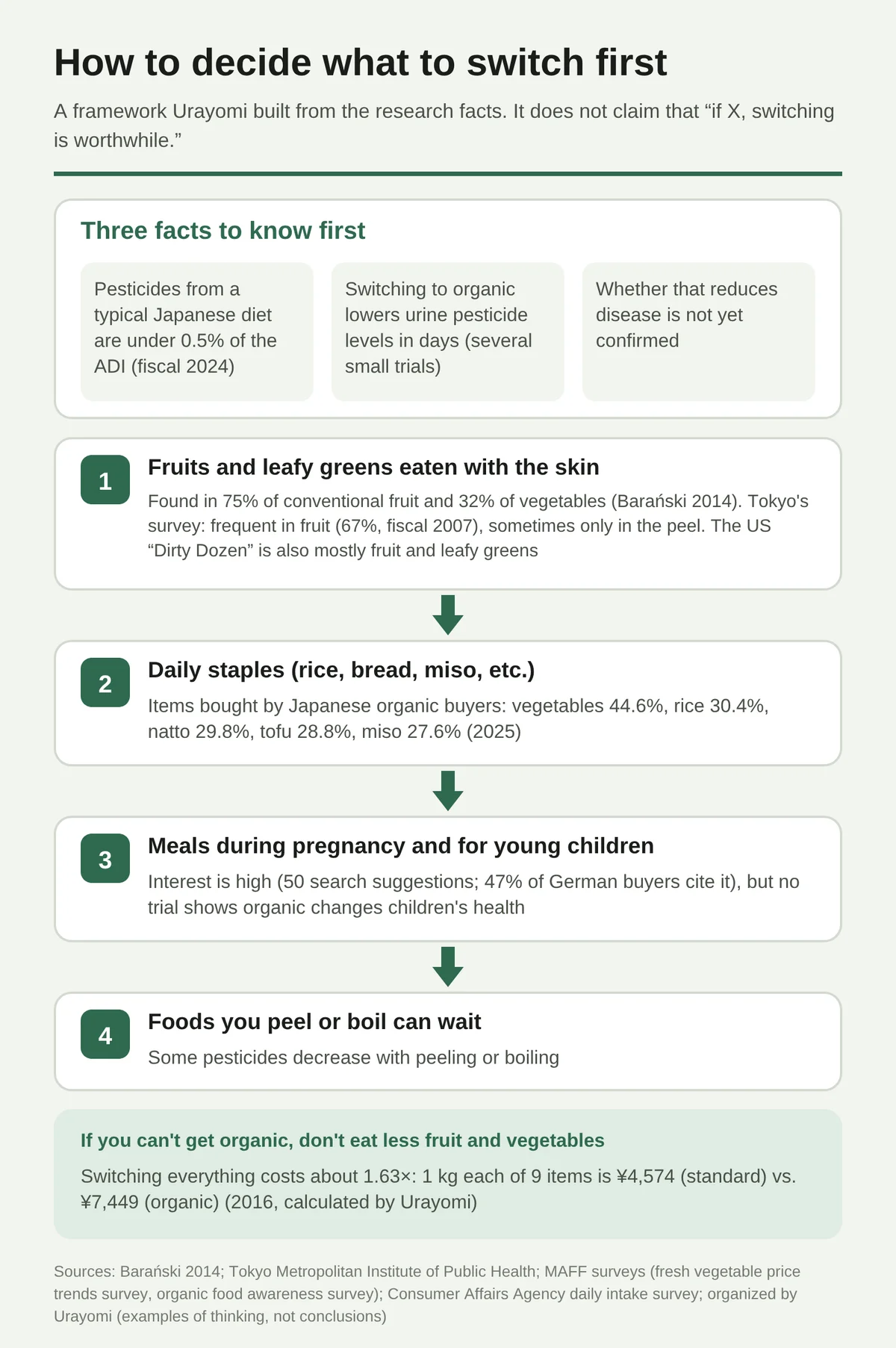
You don’t need to make everything organic; you can choose starting from where the research shows differences most readily. Here we present a “way of thinking about order” that Urayomi has organized from the facts of the research. It does not assert that “switching X is worthwhile”.
Three facts to keep in mind first
- The pesticides taken in from an ordinary Japanese diet are under 0.5% of the ADI (fiscal 2024). Domestic farm products rarely exceed the standard values
- If you switch to organic, urinary pesticides fall within days (several small trials)
- Whether disease falls as a result has not yet been confirmed. The cancer studies are observational, and newer analyses show smaller differences
With that in mind, for people who think “even if pesticides are below the standard values, I’d like to reduce them if I can”, here are the places where differences are most likely to appear.
A way of thinking about the order
| Way of thinking | Facts behind it |
|---|---|
| ① Fruits and leafy vegetables eaten with the skin | In the pooled studies, pesticides were detected in 75% of conventional fruit and 32% of vegetables (Barański 2014). In Tokyo’s survey too, detections were more frequent in fruit (67% in fiscal 2007), and there were cases where residues remained only in the peel. The US Dirty Dozen is also centered on fruit and leafy greens |
| ② Things eaten in large amounts every day (rice, bread, miso and so on) | The more you eat, the more it affects what enters the body. Items bought by organic buyers in Japan: vegetables 44.6%, rice 30.4%, natto 29.8%, tofu 28.8%, miso 27.6% (2025) |
| ③ The diet of pregnant women and small children | High interest (50 search suggestions; 47% of German buyers give it as a reason). However, no trial has confirmed that organic makes a difference to children’s health |
| ④ Things you peel or boil can come later | Some pesticides are reduced by peeling or boiling (Do washing, peeling and boiling remove them?) |
One thing to note: not being able to get organic is no basis for eating fewer vegetables and fruits. In the Rempelos 2022 trial, switching from an ordinary Western diet to a conventional Mediterranean diet (rich in vegetables and fruit) raised urinary insecticides from 7 μg to 25 μg a day. However, this trial did not examine differences in health.
Choosing organic seasonings
“② Things eaten in large amounts every day” also includes seasonings such as miso and vinegar. Among the products whose ingredients Urayomi has read, there are also organic JAS seasonings and ingredients.
- 老梅 有機純米酢 (Roubai Organic Pure Rice Vinegar) (Kawara Suzo): the only ingredient is organically grown rice
- 有機トウバンジャン (Organic Doubanjiang) (Kaze to Hikari)
- 有機白ごまいりごま (Organic Roasted White Sesame Seeds) (Kingoma Honpo)
- 有機ガーリックペースト (Organic Garlic Paste) (Mes de Provence)
- 有機スパゲッティーニ (Organic Spaghettini) (Alce Nero)
There are also products where only some of the ingredients are organic, as in “made with domestic organic vegetables”. Only products bearing the organic JAS mark may have “有機” in the product name. How to tell them apart is covered in What is organic? (standards and history).
Where to buy? Delivery and direct-from-farm
83.5% of people who buy organic food in Japan buy it at supermarkets (2025). On the other hand, the second most common reason for not buying organic or specially cultivated vegetables was “not sold nearby” at 36.6% (Japan Finance Corporation, 2021, survey of 2,000 people).
Delivery and direct-from-farm services bring vegetables meeting the organic JAS or a company’s own standards to your home. The content of the standards differs by company.
| Service | Vegetable standard (summary of wording on the official page) |
|---|---|
| Oisix | Organic JAS, or chemically synthesized pesticides and chemical fertilizers at 50% or less of the local conventional level |
| Radish Boya (らでぃっしゅぼーや) | Its own standard. 120 ingredients among nationally approved pesticides are banned |
| Sakanotsugi (坂ノ途中) | Set vegetables and rice are “in principle grown without chemically synthesized pesticides or chemical fertilizers during the growing period” (stated as a provisional standard) |
| Coop Shizen-ha (コープ自然派) | Explains that about 65% of the farm products it handles are organic or “無農薬” (“pesticide-free”) (“無農薬” is a term not used under national labeling rules and is the advertiser’s expression) |
| Tabechoku (食べチョク) | A direct-from-farm online marketplace where you buy directly from producers. Labels such as “有機JAS” (organic JAS) and “農薬不使用” (no pesticides used) are set by each producer |
(Each company’s official page. Checked September 29 – October 2, 2026.) Trial sets and cost comparisons are in the food delivery comparison article, and the difference between specially cultivated and organic JAS is in the Oisix article.
How much more does it cost? Organic prices and “what you’re willing to pay”
Organic vegetables cost 1.4 to 1.9 times as much as ordinary ones. Only about one in ten people said they would pay that.
The search suggestions include “why organic is expensive” and “organic vegetables expensive”, and even among people who buy organic, 79.2% feel that “the price is high” (2025).
| Item | Domestic standard product (yen/kg) | Organic JAS (yen/kg) | Ratio |
|---|---|---|---|
| Negi (Welsh onion) | 669 | 960 | 143% |
| Potato | 385 | 568 | 147% |
| Komatsuna | 792 | 1,223 | 154% |
| Daikon radish | 204 | 315 | 155% |
| Tomato | 697 | 1,078 | 155% |
| Cabbage | 178 | 291 | 163% |
| Carrot | 394 | 685 | 174% |
| Onion | 296 | 536 | 181% |
| Bell pepper | 959 | 1,793 | 187% |
Source: MAFF “2016 Fresh Vegetable Price Trend Survey” (annual averages at stores where organic and standard products were sold side by side). The 2016 survey is the latest public survey of this kind, and the current price gap has not been confirmed.
- Buying 1 kg of each of the 9 items costs 4,574 yen for standard and 7,449 yen for organic, about 1.63 times (a difference of 2,875 yen) (calculated by Urayomi)
- Asked “how much more than ordinary products would you still buy”, organic buyers said “not if even slightly more expensive” 30.0%, “up to 10% more” 28.3%, “up to 20% more” 15.5%. Those who said they would buy at 30% or more above ordinary totaled 14.1% (2025, 1,856 people)
- For households that buy organic, the most common monthly purchase amount was “under 5,000 yen” at 46.9%, and “20,000 yen or more” was 2.8% (2025, 1,882 households)
The actual price gap is 40–90% higher, yet about 60% (58.3%) of organic buyers answer “not if even slightly more expensive” or “up to 10% more”. Rather than switching everything, narrowing down items using the “order” above makes it easier to hold down the added cost. The reasons for the higher prices (yield, labor and certification) are covered in What is organic? (standards and history) and Organic in Japan and the world.
Fresh organic vegetables are sometimes unavailable depending on the season and the store. Frozen vegetables bearing the organic JAS mark can be bought in bulk online. Prices differ by product, so compare per kilogram.
The option of growing your own
If you grow your own, you decide what fertilizers and pesticides to use.
- For food you eat yourself, organic JAS certification is not required
- However, you may not sell vegetables you grew yourself labeled “有機” or “オーガニック” (organic). Only producers with organic JAS certification may use the label
- 225 cases of domestically acquired ascariasis were reported from 1990 to 2015, and a report from a MHLW-funded research project speculates that vegetables from home gardens using night soil (human manure) stand out
- In a US survey, more E. coli was found on vegetables from farms using compost aged less than 12 months (Compost and E. coli)
Items featured in this article (summary)
The items introduced in the article are collected here once more. The reasons and ingredients are written in each section.
| Item featured | Where to buy |
|---|---|
| オーガニック オートミール 800g(有機JAS) (Organic oatmeal, 800 g, organic JAS) | See on Rakuten (こめたつ 自然の蔵) PR |
| 味千汐路 有機まるごとベビーフード「鮭と野菜の混ぜごはん」100g(12か月頃から) (Ajisenshioji Organic Whole Baby Food “Salmon and Vegetable Mixed Rice”, 100 g, from about 12 months) | See on Rakuten (味千汐路 楽天市場店) PR |
| Oisix おためしセット (Oisix Trial Set) | おためしセットを見る(Oisix 公式)  PR PR |
| らでぃっしゅぼーや ふぞろい食材おためしセット (Radish Boya “Imperfect Ingredients” Trial Set) | おためしセットを見る(らでぃっしゅぼーや公式)  PR PR |
| 坂ノ途中 旬のお野菜セット(京都) (Sakanotsugi Seasonal Vegetable Set, Kyoto) | 坂ノ途中:お野菜・定期宅配 PR PR |
| コープ自然派 宅配の資料請求 (Coop Shizen-ha delivery brochure request) | 取り扱い青果の60%以上がオーガニック!生協の宅配コープ自然派 PR PR |
| 食べチョク(農家から直接買える産直通販) (Tabechoku, a direct-from-farm online marketplace) | 食べチョクで生産者の野菜を見る |
| 有機JAS 国産 冷凍温野菜サラダ 200g×6袋(カリフラワー・ブロッコリー・にんじん) (Organic JAS domestic frozen warm vegetable salad, 200 g × 6 bags) | See on Rakuten (楽天ファーム) PR |
Summary
| What you wonder about | What we found |
|---|---|
| Is organic more nutritious? | Split in the research. Some papers say more polyphenols (including funding from an organic-promoting foundation) and others say no difference. One result is that protein is 15% lower in organic |
| Does organic mean zero pesticide residues? | Not zero. In EU testing, something is found in about 20% of organic samples (mainly copper, which is usable in organic). Still, organic is lowest in every data set |
| What about pesticides on ordinary Japanese vegetables? | Exceedances of the standard value in domestic testing are 0.001%. The amount taken in from diet is about 1/210 of the ADI even for the highest (fiscal 2024) |
| If you switch to organic, do pesticides in your body fall? | Urinary pesticides fall 25–95% within days (small trials). Glyphosate fell less. Whether disease falls is unconfirmed |
| Does organic reduce cancer? | Observational studies are split. The “25% lower” is an absolute difference of 0.6 points, and the same research team’s 2026 analysis shows only a small difference: 2% lower per 100 g replaced |
| Pregnancy and children? | There are observational studies showing associations, but with large limitations such as small numbers. No trial has confirmed a difference in health |
| Glyphosate and neonicotinoids? | Neither can be used under the organic JAS. The most frequently found in domestic Japanese products is neonicotinoids (0 exceedances of the standard value) |
| The Dirty Dozen? | A list made by a US organization from US data. It has been criticized, and a Japanese version cannot be made from public data |
| Where to start switching? | A way of thinking: fruits and leafy vegetables eaten with the skin, things eaten in large amounts every day, and the diet of pregnant women and children. It is no reason to eat fewer vegetables and fruits |
| Cost? | Organic vegetables are 1.4–1.9 times (2016). 14.1% would buy at 30% or more above ordinary |
Sources
Nutritional value and components
- Dangour AD, et al. Nutritional quality of organic foods: a systematic review. Am J Clin Nutr 2009;90:680-5 (PMID 19640946)
- Dangour AD, et al. Nutrition-related health effects of organic foods: a systematic review. Am J Clin Nutr 2010;92:203-10 (PMID 20463045)
- Smith-Spangler C, et al. Are organic foods safer or healthier than conventional alternatives? A systematic review. Ann Intern Med 2012;157:348-66 (PMID 22944875)
- Barański M, et al. Higher antioxidant and lower cadmium concentrations and lower incidence of pesticide residues in organically grown crops. Br J Nutr 2014;112:794-811 (PMID 24968103) / Mulet JM. Br J Nutr 2014;112:1745 (PMID 25263540)
- Średnicka-Tober D, et al. Br J Nutr 2016;115:1043-60 (milk, PMID 26878105) and 994-1011 (meat, PMID 26878675)
- Nuñez de González MT, et al. Retail survey of nitrates and nitrites, 2015 (PMID 25850811) / Bernhoft A, et al. Mycotoxins in Norwegian grain, 2012 (PMID 22494553)
- Pew Research Center, “Americans’ views about and consumption of organic foods” (December 2016)
Pesticide residues
- EFSA, “The 2024 European Union report on pesticide residues in food”, EFSA Journal 2026 (PMC13140735) / same report for 2023 (PMC12076349)
- US Department of Agriculture, “Pesticide Data Program Annual Summary, Calendar Year 2024”
- Baker BP, et al. Food Addit Contam 2002;19:427-46 (PMID 12028642)
- Tokyo Metropolitan Institute of Public Health Annual Report Nos. 54, 55, 57 and 59 (surveys of pesticide residues in domestic farm products, fiscal 2002, 2003, 2005 and 2007)
- Consumer Affairs Agency (MHLW through fiscal 2023), “Daily Intake Survey of Pesticide Residues in Food”, fiscal 2020–2024
- MHLW and the Consumer Affairs Agency, “Fiscal 2024 Results of Testing for Pesticide Residues in Food” (compiled in the Urayomi Pesticide Database)
- MAFF, “Survey of Pesticide Residues in Farm Products” (fiscal 2022–2025)
- MAFF, “Japanese Agricultural Standard for Organic Plants” (JAS 1605:2024), FAMIC pesticide registration information, Food Safety Commission of Japan pesticide evaluation reports
Pesticides in the body (urine)
- Curl CL, et al. Environ Health Perspect 2003 (PMID 12611667) / Lu C, et al. Environ Health Perspect 2006 (PMID 16451864)
- Oates L, et al. Environ Res 2014;132:105-11 (PMID 24769399)
- Bradman A, et al. Environ Health Perspect 2015;123:1086-93 (PMID 25861095)
- Hyland C, et al. Environ Res 2019;171:568-75 (PMID 30765100)
- Rempelos L, et al. Am J Clin Nutr 2022;115:364-77 (PMID 34718382)
- González N, et al. Food Res Int 2023 (PMID 37803657)
- Hyland C, et al. Environ Health Perspect 2023;131:77005 (PMID 37493357)
- Vigar V, et al. Nutrients 2019;12:7 (PMID 31861431) / Mie A, et al. Environ Health 2017;16:111 (PMID 29073935) / European Parliament STOA, “Human health implications of organic food and organic agriculture” (2016, PE 581.922)
Cancer, pregnancy and children
- Baudry J, et al. JAMA Intern Med 2018;178:1597-1606 (PMID 30422212) / Correction JAMA Intern Med 2018;178:1732 (PMID 30508044)
- Bradbury KE, et al. Br J Cancer 2014;110:2321-6 (PMID 24675385)
- Theodoridis X, et al. Life 2025;15:160 (PMID 40003569)
- Berlivet J, et al. Am J Clin Nutr 2026 (PMID 41862000)
- Torjusen H, et al. BMJ Open 2014 (PMID 25208850) / Brantsæter AL, et al. Environ Health Perspect 2016 (PMID 26307850)
- Kesse-Guyot E, et al. Br J Nutr 2017 (PMID 28166859); Int J Behav Nutr Phys Act 2020 (PMID 33167995)
- Pernin-Schneider S, et al. Allergy 2025 (PMID 39749568)
- Chiu YH, et al. JAMA Intern Med 2018;178:17-26 (PMID 29084307) / Kazemi 2025 Am J Clin Nutr (PMID 41338693)
- Bouchard MF, et al. Environ Health Perspect 2011 (PMID 21507776)
Glyphosate, neonicotinoids and the Dirty Dozen
- IARC, “Q&A on Glyphosate”; European Commission, “Renewal of approval: glyphosate”; MHLW Pharmaceutical Affairs and Food Sanitation Council, Committee on Pesticides and Veterinary Drugs report (glyphosate, 2017)
- Kimura-Kuroda J, et al. PLoS One 2012 (PMID 22393406)
- EWG, “Shopper’s Guide to Pesticides in Produce”, 2026 edition and methodology (checked via the Wayback Machine)
- Winter CK, Katz JM. J Toxicol 2011:589674 (PMID 21776262)
- Temkin AM, et al. Int J Hyg Environ Health 2025;270:114654 (PMID 40998639)
- MAFF, “Results of Grading of Organic Agricultural Products, etc.” (fiscal 2024)
The other side of safety
- Robert Koch-Institut, “Abschließende Darstellung und Bewertung der epidemiologischen Erkenntnisse im EHEC O104:H4 Ausbruch” (2011); EFSA’s investigation of O104 seeds (2011)
- Buchholz U, et al. N Engl J Med 2011;365:1763-70 (PMID 22029753) / Frank C, et al. N Engl J Med 2011 (PMID 21696328)
- Mukherjee A, et al. J Food Prot 2004;67:894-900 (PMID 15151224)
- Young I, et al. Epidemiol Infect 2009 (PMID 19379542) / Golden CE, Mishra A. J Food Prot 2020 (PMID 32294168)
- MHLW Health and Labour Sciences Research Grant reports (soil-transmitted parasitic diseases, fiscal 2013 and 2015)
History, systems and consumers
- MAFF, “Understand in 5 minutes! What is organic produce?”; US Federal Register 65 FR 80548 (December 21, 2000, National Organic Program final rule); Codex “CAC/GL 32-1999”
- Environment White Paper, Showa 47 edition; MAFF list of “prohibited-for-sale pesticides”; Soil Association, “Our history”
- MAFF, “Survey on Attitudes toward Organic Agriculture and Organic Food” (fiscal 2025); MAFF, “Survey on Attitudes toward Consumption of Organic Foods, etc.” (fiscal 2019)
- Japan Finance Corporation, “Consumer Trend Survey (July 2021)”
- German Federal Ministry of Food and Agriculture, “Öko-Barometer 2024”
- MAFF, “2016 Fresh Vegetable Price Trend Survey”; MAFF, “Circumstances Surrounding Organic Agriculture” (August 2019 and April 2026)
- Google search suggestions (collected and classified by Urayomi on October 3, 2026); Wikimedia pageviews API
Related articles and databases
- What Is Organic (有機)? Organic JAS Standards, History, and How It Differs from “Pesticide-Free,” “Additive-Free,” and Shizen Saibai (Natural Farming), Explained with Official Sources
- Organic in Japan and the World: Why Is Japan’s Organic Share Only 0.9%? Markets, Farmland, Rules, and Fraud Compared with the US, EU, China, and South Korea
- Reading Oisix’s Trial Set and Subscription Down to the Back Label: Vegetable Pesticide Standards, the Trial Set, and How Cancellation Works
- Comparing 5 additive-conscious grocery delivery services: trial sets, ongoing costs, and additive standards (2026)
- Were “無添加” (Additive-Free) Labels Banned? Reading the Consumer Affairs Agency Guideline’s 10 Types from the Back Label