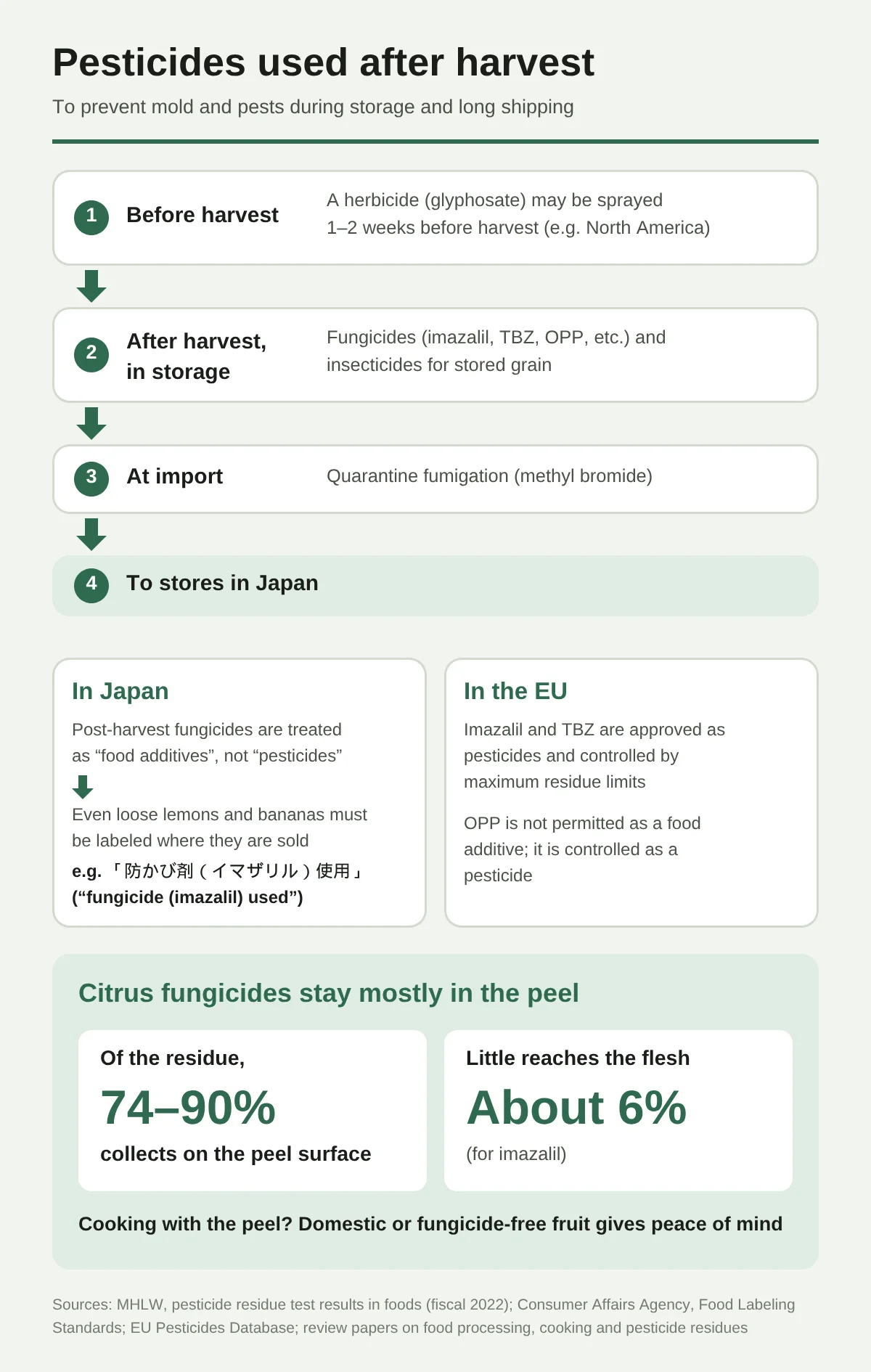
Post-harvest pesticides are applied to crops after harvest to prevent mold and insects during storage and long-distance shipping. The more a food depends on imports, the more likely they are to be used.
Japan relies heavily on imports
Wheat: self-sufficiency of about 14%. The US, Canada and Australia account for about 90% of imports
Soybeans and corn: almost entirely imported (from the US, Brazil and others)
Bananas: from the Philippines, Ecuador and others. Citrus: from the US, South Africa, Turkey and others
A rule unique to Japan
Fungicides applied after harvest are treated in Japan as “food additives,” not “pesticides.”
As a result, even for loose lemons and bananas, the fungicide used must be labeled where the food is sold.
When, and what is used
From before harvest to the Japanese store shelf
Figure: the flow of pesticides applied after harvest, how Japan and the EU treat them, and the share remaining on citrus peel
Detection rates are from MHLW, “Results of pesticide residue testing in foods, fiscal 2024” (Table 4; for those not in the top 20, summed from the food-by-food tables in the full version). For methyl bromide, the value is for “bromine,” which comes from fumigation. The detection rate is the share of tests in which any amount was detected; it does not mean the limit was exceeded.
Main pesticides used
Imazalil
Fungicide (citrus, bananas)
In Japan
Treated in Japan as a food additive (fungicide). Detection rate in imported produce: 19.6% (MHLW, fiscal 2024; 240 of 1,224 tests; 12.9% in fiscal 2022).
In the EU
Approved in the EU as a pesticide and controlled by maximum residue limits.
A food additive (fungicide) in Japan. In Tokyo Metropolitan Government testing (fiscal 2023), 0.27–0.96 ppm was found in 5 samples of imported oranges and 0.05–0.41 ppm in 5 samples of lemons (all within the limit of 10 ppm).
Used after harvest, it is a food additive (fungicide) in Japan; used in the field, it is treated as a pesticide. Detection rate in imported produce: 13.5% (MHLW, fiscal 2024; 194 of 1,439 tests; 6.8% in fiscal 2022).
In the EU
Approved in the EU as a pesticide (until September 2027).
In North America and elsewhere, it is sometimes sprayed one to two weeks before harvest to dry down the crop and even out the harvest (pre-harvest use). Japan’s maximum residue limit for wheat is 30 ppm (raised in 2017).
In the EU
The EU’s maximum residue limit for wheat is 10 ppm.
Used on grain after harvest to prevent insect damage during storage and shipping.
In the EU
Chlorpyrifos-methyl’s approval expired in the EU in 2020.
Methyl bromide (fumigation)
Fumigant (quarantine at import)
In Japan
Bromine, which comes from fumigation, is one of the substances most often detected in imported produce (MHLW, fiscal 2024: 16 of 128 tests, 12.5%; in fiscal 2022 it was 20.4%, ranking first). It has been found in dried dates and other products.
In the EU
Its use is not permitted in the EU, to protect the ozone layer.
Public testing and private testing, presented separately
Public testing
In MHLW testing of imported produce, glyphosate was detected in 18 of 99 tests (18.2%) in fiscal 2024 (soybeans, wheat, tea). In fiscal 2022 it was 18 of 122 tests (14.8%).
None exceeded the limit (the limit for wheat is 30 ppm).
Private organization testing (for reference)
In 2019, the Nouminren Food Analysis Center reported detecting 0.05–0.18 ppm in 11 of 15 commercial loaves of sandwich bread. Levels were higher in whole-wheat breads.
In the same center’s survey, nothing was detected in breads made with 100% domestic wheat or organic wheat, or in domestic-wheat and rice-flour breads served in school lunches.
Private testing differs from public testing in its methods and in how products are chosen. Please treat it as a reference for understanding trends.
What you can do at home
Citrus fungicides mostly remain on the peel. Research indicates that 74–90% of the residue collects on the surface of the peel, and only a little moves into the flesh (about 6% for imazalil).
If you use the peel of imported lemons or oranges in cooking (marmalade, candied lemon peel, slices with the peel on), choosing domestic fruit or fruit not treated with fungicides is safer.
For wheat products, choosing those made with domestic or organic wheat makes it easier to avoid glyphosate.
Check the labels in the store (such as “fungicide (imazalil) used”).
Some food delivery services state in their standards that they do not handle imported produce treated with post-harvest fungicides and the like (for example Oisix; fumigation required under the Plant Protection Act is excepted).
Most of what public testing detects is within Japan’s limits. Here we present what is likely to be used on imported foods, and how Japan and the EU treat it differently, as information to help you choose.
Sources
MHLW, “Results of pesticide residue testing in foods, fiscal 2024” (published March 2026) and the fiscal 2022 edition (Japanese)
Tokyo Metropolitan Government, “Results of residue testing of imported produce, fiscal 2022 and 2023” (Japanese)
Consumer Affairs Agency, Food Labeling Standards (labeling of fungicides) (Japanese); USDA, guide to Japan’s fungicide labeling
EU Pesticides Database; EUR-Lex (maximum residue limits)
Nouminren Food Analysis Center (private testing, for reference) (Japanese)
Review papers on food processing, cooking and pesticide residues
Last checked October 1, 2026 (testing figures updated to fiscal 2024; materials gathered and cross-checked in Gemini Notebook). → Pesticide database
This page is a translation of our Japanese page; if they differ, the Japanese page is the reference.