
Spinach
Frozen (China, Taiwan)All within the limits
Pesticide active ingredients, grouped by use (insecticides, fungicides, herbicides and more) and chemical class. For each one we show its registration, toxicity class and ADI in Japan, how often it was detected in national testing, and evaluations by WHO, the EU and IARC. We do not judge whether anything is good or bad.

Only what public sources show
Click a name for its full page
Kill insects or stop them from multiplying
Bind to the receptors in insect nerves (nicotinic acetylcholine receptors). Many are taken up through roots or leaves and spread through the whole crop (systemic)
Block the action of the enzyme that stops nerve signals (acetylcholinesterase). Used for a long time
Like organophosphates, they block the action of acetylcholinesterase
Developed from a component of pyrethrum flowers (pyrethrin). They act on the sodium channels of nerves
Act on the receptors in insect muscles (ryanodine receptors). A relatively new class
Insecticides based on substances made by soil microorganisms (spinosad, emamectin benzoate and others)
Disrupt the way insects grow, such as molting and metamorphosis
Control mites such as spider mites
Classes that fit none of the above (phenylpyrazoles, pyridine azomethines and others)
BT products (proteins made by bacteria), pyrethrum extracts, machine oil, starch and others
DDT, BHC, drins and others. Because they hardly break down and remain in the body and the environment, they stopped being used in Japan in the 1970s
Prevent crop diseases caused by molds and bacteria
Stop the respiration of fungi (the mitochondrial electron transport chain). Developed from a component of mushrooms
Stop fungi from making a component of their cell membranes (ergosterol)
Stop another step of fungal respiration (succinate dehydrogenase)
Stop fungal cell division
Classes used against gray mold and similar diseases (procymidone, iprodione, fludioxonil and others)
Act on many sites in fungal cells. Resistance is slow to develop (mancozeb, TPN, captan and others)
Inorganic fungicides used since long ago. Copper products, sulfur products, sodium bicarbonate and others
Used against rice blast, sheath blight and other rice diseases (some stop melanin synthesis, some strengthen the rice plant's own resistance)
Classes that fit none of the above, such as those for downy mildew and late blight
Kill weeds or stop them from growing
Stop a mechanism for making amino acids that only plants have. Glyphosate, glufosinate, sulfonylureas and others
Make reactive oxygen during photosynthesis and quickly kill the green parts
Act like the plant growth hormone auxin, making broadleaf weeds grow abnormally until they die
Stop the roots and shoots of newly sprouted weeds from growing. Applied to the soil of paddies and fields
Stop part of the photosynthesis mechanism (bentazone, DCMU and others)
Classes that fit none of the above
Used as a gas to control pests and pathogens in soil, warehouses and imported goods
Spread gas through the soil before planting to reduce nematodes and pathogens
Control pests in stored grain and imported farm products
Used on citrus fruits, bananas and other produce after harvest to prevent mold during storage and transport. Treated as food additives in Japan
Imazalil, thiabendazole (TBZ), ortho-phenylphenol (OPP) and others. Labeling is required at the point of sale
Adjust how crops grow, how they ripen, how they set fruit and so on
Gibberellin (for seedless grapes), ethephon (to speed up ripening) and others
Label on the right: for ingredients registered in Japan, their EU status; for others, their status in Japan (such as the year registration expired). WHO is the acute toxicity class (Ia is the strongest), ADI is in mg/kg body weight/day, IARC is the carcinogenicity classification.
MHLW, results of pesticide residue testing in foods, fiscal 2024, Tables 3 and 4
| Pesticide | Detected / tested | Detection rate |
|---|---|---|
| Dinotefuran | 169 / 1,327 | |
| Carbendazim group (incl. thiophanate-methyl, benomyl) | 13 / 153 | |
| Flonicamid | 18 / 359 | |
| Clothianidin | 147 / 2,985 | |
| Acetamiprid | 121 / 2,746 | |
| pyflubumide | 6 / 142 | |
| Boscalid | 136 / 3,457 | |
| Flubendiamide | 22 / 722 | |
| Penthiopyrad | 20 / 669 | |
| Chlorfenapyr | 120 / 4,118 |
| Pesticide | Detected / tested | Detection rate |
|---|---|---|
| Imazalil | 240 / 1,224 | |
| Fludioxonil | 194 / 1,439 | |
| Thiabendazole | 184 / 1,432 | |
| Bromine (e.g. from methyl bromide) | 16 / 128 | |
| Azoxystrobin | 467 / 4,000 | |
| Pyraclostrobin | 321 / 4,333 | |
| Arsenic | 12 / 171 | |
| Lead | 12 / 172 | |
| Boscalid | 260 / 4,442 | |
| Pyrimethanil | 262 / 4,901 |
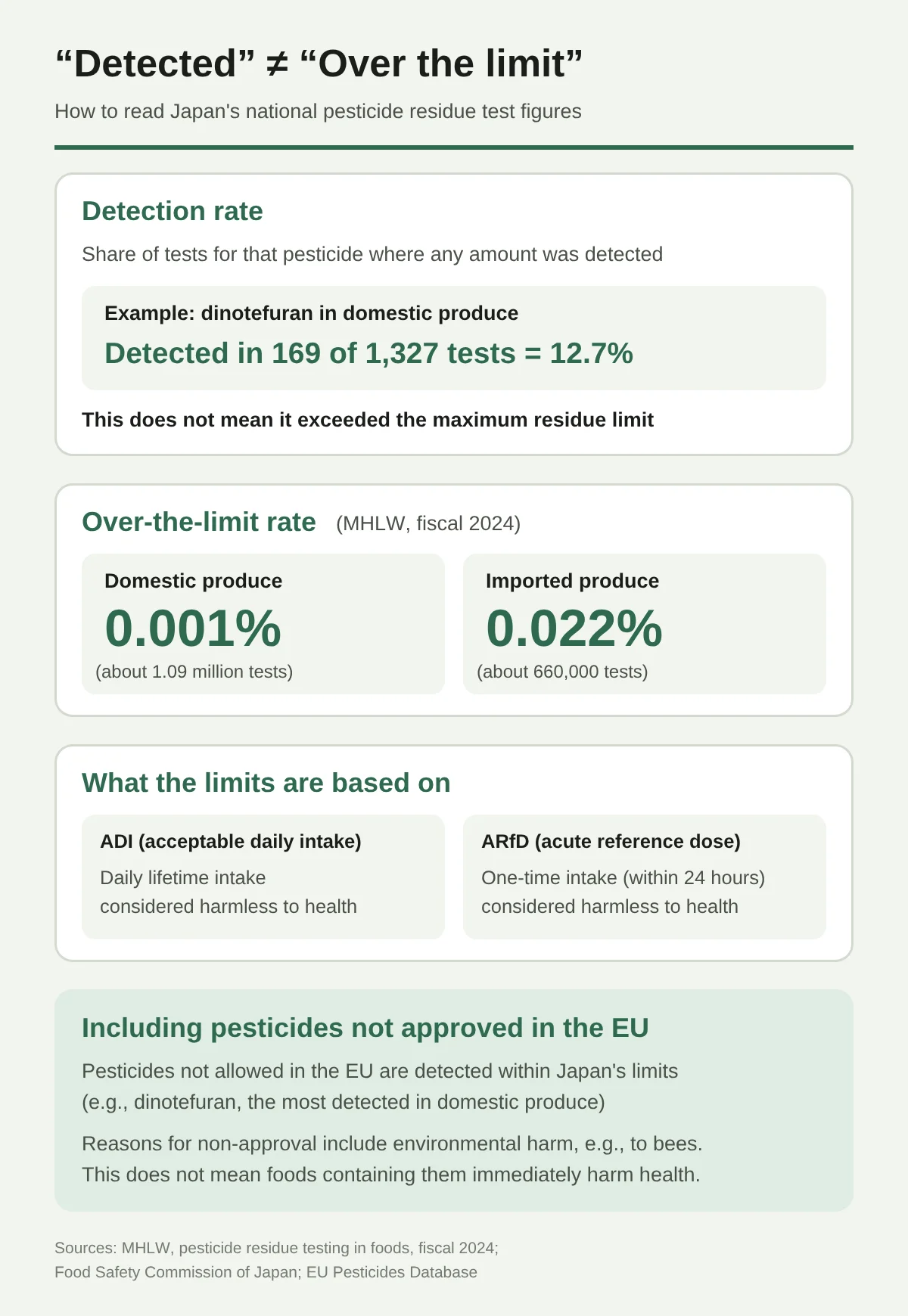
The detection rate is the share of tests for that pesticide in which any amount was detected (including below 0.01 ppm). It does not mean the limit was exceeded. Arsenic and lead in the imported table are not pesticides, but are tested in the same program.
Tokyo Metropolitan Government, residue testing of imported produce, fiscal 2022–2023
All within the limits
All within the limits
All within the limits
All within the limits
All within the limits
All within the limits
Over the limit: Thiamethoxam at 0.04 ppm (limit 0.02 ppm) exceeded the limit (fiscal 2023).
All within the limits
Over the limit: Tebuconazole at 0.07 ppm (limit 0.01 ppm) exceeded the limit (fiscal 2023).
Red labels mark pesticides not approved in the EU. A vegetable-by-vegetable breakdown for domestic produce was not published in the public sources we checked.
Last checked 2026-10-01. Registrations and evaluations change over time. These pages are translations of our Japanese pesticide database.