
How do pesticides affect ecosystems? Bees, dragonflies, birds and fish, and regulation around the world
Neonicotinoids and honeybee losses; studies on wild bees, dragonflies, birds and lake fish; the history of DDT and PCP
In short
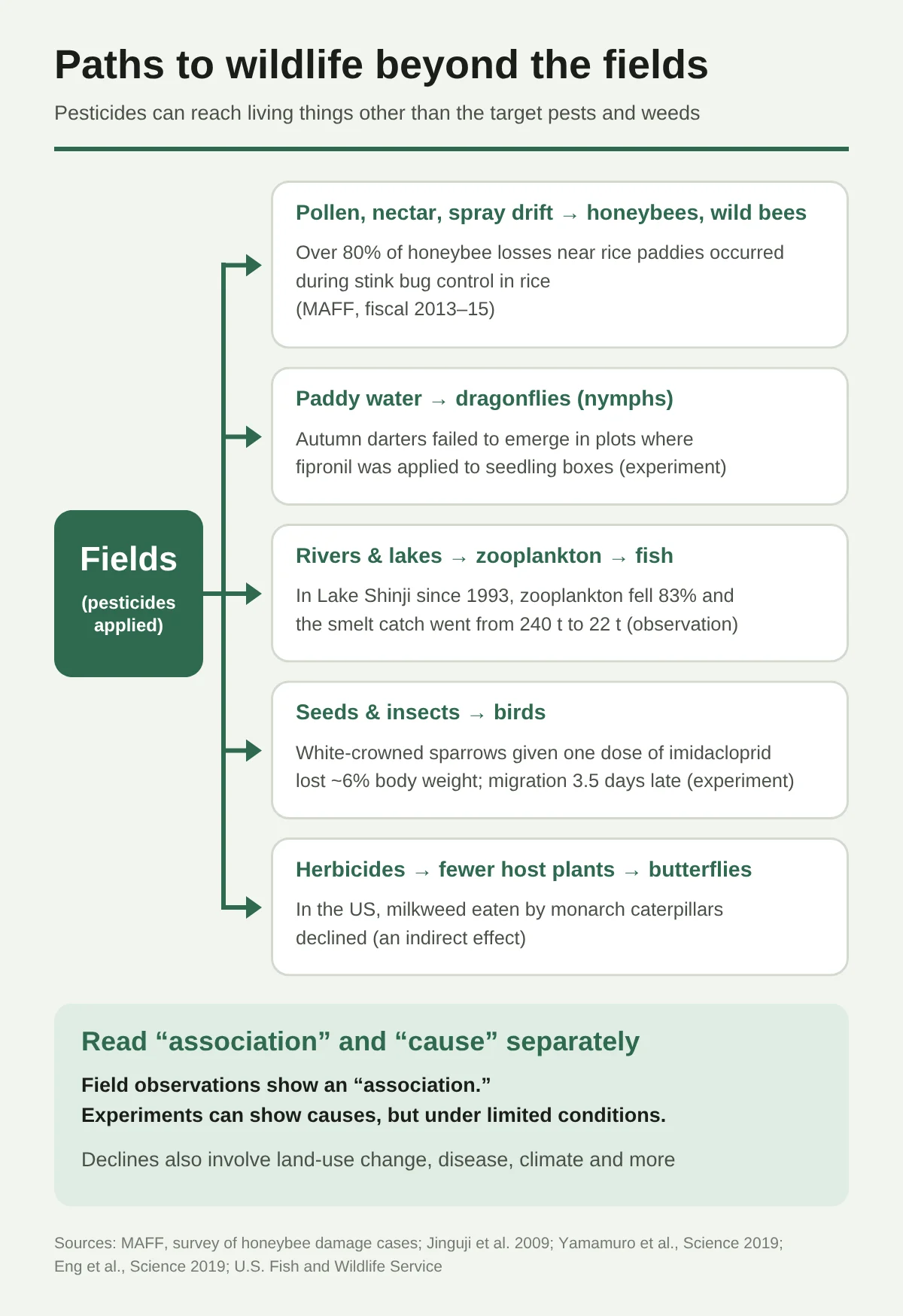
Pesticides can reach living things outside the field through pollen and nectar, paddy water, rivers and lakes, and seeds and insects that serve as food. In Japan, most honeybee damage occurs during the period when rice is sprayed against stink bugs, and insecticides such as neonicotinoids have been found in the dead bees.
For wild bees, dragonflies and birds, there are cases in which experiments confirmed effects. On the other hand, the declines of butterflies, aquatic life and the fish of Lake Shinji are mostly shown by studies of an “association” that occurred at the same time as the spread of use, and changes in land, disease, climate and other factors overlap. In 2018, the EU banned outdoor use of three neonicotinoids.
Honeybees: surveys of damage in Japan
In fiscal 2013–15, MAFF surveyed honeybee damage across Japan through the prefectures.
- Insecticides found (with overlaps, 38 in total): clothianidin 16, ethiprole 11, dinotefuran 6, imidacloprid 2, thiamethoxam 1, etofenprox 1, MEP 1. Neonicotinoids accounted for about 66%, about the same as their share of use in stink bug control (about 63% of the total sprayed area).
- MAFF says the damage was “likely caused by direct exposure to insecticides outside the hive,” but that it could not identify which insecticide had how much effect.
- In many cases the damage was small, with 1,000–2,000 or fewer dead bees in a hive, but there were also 3–4 cases every year with more than 10,000.
- MAFF states that colony collapse disorder (CCD), in which the bees in a colony suddenly disappear, has not been reported in Japan.
The government calls for information sharing between farmers and beekeepers, careful placement of hives or moving them away, spraying outside the 8 a.m.–12 p.m. period when bees are most active, and the use of granular products, and in 2015 it requested a review of the cautionary wording on pesticide labels.
Honeybees: the EU's decisions and global assessments
| Date | What the EU did |
|---|---|
| January 2013 | EFSA (the European Food Safety Authority) concluded that, for clothianidin, imidacloprid and thiamethoxam, the risk to honeybees from pollen, nectar and dust at sowing was high for some crops |
| May 2013 | Restricted seed treatment, soil treatment and spraying on crops attractive to bees and on cereals (Regulation 485/2013) |
| February 2018 | EFSA, also assessing wild bees (bumblebees and solitary bees), concluded that “most uses pose a risk” |
| May 2018 | Banned all outdoor use of the three ingredients; use allowed only inside permanent greenhouses (Regulations 2018/783, 784 and 785). Their approvals subsequently expired (2019–2020) |
| 2020 | Thiacloprid was also not renewed. The reasons, however, were breakdown products in groundwater and carcinogenicity and reproductive toxicity, not bees |
| Until 2033 | Acetamiprid remains approved, on the grounds that the “risk to bees is low” |
- IPBES (the international scientific body on biodiversity) listed, in 2016, the following as factors threatening pollinators (the animals that carry pollen): changes in land use, intensive agriculture and pesticides, pollution, invasive species, pathogens and climate change. On neonicotinoids, it says it is “well established” that they have lethal and sublethal effects on bees under controlled conditions, and that there is recent evidence of effects on the survival and reproduction of wild pollinators under actual field exposure, whereas the effects on managed honeybee colonies are “inconclusive.”
- CCD in the US: the US Environmental Protection Agency (EPA) cites a combination of parasitic mites, disease, pesticides, stress from transport and poor nutrition as causes, and says that reports of CCD have fallen sharply.
Studies of living things other than honeybees
An “Experiment” compares a group given the pesticide with one that was not, to test the cause; an “Observational” study looks at the relationship between amounts used and numbers of living things, and shows only an association.
Wild bees
Bumblebees and mason bees (wild bees)
- Where
- 16 oilseed rape fields in Sweden (2013–14)
- What was studied
- Oilseed rape with seeds treated with clothianidin (and a pyrethroid)
In the treated fields, mason bees did not nest (nesting in 6 of 8 control fields, 0 of 8 treated fields), and wild bee density and the growth of bumblebee colonies also fell. There was no difference for honeybees
Caution: The product was a mixture of two ingredients, so the effect of each cannot be separated. Few mason bees were released, so the uncertainty is large
Rundlöf et al. Nature 2015Honeybees, bumblebees and mason bees
- Where
- 33 sites in the UK, Hungary and Germany
- What was studied
- Winter oilseed rape with seeds treated with clothianidin or thiamethoxam
In the clothianidin plots in Hungary, honeybee worker numbers were 24% lower the following spring. Wild bee reproduction was lower the more pesticide remained in the nests. In Germany, however, there was a positive effect on honeybees
Caution: The direction of the results was opposite between countries. The study was funded by pesticide companies (Syngenta and Bayer)
Woodcock et al. Science 2017Butterflies
17 common farmland butterfly species
- Where
- UK (1985–2012)
- What was studied
- Area on which neonicotinoids were used
Farmland butterflies in England fell by 58% in 2000–09, and 15 of 17 species were negatively associated with the area of use. They did not decline in Scotland, where use was lower
Caution: The authors themselves wrote, “correlation, not causation; it may be only a marker of other factors of intensive agriculture”
Gilburn et al. PeerJ 2015Butterflies
- Where
- 4 lowland sites in California, USA (about 40 years of observation)
- What was studied
- Amount of neonicotinoids used
Butterflies declined in parallel with increasing use, and the association was stronger for smaller species
Caution: An association after adjusting for land use and other factors. The authors say studies of the mechanism are needed
Forister et al. Biology Letters 2016Monarch butterfly (a migratory butterfly)
- Where
- US Midwest (1999–2010)
- What was studied
- Spread of crops tolerant to a herbicide (glyphosate), and the milkweed that the larvae eat
Milkweed fell by 58% across the Midwest, and monarch production (estimated) fell by 81%. The authors say the loss of milkweed in fields strongly suggests it is a major factor in the decline. In its 2024 proposal, the US Fish and Wildlife Service lists “widespread herbicide use” as one factor in habitat loss
Caution: This is an indirect effect through the loss of the food plant, not through toxicity. Some studies argue that milkweed shortage is not the main cause (the decline occurs during migration and at the overwintering sites) (Inamine et al. 2016)
Pleasants and Oberhauser, Insect Conserv Divers 2013Dragonflies and aquatic life
Sympetrum frequens (akaakane, a “red dragonfly”)
- Where
- Outdoor model paddies (lysimeters)
- What was studied
- Insecticides applied to seedling boxes (fipronil and imidacloprid)
In the fipronil plots, no individuals emerged as adults. In the imidacloprid plots, few died, but growth was delayed and there were many emergence abnormalities
Caution: In actual paddies too (9 plots), the number of S. frequens emerging fell sharply in plots where fipronil was used (Jinguji et al. 2010, same journal, vol. 78)
Jinguji et al. 2009 (Transactions of the Japanese Society of Irrigation, Drainage and Rural Engineering, in Japanese)White-tailed skimmer (Orthetrum albistylum) and Crocothemis servilia
- Where
- 8 model paddies at the National Institute for Environmental Studies (2013)
- What was studied
- Seedling-box application of clothianidin, fipronil and chlorantraniliprole
Exuviae of the white-tailed skimmer were zero in the fipronil plots (both replicates)
Caution: A trial in small model paddies
Kasai et al. 2016Sympetrum frequens (nationwide decline)
- Where
- Toyama, Ishikawa and Shizuoka
- What was studied
- Spread of seedling-box products, and field consolidation (draining paddies), etc.
In all three prefectures it dropped suddenly in the mid-to-late 1990s, overlapping with the spread of imidacloprid (1993) and fipronil (1996). In the model, the sudden drop occurred when insecticides and field consolidation overlapped, and not with either one alone
Caution: One assessment names fipronil as the main factor (Nakanishi et al. 2018); another concludes that multiple factors overlapped (same group, 2021)
Nakanishi et al. 2018, 2021Aquatic invertebrates (mayflies, amphipods, etc.)
- Where
- Water quality monitoring data in the Netherlands (18,898 records)
- What was studied
- Imidacloprid concentration in water
The higher the concentration, the fewer aquatic insects, with a sharp drop between 13 and 67 ng/L
Caution: The authors say “correlation does not necessarily imply causation,” but that the concern is justified
Van Dijk et al. PLoS One 2013Birds
Insect-eating birds
- Where
- The Netherlands
- What was studied
- Imidacloprid concentration in water
In areas where the concentration exceeded 20 ng/L, insect-eating birds declined by 3.5% per year on average. This regional difference appeared only after the mid-1990s, when imidacloprid began to be used
Caution: An observational study that showed an association. The authors say the relationship remained after adjusting for changes in land use
Hallmann et al. Nature 2014White-crowned sparrow (a migratory bird)
- Where
- A migration stopover in Canada
- What was studied
- A single oral dose of imidacloprid (12 birds per group)
In 6 hours, body mass fell by 3.0% (lower dose) and 5.9% (higher dose), and the higher-dose group stayed at the stopover 3.5 days longer (migration was delayed)
Caution: Results from a single dose and a single bird species. Effects on whole populations would be speculation
Eng et al. Science 2019Lake Shinji: neonicotinoids and fish catches
One study reports that in Lake Shinji in Shimane Prefecture, zooplankton and the fish that eat them declined from 1993, when neonicotinoids began to be used in the surrounding paddies (Yamamuro et al., Science 2019).
- The eel catch also fell sharply, while the Japanese icefish (shirauo), which eat phytoplankton when young, did not fall sharply.
- The abstract of the English-language paper can be read as saying that neonicotinoids “caused” the decline in catches, but the Japanese announcement is worded as “pointing out a possibility” and “presumed.” This is an observational study showing that the decline coincided with the start of use.
- In another experimental study in 2025, the effect of imidacloprid on Lake Shinji's main zooplankton (the copepod Sinocalanus tenellus) was, at ordinary concentrations, far smaller than the effect of changes in salinity (Suzuki et al.). Conclusions are still divided.
Cases before neonicotinoids
| When and where | What happened |
|---|---|
| From 1947, US and UK | DDT accumulated in raptors at the top of the food chain and thinned their eggshells (by 19% or more in three raptor species in the US). The US cancelled almost all registrations of DDT in 1972. The American peregrine falcon recovered and was removed from the endangered species list in 1999 |
| 1962, Ariake Sea and Lake Biwa | Heavy rain in July washed the paddy herbicide PCP out of the fields, killing large numbers of shellfish and fish. Fishery damage from pesticides was estimated at about 2.6 billion yen, with about 7,400 fishing households affected along the Ariake Sea coast. It led to the 1963 revision of the Agricultural Chemicals Regulation Act |
| 1988, US | The organophosphate diazinon, used on golf courses and lawns, caused more than 50 reported incidents of bird deaths (more than 800 birds in one incident), and the EPA cancelled its use on golf courses and in turf production |
| Paddies in Japan | The Ministry of the Environment's Red Data Book (2014) lists, as a cause of the decline of diving beetles (gengoro) at risk of extinction, “heavy use of powerful pesticides, including aerial spraying, since the 1960s,” and for medaka (Japanese rice fish), water pollution from pesticides and other causes in the 1950s and 60s (the main recent causes for medaka are field consolidation, invasive fish and genetic disturbance) |
For the herbicide atrazine, there is a study suggesting it affects sexual development in frogs (Hayes et al. 2002), while the US EPA concluded in 2007 that there are “no adverse effects on gonadal development in amphibians,” so assessments are divided (the EU did not approve it in 2004 because of the risk of groundwater contamination).
Japan's system
- Broadened the living things assessed: with the 2018 revision of the Agricultural Chemicals Regulation Act, the living things whose exposure is assessed in registration review expanded from “aquatic animals and plants” to “animals and plants of the living environment,” which also include land birds and wild bees (from April 2020).
- Ministry of the Environment standards: for example, imidacloprid has standards of 1.9 µg/L for aquatic life, 7.4 mg per kg of body weight for birds, and 0.0022 µg per bee for wild bees (an adult's single oral intake) (January 2026). For birds and wild bees, standards have not yet been set for other neonicotinoids such as clothianidin (as of October 2026).
- Re-evaluation: “re-evaluation,” which reviews registered pesticides in light of the latest knowledge, began in fiscal 2021, and the first group includes imidacloprid, clothianidin, thiamethoxam, acetamiprid and dinotefuran (MAFF says it evaluates pesticides in order, starting with those used in the largest amounts). As of October 2026, the re-evaluation of neonicotinoids has not been completed.
- The government's Strategy for Sustainable Food Systems (“MIDORI”) targets, by 2040, the development of new pesticides that would make it unnecessary to use conventional insecticides, including neonicotinoids.
You can see the Japan and EU assessments for each ingredient from the list of neonicotinoids.
If you want vegetables grown with care for wildlife
Organic JAS cultivation generally does not use chemically synthesized pesticides, including neonicotinoids (→ What does “pesticide-free” mean?).
Sources
- MAFF, “Japan’s efforts to prevent harm to honeybees from pesticides” and Q&A (revised November 2016) (Japanese)
- MAFF, “Survey of honeybee damage cases (fiscal 2013–2015)” report and summary, and damage reports for each fiscal year (Japanese)
- EFSA, “Neonicotinoids: risks to bees confirmed” (February 28, 2018)
- EU Regulations 485/2013, 2018/783, 2018/784, 2018/785 and 2020/23; European Commission, “Neonicotinoids”
- IPBES, “Assessment report on pollinators, pollination and food production,” summary for policymakers (2016, Japanese version posted by the Ministry of the Environment) (Japanese)
- US EPA, “Colony Collapse Disorder”
- Yamamuro M, et al. Science 2019;366:620-623; joint press release by Chiba Institute of Technology and others (October 31, 2019)
- Suzuki et al. 2025 (experiment on the effect of imidacloprid on the main zooplankton of Lake Shinji, the copepod Sinocalanus tenellus)
- Rundlöf et al. Nature 2015
- Woodcock et al. Science 2017
- Gilburn et al. PeerJ 2015
- Forister et al. Biology Letters 2016
- Pleasants and Oberhauser, Insect Conserv Divers 2013
- Jinguji et al. 2009 (Transactions of the Japanese Society of Irrigation, Drainage and Rural Engineering, in Japanese) (Japanese)
- Kasai et al. 2016
- Nakanishi et al. 2018, 2021
- Van Dijk et al. PLoS One 2013
- Hallmann et al. Nature 2014
- Eng et al. Science 2019
- Jinguji et al. 2010 (Transactions of the Japanese Society of Irrigation, Drainage and Rural Engineering, vol. 78, in Japanese) (Japanese)
- Nakanishi et al. 2021
- US Fish and Wildlife Service, proposal to list the monarch butterfly (December 12, 2024)
- US EPA, “DDT Ban Takes Effect”; Hickey and Anderson, Science 1968
- US EPA, cancellation of diazinon use on golf courses and turf (1988)
- Diet minutes, House of Councillors Committee on Agriculture, Forestry and Fisheries (March 29, 1963), fishery damage caused by PCP (Japanese)
- Ministry of the Environment, “Registration standards for pesticides concerning prevention of harm to aquatic animals and plants, birds and wild bees” (Japanese)
- MAFF, “Re-evaluation of pesticides” (pesticides subject to re-evaluation) (Japanese)
- Ministry of the Environment, Red Data Book 2014 (diving beetles and medaka) (Japanese)
Last checked 2026-10-01. Systems and figures change over time. This page is a translation of our Japanese page; if they differ, the Japanese page is the reference.