
Reduced pesticide: how “○% less” is counted, and whether stronger pesticides are used instead
What the “○% less than local practice” on specially cultivated produce actually counts
In short
What used to be called “減農薬” (reduced pesticide) is now labeled as specially cultivated produce with “節減対象農薬:当地比 ○割減” (pesticides subject to reduction: ○% less than local practice). It means the number of pesticide applications is 50% or less of that in ordinary cultivation in the region (the conventional level).
All that is counted is the total number of applications per active ingredient. The toxicity of the pesticide, the amount sprayed and how long it keeps working are not part of the standard. We found no public document showing that “pesticides are being swapped for stronger ones to reduce the count,” but the way the standard is built has no rule to prevent it either.
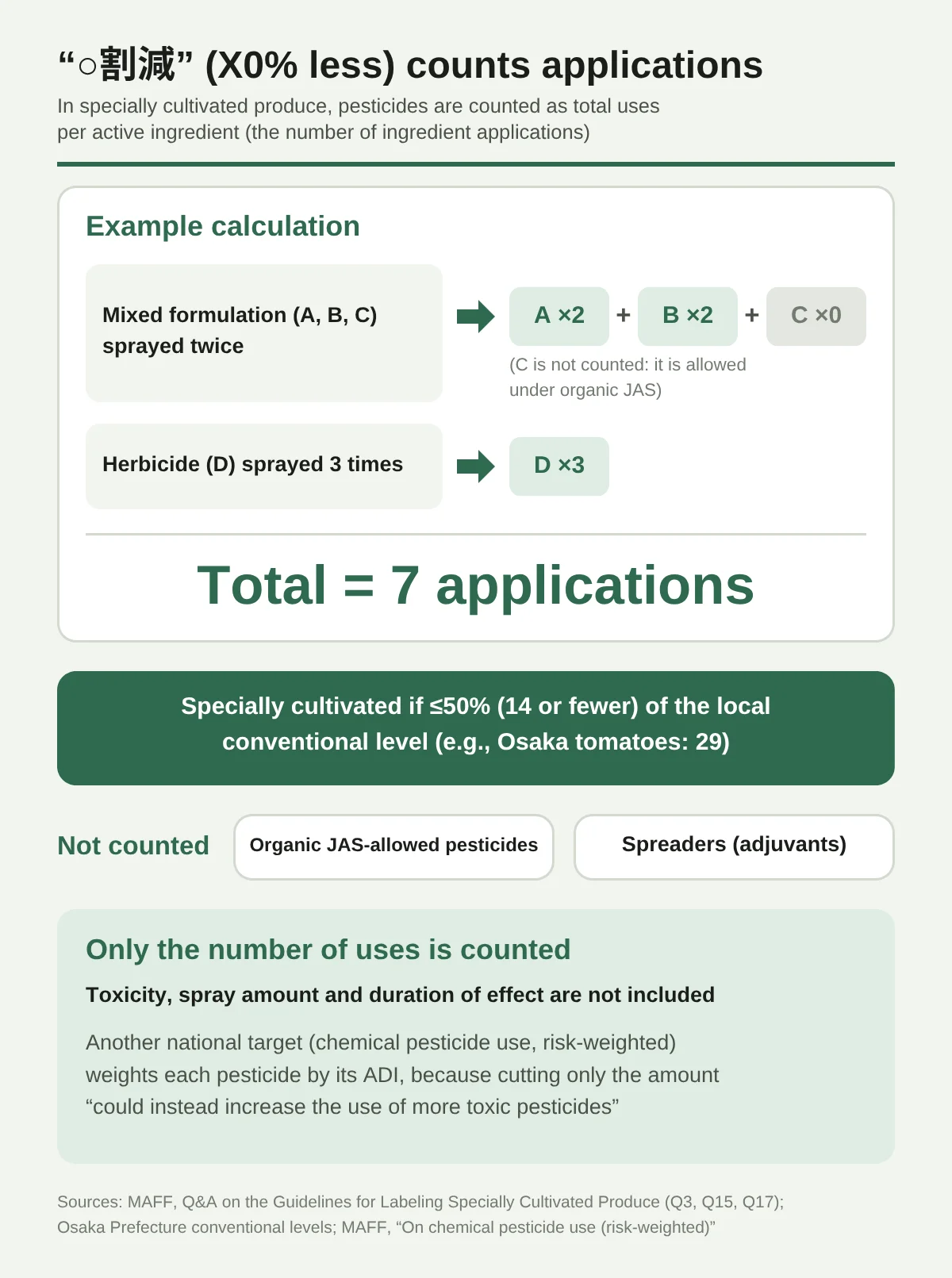
How it is counted: total applications per active ingredient
- The number of uses is counted per active ingredient of each pesticide sprayed. Besides herbicides, fungicides and insecticides, soil disinfectants applied before planting and seed disinfectants are also included (Q&A Q3).
- A pesticide that mixes two or more ingredients (a mixed product) is counted not by the number of sprays but by the total applications of each ingredient. For example, a 3-ingredient mixed product (one of the ingredients is a pesticide allowed under organic JAS) used twice, plus a herbicide used three times, comes to 2 + 2 + 0 + 3 = 7 times (Q&A Q15).
- Pesticides allowed under organic JAS (→ What does “pesticide-free” mean?) and spreaders (adjuvants) are not counted (Q&A Q11 and Q17). The pesticides that are counted are called “pesticides subject to reduction.”
“Ordinary” counts differ by region and crop
The “conventional level” used for comparison is set and published by prefectures and others for each region, crop and cropping type. In Osaka Prefecture’s example, eggplant and tomato are around 30 times and rice (paddy) is 14.
| Crop | Osaka | Aomori | Wakayama |
|---|---|---|---|
| Rice (paddy) | 14 times | 17 times | 20–22 times |
| Tomato | 29 times | 22 times | 30–44 times |
| Strawberry | 24 times | 40 times | 32 times |
| Cabbage | 18 times | 14–18 times | 16 times |
| Japanese pear | 19 times | 18 times | 23 times |
For crops split by cropping type (forced early cultivation, open field, and so on), the range is shown. Even for the same tomato, the number differs greatly by prefecture and cropping type, so “○% less” is a ratio against that region’s conventional level, not a way to compare counts across prefectures.
Does reduced pesticide mean “less amount but stronger pesticides”?
This is a common question, so we separate what is known from what is not.
- The standard counts only the number of applications: the Guidelines define it only as “the number of uses of pesticides subject to reduction.” There is no rule that weights by toxicity, amount sprayed (amount of active ingredient) or how long the effect lasts.
- A different national indicator does weight by toxicity: the national target under the “Strategy for Sustainable Food Systems, MeaDRI” (risk-converted use of chemical pesticides) says that a target that simply cut the amount could “instead increase the use of highly toxic pesticides,” so it counts ingredients with a smaller ADI more heavily (MAFF). This is not an explanation of the specially cultivated produce standard.
- There are techniques that cut the count with long-lasting applications: for example, Ibaraki Prefecture promotes a rice-growing guideline that combines fungicide and insecticide applied to seedling boxes (nursery-box treatments) with stink bug monitoring, and so on, bringing the ingredient-applications, herbicides included, to half the prefecture’s conventional level or less (5 to 8).
- What is not known: within what we checked this time, we found no public document or study showing that specially cultivated produce has been switched to “more toxic or longer-lasting pesticides.” Conversely, we found no document showing that toxicity has gone down.
The ingredient name, purpose and number of applications of the pesticides used must be shown on the label, in the store or on the web (Guidelines, Part 4, item 4). If you are curious, look up the ingredient in this database to check its toxicity class and ADI.
If you choose by counting applications
Food delivery services are a way to buy specially cultivated and organic JAS vegetables together. How far pesticides are reduced differs by company.
Comparison of the standards of 5 companies → Comparison of food delivery services
Sources
- MAFF, “Labeling guidelines for specially cultivated produce” (revised March 23, 2007), Part 3: Definitions (Japanese)
- MAFF, “Labeling guidelines for specially cultivated produce: Q&A” (June 2008), Q3, Q6, Q11, Q15, Q17 (Japanese)
- Osaka Prefecture, “List of conventional levels under the ‘Labeling guidelines for specially cultivated produce’” (Japanese)
- Aomori Prefecture, “Conventional values and certification standard values” (revised January 9, 2025) (Japanese)
- Wakayama Prefecture, “Certification standards for specially cultivated produce in Wakayama Prefecture,” Appendix Table 1 (Japanese)
- MAFF, “Chemical pesticide use (risk-converted) under the Strategy for Sustainable Food Systems, MeaDRI” (Japanese)
- 27th Agricultural Materials Council, Pesticide Subcommittee, Material 7-1 (June 28, 2021) (Japanese)
- Ibaraki Agricultural Center, “Guidelines for growing specially cultivated rice with reduced chemical pesticides and chemical fertilizers” (fiscal 2009, results to be passed on to extension work) (Japanese)
Last checked 2026-10-01. Systems and figures change over time. This page is a translation of our Japanese page; if they differ, the Japanese page is the reference.