
Comparing 5 additive-conscious grocery delivery services: trial sets, ongoing costs, and additive standards (2026)

PR This article contains ads. The Oisix and Radish Boya buttons are affiliate links (A8.net), the Co-op Shizenha and Sakanotochu buttons are affiliate links (A8.net), and the Co-op Kinki and Tabechoku buttons are affiliate links (Moshimo Affiliate). The buttons for the other services are plain links to official pages, not ads.
Grocery delivery services bring you organic vegetables and processed foods with fewer additives. You may be curious, but it is hard to tell “which one to choose” and “how much it will really cost if I keep using it.”
This article compares five representative services that promote additive-free and low-pesticide food:
- Oisix (オイシックス)
- Radish Boya (らでぃっしゅぼーや)
- Daichi o Mamoru Kai (大地を守る会)
- Palsystem (パルシステム) (consumer co-op)
- Seikatsu Club (生活クラブ) (consumer co-op)
The comparison uses only information on each company’s official pages. Trial set terms, ongoing costs, and the standards for produce and processed foods are set out in tables.
Bottom line: comparing through a “trial set” first is the surest way
- The three private companies (Oisix, Radish Boya, Daichi o Mamoru Kai) each offer a trial set for 1,980 yen (tax included, free shipping). All are a single delivery and do not automatically turn into a subscription. All three have a full-refund guarantee with conditions
- The co-op Palsystem has a trial set for 980 yen (tax included, free shipping). However, it is available only in 12 prefectures, including Tokyo and Kanagawa
- For Seikatsu Club, start with a free information request. Depending on the region, there are trial perks for people who request information
- When you keep using a service, private companies charge “annual fees and shipping,” while co-ops charge “a capital contribution (refunded when you leave) and a weekly fee.” Whether you pay in weeks when you place no order differs by service
- Each company publishes its standards for pesticides on produce and additives in processed foods. Some give numbers, such as Seikatsu Club limiting permitted additives to 93 items
Quick guide: who each service may suit
| Who it may suit | Service |
|---|---|
| You want meal kits to finish weekday cooking quickly | Oisix |
| You want seasonal food delivered, centered on vegetables | Radish Boya |
| You want to avoid additives in processed foods as much as possible | Daichi o Mamoru Kai, Seikatsu Club |
| You want a co-op that balances price and selection (Kanto, Koshinetsu, Shizuoka, Fukushima) | Palsystem |
| You want a co-op delivery service in the Kansai area (Shiga, Kyoto, Nara, Osaka, Wakayama) | Co-op Kinki |
| You want a co-op delivery service in Kansai or Shikoku with a lot of organic produce | Co-op Shizenha |
| You only want vegetable sets delivered, or want to buy directly from farmers | Sakanotochu, Tabechoku |
| You have small children and want to keep delivery fees down | All five have child-rearing discounts or perks (conditions in ongoing costs) |
*“Who it may suit” is Urayomi’s own summary based on the services described on each company’s official pages.
Trial set comparison
| Oisix | Radish Boya | Daichi o Mamoru Kai | Palsystem | Seikatsu Club | |
|---|---|---|---|---|---|
| Price (tax included) | 1,980 yen | 1,980 yen | 1,980 yen | 980 yen | Information request is free |
| Shipping | Free | Free | Free | Free (cash-on-delivery fee also free) | ― |
| Contents | 15 items including Kit Oisix, vegetables, and fruit | Vegetables, fruit, eggs, aburaage (fried tofu), bouillon, etc. | 15 items in all | Pork, ham, milk, yogurt, natto, etc. | Trial or sample perks, depending on region |
| Number of times | Once per household | Once for first-time customers | Once per household | One set, once per household | ― |
| Turns into a subscription automatically? | No | No (subscription is a separate sign-up) | No (single delivery) | ― | ― |
| Full-refund guarantee | Yes (with conditions) | Yes (with conditions) | Yes (with conditions) | ― | ― |
| Eligible area | ― | Free shipping nationwide | ― | Tokyo, Kanagawa, Chiba, Saitama, Ibaraki, Tochigi, Gunma, Fukushima, Yamanashi, Nagano, Shizuoka, Niigata | Seikatsu Club delivery areas in each region |
(Each company’s trial set sign-up page. Oisix checked September 28, 2026; the others checked September 29, 2026. Contents change with the season)
- The refund conditions in every case include contacting the company within 1 week of arrival and returning the product with at least half remaining (see each company’s sign-up page for details)
- The Radish Boya trial set can be paid for by credit card only. Daichi o Mamoru Kai accepts credit card or convenience-store payment
- Radish Boya and Daichi o Mamoru Kai say that when you apply for the refund guarantee, they may ask for details by phone or other means to improve quality
Ongoing costs
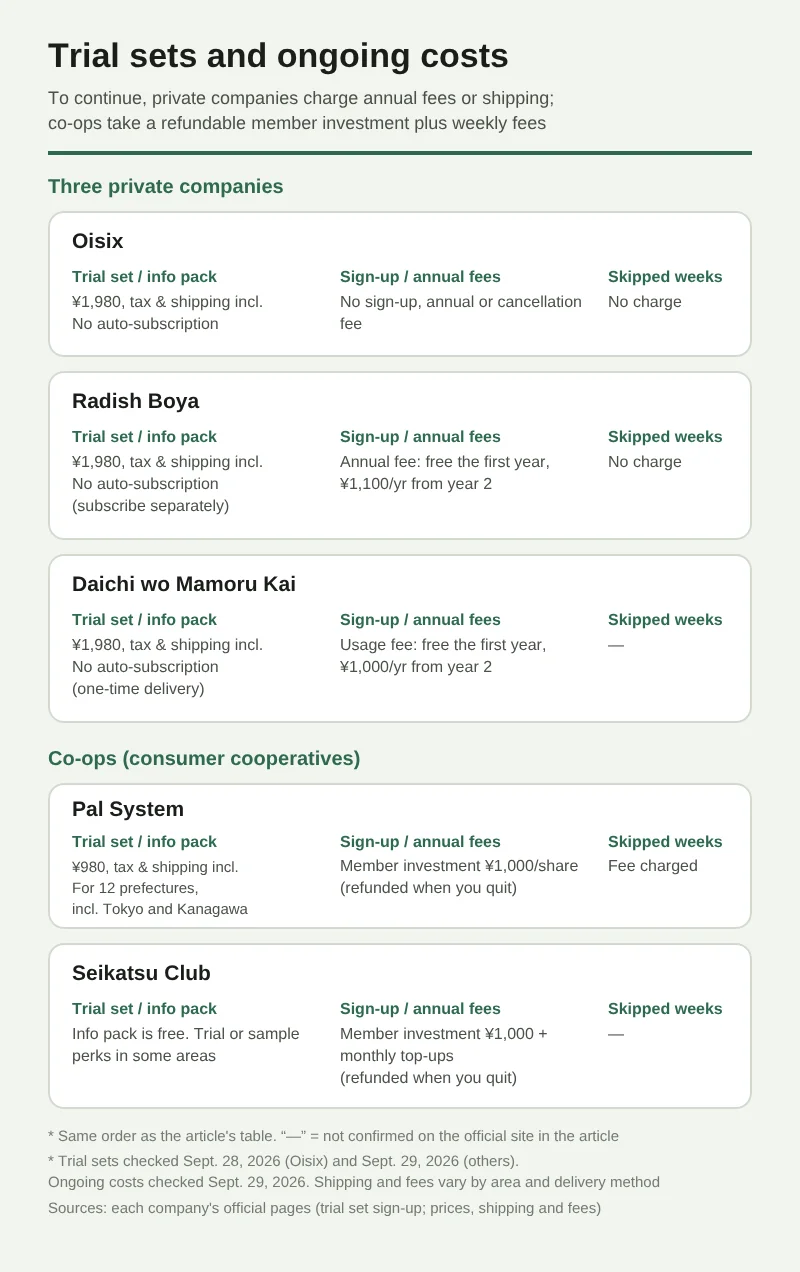
These are the costs other than the price of goods when you use a service regularly after the trial set.
| Oisix | Radish Boya | Daichi o Mamoru Kai | Palsystem | Seikatsu Club | |
|---|---|---|---|---|---|
| Enrollment fee, annual fee, etc. | No enrollment fee, annual fee, or cancellation fee | Annual fee: free the first year, 1,100 yen/year from the second year | Usage fee: free the first year, 1,000 yen/year from the second year | Capital contribution: 1,000 yen per unit (refunded when you leave) | Capital contribution 1,000 yen + monthly accumulated additional contributions (refunded when you leave) |
| Order amount at which shipping and fees become 0 yen | 6,500 yen or more before tax on Honshu (subscription members) | 6,500 yen or more before tax (delivery by dedicated vehicle) | 8,650 yen or more tax included | 12,000 yen or 15,000 yen or more tax included, depending on the region | Depends on the region (example: Seikatsu Club Chiba, 3,000 yen or more before tax) |
| Example of shipping and fees for small orders | Honshu: 600 yen for 4,499 yen or less before tax | 680-900 yen for under 3,000 yen before tax | Subscription members’ discount shipping: 350 yen for under 4,500 yen tax included | Tokyo and elsewhere: 248 yen for under 2,000 yen tax included | 110-275 yen per delivery |
| Weeks with no order | No charge | No charge | ― | Fee charged | ― |
| Child-rearing perks | ― | Baby perk: from pregnancy to under age 3, 0 yen delivery fee for orders of 4,500 yen or more before tax (up to 156 weeks) | ― | Depending on the region, 0 yen fee through the Baby perk or Kids perk, etc. | Depending on the region, the individual delivery fee is free for a set period |
(Each company’s official pages. Checked September 29, 2026. Shipping and fees vary by region and delivery method)
- Oisix subscription orders are confirmed automatically at 10:00 a.m. on the deadline day. If you don’t want a week’s delivery, cancel before the deadline
- Radish Boya also works by letting you check and change your basket by 10:00 a.m., 5 days before delivery (6-7 days before, depending on the region). You can set pauses up to about 8 weeks ahead
- Palsystem fees and discounts differ by regional co-op. Before joining, look at the table for your area
- A “―” in the table is an item that we could not confirm on the official pages for this article
Standards for produce and processed foods
| Produce standards (summary of official page wording) | Additive standards for processed foods (summary of official page wording) | |
|---|---|---|
| Oisix | Organic JAS certified cultivation, or chemically synthesized pesticides and chemical fertilizers at 50% or less of conventional farming in the area | Does not handle foods made with synthetic preservatives or synthetic colorings. Publishes additives in three groups: “allowed,” “use as little as possible,” and “not used” |
| Radish Boya | Its own standard, “RADIX.” Bans 120 ingredients among the pesticides the government permits. Handles only produce that meets standards equivalent to organic JAS or specially cultivated produce | “If it can be made without, don’t use it.” When used, limited to designated ones |
| Daichi o Mamoru Kai | Cultivation that does not rely on pesticides or chemical fertilizers. In addition to its own standards, audited by a third-party certification body following organic JAS audit methods | Food additives and genetically modified ingredients are, in principle, not used |
| Palsystem | Its own cultivation standards. “Core Food” is organic JAS certified; “Eco Challenge” uses chemically synthesized pesticides and chemical fertilizers at 1/2 or less of conventional farming | Of the roughly 1,500 or more substances approved as additives in Japan, about 20% are not used in making products |
| Seikatsu Club | Uses chemically synthesized pesticides and chemical fertilizers as little as possible. Its own residual pesticide standard aims for 1/10 or less of the national standard | Of the 803 items (excluding natural flavorings and general food additives), only 93 (about 1/8) are permitted |
(Each company’s official pages)
How standards are written differs by company. Wording like “X or less,” “in principle not used,” or “use as little as possible” may not mean zero. To find out what is used in each product, check the ingredient list (原材料名) on each company’s product page.
For Japan’s “organic JAS” and “specially cultivated” rules and how to read pesticides on vegetables, see the Oisix article and the vegetables and pesticides database. For the rules on “additive-free” (無添加) and “not used” (不使用) labeling, see the article on “additive-free” labeling rules.
Oisix
- Centered on the “Kit Oisix” meal kits, which are also included in the trial set
- The subscription service “Oisix Club” has no enrollment fee, annual fee, or cancellation fee. You are not charged in weeks with no order
- For subscriptions, the order is confirmed automatically at 10:00 a.m. on the deadline day
For Oisix’s produce standards, additive list, and subscription deadlines, see the Oisix article.
Radish Boya (らでぃっしゅぼーや)
- Under its own standard “RADIX,” bans 120 ingredients among the pesticides the government permits
- The trial set is the “Imperfect Food Trial Set” (ふぞろい食材おためしセット), which contains items such as irregularly shaped vegetables
- The annual subscription fee is free the first year and 1,100 yen/year from the second year. There is a baby perk for families with a child from pregnancy to under age 3
Daichi o Mamoru Kai (大地を守る会)
- States that food additives and genetically modified ingredients in processed foods are “in principle not used”
- Produce is audited by a third-party certification body following organic JAS audit methods
- The subscription members’ usage fee is free the first year and 1,000 yen/year from the second year. Shipping is 0 yen for orders of 8,650 yen or more, tax included
Palsystem (パルシステム)
- A co-op delivery service. You put down a capital contribution (1,000 yen per unit) when you join, and it is refunded when you leave
- Rice and fresh produce follow its own cultivation standards, “Core Food” and “Eco Challenge”
- The trial set is 980 yen (tax included, free shipping). It is available in 12 prefectures: Tokyo, Kanagawa, Chiba, Saitama, Ibaraki, Tochigi, Gunma, Fukushima, Yamanashi, Nagano, Shizuoka, and Niigata
- A fee is charged even in weeks with no order. Check the official help pages for how to take a break
Seikatsu Club (生活クラブ)
- A co-op delivery service. There is a 1,000 yen capital contribution on joining, plus monthly accumulated additional contributions after joining (refunded when you leave)
- It gives numerical standards, such as limiting permitted food additives to 93 items and aiming for a residual pesticide standard of 1/10 or less of the national standard
- The individual delivery fee is 110-275 yen per delivery (depends on the region). Start with a free information request
If you live in Kansai (Kinki)
Palsystem’s trial set is available in 12 prefectures in Kanto, Koshinetsu, Shizuoka, and Fukushima. In the Kinki region, there is delivery from the Co-op Kinki Federation (コープきんき事業連合), a group of regional co-ops.
- Seven co-ops: Shiga (Co-op Shiga), Kyoto (Kyoto Co-op), Nara (Nara Co-op), Osaka (Yodogawa Co-op, Osaka Pal Co-op, Izumi Co-op), and Wakayama (Wakayama Co-op)
- Delivery to your home once a week. Besides groceries, it also handles clothing and sundries
- Start with a free information request. Capital contributions and fees differ by co-op, so check the materials that arrive (Hyogo Prefecture is served by Co-op Kobe and is not one of these seven)
In Kinki and Shikoku, there is also delivery from Co-op Shizenha (コープ自然派).
- Delivery areas: Osaka, Hyogo, Kyoto, Nara, Shiga, and Wakayama, plus Tokushima, Kagawa, Ehime, and Kochi (some areas excluded; in Shiga, only some cities such as Otsu)
- A capital contribution is required when joining (¥5,000 in Osaka, Nara, and Wakayama; ¥3,000 in Kyoto and Shiga; ¥2,000 in Hyogo; ¥1,000 in Shikoku). It is returned when you leave
- The delivery fee for individual home delivery is ¥210–242 per delivery (tax included). In Osaka and Wakayama it becomes ¥260 from October 12, 2026
- It says it has its own voluntary standards: “do not use food additives whose safety is in doubt” and “do not use food additives that are not needed”
If you want vegetables delivered from farmers or small greengrocers
If you don’t need processed foods and only want vegetables delivered, there are also greengrocers that deliver vegetable sets and farm-direct mail-order services where you can buy directly from farmers.
How to get started
- Check the contents and ease of use with a trial set or an information request: The trial sets of the three private companies do not automatically become subscriptions, so you can compare before deciding
- If you continue, check the subscription deadline and the “cost for weeks with no order”: Some services confirm your order if you do nothing, and some charge a fee even in weeks with no order
- Families with small children should not forget to apply for perks: Many of the perks that make delivery fees or other fees 0 yen require an application
Frequently asked questions
Q. Can I buy only the trial set and not subscribe? A. The trial sets from Oisix, Radish Boya, and Daichi o Mamoru Kai are a single delivery and do not automatically become a subscription. A subscription is a separate sign-up (each company’s sign-up page).
Q. Can I order the trial set as many times as I like? A. All are for first-time customers, once per household (Radish Boya: once for first-time customers).
Q. Is a co-op’s “capital contribution” (出資金) returned? A. For both Palsystem and Seikatsu Club, it is refunded when you leave (withdraw from) the co-op.
Q. Is additive-free food good for your body? A. Urayomi does not write that. Food additives that the government has approved have gone through safety evaluation. Each company’s standards show “what is not used” and are material for choosing. For details, see the article on “additive-free” labeling rules.
Urayomi’s approach
Grocery delivery services differ considerably in both how they think about standards and how costs add up when you keep using them. Urayomi does not write which one is “safe” or “the best.” We value lining up the standards and prices each company publishes so that you can use them as material for choosing.
If you are unsure, we recommend first comparing the actual contents with a trial set that does not automatically become a subscription.
Sources
- Oisix: trial set sign-up page, “Product prices, shipping, and various fees,” “Oisix safety standards in detail,” help pages (checked September 28, 2026)
- Radish Boya: “Imperfect Food Trial Set” sign-up page, subscription course guide page, “Payment, delivery, and shipping,” “Baby perk and Egao Support,” “Environmentally conscious production standard RADIX” (checked September 29, 2026)
- Daichi o Mamoru Kai: “Trial Set” sign-up page, “Subscription member services,” “About shipping,” “Processed food handling standards,” “Vegetables: Our Promise of Peace of Mind” (checked September 29, 2026)
- Palsystem: “Quality Experience Trial Set” sign-up page, “Fees and discount programs,” “Cultivation standards,” help pages “How do you think about additives?” and “What is a capital contribution?” (checked September 29, 2026)
- Seikatsu Club: “Why not start with Seikatsu Club?,” “Reducing food additives,” “The system that supports the safety of Seikatsu Club products,” FAQ (checked September 29, 2026)
Prices, shipping, and the contents and conditions of trial sets change with the season and region. When you sign up, check each company’s official page.
Related articles and databases
- Reading Oisix’s Trial Set and Subscription Down to the Back Label: Vegetable Pesticide Standards, the Trial Set, and How Cancellation Works
- Were “無添加” (Additive-Free) Labels Banned? Reading the Consumer Affairs Agency Guideline’s 10 Types from the Back Label
- Why Did “No Chemical Seasoning” Disappear? Is Yeast Extract a Chemical Seasoning? How to Read Umami Seasonings and Hydrolyzed Protein
- Are Microwave Ovens Bad for You? History, How They Work, Use Around the World, Safety, Nutrition (vs. Boiling and Stir-Frying), the “Microwave Cover” Claim, and How to Use and Choose One
- Does Fruit Fructose Make You Gain Weight? How It Differs from the Fructose in “果糖ぶどう糖液糖” (High-Fructose Corn Syrup), and a Comparison of Sugar and Fiber in 22 Fruits
- Why Is Lung Cancer Rising When Fewer People Smoke? Smoking, Lung Cancer Types, and What You Can Do for Your Lungs, Checked Against National Data and Studies