
Why Did “No Chemical Seasoning” Disappear? Is Yeast Extract a Chemical Seasoning? How to Read Umami Seasonings and Hydrolyzed Protein

Until a little while ago, the words “化学調味料無添加” (“no chemical seasoning added”) were common on packages of dashi (soup stock) granules and soup bases. Recently, you hardly see this label anymore.
The reason is the “Guidelines on Labeling of Non-Use of Food Additives” that the Consumer Affairs Agency published in March 2022. The period for businesses to review their labels ran until the end of March 2024, and packages have been switched over.
In this article, based on laws and national materials, we sort out:
- Why the term “化学調味料” (“chemical seasoning”) stopped being used
- What “調味料(アミノ酸等)” (“seasoning (amino acids, etc.)”) on the package stands for
- Whether yeast extract and hydrolyzed protein are additives
- How “additive-free” labels relate to umami ingredients
- Safety evaluations, and how labeling differs between Japan and overseas
Conclusion: “化学調味料” is not a term in the law
- “化学調味料” (“chemical seasoning”) was a term once used in the JAS standard, and it was deleted in 1989 (Heisei 1). It has never been used in the Food Labeling Standards. The Consumer Affairs Agency’s guidelines list labels that combine words such as “chemical,” “artificial,” “synthetic,” and “natural” with “additive-free” or “non-use” as examples highly likely to mislead (type 2)
- “調味料(アミノ酸等)” on the package is a label that groups together umami seasonings (food additives) such as monosodium glutamate
- Yeast extract and hydrolyzed protein are not additives for labeling purposes but “foods,” and are written in the ingredient section. Both contain a lot of amino acids and other umami components
- The guidelines also list labeling “調味料(添加物)不使用” (“no seasoning (additive) used”) on foods that use extracts containing amino acids as an example highly likely to mislead (type 5)
- Monosodium glutamate is permitted for use by the international body (JECFA), the U.S. (FDA), and the EU (EFSA) alike. In 2017 the EU set an acceptable daily intake (ADI) and said it may be exceeded by people with high intake
- In the U.S., foods that use yeast extract or hydrolyzed protein cannot be labeled “No MSG”
The history of the term “化学調味料”
“化学調味料” has long been used as a word for monosodium glutamate and the like. The Consumer Affairs Agency’s guidelines say this about the term:
The term “chemical seasoning” was once used in the JAS standard, but it was deleted in 1989 (Heisei 1) and has never been used in the Food Labeling Standards.
The Food Labeling Standards require, in principle, that all additives be labeled, without distinguishing between those made by chemical synthesis and natural ones. The words “artificial” and “synthetic” were also deleted from the Food Labeling Standards in July 2020.
On that basis, the guidelines say that using words such as “chemical,” “artificial,” “synthetic,” and “natural” together with “additive-free” or “non-use” may lead people who have a good or bad impression of those words to believe the product is better than it actually is (type 2). The example given is “人工甘味料不使用” (“no artificial sweeteners”).
The Japan Glutamate Association (日本うま味調味料協会) explains that “化学調味料” is not used as an administrative term and is a word with no definition. In the industry, the name “うま味調味料” (umami seasoning) is now used.
How to read “調味料(アミノ酸等)” on the package
Food additives are, in principle, written by substance name. However, 14 kinds, including seasonings, flavorings, and emulsifiers, can be written together under a name for their type called a “group name” (一括名).
The group name “調味料” (seasoning) is written differently depending on the contents.
| Label | Contents | Main examples |
|---|---|---|
| 調味料(アミノ酸) (seasoning (amino acids)) | Amino acids only | Sodium L-glutamate (the umami of kombu kelp) |
| 調味料(核酸) (seasoning (nucleic acids)) | Nucleic acids only | Disodium 5’-inosinate (the umami of bonito flakes), disodium 5’-guanylate (the umami of dried shiitake) |
| 調味料(有機酸) (seasoning (organic acids)) | Organic acids only | ― |
| 調味料(無機塩) (seasoning (inorganic salts)) | Inorganic salts only | ― |
When two or more kinds are combined, “等” (“etc.”) is added to the name of the main one. The one you see most, “調味料(アミノ酸等)”, is amino acids combined mainly with nucleic acids and the like.
- The label categories follow Consumer Affairs Agency materials. The correspondence between umami components and ingredients follows the explanation of the Japan Glutamate Association.
How umami seasonings are made
According to the U.S. FDA, monosodium glutamate is now made by fermentation, from starch, sugar beet, sugarcane, and molasses. The FDA explains that the method of fermentation is similar to that used for yogurt, vinegar, and wine.
Some of the microorganisms used for fermentation are made by genetic modification. In Japan, after the Food Safety Commission of Japan (FSCJ) confirmed, among other things, that “the microorganisms made and the by-products of fermentation have been removed, and the product is highly purified as crystals,” these are notified to the Consumer Affairs Agency as “highly purified additives” (the Agency publishes a list of notifications). The rules for labeling genetic modification are also covered in our article on isomerized sugar.
Yeast extract and hydrolyzed protein are treated as “foods”
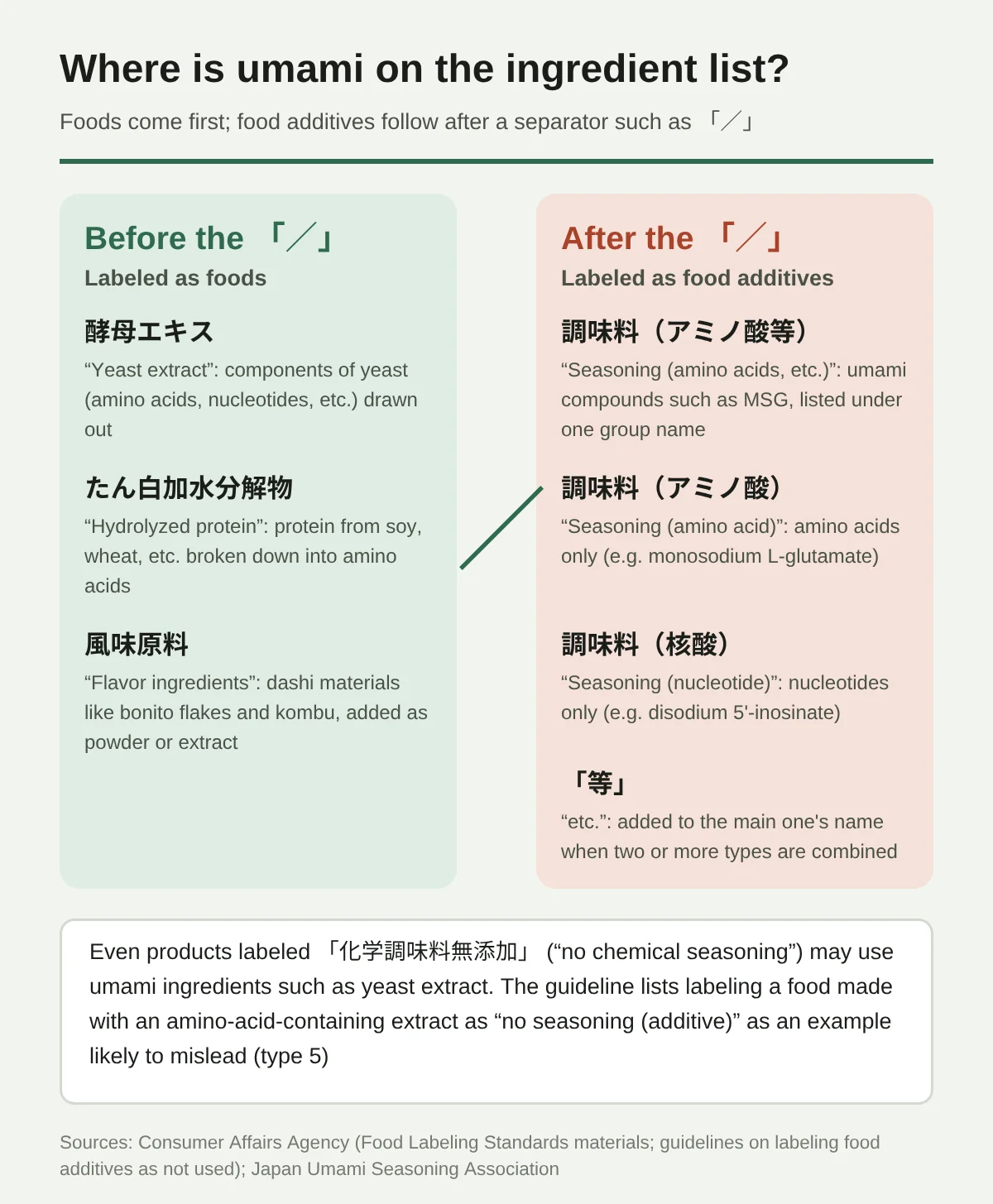
Umami ingredients are not limited to umami seasonings. Comparing the four you often see on the package:
| Label on the package | Category for labeling | Where it is written | What it is |
|---|---|---|---|
| 調味料(アミノ酸等) (seasoning (amino acids, etc.)) | Food additive | After the slash (or in the additives section) | The umami components themselves, such as monosodium glutamate |
| Yeast extract (酵母エキス) | Food | Ingredient section | Components (amino acids, nucleic acids, etc.) taken out from inside yeast |
| Hydrolyzed protein (たん白加水分解物) | Food | Ingredient section | Protein from soybeans, wheat, and the like broken down into amino acids (methods include breakdown with hydrochloric acid) |
| Flavor ingredients (風味原料) (bonito flakes, kombu kelp, etc.) | Food | Ingredient section | Materials used in dashi granules. They come in powder or extract form |
In the ingredient section, ingredients other than additives are written first, and additives after them, separated by a slash or the like. Yeast extract and hydrolyzed protein are foods, so they are written before the slash.
What was pointed out at the review committee
At the Consumer Affairs Agency’s review committee held before the guidelines (the Study Group on the Food Additive Labeling System), the following points were raised about “化学調味料無添加” products.
- Consumer Affairs Agency material: From interviews with businesses, they use yeast extract or hydrolyzed protein in place of the additives glutamic acid and nucleic acids
- Report by the Japan Glutamate Association: Of 543 products labeled “化学調味料無添加,” 60 to 70% do not use glutamic acid or nucleic acids but have food ingredients containing much of the same components do the job of umami seasoning
- The figure of 543 products was reported at the committee by an industry group (the Japan Glutamate Association); it is not a Consumer Affairs Agency survey.
Types 2 and 5 of the guidelines
The guidelines divide “additive-free” and “non-use” labels that may mislead into 10 types. Two mainly relate to umami labeling.
| Type | Content | Example in the guidelines |
|---|---|---|
| Type 2 Labels using terms not defined in the Food Labeling Standards | Using words not in the standards together with “additive-free” or “non-use” | Labels using words such as artificial, synthetic, chemical, and natural, like “人工甘味料不使用” (“no artificial sweeteners”) |
| Type 5 Labels on foods that use ingredients with the same or similar function | Saying “no ○○ used” while using an ingredient that does the same job as ○○ | Indicating that no additive seasoning is used on a food that uses, as an ingredient, an extract containing amino acids |
On type 5, the guidelines say that if the ingredient used instead is not clearly shown, consumers may not realize that it is that ingredient doing the work, and may take it to be the work of other ingredients.
The guidelines also do not ban “additive-free” and “non-use” labels across the board. They can be used if they are based on fact, make clear what is not used, and do not mislead. The full 10 types are introduced in our article on the rules for “additive-free” labels.
How consumers saw it
In the Consumer Affairs Agency’s fiscal 2017 survey (10,000 people):
- People who always buy, or choose within the same type of product, foods with labels such as “additive-free” totaled 51.2%
- Of those, 72.9% gave “because it seems safe and good for health” as their reason for choosing
- On seeing a “○○ additive-free” label, 17.8% got the impression that not only that additive but no additives at all are used, and 36.5% got the impression that there are fewer additives than in other products
Because the government permits additives after evaluating their safety, the guidelines also list labels in which a business on its own links “additive-free” to “safe” or “good for you” as examples highly likely to mislead (type 6).
How labels changed
Examples of makers that dropped the “化学調味料” label.
- Kayanoya Dashi (Kubara Honke): The maker explains that it is reviewing its packaging because the wording “化学調味料” can no longer be used under the guidelines. On the same page, it also explains that it uses no umami seasoning, which is a food additive at all, and that yeast extract is a food, not a food additive, and is used to bring out the flavor of the main ingredients
- Yuki Foods’ Gara Soup: The product name changed from “化学調味料無添加のガラスープ” (“Gara Soup with no chemical seasoning added”) to “やさしい味わいのガラスープ” (“Gara Soup with a gentle flavor”). The maker’s notice says it also switched the salt from China-made to domestically made, and that the allergen milk ingredient is gone (the notice gives neither a date nor the reason for the rename). The current product site name is “うま味調味料無添加 やさしい味わいのガラスープ” (“Gara Soup with a gentle flavor, no umami seasoning added”)
Both examples replace “化学調味料” with the word “うま味調味料” (umami seasoning).
Comparing the backs of dashi granules
Even for the same “dashi,” the way umami is added differs by product. We lined up the ingredient lists from the makers’ official pages as they are labeled (checked September 29, 2026).
PR This table contains links to Rakuten Ichiba affiliate ads (“See on Rakuten”). The products shown and their order are decided regardless of whether there are ads. The “See on Amazon.co.jp” and “See on Yahoo! Shopping” links are also affiliate links.
| Product (maker) | Ingredient list (as shown on the maker’s official page) | Umami seasoning (additive) | Yeast extract | Maker’s labeling |
|---|---|---|---|---|
| Hondashi (Ajinomoto) See on Rakuten (楽天24) PR See on Amazon.co.jp PR See on Yahoo! Shopping PR |
Salt (made in Japan), sugars (sugar, lactose), flavor ingredients (bonito flake powder, bonito extract), yeast extract, yeast extract fermented seasoning / 調味料(アミノ酸等) (seasoning (amino acids, etc.)) | Yes (調味料(アミノ酸等)) | Yes | ― |
| Kayanoya Dashi (Kubara Honke) See on Rakuten (久原本家公式) PR See on Amazon.co.jp PR See on Yahoo! Shopping PR |
Flavor ingredients [bonito flakes (made in Japan), dried sardine extract powder, grilled flying fish (ago), urume sardine flakes, kombu kelp], starch hydrolysate, yeast extract, salt, powdered soy sauce, fermented seasoning, (contains wheat and soybeans) | No | Yes | No umami seasoning, which is a food additive, is used at all (official page) |
| Sozairyoku Dashi Hon-Katsuo Dashi (Riken Vitamin) See on Rakuten (ザグザグ) PR See on Amazon.co.jp PR See on Yahoo! Shopping PR |
Flavor ingredients (made in Japan) (bonito flake powder, bonito flake extract powder, bonito extract powder, kombu kelp powder), starch hydrolysate (made in Japan), yeast extract powder, maltose | No | Yes | No “salt” added (official page) |
| Awase Dashi Pack (Marutomo) See on Rakuten (マルトモ公式) PR |
Dried sardines (niboshi) (made in Japan), dried horse mackerel, bonito flakes, soda bonito flakes, mackerel flakes, shiitake, kombu kelp | No | No | ― |
“See on Rakuten” links are affiliate ads (PR). If the maker has an official store on Rakuten Ichiba, they lead to it; if not, to a seller that carries the single item (checked September 29, 2026). Some products come in different sizes. Ingredients may change with a renewal, so check the label of the product in your hand when you buy.
- For granulated dashi, Hondashi uses both the additive umami seasoning and yeast extract, while Kayanoya Dashi and Sozairyoku Dashi do not use umami seasoning but do use yeast extract
- Marutomo’s Awase Dashi Pack, a dashi pack, is made of only fish flakes, dried sardines, shiitake, and kombu kelp. It is a tea-bag type from which you extract the dashi (it is not the kind you dissolve directly like granules)
The point is not which is good or bad, but that what is adding the umami can be read from the ingredient list on the package.
What is known about safety
Evaluations by international bodies and overseas
| Agency | Evaluation |
|---|---|
| JECFA (the FAO/WHO Joint Expert Committee on Food Additives) | In 1988, “ADI not specified” for glutamic acid and its salts (an evaluation that, at normal use, there is no need to set a numerical upper limit) |
| EFSA (the European Food Safety Authority) | In its 2017 re-evaluation, set a group ADI of 30 mg/kg body weight/day for glutamates (E 620 to 625). It also said that people whose diets are high in these, and toddlers and children, may exceed the ADI, and recommended a review of the EU’s use limits |
| FDA (the U.S. Food and Drug Administration) | Regards the addition of monosodium glutamate to food as “generally recognized as safe” (GRAS) |
EFSA’s ADI is based on the maximum amount at which no adverse effects were seen in animal studies. EFSA says this ADI is lower than the amounts at which effects were seen in humans, such as headache, increased blood pressure, and increased insulin.
The FDA estimates that the average adult takes in about 13 g of glutamate a day from the protein in food and about 0.55 g a day of added monosodium glutamate. It also explains that the glutamate formed when protein in food is broken down is chemically the same as the glutamate in monosodium glutamate.
“Chinese restaurant syndrome”
Complaints of headache or facial flushing after eating monosodium glutamate have been called “Chinese restaurant syndrome.” Trials in people have given the following results.
- A double-blind trial (multicenter, 2000) of people who believe they react to monosodium glutamate: with large doses not taken with food, symptoms were reported more often than with placebo, but the reactions were rare, inconsistent, and not reproducible. When given with food, no difference was seen
- A systematic review on headache (2016): in trials where it was taken with food, there was no difference in how likely headache was, except in the female group of one trial. However, because of inadequate blinding in the trials and other issues, it says further research is needed to judge whether there is a causal relationship
- The FDA cites a report compiled in the 1990s by the Federation of American Societies for Experimental Biology (FASEB). While saying monosodium glutamate is safe, the report says that when sensitive people take 3 g or more without food, temporary mild symptoms such as headache, numbness, and flushing can occur. The FDA says the amount in one serving of food with monosodium glutamate added is usually less than 0.5 g
Hydrolyzed protein and “3-MCPD”
In hydrolyzed protein made by breaking down plant protein with hydrochloric acid (amino acid liquid and the like), the small amount of fat in the raw material can react with the chlorine in the hydrochloric acid to form a substance called 3-MCPD (chloropropanols).
According to MAFF:
- In Japan, measures to reduce 3-MCPD have been advanced by adding a step of making the amino acid liquid alkaline and heating it (alkali treatment)
- Honjozo (naturally brewed) soy sauce, which accounts for more than 80% of Japan’s soy sauce production, does not use amino acid liquid, so 3-MCPD is below the limit of quantification
- In a fiscal 2021 survey, even assuming continued consumption of products with high concentrations, intake was about one tenth of the provisional tolerable intake the international body (JECFA) set in 2016 (4 μg/kg body weight/day), which it calls sufficiently low
If the ingredient list of a soy sauce says “アミノ酸液” (“amino acid liquid”), it is a soy sauce that uses amino acid liquid. How to read the back of a soy sauce is introduced in our Marunaka Shoyu article.
Differences between Japan and overseas
| Japan | U.S. | EU | |
|---|---|---|---|
| Labeling of monosodium glutamate | Can be written under the group names “調味料(アミノ酸)” or “調味料(アミノ酸等)” | Must be written “monosodium glutamate.” It cannot be included under “spices and flavoring” | After the functional class name “Flavour enhancer,” the substance name or E number is written (example: flavour enhancer E 621) |
| “Non-use” labels on foods using yeast extract or hydrolyzed protein | The guidelines’ type 5 (examples highly likely to mislead) includes “no seasoning used” labels on foods that use extracts containing amino acids | Cannot be labeled “No MSG” or “No added MSG” (FDA) | ― |
| Evaluation of acceptable daily intake | ― | GRAS | Group ADI 30 mg/kg body weight/day (2017) |
| Use limit | ― | ― | In principle up to 10 g per kg of food (no numerical upper limit for salt substitutes, seasonings, and the like; used within good manufacturing practice) |
- EU labeling is from Regulation (EU) No 1169/2011 Annex VII Part C; the limit is as of EFSA’s 2017 announcement.
The U.S. FDA does not allow “No MSG” labels on foods that use hydrolyzed protein, yeast extract, soy extract, and the like, on the grounds that these naturally contain glutamate. It is a rule close in thinking to Japan’s type 5.
Points for checking the package
- For “調味料(アミノ酸等),” look after the slash (the additives section): Here you can tell whether an umami seasoning (additive) is used
- Look before the slash, at yeast extract, hydrolyzed protein, and ○○ extract (○○エキス): Even when no umami seasoning is used, umami may be added by these ingredients. All are foods for labeling purposes
- Old “化学調味料無添加” labels are leftovers from the review period that ran until March 2024: Products made during the review period may still be on store shelves afterward
- “うま味調味料不使用” (“no umami seasoning used”) does not mean “no umami-adding ingredient is used at all”: Read it together with the ingredient section
- Don’t judge by the size of the “○○無添加” text: The guidelines also list labels that stress “additive-free” so much that they get in the way of seeing the group name labeling as examples that may mislead (type 10)
- If you want to choose products with few ingredients, look at the number and content of the ingredients: Some, like dashi packs, are made only of raw materials
Urayomi’s approach
To sum up so far:
- “化学調味料” is not a term in the law, and “化学調味料無添加” labels were reviewed under the guidelines
- Umami seasonings are labeled as additives, and yeast extract and hydrolyzed protein as foods. Both add umami components such as amino acids to food
- Monosodium glutamate is permitted for use in each country. On the other hand, the EU’s EFSA set an ADI, said it may be exceeded by people with high intake, and recommended a review of the use limits
At Urayomi we write neither that umami seasoning is “dangerous” nor that yeast extract is a “safe substitute.” We value making it possible to read from the label what is adding the umami.
On that basis, we write product pages in the following way:
- A maker’s “○○不使用” (“no ○○ used”) is quoted as it is, as the maker’s labeling
- For yeast extract and hydrolyzed protein, we write their role (adding umami) as ingredients
Also worth knowing
- Additives within ingredients may not be written on the package → Article on carryover
- “Flavoring” (香料) is also a group name that can be written as a single word → Article on flavorings
- Even with “no preservatives,” additives for keeping quality may be included → Article on preservatives
- Labels for “zero” and “additive-free” sweeteners → Article on sweeteners
- Overseas rules for each additive → Additives database
Sources
- Consumer Affairs Agency, “Guidelines on Labeling of Non-Use of Food Additives” (March 30, 2022) / “Guidelines on Labeling of Non-Use of Food Additives: 10 Types to Watch for When Creating Labels” / awareness leaflet
- Consumer Affairs Agency, “Review of the Discussion on Non-Use Labeling of Food Additives” (material of the Study Group on Guidelines for Non-Use Labeling of Food Additives, March 2021; includes an excerpt of the fiscal 2017 consumer intention survey)
- Consumer Affairs Agency, “Issue 3: How ‘Additive-Free’ and ‘Non-Use’ Labels Should Be” (material of the Study Group on the Food Additive Labeling System, September 2019)
- Consumer Affairs Agency, “On Labeling of Food Additives” (material of the Study Group on the Food Additive Labeling System, August 2019; includes how to label the group name “seasoning”)
- Japan Glutamate Association, “Request on the Food Additive Labeling System” (material of the same study group, June 2019) / “The ‘Guidelines on Labeling of Non-Use of Food Additives’ Have Been Published”
- Food Safety Commission of Japan, “Evaluation Report on Genetically Modified Foods, Sodium L-Glutamate Produced Using Strain GLU-No.10” (2019)
- Consumer Affairs Agency, “List of Highly Purified Additives Notified under Article 3, Paragraph 6 of the Procedures for Safety Assessment of Foods and Additives Produced by Recombinant DNA Technology”
- MAFF, “Formation of Chloropropanols and Related Substances in Food” / “Domestic Efforts to Reduce Chloropropanols and Related Substances in Food”
- JECFA “Glutamic acid and its salts” (WHO Food Additives Series 22, 1988)
- EFSA “EFSA reviews safety of glutamates added to food” (July 12, 2017) / EFSA Journal 2017;15(7):4910
- U.S. FDA “Questions and Answers on Monosodium glutamate (MSG)”
- Regulation (EU) No 1169/2011 Annex VII Part C
- Geha RS et al. Multicenter, double-blind, placebo-controlled, multiple-challenge evaluation of reported reactions to monosodium glutamate. J Allergy Clin Immunol. 2000 (PubMed)
- Obayashi Y, Nagamura Y. Does monosodium glutamate really cause headache? : a systematic review of human studies. J Headache Pain. 2016 (PubMed)
- Official pages of each maker (Ajinomoto “Hondashi,” Kubara Honke “Kayanoya Dashi,” Riken Vitamin “Sozairyoku Dashi Hon-Katsuo Dashi,” Marutomo official direct sales “Awase Dashi Pack,” Yuki Foods “Renewal Notice”). Checked September 29, 2026
This article explains labeling rules and does not judge the safety or danger of any particular food or additive. If you have a food allergy, always check the product’s label, and if anything is unclear, ask the manufacturer or seller.
Related articles and databases
- What is carryover? How it differs from processing aids, and the additives that are not listed on labels even on “additive-free” foods
- Are Flavorings Bad for You? What “香料” (Flavoring) Contains, Why It Is Written as One Word, and Japanese vs. Overseas Rules
- Are preservatives bad for you? Types such as sorbic acid, what “preservative-free” hides, and how Japanese and overseas rules differ
- Are Artificial Sweeteners Bad for You? Aspartame and Cancer, What “Zero Calorie” and “Zero Sugars” Really Mean, and Japanese vs. Overseas Rules
- What Is “果糖ぶどう糖液糖” (High-Fructose Corn Syrup)? Is It Worse for You Than Sugar? How It Differs From Sugar, and Corn and Genetic Modification
- What Is Monosodium Glutamate (Umami Seasoning)? Checking the Claims About Petroleum, GMOs, Intake Limits, and a "Damaged Sense of Taste"
- What Is Nam Pla (Fish Sauce)? How It Is Made, How It Differs from Shottsuru, Ishiru, and Ikanago Soy Sauce, and Its Salt and Histamine Checked Against International Standards and Japan's Food Composition Tables
- What Is Doubanjiang? How Sichuan’s Pixian Doubanjiang Differs from Japanese and Taiwanese Versions, with Salt, Mold Toxin, and Histamine Checked Against Official Sources
- Where Does “Too Much Salt” Begin? Checking Japan’s Salt Intake Trend, Target Amounts, and the Links to High Blood Pressure and Stomach Cancer Against National Surveys and Studies
- Thyroid Cancer: Symptoms, Types, Rates in Japan and Abroad, the Effects of Iodine (Kombu) and Radiation, and Thyradin, TSH, Thyroglobulin and Tumor Markers
- Comparing 5 additive-conscious grocery delivery services: trial sets, ongoing costs, and additive standards (2026)
- Were “無添加” (Additive-Free) Labels Banned? Reading the Consumer Affairs Agency Guideline’s 10 Types from the Back Label
- 添加物データベース