
Hon-Mirin vs. Mirin-Style Seasoning and Fermented Seasoning: History, Liquor Tax, Does Alcohol Burn Off When Heated?, Ingredients and Sugar, How to Choose

PR This article contains affiliate links to Rakuten Ichiba, Amazon, Yahoo! Shopping and A8.net (“See on Rakuten”, etc.). What we write is based on official documents and research papers, whether or not there is an ad. The “See on Amazon.co.jp” links are also affiliate links.
On the seasoning shelf of a Japanese supermarket, you will see bottles with very similar names: “本みりん” (hon-mirin, or true mirin), “みりん風調味料” (mirin-style seasoning), “みりんタイプ” (mirin type) and “発酵調味料” (fermented seasoning). The prices differ, whether they contain alcohol differs, and even the shelf they sit on differs.
You also often hear stories and assumptions like these.
- “Hon-mirin is made only from glutinous rice, rice koji and shochu.”
- “Mirin-style seasoning is cheap and bad for your health.”
- “Heating burns off all the alcohol, so it is fine to cook with for children.”
- “Fermented seasoning (mirin type) adds salt to get around liquor tax.”
- “The real hon-mirin has more careful labeling.”
In this article, we check the following against laws, National Tax Agency (NTA) documents, MEXT’s food composition tables and research papers.
- When and where did mirin first appear? Why did a drink become a seasoning?
- How do hon-mirin, mirin-style seasoning and fermented seasoning differ in how they are made, in law, in tax and in where they are sold?
- What must, and need not, be written on a “本みりん” label?
- How much alcohol remains after heating? How should children, pregnant people and people who do not drink think about it?
- How different are the sugar and salt in one tablespoon?
- How should you choose and use them?
For soy sauce, see our article on types of soy sauce. For sake and shochu as drinks, see our article on how sake is brewed and our article on types of shochu.
Conclusions
- Mirin was originally a “sweet alcoholic drink.” It first appears in writing as “蜜淋酎” in the 1593 diary 『駒井日記』 (Komai Nikki), and the character form “味醂” first appears in 1614. In the late Edo period it came to be used for grilled eel (kabayaki) and soba dipping sauce, and became a seasoning.
- Hon-mirin is “mirin” under the Liquor Tax Act, and it is an alcoholic beverage. Alcohol is about 14%. Mirin-style seasoning is a seasoning with under 1% alcohol, and fermented seasoning (mirin type) is a seasoning made undrinkable by adding salt. Neither is an alcoholic beverage.
- “Hon-mirin = rice only” is not always true. Under the law, glucose and starch syrup may be used up to 2.5 times the weight of the rice. Some hon-mirin lists “糖類” (sugars), so it is worth reading the ingredient list (原材料名).
- Under today’s rules, the “real” hon-mirin has fewer labeling duties. Because it is an alcoholic beverage, it does not need an ingredient list, allergens or country of origin, and may omit the best-by date, storage method and nutrition facts. Mirin-style seasoning and fermented seasoning must show all of these. Consumption tax also differs: 10% for hon-mirin and 8% for mirin-style seasoning.
- Liquor tax on hon-mirin is ¥20 per liter. Before the 1962 revision it was ¥140 per liter. It has not changed since 2006 and is one-fifth that of sake. Taxed domestic hon-mirin peaked at 158,000 kL in fiscal 1999 and was 94,000 kL in fiscal 2024.
- Heating does not bring alcohol to zero. In a US Department of Agriculture table, 85% remains if you add it to a boiling pot and turn off the heat at once, 40% after simmering 15 minutes, and 5% after 2.5 hours. One tablespoon of hon-mirin holds about 1.7 g of pure alcohol, about one-twelfth of a 500 mL beer.
- Per tablespoon, the energy of hon-mirin and mirin-style seasoning is almost the same (42–43 kcal). Carbohydrate (sugar) is about 1.4 times higher in mirin-style seasoning, and only fermented seasoning has salt, about 0.3 g per tablespoon.
- Most research on hon-mirin’s “shine (teri), keeping food from falling apart, and masking odors” comes from researchers at mirin makers (Takara Shuzo and Kikkoman). “三河みりん” (Mikawa mirin) is not a Geographical Indication (GI), and “純米本みりん” (junmai hon-mirin) and “本格みりん” (honkaku mirin) have no legal definition.
What we introduce in this article
| What we introduce | When it helps | Where in the article |
|---|---|---|
| 三州三河みりん 700ml (角谷文治郎商店) | When you want a hon-mirin made only from rice, rice koji and shochu | If you want a hon-mirin made only from rice, rice koji and shochu |
| 白扇酒造 福来純 伝統製法 熟成本みりん 500ml | Same as above. When you want to try an aged hon-mirin | If you want a hon-mirin made only from rice, rice koji and shochu |
| 九重味淋 本みりん 九重櫻 | Same as above. When you want a larger amount | If you want a hon-mirin made only from rice, rice koji and shochu |
How did mirin come about?
Mirin has a history of about 430 years. At first it was a “rare sweet alcoholic drink,” and it became a seasoning only from the late Edo period.
The oldest record is “蜜淋酎” in 1593
According to an NTA survey report on the history of alcoholic beverages, mirin appears in writing from the end of the Sengoku period into the Azuchi-Momoyama period.
| Year | Document | What it says |
|---|---|---|
| 1586–1592 | 『宗湛日記』 (Sotan Nikki; records of tea gatherings by Kamiya Sotan, a rich merchant of Hakata) | A letter from Kuroda Josui to Sotan mentions “密林酒” |
| 1593 | 『駒井日記』 (Komai Nikki; a diary about the Toyotomi family) | A record of presenting “蜜淋酎” as a gift |
| 1614 | 『鹿苑日録』 (Rokuon Nichiroku; a diary of Rokuon-in at Shokoku-ji, Kyoto) | The first appearance of “味醂,” the same characters used today |
After this, various other characters were used, such as “美醂酒,” “蜜醂酒” and “蜜琳酒.” At that time, mirin was drunk in the upper classes, such as court nobles, samurai families and temples, as a sweet, rare alcoholic drink given as a gift (NTA survey report).
Did it come from China? Was it born in Japan?
There are two theories about how mirin began (Yamashita 1991, Journal of the Brewing Society of Japan).
| Theory | Content |
|---|---|
| Brought from China | China had a sweet alcoholic drink called “蜜淋 (mi-lin),” which reached the Ryukyus and Kyushu around the Sengoku period. “淋” means “to drip,” and it is read as a sweet drink like dripping honey. |
| Born in Japan | Japan had long had sweet drinks such as nerizake and shirozake (the 1466 『蔭凉軒日録』 mentions “練貫酒” in Hakata). They spoiled easily, so shochu was added, and that became mirin. |
Citing Yamashita’s discussion, the NTA report says the most reasonable view is that a Ming-dynasty Chinese method of “adding shochu partway through the moromi (fermenting mash) to leave a lot of sugar” was brought over and changed in Japan to “adding shochu from the start.” The reason is that for most of the Edo period, nerizake and shirozake were made with sake, not shochu, so it is hard to think mirin was born from nerizake. The report says this change made it possible for mirin to reach 40% or more sugar, compared with 20–30% in the Chinese sweet drink.
- The 1649 『貞徳文集』 (Teitoku Bunshu) describes mirin, along with grape wine and shochu, as something that “came from abroad.”
- The distillation method for shochu, which mirin depends on, reached the Ryukyus in the 15th century, and the oldest written “焼酎” in Kyushu dates from 1559.
Note that the NTA report and Kikkoman’s explanation differ on the name of the Chinese sweet drink and the name of the book it appears in. In this article we write only “a theory that a Chinese sweet drink was brought over.”
In the Edo period it was a “sweet alcoholic drink”
Edo-period books describe how mirin was made.
| Book | How it was made | Estimated sweetness |
|---|---|---|
| 『本朝食鑑』 (Honcho Shokkan, 1697) | 3 go of glutinous rice, 2 go of koji and 1 to of shochu, ready in 37 days | Sugar about 1%. Like a faintly sweet shochu |
| 『和漢三才図会』 (Wakan Sansai Zue, 1713) | 3 sho of glutinous rice, 2 sho of koji and 1 to of shochu, 37 days | ― |
| 『日本山海名産図会』 (Nihon Sankai Meisan Zue, 1799) | The moromi period is 25 days | Sugar about 30% |
The sweetness estimates are by Kobayashi (『本みりんの科学』 (The Science of Hon-Mirin), 1986). The sugar content of today’s hon-mirin is 43–47%, so the mirin of the early Edo period was a much less sweet drink than today’s. It is thought to have changed from a mirin close to shochu, to a mirin that was a sweet drink, and then to today’s hon-mirin (NTA survey report).
『和漢三才図会』 describes mirin as “very sweet, and liked by people who cannot drink alcohol and by women.”
Becoming a seasoning in the late Edo period: eel and soba sauce
『守貞漫稿』 (Morisada Mankō), written in the late Edo period (1837–1867), says that in the Kanto region mirin was used for grilled eel (kabayaki) and soba dipping sauce. The NTA report says this change in use is thought to have affected how mirin was made and its quality.
Nagareyama’s white mirin and Mikawa’s mirin
The following is handed down about the origins of today’s main mirin-producing regions.
- Nagareyama, Chiba Prefecture: Kikkoman writes that the second-generation Horikiri Monjiro (Sagamiya) “is said to have” established the method for “white mirin” in 1814. The brand “万上” (Manjo) later came under the Kikkoman group. Kikkoman says that Nagareyama mirin was shown at the 1873 Vienna World’s Fair, and that in 1877 “万上” became a purveyor to the Imperial Household Ministry.
- Mikawa, Aichi Prefecture: In the Edo period, the neighboring Chita Peninsula was a famous sake region. There is a history of carrying the sake lees from there to Mikawa, making “kasutori shochu” (shochu from lees), and making mirin with that shochu (an explanation from a local library, introduced in the NTA report).
- Among Mikawa mirin breweries, the National Hon-Mirin Council’s “member history” says 九重味淋 (Hekinan, Aichi) began making mirin in 1772. 甘強酒造 (Kanie, Aichi) began in 1862, and 角谷文治郎商店 (Hekinan) in 1910 (all compiled from each company’s own explanation).
Mirin you drink: “hon-naoshi” and “yanagikage”
There were also drinks made by adding shochu or alcohol to mirin. They were called “本直し” (hon-naoshi), with 22–23% alcohol and 10–12% sugar. According to the NTA report, they were made and drunk in large amounts after World War II. But in the 1950s and 1960s, sake, beer and whisky became available at reasonable prices, and hon-naoshi quickly fell out of favor.
A 1986 review (Morita, Takara Shuzo) says “mirin called hon-naoshi or yanagikage is still drunk today.” There is also a custom at New Year of steeping a herbal medicine called tososan in mirin and drinking it.
War and liquor tax: mirin was an expensive drink
- In 1943, hon-mirin was treated as a luxury and the government limited its production (Kikkoman).
- The NTA report writes that even after the Meiji era hon-mirin was expensive and was hardly used in home cooking.
- In 1962, the liquor tax on mirin fell sharply, from ¥140,000 to ¥67,700 per kL (NTA report). Kikkoman writes that the tax cuts of 1959 and 1962 let it be sold more cheaply, and that by 1967 production exceeded the pre-war peak.
- From 1965 (Showa 40), hon-mirin grew as a seasoning and came to be used at home (NTA report).
The birth of mirin-style seasoning
Hon-mirin is an alcoholic beverage, so it could normally be sold only at liquor stores with a liquor retail license, and supermarkets could not carry it (Kikkoman, 1986 review). So “a seasoning that resembles mirin” that is not an alcoholic beverage was developed.
| Year | Event | Source |
|---|---|---|
| 1947 | 福泉産業 (Fuji, Shizuoka) claims to have “developed Japan’s first mirin-style seasoning” | The company’s explanation on a Fuji City brand certification site (a company’s own claim) |
| Around 1955 | “Fermentable seasoning liquid” began to draw attention, and “mirin-style seasoning” was developed at about the same time | Morita 1986 (Takara Shuzo) |
| 1960 | King Jozo launched “日の出 新味料” (Hinode Shinmiryo) (alcohol 0.4 degrees or less) | King Jozo |
| 1981 | Powdered alcohol was recognized as an alcoholic beverage, and a powdered mirin-type product came out | Morita 1986 |
The 1986 review writes that fermentable seasoning liquid (a relative of today’s fermented seasoning) was first used to hide the odor when the fish used for kamaboko (fish cakes) changed to Alaska pollock. Kikkoman explains that around 1967, when production exceeded the pre-war level, the name “本みりん” (hon-mirin) came into use to tell it apart from the mirin-style seasoning that was widely sold at the time.
1996: hon-mirin can be sold at grocery stores
The trade paper Nihon Shokuryo Shimbun (November 20, 1996) reported that on November 18, 1996, the NTA, by a notice from the Commissioner, eased the conditions for the license to sell mirin (the mirin retail license). The content is that population and distance standards would no longer be applied, so that mirin with “an extract content of 40 degrees or more, in a 1.8-liter container” could be sold at ordinary grocery stores. Kikkoman also writes that “in 1996 the rules for liquor sales licenses were relaxed, and hon-mirin became available at supermarkets too.”
We could not confirm the notice itself, so in this article we present it as a news report and a maker’s explanation. After that, from 1998 to 2003, the distance standard (January 2001) and the population standard (September 2003) were also abolished for ordinary liquor retail licenses (NTA council material).
Timeline
| Year | Event |
|---|---|
| 1593 | “蜜淋酎” in 『駒井日記』 |
| 1614 | “味醂” first appears (『鹿苑日録』) |
| 1697 | How mirin was made, in 『本朝食鑑』 |
| 1772 | 九重味淋 begins making mirin in Ohama Village (now Hekinan, Aichi) (the company’s explanation) |
| 1814 | The method for white mirin is said to be established in Nagareyama |
| 1837–1867 | Mirin for eel and soba sauce in 『守貞漫稿』 |
| 1943 | Production limited as a luxury |
| 1947 | Mirin-style seasoning developed (福泉産業’s explanation) |
| 1962 | Liquor tax cut from ¥140,000 to ¥67,700 per kL |
| 1996 | Notice making it easier to sell hon-mirin at grocery stores (news report) |
| 2006 | Liquor Tax Act revision makes “extract content of 40 degrees or more” a requirement. Liquor tax becomes ¥20,000 per kL |
| October 2026 | Liquor tax revision. Mirin is left unchanged |
How mirin is made: three types
It helps to think of hon-mirin as “making rice sweet inside an alcoholic drink,” mirin-style seasoning as “mixing in sweet things,” and fermented seasoning as “fermenting and then adding salt.”
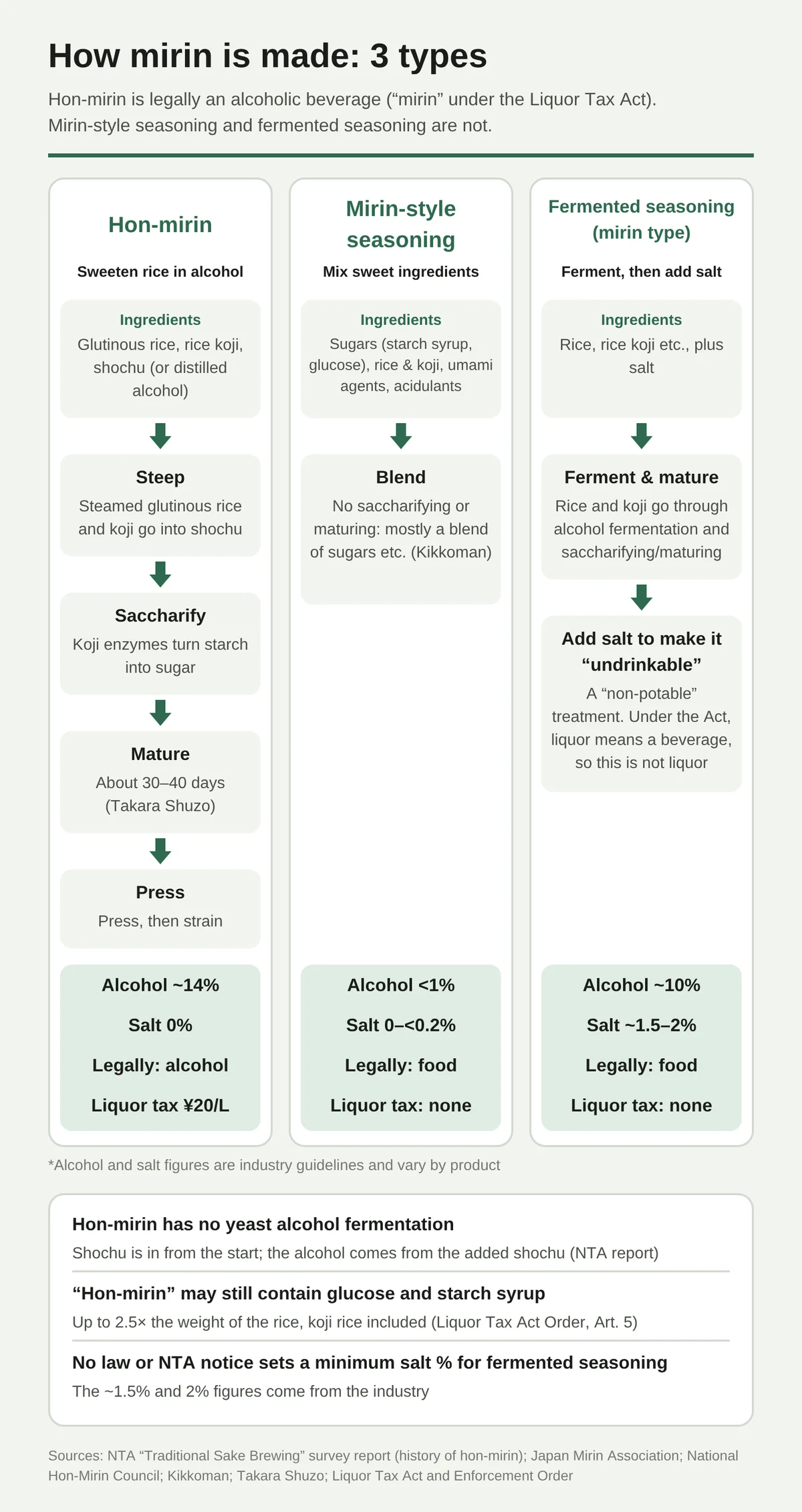
Hon-mirin: saccharification and maturing from glutinous rice, rice koji and shochu
Hon-mirin is made by putting steamed glutinous rice and rice koji into shochu (or distilled alcohol).
- Steamed glutinous rice and rice koji are steeped in shochu or alcohol.
- Koji enzymes break down the starch in the glutinous rice into sugars, and break down proteins into amino acids (saccharification).
- According to Takara Shuzo, it is left for about 30–40 days to mature, and during that time the sugars and amino acids build up various aromas and flavors.
- The moromi is pressed and strained.
Because shochu is added from the start, yeast alcohol fermentation does not take place (NTA report). The alcohol comes from the shochu or alcohol that was added. This is where it differs from sake, where “rice is fermented to make alcohol.” For how sake is made, see our article on how sake is brewed, and for the types of shochu, see our article on types of shochu.
80–90% of the sugar in hon-mirin is glucose, and it also contains sugars such as nigerose, maltose and isomaltotriose, as well as oligosaccharides in which more glucose is linked together (Tsuda 2009).
There are two trade groups of hon-mirin makers.
| Group | What kind of makers |
|---|---|
| The Japan Mirin Association (全国味淋協会) | Makers that use continuous-distilled shochu (distilled alcohol, etc.). Takara Shuzo, Kikkoman Foods, Mizkan, etc. |
| The National Hon-Mirin Council (全国本みりん協議会) | In principle, makers that use single-distilled shochu (shochu distilled one batch at a time, like honkaku shochu). It is part of the Aichi Prefecture Sake Brewers Association. 角谷文治郎商店, 甘強酒造, 白扇酒造, etc. |
Mirin-style seasoning: made by mixing starch syrup and other ingredients
Mirin-style seasoning is a seasoning made by mixing rice, rice koji, umami agents, acidulants and so on into sugars such as starch syrup and glucose. Alcohol is under 1%, and it is not an alcoholic beverage (the Japan Mirin Association, NTA report).
Kikkoman explains mirin-style seasoning as something “made mainly by blending ingredients such as sugars, without saccharification or maturing.”
Fermented seasoning (mirin type): salt is added to “make it undrinkable”
Fermented seasoning (mirin type) uses rice and rice koji, goes through both alcohol fermentation and saccharification/maturing, and then has salt added to make it undrinkable (NTA report). This is called “不可飲処置” (fukain shochi, making it undrinkable by adding salt).
Under the Liquor Tax Act, “alcoholic beverages” are “drinks with 1 degree or more of alcohol” (Article 2), so something made undrinkable is not an alcoholic beverage even if it has about 10% alcohol. That is why no liquor tax applies, and it can be sold by stores that are not liquor stores.
However, we could not find, in any law or NTA notice, a figure for “how much salt must be added for it to count as undrinkable.”
- The NTA report says “many are close to hon-mirin with 1.5% or more salt added.”
- The Japan Mirin Association says “about 1.5% salt.”
- The National Hon-Mirin Council’s table says “2%,” and material from a mirin makers’ study group says “1.5% or more.”
All of these are industry figures. We could not find a salt percentage in any law or notice. We also do not write that “the law sets it at 2% or more.”
Comparing the three types
| Hon-mirin | Mirin-style seasoning | Fermented seasoning (mirin type) | |
|---|---|---|---|
| How it is made | Saccharification and maturing with glutinous rice, rice koji and shochu (alcohol) | Mixing sugars, rice, rice koji, seasonings, acidulants, etc. | Fermenting rice, rice koji, etc., then adding salt, etc. |
| Alcohol | About 14% | Under 1% | About 10% |
| Salt | 0% | 0 to under 0.2% | About 1.5–2% |
| In law | Alcoholic beverage (“mirin” under the Liquor Tax Act) | Food | Food |
| Liquor tax | ¥20 per liter | None | None |
| Where sold | Stores with a liquor sales license | Anywhere | Anywhere |
Sources: the Japan Mirin Association, the National Hon-Mirin Council, the NTA report, the Liquor Tax Act. The figures are trade-group guides and differ by product.
The rules on ingredients also differ. The ingredients of hon-mirin are set by the Liquor Tax Act, but for mirin-style seasoning and fermented seasoning they are “industry voluntary standards” (material from a mirin makers’ study group).
“発酵調味料” in an ingredient list does not always mean the mirin type
When “発酵調味料” appears in the ingredient list (原材料名) of a processed food, it is not always the mirin type. Looking at the products on Urayomi,
| How the ingredient list is written | Product examples |
|---|---|
| 本みりん | Yakiniku sauce (味研), namekotake (小林) |
| みりん | Ponzu (センザン・黒滝), furikake (カネイ) |
| 有機米醗酵調味料, 米発酵調味料 | Yakisoba sauce (光食品), white dashi (ヤマキ) |
| 酵母エキス発酵調味料 | Hondashi (味の素) |
| 小麦発酵調味料 | Java Curry (ハウス) |
so there are many kinds of fermented seasoning: rice, yeast extract, wheat and so on. The Consumer Affairs Agency’s Q&A has an example that writes the ingredients in parentheses, as in “発酵調味料(米、米こうじ、酒、砂糖、食塩)”. For details, see the ingredient dictionary entry “Mirin and rice fermented seasoning” and our article on yeast extract.
Mirin’s “relative”: ash-added sake (akamochi-zake, or akazake)
Under the Liquor Tax Act there is a drink treated as “similar to mirin” that carries the same tax rate as mirin. It is 灰持酒 (aku-mochi-zake, ash-added sake). It is a drink fermented from rice and rice koji with wood ash added, and the conditions include using 1 kg or more of wood ash per kL and a pH of 5.5 or higher (Liquor Tax Act Enforcement Order, Article 8-2). The 1986 review lists Kumamoto Prefecture’s “赤酒” (akazake) in this group.
What does the law set?
The contents of hon-mirin are set by the Liquor Tax Act, but words like “本” (hon), “純米” (junmai) and “三河” (Mikawa) have no legal definition.
“Mirin” under the Liquor Tax Act
Under the Liquor Tax Act, mirin is one kind of “blended alcoholic beverage” (混成酒類), and is defined as follows (Article 3, item 11; Enforcement Order, Article 5).
| What is set | Content |
|---|---|
| Alcohol content | Under 15 degrees |
| Extract content (amount of sugars, etc.) | 40 degrees or more (a requirement added in the 2006 revision) |
| Raw materials | Rice and rice koji with shochu or alcohol added, then strained, etc. |
| Permitted secondary ingredients | Corn, glucose, starch syrup, protein hydrolysate, organic acids, amino acid salts, sake lees, mirin lees, etc. |
| Amount of glucose and starch syrup | Up to 2.5 times the weight of the rice (including koji rice) |
For “protein hydrolysate,” an NTA notice says “for the time being, limited to those made from wheat gluten.” If you mix mirin with water or the like so that the extract content falls below 40 degrees, the law treats it as making a different drink, such as a “liqueur” (Enforcement Order).
Even “hon-mirin” can use sugars
This is the point most often overlooked. The law allows hon-mirin to use glucose and starch syrup up to 2.5 times the weight of the rice. The NTA report cites a book from the mirin industry (Tsuruta, 2003), which says that the use of sugars for brewing was permitted soon after the war, and that it is estimated to be used in “nearly 80%” of total hon-mirin production. This is an estimate from a 2003 book, so we do not know the current share.
Comparing products from the same maker (King Jozo’s “Hinode”), the differences show up in the ingredient list (原材料名).
| Product | Type | Ingredient list (as shown on the official site) | Per tablespoon |
|---|---|---|---|
| 本みりん(醇良) | Hon-mirin | Glutinous rice (Thailand, Japan), rice koji (Thai rice, Japanese rice), distilled alcohol (醸造アルコール), sugars (糖類; made in Japan) | 41 kcal, carbohydrate 7.4 g |
| 昔ながらの純米本みりん | Hon-mirin | Glutinous rice (Thailand, Japan), rice koji (Thai rice, Japanese rice), distilled alcohol (醸造アルコール) | 42 kcal, carbohydrate 7.4 g |
| 新味料(醇良) | Mirin-style seasoning | Starch syrup (made in Japan), brewed seasoning of rice and rice koji (made in Japan), black rice vinegar (made in Japan) / acidulant (酸味料) | 43 kcal, carbohydrate 10.7 g |
| 和風天国 みりんタイプ | “みりんタイプ調味料(加塩)” (mirin-type seasoning, salted) | Starch syrup (made in Japan), brewed seasoning of rice and rice koji, salt / alcohol (酒精), seasoning (amino acids, etc.) (調味料(アミノ酸等)), acidulant (酸味料) | 29 kcal, carbohydrate 5.1 g, salt 0.3 g |
Source: King Jozo’s product pages (checked October 3, 2026). “みりんタイプ調味料(加塩)” for 和風天国 is the maker’s wording, and its alcohol content is 10.0%. In this article we treat it as an example of a product sold in the “fermented seasoning (mirin type)” section, which contains salt.
Even when the label says “本みりん,” some are made only from rice, rice koji and shochu, and some use distilled alcohol or sugars. Legally, both are the same “mirin.” If you want one made only from rice, the only way is to check the ingredient list for “糖類” (sugars), “水あめ” (starch syrup) and “醸造アルコール” (distilled alcohol). We cover distilled alcohol in the additives database entry “醸造用アルコール・酒精”.
Note that some hon-mirin reference sites say “secondary ingredients up to twice the weight of polished rice,” but the current Enforcement Order says “2.5 times or less.”
The words “本,” “純米,” “本格” and “三河”
| Word | How the law treats it |
|---|---|
| 本みりん (hon-mirin) | The Liquor Tax Act item is “mirin.” Kikkoman writes that “it is permitted to add ‘本’ (hon) to tell it apart from similar seasonings,” but we found no law or notice that sets the name. |
| 純米本みりん, 純米みりん (junmai hon-mirin) | No legal definition. A Takara Shuzo researcher also writes that “the rules for names based on raw materials or production methods are unclear” (Takakura 2022). It generally refers to products that use no secondary ingredients such as sugars. |
| 本格みりん (honkaku mirin) | We found no legal definition. There is no rule like the one for “本格焼酎” (honkaku shochu) for shochu. |
| 三河みりん (Mikawa mirin) | Not designated as a Geographical Indication (GI) by the NTA (“mirin” is not on the list as of October 2026). “三州三河みりん” is the brand name of 角谷文治郎商店. |
Shochu’s “本格焼酎” (honkaku shochu) and sake’s “純米酒” (junmai-shu) have national standards (our article on types of shochu, our article on how sake is brewed). Mirin’s “純米” and “本格” have no equivalent standard. The sure way is to check the contents by the ingredient list, not by the words.
Does the “real thing” have fewer labeling duties? A reversal in labeling, tax and where it is sold
Because hon-mirin is an alcoholic beverage, under the food labeling rules there is a lot that it does not need to write, compared with mirin-style seasoning.
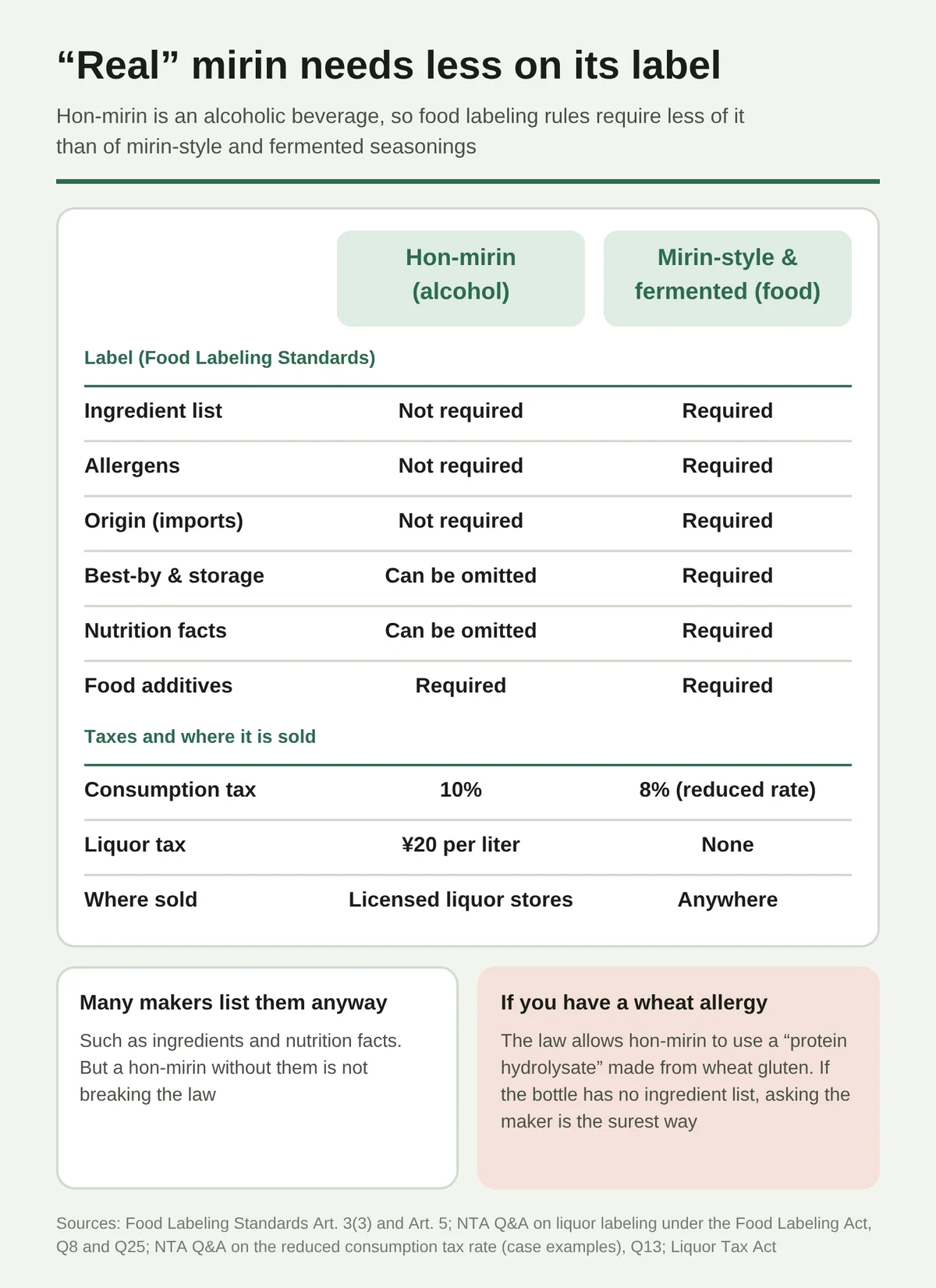
Comparing the labels
The Food Labeling Standards say that alcoholic beverages (酒類) do not need to show the “ingredient list (原材料名),” “allergens” or “country of origin,” and may also omit the “storage method,” “best-by date” and “nutrition facts” (Article 3, paragraph 3 and Article 5; NTA “Q&A on labeling of alcoholic beverages under the Food Labeling Act,” Q8 and Q25). Mirin-style seasoning and fermented seasoning follow the same rules as ordinary processed foods.
| Label item | Hon-mirin (alcoholic beverage) | Mirin-style and fermented seasonings (foods) |
|---|---|---|
| Ingredient list (原材料名) | Not required | Required |
| Allergens | Not required | Required |
| Country of origin (imports) | Not required | Required |
| Best-by date and storage method | May be omitted | Required |
| Nutrition facts (energy, protein, fat, carbohydrate, salt) | May be omitted (if written, it must follow the standard) | Required |
| Food additives | Required | Required |
| Item (“mirin”), alcohol content, volume | Required (Act on Liquor Tax Conservation and Liquor Industry Associations, Article 86-5; Enforcement Order, Article 8-3) | ― |
| “Drinking under age 20 is prohibited by law” | May be omitted if the container is clearly for use as a seasoning | ― |
| Consumption tax | 10% | 8% (reduced rate) |
| Liquor tax | ¥20 per liter | None |
| Where sold | Stores with a liquor sales license | Anywhere |
Sources: the Food Labeling Standards; NTA “Q&A on labeling of alcoholic beverages under the Food Labeling Act,” Q8, Q9 and Q25; Act on Liquor Tax Conservation and Liquor Industry Associations, Article 86-5, and its Enforcement Order, Article 8-3; NTA “Q&A on the reduced tax rate system for consumption tax (individual cases),” Q13; NTA notice “Labeling standards for preventing drinking by persons under 20.”
In other words, under the law, the “real” hon-mirin often has less it must write on the label. In practice, many makers voluntarily write the ingredient list and nutrition facts. King Jozo’s hon-mirin also had, on its product page, an ingredient list and a voluntary statement that “no specified allergens are included.” But it is not a legal violation if some hon-mirin does not write them.
On allergens, the law permits the use of “a protein hydrolysate made from wheat gluten” as a secondary ingredient of hon-mirin. We could not confirm which products actually use it, but because alcoholic beverages have no allergen labeling duty, people with a wheat allergy should ask the maker if the hon-mirin has no ingredient list.
There is a separate rule for the origin of the rice. Mirin is an item under the “Rice Traceability Act” (rice processed foods), which requires keeping transaction records and passing on origin information about the rice to business partners and consumers (MAFF). Telling consumers can be done on the container or by other means such as a website. The Hinode hon-mirin showed the origin within the ingredient list, as “glutinous rice (Thailand, Japan).”
Consumption tax is 10% and 8%
The NTA’s Q&A on the reduced tax rate says that mirin and cooking sake that count as alcoholic beverages under the Liquor Tax Act are not eligible for the reduced rate, while mirin-style seasoning that is not an alcoholic beverage (under 1 degree of alcohol) is a “food or drink” and is eligible. Fermented seasoning is also a food if it is not an alcoholic beverage, but the Q&A had no direct statement on it.
Let us calculate how much the price changes from tax alone (an example calculation).
| Hon-mirin | Mirin-style seasoning | |
|---|---|---|
| Price before tax (1 L) | ¥500 | ¥500 |
| Liquor tax | ¥20 | ¥0 |
| Consumption tax | ¥52 (10% of ¥520) | ¥40 (8% of ¥500) |
| Total | ¥572 | ¥540 |
If they are made at the same price, the difference from tax alone is about ¥32 per liter. The actual price difference is thought to come largely from raw materials (glutinous rice or starch syrup), the length of maturing and so on.
Age checks and the “drinking under age 20 is prohibited by law” label
When you buy hon-mirin, an age-check screen may appear at the register.
- The Act Prohibiting Drinking by Persons Under 20 (二十歳未満ノ者ノ飲酒ノ禁止ニ関スル法律) bans stores from selling alcohol knowing that a person under 20 will drink it (Article 1, paragraph 3), and requires stores to take measures such as checking age (Article 1, paragraph 4).
- The label “Drinking by persons under 20 is prohibited by law” on a container may be omitted if the container is clearly for use as a seasoning (NTA notice 3(3)).
- In the store, a sign such as “alcoholic beverage section” is required on the alcohol shelf. However, the NTA explains that if mirin is placed on a shelf separate from other alcohol and labeled “mirin,” “this is alcohol” or “alcohol-containing seasoning,” this large sign is not needed (display Q&A, Q5).
We found no NTA material that specifically explains age checks when you buy hon-mirin for cooking. The check at the register is a “measure” the law requires, and each store runs it in its own way.
Liquor tax and the volume of hon-mirin sold
The liquor tax on hon-mirin fell from ¥140 to ¥20 per liter over a little more than 60 years.
Liquor tax: from ¥140 to ¥20 per liter
| Period | Liquor tax per kL | Per liter | Source |
|---|---|---|---|
| Before the 1962 revision | ¥140,000 | ¥140 | NTA report |
| After the 1962 revision | ¥67,700 | ¥67.7 | NTA report |
| Around 1986 | ― | About ¥74 | Morita 1986 (Takara Shuzo) |
| 2005 (alcohol 13.5–14.5 degrees) | ¥21,600 | ¥21.6 | NTA “Sake Guide,” 2005 edition |
| May 2006 to now | ¥20,000 | ¥20 | Liquor Tax Act, Article 23; “Sake Guide,” 2026 edition |
- It has not changed since May 1, 2006. In the liquor tax revisions of October 2023 and October 2026, mirin was left unchanged (checked in the tax rate list of the “Sake Guide”).
- Sake and fruit wine are ¥100,000 per kL, and beer-type drinks are ¥155,000 from October 2026. Mirin is one-fifth of sake.
- For a 1-liter bottle the liquor tax is ¥20, for 1.8 L it is ¥36, and for 500 mL it is ¥10.
- The around-1986 figure of “about ¥74 per liter” is higher than the ¥67.7 of 1962. That means it rose once after 1962 and fell sharply by 2005, but we could not confirm when or by how much it changed (¥74 is an “about” figure written in a review by a Takara Shuzo researcher).
Trend in taxed volume of hon-mirin
In NTA statistics, the volume of hon-mirin on which liquor tax was paid in Japan (taxed volume) shows the following.
- In fiscal 1970 it was 31,000 kL.
- It rose to 80,000 kL in fiscal 1985 and 97,000 kL in fiscal 1996, and reached its peak of 158,000 kL in fiscal 1999.
- After that it stayed at about 100,000–110,000 kL, and in fiscal 2024 it was 94,000 kL, about 60% of the peak in fiscal 1999.
- Hon-mirin in fiscal 2024 was about 1.2% of all alcoholic beverages (8.116 million kL).
We could not confirm why fiscal 1999–2000 alone are so high. Also, figures through fiscal 2005 are counted under the categories used before the 2006 revision.
In 1984, mirin-style seasoning outsold hon-mirin in homes
Mirin-style seasoning and fermented seasoning are not alcoholic beverages, so they are not in the national alcohol statistics. In what we looked at, we could not find national shipment statistics.
The figures are old, but a 1986 review gives Takara Shuzo’s estimate of the volume of mirin and similar seasonings in 1984. The total was about 152,000 kL, with sales of about ¥60 billion.
| 1984 | Hon-mirin | Mirin-style seasoning | Fermented seasoning |
|---|---|---|---|
| Household use | 42% | 43% | 15% |
| Commercial use (food factories, restaurants, etc.) | 51% | 13% | 36% |
Source: Morita 1986 (Figure 1; originally an estimate by Takara Shuzo’s marketing department).
In households, mirin-style seasoning (43%) slightly exceeded hon-mirin (42%). This suggests that in the era when hon-mirin could be bought only at liquor stores, mirin-style seasoning, available at supermarkets, was spreading into homes. For commercial use, fermented seasoning with salt made up more than one-third.
What about effects on the body?
The points to watch are “alcohol” in hon-mirin, “the amount of sugar and food additives” in mirin-style seasoning, and “salt and alcohol” in fermented seasoning.
How much alcohol remains after heating?
It is often said that “the alcohol in mirin burns off when heated.” The makers’ explanations also split into two.
| Explanation | |
|---|---|
| Kikkoman (FAQ) | Says the alcohol burns off when heated and “it is thought to be no problem,” but also writes that “the alcohol content does not become zero” |
| Takara Shuzo (FAQ) | On cooking for children: “in a dish that is heated thoroughly, the alcohol burns off and does not remain.” For unheated dishes such as dressed salads, it recommends boiling the mirin first (nikiri) |
The figures we can check are in a US Department of Agriculture (USDA) table, “the share of alcohol that remains in a dish,” which the USDA publishes for nutrition calculations. It is based on an experiment at the University of Idaho in the US and elsewhere (Augustin et al. 1992).
| How the dish is cooked | Share remaining | For 1 tbsp of hon-mirin |
|---|---|---|
| Added to a boiling liquid, heat turned off at once | 85% | About 1.4 g |
| Flamed (flambé) | 75% | About 1.3 g |
| No heat, left overnight | 70% | About 1.2 g |
| Stirred in and simmered or baked, 15 minutes | 40% | About 0.7 g |
| Ditto, 30 minutes | 35% | About 0.6 g |
| Ditto, 1 hour | 25% | About 0.4 g |
| Ditto, 2 hours | 10% | About 0.2 g |
| Ditto, 2.5 hours | 5% | About 0.1 g |
- Even after simmering 2.5 hours, 5% remains. The explanation that “nothing remains if you heat it enough” does not match this table.
- However, this table is based on dishes made with wine and liqueurs, not measured with mirin. It also varies with the size of the pot, whether there is a lid, and the strength of the heat.
- We found no Japanese paper that measured how much alcohol remains in nikiri mirin (mirin boiled first to drive off the alcohol).
How much pure alcohol is in 1 tablespoon?
Using the formula in the MHLW’s “Guidelines on Alcohol Consumption with Consideration for Health” (2024) (amount × alcohol content × 0.8),
- 1 tbsp of hon-mirin (15 mL, 14 degrees) has about 1.7 g of pure alcohol.
- A 500 mL beer (5%) has 20 g, so 1 tbsp of hon-mirin is about one-twelfth of a medium bottle of beer.
- 1 tbsp of fermented seasoning (alcohol 10%) has about 1.2 g.
As an example calculation, if you use 2 tbsp of hon-mirin in a simmered dish for 4 people and simmer it 15 minutes, the remaining alcohol is “1.7 g × 2 × 40%,” about 1.3 g, or about 0.3 g per person.
Everyday foods also contain very small amounts of alcohol. In a study that analyzed German retail products (Gorgus et al. 2016), orange, apple and grape juices contained up to 0.77 g of ethanol per liter. For one glass (200 mL), that is up to about 0.15 g.
The guidelines put the amount that raises the risk of lifestyle-related diseases at 40 g or more of pure alcohol per day for men and 20 g or more for women. The alcohol in mirin used in cooking is orders of magnitude below this. However, this is a “comparison of amounts,” and it does not mean “zero” for people who want to avoid even a little.
What about children, pregnancy, driving and people who do not drink?
We found no material in which the government or a public body gave a view such as “children and pregnant people should avoid” on mirin used in cooking. Here are the facts that are known.
| Who is concerned | What is known |
|---|---|
| Children | Drinking under age 20 is prohibited by law. Hon-mirin in cooking is not something you “drink,” but heating does not bring alcohol to zero (USDA table). Takara Shuzo recommends boiling it first for dishes that are not heated. |
| Pregnant or breastfeeding people | The MHLW guidelines say drinking during pregnancy may cause fetal alcohol syndrome and other effects. Kikkoman also writes on its site that “drinking during pregnancy or breastfeeding may adversely affect the growth of the fetus or infant.” |
| People with a constitution that is sensitive to alcohol | The guidelines say people with very weak enzymes that break down alcohol may have a strong reaction even to a very small amount. |
| People who drive | 1 tbsp of hon-mirin has about 1.7 g of pure alcohol, which decreases with heating. We found no material on mirin in cooking and driving. |
| People who do not take alcohol for religious or other reasons | Hon-mirin (about 14%) and fermented seasoning (about 10%) contain alcohol. Mirin-style seasoning is also “under 1%”: 0.5 vol% in the composition table and 0.4 degrees or less for Hinode Shinmiryo, so it is not zero. |
If this concerns you, you can boil mirin first for dishes that are not heated, use it in dishes that simmer for a long time, or, if you want to avoid alcohol, choose by looking at the alcohol content on the label.
There is also an animal experiment in which mice were given mirin, sake, red wine or 5% ethanol to drink for 45 days, and the action of the enzymes that break down alcohol in the liver changed (Kishimoto et al. 1997). In this experiment mirin was given in large amounts as a drink, which has nothing to do with the amount used in cooking. For the link between heavy drinking and the body, see our article on sake and health, our article on shochu and health and our article on beer and health.
Sugar: compared per tablespoon
It is often said that “mirin-style seasoning has a lot of sugar.” We check this against the food composition table.
The values in the composition table are “per 100 g.” But mirin-style seasoning is heavier than hon-mirin (per 100 mL: hon-mirin 117.0 g, mirin-style seasoning 126.9 g), so the weight differs even for the same tablespoon. So we recalculated per tablespoon (15 mL) (our own calculation).
| Per tablespoon | Hon-mirin | Mirin-style seasoning | Fermented seasoning (Hinode Wafu Tengoku) | Cooking sake (reference) |
|---|---|---|---|---|
| Energy | 42 kcal | 43 kcal | 29 kcal | 13 kcal |
| Carbohydrate | 7.6 g | 10.6 g | 5.1 g | 0.7 g |
| Alcohol | 1.7 g | 0.06 g | About 1.2 g (calculated) | 1.6 g |
| Salt equivalent | 0 g | 0.04 g | 0.3 g | 0.34 g |
Sources: hon-mirin, mirin-style seasoning and cooking sake are calculated from the composition table (8th Revised Edition, 2023 Supplement); fermented seasoning is the maker’s published values.
- The energy of hon-mirin and mirin-style seasoning is about the same. Hon-mirin’s alcohol also has energy, so it makes up for the lower sugar.
- Carbohydrate (mostly sugars) in mirin-style seasoning is about 1.4 times that of hon-mirin. Compared by the amount of sugar that becomes energy in the body (available carbohydrate), hon-mirin is about 4.7 g and mirin-style seasoning about 7.6 g, so the gap is even larger.
- On types of sugar, hon-mirin is mainly glucose, and also contains oligosaccharides and others that the composition table does not measure individually. Mirin-style seasoning is characterized by a lot of glucose and maltose (the sugar of starch syrup) (composition table, per 100 g: glucose 24.4 g, maltose 12.4 g).
- Some mirin-type seasonings advertise “zero sugar.” Hinode’s “みりんタイプ糖質ゼロ” (Mirin Type, zero sugar) is sweetened with resistant dextrin and a sweetener (stevia), and has 13 kcal per tablespoon.
The sugar difference per tablespoon is about 3 g. For one simmered dish that is not a big difference, but it adds up in households that use a lot in daily cooking. On types of sugar, see our article on types of sugar and our article on isomerized sugar; on sweeteners, see our article on sweeteners.
Salt: use fermented seasoning by “subtracting salt”
Fermented seasoning contains salt to make it undrinkable. Hinode’s Wafu Tengoku (mirin type) has 0.3 g of salt per tablespoon, and “みりんタイプ糖質ゼロ” has 0.35 g.
Material from a mirin makers’ study group also writes that “salt needs to be adjusted when using it.” When you replace the “mirin” in a recipe with fermented seasoning, reduce the salt or soy sauce a little by that amount to avoid taking too much salt. On salt intake, see our article on salt intake.
Food additives: more common in mirin-style and fermented seasonings
Depending on the product, mirin-style and fermented seasonings use food additives. In the Hinode examples,
- Shinmiryo (mirin-style seasoning): acidulant (酸味料)
- Wafu Tengoku (mirin type): alcohol (酒精), seasoning (amino acids, etc.) (調味料(アミノ酸等)), acidulant (酸味料)
- Mirin Type, zero sugar: alcohol (酒精), seasoning (amino acid) (調味料(アミノ酸)), sweetener (stevia) (甘味料(ステビア))
King Jozo notes that the effect of Shinmiryo in “masking odors” is “the effect of the acidulant.” For how these additives work and how their safety is assessed, see our article on acidulants and pH adjusters, our article on umami seasonings, our article on sweeteners and the additives database.
Even for hon-mirin, labeling is required if food additives are used, but the secondary ingredients that may be used are set by law, and Hinode’s hon-mirin showed no food additives on its label.
Is mirin-style seasoning “bad for the body”?
We could not confirm any study that compared the effects on the body of people who ate mirin-style seasoning and hon-mirin. The known differences are as follows.
| Hon-mirin | Mirin-style seasoning | |
|---|---|---|
| Sugar | 7.6 g per tablespoon | 10.6 g per tablespoon (about 1.4 times) |
| Amino acids | More (227–234 mg per 100 g in a 1986 analysis) | Fewer (45–61 mg in the same analysis) |
| Alcohol | About 14% | Under 1% |
| Food additives | In principle none | Some products use acidulants, etc. |
In the 1986 review’s analysis, total sugar in mirin-style seasoning was 61.5–68.3%, higher than in hon-mirin (46.9–47.2%). A 2021 study (Yamamoto et al.; a Kikkoman researcher is among the co-authors) reported that hon-mirin has more amino acids and less sugar than mirin-style seasoning, and that a taste test found differences in sweetness and richness (kokumi).
Whether it is “bad for the body” comes down to applying these differences to your own diet. It is realistic to choose by purpose: hon-mirin if you want less sugar, mirin-style seasoning if you want to avoid alcohol.
Studies of cooking effects are mostly by makers’ researchers
Hon-mirin is said to have effects such as “giving shine (teri),” “keeping food from falling apart” and “masking odors,” and there are papers on them.
| Effect | What was found | Study |
|---|---|---|
| Shine (teri) | When the gloss of teriyaki Spanish mackerel (sawara) was measured, with hon-mirin as 100, sake plus sugar was about 53 | Takakura 2022 (Takara Shuzo) |
| Keeping food from falling apart | Potatoes simmered in hon-mirin kept their tissue after heating. Both sugar and alcohol act, and either alone has little effect. | Takakura et al. 2000 (Takara Shuzo); summary in Tsuda 2009 |
| Keeping meat’s umami from flowing out | Pork soaked in a 5% hon-mirin liquid kept its muscle fibers after heating | Takakura et al. 2000 (Takara Shuzo) |
| Masking odors | Alcohol carries odor compounds away as it evaporates, and components of hon-mirin react with odor compounds. The fish odor compound (methylamine) fell more than with a mix of sake and sugar. | Kawabe and Morita 1998 (Takara Shuzo) |
The studies listed here are by Takara Shuzo researchers (Tsuda 2009 is a summary by a researcher at a junior college, but Takara Shuzo researchers took part in many of the experiments it draws on). Most other papers on the cooking effects of mirin were also by researchers at Takara Shuzo and Kikkoman. In what we looked at, we found no follow-up study (replication) by researchers unrelated to the makers that confirmed the same results. This does not mean the research is wrong, but it is worth knowing that there may be a conflict of interest.
A foreword in a society journal puts it as “mirin-style seasoning does not have the cooking effects of hon-mirin,” but King Jozo rates its mirin-style Shinmiryo “◎” for sweetness and shine and “○” for masking odors. If the research explanation holds, effects that need “both sugar and alcohol,” such as keeping food from falling apart, would be hard to achieve with mirin-style seasoning, which has almost no alcohol, but we could not confirm any study that ran the same experiment with mirin-style seasoning.
There is also research suggesting that hon-mirin has an antioxidant effect (preventing things from oxidizing). However, this is about suppressing the oxidation of oils and the like during cooking, and it is not research showing a benefit to human health.
Judging what you often hear
| What you often hear | Verdict |
|---|---|
| Hon-mirin is made only from glutinous rice, rice koji and shochu | Not always. The law allows sugars (glucose and starch syrup) up to 2.5 times the rice, and distilled alcohol too. Check the ingredient list. |
| Heating burns off all the alcohol | It does not reach zero (5% even after 2.5 hours in the USDA table). However, the table is not a value measured with mirin. |
| Mirin-style seasoning is bad for the body | We could not confirm any study that compared them. The differences are sugar (about 1.4 times), amino acids and food additives. |
| The law sets fermented seasoning at 2% salt or more | No figure in any law or notice. 1.5% and 2% are industry figures. |
| The real hon-mirin has more careful labels | The opposite. Because it is an alcoholic beverage, it need not write the ingredient list or allergens, and may omit the best-by date and nutrition facts. |
| Mikawa mirin is a regional brand (GI) | It is not designated as a Geographical Indication. “三州三河みりん” is a brand name. |
| Junmai hon-mirin has a national standard | It does not. |
| Hon-mirin helps with shine and keeping food from falling apart | There are papers, but mostly by makers’ researchers. |
How to choose and use
First decide whether you want to “avoid alcohol,” “cut sugar” or “care about raw materials,” and what to choose becomes clear.
Choose by purpose
| When | What to choose | Why |
|---|---|---|
| You value shine, richness and keeping food from falling apart | Hon-mirin | It has both alcohol and sugar |
| You want only rice, rice koji and shochu as raw materials | Hon-mirin (one whose ingredient list has no sugars or distilled alcohol) | “本みりん” alone does not tell you |
| You want to avoid alcohol | Mirin-style seasoning | Alcohol under 1% (not zero) |
| You want to cut sugar | Hon-mirin (or a seasoning that advertises zero sugar) | Mirin-style seasoning has about 1.4 times the sugar |
| You want to cut salt | Hon-mirin or mirin-style seasoning | Fermented seasoning has about 0.3 g of salt per tablespoon |
| You want to buy at a store that does not sell alcohol | Mirin-style or fermented seasoning | They are not alcoholic beverages, so no license is needed |
What to look at on the label
- Type: is it “みりん” (an alcoholic beverage), or “みりん風調味料,” “発酵調味料” or “みりんタイプ調味料”?
- Alcohol content: hon-mirin is about 13.5–14.5 degrees. Mirin-style seasoning is under 1%, and fermented seasoning is about 10%.
- Ingredient list (原材料名): which of “糖類” (sugars), “水あめ” (starch syrup), “醸造アルコール” (distilled alcohol) and “焼酎” (shochu) is in it? Some hon-mirin does not list ingredients.
- Salt equivalent: fermented seasoning contains salt.
- Food additives: acidulants, seasonings (amino acids, etc.), sweeteners and so on, written after the “/”.
How to use: nikiri, when to add it, and storage
- Nikiri: for dishes that are not heated, such as dressed salads and sauces, there is a method of bringing hon-mirin to a boil in a small pot to drive off the alcohol before using it (Takara Shuzo). However, we found no data measuring how far the alcohol falls.
- When to add it: Takara Shuzo recommends adding it at the start to keep food from falling apart and to mask odors, and adding it again at the end when you want shine.
- Storage: hon-mirin has a lot of alcohol and sugar (about 45%), so after opening it can be kept in a cool, dark place at room temperature. In the refrigerator, the sugar may crystallize white, but the makers explain that there is no problem with quality. Mirin-style seasoning has almost no alcohol, so put it in the refrigerator once opened (Kikkoman).
- Hon-mirin gets darker because of a reaction in which sugars and amino acids gradually bond (the Maillard reaction), which goes faster at higher temperatures (Takara Shuzo).
- If you substitute: a method often introduced is to use sake and sugar in place of hon-mirin. However, Takara Shuzo measured shine at about half that of hon-mirin.
If you want a hon-mirin made only from rice, rice koji and shochu
As we saw above, some products labeled “本みりん” use sugars or distilled alcohol. If you want a hon-mirin made only from rice, rice koji and shochu, choose one whose ingredient list has no “糖類,” “水あめ” or “醸造アルコール”.
The National Hon-Mirin Council is a group of mirin makers that, in principle, use single-distilled shochu (shochu distilled one batch at a time). 角谷文治郎商店’s “三州三河みりん” (Hekinan, Aichi; founded 1910) is a brand of a member of this council. Check the ingredient list and volume on the product page before you buy.
白扇酒造 (Kawabe, Gifu Prefecture) is also a member of the same council. According to the council’s introduction, it is a brewery that in the late Edo period made “kasutori shochu” from the sake lees of a nearby sake brewery and made mirin with it. It is described as making its koji by hand, without machines.
According to the National Hon-Mirin Council’s “member history,” 九重味淋 (Hekinan, Aichi) is a brewery that began making mirin in 1772 (the company’s explanation). 九重味淋 is also named in the Japan Mirin Association’s member list (on its “Hon-Mirin Day” page). According to the council’s introduction, its brand “九重櫻” is made with glutinous rice, rice koji and honkaku shochu. You can choose a larger size, for households that use a lot.
What we introduced in this article (summary)
Here is a recap of what we introduced in the article. The reasons and ingredients are in each section.
| What we introduced | Where to buy |
|---|---|
| 角谷文治郎商店 三州三河みりん 700ml | See on Rakuten (ライフスタイル&生活雑貨のCheeky) PR See on Amazon.co.jp PR See on Yahoo! Shopping PR |
| 白扇酒造 福来純 伝統製法 熟成本みりん 500ml | See on Rakuten (楽天24) PR See on Amazon.co.jp PR See on Yahoo! Shopping PR |
| 九重味淋 本みりん 九重櫻 1.8L | See on Rakuten (にっぽん津々浦々) PR See on Amazon.co.jp PR See on Yahoo! Shopping PR |
Summary
| What you may wonder | What we found |
|---|---|
| When was mirin born? | In writing, “蜜淋酎” in 1593 is the first. The characters “味醂” date from 1614. There is a theory that it came from China and a theory that it began in Japan, and the NTA report introduces the view that “a Chinese method was brought over and changed in Japan.” |
| When did it become a seasoning? | The late Edo period: grilled eel (kabayaki) and soba dipping sauce. Until then it was a sweet alcoholic drink. |
| How do the three types differ? | Hon-mirin = an alcoholic beverage (alcohol about 14%); mirin-style seasoning = a seasoning with under 1% alcohol; fermented seasoning = a seasoning made undrinkable by adding salt (alcohol about 10%). |
| Is hon-mirin only rice? | The law allows sugars up to 2.5 times the rice. Check the ingredient list. |
| What about labels? | Because it is an alcoholic beverage, hon-mirin need not list ingredients or allergens and may omit the best-by date and nutrition facts. Mirin-style and fermented seasonings must. Consumption tax is 10% and 8%. |
| Liquor tax? | ¥20 per liter (unchanged since 2006). It was ¥140 before the 1962 revision. |
| Does heating burn off the alcohol? | It does not reach zero (40% after 15 minutes and 5% after 2.5 hours in the USDA table). 1 tbsp of hon-mirin has about 1.7 g of pure alcohol. |
| Sugar and salt? | Energy per tablespoon is about the same (42–43 kcal). Sugar is about 1.4 times higher in mirin-style seasoning. Only fermented seasoning has salt, about 0.3 g. |
| Cooking effects? | There are papers on shine, keeping food from falling apart and so on, but mostly by makers’ researchers. |
Sources
Laws and the NTA
- Liquor Tax Act (Act No. 6 of 1953), Articles 2, 3 and 23; Liquor Tax Act Enforcement Order (Cabinet Order No. 97 of 1962), Articles 5 and 8-2 (e-Gov Law Search) https://laws.e-gov.go.jp/law/328AC0000000006 ・ https://laws.e-gov.go.jp/law/337CO0000000097
- NTA, “Interpretive notices on the Liquor Tax Act and laws on liquor administration,” Article 3 (definition of mirin) https://www.nta.go.jp/law/tsutatsu/kihon/sake/2-02.htm
- NTA, “Traditional Sake Brewing” survey report, II-4 History of hon-mirin https://www.nta.go.jp/taxes/sake/koujikin/pdf/0021012-102_05.pdf
- NTA, “Sake Guide” 2026 edition (tax rate list, taxed volume, production volume, history), 2006 and 2005 editions (tax rate list)
- NTA, “Q&A on labeling of alcoholic beverages under the Food Labeling Act,” Q8, Q9, Q25 and Q26 https://www.nta.go.jp/taxes/sake/hyoji/shokuhin/sakeqa/3007.pdf
- Act on Liquor Tax Conservation and Liquor Industry Associations, Article 86-5, and its Enforcement Order, Article 8-3 (e-Gov Law Search) https://laws.e-gov.go.jp/law/328AC0000000007
- MAFF, “Rice Traceability System” https://www.maff.go.jp/j/syouan/keikaku/kome_toresa/
- NTA, “Q&A on the reduced tax rate system for consumption tax (individual cases),” Q13
- NTA notice “Labeling standards for preventing drinking by persons under 20,” and “Labeling standards for preventing drinking by minors (display) Q&A,” Q5
- Act Prohibiting Drinking by Persons Under 20 (二十歳未満ノ者ノ飲酒ノ禁止ニ関スル法律) (e-Gov Law Search)
- NTA, “List of Geographical Indications for alcoholic beverages” (checked October 3, 2026)
- NTA, Central Council for Alcoholic Beverages material (deregulation of liquor retail licenses)
- Nihon Shokuryo Shimbun, “Mirin retail license: supply-demand adjustment requirement not applied” (November 20, 1996)
Composition and health
- MEXT, “Standard Tables of Food Composition in Japan (8th Revised Edition), 2023 Supplement,” main table and carbohydrate table (hon-mirin 16025, mirin-style seasoning 17054, cooking sake 17138) https://www.mext.go.jp/a_menu/syokuhinseibun/mext_00001.html
- MHLW, “Guidelines on Alcohol Consumption with Consideration for Health” (February 2024)
- USDA, “Table of Nutrient Retention Factors, Release 6” (2007) https://www.ars.usda.gov/ARSUserFiles/80400525/Data/retn/retn06.pdf
- Augustin J, et al. Alcohol retention in food preparation. J Am Diet Assoc 1992;92(4):486-488 (PMID 1556354)
- Gorgus E, et al. J Anal Toxicol 2016 (PMID 27405361)
- Kishimoto R, et al. J Nutr Sci Vitaminol 1997 (PMID 9530614)
- Yamamoto K, et al. J Biosci Bioeng 2021;132(6):599-605 (PMID 34607774)
History and cooking effects (including papers by researchers at mirin makers)
- Yamashita, “The origin of mirin,” Journal of the Brewing Society of Japan 1991;86(10):768-772
- Morita H, “Mirin and similar seasonings,” Journal of Cookery Science of Japan 1986;19(3):161-169
- Tsuda, “Cooking effects of mirin,” Journal of Cookery Science of Japan 2009;42(1):44-48
- Takakura, “Cooking effects of hon-mirin,” Seibutsu-kogaku Kaishi 2022;100(2):81-84
- Oe et al., Journal of Cookery Science of Japan 2001;34:25 (a survey of Edo-period cookbooks)
Trade groups and companies
- The Japan Mirin Association (全国味淋協会), “Knowledge of hon-mirin” https://www.honmirin.org/knowledge/
- The National Hon-Mirin Council (全国本みりん協議会), “Get to know hon-mirin” and “Member history” http://zenkokuhonmirin.com/study.html
- Kikkoman, “History of mirin,” “What is hon-mirin,” “FAQ” https://www.kikkoman.co.jp/enjoys/mirin/history.html
- Takara Shuzo, “Hon-mirin FAQ”
- King Jozo “Hinode,” product pages for Hon-mirin Junryo, Mukashinagara no Junmai Hon-mirin, Shinmiryo, Wafu Tengoku and Mirin Type zero sugar (checked October 3, 2026)
- Fuji Brand, “Shin-mirin Fukusen” (福泉産業)
Related articles and databases
- Types of Soy Sauce and How to Choose: Honjōzō, Kongō Jōzō and Kongō, Whole vs. Defatted Soybeans, Grade and Reduced-Salt Rules, and 3-MCPD
- What Is the Rice Polishing Ratio? How Sake Is Made, Flat Polishing, and Yeast: Reading the Words on the Label from Government Sources
- Types of Shochu: Class A, Class B, Honkaku Shochu, and Awamori Explained, with a Popularity Ranking, Using National Tax Agency Materials
- Why Did “No Chemical Seasoning” Disappear? Is Yeast Extract a Chemical Seasoning? How to Read Umami Seasonings and Hydrolyzed Protein