
Is Yeast Extract Bad for You? Its History from Meat Extract, How It's Made, Glutamate Content, the “Hidden MSG” Claim, and Labeling Rules in Japan, the US and Germany

PR This article contains affiliate links to Rakuten Ichiba, Amazon, Yahoo! Shopping and A8.net (“See on Rakuten” and others). What it says is based on public-agency documents and papers, whether or not there is an ad. The “See on Amazon.co.jp” links are also affiliate links.
Curry roux, consommé, dashi stock mixes, potato chips. Look at the ingredient list on the back of the package and you often see the words “酵母エキス” (yeast extract).
People often say two opposite things about yeast extract.
- “Yeast extract is not a food additive, so a product that uses it can still say ‘additive-free’ (無添加). That’s sneaky.”
- “Yeast extract is ‘hidden MSG’ (monosodium glutamate). It’s just umami seasoning under another name.”
- “Yeast extract is bad for the brain. It’s an ‘excitotoxin’ that destroys nerves.”
- “Yeast extract is natural, so it’s safe.”
- “Yeast is high in purines, so people with gout should avoid it.”
In this article we check the following against laws, public-agency documents, papers, and the ingredient lists of the products on Urayomi:
- When, where and as a substitute for what did yeast extract come about?
- How is it made? How does it differ from umami seasoning (a food additive)?
- Why is it a “food” for labeling purposes? Are there cases where it counts as an additive?
- How do Japan, the US and Germany treat a “no umami seasoning” claim on a food that uses yeast extract?
- Where did the “hidden MSG” and “excitotoxin” claims come from?
- Effects on the body (glutamate, purines, 3-MCPD, allergies, interactions with drugs)
- How much is actually in real products, and how much equals umami seasoning?
How the “no chemical seasoning” (化学調味料無添加) label disappeared is covered in our article on umami seasoning. The history of monosodium glutamate and its ADI (acceptable daily intake) are covered in our article on monosodium glutamate. This article digs into yeast extract itself.
Conclusions
- Yeast extract descends from the 19th-century “meat extract.” In Europe, yeast extract has long been used in place of beef extract. Marmite was incorporated in 1902 in the UK. In Japan, Asahi Group Foods describes “ミースト” (Miisuto), launched in 1966, as the country’s first yeast extract
- It is made by “taking out the contents of yeast all together.” The yeast is broken down by its own enzymes or by added enzymes, and the dissolved part is concentrated. The typical methods do not include a step of breaking it down with hydrochloric acid, as is done for hydrolyzed protein. There is a type high in glutamic acid and a type high in nucleic acids (inosinic acid and guanylic acid)
- For labeling purposes it is a “food.” But the line is blurry. A component isolated one at a time from yeast (such as 5’-adenylic acid) is a food additive; yeast extract, which takes out the contents all together, is a food. A Consumer Affairs Agency Q&A also says “if a food is used for an additive’s purpose, additive labeling is needed,” and in 2019 the Agency explained that “writing yeast extract after the slash (/) as an additive could be considered.” The decision is left to the business
- The same practice gets different answers in Japan, the US and Germany. For foods using yeast extract, the US does not allow “No MSG,” and Japan’s 2022 guidelines list it as an example “highly likely to fall under prohibited labeling.” In 2016 a German higher regional court ruled that “no flavor-enhancing additives” was not misleading
- The phrase “hidden MSG” spread from a labeling campaign in the US. The starting point was less “it’s dangerous” than “I don’t want to eat it without knowing” — a demand for labeling. On the other hand, the makers also explained “no labeling obligation” as an advantage (a 2001 review)
- In the body, the glutamate in yeast extract and the glutamate in MSG are the same (FASEB, FDA, EFSA). We found no study showing a harm specific to yeast extract. The difference lies in the nucleic acids (purines) that come with it, but per serving of dashi mix or consommé this is a few mg, small against the daily guideline of 400 mg
- Some people should be careful. People with a yeast-related allergy (rare) and people taking MAO-inhibitor antidepressants (for concentrated yeast extract spreads such as Marmite). For 3-MCPD, an EU survey found no quantifiable amount in yeast extract
- Of the 69 foods on Urayomi, 23 (33%) contain yeast extract. All 11 curry roux do. Of 16 products labeled “〇〇不使用” (“no 〇〇”), 6 contain yeast extract, but what they claimed not to use was preservatives, wheat flour and the like, unrelated to umami. None of the 7 products that claim no umami seasoning or no additives overall used yeast extract
What we introduce in this article
| What we introduce | When it helps | Where in the article |
|---|---|---|
| かね七「料亭仕込み 天然だしの素パック」 (Kane-shichi natural dashi packs) | When you want a dashi pack with neither yeast extract nor umami seasoning | When you want to choose products without yeast extract |
| マエカワテイスト「だしパック 十二単」 (Maekawa Taste “Juni-hitoe” dashi packs) | Same (a dashi pack of only seafood, kelp and shiitake) | When you want to choose products without yeast extract |
| マルトモ公式直販 (Marutomo official online shop; bonito flakes) | When you want to make your own dashi | If you make your own dashi |
| 無塩ドットコム (Muen.com; a shop specializing in low-salt and no-salt foods) | When you want to cut salt itself | Research on salt reduction stops at taste evaluation |
| 3 products labeled “酵母エキス不使用” (no yeast extract): 光食品 (Hikari Shokuhin), 鰹節のカネイ (Katsuobushi no Kanei), 風と光 (Kaze to Hikari) | When you want to choose by checking the label | The 3 products that say “no yeast extract” |
How did yeast extract come about?
The history of yeast extract begins as “a substitute for meat extract.”
Its ancestor is the 19th-century “meat extract”
In 19th-century Europe, “meat extract,” made by boiling meat down, was sold as a nutritious food. It was popularized by the German chemist Liebig. He published the method in 1847, and it is said that about 30 pounds (about 14 kg) of meat yielded only 1 pound (about 450 g) of extract (from an explanation by the Science History Institute in the US; the ratio varies by source).
- Meat extract was made in large quantities at a factory in Fray Bentos, Uruguay. According to UNESCO, the Liebig Extract of Meat Company exported meat extract and corned beef to Europe from 1865. The factory site became a World Heritage site in 2015
- However, meat extract had almost no nutrition. In 1868, a German physiologist fed dogs nothing but meat extract and all the dogs died, setting off a big controversy about how little nutrition the extract had (same explanation). Meat extract was about “flavor,” not “nutrition”
A 2001 review by a researcher at a yeast extract maker (Kohjin) explains that European yeast extract was developed long ago as a substitute for beef extract, in part because “its taste quality is similar to beef extract.”
You may see the claim that “Liebig also invented yeast extract.” It appears even on English Wikipedia, but the sources are trivia articles and fan sites, and we could not confirm any document by Liebig himself. What Liebig certainly made was meat extract.
Attention turned to what is “inside” yeast
Yeast is a microorganism (a kind of fungus, like molds and mushrooms) used to make bread, beer and sake. The 1907 Nobel Prize in Chemistry went to Buchner of Germany. It was awarded for “the discovery of cell-free fermentation,” research showing that fermentation can occur without living yeast, using only the juice pressed from broken yeast (Nobel Foundation). The inside of yeast is packed with enzymes that break down protein, among other things. Yeast extract is that inside, taken out for use as food.
Marmite and Vegemite
| Year | Event | Source |
|---|---|---|
| June 13, 1902 | The Marmite Food Extract Co is registered in the UK. The first factory was in the brewing town of Burton upon Trent and used brewer’s yeast left over from the nearby Bass brewery | Grace’s Guide (a UK industrial history site) |
| 1920s | In Australia, after World War I cut off imports of British Marmite, Cyril Callister, a chemist at Fred Walker & Co, made the domestic yeast extract “Vegemite” | Monash University article, Australian Dictionary of Biography |
| 1930s | The physician Lucy Wills is described as using Marmite to treat anemia in Bombay (now Mumbai), which later led to the discovery of folate | English Wikipedia, citing Bastian 2007 |
Vegemite’s launch is generally given as “1923,” and its 100th anniversary was celebrated in 2023. However, the Australian Dictionary of Biography (1979) says Callister joined the company in February 1923 and the launch was in “early 1924.” We could not confirm which is correct.
Both Marmite and Vegemite are black pastes (spreads) eaten on bread, and both were born from the “leftover” yeast of breweries.
In Japan: imported in the early Showa era, made domestically in 1966
| Year | Event | Source |
|---|---|---|
| Early Showa era | Yeast extract begins to be imported from the Netherlands | Kohjin review (2001) |
| Showa 30s (1955–64) | Demand grows with the instant ramen boom | Same |
| 1962 | Kohjin’s Saiki factory in Oita Prefecture (originally a pulp factory) starts growing yeast on sugar liquor taken from wood | Kohjin Life Sciences |
| 1966 | The predecessor of Asahi Group Foods launches “ミースト” (Miisuto), a yeast extract made by autolyzing brewer’s yeast. The company describes it as “the first yeast extract developed and commercialized in Japan” | Asahi Group Foods company history, Gourmet Watch (March 2026) |
| Early Showa 40s (mid-1960s) | Brewer’s yeast extract is made domestically and several companies start making it. But its uses were limited by “its distinctive yeast smell and off-flavors” | Kohjin review |
| 1991 | Asahi launches “スーパーミースト” (Super Miisuto), an enzyme-digested type | Asahi Group Foods company history |
| Fiscal 2000 | Kohjin’s nucleic-acid-rich yeast extract “アロマイルド” (Aromild) wins the Japanese Society for Food Preservation Science’s technology award. A single product with sales of “10-some hundred million yen” (1 to 2 billion yen) | Kohjin review |
| 2019 | Kohjin Life Sciences and others merge to become Mitsubishi Corporation Life Sciences | The company’s history |
| 2026 | Asahi Group Foods’ yeast extract output is reported to be on track to reach about 5,700 t, 1.5 times the previous level | Gourmet Watch (January 2024) |
“The first in Japan” is Asahi Group Foods’ own claim. The Kohjin review says “made domestically in the early Showa 40s” without naming a company. The two do not contradict each other, but we have not checked them against other companies’ records.
“Natural seasoning” born in a pulp factory
The raw material for Kohjin’s yeast extract is torula yeast (scientific name Cyberlindnera jadinii, formerly Candida utilis). According to the company, torula yeast came into use when Germany began making it as a source of protein during World War I. The Saiki factory in Japan started up in 1953 as a dissolving-pulp factory (pulp used not for paper but for rayon and the like), and began growing yeast on sugar liquor from wood in 1962.
Hearing “natural seasoning,” you might picture something from the fields or the sea. The history of yeast extract is also an industrial history of how to use by-products of breweries and pulp mills as food.
Backlash against “chemical seasoning” and the flow toward “additive-free”
In the 1960s and 70s, criticism of monosodium glutamate (so-called “chemical seasoning”) grew. Details are in our article on monosodium glutamate.
After that, products that advertise “no additives used” increased. According to what the Consumer Affairs Agency presented at a 2019 study panel, a 1987 national panel report had already pointed out that saying “additive-free” while using “natural additives,” which then did not have to be labeled, “damages public trust” and is undesirable. So the pattern of replacing something with an unlabeled alternative and advertising “additive-free” goes back to the 1980s.
Yeast extract grew in demand in this flow. However, we could not find, in public documents or in figures published by industry groups, any Japanese statistic saying “yeast extract production multiplied several times in the additive-free boom.” All we can say is that makers’ own documents cited demand for “additive-free” as an advantage (What the makers have said).
How yeast extract is made
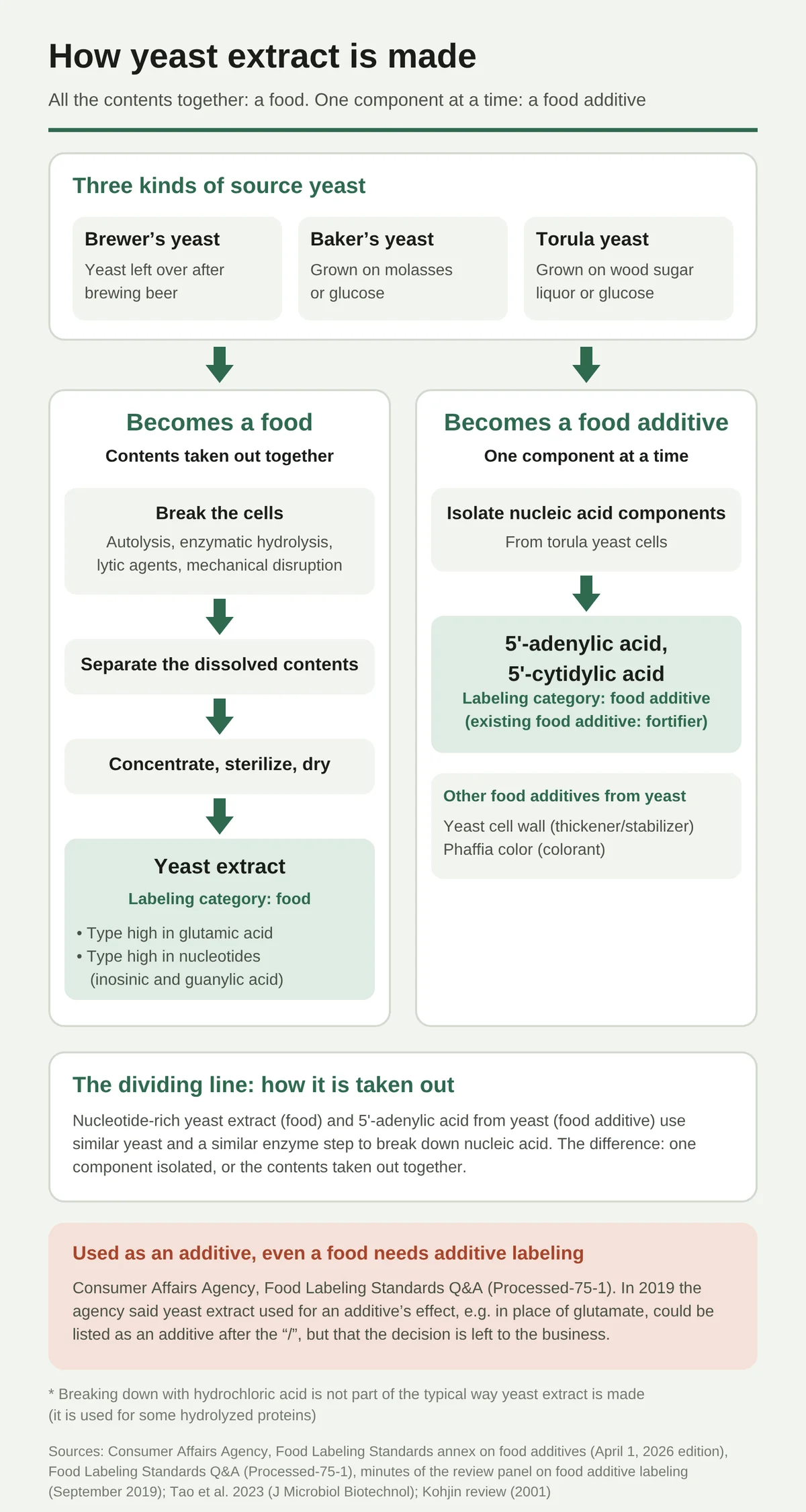
Yeast extract is made by breaking open yeast cells and concentrating the contents that dissolve out.
Three kinds of source yeast
| Yeast | Where it comes from | Characteristics |
|---|---|---|
| Brewer’s yeast | Yeast left over after brewing beer. 150–200 t comes out per 10,000 t of beer (Tao et al. 2023) | A step to remove the bitterness of hops is needed |
| Baker’s yeast | Yeast grown on molasses or glucose (Kohjin Life Sciences) | Grown specifically for yeast extract |
| Torula yeast | Grown on sugar liquor from wood or on glucose (Kohjin) | Multiplies fast. Strains that store a lot of nucleic acid are selected |
In January 2024, Asahi Group Foods announced a system in which yeast for yeast extract is grown at Asahi Breweries’ plants and the extract is made at its own plant. According to news reports, this is because the grown yeast lets it “control the nutrients contained in the extract.”
Four ways to break the cells
A 2023 review (Tao et al., in a Korean microbiology society journal) divides the ways of breaking yeast cells into four.
| Method | What it involves |
|---|---|
| Autolysis | The yeast is killed by heating or similar, and its own enzymes break down the contents. The traditional method used for Marmite and the like |
| Lytic agents | Salt, ethyl acetate and the like break the cell membrane |
| Enzymatic hydrolysis | Enzymes such as protein-degrading enzymes are added to break things down |
| Mechanical disruption | The cells are broken by machine. The “baker’s yeast extract” in US regulations is the soluble part of mechanically broken cells, concentrated |
The process for Kohjin’s “アロマイルド” (Aromild) is continuous culture → separating the yeast → hot-water extraction → separating the extract → enzyme reaction → concentration → sterilization → drying (2001 review). The guidelines of the Japan Extract Seasoning Association (2023) describe how to make an extract as “extraction or pressing, autolysis, enzyme treatment, refining, concentration, etc.”
A step of breaking down with hydrochloric acid is not part of the typical way to make yeast extract. Hydrochloric acid is used for some “hydrolyzed protein” (amino acid liquid and the like) made from soy or wheat protein. However, the US has an ingredient named “hydrolyzed yeast,” and we could not confirm that there are absolutely no acid-digested yeast products anywhere in the world.
Glutamic acid type and nucleic acid type
Yeast extracts fall into two broad types by how rich they are in umami components.
| Type | Main component | Key point in making | Example |
|---|---|---|---|
| Type high in glutamic acid | Glutamic acid (the umami of kelp) | Increase the glutamic acid the yeast holds | “アジトップ” (Ajitop) from Mitsubishi Corporation Life Sciences. The company describes it as “high in sodium L-glutamate” |
| Type high in nucleic acids | Inosinic acid (the umami of bonito flakes) and guanylic acid (the umami of dried shiitake) | Select yeast that stores a lot of nucleic acid (RNA) and break it down in two enzyme steps | Kohjin’s “アロマイルド” (Aromild). Under the 2001 specification, inosinic acid + guanylic acid is 20% or more |
In ordinary baker’s and brewer’s yeast, RNA (nucleic acid) is 4–8% of the dry yeast weight. Kohjin selected a torula yeast, through breeding, that stores 18% or more RNA, and converts it into umami nucleic acids in two enzyme steps: nuclease (an enzyme that cuts RNA into small pieces) and deaminase (an enzyme that converts adenylic acid into inosinic acid). The company’s review describes this breeding as “by classical methods” and says the strain is “not a genetically modified organism” (both are reviews written by employees of the maker).
What is in yeast extract
| Component | What it is |
|---|---|
| Amino acids and peptides | Broken-down protein. Free glutamic acid is a few % to 30% depending on the type (details in the section below) |
| Nucleic acids | Inosinic acid, guanylic acid and the like. There is also a patent in which umami nucleic acids are 25–55% of dry weight in a nucleic-acid-rich type (Lesaffre, priority date 2017) |
| Vitamins | B vitamins and others |
| Salt | Depends on the product. The Aromild specification is “salt 10% or less”; one analysis example is sodium 3.9 g/100 g (about 9.9 g as salt) |
The definition by the Japan Extract Seasoning Association (2023) also includes “this with secondary ingredients or taste components added.” In other words, an “extract” in the industry’s definition can include one with umami components added. The same guidelines, however, say that any additives added must be labeled in accordance with the Food Labeling Standards.
Why it is a “food”: Japan’s labeling rules
Yeast extract is a “food” for labeling purposes. But where that line falls is not as simple as it looks.
It is not on the list of food additives
In Japan, only the food additives on a list set by the state can be used. We checked the Consumer Affairs Agency’s “Attachment: Food Additives” (April 2026 edition; lists of existing additives, source substances of natural flavorings, general food additives, and so on), and the term “酵母エキス” (yeast extract) did not appear even once. That is why yeast extract is not an additive and is written, as a food, before the “/” in the ingredient list, in descending order by weight.
Note that the list of source substances for natural flavorings contains “イースト/酵母” (yeast). A flavoring made from yeast for the purpose of adding aroma is labeled “香料” (flavoring). Flavoring labels are covered in our article on flavorings.
Isolate one component and it becomes a “food additive”
What is interesting is that some things made from the same yeast are additives.
| Made from yeast | Labeling category | What it is |
|---|---|---|
| Yeast extract | Food | The contents of yeast taken out together and concentrated |
| 5’-adenylic acid, 5’-cytidylic acid | Food additive (existing additive; fortifier) | Nucleic acid components isolated from the cells of torula yeast (Candida utilis) |
| Yeast cell wall | Food additive (existing additive; thickener/stabilizer) | The wall of the yeast cell |
| Phaffia pigment | Food additive (existing additive; colorant) | A pigment taken from a yeast culture |
Sources: Consumer Affairs Agency “Attachment: Food Additives” (April 1, 2026 edition); Osaka Prefecture’s old-and-new comparison table of existing additives (2018).
The Consumer Affairs Agency’s Q&A on amino acid liquids (Processing-76) explains the thinking this way: something that keeps a mix of various amino acids, without isolating individual amino acids, is treated as a food, like meat extract. On the other hand, something reduced to a single component, such as monosodium glutamate, is a food additive.
A yeast extract (a food) containing 20% or more nucleic acids and 5’-adenylic acid isolated from yeast (an additive) are very similar in their source yeast and in the enzyme step that breaks down the nucleic acids. The difference is “whether it was taken down to a single component or taken out all together.”
The Q&A: “if used for an additive’s purpose, label it as an additive”
From here on, this is something other sites seldom write about.
The Consumer Affairs Agency’s Food Labeling Standards Q&A (Processing-75-1) contains the following exchange.
(Q) Can we take it that a food not on the list of general food additives needs no additive labeling even if it is used for an additive’s purpose? (A) If it is used for an additive’s purpose, additive labeling is required even if the substance is a food.
At the “Study Panel on the Food Additive Labeling System” on September 20, 2019, the Agency cited this Q&A and a 2007 notice (saying that if Chinese cabbage extract containing nitrate is used to color meat, it is labeled “発色剤” (color-developing agent)), and explained as follows (minutes).
- When yeast extract is used in place of glutamic acid, which is an additive, that is, when it is used expecting an additive’s effect, “labeling yeast extract as an additive after the slash (/)” could also be considered
- However, the decision whether to use it as a food or label it as an additive is, in the end, left to the business that uses it
So “yeast extract is not an additive” is a correct statement, but more precisely it is “normally labeled as a food. However, there is a Q&A saying it should be labeled as an additive if used for an additive’s purpose, and that decision is left to the business.” As far as we checked, no product in Urayomi’s product data writes yeast extract after the “/”.
The 2022 guidelines: Type 5
In March 2022, the Consumer Affairs Agency issued its “Guidelines on Not-Used Labeling of Food Additives.” In the end, rather than changing how yeast extract is treated as an additive, it responds on the “not used” labeling side.
Type 5 of the guidelines (labeling on foods that use an ingredient with the same or a similar function) gives, as an example highly likely to fall under prohibited labeling, “labeling that no seasoning as an additive is used, on a food that uses an extract containing amino acids as an ingredient.” The guidelines give this reason:
Substituting something from which only a specific component of a food has been extracted, so that scientific identity with that food is considered lost, is different, in terms of social convention, from substituting something considered a food.
On top of that, it says that if a consumer who wants to avoid additives buys such a product without noticing, they may be misled into thinking it is better than a product using additives. As a reference for Type 5, the Codex “General Guidelines on Claims” is cited.
The full list of types in the guidelines is in our article on “additive-free” labeling rules, and how the “no chemical seasoning” label disappeared is in our article on umami seasoning.
Japan, the US and Germany give different answers
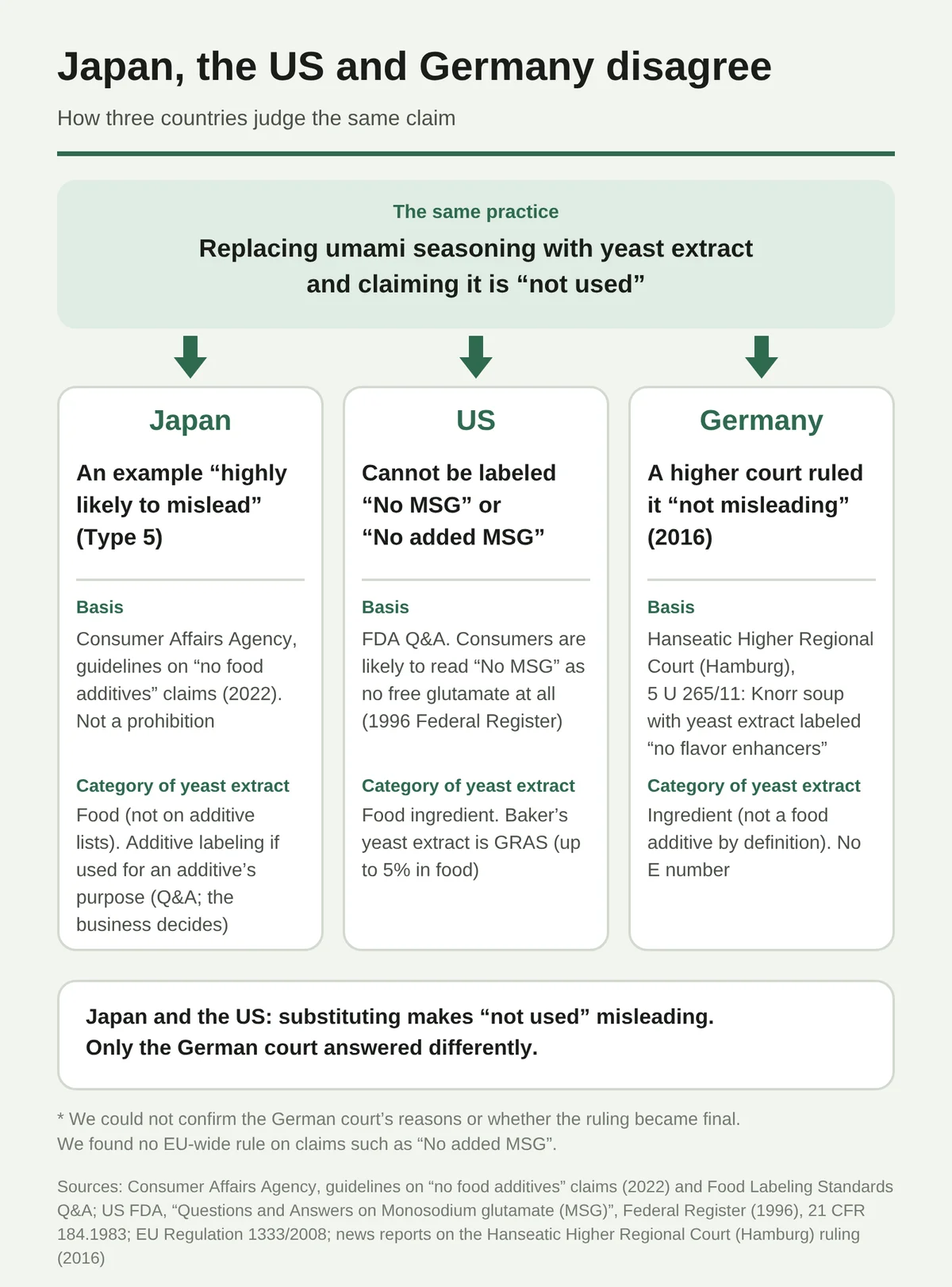
The same practice, “replacing umami seasoning with yeast extract and advertising ‘not used,’” gets different answers in three countries.
The US: you cannot write “No MSG”
The US Food and Drug Administration (FDA) Q&A says that a food using an ingredient that naturally contains free glutamate, such as yeast extract, cannot be labeled “No MSG” or “No added MSG”.
This Q&A was reworded on July 17, 2026.
| Version | Wording |
|---|---|
| Published 2012 (as of 2018) | MSG “occurs naturally” in ingredients such as hydrolyzed protein and yeast extract |
| Updated July 17, 2026 | Free glutamate and sodium “occur together naturally” in ingredients such as yeast extract |
The wording changed from “yeast extract contains MSG” to the more accurate “yeast extract contains free glutamate and sodium.” The conclusion that you cannot write “No MSG” has not changed.
The FDA had already worked through this issue in the Federal Register of September 12, 1996 (an advance notice, seeking comments before rulemaking).
- Consumers are highly likely to take a “No MSG” label to mean there is no free glutamate at all
- Makers of ingredients such as hydrolyzed protein market them to finished-food makers as “functional replacements for MSG that allow a ‘clean’ ingredient declaration and a ‘No MSG’ claim.” Here “clean” means that “monosodium glutamate” does not appear in the ingredient list
- A “No MSG” claim on a food using an ingredient high in free glutamate is misleading
There are also naming rules. US regulations (21 CFR 102.22, 1993) require the name of hydrolyzed protein to indicate its source, and “autolyzed yeast extract” is given in the text as an example of an acceptable name.
The EU and Germany: an ingredient, not an additive. The court said “not misleading”
In the EU, an additive is defined as something “not normally consumed as a food in itself” (Regulation 1333/2008, Article 3). Yeast extract is not on the list of additives and has no E number. The Austrian Chamber of Labour explains that “glutamate is an additive; yeast extract is an ingredient,” and so a product can say “ohne Geschmacksverstärker” (without flavor enhancers).
| Year | Event | Source |
|---|---|---|
| 2011 | Complaints about products advertising “no additives” gather on a German consumer group’s complaint site. In the first tally (October 2011), among 15 “no additives” products, the most common example was a product that said “no flavor-enhancing additives” while replacing them with yeast extract (chips, instant soups, sauces and so on) | Federation of German Consumer Organisations (vzbv) |
| December 2011 | A European yeast industry group counters that “yeast extract is a 100% natural ingredient and should not be confused with MSG.” The same month, the major retailer Lidl was reported to have said it would stop writing “free of monosodium glutamate” on products containing yeast extract | FoodNavigator, t-online |
| September 8, 2016 | In a lawsuit brought by the Saxony consumer center over a Knorr soup containing yeast extract labeled “natürlich, ohne geschmacksverstärkende Zusatzstoffe” (naturally, without flavor-enhancing additives), the Hanseatic Higher Regional Court (Hamburg) ruled “not misleading” (case number 5 U 265/11) | News reports of the consumer center’s announcement |
At the time of the reports, the ruling was said not to be final. We could not confirm the full text of the ruling or whether it later became final. We also could not find any EU-wide common rule governing labels like “No added MSG.”
The three countries side by side
| Japan | US | Germany (EU) | |
|---|---|---|---|
| Category of yeast extract | Food (not on the additive list). But additive labeling if used for an additive’s purpose (Q&A; decision left to the business) | Food ingredient. Baker’s yeast extract is “generally recognized as safe” (GRAS), up to 5% in food | Ingredient (does not meet the definition of an additive). No E number |
| “No umami seasoning” while using yeast extract | An example “highly likely to fall under prohibited labeling” in the 2022 guidelines (Type 5). The guidelines are an interpretive guide, not an individual prohibition | “No MSG” and “No added MSG” not allowed (FDA) | In 2016 a higher regional court ruled “no flavor-enhancing additives” not misleading |
| Reasoning | Substitution with an ingredient that does the same job. Draws on the Codex approach | Consumers take “No MSG” to mean the absence of all free glutamate (1996) | Judged case by case under the general rule on misleading labeling (Regulation 1169/2011, Article 7) |
Japan and the US are close in thinking: “if you substituted, ‘not used’ is misleading.” Only the German court gave a different answer (its reasons could not be confirmed).
Where did the “hidden MSG” claim come from?
The phrase “yeast extract is hidden MSG” is common on social media and some websites. Trace it back and you arrive in the US of the 1990s.
| Year | Event | Source |
|---|---|---|
| January 1993 | The FDA proposes adding “(contains glutamate)” to names such as autolyzed yeast extract. The FDA itself explained this was “not due to health concerns” | FDA, 1996 Federal Register |
| 1994 | The neurosurgeon Blaylock’s book Excitotoxins: The Taste That Kills is published | Bibliographic information |
| December 31, 1994 | Groups demanding MSG labeling (the Truth in Labeling Campaign; Mr. and Mrs. Samuels) and researchers such as Olney petition the FDA to require labeling of whether and how much free glutamate processed foods contain | FDA, 1996 Federal Register |
| 1995 | At the FDA’s request, the Federation of American Societies for Experimental Biology (FASEB) prepares a report | Same |
| September 1996 | The FDA seeks comments (advance notice), including a proposal to require labeling for foods containing 0.2 g or more of free glutamate per serving. The Federal Register also notes that consumers complain that “MSG is being hidden with yeast extract and the like” | Same |
| 2011 | In Germany, criticism that “yeast extract is hidden glutamate” spreads | Consumer groups, news reports |
| 2016 | A German higher regional court rules “no flavor-enhancing additives” on a product containing yeast extract not misleading | News reports |
| 2018 | A US coalition of yeast extract makers (Savory Taste Alliance) publicizes that it is “not hidden MSG” | FoodNavigator |
| 2022 | Japan’s guidelines set Type 5 | Consumer Affairs Agency |
| 2026 | The FDA rewords its Q&A to “free glutamate and sodium occur together naturally” | FDA |
Neither the FDA’s 1993 proposal nor its 1996 proposal became a regulation (we could not confirm what happened afterward). The site of the group that demanded labeling still classifies yeast extract as something that “always contains manufactured free glutamate.” We could not confirm from the original whether Blaylock’s book names yeast extract. Many of the “hidden MSG lists” circulating online were compiled by third parties, and who first made them is unclear.
What this history shows is that the starting point of “hidden MSG” was less “it’s dangerous” than a demand for labeling: “I don’t want to eat it without being told.”
| What people often say | Verdict |
|---|---|
| Yeast extract is MSG itself | No. Yeast extract is an ingredient containing free glutamate, not a single substance called MSG (monosodium glutamate). The FDA also reworded its text in 2026 |
| The glutamate in yeast extract is different from the glutamate in MSG | No. They are the same in the body (next section) |
| Yeast extract is worse for you than additives | We found no research to support this |
| Yeast extract is natural, so it’s safe | Not a basis (advertising language). The assessment is that glutamate is the same regardless of origin |
| Yeast extract is sometimes used as a replacement to advertise “additive-free” | True. It is written in industry documents and in the US FDA’s Federal Register notice (What the makers have said) |
Is yeast extract bad for you? Checking claim by claim
Glutamate does not change with “where it came from”
The glutamate in yeast extract and the glutamate in umami seasoning are the same thing in the body.
- FASEB (1995) concluded that only the L form of glutamic acid enhances flavor, and that its chemical properties are the same whether made in a factory or naturally present in food (cited in the FDA’s 1996 Federal Register notice)
- In the same notice, the FDA wrote that “scientific evidence does not support the claim that manufactured free glutamate acts differently in the body from naturally occurring free glutamate”
- In its 2017 re-evaluation, the European Food Safety Authority (EFSA) said analysis cannot distinguish glutamate “originally contained” from glutamate “added as an additive,” and noted that yeast extract is used as a source of glutamate
- Germany’s Stiftung Warentest also wrote in 2008 that “the glutamate in yeast extract is chemically identical to the industrial additive”
According to the FDA, adults get about 13 g of glutamate a day from the protein in food, and added monosodium glutamate is about 0.55 g a day. The ADI (acceptable daily intake) for monosodium glutamate and human trials are covered in our article on monosodium glutamate. That assessment is directly relevant to the glutamate in yeast extract too.
The “excitotoxin” claim
There is a claim that “glutamate is an ‘excitotoxin’ that overexcites nerve cells and destroys them, and it is in yeast extract too.”
- In the brain, glutamate is a substance that carries nerve signals, and when large amounts are released in the brain it does damage nerves (a problem in stroke and the like)
- But FASEB (1995) concluded that “there is no evidence that MSG or other free glutamate taken in the diet causes or worsens long-term diseases in which nerve cells deteriorate, such as Alzheimer’s disease, Huntington’s disease and ALS (amyotrophic lateral sclerosis)”
- EFSA (2017) sums up that the animal experiments in which the brain was damaged were ones in which large amounts were given systemically, such as by injection, and the damage occurred in places not protected by the blood-brain barrier (the brain’s checkpoint). It also notes that most glutamate that is eaten is used up as it passes through the gut and liver (for example, studies in premature infants)
Yeast extract is “an ingredient containing glutamate,” so the excitotoxin claim rides directly on the MSG debate. We found no research showing a nerve harm specific to yeast extract.
“Chinese restaurant syndrome” and hydrolysates
Complaints of headache or flushing after eating monosodium glutamate (so-called Chinese restaurant syndrome) are covered, with human trials, in our article on monosodium glutamate. For yeast extract, the following is known.
- FASEB (1995) found no scientific reports of adverse reactions caused by glutamate in protein hydrolysates (of microbial, plant or animal origin, including yeast). It says hydrolysates are normally used at less than 1% of a food
- On the other hand, the FDA recorded in the same notice that people who say they react to MSG report “the same symptoms from hydrolyzed protein or autolyzed yeast extract.” These are reports of experience, not trials
- We searched PubMed combining “yeast extract” with “Chinese restaurant syndrome / MSG symptoms,” and found no trial that tested whether yeast extract causes symptoms (searched October 3, 2026)
- The US consumer group CSPI puts yeast extract in “some people should avoid.” The reasons are people who react to MSG and people with mold allergy. The same page, however, also says reactions are less likely because there is much less glutamate than in MSG
Purines: the difference is the “nucleic acids”
The glutamate in yeast extract and in umami seasoning is the same, but something does differ in the body: the nucleic acids that come along with it.
Nucleic acids such as inosinic acid and guanylic acid are a kind of purine. When broken down in the body they end up as uric acid. If uric acid stays too high for a long time, it can cause gout. Monosodium glutamate has no such pathway.
| Food | Total purines (mg/100 g) | Source |
|---|---|---|
| Dried brewer’s yeast (supplement) | 2,995.7 | Kaneko et al. 2014 |
| Brewer’s yeast product | 1,206.2 | Same |
| Dried yeast | 847.1 | Kaneko et al. 2020 |
| Powdered umami dashi (with inosinic acid) | 684.8 | Kaneko et al. 2014 |
| Chinese dashi (dried) | 508.9 | Kaneko et al. 2020 |
| Powdered soup (consommé) | 179.8 | Kaneko et al. 2014 |
| Dark soy sauce | 45.2 | Same |
- We found no public table or paper that measured the purines of yeast extract itself. The USDA/NIH purine database (March 2025 edition) also has no row for yeast extract
- Japan’s guidelines recommend keeping dietary purines under 400 mg a day to prevent gout and hyperuricemia (as explained in Kaneko et al. 2014)
- Kaneko et al. say that attention is needed for foods with a high share of hypoxanthine (the form that comes from inosinic acid) among their purines. In powdered umami dashi, over 90% of the purines were hypoxanthine
By weight, it does look high. But when converted to the amount used in one serving, it comes out as follows.
| Amount per serving | Purines (calculated) |
|---|---|
| Powdered umami dashi 1 g (one bowl of miso soup) | about 6.8 mg |
| Powdered consommé soup 5.3 g (weight of one cube) | about 9.5 mg |
| Dark soy sauce 1 tablespoon (18 g) | about 8.1 mg |
| Red miso 12 g (one bowl of miso soup) | about 7.6 mg |
| Daily guideline | under 400 mg |
“Yeast extract is high in purines” is correct by weight, but at the amount used as a seasoning it is around 2% of the daily guideline. Kaneko et al. also say that powdered umami dashi is high in purines but only a small amount is used in cooking.
What to watch for is brewer’s yeast supplements (tablets or powder). Dried brewer’s yeast has about 3,000 mg per 100 g, so, for example, 3 g a day comes to about 90 mg. That is an order of magnitude more than yeast extract used as a seasoning. The purines in beer itself are covered in our article on beer and health.
3-MCPD: an EU survey found no quantifiable amount
3-MCPD (a chloropropanol) is a substance formed when plant protein is broken down with hydrochloric acid, as the fat in the raw material reacts with chlorine. Its occurrence in hydrolyzed protein and amino acid liquids is covered in our article on umami seasoning.
- A report from an EU scientific cooperation project (SCOOP 3.2.9, June 2004) says that neither 3-MCPD nor 2-MCPD was detected at a quantifiable level in the yeast extract samples. The same report gave an average of 0.068 mg/kg for acid-hydrolyzed hydrolyzed protein and 0.005 mg/kg for enzyme-digested
- Yeast extract is normally made by autolysis or enzymes, not with hydrochloric acid. Kohjin’s review likewise says that, because there is “no hydrochloric acid hydrolysis step,” it is not contained (the maker’s own explanation)
- Searching PubMed for “yeast extract” combined with “3-MCPD / chloropropanol” returned 0 papers. Japan’s Ministry of Agriculture, Forestry and Fisheries (MAFF) survey focused on soy sauce and amino acid liquids, and we could not confirm whether it measured yeast extract
All we can say is “below the limit of quantification in an EU survey” and “the manufacturing method differs from hydrochloric acid hydrolysis.” We cannot say that “yeast extract has no 3-MCPD at all.” We also could not confirm from the text how many yeast extract samples the EU survey had.
Yeast allergy
- In a Finnish case report (2006), a person with an allergy to molds had repeated anaphylaxis (a severe, whole-body allergic reaction) from a pasta sauce containing yeast extract. Blood tests were positive for antibodies to baker’s yeast and to food-grade yeast extract, and cross-reactivity between yeast and mold (reacting to similar components) was confirmed
- In the UK, there was also a 1989 letter in the BMJ titled “Allergy to Marmite?”
- The US consumer group CSPI cautions that some people who react to molds also react to yeast extract
All of these are rare cases. Yeast is not among the 28 allergens that are mandatory or recommended for labeling in Japan. Note that “酵母エキス(小麦を含む)” (yeast extract (contains wheat)) in an ingredient list indicates that a wheat-derived material is used in the yeast extract (an example from a Consumer Affairs Agency Q&A).
Antidepressants (MAO inhibitors) and Marmite
MAO inhibitors (monoamine oxidase inhibitors) are a class of drugs used to treat depression and other conditions. When a person taking this drug eats a food high in tyramine (a substance abundant in aged foods), blood pressure can rise suddenly.
- In 1965, the medical journal The Lancet published two reports titled “Effect of yeast extract after MAO inhibition” (we could confirm only the titles and bibliographic details, not the text)
- A dietary guide (1989) by researchers at the University of Toronto, Canada, who measured tyramine in over 100 foods, lists “concentrated yeast extract (for example, Marmite)” among foods to be absolutely avoided, alongside aged cheese, sauerkraut and others. The 1996 guide also lists Marmite among foods to avoid
- According to a psychiatrist’s explanation, 1970s measurements put tyramine in Marmite at about 300 mg per kg, and it may be lower now that the manufacturing has changed
This concerns people taking MAO inhibitors and concentrated yeast extract like a spread eaten on bread. We found no data measuring whether the small amount of yeast extract in dashi mix or roux is a problem. People taking the drug should check with their doctor or pharmacist.
Research on salt reduction stops at taste evaluation
In maker documents we often see the explanation that “yeast extract lets you cut salt.” Looking for studies in people, we found the following.
| Study | Type, number of people, duration | What was found | Funding / conflicts of interest |
|---|---|---|---|
| Bolhuis et al. 2011 (Netherlands) | 116 people (mean age 21), 4 weeks, bread at a breakfast buffet | When the salt in bread was reduced each week, the amount eaten did not change up to a 52% cut and fell at a 67% cut. The group whose taste was made up with potassium chloride and yeast extract did not eat less even at a 67% cut | University and a national institute. We could not confirm the funding source |
| Santana et al. 2026 (Brazil) | Sensory test (number of people not given in the abstract) | In beef patties with salt cut by 50% and 2% yeast extract added, liking was about the same as with the original salt level | Declared no conflicts of interest |
| Şen Yılmaz 2023 (Türkiye) | Sensory test (marinated shrimp) | Half the salt was replaced with potassium chloride, and the bitterness was masked with yeast extract | Declared no conflicts of interest |
- We found no trial that measured blood pressure or urinary sodium in people (PubMed, searched October 3, 2026). What has been confirmed goes only as far as “taste” and “amount eaten”
- Some studies of salt reduction with yeast extract include employees of a major Chinese yeast extract maker (Angel Yeast) as coauthors (for example, a 2022 paper searching for salt-enhancing peptides). A 2024 paper (a study of aroma compounds) declared “no conflicts of interest” although three of the coauthors were affiliated with that company
- An analysis of Australia’s national nutrition survey (2011–12, 12,153 people) found that yeast extract spreads such as Vegemite help intake of B vitamins and others, but also pushed up sodium intake (Whatnall et al. 2024). Yeast extract itself can contain salt
It is the same picture as the salt-reduction research on umami seasoning covered in our article on monosodium glutamate. Excess salt is covered in our article on salt intake. For people who want to cut salt itself, another option is to choose from foods made with less salt from the start.
Assessments by country: it’s a food, so there is no ADI
| Agency / country | How yeast extract (for umami) is treated |
|---|---|
| JECFA (the FAO/WHO Joint Expert Committee on Food Additives) | We found no evaluation of yeast extract for umami. It evaluated only “yeast extract containing mannoproteins” for wine, and in 2017 concluded that, for the stabilization use of up to 400 mg per liter of wine, it is “unlikely to be a health concern.” It cited the “long history of consumption of yeast products” as a basis |
| EFSA (EU) | Yeast extract is an ingredient, not an additive, so it is outside the scope of evaluation. It was only noted as a source of glutamate in the 2017 re-evaluation of glutamates |
| FDA (US) | Baker’s yeast extract is affirmed as GRAS in regulation (21 CFR 184.1983). It has specifications for heavy metals (arsenic under 0.4 ppm, lead 0.2 ppm and so on) and for microbes, and its use is up to 5% in food as a flavoring and the like. Autolyzed yeast extract is not in the regulations and has been treated as GRAS through FDA opinion letters of 1959–1972 and similar documents |
| Japan | It is a food, so it is not subject to an individual evaluation by the Food Safety Commission of Japan (FSCJ) (we found no evaluation report) |
Food additives are evaluated, with data such as animal studies, to set an ADI (acceptable daily intake). Yeast extract is a food, so it has no such procedure. What supports it instead is the long history of eating the source yeast, and, in the US, specifications for heavy metals and microbes and a use limit.
What this does and does not say: it is neither “not evaluated, therefore dangerous” nor “a food, therefore proven safe.” For glutamate, it is the same substance as MSG, so the evaluation of MSG is directly relevant.
Counting across the 69 foods on Urayomi
How much yeast extract is actually in real products? On October 3, 2026, we recounted the ingredient lists of the 69 foods listed on Urayomi (excluding 2 household goods).
| Category | Products | With yeast extract | With umami seasoning | With hydrolyzed protein |
|---|---|---|---|---|
| Curry and stew roux | 11 | 11 | 5 | 2 |
| Soup base mixes | 7 | 5 | 5 | 3 |
| Dashi | 6 | 3 | 3 | 1 |
| Sauces | 6 | 2 | 1 | 1 |
| Dressings and mayonnaise | 4 | 1 | 2 | 0 |
| Others (sauces, bottled foods, spices, salt, vinegar, soy sauce, miso, noodles, etc.) | 35 | 1 | 5 | 2 |
| Total | 69 | 23 (33%) | 21 | 9 |
Note: “Yeast extract” includes yeast extract seasoning, fermented yeast extract seasoning, processed yeast extract products and yeast extract powder. “Umami seasoning” means 調味料(アミノ酸等) (seasoning (amino acids, etc.)), sodium glutamate, inosinate and guanylate. Of the 5 other products with umami seasoning, 1 is infant formula with added nutrients (sodium 5’-inosinate and the like).
- One product in three contained yeast extract. All 11 curry and stew roux did, and 5 of 7 soup base mixes. How to read the ingredients of curry roux is covered in the curry roux article
- By combination, both yeast extract and umami seasoning were in 12 products, yeast extract only in 11, umami seasoning only in 9, and neither in 37. Yeast extract is not only used as a “substitute” for umami seasoning; it is often used together with it
- Ingredients are listed in descending order by weight. In 19 of the 23 products, yeast extract was written in the back half of the ingredient list, meaning a small amount. But among products that use only yeast extract, some had it near the front (3rd of 10 for ムソー「野菜のおかげ」 (Muso “Yasai no Okage”), 4th of 11 for 創健社’s curry roux, 5th of 9 for ユウキ食品’s ガラスープ (Chinese-style bone-broth base))
“Not used” (〇〇不使用) labels and yeast extract
Of the 16 products whose maker states a “〇〇不使用” (not used) or “無添加” (additive-free) claim, 6 contained yeast extract. But in all 6, what is claimed not to be used is unrelated to umami.
| Product | What the not-used / additive-free claim covers |
|---|---|
| コスモ直火焼 米粉のカレー・ルー 甘口 | Wheat flour |
| コスモ直火焼 米粉のカレー・ルー 中辛 | Wheat flour |
| 小林農園 元祖の本造りなめ茸 | Thickener, preservatives |
| MAYO×MAYO マヨ | Preservatives, thickener, antioxidant |
| ムソー 野菜のおかげ | Animal-derived extracts |
| 創健社 植物素材の本格カレールウ | Acidulant, emulsifier, animal-derived ingredients |
On the other hand, of the 7 products that claim no umami, no seasoning or no additives overall (2 yakiniku sauces, a yakisoba sauce, 2 dashi packs, a furikake and a nam pla), none used yeast extract. Among these 69 products, none claims no umami seasoning while replacing it with yeast extract.
Since the 2022 guidelines, products claiming “no umami seasoning” appear to be moving toward not using yeast extract either. But note that these are 69 products chosen and listed by Urayomi, not a random sample. They do not represent the share across the whole market.
The 3 products that say “no yeast extract”
Three more products explicitly named “酵母エキス” (yeast extract) among the things not used.
| Product | Category | Wording of the claim |
|---|---|---|
| 光食品 有機やきそばソース | Sauce (name: Worcestershire-type sauce) | On the official site’s product features: “does not use preservatives, 調味料(アミノ酸等), caramel color, or yeast extract” |
| 鰹節のカネイ 無添加かつおふりかけ | Furikake (rice seasoning) | The “無添加” (additive-free) claim on the front of the package (sodium glutamate, yeast extract, colorants, preservatives). On the official shop: “additive-free of 調味料(アミノ酸), yeast extract, colorants and preservatives” |
| 風と光 有機トウバンジャン | Chinese seasoning (doubanjiang) | In a notice on the official site (August 2024): “does not use any preservatives, colorants, yeast extract or alcohol that people worry about” |
In all three, the umami comes from ingredients such as kelp, bonito flakes, shiitake, soy sauce and fish sauce. It seems best to read “no yeast extract” not as saying yeast extract is bad for you but as a label that makes clear what is used to add umami.
How much does it take to equal umami seasoning?
The “amount of glutamate” in yeast extract is almost never published. Here we calculate from the numbers that are known.
Glutamate in yeast extract: a few % to 30%, depending on type
| Category | Free glutamate (per dry weight) | Source |
|---|---|---|
| Industry explanation | About 5% | A US coalition of yeast extract makers (2018) |
| Conventional product example | 4–7% | Comparison example in an Asahi Breweries patent (published 2010) |
| Common in commercial products | Around 10% | Description in the same patent |
| Type high in glutamic acid | 20–30% (max 29.1%) | Inventive product in the same patent |
| For reference: monosodium glutamate | About 79% (as glutamic acid) | Calculated from molecular weights |
All of these numbers come from the makers’ side. We found no cross-sectional measurement of commercial yeast extracts by a public agency. The industry group writes a smaller “about 5%,” and the patent for a high-glutamate type writes a larger “20–30%,” so the number changes with the position of the source. We cannot say in a single figure that “the glutamate in yeast extract is ○%.”
How many grams does it take to equal umami seasoning
In our article on monosodium glutamate, we put the umami seasoning added to one person’s serving of a dish at about 0.2 g (from the Japan Umami Seasoning Association’s guide of “0.8 g for four servings of stir-fry or soup”). The glutamate in 0.2 g of “味の素®” (AJI-NO-MOTO®; 97.5% sodium glutamate), calculated from molecular weights, is about 153 mg.
To get the same amount of glutamate from yeast extract:
| Glutamate in the yeast extract | Yeast extract needed |
|---|---|
| 5% | About 3.1 g |
| 10% | About 1.5 g |
| 20% | About 0.77 g |
| 30% | About 0.51 g |
For ordinary types (5–10%), this works out to about 8 to 15 times the weight of umami seasoning. For a high-glutamate type, about 2.5 to 4 times is enough. Put the other way, the glutamate in 1 g of 10% yeast extract (100 mg) is about the same as in 100 g of kelp dashi (a 3% simmered extract of ma-konbu) (in the Standard Tables of Food Composition in Japan, amino acid table, kelp dashi has 100 mg of glutamate per 100 g).
However, the strength of umami is not determined by the amount of glutamate alone. A nucleic-acid-rich type produces strong umami even with little glutamate. The “mentsuyu” (noodle dipping sauce) example in the next section is a case of this.
For one serving of dashi mix, published values give only an “upper limit”
So how much glutamate from yeast extract is in one serving of a store-bought dashi mix? The answer is that it “cannot be determined from published numbers alone.”
As an example, let us calculate for ムソー「野菜のおかげ」 (Muso “Yasai no Okage”; 5 g per pouch, enough for 300 ml of soup).
- The ingredients read “salt, starch hydrolysate, yeast extract, …” in that order. Because it is in descending order by weight, yeast extract is at most one third of 5 g, about 1.7 g or less
- The nutrition label shows protein of 0.5 g per pouch. Suppose all of that protein comes from yeast extract and that half to two thirds of yeast extract is protein; then yeast extract is at most about 0.8–1.0 g. However, in the examples compiled by Tao et al. 2023, the protein in yeast extract ranges widely from 14% to 64% depending on the method, and for a low-protein product the upper limit stays at the roughly 1.7 g of step 1. In reality, soy sauce and vegetable powder also contain protein, so there should be less yeast extract
- For an ordinary type (4–10%), glutamate is at most about 30–100 mg (about 70–170 mg if calculated with the 1.7 g upper limit). In 300 ml of soup, that is about 10–33 mg per 100 ml (about 23–57 mg with 1.7 g), less than kelp dashi (about 100 mg per 100 ml)
- However, if a high-glutamate type (20–30%) is used, the range widens to at most about 300 mg (about 500 mg with the 1.7 g upper limit)
Unless the maker discloses the amount of yeast extract and which type it used, we cannot say “this equals ○ mg of umami seasoning.” On Urayomi we do not fill this gap with guesses; we leave it as unknown.
What the makers have said
“Replace with yeast extract and advertise ‘additive-free’” is not only something critics say. The makers’ own documents say the same.
The industry’s own words (a 2001 review)
A review written in 2001 by Kohjin employees in the Journal of the Japanese Society for Food Preservation Science (the one on developing nucleic-acid-rich yeast extract, which won the society’s technology award) says:
- Yeast extract is classified as a “natural seasoning,” unlike food additives such as glutamic acid and inosinic acid, so for processed foods built entirely from natural ingredients it has “the advantage of ‘no obligation to label as a food additive’”
- In the product material: “‘Aromild’ helps in developing additive-free products”
- In a trial of mentsuyu (3x concentrate), it gives an “all-natural recipe” in which 0.8 g of Aromild completely replaces a control that used 15 g of sodium glutamate
The review also says that ordinary yeast is low in nucleic acids, and that reinforcing it with inosinic acid or the like would require labels such as “調味料(核酸)” (seasoning (nucleic acid)). The explanation is that the nucleic-acid-rich yeast extract was made so that such labeling would not be needed.
Note that this review was written by employees of the manufacturer. Evaluative words such as “natural” and “health-conscious” have the character of advertising, so this article uses only the method and the numbers.
The US FDA wrote the same thing
As noted in the US section, the FDA wrote in its 1996 Federal Register notice that ingredient makers market hydrolyzed protein and the like as “MSG replacements that allow a clean ingredient declaration and a No MSG claim.” So the Japanese industry review and the US official document leave the same picture.
In Japan too, materials for the Consumer Affairs Agency’s 2019 study panel (a summary of members’ main opinions so far) include an opinion that asks where to draw the line on substitution by ingredients — “most products with no chemical seasoning (化学調味料無添加) use umami seasonings such as yeast extract or hydrolyzed protein” — and an opinion that “just as substitutes and substitute technologies appeared 20 years ago, the same sort of thing may come up again.”
The same corporate group makes both umami seasoning and yeast extract
The framing of “chemical seasoning versus natural yeast extract” does not hold on the makers’ side.
Mitsubishi Corporation Life Sciences was formed in 2019 by merging MC Food Specialties, which descends from the former Kirin Kyowa Foods, with Kohjin Life Sciences, which makes torula yeast extract, and others. The company is a maker of umami seasoning (descended from the former Kyowa Hakko food business) that describes itself as having “established, for the first time in the world,” the method of mass-producing sodium glutamate by fermentation, and at the same time is a major yeast extract maker. It describes its own yeast extract “Ajitop” as “high in sodium L-glutamate.”
So choosing between umami seasoning and yeast extract is also a choice within the products of the same company.
How to read the back label and how to choose
Whether you need to avoid yeast extract depends on your own view and your health. Here we pull together how to read labels and how to choose, so that you can decide based on facts.
Label-checking points
- Look for “酵母エキス” (yeast extract) before the “/”: Yeast extract is a food, so it is written before the “/”. Even if no umami seasoning (“調味料(アミノ酸等)” after the “/”) is used, umami may be added with yeast extract
- Look at where the yeast extract sits: Ingredients are in descending order by weight. Near the end means a small amount; near the front means more (though the actual amount is not known)
- For “〇〇不使用” (“no 〇〇”), read what is not used: Among Urayomi’s 69 products, there were products with a not-used claim that covered preservatives or wheat flour yet contained yeast extract
- If “no yeast extract” is stated, you can confirm it from the label: Some products state it explicitly, like the ones in the 3 products that say “no yeast extract”
- “酵母エキス(小麦を含む)” (yeast extract (contains wheat)) is an allergen label: People with a wheat allergy should check
When you want to choose products without yeast extract
The surest way is to choose products made only of raw ingredients. For dashi, there are “dashi packs” filled with only dried fish, niboshi (dried small sardines), kelp or shiitake. These are not the kind you dissolve straight in, like granulated dashi mix, but the kind you simmer.
Of the dashi packs listed on Urayomi, the following 2 have only seafood, kelp and shiitake as ingredients, and use no yeast extract, no umami seasoning and no salt.
If you make your own dashi
If you make your own dashi from bonito flakes and kelp, you know everything that goes in. The glutamate in kelp dashi is about 100 mg per 100 ml (a 3% simmered extract of ma-konbu, Standard Tables of Food Composition in Japan), so the amount of umami is known too. If you buy bonito flakes, there are makers’ official online shops.
People who should be careful
| Who | What to watch for |
|---|---|
| People taking MAO inhibitors | Concentrated yeast extract spreads such as Marmite are on the dietary guidance list of foods to avoid. Check with your doctor or pharmacist |
| People with gout or hyperuricemia | The purines at the amount used as a seasoning are a few mg. What to watch is brewer’s yeast supplements (several grams a day) |
| People with a mold allergy | There are rare cases of reactions to yeast extract. If concerned, consult a doctor |
| People who want to avoid umami seasoning | The glutamate in yeast extract is the same thing in the body. Even for a “no umami seasoning” product, check the ingredient list for whether umami is added with yeast extract or hydrolyzed protein |
What we introduced in this article (summary)
Here is everything introduced in the article, once more. The reasons and ingredients are in each section.
| What we introduced | Where to buy |
|---|---|
| 無塩ドットコム (Muen.com; a specialty shop for low-salt and no-salt foods) | 他では買えない減塩食品がたくさん!減塩専門店「無塩ドットコム」  PR PR |
| かね七 料亭仕込み 天然だしの素パック 30袋入(8g×30袋) (Kane-shichi natural dashi packs, 30 bags of 8 g) | See on Rakuten (くすりのiQ) PR See on Amazon.co.jp PR See on Yahoo! Shopping PR |
| マエカワテイスト だしパック 十二単(10g×20袋) (Maekawa Taste “Juni-hitoe” dashi packs, 20 bags of 10 g) | See on Rakuten (にっぽん津々浦々) PR See on Amazon.co.jp PR See on Yahoo! Shopping PR |
| マルトモ公式直販 (Marutomo official online shop; bonito flakes and dashi) | かつお節・だしを楽しむ通販サイト【マルトモ公式直販】  PR PR |
Summary
| What you may wonder | What we found |
|---|---|
| Where did yeast extract come from? | It spread in Europe as a substitute for 19th-century meat extract. Marmite was incorporated in the UK in 1902. In Japan it was imported in the early Showa era, and Asahi describes its 1966 “ミースト” (Miisuto) as the country’s first |
| How is it made? | Yeast is broken down by autolysis or enzymes and the dissolved contents are concentrated. Breaking down with hydrochloric acid is not part of the typical method. There are glutamic acid and nucleic acid types |
| Isn’t it an additive? | A food for labeling purposes. Isolating components one at a time makes an additive; taking them out all together makes a food. But a Q&A says “if used for an additive’s purpose, label it as an additive,” and the decision is left to the business |
| Does it differ between Japan and abroad? | For a “not used” claim made by replacing with yeast extract, the US says not allowed, Japan’s guidelines call it an example “highly likely to fall under prohibited labeling,” and a German higher court ruled “not misleading” |
| Is “hidden MSG” true? | Yeast extract is not MSG itself, but it contains free glutamate. The starting point was a demand for labeling. The makers also cited “no labeling obligation” as an advantage |
| Is it bad for you? | Glutamate is the same regardless of origin, and we found no research showing a harm specific to yeast extract. The difference is the nucleic acids (purines), but a serving is a few mg |
| Who should be careful? | People taking MAO inhibitors (for concentrated yeast extract spreads) and those with a rare yeast allergy. 3-MCPD was below the limit of quantification in an EU survey |
| How much is in products? | 33% of Urayomi’s 69 foods, and all 11 curry roux. 0 of the 7 products claiming no umami. The glutamate of 0.2 g of umami seasoning needs about 1.5–3.1 g of an ordinary type |
Sources
History
- Science History Institute, “Where’s the Beef?” Distillations (December 14, 2013) https://www.sciencehistory.org/stories/magazine/wheres-the-beef/
- UNESCO World Heritage, “Fray Bentos Industrial Landscape” https://whc.unesco.org/en/list/1464/
- The Nobel Prize in Chemistry 1907, Eduard Buchner https://www.nobelprize.org/prizes/chemistry/1907/summary/
- Grace’s Guide, “Marmite Food Extract Co”; Australian Dictionary of Biography, “Callister, Cyril Percy” (1979); Monash Lens (July 14, 2023)
- Aoyagi Y, et al. “Development of high-function yeast extracts and their use in foods” (高機能酵母エキスの開発と食品への利用), Journal of the Japanese Society for Food Preservation Science 2001;27(2):99-106 (the authors are employees of the manufacturer)
- Imura T. “Yeast extract” (酵母エキス), Seibutsu-kogaku Kaishi 2014;92(2):81 (the author is an employee of the manufacturer)
- Asahi Group Foods, “Company history”; Kohjin Life Sciences, “Company profile,” “Locations,” “What is yeast extract?”; Mitsubishi Corporation Life Sciences, “Company history,” “Yeast extract”
- Gourmet Watch (January 25, 2024; March 2, 2026)
How it is made, and its components
- Tao Z, et al. Yeast Extract: Characteristics, Production, Applications and Future Perspectives. J Microbiol Biotechnol 2023;33:151 (PMID 36474327)
- Japan Extract Seasoning Association, “Guidelines on labeling of extracts” (July 20, 2023)
- Patents JP4503700B1 (Asahi Breweries, published 2010) and US11896042B2 (Lesaffre, priority date December 13, 2017)
- FoodNavigator, “Savory Taste Alliance” (September 5, 2018)
- MEXT, “Standard Tables of Food Composition in Japan 2020 (Eighth Revised Edition), Amino Acids”
Labeling rules
- Consumer Affairs Agency, “Food Labeling Standards, Attachment: Food Additives” (April 1, 2026); “Food Labeling Standards Q&A,” Chapter 2 (October 1, 2026 edition), Processing-75-1 and Processing-76
- Consumer Affairs Agency, “5th Study Panel on the Food Additive Labeling System,” minutes and Material 3 (September 20, 2019)
- Consumer Affairs Agency, “Guidelines on Not-Used Labeling of Food Additives” (March 30, 2022)
- US FDA, “Questions and Answers on Monosodium glutamate (MSG)” (published 2012, updated July 17, 2026)
- US FDA, Federal Register 61 FR 48102 (September 12, 1996) https://www.govinfo.gov/content/pkg/FR-1996-09-12/html/96-23159.htm
- 21 CFR 102.22, 21 CFR 101.22, 21 CFR 184.1983 (eCFR)
- Regulation (EC) No 1333/2008, Article 3; Regulation (EU) No 1169/2011, Article 7
- Federation of German Consumer Organisations (vzbv), Lebensmittelklarheit tally (October 2011); FoodNavigator (December 7, 2011); Leipziger Internet Zeitung (September 2016, report on the Hanseatic Higher Regional Court case 5 U 265/11); Austrian Chamber of Labour, “Geschmacksverstärker”
Safety and effects on the body
- EFSA ANS Panel. Re-evaluation of glutamic acid (E 620), sodium glutamate (E 621) …. EFSA J 2017;15(7):4910
- JECFA 84th meeting (2017), evaluation of yeast extract containing mannoproteins (OIV’s CCFA50 report material)
- Kaneko K, et al. Total purine and purine base content of common foodstuffs for facilitating nutritional therapy for gout and hyperuricemia. Biol Pharm Bull 2014;37:709-721
- USDA and NIH, “Purine Content of Foods” Release 2.0 (March 2025)
- European Commission. SCOOP Task 3.2.9 Collection and collation of data on levels of 3-monochloropropanediol (3-MCPD) and related substances in foodstuffs (June 2004)
- Airola K, et al. Ann Allergy Asthma Immunol 2006;97:294 (PMID 17042133) / Higson N. BMJ 1989;298:190 (PMID 2493858)
- Blackwell B, et al. Lancet 1965 (PMID 14275831, 14287333) / Shulman KI, et al. J Clin Psychopharmacol 1989;9:397 (PMID 2592589) / Gardner DM, et al. J Clin Psychiatry 1996;57:99 (PMID 8617704)
- Bolhuis DP, et al. J Nutr 2011;141:2249 (PMID 22049293) / Santana LP, et al. Meat Sci 2026 (PMID 41671679) / Şen Yılmaz EB. Molecules 2023 (PMID 38202767) / Whatnall M, et al. J Hum Nutr Diet 2024 (PMID 37853549) / Shen DY, et al. Food Chem 2022 (PMID 35447578) / Shan Y, et al. Food Chem X 2024 (PMID 38721385)
- CSPI, “Chemical Cuisine: Autolyzed yeast extract”; Stiftung Warentest (March 27, 2008)
Urayomi’s tally
- Urayomi product data (ingredients and not-used claims for 69 foods), tallied October 3, 2026
Related articles and databases
- Why Did “No Chemical Seasoning” Disappear? Is Yeast Extract a Chemical Seasoning? How to Read Umami Seasonings and Hydrolyzed Protein
- What Is Monosodium Glutamate (Umami Seasoning)? Checking the Claims About Petroleum, GMOs, Intake Limits, and a "Damaged Sense of Taste"
- Were “無添加” (Additive-Free) Labels Banned? Reading the Consumer Affairs Agency Guideline’s 10 Types from the Back Label
- Comparing Store-Bought Curry Roux by the Label: From Meiji-Era Cookbooks to Solid Roux, Fat, Salt and Additives in 11 Products, Lead in Turmeric, and Food Poisoning from Leftover Curry
- Are emulsifiers bad for you? The history that began with egg yolk lecithin, types and uses, gut microbiota research (mice and humans), and how Japan and the EU label them