

Store-Bought Nabe Broths: Ingredients and Salt in 18 Products (Winter 2026)

PR This article contains advertising. “See on Rakuten” links are Rakuten affiliate links, and the Shichifuku Jozo and Muen.com buttons are affiliate ads (A8.net). The “See on Amazon.co.jp” links are also affiliate links.
When the weather turns cold, store-bought nabe tsuyu (hot pot broth) sees more use. Some types are poured into the pot straight from the pouch, some are diluted, and others come as single-serving packets or cubes.
Turn the package over and you find terms such as “調味料(アミノ酸等)” (seasoning (amino acids, etc.)), yeast extract, and hydrolyzed protein. Even the salt equivalent is written differently from product to product: per 100 g on one, per piece on another. That makes it hard to see how the products differ.
In this article, based on the labels the makers published on their official websites as of October 26, 2026, we compared 18 store-bought nabe broths on three points:
- the additives in the ingredient list, and the ingredients that provide umami
- the salt equivalent per serving (calculated after aligning the units on the labels)
- what the “無添加” (mutenka, “additive-free”) and “化学調味料無添加” (kagaku chomiryo mutenka, “no chemical seasoning added”) labels actually refer to
Bottom line: you can compare nabe broths by thinking about how many servings a pack makes and how much of the broth you drink
- The 13 products from the seven major makers (Mizkan, Ebara Foods, Ajinomoto, Daisho, Moranbong, Yamaki, Kikkoman) all use seasoning (amino acids, etc.). The additive entries after the slash (/) in the ingredient list number 2 to 6
- Three nabe broths have no additive entries at all in the ingredient list (Marusan’s yosenabe soup and two Fuki nabe concentrates). The two Choko Shoyu products have just one additive entry, alcohol
- Even in the broths with no additive entries, umami sources such as “yeast extract” and “○○ extract” are included as foods. On the label these are not additives, so they are written before the slash
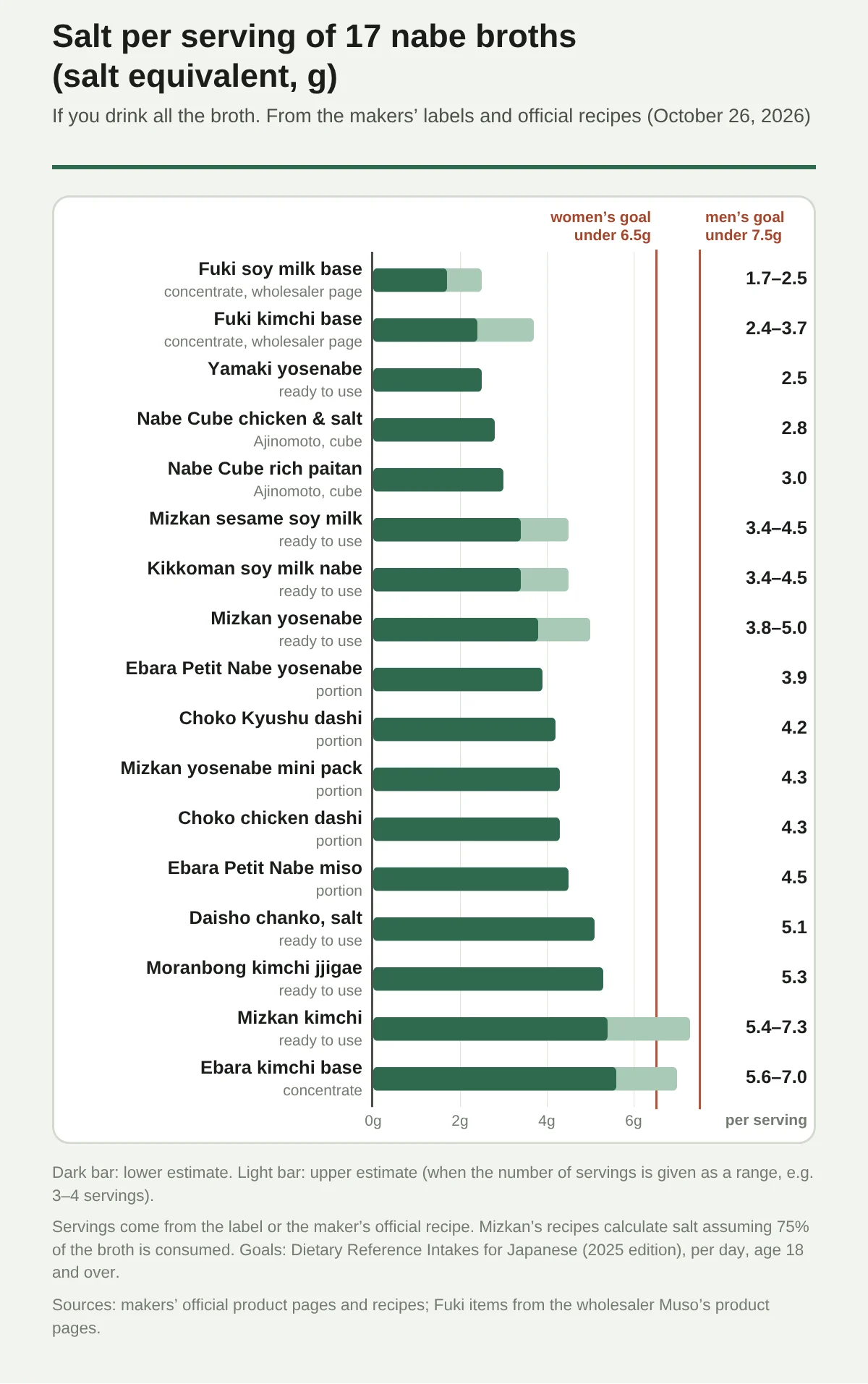
- For the 17 products whose salt could be converted to one serving from the maker’s label or official recipe, the salt equivalent per serving was about 1.7 to 7.3 g. Kimchi types tend to be higher
- Japan’s dietary goal for salt (Dietary Reference Intakes for Japanese, 2025 edition) is under 7.5 g for men and under 6.5 g for women aged 18 and over. The label figure is the amount if you drink all the broth, so if you leave broth behind, you take in correspondingly less
- For ready-to-use types in large pouches, many product pages from the makers do not state how many servings a pack makes, so salt per serving cannot be compared as is. In this article we calculated one serving from the number of people an official recipe uses one pack for, and similar information
What this article covers
| For people who… | What is covered | Where |
|---|---|---|
| want to choose a nabe broth by its ingredient list | 18 store-bought nabe broths (Mizkan, Ebara, Ajinomoto, Daisho, Moranbong, Yamaki, Kikkoman, Choko, Marusan, Fuki) | Comparing the ingredients of 18 products |
| want to compare salt per serving | Nabe broths in single-serving portions and cubes | Salt equivalent per serving |
| want to cut salt itself | Muen.com (online shop specializing in low-salt and no-salt foods) | How much less do you take in if you leave the broth? |
| want to make nabe broth themselves | Shichifuku Jozo shiro-dashi (white dashi) trial set | If you make it yourself |
The four forms of nabe broth, and the units on the label
Nabe broths fall into four forms, depending on how you use them.
| Form | How to use | Products in this article | Unit on the nutrition label (examples) |
|---|---|---|---|
| Ready-to-use | Pour from the pouch into the pot (no water added) | Mizkan “〆まで美味しい” (Shime made oishii), Daisho, Moranbong, Yamaki, Kikkoman, Marusan | per 100 g, per serving (○ g) |
| Concentrate | Dilute with water | Ebara kimchi nabe broth (bottle), Fuki nabe concentrates | per 100 mL, per pack |
| Single-serving portion (small packet) | Use one packet per serving | Ebara “Petit Nabe” (プチッと鍋), Mizkan mini packs, Choko | per piece, per 100 g, per 30 mL |
| Cube | Dissolve one solid cube at a time | Ajinomoto “Nabe Cube” (鍋キューブ) | per cube |
Under the Food Labeling Standards, nutrients are written per one of these units: “100 g,” “100 mL,” “one serving,” “one package,” and so on. When it is written per serving, the amount of that serving must also be stated. The maker can choose which unit to use, so the unit differs from product to product even for the same kind of nabe broth. In this article we give the numbers on the labels as they are, and for the products that can be converted to one serving, we calculated and lined them up.
Market size figures differ depending on how it is surveyed. According to the research firm Fuji Keizai, the nabe broth market grew from 27.9 billion yen in 2010 to 44.8 billion yen in 2020, and was 40.7 billion yen in 2023 (figures cited in an explainer article in PRESIDENT Online). The single-serving format spread from Ajinomoto’s “Nabe Cube” in 2012 and Ebara Foods’ “Petit Nabe” in 2013, and is now said to account for about 20% of the market.
Comparing the ingredients of 18 products
The ingredient lists were checked on October 26, 2026, on the makers’ official product pages (for the three Marusan and Fuki products, on the product pages of the wholesaler Muso).
| Product | Form and flavor | Additive entries | What the additives are | Umami-source ingredients (foods) |
|---|---|---|---|---|
| ミツカン 〆まで美味しい 寄せ鍋つゆ ストレート 750g (Mizkan yosenabe broth, ready to use) See on Rakuten (JET PRICE) PR See on Amazon.co.jp PR |
Ready-to-use, yosenabe | 2 | seasoning (amino acids, etc.), lactic acid | bonito extract, yeast extract, amino acid liquid |
| ミツカン 〆まで美味しい ごま豆乳鍋つゆ ストレート 750g (Mizkan sesame soy milk nabe broth, ready to use) See on Rakuten (天満市場) PR See on Amazon.co.jp PR |
Ready-to-use, sesame soy milk | 3 | seasoning (amino acids, etc.), lecithin (from soy), potassium carbonate | chicken extract, yeast extract, amino acid liquid |
| ミツカン 〆まで美味しい キムチ鍋つゆ ストレート 750g (Mizkan kimchi nabe broth, ready to use) See on Rakuten (楽天24) PR See on Amazon.co.jp PR |
Ready-to-use, kimchi | 4 | seasoning (amino acids, etc.), lactic acid, paprika color, thickener (xanthan gum) | hydrolyzed protein, yeast extract, amino acid liquid |
| ミツカン 〆まで美味しい 寄せ鍋つゆ ミニパック(32g×4袋) (Mizkan yosenabe broth, mini packs) See on Rakuten (くまの中谷商店) PR See on Amazon.co.jp PR |
Portion, yosenabe | 2 | seasoning (amino acids, etc.), lactic acid | bonito extract, yeast extract, amino acid liquid |
| エバラ プチッと鍋 寄せ鍋(23g×6個) (Ebara “Petit Nabe” yosenabe, 6 portions) See on Rakuten (エバラ食品公式) PR See on Amazon.co.jp PR |
Portion, yosenabe | 2 | seasoning (amino acids, etc.), acidulant | bonito extract, kelp (kombu) extract |
| エバラ プチッと鍋 濃厚みそ鍋(40g×4個) (Ebara “Petit Nabe” rich miso nabe, 4 portions) See on Rakuten (エバラ食品公式) PR See on Amazon.co.jp PR |
Portion, miso | 3 | seasoning (amino acids, etc.), caramel color, antioxidant (vitamin E) | pork extract |
| エバラ キムチ鍋の素 300mL (Ebara kimchi nabe broth concentrate) See on Rakuten (楽天24) PR See on Amazon.co.jp PR |
Concentrate, kimchi | 6 | seasoning (amino acids, etc.), paprika color, Monascus color, acidulant, spice extract, caramel color | seafood extract, chicken extract, yeast extract, amino acid liquid |
| 味の素 鍋キューブ 鶏だし・うま塩(7個入) (Ajinomoto Nabe Cube, chicken dashi and umashio, 7 cubes) See on Rakuten (楽天24) PR |
Cube, salt | 2 | seasoning (amino acids, etc.), acidulant | hydrolyzed soy protein, chicken extract, yeast extract |
| 味の素 鍋キューブ 濃厚白湯(7個入) (Ajinomoto Nabe Cube, rich paitan, 7 cubes) See on Rakuten (くまの中谷商店) PR See on Amazon.co.jp PR |
Cube, paitan | 5 | seasoning (amino acids, etc.), thickener (xanthan, sodium alginate, tara gum), emulsifier, sodium bicarbonate, caramel color | pork extract, chicken extract, hydrolyzed protein, bonito extract, yeast extract |
| ダイショー 出羽海部屋直伝 ちゃんこ鍋つゆ 塩 800g (Daisho chanko nabe broth, salt, from the Dewanoumi sumo stable) See on Rakuten (楽天24) PR |
Ready-to-use, salt chanko | 3 | seasoning (amino acids, etc.), thickener (xanthan), emulsifier | kelp (kombu) extract |
| モランボン 熟成濃厚キムチチゲ用スープ 750g (Moranbong aged rich kimchi jjigae soup) See on Rakuten (Re-light, 10 bags) PR See on Amazon.co.jp PR |
Ready-to-use, kimchi | 3 | seasoning (amino acids, etc.), thickener (xanthan), paprika color | beef extract, crab extract |
| ヤマキ 鰹荒節の奥深いだし寄せ鍋つゆ 700g (Yamaki yosenabe broth with deep arabushi bonito dashi) See on Rakuten (ぱーそなるたのめーる) PR |
Ready-to-use, yosenabe | 2 | seasoning (amino acids, etc.), thickener (xanthan) | hydrolyzed protein, bonito flake extract, seafood extract, kelp (kombu) extract, yeast extract, scallop extract |
| キッコーマン 濃厚豆乳鍋 コク旨鶏白湯 750g (Kikkoman rich soy milk nabe, chicken paitan) See on Rakuten (業務用食品アミカ) PR |
Ready-to-use, soy milk | 5 | seasoning (amino acids, etc.), thickener (modified starch, xanthan), alcohol, emulsifier, acidulant | chicken extract, bonito flake extract, kelp (kombu) extract |
| チョーコー醤油 鶏だしコク鍋つゆ(30mL×4袋) (Choko Shoyu chicken dashi rich nabe broth) See on Rakuten (チョーコー醤油公式) PR See on Amazon.co.jp PR |
Portion, chicken dashi | 1 | alcohol | kelp (kombu) extract |
| チョーコー醤油 九州だし寄せ鍋つゆ(30mL×4袋) (Choko Shoyu Kyushu dashi yosenabe broth) See on Rakuten (チョーコー醤油公式) PR See on Amazon.co.jp PR |
Portion, yosenabe | 1 | alcohol | seafood extract |
| マルサン あっさり醤油味の寄せ鍋スープ 600g (Marusan light soy sauce yosenabe soup) See on Rakuten (安心・安全の食品館) PR |
Ready-to-use, yosenabe | 0 | ― | bonito flake extract, kelp (kombu) extract, yeast extract powder |
| 冨貴 キムチ鍋の素 150g (Fuki kimchi nabe concentrate) See on Rakuten (楽天24) PR See on Amazon.co.jp PR |
Concentrate, kimchi | 0 | ― | kelp (kombu) extract, dried sardine (niboshi) extract, sardine extract |
| 冨貴 豆乳鍋の素 150g (Fuki soy milk nabe concentrate) See on Rakuten (楽天24) PR See on Amazon.co.jp PR |
Concentrate, soy milk | 0 | ― | kelp (kombu) extract |
※How we counted: additives written after the slash (/) in the ingredient list were counted as one per label entry. An entry that gives a purpose name followed by the substances, such as “thickener (modified starch, xanthan)” or “thickener (xanthan, sodium alginate, tara gum),” also counts as one (counted by substance, Ajinomoto Nabe Cube rich paitan would be 7 and Kikkoman would be 6). Allergen notices such as “(一部に〇〇を含む)” (“contains ○○ as part of the product”) are not counted. The ingredient lists of the three Marusan and Fuki products have no slash and no names that correspond to additives. The umami-source column lists only extracts, hydrolyzed proteins, and amino acid liquid. For the three Marusan and Fuki products, we used the labels on the product pages of the wholesaler Muso and did not check them against the back of the package.
Notes on reading the table
- Ingredients are listed in descending order of the amount used. Even when the number of additives is the same, the label does not show differences in how much is used
- “Seasoning (amino acids, etc.)” is a group name that lumps together monosodium glutamate and similar substances. The label does not show what was used or how much (next section)
- For Fuki’s kimchi nabe concentrate, one of the Rakuten Ichiba sellers carried the note “2026年11月 原材料変更” (ingredients changed in November 2026). When you buy it, check the back of the package you receive
- The same JAN barcode as Kikkoman’s soy milk nabe is also sold online under its earlier name, “濃厚白だし豆乳鍋” (rich white dashi soy milk nabe). The ingredients may have changed along with the name, so check the back of the package
Salt equivalent per serving
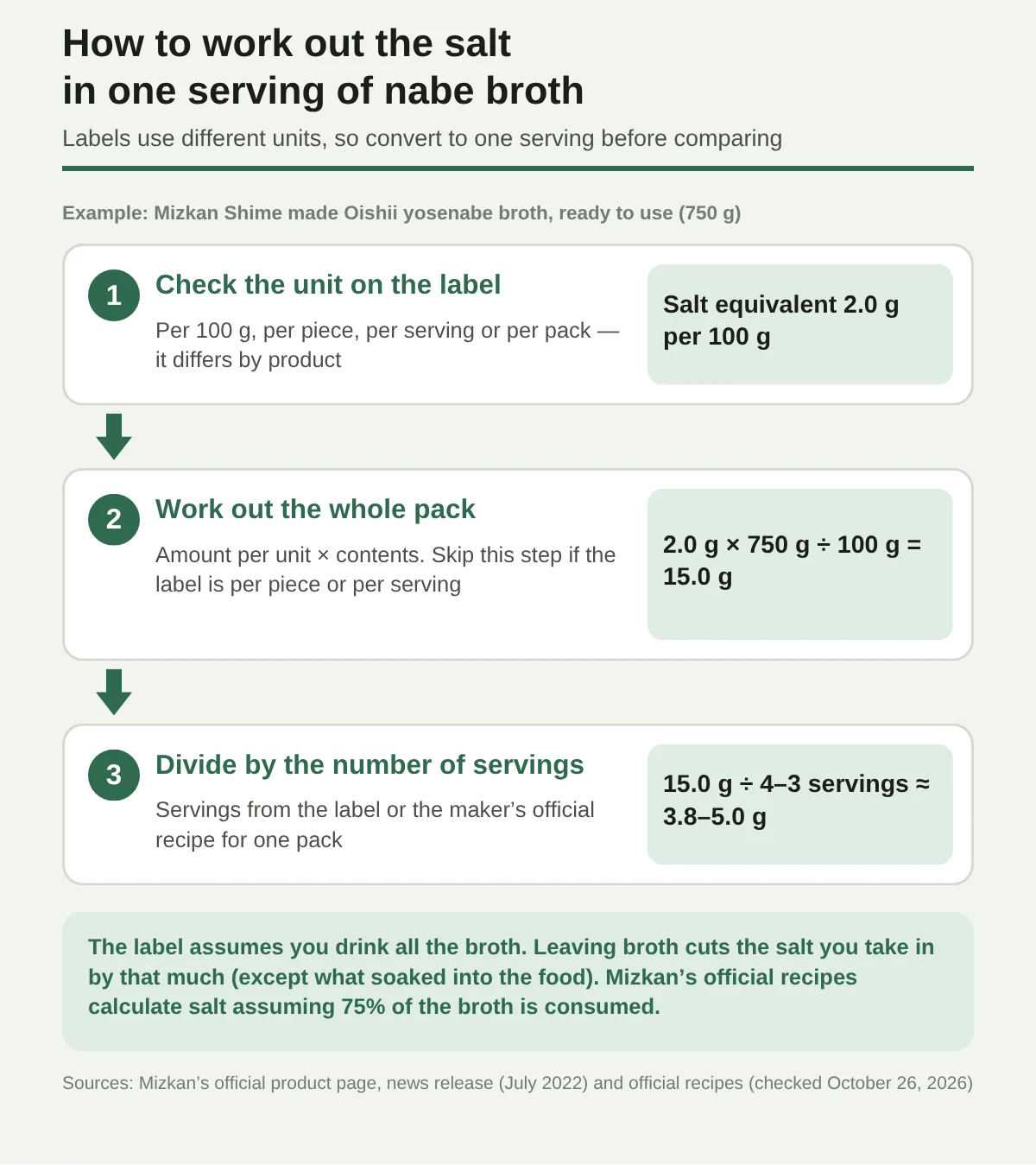
The nutrition labels on nabe broths vary by product: “per 100 g,” “per piece,” “per pack,” and so on. For only the products where the maker’s label or official recipe shows how many servings a pack makes, we recalculated the figure per serving.
| Product | Salt equivalent per serving | Basis of the calculation |
|---|---|---|
| 冨貴 豆乳鍋の素 (Fuki soy milk nabe concentrate) | about 1.7–2.5 g | 5 g per pack (150 g). The directions make “2–3 servings,” so 5 g ÷ 3–2 |
| ヤマキ 寄せ鍋つゆ (Yamaki yosenabe broth) | about 2.5 g | 1.4 g per 100 g × 700 g = 9.8 g. The official recipe uses one pack for 4 servings, so 9.8 g ÷ 4 |
| キッコーマン 濃厚豆乳鍋 コク旨鶏白湯 (Kikkoman rich soy milk nabe, chicken paitan) | about 3.4–4.5 g | 1.8 g per 100 g × 750 g = 13.5 g. The official recipe uses one pack for 3–4 servings, so 13.5 g ÷ 4–3 |
| ミツカン ごま豆乳鍋つゆ ストレート (Mizkan sesame soy milk nabe broth, ready to use) | about 3.4–4.5 g | 1.8 g per 100 g × 750 g = 13.5 g. Mizkan describes it as “3–4 servings,” so 13.5 g ÷ 4–3 |
| ミツカン 寄せ鍋つゆ ストレート (Mizkan yosenabe broth, ready to use) | about 3.8–5.0 g | 2.0 g per 100 g × 750 g = 15.0 g. “3–4 servings,” so 15.0 g ÷ 4–3 |
| 冨貴 キムチ鍋の素 (Fuki kimchi nabe concentrate) | about 2.4–3.7 g | 7.3 g per pack (150 g). “2–3 servings,” so 7.3 g ÷ 3–2 |
| 味の素 鍋キューブ 鶏だし・うま塩 (Ajinomoto Nabe Cube, chicken dashi and umashio) | 2.8 g | Per cube (7.3 g). One cube is one serving |
| 味の素 鍋キューブ 濃厚白湯 (Ajinomoto Nabe Cube, rich paitan) | 3.0 g | Per cube (9.1 g). One cube is one serving |
| エバラ プチッと鍋 寄せ鍋 (Ebara “Petit Nabe” yosenabe) | 3.9 g | Per piece (23 g). One piece is one serving |
| チョーコー醤油 九州だし寄せ鍋つゆ (Choko Shoyu Kyushu dashi yosenabe broth) | 4.2 g | Per packet (30 mL). The official recipe uses 2 packets plus 400 mL of water for 2 servings |
| ミツカン 寄せ鍋つゆ ミニパック (Mizkan yosenabe broth, mini packs) | about 4.3 g | 13.4 g per 100 g. Taking one 32 g packet, 13.4 g × 0.32 |
| チョーコー醤油 鶏だしコク鍋つゆ (Choko Shoyu chicken dashi rich nabe broth) | 4.3 g | Per packet (30 mL). The official recipe uses 2 packets plus 400 mL of water for 2 servings |
| エバラ プチッと鍋 濃厚みそ鍋 (Ebara “Petit Nabe” rich miso nabe) | 4.5 g | Per piece (40 g). In the official recipe, 2 pieces make 2 servings |
| ダイショー ちゃんこ鍋つゆ 塩 (Daisho chanko nabe broth, salt) | 5.1 g | Label figure per serving (229 g) |
| モランボン キムチチゲ用スープ (Moranbong kimchi jjigae soup) | 5.3 g | Label figure per serving (214 g) |
| エバラ キムチ鍋の素 (Ebara kimchi nabe broth concentrate) | about 5.6–7.0 g | 9.3 g per 100 mL. The official recipe uses 300 mL of the product plus 600 mL of water for 4–5 servings, so 27.9 g ÷ 5–4 |
| ミツカン キムチ鍋つゆ ストレート (Mizkan kimchi nabe broth, ready to use) | about 5.4–7.3 g | 2.9 g per 100 g × 750 g = about 21.8 g. “3–4 servings,” so 21.75 g ÷ 4–3 |
※The “3–4 servings” for Mizkan’s ready-to-use products comes from Mizkan’s news release (July 2022) and the official recipe (one pack for 4 servings). The product page does not state the number of servings. The “one 32 g packet = one serving” for the Mizkan mini packs comes from the official recipe (one 32 g packet plus 200 mL of water makes one serving). Fuki’s “2–3 servings” is the amount in the directions on the product page of the wholesaler Muso. For Yamaki, Kikkoman, and Choko Shoyu, the number of servings is the number of people for which the official recipe uses one pack (the product pages do not state servings).
For Marusan’s yosenabe soup alone, we could not find anything that shows how many servings it makes, so we could calculate only the salt equivalent of the whole pack (1.6 g per 100 g × 600 g = 9.6 g). The amount per serving depends on how many people share it. For example, it is 3.2 g for 3 people and 2.4 g for 4 people (the numbers of people are assumed for illustration and are not the seller’s labeling).
Materials from medical institutions and from the nutrition departments of university hospitals also say that store-bought nabe broth comes to roughly 3–5 g of salt per serving.
How much less do you take in if you leave the broth?
The salt equivalent on the label is the amount if you take in all of the nabe broth, liquid included. Some of Mizkan’s official recipes give the salt equivalent per serving with the note “鍋つゆを75%摂取するとして計算” (calculated assuming 75% of the nabe broth is consumed). We could not find a survey that actually measured how much broth people drink, but on paper:
- With a nabe broth that has 4 g of salt per serving, leaving half the broth cuts the salt you take in from the broth by about 2 g
- However, the salt that has soaked into the ingredients cannot be left behind, so it does not come out to exactly half
As tips for reducing salt in nabe, a university hospital nutrition department’s material lists “don’t drink the broth,” “add more ingredients and use half the broth,” and “choose reduced-salt types of store-bought products,” and a clinic’s material lists “don’t finish the nabe broth.” A local government’s material also gives an example where leaving the udon broth saves about 2 g of salt.
Japan’s dietary goal for salt (Dietary Reference Intakes for Japanese, 2025 edition) is under 7.5 g for men and under 6.5 g for women aged 18 and over, and under 6 g for preventing worsening of hypertension and chronic kidney disease. The Japanese average in 2024 was 9.6 g (the National Health and Nutrition Survey). How the dietary goal is set, and where people in Japan get their salt, is summarized in the article on salt intake.
How to read the ingredient list
“調味料(アミノ酸等)” (seasoning (amino acids, etc.))
All 13 products from the seven major makers use “seasoning (amino acids, etc.).” This is a group name (一括名) that lets food additives used for umami and flavor adjustment be written together.
Under the Food Labeling Standards, seasoning additives are divided into four groups: amino acids, nucleic acids, organic acids, and inorganic salts.
- When only the amino acid group is used, it is written “調味料(アミノ酸)” (seasoning (amino acids))
- When the amino acid group is used together with another group, it is written “調味料(アミノ酸等)” (seasoning (amino acids, etc.))
The representative of the amino acid group is monosodium glutamate (MSG). It is also permitted to spell out what the “etc.” covers, as in “調味料(アミノ酸、核酸)” (seasoning (amino acids, nucleic acids)), but all 13 products here used “調味料(アミノ酸等).”
The evaluation of monosodium glutamate is summarized in the article on monosodium glutamate, and the difference between the terms “chemical seasoning” and “umami seasoning” is in the article on umami seasonings.
Yeast extract, hydrolyzed protein, and amino acid liquid are “food”
“Yeast extract,” “hydrolyzed protein,” “amino acid liquid,” and “○○ extract,” lined up in the right-hand column of the table, are ingredients that provide umami, but on the label they are treated as foods, not additives, and are written before the slash.
- Yeast extract was in 9 of the 18 products (counting yeast extract powder), hydrolyzed protein in 4, and amino acid liquid in 5 products from Mizkan and Ebara
- Marusan’s yosenabe soup, which has no additive entries, also contains yeast extract powder
Why they are written as foods, and how that relates to “無添加” (mutenka, “additive-free”) labels, is summarized in the article on yeast extract.
Additives for thickness, oil, and color
- Thickener (xanthan) and other thickening agents: used to add body so the flavor clings to the ingredients. Xanthan gum is a polysaccharide made by microorganisms
- Emulsifier and lecithin: used to keep oil and water mixed. They were in nabe broths that contain oil or soy milk, such as the sesame soy milk, paitan, and soy milk nabe (article on emulsifiers)
- Paprika color, Monascus color, and caramel color: colorants. They were in kimchi types and in the miso and paitan nabe broths (article on caramel color, article on food colors)
- Lactic acid, acidulant, potassium carbonate, and sodium bicarbonate: used to adjust sourness, flavor balance, and pH (the degree of acidity or alkalinity) (article on acidulants and pH adjusters)
Alcohol
Two Choko Shoyu products and the Kikkoman soy milk nabe have “alcohol” after the slash. It is commonly used to keep food longer and maintain its quality, and it is labeled as a food additive.
The “無添加” (mutenka, “additive-free”) and “化学調味料無添加” (“no chemical seasoning added”) labels
Among these 18 products, the only one where the maker itself used the word “無添加” (mutenka, “additive-free”) on its official page was Choko Shoyu’s Kyushu Dashi Yosenabe Tsuyu (“化学調味料無添加,” “no chemical seasoning added”).
- This product’s ingredient list has one additive, alcohol. “化学調味料無添加” means “no umami additives such as seasoning (amino acids, etc.) are used,” and it does not mean that no additives at all are used
- The Consumer Affairs Agency’s Guidelines on “No Additive” Labeling (2022) divide labels that need caution into ten categories. Examples are a plain “無添加” (mutenka, “additive-free”) that does not say what is left out (Category 1), and labels that use words not found in the Food Labeling Standards, such as “chemical” or “artificial,” together with “無添加” or “不使用” (not used) (Category 2). The Guidelines explain that the word “化学調味料” (chemical seasoning) has never been used in the Food Labeling Standards (article on the rules for “無添加” labeling)
- The three Marusan and Fuki products have no additive entries in their ingredient lists, but the word “無添加” does not appear on the Muso product pages
You can compare “無添加” labels by reading what is actually not being used. An article that checked the same thing for osechi (Japanese New Year dishes) is also available (article on additive-free osechi).
If you make it yourself
You can also skip store-bought nabe broth and make your own from shiro-dashi (white dashi), soy sauce, mirin, and so on. Here too, white dashi and soy sauce contain a lot of salt, so the amount you use determines the salt. The types of white dashi, and white dashi made with shiro-shoyu (white soy sauce), are summarized in the article on types of soy sauce.
Frequently asked questions
Are the additives in nabe broth bad for you?
This article does not judge good or bad. Every additive in the ingredient lists of these nabe broths is one that is permitted for use in food in Japan. You can look up the evaluations of each additive in Japan and abroad in the additive database.
How much salt is in one serving of nabe broth?
For the 17 products that could be converted to one serving from the maker’s label or official recipe, it was about 1.7 to 7.3 g. The label figure is the amount if you take in all the broth, so if you leave broth behind, you take in correspondingly less.
Are there nabe broths with no additives?
Among these 18 products, three had no additive entries in their ingredient lists: Marusan’s yosenabe soup and Fuki’s kimchi nabe concentrate and soy milk nabe concentrate (based on the labels on the product pages of the wholesaler Muso). Note, however, that extracts that provide umami and yeast extract are included as foods.
How can I compare nabe broths that do not say how many servings a pack makes?
Work out the salt equivalent of the whole pack (the amount per 100 g × the net weight) and divide it by the number of people eating. This gives a rough guide. The amount each person takes in changes with the number of people eating and how much of the broth they drink.
Also worth knowing
- The dietary goal for salt, and where people in Japan get their salt → article on salt intake
- What is in “seasoning (amino acids, etc.)” and how it is evaluated → article on monosodium glutamate, article on umami seasonings
- Why yeast extract is written as a “food” → article on yeast extract
- The rules for “無添加” (mutenka, “additive-free”) and “不使用” (not used) labels → article on the rules for “無添加” labeling
- How additives carried in from ingredients go unlabeled → article on carryover
Everything covered in this article (summary)
Here is everything introduced in the article, gathered once more. The reasons and the ingredients are given in each section.
| Item covered | Where to buy |
|---|---|
| ミツカン 〆まで美味しい 寄せ鍋つゆ ストレート 750g (Mizkan yosenabe broth, ready to use) | See on Rakuten (JET PRICE) PR See on Amazon.co.jp PR |
| ミツカン 〆まで美味しい ごま豆乳鍋つゆ ストレート 750g (Mizkan sesame soy milk nabe broth, ready to use) | See on Rakuten (天満市場) PR See on Amazon.co.jp PR |
| ミツカン 〆まで美味しい キムチ鍋つゆ ストレート 750g (Mizkan kimchi nabe broth, ready to use) | See on Rakuten (楽天24) PR See on Amazon.co.jp PR |
| ミツカン 〆まで美味しい 寄せ鍋つゆ ミニパック(32g×4袋) (Mizkan yosenabe broth, mini packs) | See on Rakuten (くまの中谷商店) PR See on Amazon.co.jp PR |
| エバラ プチッと鍋 寄せ鍋(23g×6個) (Ebara “Petit Nabe” yosenabe, 6 portions) | See on Rakuten (エバラ食品公式) PR See on Amazon.co.jp PR |
| エバラ プチッと鍋 濃厚みそ鍋(40g×4個) (Ebara “Petit Nabe” rich miso nabe, 4 portions) | See on Rakuten (エバラ食品公式) PR See on Amazon.co.jp PR |
| エバラ キムチ鍋の素 300mL (Ebara kimchi nabe broth concentrate) | See on Rakuten (楽天24) PR See on Amazon.co.jp PR |
| 味の素 鍋キューブ 鶏だし・うま塩(7個入) (Ajinomoto Nabe Cube, chicken dashi and umashio, 7 cubes) | See on Rakuten (楽天24) PR |
| 味の素 鍋キューブ 濃厚白湯(7個入) (Ajinomoto Nabe Cube, rich paitan, 7 cubes) | See on Rakuten (くまの中谷商店) PR See on Amazon.co.jp PR |
| ダイショー 出羽海部屋直伝 ちゃんこ鍋つゆ 塩 800g (Daisho chanko nabe broth, salt, from the Dewanoumi sumo stable) | See on Rakuten (楽天24) PR |
| モランボン 熟成濃厚キムチチゲ用スープ 750g (Moranbong aged rich kimchi jjigae soup) | See on Rakuten (Re-light, 10 bags) PR See on Amazon.co.jp PR |
| ヤマキ 鰹荒節の奥深いだし寄せ鍋つゆ 700g (Yamaki yosenabe broth with deep arabushi bonito dashi) | See on Rakuten (ぱーそなるたのめーる) PR |
| キッコーマン 濃厚豆乳鍋 コク旨鶏白湯 750g (Kikkoman rich soy milk nabe, chicken paitan) | See on Rakuten (業務用食品アミカ) PR |
| チョーコー醤油 鶏だしコク鍋つゆ(30mL×4袋) (Choko Shoyu chicken dashi rich nabe broth) | See on Rakuten (チョーコー醤油公式) PR See on Amazon.co.jp PR |
| チョーコー醤油 九州だし寄せ鍋つゆ(30mL×4袋) (Choko Shoyu Kyushu dashi yosenabe broth) | See on Rakuten (チョーコー醤油公式) PR See on Amazon.co.jp PR |
| マルサン あっさり醤油味の寄せ鍋スープ 600g (Marusan light soy sauce yosenabe soup) | See on Rakuten (安心・安全の食品館) PR |
| 冨貴 キムチ鍋の素 150g (Fuki kimchi nabe concentrate) | See on Rakuten (楽天24) PR See on Amazon.co.jp PR |
| 冨貴 豆乳鍋の素 150g (Fuki soy milk nabe concentrate) | See on Rakuten (楽天24) PR See on Amazon.co.jp PR |
| 七福醸造 特選料亭白だし「四季の彩」お試しセット(360ml×2本) (Shichifuku Jozo Special Ryotei Shiro-Dashi “Shiki no Irodori” trial set, 360 ml × 2 bottles) | 特選料亭白だし「四季の彩」お試しセット  PR |
Sources
- Product pages on the official websites of each maker (Mizkan, Ebara Foods, Ajinomoto, Daisho, Moranbong, Yamaki, Kikkoman, Choko Shoyu), and the product pages of the wholesaler Muso (Marusan, Fuki). Checked October 26, 2026
- Mizkan news release (July 22, 2022, on the ready-to-use type and mini packs of “Shime made oishii” nabe broth), and official recipes from Mizkan and Ebara Foods (number of packets used and number of servings)
- Consumer Affairs Agency, Food Labeling Standards (Appended Table 7 = group names, Appended Table 9 = amounts of nutrients and calories) and the Food Labeling Standards Q&A
- Consumer Affairs Agency, Guidelines on “No Additive” Labeling (March 2022)
- MHLW, Dietary Reference Intakes for Japanese (2025 edition), and the National Health and Nutrition Survey
- Nutrition Management Department, Wakabayashi Hospital, Tohoku Medical and Pharmaceutical University, “Tips for reducing salt in winter dishes” (January 2023)
- Takarazuka City, “Let’s reduce salt wisely”
- Ryunosuke Nagai, “Overturning ‘nabe base is only for winter’: why Ebara Foods’ ‘Petit Nabe’ calls itself a ‘portion seasoning,’” PRESIDENT Online (cites Fuji Keizai’s market size figures)
Shop in the US PR
Links to shops that deliver in the US. These are not recommendations of a specific product; check the label and certifications before you buy. Urayomi may earn a commission from purchases made through these links. As an Amazon Associate, Urayomi earns from qualifying purchases.
Products related to this article PR
Products whose labels Urayomi has read, picked because their ingredients or category relate to this article. This is not a recommendation or a safety rating. The shop buttons are affiliate links; prices are reference prices on the date we checked.
- 味の素 鍋キューブ 濃厚白湯 7個入Read the label (in Japanese) →
- チョーコー醤油 九州だし寄せ鍋つゆ 30ml×4袋Read the label (in Japanese) →
- チョーコー醤油 鶏だしコク鍋つゆ 30ml×4袋Read the label (in Japanese) →
- エバラ キムチ鍋の素 300mlRead the label (in Japanese) →
- エバラ プチッと鍋 寄せ鍋 23g×6個Read the label (in Japanese) →
- ミツカン 〆まで美味しい ごま豆乳鍋つゆ ストレート 750gRead the label (in Japanese) →
Frequently asked questions
- What are the key findings on: Store-Bought Nabe Broths: Ingredients and Salt in 18 Products (Winter 2026)?
- All 13 products from 7 major makers use seasoning (amino acids, etc.). Across 18 nabe broths, salt per serving is about 1.7-7.3 g, highest in kimchi types.
- What does the evidence show regarding: The four forms of nabe broth, and the units on the label?
- Nabe broths fall into four forms, depending on how you use them.
- What does the evidence show regarding: Comparing the ingredients of 18 products?
- The ingredient lists were checked on October 26, 2026, on the makers’ official product pages (for the three Marusan and Fuki products, on the product pages of the wholesaler Muso).
- What does the evidence show regarding: Salt equivalent per serving?
- The nutrition labels on nabe broths vary by product: “per 100 g,” “per piece,” “per pack,” and so on. For only the products where the maker’s label or official recipe shows how many servings a pack makes, we recalculated the figure per serving.
Related articles and databases
- Where Does “Too Much Salt” Begin? Checking Japan’s Salt Intake Trend, Target Amounts, and the Links to High Blood Pressure and Stomach Cancer Against National Surveys and Studies
- What Is Monosodium Glutamate (Umami Seasoning)? Checking the Claims About Petroleum, GMOs, Intake Limits, and a "Damaged Sense of Taste"
- Is Yeast Extract Bad for You? Its History from Meat Extract, How It's Made, Glutamate Content, the “Hidden MSG” Claim, and Labeling Rules in Japan, the US and Germany
- Why Did “No Chemical Seasoning” Disappear? Is Yeast Extract a Chemical Seasoning? How to Read Umami Seasonings and Hydrolyzed Protein
- Were “無添加” (Additive-Free) Labels Banned? Reading the Consumer Affairs Agency Guideline’s 10 Types from the Back Label
- Is Caramel Color Dangerous? The Carcinogen Claim About “4-MEI” and the Four Types, Checked Against Japan, EU, and US Assessments
- Are emulsifiers bad for you? The history that began with egg yolk lecithin, types and uses, gut microbiota research (mice and humans), and how Japan and the EU label them
- Dashi Granules and Dashi Packs Compared (16 Products): Ingredients, Salt and What “Additive-Free” Means
- Toshikoshi Soba and Ozoni Ingredients Compared (Year-End 2026): Buckwheat Share and What Is in Kirimochi