
Is Caramel Color Dangerous? The Carcinogen Claim About “4-MEI” and the Four Types, Checked Against Japan, EU, and US Assessments

PR This article contains affiliate links to Rakuten Ichiba and A8.net (“See on Rakuten”, “See the trial set”). What is written here is based on official sources and published studies, whether or not there is an ad. The “See on Amazon.co.jp” and “See on Yahoo! Shopping” links are also affiliate links.
Cola, sauces, soy sauce, curry roux, noodle soup base. A great many foods list “カラメル色素” (caramel color) or “着色料(カラメル)” (colorant (caramel)) on the back label, and it is widely used to color brown foods.
At the same time, you often see the claim that “caramel color causes cancer.”
This article uses official sources and studies to check:
- What caramel color is, and how the four types differ
- What the ingredient said to be “carcinogenic” (4-MEI) is, and how much is known
- How Japan, the EU, and the US (and California) each assess it
- Whether you can tell them apart on labels, and what to do if you want to avoid it
Conclusion
- Caramel color is a brown colorant made by heating sugars such as sucrose. There are four types (I to IV) depending on how it is made, and all four may be used in Japan
- What is said to be “carcinogenic” is not the colorant itself but “4-MEI (4-methylimidazole),” a byproduct formed when types III and IV are made. In tests feeding large amounts to mice, lung cancers increased, and IARC (the International Agency for Research on Cancer) classifies it as “2B (possibly carcinogenic to humans).” No studies have been done in humans
- Japan, the EU, and the international body JECFA allow its use with set limits. The EU’s EFSA and the US FDA take the position that the amount of 4-MEI taken in from caramel color is not a health concern
- On the other hand, the US state of California requires a warning label on products exceeding 29 µg a day, and in a 2012 survey a can (355 ml) of cola sold in Japan contained 72 µg. Even with the same number, assessments split widely depending on whether you assume a threshold exists
- Japanese labels say only “カラメル色素” or “着色料(カラメル),” so you cannot tell which of the four types is used. If you are concerned, the surest approach is to choose products without the word “カラメル”
What caramel color is: the differences among the four types
Caramel color is made by heating sugars from broken-down starch (such as starch syrup), molasses, sucrose, and similar materials. It falls into four types depending on what is added in the process (10th edition of the Japanese Specifications and Standards for Food Additives; JECFA specifications).
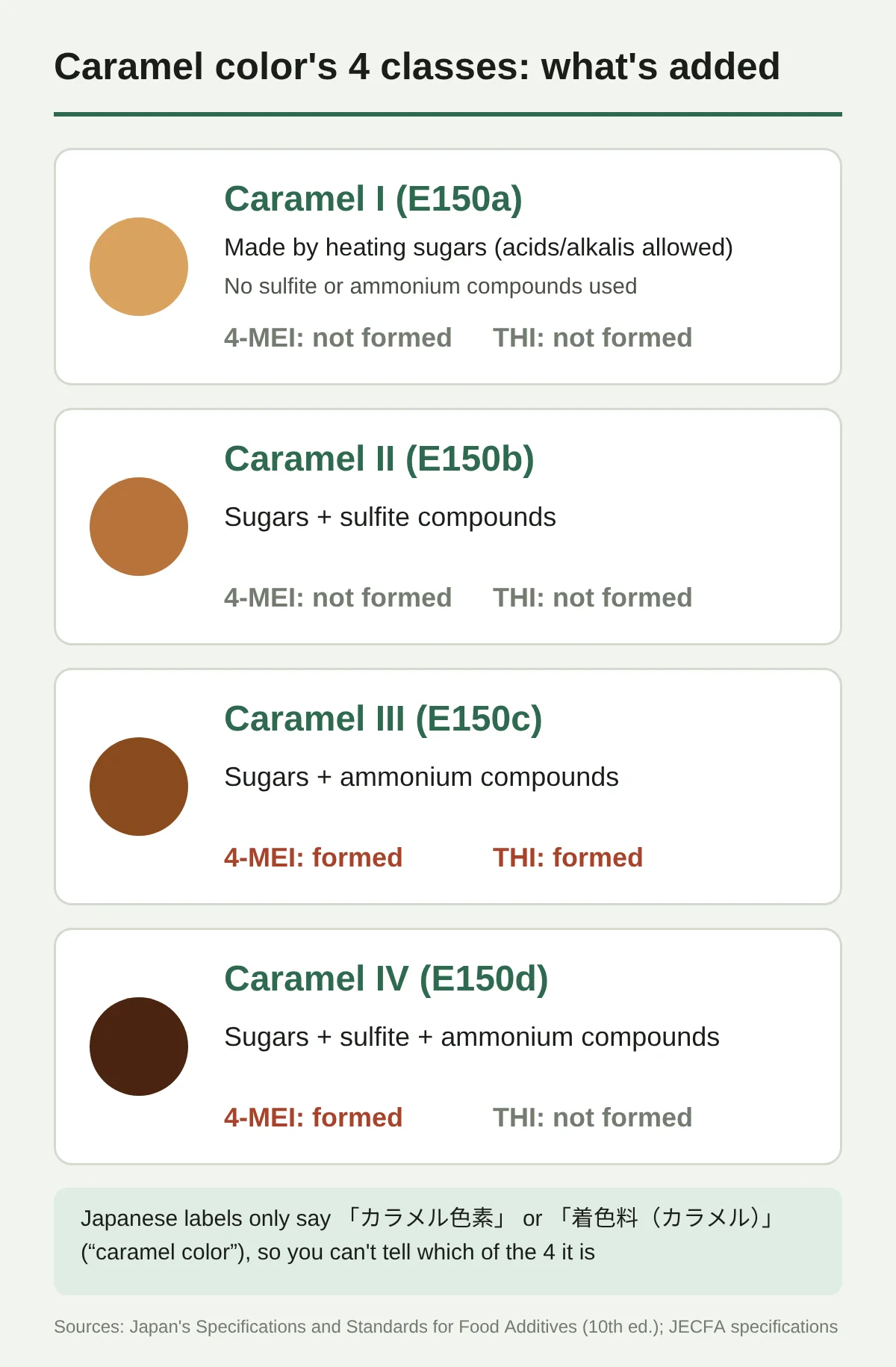
| Type | What is added | Examples of foods using it overseas | 4-MEI | THI |
|---|---|---|---|---|
| Caramel I (E150a) | None (acids and alkalis are allowed). No sulfite or ammonium compounds | Spirits such as whisky, bread and cookies | Not formed | Not formed |
| Caramel II (E150b) | Sulfite compounds | Spirits such as brandy and rum, some vinegars | Not formed | Not formed |
| Caramel III (E150c) | Ammonium compounds | Beer, soy sauce, sauces, confectionery | Formed | Formed |
| Caramel IV (E150d) | Sulfite and ammonium compounds | Soft drinks such as cola, balsamic vinegar, soups | Formed | Not formed |
(The food examples show how it is used overseas, based on JECFA and overseas manufacturers’ materials. You cannot tell from the label which type is used in any particular product sold in Japan.)
- In Japan, a 1995 revision of the Food Sanitation Act put “natural additives” that had long been used into a category called “existing additives” (既存添加物). Caramel color is one of them, and specifications have been set for “Caramel I to IV” since the 7th edition of the Specifications and Standards for Food Additives in 1999
- There is no upper limit on the amount that can be used. However, as with other natural-type colorants, it may not be used in kelp (konbu) products, meat, fresh fish and shellfish, tea, nori products, beans, vegetables, or wakame products (usage standards in the Specifications and Standards for Food Additives)
- It is sometimes called a “natural colorant,” but types III and IV are made by adding ammonium compounds and the like. The US consumer group Consumer Reports takes the position that “all caramel colors are artificial”
The ingredient said to be “carcinogenic”: 4-MEI
What 4-MEI is
4-MEI (4-methylimidazole) is a substance formed when ammonia and sugars are heated together. It forms in small amounts as a byproduct when types III and IV, which use ammonium compounds, are made.
It is not a problem of caramel color alone. Materials introduced by the US FDA and the Food Safety Commission of Japan say that it also forms when coffee beans are roasted and when meat is cooked.
What animal tests showed
In 2007 the US NTP (National Toxicology Program) ran a two-year test in which 4-MEI was mixed into the feed of mice and rats.
| Animal | Result | Dose given (per day, per kg of body weight) |
|---|---|---|
| Mice (male and female) | Lung tumors (adenomas and cancers) increased = “clear evidence of carcinogenic activity” | About 40, 80, 170 mg |
| Rats (female) | Leukemia (mononuclear cell leukemia) increased = “equivocal evidence” | About 60, 120, 250 mg |
| Rats (male) | No evidence of carcinogenic activity | About 30, 55, 115 mg |
Based on this, IARC (the International Agency for Research on Cancer), in its 2011 assessment (Monographs Volume 101), classified 4-MEI as “Group 2B: possibly carcinogenic to humans.” Group 2B is used when there is evidence from animal tests but the evidence in humans is not sufficient. For 4-MEI, there are no studies in humans (epidemiological studies).
Does it damage genes
Carcinogens include those that damage genes directly (for which even a very small amount is thought to carry some risk) and those that do not (for which amounts below a certain level are thought to cause no effect, that is, there is a threshold).
- 4-MEI was negative in bacterial tests (the Ames test) and in micronucleus tests in mice and rats
- EFSA says that 4-MEI does not damage genes and that a threshold can be assumed. A review by researchers at the National Institute of Health Sciences (Morita and Uneyama 2016) also argues in the same direction based on new test data
- On the other hand, California’s environmental protection agency said that “the tests are not sufficient to rule out a gene-damaging mechanism” and set its standard on the assumption that there is no threshold
This is the “fork in the assessments” we will see later.
THI, formed only in Caramel III
Caramel III also forms a byproduct called THI (2-acetyl-4-tetrahydroxybutylimidazole) in addition to 4-MEI.
- THI is known to reduce lymphocytes in the blood of rats (it prevents lymphocytes from leaving the lymph nodes and other tissues into the blood). The effect is stronger when vitamin B6 is deficient
- In 2011, because uncertainty remained about this effect on immunity, EFSA set a stricter acceptable intake for Caramel III only (see the table below)
Assessments and rules in Japan, the EU, and the US
| Assessment / rules | |
|---|---|
| JECFA (international assessment body) | Acceptable daily intake (ADI, per kg of body weight): “not specified” for I, up to 160 mg for II, up to 200 mg for III and IV. The ADI for IV is based on animal tests and also on the finding that people who ate up to 18 g a day of Caramel IV had no effects other than loose stools (1986). The specifications set upper limits for 4-MEI (III and IV) and THI (III) |
| EU (EFSA) | Re-evaluated in 2011 and set a combined ADI of 300 mg for all four types, with 100 mg for III alone. The calculations at the time suggested that children and adults who eat a lot might exceed the ADI, but in 2012 it recalculated using actual use levels and concluded that the total is below the ADI for all age groups (while noting that III could exceed its own ADI in some cases, such as toddlers in some countries). For 4-MEI, “the amount taken in from caramel color is not a concern.” The specifications set 4-MEI limits of 200 mg/kg for III and 250 mg/kg for IV, and 10 mg/kg for THI in III |
| US (FDA) | “There is no reason to believe that there is any imminent or short-term danger at the levels of caramel color used in food” and “we do not recommend changing your diet because of 4-MEI” (2014 Q&A). It also says it continues to review the data |
| California, US | Added 4-MEI to its state-law (Proposition 65) list of carcinogens in 2011. Sets 29 µg a day as the “no significant risk level,” and products exceeding it need a warning label |
| Japan | May be used as an existing additive. The Specifications and Standards for Food Additives set 4-MEI at 0.30 mg/g or less and THI at 40 µg/g or less for III, and 4-MEI at 1.0 mg/g or less for IV (all per solids) |
The EU and Japan use different units and calculation methods, so the numbers cannot be compared directly. FOOCOM (a food safety information site) explains that Japan’s values are somewhat larger than the EU’s.
California’s regulation and 4-MEI in cola
After California’s regulation took effect, in 2012 beverage makers such as Coca-Cola and PepsiCo announced that they would switch to caramel color with less 4-MEI for products sold in the US.
US consumer groups’ surveys gave the following results.
- 2012 (CSPI, cola in nine countries, per 355 ml): California 4 µg, Japan 72 µg, Washington DC 144 µg, UK 145 µg, Canada 160 µg, Brazil 267 µg. Even for similar products, there were large differences from country to country
- 2014 (Consumer Reports, soft drinks bought in the US): Coca-Cola, Diet Coke, and Coke Zero had less than 5 µg per can. Pepsi One (39.5 to 195.3 µg) and Malta Goya (307.5 to 352.5 µg) exceeded 29 µg in every test
The Japanese cola figure is from 2012, and we do not know the figures for current products.
Why the same number is assessed differently
Let us look at the 4-MEI in one can of cola sold in Japan (72 µg, 2012) from two ways of thinking.
| Way of thinking | Standard | One can of cola (72 µg) |
|---|---|---|
| Assume a threshold exists (EFSA and others) | The amount with no effect in animals (80 mg per day per kg of body weight) divided by 100. For a 60 kg person, 48 mg a day (48,000 µg) | About 1/670 of the standard. It would take about 667 cans a day to reach the standard (FOOCOM estimate) |
| Assume no threshold exists (California) | The amount at which, if taken for 70 years, no more than 1 person in 100,000 would develop cancer = 29 µg a day | One can is about 2.5 times the standard |
Both start from the same animal tests, but the conclusion changes greatly depending on whether you think “small amounts have no effect” or “risk is proportional to the amount, so draw a sufficiently low line.”
For reference, an FDA survey in 2014 estimated that Americans (age 2 and over) take in an average of 60 to 90 µg a day of 4-MEI from foods containing caramel color, with the largest share coming from carbonated drinks containing caramel color (about 25% of the total). Separately from caramel color, ordinary cooking is estimated to supply about 6 to 20 µg a day. We could not find an estimate of Japanese intake within the scope of this research.
Japanese labels do not show the type
In Japan, when caramel color is used for coloring, it is generally written as one of the following.
- “着色料(カラメル)” (colorant (caramel))
- “カラメル色素” (caramel color)
- “カラメル” (caramel)
With any of these, you cannot tell which of the four types is used or how much. You also cannot tell from the label whether it is type I or II, which do not form 4-MEI, or type III or IV, which do.
In the EU, labels show the number for each type, such as “colour: E150d” (see the article on colorants).
It may be in products marked “tokkyu” or “honjozo”
The JAS standard (Japanese Agricultural Standard) for soy sauce used to provide that even tokkyu (special grade) koikuchi soy sauce may use one type of caramel among I, III, and IV (when established in 2004). A 2021 revision changed the wording so that additives conforming to international standards (Codex) may be used.
A “tokkyu” label alone does not mean that caramel color is absent. The surest way is to check the ingredient list (原材料名).
Watch the wording of “caramel color free” too
Claims such as “no synthetic colorants” and “no caramel color” fall under Consumer Affairs Agency guidelines (see the article on “additive-free” labeling rules). For example, if a product emphasizes only “no caramel color” while using another colorant, it can look as if no colorant is used at all. The surest way is to check the ingredient list (原材料名) on the back rather than the front-label wording.
How to choose when you want to avoid caramel color
You can tell whether caramel color is included by whether the ingredient list has the word “カラメル.” Some brown foods get their color only from their ingredients (aging of soy sauce, vegetables and fruit, or heated sugar).
Seasonings and drinks without “カラメル” (Rakuten Ichiba)
From the types most likely to contain caramel color, we chose products whose ingredient lists do not include “カラメル.”
| Type | Name | Instead of caramel color | Approx. price | Rakuten Ichiba |
|---|---|---|---|---|
| Soy sauce | 丸中醸造醤油(こいくち) (Marunaka Shoyu, koikuchi soy sauce) | Ingredients are only soybeans, wheat, and salt. Aged in cedar barrels | 720 ml ¥1,788 (official shop) | See on Rakuten (成城石井) PR See on Amazon.co.jp PR See on Yahoo! Shopping PR |
| Worcestershire sauce | ヒカリ ウスターソース(国産有機野菜・果実使用)(Hikari Foods; Worcestershire sauce made with domestic organic vegetables and fruit) | Organic onion, tomato, mandarin orange, garlic, and carrot, rice vinegar, sugar, and organic molasses. The maker states: “No preservatives, seasoning (amino acids, etc.), caramel color, or yeast extract are used” | 360 ml ¥442 (suggested retail price) | See on Rakuten (ビーライフショップ) PR See on Amazon.co.jp PR See on Yahoo! Shopping PR |
| Cola | ヒカリ オーガニッククラフトコーラシロップ (Hikari Foods; organic craft cola syrup) | Organic ginger, spices, and organic fruit juice, with organic sugar and organic molasses. The maker states: “No flavoring, caramel color, or acidulant is used.” Dilute about 5 times with carbonated water | 150 ml ¥540 (suggested retail price) | See on Rakuten (楽天24) PR See on Amazon.co.jp PR See on Yahoo! Shopping PR |
| Curry roux | 植物素材の本格カレールウ 中辛 (Sokensha; plant-based curry roux, medium hot) | No additives in the ingredient list. Some ordinary solid roux list “colorant (caramel, paprika pigment)” | 135 g ¥530 (suggested retail price) | See on Rakuten (楽天24) PR See on Amazon.co.jp PR See on Yahoo! Shopping PR |
| Curry roux | コスモ直火焼 米粉のカレー・ルー 中辛 (Cosmo Foods; rice flour curry roux, medium hot) | No additives in the ingredient list. The same maker’s wheat flour roux contains caramel color | 110 g ¥357 (official store) | See on Rakuten (コスモ食品 楽天市場店) PR See on Amazon.co.jp PR See on Yahoo! Shopping PR |
(Checked on September 30, 2026 on the makers’ official pages and Rakuten Ichiba sales pages. Prices and shipping may change. The ingredients of the sauce and cola syrup are based on Hikari Foods’ official pages and the sales page listings.)
- Hikari Foods’ sauce and cola syrup are not pale. They get their brown color from vegetables, fruit, molasses, and spices
- “No caramel color” does not mean healthy. The cola syrup is also a sweet drink made with sugar
Choosing by a food delivery service’s standards
Oisix lists natural colorants including caramel color among the additives it uses “as little as possible” under its own additive standards (see the Oisix article). If checking labels one by one is a lot of work, one option is to use a delivery service that publishes standards like this.
Summary
- There are four types of caramel color, and what is said to be “carcinogenic” is 4-MEI, a byproduct formed when types III and IV are made. Lung cancers increased in mouse tests, and IARC classifies it as 2B. There are no studies in humans
- Japan, the EU, and JECFA allow its use with limits set for 4-MEI. EFSA and the FDA say the amount taken in from caramel color is not a concern
- California draws a low line of 29 µg a day, and cola sold in Japan in 2012 had 72 µg per can. Assessments split widely depending on whether you assume a threshold exists
- Japanese labels do not show the type. If you are concerned, choose products without the word “カラメル” in the ingredient list
The current sources do not let us say either “it is dangerous, so avoid it” or “it is safe, so no need to worry.” The conclusion changes depending on which way of thinking you adopt, and it is realistic to decide, knowing that, whether to review things you take in large amounts every day, such as cola.
Sources
- Consumer Affairs Agency, “Specifications and Standards for Food Additives, 10th edition” (2024), component specifications and usage standards for Caramel I to IV https://www.caa.go.jp/policies/policy/standards_evaluation/food_additives/official_002/
- Food Safety Commission of Japan, Food Safety Related Information, “US Food and Drug Administration (FDA) Publishes Q&A on Caramel Color and 4-MEI” (2014) https://www.fsc.go.jp/fsciis/foodSafetyMaterial/show/syu04110150105
- US Food and Drug Administration (FDA), “Questions & Answers About 4-MEI”
- MAFF, “Japanese Agricultural Standard for Soy Sauce” (revised 2021) https://www.maff.go.jp/j/jas/jas_standard/attach/pdf/index-470.pdf , and the 2004 notification when it was established https://www.maff.go.jp/j/jas/jas_kikaku/pdf/kikaku_33.pdf
- Agriculture & Livestock Industries Corporation (ALIC), “Karameru no hanashi” (The Story of Caramel) https://www.alic.go.jp/joho-s/joho07_000216.html
- Consumer Affairs Agency, “Trivia on Food Additive Labeling”
- “Use of Caramel Color in Foods and Its Safety,” Journal of Japan Society for Safety Engineering, Vol. 56, No. 5 https://www.jstage.jst.go.jp/article/safety/56/5/56_356/_article/-char/ja/
- FOOCOM.NET, “Caramel color: what are the health effects?” https://foocom.net/column/answer/17643/
- JECFA, “Caramel colours” specifications (FAO JECFA Monographs 11, 2011) https://www.fao.org/fileadmin/user_upload/jecfa_additives/docs/monograph11/additive-102-m11.pdf
- EFSA ANS Panel (2011) Scientific Opinion on the re-evaluation of caramel colours (E 150 a,b,c,d) as food additives. EFSA Journal 9(3):2004 https://www.efsa.europa.eu/en/efsajournal/pub/2004
- EFSA (2012) Refined exposure assessment for caramel colours (E 150a, c, d). EFSA Journal 10(12):3030 https://efsa.onlinelibrary.wiley.com/doi/abs/10.2903/j.efsa.2012.3030
- National Toxicology Program (2007) TR-535: 4-Methylimidazole https://ntp.niehs.nih.gov/sites/default/files/ntp/htdocs/lt_rpts/tr535.pdf
- IARC Monographs Volume 101 (2013) 4-Methylimidazole
- California Office of Environmental Health Hazard Assessment (OEHHA), “4-Methylimidazole” https://oehha.ca.gov/proposition-65/chemicals/4-methylimidazole
- Consumer Reports (2014) “Consumer Reports tests show consumers unnecessarily exposed to potential cancer risk in many soft drinks”
- Smith TJS et al. (2015) Caramel color in soft drinks and exposure to 4-methylimidazole: a quantitative risk assessment. PLoS One. https://pubmed.ncbi.nlm.nih.gov/25693062/
- Vollmuth TA (2018) Caramel color safety – An update. Food Chem Toxicol. https://pubmed.ncbi.nlm.nih.gov/29222054/
- Morita T, Uneyama C (2016) Genotoxicity assessment of 4-methylimidazole: regulatory perspectives. Genes Environ. https://pubmed.ncbi.nlm.nih.gov/27822321/
- Hikari Foods, “Product information: Sauce” and “Product information: Citrus juice (Organic Craft Cola Syrup)” http://www.hikarishokuhin.co.jp/product_sauce.html http://www.hikarishokuhin.co.jp/product_kankitsu.html
- Rakuten Ichiba sales pages for ビーライフショップ “ムソー ヒカリ ウスターソース 360ml” and 楽天24 “光 オーガニッククラフトコーラシロップ(150ml)” (checked September 30, 2026)
Related articles and databases
- Are Food Colorings (Red No. 102, Yellow No. 4) Bad for You? Cancer Assessments and Whether They Are Banned Abroad, Checked Against Rules in Japan and Overseas
- Were “無添加” (Additive-Free) Labels Banned? Reading the Consumer Affairs Agency Guideline’s 10 Types from the Back Label
- Reading Oisix’s Trial Set and Subscription Down to the Back Label: Vegetable Pesticide Standards, the Trial Set, and How Cancellation Works
- What Is Nam Pla (Fish Sauce)? How It Is Made, How It Differs from Shottsuru, Ishiru, and Ikanago Soy Sauce, and Its Salt and Histamine Checked Against International Standards and Japan's Food Composition Tables
- Is Garlic Good for You? How Allicin Forms, the Smell, Research on Blood Pressure and Cancer, Drug Interactions, and the Cautions on Garlic in Oil
- What Is Tomato Ketchup? The JAS “Special Grade,” How It Differs from Tomato Sauce, and Whether Lycopene Absorption Changes with Heat and Oil