
What Is Nam Pla (Fish Sauce)? How It Is Made, How It Differs from Shottsuru, Ishiru, and Ikanago Soy Sauce, and Its Salt and Histamine Checked Against International Standards and Japan's Food Composition Tables

PR This article contains affiliate links to Rakuten Ichiba (“See on Rakuten”). What is written here is based on official sources and published studies, whether or not there is an ad. The “See on Amazon.co.jp” and “See on Yahoo! Shopping” links are also affiliate links.
Nam pla is an essential seasoning in Thai dishes such as gapao and tom yum kung, and in Vietnamese pho. Japan has its own fish sauces too: “shottsuru” from Akita, “ishiru” from Noto, and “ikanago soy sauce” (ikanago shoyu) from Kagawa.
At the same time, you often hear that it “smells strong,” that it is “high in salt,” and that it is “said to be high in histamine.”
This article uses international standards, government sources, Japan’s food composition tables, and studies to check:
- What fish sauce (nam pla) is made from, and how
- How nam pla, nuoc mam, shottsuru, ishiru, and ikanago soy sauce differ
- What the international standard (Codex) and the Thai standard actually set
- How much more salt it contains than soy sauce
- How much glutamic acid, the source of umami, it contains
- What histamine standards exist, and what the actual test values and food poisoning cases look like
Conclusion
- Fish sauce is a liquid obtained by mixing fish with salt, fermenting and aging it, and straining it. Enzymes already present in the fish’s innards and muscle break proteins down into amino acids (autolysis). The international standard (Codex) says fermentation “usually takes 6 months or more”
- Nam pla (Thailand) and nuoc mam (Vietnam) are made mainly from anchovies. Shottsuru (Akita) is made from sailfin sandfish (hatahata), ishiru (Noto) from squid innards or sardines, and ikanago soy sauce (Kagawa) from sand lance (ikanago)
- The Codex fish sauce standard sets, among other things, total nitrogen of at least 10 g per liter, salt of at least 200 g per liter, and histamine of no more than 40 mg per 100 g (= 400 mg/kg). A notification from Thailand’s Ministry of Public Health sets total nitrogen for “genuine fish sauce” at 9 g/L or more and puts a cap on the proportion of glutamic acid
- In Japan’s food composition tables, the salt equivalent of the four fish sauces is 21.2 to 24.3 g per 100 g, about 1.5 times that of koikuchi (dark) soy sauce (14.5 g)
- Histamine is detected in fish sauces on the market. In a Tokyo Metropolitan Government survey (55 samples), the highest value was 380 mg/kg, and none exceeded the international standard of 400 mg/kg. Japan has no standard value for histamine in food. The main causes of histamine food poisoning are fish themselves, such as tuna, marlin, and mackerel, and among the sources we checked we found no food poisoning case in which fish sauce was identified as the cause
Products introduced in this article
Within the article, we introduce the following items where they fit the point being made (these are Rakuten Ichiba links).
| For people who… | Product introduced | Why chosen (facts) | Where |
|---|---|---|---|
| Want to compare nam pla ingredients | メガシェフ ナンプラー (Mega Chef Nam Pla) 200 ml | Made in Thailand. The ingredient list (原材料名) reads iwashi (sardine/anchovy-type fish), salt, sugar, and fructose. The Thai-language label on the bottle gives proportions: 70% katakuchi iwashi (anchovy), 27% salt, 2% sugar | What the label tells you |
| Want nam pla with just fish and salt | ユウキ ナンプラー (Yuki Nam Pla) 600 g | The ingredient list has two items: anchovy (katakuchi iwashi) and salt (from the sales page) | What the label tells you |
| Want to try Japanese fish sauce | 諸井醸造 秋田しょっつる ハタハタ100% (Moroi Brewing Akita Shottsuru, 100% Hatahata), カネイシ いしり (Kaneishi Ishiri) | Shottsuru is hatahata (from Akita Prefecture) and salt; ishiri is squid (squid innards) and salt | If you want to try a Japanese fish sauce |
What Is Nam Pla (Fish Sauce)?
Fish sauce (gyosho in Japanese) is a seasoning made by soaking fish or shellfish in salt, fermenting and aging it, and using the liquid that comes out. Nam pla is the Thai name for fish sauce.
The Codex Alimentarius Commission, which sets international food standards (a body created by FAO and WHO), defines fish sauce in its “Standard for Fish Sauce (CXS 302-2011)” as follows.
- A clear liquid with a salty taste and a fish flavor, obtained from a fermented mixture of fish and salt
- Other ingredients that help fermentation may be added
- Fish sauce made by breaking fish down with acid is not covered by this standard
Japan’s food composition tables also group nam pla, shottsuru, ishiru (ishiri), and ikanago soy sauce together as “魚醤油” (fish soy sauce).
How It Is Made
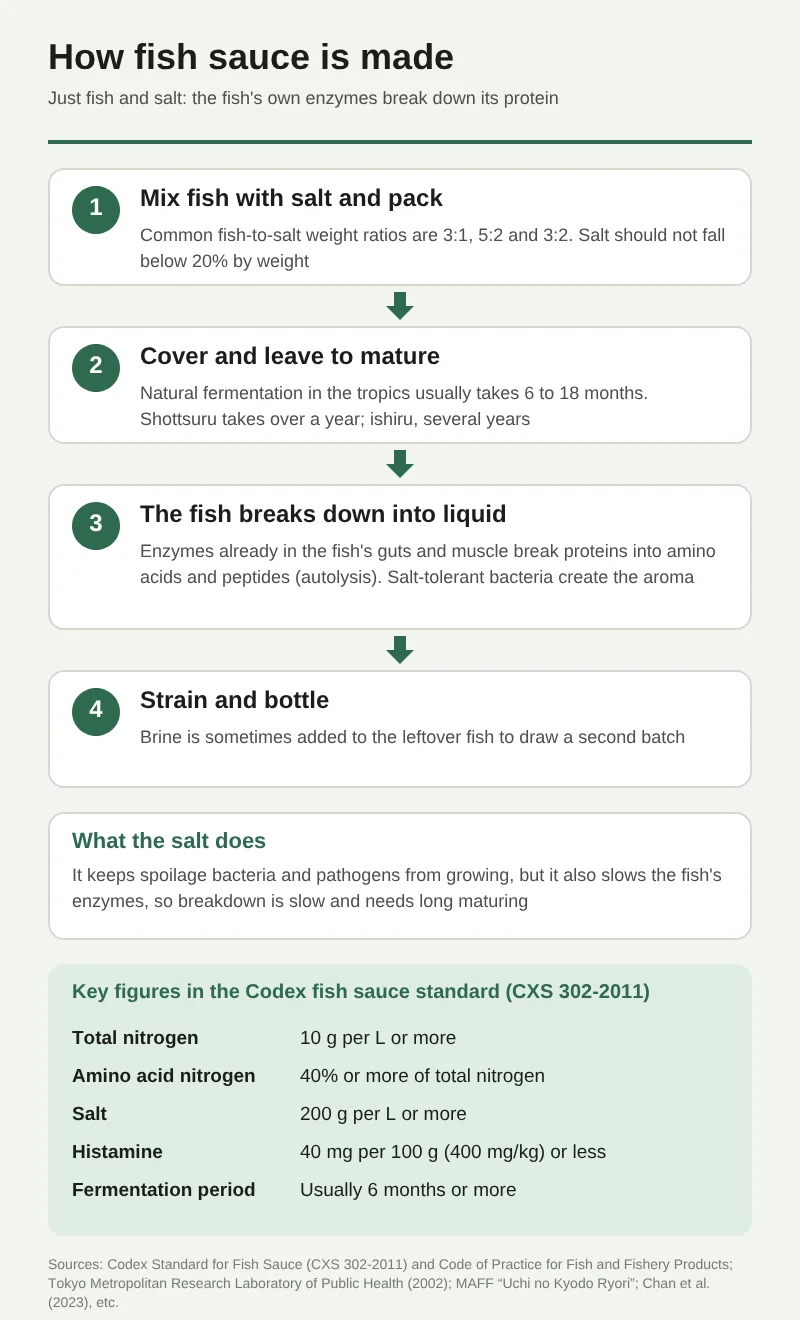
Mix fish and salt, and let it sit for a long time
The method is broadly the same for fish sauce from any country.
- Coat fish (whole, or just the innards) with a large amount of salt and pack it into a pot, tank, or barrel
- Cover it and leave it for months to years. The fish loses its shape and everything gradually turns to liquid
- Strain the liquid and bottle it. Salt water is sometimes added to the remaining fish to extract a second liquid
The Codex “Code of Practice for Fish and Fishery Products” says that weight ratios of fish to salt of 3:1, 5:2, and 3:2 are common, and that, to prevent spoilage and the growth of disease-causing bacteria, the salt concentration should not fall below 20% by weight. It says that natural fermentation in the tropics generally takes 6 to 18 months to reach good quality.
| Fish sauce | Fish-to-salt ratio (example from the sources) | Aging period (example from the sources) |
|---|---|---|
| Nam pla (Thailand) | 2:1 or 3:1 (traditional method) | 12 to 18 months |
| Nuoc mam (Vietnam) | 3:1 (example of a home recipe) | About 2 months at home. 12 months or more in factories, and some are aged 18 to 24 months |
| Shottsuru (Akita) | − | 1 year or more |
| Ishiru (Noto) | − | Several years or so |
| Ikanago soy sauce (Kagawa) | A producer says 25% salt is needed | Half a year to 1 year for small sand lance, and 3 years for larger ones, in one example |
(Nam pla and nuoc mam are from the book “The Story of Garum,” on ancient fish sauce, and the review by Chan et al. (2023); shottsuru and ishiru are from MAFF’s “Uchi no Kyodo Ryori” (Our Local Dishes); ikanago soy sauce is from an interview survey of Kagawa food culture (2018).)
The enzymes that break down the protein come from the fish itself
The umami of fish sauce comes from the amino acids and peptides formed when fish protein is broken down.
- The main players are protein-digesting enzymes (proteases) already present in the fish’s innards and muscle. The fish breaks itself down with its own enzymes, which is why this is called “autolysis”
- Salt-tolerant bacteria (halophilic and halotolerant bacteria) are also involved, and are reported to produce aroma compounds and organic acids
- A report by the Tokyo Metropolitan Research Laboratory of Public Health (2002) says that fermentation microbes such as koji mold, yeast, and lactic acid bacteria, as used for soy sauce and miso, are not used in making fish soy sauce, and that, because the salt content is also high, protein breakdown is thought to occur mainly through autolysis. However, some shottsuru has koji added, and a Food Safety Commission of Japan document also says “methods using koji and the like are known”
The role of salt
The high salt content of around 20% is there to keep the fish from spoiling.
- Salt draws out water, making it harder for spoilage bacteria and disease-causing bacteria to grow
- On the other hand, high salt also weakens the action of the fish’s enzymes, so breakdown proceeds slowly and a long aging period is needed
- There is research on reducing salt to make it faster, but other measures, such as temperature control, are then needed to keep unwanted bacteria from growing
How Nam Pla, Nuoc Mam, Shottsuru, Ishiru, and Ikanago Soy Sauce Differ
| Name | Country / region | Main raw material | In brief | Salt equivalent (per 100 g) |
|---|---|---|---|---|
| Nam pla | Thailand | Anchovies and similar fish | Thailand’s Ministry of Public Health divides fish sauce into “genuine fish sauce,” “fish sauce made from other animals,” and “mixed fish sauce” | 22.9 g |
| Nuoc mam | Vietnam | Anchovies and similar fish | Phu Quoc Island and Phan Thiet are known as production areas | (not in the composition tables) |
| Shottsuru (塩魚汁) | Akita Prefecture | Sailfin sandfish (hatahata) | Fish are salted and left for 1 year or more until they dissolve. Used in shottsuru hot pot | 24.3 g |
| Ishiru (ishiri) | Noto region, Ishikawa Prefecture | Innards of Japanese flying squid. Depending on the area, Japanese sardine, round herring, mackerel, or horse mackerel | Said to come from “魚汁 (uoshiru),” with the name softening over time. Made since at least the 1700s | 21.9 g |
| Ikanago soy sauce | Kagawa Prefecture | Sand lance (ikanago) | Almost no longer made after the 1950s; efforts to revive it began in the 1990s | 21.2 g |
(Salt equivalents are from MEXT’s “Standard Tables of Food Composition in Japan 2020 (Eighth Revised Edition), 2023 Supplement.”)
- MAFF’s “Uchi no Kyodo Ryori” presents ishiru as one of the “three great fish sauces of Japan,” along with Akita’s “shottsuru” and Kagawa’s “ikanago soy sauce”
- The sailfin sandfish used for shottsuru is caught more off Akita than anywhere else in Japan. To protect the resource, sailfin sandfish fishing was banned entirely from September 1992 to September 1995, and it is said that shottsuru makers also had to stop production
- Ishiru is said to have been obtained in exchange for rice, to add umami in place of fish in mountain villages in the days when distribution networks did not reach them (MAFF, “Uchi no Kyodo Ryori”)
If you want to try a Japanese fish sauce
We chose two Japanese fish sauces whose only ingredients are fish and salt. Neither has any food additive listed in the ingredient list (原材料名).
International Standards and the Thai Standard
The Codex fish sauce standard (CXS 302-2011)
The Codex standard is an international benchmark that countries use when setting their own food standards. For fish sauce, it sets values such as the following.
| Item | Standard | What it indicates |
|---|---|---|
| Total nitrogen | At least 10 g per liter (a lower value may be set in some countries) | A guide to the amount of protein and amino acids. The more there is, the more has dissolved out of the fish |
| Amino acid nitrogen | At least 40% of total nitrogen | The share of protein that has been broken down to amino acids |
| Salt | At least 200 g per liter (as sodium chloride) | Prevents spoilage |
| pH | 5.0 to 6.5 for traditional products (4.5 or higher when ingredients that help fermentation are used) | How sour it is |
| Histamine | No more than 40 mg per 100 g (= 400 mg/kg) | A hygiene standard. No sample may exceed it |
| Fermentation period | Usually 6 months or more | A statement in the standard’s definition of the production method |
- The standard says that, if a country requires it, total nitrogen (g/L) may be required on the label, and that terms describing quality by the amount of total nitrogen may be allowed
- It also specifies the additives that may be used: flavor enhancers (such as monosodium glutamate), sweeteners (acesulfame K, sucralose, aspartame), preservatives (benzoic acid and sorbic acid, up to 1,000 mg per kg), and caramel color (Caramel III, up to 50,000 mg per kg). Whether additives are used differs by product, so check the ingredient list (原材料名) on the back label (our article on caramel color)
The Thai standard (Ministry of Public Health Notification No. 203, 2000)
Thailand sets fish sauce quality by a Ministry of Public Health notification (based on an unofficial English translation).
| Item | Genuine fish sauce | Mixed fish sauce |
|---|---|---|
| What it is | Obtained by fermenting and breaking down fish or fish parts | Genuine fish sauce or the like, with other ingredients added, diluted, or seasoned |
| Total nitrogen | At least 9 g per liter | At least 4 g per liter |
| Amino acid nitrogen | 40% to 60% of total nitrogen | (not set) |
| Glutamic acid ÷ total nitrogen | 0.4 to 0.6 | 0.4 to 1.3 |
| Salt | At least 200 g per liter (in total, if potassium chloride is used) | Same |
| Color | No coloring other than brown sugar or caramel color | Same |
- How the product is named is also set. Genuine fish sauce is labeled “genuine fish sauce,” and mixed fish sauce is labeled “mixed fish sauce”
- Fish sauce made with potassium chloride must carry, in bold red letters, a statement that it contains potassium chloride and is “not suitable for people with kidney disease.” If an artificial sweetener is used, its name must also be shown in bold red letters
- The 2010 amendment (No. 2) added a requirement that fish sauce to which iodine is added contain 2 to 3 mg of iodine per liter. Fish sauce intended for people who need to limit iodine intake is exempt if this is stated on the label. The notification does not apply to fish sauce made for export (for iodine and the thyroid, see our article on thyroid cancer)
The upper limit on “glutamic acid ÷ total nitrogen” can be read as meant to keep the proportion of glutamic acid in genuine fish sauce within the range that forms naturally from fish. For mixed fish sauce, the upper limit is widened to 1.3.
In the sources we checked, we found no national standard in Japan for the composition of fish sauce (such as total nitrogen). The labeling rules for fish sauce are summarized on the “魚醤” (fish sauce) page of our ingredient dictionary.
What the label tells you
From the label of nam pla sold in Japan, you can learn the ingredient list (原材料名) and the nutrition facts (salt equivalent). Total nitrogen and histamine are not usually given.
Here are nam pla products whose ingredients we have checked on this site, in a form that is easy to compare.
| メガシェフ ナンプラー (Mega Chef Nam Pla) | ユウキ ナンプラー (Yuki Nam Pla) | |
|---|---|---|
| Country of manufacture | Thailand | Thailand |
| Ingredient list (原材料名) | iwashi (sardine/anchovy-type fish), salt, sugar, fructose | katakuchi iwashi (anchovy), salt |
| Proportions shown | The Thai-language label on the bottle gives 70% katakuchi iwashi (anchovy), 27% salt, 2% sugar | None |
| Salt equivalent | 3.95 g per tablespoon (15 ml) (estimate) | 21.6 g per 100 g |
| Additives listed | None | None |
(For Mega Chef, from the importer’s product page and the Japanese-language label shown in an image posted by Kaldi Coffee Farm; for Yuki, from the Rakuten 24 sales page. Checked September 30 to October 1, 2026.)
Salt Equivalent: About 1.5 Times That of Soy Sauce
In the food composition tables, the salt equivalent of the four fish sauces is 21.2 to 24.3 g per 100 g, about 1.5 times that of koikuchi (dark) soy sauce (14.5 g) and higher even than usukuchi (light) soy sauce (16.0 g).
- On the Mega Chef Nam Pla label, one tablespoon (15 ml) has a salt equivalent of 3.95 g (estimate)
- The target intake in Japan’s Dietary Reference Intakes (2025 edition) for adults is under 7.5 g for men and under 6.5 g for women (per day). WHO recommends that adults keep salt to under 5 g a day. Details are in our article on salt intake
- The values in the composition tables are per weight (100 g). Even for the same tablespoon, a liquid seasoning can differ in weight
Ways to use less
Because it is so salty, a small amount is enough to season a dish, which is a feature of fish sauce too. Studies have found the following.
- Replacing part of the salt with fish sauce: In a US study (Huynh et al. 2016; 70 to 73 tasters per dish), even when sodium chloride was cut by 25% in chicken broth, 16% in tomato sauce, and 10% in coconut curry, liking and flavor intensity did not change much if the difference was made up with fish sauce
- Changing how it is served: In a study at a university cafeteria in Thailand (Kanchanachitra et al. 2020), serving fish sauce in a small dish with a spoon instead of in a bottle cut the average amount of fish sauce per bowl of noodles sold by 0.25 g, and a special spoon with holes (with an explanation) cut it by 0.58 g. The share of people who added fish sauce did not change, however. The study notes that in Thailand excess salt intake is common and that fish sauce is one of the main sources of salt
The Source of Umami: Glutamic Acid
Comparing the umami component glutamic acid in the “Amino Acids” tables of the food composition tables, nam pla has 1,300 mg per 100 g, about the same as usukuchi (light) soy sauce and a little less than koikuchi (dark) soy sauce (1,600 mg). Ikanago soy sauce (1,900 mg) and ishiru (1,500 mg) are about the same as koikuchi soy sauce.
There are some cautions in reading these figures.
- The amino acids in the composition tables are amounts measured after hydrolyzing the protein. What we perceive as umami is “free” glutamic acid, not bound in protein, so the table value does not translate directly into “strength of umami”
- A study of Italian fish sauce (colatura di Alici) (Corona et al. 2022) cites reports that fish sauce contains about 10 g of amino acids per 100 ml, about 70% of them free. In that study, free glutamic acid in the colatura was 0.56 to 0.73 g per 100 ml
- A study of Kamakura whitebait (shirasu) fish sauce aged 2 months found 290 mg of glutamic acid per 100 g, and says that fish sauce is also rich in peptides and that glutamic acid alone is not the source of its umami
The Codex standard says “amino acid nitrogen of at least 40% of total nitrogen,” and the Thai standard sets the “proportion of glutamic acid,” because the flavor of fish sauce comes from amino acids.
The difference between umami seasonings labeled “調味料(アミノ酸等)” (seasoning (amino acids, etc.)) and the umami of foods such as fish sauce is sorted out in our article on umami seasonings.
Histamine: Standards, Test Values, and Cases
What is histamine?
Histamine is a chemical that can cause food poisoning (MHLW, FSCJ).
- It forms when enzymes of bacteria (histamine-producing bacteria) act on histidine, an amino acid abundant in fish. Red-fleshed fish such as tuna, marlin, bonito, mackerel, sardine, saury, yellowtail, and horse mackerel are naturally high in histidine, so histamine builds up if they are handled poorly, for example left at room temperature
- Histamine is heat-stable, and once formed, it is not broken down by cooking
- After eating food high in histamine, symptoms such as a flushed face (especially around the mouth and on the earlobes), headache, hives, and fever appear within several minutes to about 30 minutes. It resembles an allergy, but it is food poisoning, not an allergy. Most people recover in 6 to 10 hours
- The FSCJ says that no deaths have been reported in reports from Japan (notifications from 1998 to 2019), the EU, and the US
The anchovies and sardines used to make fish sauce are also among the fish in which histamine forms easily. A proposed amendment to the Codex code of practice (2018) says that mackerel, sardine, anchovy, and other fish used as raw material for fish sauce carry a risk of histamine formation, and calls for controlling the raw material from aboard the fishing vessel. A Food Safety Commission document also says that histamine “may accumulate” during the production of fermented seasonings.
Histamine standards for fish sauce
| Country / organization | Histamine standard for fish sauce |
|---|---|
| Codex | Must not exceed 40 mg per 100 g (400 mg/kg) |
| EU | Must not exceed 400 mg/kg (one sample tested per batch) |
| Canada | 200 mg/kg for anchovies, fish sauce, and fermented fish paste |
| Thailand | 200 mg/kg (from a US National Oceanic and Atmospheric Administration survey of national standards) |
| Japan | There is no standard value for histamine in food |
(FSCJ “Fact Sheet: Histamine,” 2021; DeBeer et al., “Histamine Limits by Country,” 2021; Codex CXS 302-2011)
- For fish itself (frozen fish, canned fish, and so on), the standard in both Codex and the EU is 200 mg/kg. For fish sauce and products matured in brine, the value is double that
- In 2010 Codex carried out a risk assessment of histamine in Thai fish sauce, and found that the risk was about the same at 200 ppm (mg/kg) and at 400 ppm (per the FSCJ fact sheet)
- Japan has no standard value, but prefectures and other authorities carry out monitoring and guidance of distributed foods and restaurants under the Food Sanitation Act
Test values for fish sauce on the market
| Survey | Samples | Results |
|---|---|---|
| Tokyo Metropolitan Research Laboratory of Public Health (2002) | 55 fish soy sauce samples bought in Tokyo (41 imported, 14 domestic) | For imported products, 75% were under 100 mg/kg, with a maximum of 310 mg/kg. For domestic products, 6 samples had none detected, with a maximum of 380 mg/kg. None exceeded 400 mg/kg |
| European Food Safety Authority (2011) | Foods in Europe | Average for fish sauce of 196 to 197 mg/kg |
| Vietnam (Tran et al. 2020) | 21 fish sauce samples bought in Ho Chi Minh City (factory-made and traditional fish sauce) | Factory-made fish sauce 8.0 to 80.9 mg/L; traditional fish sauce 385.6 to 1436.4 mg/L. The authors say that, because the amounts used in daily meals are small, histamine poisoning from fish sauce is very rare |
| Vietnam (Pham et al. 2025) | 15 samples of traditional fish sauce, among others | Histamine was found in all samples, and some were high, but traditional fish sauce bought at supermarkets was below the EU limit |
| US, Northern California (Li et al. 2018) | 4 samples of fish sauce bought at supermarkets | 3 of the 4 samples exceeded either Thailand’s 200 ppm or the EU’s 400 ppm. The authors also write that the amount taken in from fish sauce is very small compared with other fish |
- In the Tokyo survey, domestic fish soy sauce split into two groups: shottsuru made with sailfin sandfish and blended products were low in amines, while ishiru and others made with the innards of sardines, mackerel, and squid were high
- The same survey also found tyramine, which can raise blood pressure (up to 1,700 µg/g), and the authors say people taking drugs that inhibit the action of monoamine oxidase (MAO) need to be careful
Food poisoning cases
In Japan, histamine food poisoning is reported every year. In 2025 there were 13 incidents and 431 patients.
- An analysis by the National Institute of Health Sciences (89 incidents from 1998 to 2008) found that the fish responsible were, in descending order, tuna (33%), marlin (18%), and mackerel (13%), and that about 60% of the dishes were grilled
- In 2015, 87 people fell ill in a school lunch food poisoning case caused by minced fish (histamine 3,600 to 3,900 mg/kg) that had been handled improperly in distribution. In 2018, 92 people fell ill from a tuna dish (2,300 to 3,600 mg/kg) served in school lunches at a nursery school
- In the domestic and overseas sources we checked, we found no histamine food poisoning case in which fish sauce was identified as the cause. The EU’s food alert system (RASFF) has 10 notifications about histamine in fish sauce from 1981 to 2020, but these are notifications of products exceeding limits and the like, not counts of food poisoning cases (tuna products over the same period: 444)
Thinking in terms of amount
For histamine, what matters is less “whether it is present” than “how much you take in at one time.”
- The European Food Safety Authority and the FAO/WHO expert meeting regard up to 50 mg per meal as the no-observed-adverse-effect level for healthy adults. From this and a maximum fish portion of 250 g, FAO/WHO calculated a maximum permissible concentration in fish of 200 mg/kg
- The authors of the Tokyo survey judged that even eating 100 g of the highest-value fish soy sauce (380 µg/g = 380 mg/kg) would give 38 mg of histamine, and that, used little by little as a seasoning, it would not cause poisoning
- Urayomi’s calculation: using 15 g of fish sauce at exactly the Codex limit (400 mg/kg) gives 6 mg of histamine
- However, sensitivity to histamine varies from person to person. The ability to break it down can fall with physical condition, medication, alcohol, and tobacco, and some people have “intolerance,” an inability to break histamine down well (FSCJ)
It cannot be said either that “it is dangerous because it is high in histamine” or that “there is no need to think about it at all.” What we know is that international standards and the EU have a limit for fish sauce (400 mg/kg), that a survey of fish sauce sold in Japanese stores found values within that range, and that most food poisoning is caused by fish themselves that have lost freshness.
Summary
| Point | What we found | Source |
|---|---|---|
| How it is made | Fish and salt (such as 3:1 by weight, salt 20% or more) are mixed and aged for 6 months or more, mostly 1 year or more. The main players in the breakdown are the fish’s own enzymes | Codex standard and code of practice, Tokyo Metropolitan Research Laboratory of Public Health |
| Types | Nam pla (Thailand) and nuoc mam (Vietnam) are from anchovies, shottsuru from sailfin sandfish, ishiru from squid innards or sardines, ikanago soy sauce from sand lance | MAFF and others |
| Standards | Codex: total nitrogen 10 g/L or more, salt 200 g/L or more, histamine 400 mg/kg or less. Thailand: genuine fish sauce has total nitrogen of 9 g/L or more and a cap on the proportion of glutamic acid | CXS 302-2011, Thai Ministry of Public Health notification |
| Salt | 21.2 to 24.3 g per 100 g. About 1.5 times koikuchi soy sauce | Food composition tables |
| Umami | Glutamic acid is 870 to 1,900 mg per 100 g (table values). About the same as soy sauce | Food composition tables |
| Histamine | 55 samples from Japanese stores had a maximum of 380 mg/kg, within 400 mg/kg. The main cause of food poisoning is the fish itself, and no case with fish sauce identified as the cause was found | Tokyo Metropolitan Research Laboratory of Public Health, MHLW, National Institute of Health Sciences |
When choosing fish sauce, what you can check on the label is the ingredient list (原材料名) and the salt equivalent.
- Some have only fish and salt, and some are seasoned with sugar and the like (comparison of Mega Chef and Yuki)
- Japanese fish sauces also come with only fish and salt as ingredients (shottsuru and ishiri)
- Because it is high in salt, the basic approach is not to use it like soy sauce but to add it a little at a time
Note The products introduced here are not presented as being good for your health. Prices and shipping costs may change (shipping varies by region).
Sources
- Codex Alimentarius Commission, “Standard for Fish Sauce (CODEX STAN 302-2011, amended 2012 and 2013)” https://www.fao.org/input/download/standards/11796/CXS_302e.pdf
- Codex Alimentarius Commission, “Code of Practice for Fish and Fishery Products (CAC/RCP 52-2003),” Section 18, Production of Fish Sauce
- Codex Alimentarius Commission, “Proposed amendments to codes of practice and standards in line with histamine control guidance (CL 2018/70-FH)”
- Thailand Ministry of Public Health, “Notification of the Ministry of Public Health (No. 203) B.E. 2543 (2000) Re: Fish Sauce” (unofficial English translation) https://food.fda.moph.go.th/food-law/f2-fish-sauce
- Thailand Ministry of Public Health, “Notification of the Ministry of Public Health Re: Fish Sauce (No.2)” (2010, unofficial English translation), same site
- MEXT, “Standard Tables of Food Composition in Japan (Eighth Revised Edition), 2023 Supplement,” main tables and Amino Acids tables (updated March 27, 2026) https://www.mext.go.jp/a_menu/syokuhinseibun/mext_00001.html
- MAFF, “Uchi no Kyodo Ryori” (Our Local Dishes): shottsuru hot pot (Akita Prefecture) https://www.maff.go.jp/j/keikaku/syokubunka/k_ryouri/search_menu/menu/29_23_akita.html ; ishiru hot pot (Ishikawa Prefecture) https://www.maff.go.jp/j/keikaku/syokubunka/k_ryouri/search_menu/menu/ishirunabe_ishikawa.html
- MHLW, “Food Poisoning from Histamine” https://www.mhlw.go.jp/stf/seisakunitsuite/bunya/0000130677.html
- Food Safety Commission of Japan, “Fact Sheet: Histamine” (updated March 30, 2021) https://www.fsc.go.jp/factsheets/index.data/210330histamine.pdf
- Consumer Affairs Agency, “Food Poisoning from Histamine” (Food Safety Portal) https://www.caa.go.jp/policies/policy/consumer_safety/food_safety/food_safety_portal/other/contents_001
- Toda M et al., “Histamine Food Poisoning in Japan and Overseas,” Bulletin of the National Institute of Health Sciences, No. 127 (2009) https://www.nihs.go.jp/library/eikenhoukoku/2009/031-038.pdf
- Nakazato M et al., “Analysis of Volatile Basic Nitrogen and Non-volatile Amines in Fish Soy Sauce,” Annual Report of the Tokyo Metropolitan Research Laboratory of Public Health, No. 53 (2002) https://www.tmiph.metro.tokyo.lg.jp/files/archive/issue/kenkyunenpo/nenpou53/53-19.pdf
- DeBeer J et al. (2021) Histamine Limits by Country: A Survey and Review. Journal of Food Protection (NOAA Institutional Repository)
- Chan SXY et al. (2023) A Comprehensive Review with Future Insights on the Processing and Safety of Fermented Fish and the Associated Changes. Foods. https://pubmed.ncbi.nlm.nih.gov/36766088/
- Tran QH et al. (2020) Development of the High Sensitivity and Selectivity Method for the Determination of Histamine in Fish and Fish Sauce from Vietnam by UPLC-MS/MS. https://pubmed.ncbi.nlm.nih.gov/32612656/
- Pham DT et al. (2025) Histamine and biogenic amines in Vietnamese traditional fish sauce by HILIC-MS/MS. Food Addit Contam Part B. https://pubmed.ncbi.nlm.nih.gov/40105692/
- Li C, Vrdoljak G, Moezzi B (2018) Sampling and Analysis of Histamine in Fish Products from Local Northern California Markets. Food Nutr J 3:189 (California Department of Public Health)
- Corona O et al. (2022) Evolution of Free Amino Acids, Histamine and Volatile Compounds in the Italian Anchovies (Engraulis encrasicolus L.) Sauce at Different Ripening Times. Foods. https://pubmed.ncbi.nlm.nih.gov/36613342/
- “Production and component analysis of ‘Shirasu’ (whitebait) fish sauce from Kamakura, Japan,” MedCrave
- Huynh HL et al. (2016) Using Fish Sauce as a Substitute for Sodium Chloride in Culinary Sauces and Effects on Sensory Properties. J Food Sci. https://pubmed.ncbi.nlm.nih.gov/26613570/
- Kanchanachitra M et al. (2020) Nudge interventions to reduce fish sauce consumption in Thailand. PLoS One. https://pubmed.ncbi.nlm.nih.gov/32898855/
- Yu H et al. (2025) Preparation of no-salt-added fish sauce with aroma and umami coexistence from yellowfin tuna dark meat. https://pubmed.ncbi.nlm.nih.gov/41219234/
- Grainger S (2021) The Story of Garum: Fermented Fish Sauce and Salted Fish in the Ancient World. Routledge
- Kagawa Prefecture food culture survey report (ikanago soy sauce, surveyed March 2018)
- MHLW, “Dietary Reference Intakes for Japanese (2025 Edition)”
- Importer Overseas Co., Ltd., “Mega Chef Nam Pla 200 ml” https://overseas-inc.jp/food/detail/3511 ; sales pages on Rakuten Ichiba (checked October 1, 2026)
Related articles and databases
- Why Did “No Chemical Seasoning” Disappear? Is Yeast Extract a Chemical Seasoning? How to Read Umami Seasonings and Hydrolyzed Protein
- Where Does “Too Much Salt” Begin? Checking Japan’s Salt Intake Trend, Target Amounts, and the Links to High Blood Pressure and Stomach Cancer Against National Surveys and Studies
- Thyroid Cancer: Symptoms, Types, Rates in Japan and Abroad, the Effects of Iodine (Kombu) and Radiation, and Thyradin, TSH, Thyroglobulin and Tumor Markers
- Is Caramel Color Dangerous? The Carcinogen Claim About “4-MEI” and the Four Types, Checked Against Japan, EU, and US Assessments