
Types of Soy Sauce and How to Choose: Honjōzō, Kongō Jōzō and Kongō, Whole vs. Defatted Soybeans, Grade and Reduced-Salt Rules, and 3-MCPD

PR This article contains affiliate links to Rakuten Ichiba, Amazon, Yahoo! Shopping and A8.net (“See on Rakuten” and others). What we write is based on public agency documents and research papers, whether or not there is an ad. The “See on Amazon.co.jp” links are also affiliate links.
Soy sauce (shoyu) is one of the most familiar seasonings in Japanese kitchens. Yet if you turn the bottle around, you find words that are hard to make sense of: “こいくちしょうゆ(混合)” (koikuchi soy sauce, kongō), “アミノ酸液” (amino acid liquid), “脱脂加工大豆” (defatted soybeans), “超特選” (chō-tokusen) and so on.
You also hear claims like these about soy sauce.
- What is the difference between “本醸造” (honjōzō) and “混合” (kongō)? Is it true that kongō soy sauce contains a carcinogenic substance (3-MCPD)?
- Are “丸大豆” (whole soybeans, marudaizu) better for you? Do defatted soybeans still contain the solvent used to remove the oil?
- Does “特選” (tokusen) or “超特選” (chō-tokusen) mean a premium product with no additives?
- Does “天然醸造” (tennen jōzō) mean it was made slowly without heating?
- Reduced-salt soy sauce contains potassium in place of salt, so is it bad for the kidneys?
- Was soy sauce born in Yuasa, Wakayama, in the Kamakura period?
- Are we using less soy sauce now? Was the peak in 1984?
In this article we check the following against laws, national statistics, Ministry of Agriculture, Forestry and Fisheries (MAFF) surveys and research papers.
- Where soy sauce came from, how it spread, and how war and the postwar years changed it
- How honjōzō, kongō jōzō and kongō are made differently, and what amino acid liquid is
- How to read the name field, special grade, tokusen, chō-tokusen, tennen jōzō, reduced-salt and whole soybeans on a label
- What is known about salt, potassium, 3-MCPD, allergens, additives and genetically modified ingredients
- In which prefectures blended soy sauce is mostly made (tallied by Urayomi from national statistics)
- What to look at when choosing
For fish sauce, another fermented seasoning like soy sauce, see our fish sauce article. For salt intake as a whole, see our salt intake article.
Summary
- The ancestor of soy sauce is “醤” (hishio), which came from China. The story that “the Kamakura-period monk Kakushin started soy sauce in Yuasa” is a tradition; even the Japan Heritage story words it as “it is said.” What the records do confirm is a commercial record of soy sauce shipped from Yuasa to Osaka in 1535.
- There are three ways to make soy sauce, and in 2024 honjōzō was 89.8%; kongō jōzō and kongō, which add amino acid liquid and similar ingredients, were 10.2%. Amino acid liquid is a liquid made by breaking down the protein of soybeans and similar materials with acid (hydrochloric acid). You can tell which method was used from the brackets in the name field, as in “こいくちしょうゆ(本醸造)” (koikuchi soy sauce, honjōzō).
- Shipments were highest in 1973 (1.294 million kL). Some articles say “the peak was 1984,” but the figure is from 1973. In 2024 shipments were 681,000 kL, down to 52.6% of 1973. Meanwhile, “processed soy sauce products” such as soy sauce with dashi, tsuyu and tare are increasing.
- “特選” (tokusen) and “超特選” (chō-tokusen) mean a higher nitrogen content, the source of umami, and are not a condition about additives. In fact, some products labeled “超特選” use “調味料(アミノ酸等)” (seasoning (amino acids, etc.)), caramel color and sweeteners. Using whole soybeans is not a condition either.
- There are three legal conditions for writing “天然醸造” (tennen jōzō): it must be honjōzō, brewing must not be sped up with enzymes, and no designated additives may be used. The common claim “not heated” is, in the law, a condition for miso, and we could not confirm any basis for it for soy sauce.
- Reduced-salt soy sauce is made by removing salt from finished soy sauce, for example. In the Standard Tables of Food Composition, potassium is also lower in reduced-salt (260 mg) than in ordinary koikuchi (390 mg) (per 100 g). The amount differs by product, however.
- 3-MCPD is a substance that can form when amino acid liquid is made. In MAFF surveys, 89% of honjōzō soy sauces were below the limit of quantification, and some blended products were high. With “alkali treatment” of the amino acid liquid, the median for the soy sauces of the manufacturers that had a problem fell from 0.83 mg/kg (fiscal 2006) to 0.024 mg/kg (fiscal 2021). Japan has no legal limit; the EU limit is 0.02 and the international standard (Codex) is 0.4 mg/kg.
- The share of blended soy sauce differs greatly by prefecture (tallied by Urayomi). It was 1.2% in Chiba and 2.0% in Hyogo, but 55.5% in the seven Kyushu prefectures, 94.1% in Kagoshima, 89.8% in Toyama and 86.2% in Yamagata. This overlaps with regions that prefer sweeter soy sauce.
What we introduce in this article
| What we introduce | When it helps | Where in this article |
|---|---|---|
| 丸中醸造醤油 (koikuchi, honjōzō) | When you want a whole-soybean honjōzō soy sauce whose ingredients are only soybeans, wheat and salt | If you want honjōzō and whole soybeans |
| ヤマキ醸造 国産有機醤油 濃口タイプ 500ml | When you also want to choose by where the ingredients come from (domestic) or whether it is organic | If you want honjōzō and whole soybeans |
| 丸又商店 オーガニック たまり醤油 900ml | When you are looking for soy sauce made without wheat, or want to try tamari soy sauce | If you have a wheat or soybean allergy |
The history of soy sauce
Soy sauce grew in Japan into a liquid seasoning from “醤” (hishio), which came from China. Here we separate tradition from records.
From hishio to “醤油” (shoyu)
“醤” is a general term for foods made by fermenting meat, fish, grains and so on in salt. According to Kikkoman, the oldest record is the Chinese Zhou-period Zhouli, when hishio was made from meat and fish.
In Japan, under the Taihō Code of 701, a “醤院” (hishio-tsukasa) was set up in the office in charge of the imperial court’s meals, and hishio made from soybeans is said to have been produced there (Shoyu Information Center). Hishio included plant hishio (what we now call pickles), meat hishio (shiokara) and grain hishio, and grain hishio is thought to be the original form of soy sauce.
When the word “醤油” first appeared differs by source.
| Year | Source | What it says | Cited from |
|---|---|---|---|
| 1559 | The courtier’s diary Tokitsugu-kyō ki | “しようゆう” as a get-well gift | Shoyu Information Center |
| 1568 | Tamonin nikki | An entry for “醤油” | Kikkoman |
| 1597 | The dictionary Ekirin-bon Setsuyōshū | “醤油(シヤウユ)”. The name is estimated to have started to settle around this time | Both |
Which one counts as the “first” differs by source. This article does not decide.
Yuasa’s “first drop” is a tradition
In 2017, Yuasa Town in Wakayama Prefecture was designated a Japan Heritage site as “Kishū Yuasa, the birthplace of soy sauce brewing: the ‘first drop.’” The Japan Heritage story presents it as follows.
- The Kamakura-period Zen monk Kakushin (Hottō Kokushi) crossed to Song China in 1249, learned how to make Kinzanji miso, and returned in 1254.
- When he tasted the liquid that collected in the tub while making miso, it was delicious. The people of Yuasa kept improving it, and “it is said that today’s soy sauce was born.”
The text of the Agency for Cultural Affairs’ Japan Heritage entry itself says “it is said” (hearsay). The Shoyu Information Center also uses “it is said.” Kikkoman’s history page does not mention Kakushin, and says that the increase in words close to “醤油” from the middle of the Muromachi period may be due to the influence of Japan–Ming trade.
| What is told as tradition | What the records confirm |
|---|---|
| Kakushin brought the method of making Kinzanji miso (returned in 1254) | In 1535, Akagiri Saburōshirō of Yuasa shipped a little over 100 koku of soy sauce to Osaka |
| The liquid in the miso tub became the beginning of soy sauce | In 1591, the Akagiri family was permitted by Toyotomi Hideyoshi to keep one large ship, which they used to transport soy sauce |
| In 1804–18 (Bunka era), there were “said to be” 92 soy sauce makers in Yuasa |
Source: Japan Heritage Portal, STORY #047.
The records do show that Yuasa is an old soy sauce production area. But we found no Kamakura-period record showing that “Kakushin started soy sauce” in this survey. This article presents it as a tradition.
Usukuchi in the Kansai, koikuchi in the Kanto
| Year | Event | Cited from |
|---|---|---|
| 1640 | Production of koikuchi soy sauce begins in the Kanto | Shoyu Information Center |
| 1666 | Enoo Magoemon of Tatsuno, Hyogo, develops usukuchi soy sauce | Shoyu Information Center |
| Early Edo period | Edo’s soy sauce is mainly “kudari shoyu,” shipped from the Kamigata region | Kikkoman |
| From the 1700s | In Noda and Choshi in Shimōsa Province (now Chiba), soy sauce making to suit Edo tastes spreads | Kikkoman |
| 1840 | In the ranking of sales in Edo, makers from Noda and Choshi are near the top | Kikkoman |
The map is not very different even now. In 2024 shipments, Chiba Prefecture had 37.6% and Hyogo Prefecture 15.7%, the top two prefectures. Hyogo ships 39.4% of the nation’s usukuchi soy sauce, and Aichi ships 57.4% of its tamari soy sauce (Shoyu Information Center statistics; original source MAFF).
War, “new-style soy sauce” and defatted soybeans
The difference in how soy sauce is made today (honjōzō and kongō) started with wartime shortages of raw materials.
| Year | Event | Cited from |
|---|---|---|
| 1939 | Price controls on soy sauce begin | Note to Shoyu Information Center statistics |
| 1940 | Soy sauce becomes a controlled commodity (rationing rules in 1942) | Shoyu Information Center |
| During the war | Soybean imports stop, and a method using soybeans after the oil has been pressed out (defatted soybeans) is established. When even those ran short, coconut-oil pressing residue (copra meal) was used | Kikkoman |
| 1943 | Noda Shoyu (now Kikkoman) devises a “new-style soy sauce manufacturing method” and opens the patent to the industry free of charge | Kikkoman |
| Near the end of the war | The standard for soy sauce becomes “specific gravity” (weight) only | Kikkoman |
| 1947 | Production falls to 336,000 kL (939,000 kL in 1938) | Shoyu Information Center statistics |
| 1950 | Controls end | Shoyu Information Center |
New-style soy sauce is soy sauce brewed with part of the process done by chemical treatment. With raw materials short, a method spread of supplementing umami with amino acid liquid and increasing the volume (Kikkoman). Hiroshi Tachi of Tokyo University of Agriculture, drawing on Ajinomoto Enkakushi (1951), notes that Ajinomoto seems to have been selling amino acid liquid from around 1933, before the war.
Kikkoman writes that after the war, when GHQ tried to distribute defatted soybeans mainly to the amino acid industry, it again opened its improved method free of charge, and the distribution shifted to focus on the soy sauce industry. This is from Kikkoman’s own company history, and we could not confirm it in public documents.
JAS and the “honjōzō” label
| Year | Event | Cited from |
|---|---|---|
| 1963 | The JAS (Japanese Agricultural Standard) for soy sauce is created. Its definition at the time already included “a blend of a hydrochloric-acid hydrolysate of plant protein” | Contribution by Hideki Matsumoto, Japan Soy Sauce Technology Center |
| 1970 | Kikkoman stops making new-style soy sauce and switches to 100% honjōzō. In the JAS revision the same year, “honjōzō” can be labeled (in force the next year) | Kikkoman |
| 1972 | JAS divides the methods into three: “honjōzō,” “shinshiki jōzō (new-style brewing)” and “amino acid liquid blended” | Kikkoman |
| 2004 | Full revision of the JAS. From October, “new-style brewing” and “amino acid liquid blended” become today’s “kongō jōzō” and “kongō” | Note to Shoyu Information Center statistics, JAS |
| 2015 | Quality labeling rules are consolidated into the Food Labeling Standards | e-Gov Laws and Regulations Search |
| 2021 | Revision of the JAS (today’s JAS 1703:2021) | MAFF |
JAS is a voluntary standard that businesses choose whether to follow. The share of all soy sauce that received JAS grading was highest in 1977 at 92.9%, and 53.2% in 2024 (Shoyu Information Center statistics).
Shipments peaked in 1973
The year with the most soy sauce shipped was 1973, at 1,294,155 kL. In 2024 it was 681,019 kL, 52.6% of the peak.
You will see articles saying “soy sauce shipments peaked in 1984.” For example, a contribution by a director of the Japan Soy Sauce Technology Center (Kikkoman Institute for International Food Culture, FOOD CULTURE No. 31) gives 1,294,155 kL as the figure for “1984, when shipments were highest.” But in the statistics table, 1,294,155 kL is the value for 1973; 1984 was 1,201,122 kL. There is also a story that “1979 was the peak,” but 1979 was 1,250,721 kL, lower than 1973.
A note to the statistics table also says that 1973 was the year of the first oil shock, and that soy sauce prices were revised three times in 1973–74.
| 1973 | 2024 | |
|---|---|---|
| Shipments | 1.294 million kL | 681,000 kL |
| Per person (shipments ÷ population) | 11.9 L | 5.5 L |
| Amount one household buys per year (Family Income and Expenditure Survey) | 23.2 L | 3.9 L |
| Number of soy sauce companies (factories) | – | 1,013 (about 6,000 in 1955) |
Source: Shoyu Information Center, “Soy Sauce Statistics” (based on the Ministry of Internal Affairs and Communications’ Family Income and Expenditure Survey and population estimates, and MAFF materials).
The soy sauce bought for home use is now about one-sixth of the 1973 level. Meanwhile, “processed soy sauce products” such as dashi soy sauce, mentsuyu (noodle soup base) and tare (sauces) are increasing. According to the contribution mentioned above, shipments of processed soy sauce products rose by a little over 40%, from 221,000 kL in 2003 to 320,000 kL in 2019. It also says that more than 20% of the top 50 sellers in supermarkets are processed soy sauce products. In the 2024 statistics table, processed soy sauce products and noodle soup bases and tare together come to about 300,000 kL, more than 40% of the volume of soy sauce (we could not confirm a comparison with past figures using the same categories).
Overseas
Japanese soy sauce exports began in the Edo period, carried from Dejima in Nagasaki by Dutch and Chinese ships. The mid-18th-century French Encyclopédie has an entry for “SOUI (soy sauce)” (Kikkoman). Exports stopped around 1941 and resumed in 1949.
| Year | Event |
|---|---|
| 1957 | Kikkoman sets up a sales company in San Francisco, USA |
| 1973 | Kikkoman completes a plant in Walworth, Wisconsin, USA, and starts local production (now 9 plants overseas) |
| 1989 | Soy sauce exports: 8,419 kL, 1.61 billion yen (53 countries) |
| 2024 | Exports: 47,490 kL, 12.19 billion yen (79 countries). The volume is 5.6 times the 1989 level, and the value 7.6 times |
Source: Kikkoman; Ministry of Finance trade statistics compiled by the Shoyu Information Center.
Exports in 2024 were about 7.0% of shipments. Shipments to the US were 5,157 kL, which is not large at 10.9% of all exports. This is thought to be because Kikkoman and others produce locally in the US.
In 1998, Japan proposed a Japanese soy sauce standard to the international standard (Codex), but withdrew it because “it is difficult to distinguish from overseas-style soy sauce” (contribution by Hideki Matsumoto).
How soy sauce is made
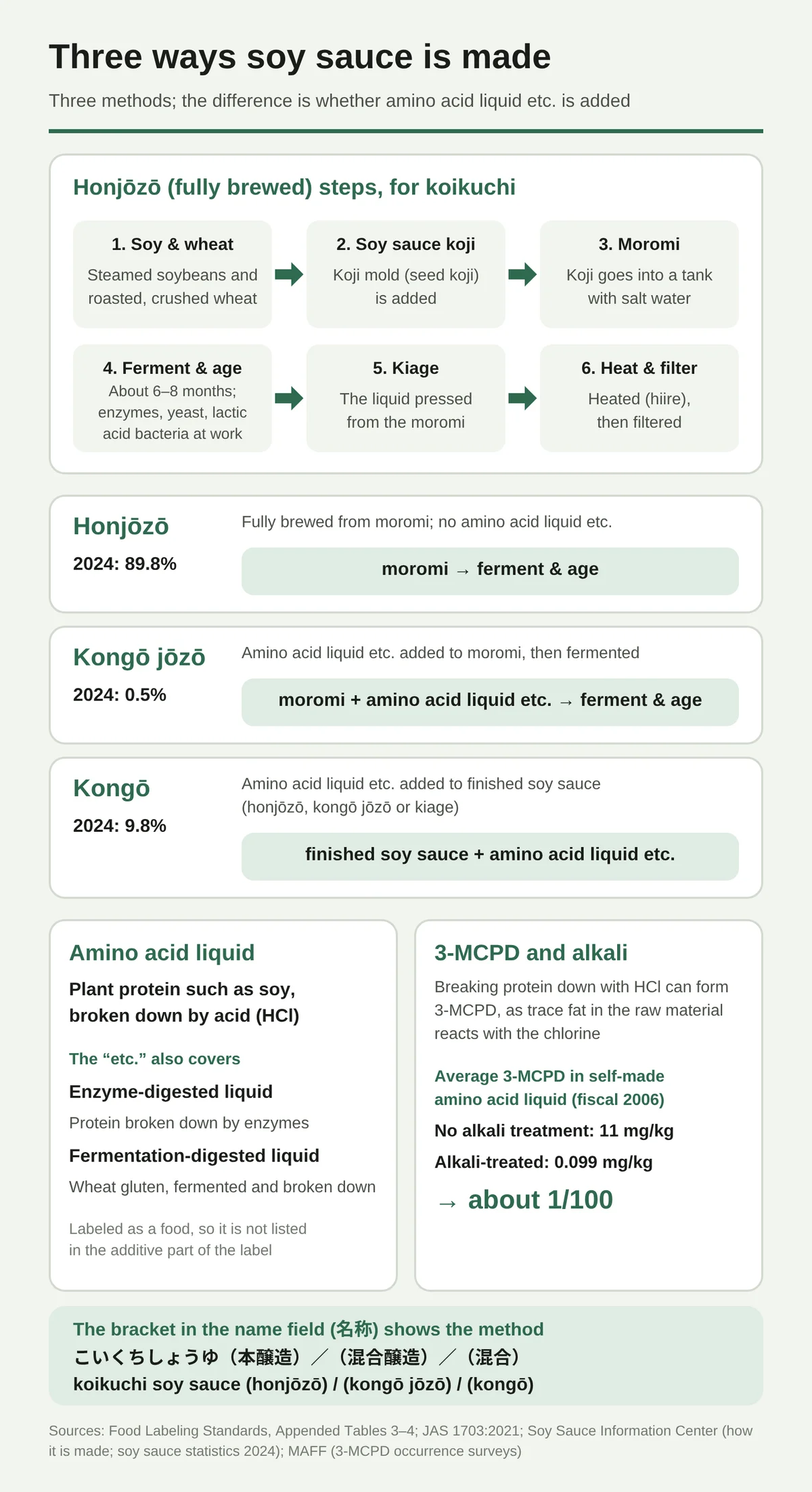
Even for the same “soy sauce,” there are three ways of making it. The difference is whether amino acid liquid and similar ingredients are added.
Honjōzō: koji, moromi and aging
According to the Shoyu Information Center, koikuchi soy sauce made by honjōzō is produced as follows.
- Steamed soybeans (defatted soybeans) and roasted, crushed wheat are mixed in about equal amounts, and koji mold (seed koji) is added to make “shoyu koji.”
- The koji is put into a tank together with salt water to make “moromi” (the mash).
- It is left for about 6–8 months with stirring. The enzymes of the koji mold, yeast and lactic acid bacteria work, and breakdown, fermentation and aging proceed.
- The liquid pressed from the moromi is “kiage” (raw pressed soy sauce). This is heated (hiire, pasteurization) and filtered.
The Food Labeling Standards and JAS define honjōzō as “a liquid seasoning made by fermenting and aging moromi.” Auxiliary use of enzymes such as cellulase is permitted.
What amino acid liquid is
Amino acid liquid is a liquid made by breaking down the protein of plants such as soybeans with acid (definition in JAS and the Food Labeling Standards). The soy sauce industry’s agreement (2007) describes it as “a liquid seasoning made by breaking down plant protein such as defatted soybeans or wheat gluten with acid and neutralizing it with alkali” (the acid used is hydrochloric acid; MAFF), and gives Ajinomoto’s “Ajieki” as an example.
| What is added | How it is made (definition) |
|---|---|
| Amino acid liquid | Plant protein such as soybeans, treated with acid |
| Enzyme-hydrolyzed seasoning liquid | Plant protein such as soybeans, treated with an enzyme that breaks down protein |
| Fermentation-hydrolyzed seasoning liquid | Wheat gluten, fermented and broken down |
Source: JAS 1703:2021, Food Labeling Standards, Appended Table 3.
Because the protein is broken down into amino acids, the umami becomes stronger. On a label, amino acid liquid is treated as a “food” and is not written in the additive section. For details, see Ingredient Dictionary: amino acid liquid and our article on umami seasonings.
The amount of amino acid liquid used in soy sauce fell by about 70%, from 76,837 kL in 1984 to 21,002 kL in 2024 (Shoyu Information Center statistics).
The three production methods
| Method | What is done | Share in 2024 | Example of how the name field is written |
|---|---|---|---|
| Honjōzō (fully brewed) | Moromi is fermented and aged | 89.8% | “こいくちしょうゆ(本醸造)” (koikuchi soy sauce, honjōzō) |
| Kongō jōzō (blended brewing) | Amino acid liquid and similar ingredients are added to the moromi, then fermented and aged | 0.5% | “こいくちしょうゆ(混合醸造)” (koikuchi soy sauce, kongō jōzō) |
| Kongō (blended) | Amino acid liquid and similar ingredients are added to finished soy sauce (honjōzō, kongō jōzō or kiage) | 9.8% | “こいくちしょうゆ(混合)” (koikuchi soy sauce, kongō) |
Source: Food Labeling Standards, Appended Tables 3 and 4; JAS 1703:2021; Shoyu Information Center statistics (2024). The share of kongō was calculated by Urayomi from the shipment volume in the statistics table (66,534 kL). (The composition-ratio column of the table says 9.7%, but calculating from shipment volume gives 9.8%.)
The share of honjōzō was 66.6% in 1977, the first year with statistics. By 2024 it had grown to 89.8%, and methods using amino acid liquid and similar ingredients fell from 33.4% to 10.2%. The Shoyu Information Center explains that kongō jōzō and kongō soy sauces are “soy sauces that make use of the umami characteristic of amino acid liquid, and in some regions this characteristic is preferred.” We look at regional differences in Prefectures with more and fewer blended soy sauces.
Whole soybeans and defatted soybeans
Today, 80% of the soybeans used as soy sauce raw material are “defatted soybeans,” soybeans with the oil already pressed out.
According to the Shoyu Information Center, defatted soybeans are “soybeans from which the fat not much needed for soy sauce making has been removed in advance, leaving the protein needed.” In the legal definition too, the “soybeans” in the raw material of shoyu koji include defatted soybeans. In the ingredient list they are written separately as “脱脂加工大豆” (defatted soybeans).
| Year | Defatted soybeans | Whole soybeans | Share of whole soybeans (converted to soybeans) |
|---|---|---|---|
| 1984 | 181,385 t | 4,654 t | 2.0% |
| 1990 | 174,206 t | 23,775 t | 9.8% |
| 2005 | 140,288 t | 40,094 t | 18.6% |
| 2024 | 108,479 t | 32,281 t | 19.2% |
Source: Shoyu Information Center statistics 3.(1) (original source MAFF; partly industry estimates). The share is calculated by dividing defatted soybeans, converted to soybeans by taking the oil portion as about 20%. Of the whole soybeans in 2024, 6,554 t were domestic and 25,727 t were foreign.
Whole soybeans were only 2% of use in 1984. They reached about 10% in 1990, when Kikkoman launched its “Tokusen Marudaizu Shoyu,” grew to nearly 20% in 2005, and have been roughly flat since. Kikkoman describes whole-soybean soy sauce as “rich and mellow” and defatted-soybean soy sauce as “crisp in flavor” (the maker’s wording).
Even for the same Kikkoman, comparing ingredient lists shows the difference.
| Product | Ingredient list (official site) |
|---|---|
| Kikkoman Tokusen Marudaizu Shoyu | 大豆(アメリカ)(分別生産流通管理済み)、小麦、食塩 (soybeans (USA) (identity-preserved), wheat, salt) |
| Kikkoman Shoyu | 脱脂加工大豆(大豆(アメリカ又はカナダ(5%未満))(分別生産流通管理済み))、小麦、食塩、大豆(分別生産流通管理済み)/アルコール (defatted soybeans (soybeans (USA or Canada (under 5%)) (identity-preserved)), wheat, salt, soybeans (identity-preserved) / alcohol) |
A study on differences in taste was found from China. It is a report that in sensory evaluation, whole-soybean soy sauce had a stronger sourness and fruity aroma, and defatted-soybean soy sauce had a stronger smoky aroma (Tian 2023). However, an employee of a Chinese soy sauce maker (Haitian) is among the coauthors. We could not obtain data compared by Japanese makers or public agencies.
We could not confirm the text of the industry’s rule (Fair Competition Code) for writing “丸大豆” (whole soybeans).
Does solvent remain in defatted soybeans?
Soybean oil is generally extracted with a solvent called hexane. Under Japanese rules, hexane may be used on the conditions that it is “limited to extracting oil when making edible oils and fats” and “removed before the final food is made” (usage standard for food additives, MHLW notice of 1976). There is no numerical standard for the amount allowed to remain.
The EU sets residue limits of 10 mg/kg in foods containing defatted protein products, 30 mg/kg in defatted soy products for consumers, and 1 mg/kg in fats and oils (Directive 2009/32/EC).
We found no Japanese public data measuring how much hexane actually remains in soy sauce or defatted soybeans. This article cannot say either that it “remains” or that it “does not remain.”
Types of soy sauce and how to read the label
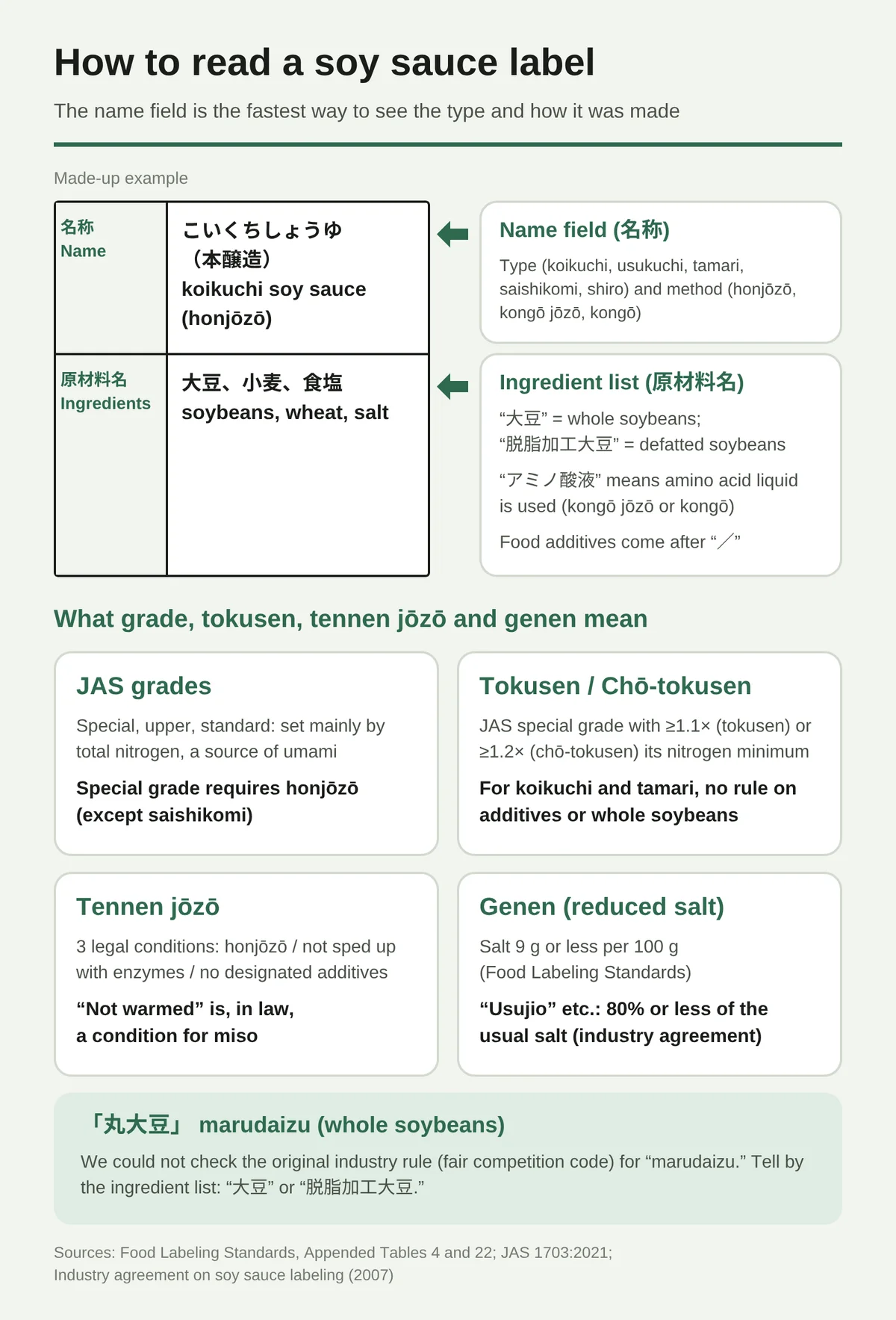
There are five types of soy sauce. The fastest way to tell which one it is, and how it was made, is the name field.
The five types
| Type | Raw materials and method (from the JAS definition) | Share in 2024 | Prefectures making the most (2024) |
|---|---|---|---|
| Koikuchi | Soybeans with about the same amount of wheat added | 84.9% | Chiba, Hyogo, Gunma and others |
| Usukuchi | Made so the color does not darken. Rice or amazake may be used | 11.5% | Hyogo (39.4%) |
| Tamari | Soybeans only, or soybeans with a little wheat | 2.1% | Aichi (57.4%) |
| Saishikomi | Brewed with soy sauce (kiage) instead of salt water | 1.0% | Gunma (19.6%). Born in Yanai, Yamaguchi |
| Shiro | A little soybean with wheat. The color is strongly held back | 0.6% | Aichi (35.7%). Born in Hekinan, Aichi |
Source: JAS 1703:2021; Shoyu Information Center statistics 2.(1)(3) (figures in brackets are the share of that type’s national shipments; calculated by Urayomi).
- “Usukuchi” means “light in color.” To keep the color pale, about 10% more salt is used than in koikuchi (Shoyu Information Center). It is not lower in salt.
- Saishikomi is rich in color, flavor and aroma, and is also called “kanro shoyu” (sweet-dew soy sauce).
- Shiro is an even paler amber than usukuchi, and is a soy sauce with strong sweetness.
Tamari soy sauce
Tamari soy sauce is made mainly in the Chubu region; it is dark and thick. The raw material is mainly soybeans, with very little wheat. “Miso-ball koji” is made from soybeans, and the liquid that collects at the bottom is ladled over while it ferments and ages for nearly a year (Shoyu Information Center). Besides being a dipping soy sauce for sashimi and sushi, it gives a nice reddish color when heated, so it is also used for teriyaki and senbei (rice crackers).
The JAS definition is “soybeans, or soybeans with a little wheat,” so some tamari uses wheat and some does not. Whether wheat is used has to be checked in the ingredient list of each product.
An example of tamari soy sauce made without wheat is introduced in If you have a wheat or soybean allergy.
In the name field: “こいくちしょうゆ(本醸造)”
The Food Labeling Standards (Appended Table 4) require the name of soy sauce to be written in the form “type (method)”.
- こいくちしょうゆ(本醸造) (koikuchi soy sauce (honjōzō))
- うすくちしょうゆ(混合醸造) (usukuchi soy sauce (kongō jōzō))
- たまりしょうゆ(混合) (tamari soy sauce (kongō))
Products that do not fit the five types are written as “しょうゆ(本醸造)” (soy sauce (honjōzō)) and so on.
Under the soy sauce industry’s agreement (2007), a product that uses no soybeans at all cannot be written as “こいくちしょうゆ(本醸造)” and the like. Products using yeast extract, shiitake, honey, chili pepper, garlic, kombu and so on also do not count as “soy sauce.” Products with bonito or kombu dashi added have a name field that is not “しょうゆ” even when the product name is “○○ shoyu,” but “しょうゆ加工品” (processed soy sauce product) or similar (contribution by Hideki Matsumoto).
Kikkoman has a “soy sauce made without soybeans or wheat,” made from peas (ingredients: peas (USA), salt / alcohol). We could not confirm what is written in this product’s name field.
Special grade, high grade and standard (JAS)
JAS gives soy sauce three grades, based on the amount of nitrogen that is the source of umami (total nitrogen) and other factors.
| Type | Methods that can be special grade | Total nitrogen (g/100 mL or more) special / high / standard |
|---|---|---|
| Koikuchi | Honjōzō only | 1.50 / 1.35 / 1.20 |
| Usukuchi | Honjōzō only | 1.15 / 1.05 / 0.95 |
| Tamari | Honjōzō only | 1.60 / 1.40 / 1.20 |
| Saishikomi | Honjōzō, or kongō jōzō with 20% or less amino acid liquid and similar | 1.65 (2.00 for kongō jōzō) / 1.50 / 1.40 |
| Shiro | Honjōzō only | 0.40 or more and under 0.80 (high and standard: under 0.90) |
Source: JAS 1703:2021. For shiro, lower total nitrogen is the condition; grades are also set by salt-free soluble solids and reducing sugars.
- Special grade requires honjōzō, except for saishikomi. High and standard grades do not specify the method.
- The raw materials allowed under JAS are limited to soybeans, wheat, rice, wheat gluten, salt, amino acid liquid and similar, sugars, alcohol, mirin and so on. Additives that meet the Codex General Standard for Food Additives may be used.
- As noted above, soy sauce with JAS grading was 53.2% of shipments in 2024. The absence of a JAS mark or grade does not necessarily mean lower quality.
The conditions for “tokusen” and “chō-tokusen”
“特選” (tokusen) and “超特選” (chō-tokusen) are words whose conditions are set by the Food Labeling Standards (Appended Table 22).
| Label | Condition (for koikuchi and tamari) | For koikuchi, this means |
|---|---|---|
| Tokusen | Graded JAS special grade, with total nitrogen 1.1 times or more the special-grade standard | 1.65 g/100 mL or more |
| Chō-tokusen | Likewise, 1.2 times or more | 1.80 g/100 mL or more |
For usukuchi and shiro, the judgment uses “salt-free soluble solids” instead of total nitrogen, and it is also a condition that no sugars have been added. For saishikomi, only honjōzō special grade is covered.
Three things follow from this.
- Tokusen and chō-tokusen are honjōzō JAS special-grade soy sauces with more nitrogen, the source of umami.
- For koikuchi and tamari, not using additives is not a condition.
- Using whole soybeans is not a condition either.
In fact, comparing ingredients on Kikkoman’s official site gave the following (checked October 3, 2026).
| Product | Ingredient list |
|---|---|
| いつでも新鮮 超特選 極旨しょうゆ | 脱脂加工大豆(…)、小麦、食塩/アルコール (defatted soybeans (…), wheat, salt / alcohol) |
| いつでも新鮮 超特選 九州あまくちさしみしょうゆ | 脱脂加工大豆(…)、食塩、小麦、砂糖、みりん/調味料(アミノ酸等)、アルコール、着色料(カラメル)、甘味料(甘草、ステビア)、増粘剤(キサンタン) (defatted soybeans (…), salt, wheat, sugar, mirin / seasoning (amino acids, etc.), alcohol, coloring (caramel), sweeteners (licorice, stevia), thickener (xanthan)) |
| 特選 丸大豆しょうゆ | 大豆(アメリカ)(分別生産流通管理済み)、小麦、食塩 (soybeans (USA) (identity-preserved), wheat, salt) |
| 特選有機しょうゆ | 有機大豆(アメリカ)、有機小麦、食塩 (organic soybeans (USA), organic wheat, salt) |
Even some “超特選” products use “調味料(アミノ酸等)” (seasoning (amino acids, etc.)), caramel color and sweeteners. When you want to choose products without additives, the sure way is to look not at the word “特選” but at what comes after the “/” in the ingredient list (the additive section).
The industry’s agreement (2007) prohibits words easily confused with grades, such as “最上,” “極上” and “最高,” and says that words such as “特醸,” “高逸” and “ゴールド” may be used for special grade, and “上選,” “優選” and “吟醸” for high grade. This agreement is a document that supplemented the JAS and the soy sauce quality labeling standard as of 2004. The soy sauce section of today’s Food Labeling Standards (Appended Table 22) contains only three terms, “特選・超特選,” “天然醸造” and “減塩,” and we found no rules for those words. We could not confirm whether the industry still operates the same way today.
The conditions for “tennen jōzō”
The Food Labeling Standards in principle prohibit writing “天然” (natural) or “自然” (natural) on soy sauce. The exception is “天然醸造”, which may be used only when all three of the following are met.
- It was made by the honjōzō method.
- Brewing was not sped up with enzymes such as cellulase.
- No designated additives (additives listed in Appended Table 1 of the Food Sanitation Act Enforcement Regulations) were used.
You often see the explanation that “tennen jōzō means brewed at natural temperatures without raising the temperature.” But what the Food Labeling Standards word as “not accelerated by heating” is the condition for “tennen jōzō” miso. The conditions for soy sauce do not contain the word “heating.”
The industry’s voluntary rules (the “Fair Competition Code on Soy Sauce Labeling” of the Central Fair Trade Council for the Soy Sauce Industry) may have a heating condition, but we could not obtain the text of the code and could not confirm it. This article writes only the three conditions confirmed in law.
Note that the third condition is limited to “designated additives” (Appended Table 1, Food Sanitation Act Enforcement Regulations). Caramel color (Caramel I–IV), licorice extract (kanzō) and stevia extract are on a separate list of “existing additives” (List of Existing Additives, as of August 25, 2025), and in the wording of the law they do not fall under this condition. We could not confirm how this works in practice, but the words “tennen jōzō” alone do not let you say that no additives at all are included. Here too, looking at the ingredient list is the sure way.
“Reduced-salt,” “light-salt” and “raw”
| Label | Condition | Set by |
|---|---|---|
| Reduced-salt (減塩) | Salt in 100 g of soy sauce is 9 g or less | Food Labeling Standards, Appended Table 22 |
| Light-salt, shallow-salt, mild-salt, low-salt (うす塩・あさ塩・あま塩・低塩) | 80% or less of the salt in ordinary soy sauce (the Shoyu Information Center says “80% or less, 50% or more”) | Wording of the 2004 standard and the industry agreement (2007) that supplemented it. Not in the soy sauce section of today’s Food Labeling Standards |
| Raw (生, ki or nama) | A furigana reading of “ki” or “nama” is attached. Instead of heating (hiire), at least a sterilization treatment that can remove yeast is applied | Same as above |
Kikkoman explains that “reduced-salt” is soy sauce with salt cut to “nearly half” of ordinary soy sauce, and “light-salt” and similar is 80% or less. The rules for labels that compare with other foods, such as “reduced-salt” and “salt cut by ○%,” are summarized in our salt intake article.
Is soy sauce bad for you? Checking each claim
Salt: how much in one tablespoon?
The component of soy sauce to watch first is salt.
Per the product labels, per tablespoon (15 mL), the figures were as follows (each company’s official site, checked October 3, 2026).
| Product | Salt equivalent (per tablespoon) |
|---|---|
| Kikkoman Usukuchi Shoyu | 2.8 g |
| Kikkoman Shoyu | 2.5 g |
| Kikkoman Tokusen Marudaizu Shoyu | 2.5 g |
| 丸中醸造醤油 | 2.4 g |
| Kikkoman Itsudemo Shinsen Shiboritate Nama Shoyu | 2.3 g |
| Kikkoman Genen Shoyu (reduced-salt) | 1.2 g |
| Kikkoman Itsudemo Shinsen Sukkiri Clear by Genen Shoyu (reduced-salt) | 0.8 g |
Ordinary soy sauce has about 2.5 g of salt per tablespoon. That is about one-third of Japan’s target (under 7.5 g for men and under 6.5 g for women).
Calculated by Urayomi, the 2024 shipment volume (681,000 kL) divided by the population is about 15 mL per person per day, or about 2.5 g when converted to salt. However, shipments also include ingredients for restaurant meals and processed foods, and exports (about 7%), so this is not the same as what one person actually consumes.
Reduced-salt soy sauce and potassium
Reduced-salt soy sauce made in Japan is basically made by reducing the salt, not by replacing the salt with another salt (potassium chloride).
According to Kikkoman, there are two ways of making reduced-salt soy sauce: the “desalting method,” which removes salt from soy sauce with ion-exchange membranes, and the “dilution method,” which dilutes a soy sauce made strong. The company uses the desalting method. It started in 1965, when a “hoken shoyu” (health soy sauce) with about 50% less salt was made for people on salt restriction because of heart or kidney disease, and it was used by the University of Tokyo Hospital and others.
| Ordinary koikuchi | Koikuchi, reduced-salt (genen) | |
|---|---|---|
| Sodium (per 100 g) | 5,700 mg | 3,300 mg |
| Salt equivalent (per 100 g) | 14.5 g | 8.3 g |
| Potassium (per 100 g) | 390 mg | 260 mg |
Source: MEXT, Standards Tables of Food Composition in Japan 2023 (8th revised edition, supplement).
In the Standard Tables of Food Composition, reduced-salt soy sauce has a lower potassium value too. The ingredient lists of Kikkoman’s three reduced-salt soy sauces did not include potassium chloride either (reduced-salt soy sauce: wheat, defatted soybeans, salt, soybeans / alcohol, acidulant, vitamin B1).
However, on the product labels, potassium per tablespoon was 25 mg for “減塩しょうゆ,” 28 mg for “特選 丸大豆減塩しょうゆ” and 80 mg for “すっきりClear by減塩しょうゆ,” a threefold difference by product. There are also products such as “reduced-salt salt” that replace salt with potassium chloride, and studies of soy sauce using potassium chloride exist. Not every reduced-salt soy sauce in Japan and abroad has been examined, so we also cannot generalize that “reduced-salt soy sauce is low in potassium.”
People who restrict potassium because of kidney disease or other conditions should look not at the word “減塩” (reduced-salt) but at the potassium value in the nutrition facts and the ingredient list (whether potassium chloride is there), and consult a doctor or registered dietitian. Potassium labeling is voluntary, so some products do not show it.
As a trial on the effect of reduced-salt soy sauce, there is a double-blind randomized controlled trial (64 people) in which soy sauce with about 25% less salt and miso with about 20% less salt were used for 6 weeks. Overall there was no difference in blood pressure, and in people aged 40 and over, diastolic blood pressure (the lower number) fell by 6.4 mmHg (Nakamura 2003; a Hamamatsu University School of Medicine study, funded by a Japan Society for the Promotion of Science Grant-in-Aid for Scientific Research).
Is 3-MCPD a concern?
3-MCPD (3-chloro-1,2-propanediol) is a substance that can form when amino acid liquid is made. When plant protein is broken down with hydrochloric acid, it forms from the small amount of lipid in the raw material reacting with the chlorine of the hydrochloric acid (MAFF).
In 1996, the EU Scientific Committee on Food judged 3-MCPD to be “a carcinogen that should not be detected in food.” Based on later research, in 2001 it changed its conclusion to “not carcinogenic” and set a tolerable intake of 2 µg per kg of body weight per day (MAFF’s explanation). The international expert committee (JECFA) in 2016 set a provisional maximum of 4 µg per kg of body weight per day for 3-MCPD and its relatives (fatty acid esters) combined.
Concentrations were completely different in honjōzō and blended products
In fiscal 2004, MAFF measured 3-MCPD in soy sauce by production method.
| Method | Samples | Below limit of quantification (0.004 mg/kg) | Median | Maximum | Mean |
|---|---|---|---|---|---|
| Honjōzō | 104 | 93 samples (89%) | – | 0.008 | 0.003 |
| Kongō jōzō and kongō | 120 | 1 sample | 0.016 | 7.8 | 0.21 |
Units are mg/kg. Source: MAFF, “Results of surveys of 3-MCPD and 1,3-DCP content in food, fiscal 2004–fiscal 2021” (updated May 29, 2024).
- Because honjōzō does not use amino acid liquid, almost no 3-MCPD was detected. The small amounts detected are presumed to have come from mixing, because the same tanks and piping were used as for blended soy sauce.
- Of the 120 kongō jōzō and kongō samples, 110 (92%) were 0.05 mg/kg or lower. Some were high (maximum 7.8 mg/kg).
The mismatched median: why we used 0.016
MAFF has two pages carrying figures from this survey, and the median for blended products does not match.
| Page | Updated | Median for blended products | Mean |
|---|---|---|---|
| “Content of 3-MCPD and 1,3-DCP in food” | March 24, 2023 | 0.21 | Not listed |
| “…Results of the content survey” (the main survey results) | May 29, 2024 | 0.016 | 0.21 |
In this article we used 0.016, for two reasons.
- The main survey results page lists the median and the mean in separate columns, and the mean is 0.21.
- Since 92% of the 120 samples were 0.05 mg/kg or lower, the middle value (median) should be 0.05 or lower. 0.21 is impossible as a median.
It is most likely that the mean (0.21), which is pulled up by some high values, was written as the median on the other page.
The cause was “self-made amino acid liquid,” and the fix was “alkali treatment”
On investigation, the cause of the high 3-MCPD became clear. There are two kinds of amino acid liquid: that made and sold by large factories as an ingredient for processed foods, and that made in-house (self-made amino acid liquid) by blended soy sauce makers.
| Amino acid liquid (fiscal 2004 and 2006) | Samples | Median | Maximum | Mean |
|---|---|---|---|---|
| Made on a large scale and alkali-treated | 148 | 0.049 | 0.14 | 0.047 |
| Self-made (fiscal 2004) | 9 | 2.7 | 44 | 8.4 |
| Self-made, no alkali treatment (fiscal 2006) | 50 | 3.3 | 57 | 11 |
| Self-made, with alkali treatment (fiscal 2006) | 31 | 0.053 | 0.30 | 0.099 |
Units are mg/kg. Source: same as above.
With alkali treatment, the mean 3-MCPD fell to about one-hundredth. Alkali treatment is a method in which, after breaking down with hydrochloric acid and neutralizing, the liquid is made alkaline again and heated to break down 3-MCPD, and then neutralized once more.
According to MAFF, this reduction technology was developed by Japan’s industry and has also been adopted in the code of practice that the Codex Alimentarius Commission adopted in 2008 (CXC 64-2008, “Code of Practice for the Reduction of 3-MCPD during the Production of Acid-HVPs”).
In fiscal 2008, MAFF asked the industry to introduce alkali treatment or to buy and use alkali-treated amino acid liquid, and it asked again for thorough implementation in fiscal 2012 and March 2023.
| Fiscal year | Soy sauce examined | Samples | Median | Maximum |
|---|---|---|---|---|
| 2005 | Blended products using self-made amino acid liquid | 40 | 1.5 | 17 |
| 2006 | Same | 54 | 0.83 | 20 |
| 2009 | Blended products of makers that used self-made amino acid liquid in fiscal 2006 | 55 | 0.069 | 4.6 |
| 2011 | Same | 55 | 0.087 | 3.4 |
| 2016 | Same | 55 | 0.035 | 1.2 |
| 2021 | Same | 55 | 0.024 | 1.6 |
Units are mg/kg. Source: same as above.
Before and after the measures, the same makers’ soy sauce went from a median of 0.83 to 0.024, about 35 times lower, and from a maximum of 20 to 1.6, 12.5 times lower. In the fiscal 2021 questionnaire, all makers except one were taking the measures, and more makers had stopped making their own and were using only treated amino acid liquid.
Standards in Japan, the EU and the international standard
| Country/region | Standard for 3-MCPD in soy sauce and similar (mg/kg) | Applies to |
|---|---|---|
| Japan | No legal standard | Managed through MAFF requests and surveys |
| EU | 0.02 | Soy sauce and acid-hydrolyzed vegetable protein (as a liquid with 40% solids; varies with the share of solids) |
| South Korea | 0.02 | Acid-hydrolyzed soy sauce and soy sauce blended with it |
| Singapore | 0.02 | Soy sauce, oyster sauce |
| Australia and New Zealand | 0.2 | Soy sauce, oyster sauce |
| Taiwan | 0.3 | Soy sauce, processed soy sauce products |
| Codex (international standard) | 0.4 | Liquid seasonings containing acid-hydrolyzed vegetable protein (excluding honjōzō soy sauce) |
| Canada | 1.0 (provisional) | Soy sauce, oyster sauce and others |
| United States | 1 (industry voluntary standard) | Acid-hydrolyzed vegetable protein |
Source: MAFF, “International initiatives on chloropropanols” (table as of May 1, 2024).
The maximum for honjōzō (0.008) was lower than the value of the strictest standard, the EU’s. On the other hand, the maximum for blended products in fiscal 2021 (1.6) is 4 times the Codex value and 80 times the EU value (not considering the difference in solids). Japan is a country that contributed the technology to the international standard, but it has no legal standard for 3-MCPD in soy sauce, and this is the biggest difference between Japan and other countries.
Overseas soy sauces also include ones that exceed standards: 31 samples in South Korea (mean 11.6 µg/kg, maximum 55 µg/kg, 23% above the Korean standard; Jang & Koh 2020), and 21 Bulgarian soy sauces containing hydrolyzed vegetable protein (3.7–186 µg/kg, 33% above the EU standard). 1 µg/kg is 0.001 mg/kg.
Thinking in terms of the amount that enters the body
MAFF evaluates it as follows.
- The 3-MCPD that the average Japanese person takes in from soy sauce is under 1% of the tolerable intake at the time (2 µg per kg of body weight).
- The amount from all food is 2.0–4.7 µg per day (total diet study, fiscal 2005–2007), which is 2–5% of the tolerable intake at the time.
- Based on the fiscal 2021 survey, even assuming continued intake of high-concentration soy sauce, it is about one-tenth of the maximum set in 2016 (4 µg per kg of body weight).
Urayomi also calculated it. Suppose a person takes 15 g of soy sauce a day (the shipment volume per person is about 15 mL a day, which is a little more by weight), and all of it is soy sauce at the fiscal 2021 maximum (1.6 mg/kg). Then 3-MCPD is about 24 µg a day. That is about 12% of the maximum for a person of 50 kg (4 µg × 50 kg = 200 µg), almost the same as MAFF’s “about one-tenth.” With soy sauce at the median (0.024 mg/kg), it is about 0.36 µg, about 0.2% of the maximum.
If you choose honjōzō, the amount of 3-MCPD is so small that you hardly need to worry about it. For blended soy sauce too, concentrations after the measures have fallen greatly. If you are concerned, you can tell by looking for “(本醸造)” in the name field and for the absence of “アミノ酸液” (amino acid liquid) in the ingredient list. Note that amino acid liquid is also used in mentsuyu, tare, sauces, pickling liquids and so on (MAFF).
Allergy: wheat and soybeans
Wheat, a raw material of soy sauce, is an item for which allergen labeling is mandatory, and soybeans are an item for which labeling is recommended. For soy sauce itself, “小麦” (wheat) and “大豆” (soybeans) are written in the ingredient list. As an ingredient of other foods, it is written like “しょうゆ(小麦・大豆を含む)” (soy sauce (contains wheat and soybeans)).
| Study | What was found | Note |
|---|---|---|
| Kobayashi 2004 | Testing blood from 5 children with wheat allergy, the wheat allergens were broken down at the moromi stage and no longer reacted. They were also not detected in 10 commercial products (test-tube study) | Higashimaru Shoyu’s laboratory |
| Magishi 2017 | Soybean allergens were not completely broken down by fermentation and remained in kiage, but they were coagulated by heating and removed by filtration (blood from 2 children with soybean allergy) | Higashimaru Shoyu’s laboratory and pediatricians |
| Lee 2025 | In Korean soy sauce, blood from children who react to wheat and soybeans reacted depending on the type of soy sauce | Researchers in a pediatrics department at a Korean university hospital |
Kikkoman explains that the wheat and soybean proteins are broken down into amino acids in soy sauce. However, the studies above involve few people, and the two Japanese ones are makers’ research. We found no data examining what happens to soybean allergens in unheated raw soy sauce.
Whether a person with a wheat or soybean allergy can use soy sauce should follow a doctor’s instructions. When looking for soy sauce made without wheat, as noted above, some tamari also uses wheat, so check the ingredient list (for an example of a product without wheat, see If you have a wheat or soybean allergy).
There is also a report of 4 cases of inflammation around the mouth after meals using soy sauce (a dermatology clinic in Nagoya). Among the sauces examined, histamine (a substance that causes itching and so on) was detected only in those made from soybeans and fava beans, and not in the other sauces. The author considers it not histamine poisoning but an allergy to a substance formed during brewing (Sugiura 2010). We found no survey measuring histamine in commercial soy sauce in Japan. For histamine in fish sauce, see our fish sauce article.
Some soy sauces use additives
Some soy sauces contain only “soybeans, wheat and salt,” while others have sweeteners or seasonings added. We compared the ingredient lists on Kikkoman’s official site (checked October 3, 2026).
| Product | Main ingredients | Additives (after the “/”) |
|---|---|---|
| Tokusen Marudaizu Shoyu | Soybeans, wheat, salt | None |
| Shoyu | Defatted soybeans, wheat, salt, soybeans | Alcohol |
| Usukuchi Shoyu | Salt, defatted soybeans, wheat, high-fructose glucose syrup, rice, soybeans | Alcohol |
| Itsudemo Shinsen Kyushu Umakuchi Mellow Shoyu | Defatted soybeans, salt, wheat, high-fructose glucose syrup, sugar | Alcohol, seasoning (amino acids, etc.), coloring (caramel), sweeteners (licorice, stevia) and others |
- Alcohol is added for aroma and preservation (Shoyu Information Center), and under JAS it is treated as an ingredient (food). In the ingredient list it is written after the “/”.
- Sweet soy sauces may use sugar and high-fructose glucose syrup, and also sweeteners such as licorice and stevia (our sweeteners article, our isomerized sugar article).
- For the preservative paraoxybenzoic acid esters (parabens), the usage standard for soy sauce is up to 0.25 g per liter (our preservatives article).
Caramel color and 4-MEI
Some caramel colors (III and IV) form a substance called 4-MEI during manufacture (for details, see our caramel color article). In a study measuring 4-MEI in soy sauce, honjōzō soy sauce had very small amounts, under 0.002 µg to 0.023 µg per gram, and soy sauce containing caramel color had 0.43–4.8 µg (Yamaguchi & Masuda 2011; the authors are Kikkoman researchers. The number of samples and brands are not given in the abstract).
Per 10 g of soy sauce, that is about 4–48 µg for those with caramel color, and 0.23 µg or less for honjōzō. The US state of California requires a warning label for an intake of 29 µg or more of 4-MEI per day. Caramel color can be used even in “special grade” and “honjōzō” soy sauce, so check the ingredient list if you want to avoid it.
Why there is no genetically modified label
Soy sauce is a food with no obligation to label genetic modification. According to the Consumer Affairs Agency, this is because the recombinant DNA and the proteins it produces are removed or broken down in the processing steps and cannot be found even with current detection technology. This treatment was decided in the 1997–99 reviews and did not change in the 2017 review committee.
As a result, “遺伝子組換えでない” (non-GM) on soy sauce is a voluntary label. Since April 2023, it can be written only when the ingredient is segregated (identity preserved) and confirmed to have no genetically modified material mixed in. For something that may still contain a small amount even when segregated, “分別生産流通管理済み” (identity preserved) is written.
| Product | How soybeans are written |
|---|---|
| Kikkoman Tokusen Marudaizu Shoyu | 大豆(アメリカ)(分別生産流通管理済み) (soybeans (USA) (identity-preserved)) |
| 丸中醸造醤油 | 大豆(国産、遺伝子組換えでない) (soybeans (domestic, non-GM)) |
Of the 32,281 t of whole soybeans used in soy sauce in 2024, 6,554 t (about 20%) were domestic.
Is there research saying “soy sauce is good for you”?
There is research on the action of components in soy sauce, but much of it is by soy sauce makers.
| Study | Content | Note |
|---|---|---|
| Shoyu polysaccharides (SPS) | Randomized controlled trials on nasal allergy symptoms (21 people, 4 weeks; 51 people, 8 weeks), iron absorption (45 people) and triglycerides (30 people) | All from Higashimaru Shoyu’s laboratory. The trials used the component as a supplement at 600 mg a day; they were not tested with the amount of soy sauce people normally use |
| Summary of soy sauce functions (review) | Aiding digestion, antibacterial action, components that interfere with enzymes involved in blood pressure, and so on | A review by Kikkoman’s Quality Assurance Department. Mainly animal and test-tube studies |
For this reason, this article does not treat these as evidence for “soy sauce is good for you.”
Prefectures with more and fewer blended soy sauces
The share of blended soy sauce differs by prefecture from the 1% range to the 90% range. Urayomi calculated the shares from the national statistics on shipments by prefecture and production method.
| Prefecture/region | Shipments | Share of kongō jōzō and kongō |
|---|---|---|
| Nationwide | 681,019 kL | 10.2% |
| Chiba | 256,218 kL | 1.2% |
| Hyogo | 107,163 kL | 2.0% |
| Oita | 25,741 kL | 49.1% |
| Seven Kyushu prefectures | 63,501 kL | 55.5% |
| Kagoshima | 5,239 kL | 94.1% |
| Toyama | 1,116 kL | 89.8% |
| Yamagata | 2,191 kL | 86.2% |
| Miyazaki | 3,527 kL | 83.3% |
| Akita | 1,387 kL | 79.5% |
The highest share was Kochi (96.7%), but its shipments were small at 428 kL. Tottori (93.2%), Yamaguchi (91.0%), Fukui (89.7%) and Ehime (84.3%) were also high.
- Chiba and Hyogo, which account for more than half of national shipments, are almost all honjōzō. That is why honjōzō is 90% nationwide.
- About 51% of kongō jōzō and kongō soy sauce (69,600 kL) is made in the seven Kyushu prefectures, and about 18% in Oita Prefecture alone.
- Even though Chiba’s share is 1.2%, it ships about 3,000 kL of blended soy sauce by volume.
These figures match well with the explanations of makers and researchers. Kikkoman writes that in Kyushu “sweet blended soy sauce makes up much of the market,” that Miyazaki and Kagoshima are “regions where especially sweet blended soy sauce is preferred,” that in Kochi and Ehime too, under Kyushu’s influence, sweet blended soy sauce is preferred, and that Kanazawa (Ishikawa) is a production area for sweet blended soy sauce along with Kyushu. In a 2017 survey by Hiroshi Tachi of Tokyo University of Agriculture, who visited 19 soy sauce makers in the six Tohoku prefectures, blended soy sauce was 60% or more of production at most makers.
However, this is shipments by the prefecture where the factory is, not the amount used in that prefecture. Also, there is no data showing that soy sauce from prefectures with much blended soy sauce has higher 3-MCPD. MAFF’s survey does not publish results by prefecture.
Blended soy sauce is soy sauce that has been loved as a regional taste. MAFF also writes that it “has a distinctive flavor compared with honjōzō soy sauce, and is preferred in some regions.” Which one to choose is a matter of taste, and in this article we recommend knowing how to tell them apart (the brackets in the name field).
How to choose soy sauce
Three places to look when choosing: the name field, the ingredient list, and the labeling.
| What you want to know | Where to look | Example |
|---|---|---|
| Type and method | Name field | “こいくちしょうゆ(本醸造)” or “(混合)” |
| Whole soybeans or defatted soybeans | Ingredient list | “大豆” alone means whole soybeans; “脱脂加工大豆” means soybeans with the oil pressed out |
| Whether amino acid liquid is used | Ingredient list | The words “アミノ酸液” |
| Whether additives are used | After the “/” in the ingredient list | 調味料(アミノ酸等), caramel color, sweeteners and so on |
| Whether nitrogen, the source of umami, is high | Grade, tokusen and chō-tokusen labels | Tokusen is 1.1 times or more of special grade; chō-tokusen is 1.2 times or more |
| Salt and potassium | Nutrition facts | Salt equivalent per tablespoon; potassium (voluntary) |
If you want honjōzō and whole soybeans
If the ingredients are only the three “soybeans, wheat, salt” and the name field says “こいくちしょうゆ(本醸造),” the label tells you that no amino acid liquid, defatted soybeans or additives are used. For example, Kikkoman Tokusen Marudaizu Shoyu has just three ingredients, soybeans (USA), wheat and salt, and a suggested retail price of 580 yen (excluding tax) per liter.
丸中醸造醤油 is a koikuchi soy sauce (honjōzō) from Marunaka Shoyu in Aisho, Shiga Prefecture. Its ingredients are the three of soybeans (domestic, non-GM), wheat and salt, and the maker explains that it is basically aged three years in cedar barrels. At 1,788 yen for 720 mL (tax included, official shop), it is pricier than typical supermarket soy sauce.
Here is also an example for people who want to choose by where the ingredients come from or whether it is organic. Yamaki Jozo’s “Kokusan Yūki Shoyu Koikuchi Type” (500 mL) lists three ingredients, “有機大豆(国産)、有機小麦(国産)、食塩” (organic soybeans (domestic), organic wheat (domestic), salt). It says “大豆” (soybeans), not “脱脂加工大豆” (defatted soybeans), so it is whole soybeans, and both the soybeans and the wheat are domestic organic ingredients.
If you want to cut salt
- “減塩” (reduced-salt) means 9 g or less of salt per 100 g (Food Labeling Standards), and “うす塩” (light-salt) and similar mean 80% or less of ordinary soy sauce (industry guideline). When comparing, look at the salt equivalent in the nutrition facts.
- People who restrict potassium should also look at the potassium value and whether potassium chloride is in the ingredients.
- Ways to reduce the amount of soy sauce itself, and examples of reduced-salt soy sauce, are summarized in our salt intake article.
If you are concerned about 3-MCPD
- If the name field says “(本醸造),” no amino acid liquid is used. In the fiscal 2004 survey, 89% of honjōzō was below the limit of quantification for 3-MCPD, and the maximum was 0.008 mg/kg.
- Even for kongō jōzō and kongō, the median after the measures has fallen to 0.024 mg/kg (fiscal 2021).
If you have a wheat or soybean allergy
- Check with a doctor whether you can use it.
- When looking for soy sauce without wheat, check the ingredient list even for tamari. There is also soy sauce that uses neither soybeans nor wheat (made from peas and so on).
Here is one example of soy sauce made without wheat. Marumata Shoten’s “Organic Tamari Shoyu” (900 mL) lists two ingredients, “オーガニック大豆(中国産)、食塩” (organic soybeans (China), salt), and uses no wheat (as shown on the Rakuten Ichiba product page). It does use soybeans, so it is not suitable for people with a soybean allergy. The ingredient list does not tell you whether wheat is handled in the same factory (risk of cross-contact), so if this concerns you, check with the maker.
What we introduced in this article (summary)
Here is a recap of what we introduced in the article. The reasons and ingredients are written in each section.
| What we introduced | Where to buy |
|---|---|
| Marunaka Shoyu: Marunaka Jōzō Shoyu (koikuchi) 720 mL | See on Rakuten (成城石井) PR See on Amazon.co.jp PR See on Yahoo! Shopping PR |
| Yamaki Jozo: Kokusan Yūki Shoyu Koikuchi Type 500 mL | See on Rakuten (楽天24) PR See on Amazon.co.jp PR See on Yahoo! Shopping PR |
| Marumata Shoten: Organic Tamari Shoyu 900 mL (wheat-free) | See on Rakuten (リフココ) PR See on Amazon.co.jp PR See on Yahoo! Shopping PR |
Wrap-up
| Question | What we found |
|---|---|
| How did soy sauce begin? | The original form is “醤” (hishio), which came from China. The story of Kakushin in Yuasa is a tradition; what the records confirm is a 1535 shipment to Osaka |
| What is the difference between honjōzō and blended? | Kongō jōzō and kongō add amino acid liquid (a liquid made by breaking down plant protein with acid) and similar. In 2024 honjōzō was 89.8%. You can tell from the brackets in the name field |
| Is soy sauce consumption falling? | Shipments peaked in 1973 (1.294 million kL), and 2024 was 52.6% of that. “The peak was 1984” is wrong. Processed products such as tsuyu and tare have increased |
| Whole soybeans vs. defatted soybeans? | About 80% of the soybeans used are defatted soybeans. Whole soybeans went from 2% in 1984 to 19.2% in 2024. We found no Japanese public data measuring residual solvent |
| Tokusen and chō-tokusen? | JAS special grade with nitrogen 1.1 times or 1.2 times or more. There is no condition on additives or whole soybeans, and even chō-tokusen includes products with caramel color and sweeteners |
| Tennen jōzō? | The legal conditions are three: honjōzō, not sped up by enzymes, no designated additives. “Not heated” is a condition for miso, and we could not confirm it for soy sauce |
| Is reduced-salt soy sauce high in potassium? | In the composition table reduced-salt is lower (390 mg to 260 mg per 100 g). But products differ, and people with restrictions should check the label |
| 3-MCPD? | 89% of honjōzō was below the limit of quantification. For blended products the median fell from 0.83 to 0.024 mg/kg with the measures. Japan has no legal standard; the EU is 0.02 and Codex is 0.4 |
| Where is blended soy sauce common? | Chiba 1.2% and Hyogo 2.0%, versus Kyushu 55.5%, Kagoshima 94.1%, Toyama 89.8% and Yamagata 86.2% (tally by shipping prefecture) |
Sources
Laws and standards
- Food Labeling Standards (Cabinet Office Order No. 10 of 2015), Appended Tables 3, 4 and 22 (e-Gov Laws and Regulations Search) https://laws.e-gov.go.jp/law/427M60000002010
- MAFF, “Japanese Agricultural Standard for Soy Sauce,” JAS 1703:2021 https://www.maff.go.jp/j/jas/jas_standard/attach/pdf/index-470.pdf
- Japan Soy Sauce Association and others, “Industry agreement on soy sauce labeling and related matters” (2006, revised 2007)
- Consumer Affairs Agency, “Approach to the new genetically modified food labeling system (supplementary material)” (2019)
- Japan Food Chemical Research Foundation, “Usage standards and storage standards for each additive,” and “List of Existing Additives” (as of August 25, 2025) https://www.ffcr.or.jp/webupload/kizontenkameibo.pdf ; Ministry of Health and Welfare notice, Kankyō-shokuka No. 110-2 of 1976 (hexane)
- EU Directive 2009/32/EC Annex I (extraction solvents); EU Regulation (EC) 1881/2006 Annex Section 4.1 (3-MCPD)
Statistics
- Shoyu Information Center, “Soy Sauce Statistics” (2024 edition; original sources: MAFF, MIC Family Income and Expenditure Survey and population estimates, Ministry of Finance trade statistics) https://www.soysauce.or.jp/statistical-data
- MEXT, Standard Tables of Food Composition in Japan (8th revised edition), 2023 supplement, Food Composition Database https://fooddb.mext.go.jp/
3-MCPD
- MAFF, “Results of surveys of 3-MCPD and 1,3-DCP content in food, fiscal 2004–fiscal 2021 (2004–2021)” https://www.maff.go.jp/j/syouan/seisaku/c_propanol/content/free_survey.html
- MAFF, “Content of 3-MCPD and 1,3-DCP in food” https://www.maff.go.jp/j/syouan/seisaku/c_propanol/content/free.html
- MAFF, “Domestic efforts to reduce chloropropanols” https://www.maff.go.jp/j/syouan/seisaku/c_propanol/mitigation.html
- MAFF, “International initiatives on chloropropanols” https://www.maff.go.jp/j/syouan/seisaku/c_propanol/international.html
- Jang YJ, Koh E. 2020 (PMID 33282433); a survey of commercial soy sauce in Bulgaria (PMID 24779899); Lee BQ, Khor SM. Compr Rev Food Sci Food Saf 2015 (PMID 33401813)
History
- Japan Heritage Portal, STORY #047, “Kishū Yuasa, the birthplace of soy sauce brewing: the ‘first drop’” https://japan-heritage.bunka.go.jp/ja/stories/story047/
- Shoyu Information Center, “History of soy sauce,” “Production methods,” “Types,” “JAS”
- Kikkoman, “History of soy sauce,” “Soy sauce around Japan,” “Soy sauce spreading around the world” https://www.kikkoman.co.jp/enjoys/soysaucemuseum/history.html
- Hiroshi Tachi, “Soy sauce of Tohoku,” FOOD CULTURE No. 29; Hideki Matsumoto, “The current state of soy sauce seen from the cooperative’s efforts,” FOOD CULTURE No. 31 (Kikkoman Institute for International Food Culture)
Health and components
- Nakamura M, et al. Circ J 2003 (PMID 12808272)
- Kobayashi M, et al. Int J Mol Med 2004 (PMID 15138619) / Magishi N, et al. Mol Med Rep 2017 (PMID 28656270) / Lee 2025 Asian Pac J Allergy Immunol (PMID 40321138) / Sugiura 2010 J Eur Acad Dermatol Venereol (PMID 19943834)
- Yamaguchi H, Masuda T. J Agric Food Chem 2011 (PMID 21879707)
- Tian 2023 J Sci Food Agric (PMID 36054657)
- Trials of shoyu polysaccharides (PMID 15492861, 15702239, 17089021, 18813866); Kataoka S. 2005 (PMID 16243270)
Product information
- Kikkoman product information (Shoyu, Tokusen Marudaizu Shoyu, Genen Shoyu, Tokusen Marudaizu Genen Shoyu, Shiboritate Nama Shoyu, Usukuchi Shoyu, Kyushu Umakuchi Mellow, Chō-tokusen Kyushu Amakuchi Sashimi, Sukkiri Clear by Genen, Shoyu made without soybeans and wheat, Chō-tokusen Gokuuma, Tokusen Organic), and Kikkoman “Genen Shoyu” (checked October 3, 2026)
- Marunaka Shoyu official shop, “Marunaka Jōzō Shoyu”
- Yamaki Jozo, “Kokusan Yūki Shoyu Koikuchi Type,” and Marumata Shoten, “Organic Tamari Shoyu” (ingredient lists on Rakuten Ichiba product pages)
Related articles and databases
- Hon-Mirin vs. Mirin-Style Seasoning and Fermented Seasoning: History, Liquor Tax, Does Alcohol Burn Off When Heated?, Ingredients and Sugar, How to Choose
- Why Did “No Chemical Seasoning” Disappear? Is Yeast Extract a Chemical Seasoning? How to Read Umami Seasonings and Hydrolyzed Protein
- Where Does “Too Much Salt” Begin? Checking Japan’s Salt Intake Trend, Target Amounts, and the Links to High Blood Pressure and Stomach Cancer Against National Surveys and Studies
- What Is Nam Pla (Fish Sauce)? How It Is Made, How It Differs from Shottsuru, Ishiru, and Ikanago Soy Sauce, and Its Salt and Histamine Checked Against International Standards and Japan's Food Composition Tables