
What Is “果糖ぶどう糖液糖” (High-Fructose Corn Syrup)? Is It Worse for You Than Sugar? How It Differs From Sugar, and Corn and Genetic Modification

On the back of soft drinks, sports drinks, and mentsuyu (noodle soup base), you often see “果糖ぶどう糖液糖” (“fructose-glucose syrup”) and “ぶどう糖果糖液糖” (“glucose-fructose syrup”). Together they are called isomerized sugar (異性化液糖, iseika ekitō), a liquid sugar.
The raw material is mainly corn, much of it imported. And much of the imported corn is estimated to be genetically modified varieties. Even so, it is almost never written “遺伝子組換え” (“genetically modified”) on the package.
In this article, based on materials from public agencies in Japan and abroad, we sort out:
- What isomerized sugar is, and what the differences in name mean
- What foods it is used in, and why
- How public agencies view the claim that it is “worse for you than sugar”
- The corn raw material, genetic modification, and the labeling rules
- How genetic modification labeling differs between Japan and overseas
- The relationship between genetically modified crops and herbicide (glyphosate)
Conclusion: You cannot tell about the raw material from the label
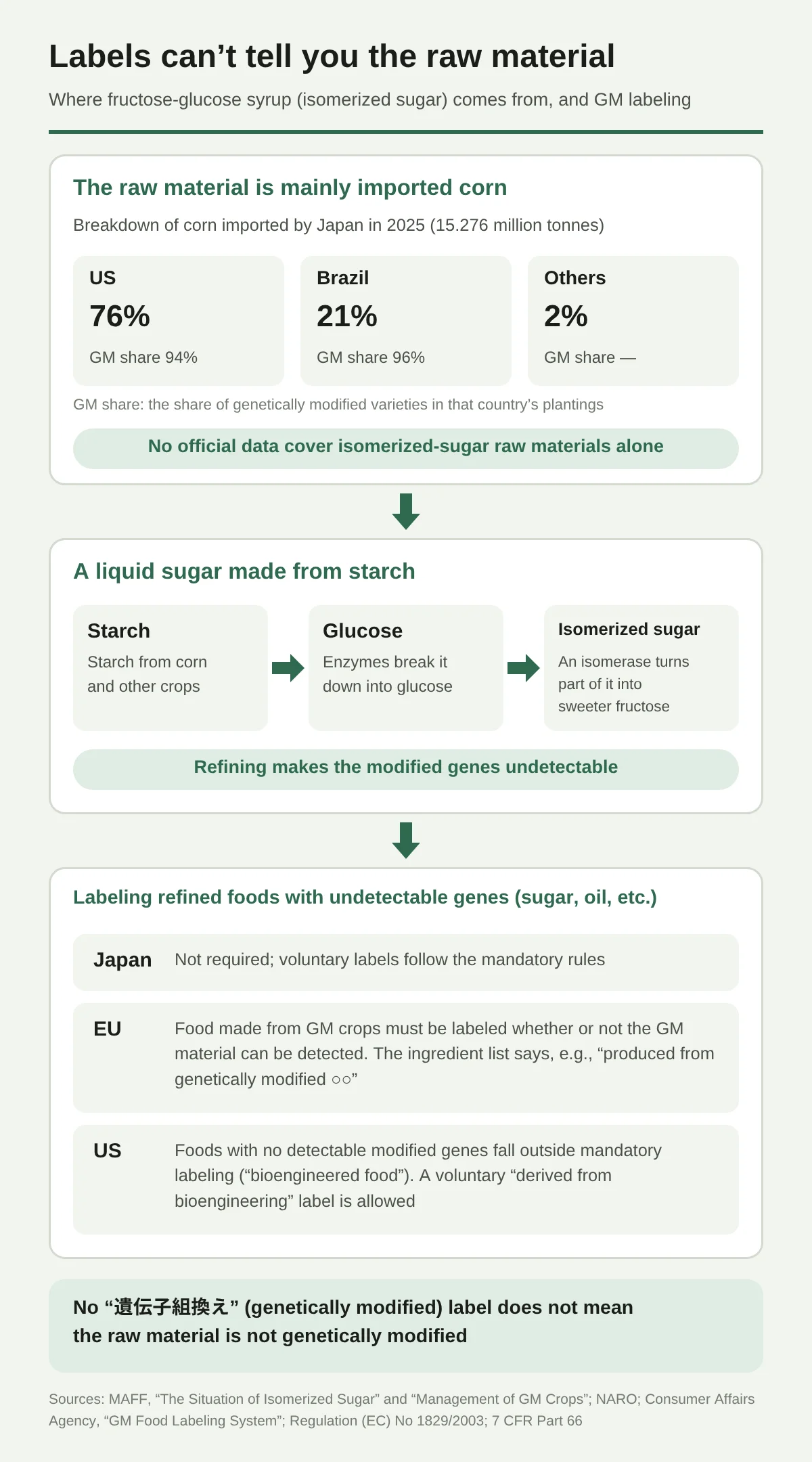
- Isomerized sugar is a liquid sugar made from starch, a mixture of glucose and fructose. The name changes to “ぶどう糖果糖液糖,” “果糖ぶどう糖液糖,” or “高果糖液糖” (“high-fructose syrup”) depending on the share of fructose
- More than half (54%) of the amount used goes to soft drinks. The reasons given are that fructose tastes sweeter when chilled and that a liquid is easy to handle
- The U.S. Food and Drug Administration (FDA) says it is not aware of any evidence that there is a difference in safety compared with a similar amount of sugar. On the other hand, WHO and the European Food Safety Authority (EFSA) recommend reducing “added sugars,” including sugar
- About 97% of the corn Japan imports comes from the U.S. and Brazil, where more than 90% of the planting is genetically modified varieties. However, there is no public data limited to the raw material of isomerized sugar
- Because the modified genes can no longer be detected once isomerized sugar is refined, Japan has no requirement to label it as genetically modified. You cannot confirm from the label whether the raw material is genetically modified
- The EU requires labeling of foods made from genetically modified crops regardless of whether it can be detected. The thinking differs from Japan’s and the U.S.’s
What is isomerized sugar?
A liquid sugar made from starch
According to MAFF materials, isomerized sugar is made as follows.
- Starch from corn and the like is broken down with an enzyme into glucose
- Another enzyme (an isomerase) acts on the glucose and turns part of it into sweeter fructose
Turning glucose into fructose is called “isomerization,” hence the name isomerized sugar. The technology using the enzyme at the heart of this process was developed in the 1960s at the Fermentation Research Institute in Japan (now the National Institute of Advanced Industrial Science and Technology, AIST), and it was the first Japanese national patent to be exported overseas (MAFF).
How it differs from sugar
| Sugar (sucrose) | Isomerized sugar | |
|---|---|---|
| Contents | One glucose and one fructose bonded together | Glucose and fructose mixed while separate |
| Form | Crystals (powder) | Liquid (about 25% water) |
| Sweetness | The standard (100) | The standard type, containing 55% fructose, is about as sweet as sugar |
(From materials of MAFF and the Agriculture & Livestock Industries Corporation.)
As a guide to sweetness, with sugar at 100, fructose is 120 to 170 and glucose is 65 to 80 (MAFF).
The name is decided by the share of fructose
| Name | Share of fructose |
|---|---|
| ぶどう糖果糖液糖 (glucose-fructose syrup) | Less than 50% |
| 果糖ぶどう糖液糖 (fructose-glucose syrup) | 50% or more and less than 90% |
| 高果糖液糖 (high-fructose syrup) | 90% or more |
| 砂糖混合○○液糖 (sugar-mixed ○○ syrup) | The above syrups mixed with sugar |
(The JAS classification given in MAFF materials.)
It is an easy set of names to remember: the sugar that comes first is the one there is more of. “果糖ぶどう糖液糖” is a syrup with at least half fructose, and “ぶどう糖果糖液糖” is one with more glucose.
In the ingredient list on the package, under the Food Labeling Standards, these three can also be written together as “異性化液糖” (isomerized sugar). Those mixed with sugar can be written “砂糖混合異性化液糖” or “砂糖・異性化液糖”. Isomerized sugar is not an additive but an ingredient, so it is listed in the ingredient section in descending order of the amount used.
What foods is it used in?
According to MAFF, the uses of isomerized sugar (776,000 tons a year on a dry basis, fiscal 2024 sugar year) are as follows.
| Use | Isomerized sugar | (For reference) Sugar |
|---|---|---|
| Soft drinks | 54.4% | 17.4% |
| Seasonings | 12.1% | 5.2% |
| Alcoholic drinks | 11.1% | 2.1% |
| Bread | 5.9% | 11.5% |
| Confectionery and frozen desserts | 5.4% | 29.5% |
(Only the main uses are shown. The sugar figures are for fiscal 2024 and include 8.7% for household use.)
In liquid foods such as soft drinks and alcoholic drinks, it is used more than sugar. In confectionery and bread, on the other hand, it stays at about one tenth of sugar (MAFF).
Why is it used?
Ease of use and the nature of its sweetness
MAFF materials list the following as features of isomerized sugar.
- It is a liquid, so there is no need to dissolve it. It can be transported by tanker truck and stored in tanks
- It is perceived as having a sharper sweetness than sugar, and tastes sweeter the lower the temperature (it is rated sweetest at 5°C)
- It can be made cheaply compared with sugar
- It is hard to crystallize and easy to handle in the production process
The Agriculture & Livestock Industries Corporation likewise explains that while the sweetness of sugar and glucose changes little with temperature, fructose tastes sweeter when chilled, so “果糖ぶどう糖液糖,” which is rich in fructose, is often used for soft drinks.
Conversely, being a liquid, it is inconvenient to transport and spoils easily so it cannot be stored for long. This difference in properties is why sugar remains central in confectionery and bread.
How prices are adjusted
In Japan, “adjustment money” is collected from imported sugar and the like to support domestic sugarcane and sugar beet production. Isomerized sugar, as a substitute for sugar, is also covered by this adjustment money.
However, because a coefficient that treated isomerized sugar as “inferior” to sugar was used when converting sugar prices into isomerized sugar prices, no adjustment money for isomerized sugar had been collected even once since fiscal 2011.
MAFF reviewed this coefficient “to reflect the expansion of uses of isomerized sugar,” and from April 2024, adjustment money is again collected, for the first time in 13 years (after measures to avoid a sudden increase in the burden, an expected 2,000 yen or so per ton of product).
What “increased” really means
Demand for sweeteners as a whole is declining, and the amount of isomerized sugar is slightly increasing to flat. Because sugar has fallen sharply, the share of the whole (sugar : isomerized sugar : sweetened preparations) has changed from 76 : 21 : 2 (1989) to 62 : 27 : 11 (recent years) (MAFF). Rather than “isomerized sugar has increased,” the reality is that it has replaced sugar and its share has grown.
Is it worse for you than sugar?
You sometimes see the claim that “fructose-glucose syrup is worse for you than sugar.” We sort out the views of public agencies.
Evaluation compared with sugar
- U.S. Food and Drug Administration (FDA): It says it is not aware of any evidence of a difference in safety between foods containing isomerized syrup with 42% or 55% fructose (HFCS) and foods containing similar amounts of sugar, honey, and the like, which contain glucose and fructose in about the same proportion
- European Food Safety Authority (EFSA, 2022): It says trials in which fructose was swapped for glucose at the same calories did not show a higher risk of fatty liver or obesity (though there are few trials)
Sugar too is split into glucose and fructose in the body. What is at issue is the “amount” taken, more than the “type,” isomerized sugar or sugar.
Reducing “added sugars” is recommended
- WHO (2015): It recommends keeping “free sugars,” meaning sugars added to food (sugar, glucose, fructose, etc.) plus the sugars in honey, syrups, and fruit juice, to less than 10% of daily energy, and ideally less than 5% (about 25 g). It says a sweet soda can contains up to about 40 g of free sugars
- EFSA (2022): It said added sugars and free sugars should be as low as possible within a nutritionally adequate diet. It rated the causal relationship between free consumption of sweet drinks and obesity as having high certainty. It did not set a numerical upper limit
More than half of isomerized sugar goes into soft drinks. If there is something to watch, it is not isomerized sugar itself but the amount of sugar taken from sweet drinks. For sweeteners (such as artificial sweeteners used in place of sugar), see → Article on sweeteners
The corn raw material and genetic modification
The raw material is mainly imported corn
According to MAFF, there are 11 companies and 14 plants making isomerized sugar, using cornstarch and domestic root starch (sweet potato and potato) as raw material. Of these, 9 companies and 11 plants make isomerized sugar and the like in a continuous process from imported corn.
Much of the imported corn is estimated to be genetically modified
Japan imported 15.276 million tons of corn in 2025. The breakdown is as follows.
| Imported from | Share | Planting rate of genetically modified varieties in that country |
|---|---|---|
| U.S. | 76% | 94% |
| Brazil | 21% | 96% |
| Others | 2% | ― |
(MAFF, “On the Management of Genetically Modified Crops,” July 2026)
For corn and the like imported as raw material for cooking oil and sweeteners, MAFF estimates that much of it is genetically modified, because most is imported without being separated from genetically modified corn.
For the raw material of isomerized sugar alone, we don’t know
So what about the raw material of isomerized sugar?
An industry group (the Japan Starch & Sugar Manufacturers Association) explains that for cornstarch used directly in food, it mainly uses corn that has been managed separately from genetically modified corn (identity preserved handling). However, we could find no similar explanation for saccharification uses such as isomerized sugar, which account for about 70% of starch uses.
There is no public data showing whether the raw material of isomerized sugar is genetically modified, and the current state is that it cannot be said either that it is “likely genetically modified” or that it is “mainly non-genetically modified.”
Genetic modification labeling rules (Japan)
Labeling is required only for foods where it can be detected
Labeling of genetic modification is mandatory for the following nine agricultural products and the 33 processed food groups made from them.
- Soybeans (including edamame and soybean sprouts), corn, potatoes, rapeseed (canola), cottonseed, alfalfa, sugar beet, papaya, and mustard greens (karashina)
The processed foods subject to the requirement are things like tofu, natto, and corn snacks, where the modified genes (DNA) or the proteins made from them can still be detected after processing.
Isomerized sugar, soy sauce, and oil are exempt from the requirement
NARO explains that soy sauce, soybean oil, corn oil, rapeseed oil, sugar from sugar beet, corn flakes, isomerized sugar, and the like are exempt from the labeling requirement because the modified DNA and proteins are broken down and removed during processing, and cannot be detected even with the latest technology, so they cannot be confirmed by testing.
For that reason, even isomerized sugar made from genetically modified corn need not be labeled “遺伝子組換え”.
There is an exception. When a genetically modified crop whose components or nutritional value themselves were changed, such as high-oleic soybeans, is used, labeling is required even for oil and the like.
When labeled voluntarily, the same rules apply
Even for foods with no labeling requirement, they can be labeled voluntarily. In that case, the same rules apply as for those subject to the requirement (Consumer Affairs Agency).
Since April 2023, “遺伝子組換えでない” (“not genetically modified”) can be written only when the product has been managed separately and no mixing of genetically modified material is confirmed (before that, it could be written if mixing was 5% or less). Products managed separately with mixing held to 5% or less are labeled “分別生産流通管理済み” (“identity preserved handling done”) and the like.
Differences between Japan and overseas
| Foods refined so that genes cannot be detected (sugars, oils, etc.) | |
|---|---|
| Japan | No labeling requirement. When labeled voluntarily, the same rules apply as for those subject to the requirement |
| EU | Regardless of whether it can be detected, foods made from genetically modified crops must be labeled. The ingredient list says things like “produced from genetically modified ○○” |
| U.S. | Foods in which the modified genes cannot be detected do not fall under the labeling requirement (bioengineered food). “Derived from bioengineering” can be written voluntarily |
The preamble of the EU regulation (1829/2003) explains that clear labeling, regardless of whether the modified DNA or protein can be detected in the final product, meets the wishes of many consumers and helps them choose.
Even in the EU, however, the following are exempt from labeling.
- Mixing of genetically modified material of 0.9% or less per ingredient that is unintentional or technically unavoidable
- Meat, milk, and eggs from livestock raised on genetically modified feed (they are made “using” genetically modified crops, not “from” them, so they are not covered)
Genetically modified crops and herbicide
Crops that don’t die when sprayed with herbicide
Genetically modified crops come mainly in two types.
| Type | What it is | Planting rate in U.S. corn (2025) |
|---|---|---|
| Herbicide tolerant | Genes were inserted so the crop doesn’t die when sprayed with herbicide | About 92% |
| Insect resistant (Bt) | A gene from a soil bacterium (Bt) was inserted so the crop itself makes a protein that acts on certain insect pests | 87% |
(USDA Economic Research Service. Varieties combining both are 84%.)
With herbicide-tolerant crops, it became possible to spray herbicide (mainly glyphosate) over the whole field even while the crop is growing. From 1996, when herbicide-tolerant crops appeared, to 2014, worldwide glyphosate use grew about 15-fold. In 2012, it is estimated that about 56% of worldwide agricultural use was on herbicide-tolerant crops (Benbrook 2016).
Evaluations of glyphosate are divided
| Agency | Evaluation |
|---|---|
| International Agency for Research on Cancer (IARC, 2015) | “Probably carcinogenic to humans” (Group 2A) |
| Food Safety Commission of Japan | No carcinogenicity or genotoxicity found. Acceptable daily intake (ADI) is 1 mg per kg of body weight |
| European Food Safety Authority (EFSA) | Not genotoxic and not a human carcinogen |
An MHLW document explains the difference this way: IARC judges “whether there is a hazard” from published papers and the like, while the Food Safety Commission and others evaluate “the actual risk when eaten” from the results of tests done by internationally set methods.
Revision of Japan’s residue standards (2017)
In December 2017, the residue standards for glyphosate were revised.
| Food | Before revision | After revision |
|---|---|---|
| Wheat | 5.0 ppm | 30 ppm |
| Barley | 20 ppm | 30 ppm |
| Rye, buckwheat | 0.2 ppm | 30 ppm |
| Corn | 1.0 ppm | 5 ppm |
The revision was prompted by an application to widen the crops it can be used on in Japan and an application asking Japan to set standards for pesticides used overseas. It was deliberated based on the Food Safety Commission’s evaluation (MHLW).
For test results on glyphosate in imported wheat and bread → Article on post-harvest chemicals
Points for checking the package
- Look for “果糖ぶどう糖液糖,” “ぶどう糖果糖液糖,” and “異性化液糖” in the ingredient list: The ingredient list is in descending order of amount used. If it is near the front, you can tell a lot is used
- The name gives a guide to the share of fructose: The sugar that comes first is the larger. “果糖ぶどう糖液糖” has 50% or more fructose
- The absence of a “遺伝子組換え” label does not mean the raw material is not genetically modified: Isomerized sugar has no labeling requirement
- If it says “遺伝子組換えでない,” that is a voluntary label: Since April 2023, it is limited to cases where no mixing is confirmed
- For sweet drinks, look at “炭水化物” (carbohydrates) in the nutrition facts for a guide to the amount of sugar: WHO says a sweet soda can contains up to about 40 g of free sugars
Urayomi’s approach
To sum up so far:
- The U.S. FDA sees no evidence of a difference in safety between isomerized sugar and a similar amount of sugar. What is at issue is the amount of sugar taken from sweet drinks and the like
- On the other hand, whether the corn raw material is genetically modified cannot be told from Japanese labels. Some countries, like the EU, require labeling even when it cannot be detected
At Urayomi we do not write isomerized sugar off as a “bad sugar.” Instead, so that people who want to avoid genetic modification can decide, we convey the fact that “the raw material does not appear on the label.”
“Carryover,” in which additives used in ingredients are not labeled, is also one of the things that do not appear on the label → Article on carryover
Also worth knowing
- Sweeteners used in place of sugar and “zero calorie” labels → Article on sweeteners
- How additives used in ingredients go unlabeled → Article on carryover
- Genetic modification labeling for soybean oil and corn oil, and “vegetable oils and fats” → Article on vegetable oils
- Test results for glyphosate in imported wheat → Article on post-harvest chemicals
Sources
- MAFF, “On the Situation Surrounding Isomerized Sugar” (March 2026)
- MAFF, “On the Review of the Operation of the Sugar Price Adjustment System Related to Isomerized Sugar” (December 2023, Sugar and Starch Information, April 2024 issue) / “On the Determination of Various Indicators of the Price Adjustment System for the Fiscal 2026 Sugar Year and Fiscal 2026 Starch Year”
- Agriculture & Livestock Industries Corporation, “The Story of Isomerized Sugar”
- Food Labeling Standards (Cabinet Office Order), Article 3, paragraph 1, table “Ingredient list” (e-Gov Law Search, checked September 2026)
- U.S. Food and Drug Administration (FDA), “High Fructose Corn Syrup Questions and Answers”
- European Food Safety Authority (EFSA), “Tolerable upper intake level for dietary sugars” (EFSA Journal 2022)
- WHO, “Guideline: Sugars intake for adults and children” (2015)
- MAFF Food Safety and Consumer Affairs Bureau, “On the Management of Genetically Modified Crops” (July 2026)
- Japan Starch & Sugar Manufacturers Association, “Q&A”
- Agriculture & Livestock Industries Corporation, “The Many Uses of Starch”
- Consumer Affairs Agency, “Genetically Modified Food Labeling System”
- NARO, “Why Is There No Labeling Requirement for Soy Sauce and Cooking Oil Even When Genetically Modified Crops Are Used?”
- Niigata Prefecture, “The Genetically Modified Labeling System Changed on April 1, 2023”
- Regulation (EC) No 1829/2003 (recitals 16 and 21, Articles 12 and 13)
- 7 CFR Part 66 (National Bioengineered Food Disclosure Standard) §66.1, §66.9, §66.116
- USDA Economic Research Service (USDA ERS), “Recent Trends in GE Adoption”
- Benbrook CM, “Trends in glyphosate herbicide use in the United States and globally,” Environ Sci Eur 2016
- MHLW Notice Shokusei-hatsu 1225 No. 5 (December 25, 2017) / Pharmaceutical Affairs and Food Sanitation Council, Pesticides and Veterinary Drugs Committee, “Glyphosate (draft)”
This article explains labeling rules and the evaluations of public agencies, and does not judge the safety or danger of any particular food or ingredient.
Related articles and databases
- Are Artificial Sweeteners Bad for You? Aspartame and Cancer, What “Zero Calorie” and “Zero Sugars” Really Mean, and Japanese vs. Overseas Rules
- What is carryover? How it differs from processing aids, and the additives that are not listed on labels even on “additive-free” foods
- What Is “植物油脂” (Vegetable Fat)? How True Is “Vegetable Oils Are Bad for You,” and What the Back Label Does and Does Not Tell You
- What Is Tomato Ketchup? The JAS “Special Grade,” How It Differs from Tomato Sauce, and Whether Lycopene Absorption Changes with Heat and Oil
- Does Fruit Fructose Make You Gain Weight? How It Differs from the Fructose in “果糖ぶどう糖液糖” (High-Fructose Corn Syrup), and a Comparison of Sugar and Fiber in 22 Fruits
- Does Eating Too Much Wheat Flour Cause Colorectal Cancer? Checking the Link Between Wheat and Cancer Against Studies and Government Data
- What is spelt wheat? Does gluten make holes in the gut? Checking “leaky gut” and pesticides in imported wheat against papers and national data
- Why Did “No Chemical Seasoning” Disappear? Is Yeast Extract a Chemical Seasoning? How to Read Umami Seasonings and Hydrolyzed Protein
- Reading Oisix’s Trial Set and Subscription Down to the Back Label: Vegetable Pesticide Standards, the Trial Set, and How Cancellation Works
- Are Food Colorings (Red No. 102, Yellow No. 4) Bad for You? Cancer Assessments and Whether They Are Banned Abroad, Checked Against Rules in Japan and Overseas
- ポストハーベスト農薬と輸入食品
- 農薬データベース