
What is spelt wheat? Does gluten make holes in the gut? Checking “leaky gut” and pesticides in imported wheat against papers and national data

PR This article contains affiliate links to Rakuten Ichiba (“See on Rakuten”). What is written is based on papers and national materials, regardless of whether there is advertising.
“Gluten in wheat widens the gaps in the gut (leaky gut).” “Imported wheat has pesticide residues.” “Spelt, an ancient wheat, has less gluten and is gentler on the body.” These are three things you often hear about wheat.
This article checks, against papers and national materials:
- What “leaky gut” is, and how it is treated in medicine
- What the research saying gluten widens the gaps in the gut actually confirmed
- Which pesticides, and how much, have been found in imported wheat (inspection results from the Ministry of Agriculture, Forestry and Fisheries, MAFF)
- Whether spelt really has less gluten
At the end, it introduces a domestic spelt flour grown without pesticides.
Conclusion
- “Leaky gut syndrome” is not an official medical diagnosis. That intestinal permeability (how easily things pass through the gaps) goes up does actually happen, for example in celiac disease
- Gliadin, a component of gluten, has been confirmed to temporarily widen the gaps in excised intestinal tissue and cultured cells. It also happened in tissue from people without celiac disease, but the change was smaller than in people with celiac disease and lasted a shorter time. What happens in a healthy person’s body from ordinary meals is not known
- In imported food-use wheat inspected by MAFF from April to September 2025, glyphosate (a herbicide) was found in 53 of 54 samples from the U.S. and 36 of 38 from Canada. All were within Japan’s standard value (30 ppm)
- Glyphosate is said to remain not from “post-harvest” use but from use sprayed on the field just before harvest (pre-harvest). Insecticides used during post-harvest storage (malathion and others) have also been found in some wheat
- Spelt is not low in gluten. In a comparison grown under the same conditions in Germany, it had more gluten and more protein than common wheat. People with celiac disease or wheat allergy cannot eat it
- The reason to choose spelt is not the amount of gluten but where and how it was grown
What is “leaky gut”?
The inside of the gut is a wall made of a single layer of cells. The spaces between cells are closed by proteins called “tight junctions,” which let nutrients through but make it hard for bacteria and large molecules to pass.
The state in which these seals loosen and things that do not normally pass get through more easily is generally called “leaky gut.”
However, a 2024 review by gastroenterologists at the Mayo Clinic in the U.S. says of leaky gut syndrome that:
- It spread through books for general readers, but it is not recognized as an official medical diagnosis
- It is often described as diagnosable by blood or stool tests, but there is currently no established test
The Cleveland Clinic’s health information in the U.S. likewise says that increased intestinal permeability does actually occur, but that it is not known whether it is a disease on its own or a cause of other diseases.
Gluten and gaps in the gut: what research shows
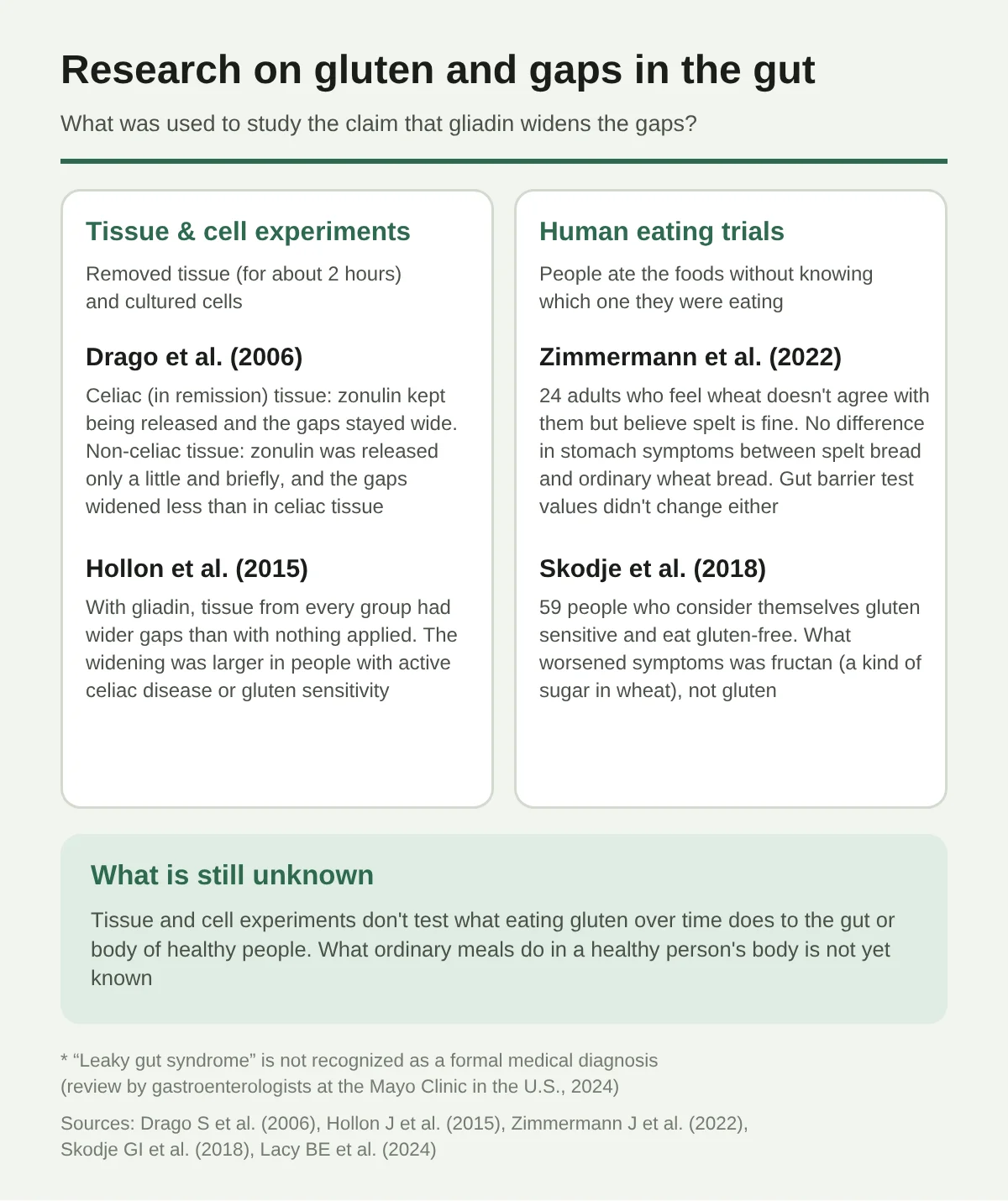
Gliadin makes cells release “zonulin”
Gluten is made mainly of two kinds of proteins, gliadin and glutenin. A group including Fasano (then at the University of Maryland in the U.S.) has reported a mechanism in which, when gliadin binds to gut cells, a protein called zonulin is released and the seals between cells loosen (2006, 2008).
This is sometimes presented as “gluten makes holes in the gut.” Let us look at what the research was.
It happened in people without celiac disease too, but was smaller and shorter
| Study | What was used | Result |
|---|---|---|
| Drago et al. (2006) | Gut tissue taken by surgery or endoscopy, cultured cells | In tissue from people with celiac disease (in remission), zonulin kept being released and the gaps stayed widened. In tissue from people without celiac disease, zonulin was released only a little and briefly, and the widening of the gaps was not as large as in celiac tissue |
| Hollon et al. (2015) | Duodenal tissue taken by endoscopy (4 groups, 5–6 people each) | When gliadin was applied, tissue from every group had wider gaps than with nothing applied. The widening was larger in people with active celiac disease or gluten sensitivity |
Both are experiments on tissue taken out of the body (for about 2 hours) and cultured cells. They are not studies that checked what effect continuing to eat gluten-containing meals has on the gut or body of healthy people.
In trials where people ate the food
| Study | Subjects | Result |
|---|---|---|
| Zimmermann et al. (2022, Germany) | 24 adults who feel wheat does not agree with them and believe spelt is fine | When they ate spelt bread and ordinary wheat bread without knowing which, there was no difference in stomach symptoms. Test values showing the state of the gut barrier did not change either. The authors consider that beliefs such as “wheat does not agree with me” and “spelt is fine” had a large influence |
| Skodje et al. (2018, Norway) | 59 people who consider themselves gluten sensitive and follow a gluten-free diet | When they ate gluten, fructan (a kind of sugar in wheat), and a fake (placebo) without knowing which, what worsened symptoms was fructan, not gluten |
A protein other than gluten: “ATI”
Wheat also contains proteins that protect the seed from insects, “amylase-trypsin inhibitors (ATI).” In experiments in mice and cells there are reports that ATI stimulates gut immunity and strengthens inflammation, but a 2025 study from the Netherlands reported that most of that stimulation was due to a bacterial component (LPS) mixed into the samples. What ATI does in the human body has not yet been settled.
Pesticides found in imported wheat
Results of MAFF inspections (April–September 2025)
For food-use wheat that Japan imports, MAFF inspects for residual pesticides at the time of import and publishes the results. In the latest set, published on January 30, 2026 (April–September 2025), the main pesticides found within the standard values were as follows.
| Origin (number of samples) | Glyphosate (herbicide) | Insecticides etc. used during storage | Others |
|---|---|---|---|
| U.S. (54) | 53 samples, 0.01–1.5 ppm | Malathion 9 samples (0.01–0.05 ppm), methoprene 50 (0.01–0.72 ppm), piperonyl butoxide 17 (0.02–0.6 ppm) | Clopyralid (herbicide) 43 samples, deltamethrin and others (insecticides) 18, 2,4-D (herbicide) 9, and others |
| Canada (38) | 36 samples, 0.02–1.4 ppm | Malathion 8 samples (0.01–0.08 ppm) | Chlormequat (plant growth regulator) 34 samples, clopyralid 29, and others |
| Australia (20) | 11 samples, 0.01–0.02 ppm | Methoprene 2 samples (0.06 ppm) | Clopyralid 12 samples, and others |
| France (5) | 1 sample, 0.03 ppm | Pirimiphos-methyl 4 samples (0.01–0.39 ppm), piperonyl butoxide 3 (0.08–2.9 ppm) | Chlormequat 5 samples, and others |
(From MAFF, “Results of analysis of mycotoxins and residual pesticides in wheat (for food), by country, first half of fiscal 2025.” Bromine is left out of the table because it occurs naturally as well as being used as a fumigant. For every item inspected, nothing exceeded Japan’s standard value.)
“Post-harvest” and “pre-harvest”
When people talk about pesticides in imported wheat, “post-harvest pesticides” are often the topic, but glyphosate, the one found most often, is used differently.
| Pre-harvest | Post-harvest | |
|---|---|---|
| When | Sprayed on the field 1–2 weeks before harvest | Used on harvested grain during storage and transport |
| Purpose | To dry out the wheat all at once so it is easier to harvest | To prevent pests during storage |
| Examples | Glyphosate | Malathion, pirimiphos-methyl, methoprene, and others |
The European Food Safety Authority (EFSA) materials describe a use on U.S. wheat in which it is sprayed on the leaves up to 7 days before harvest. In Japan, spraying glyphosate before the wheat harvest is not an approved use, so glyphosate has not been found in flour or bread made only from domestic wheat (a survey by the Nouminren Food Analysis Center, Japan Family Farmers Movement).
The overall picture of post-harvest pesticides in imported food is in the post-harvest article, and the relationship between glyphosate and genetically modified crops is in the isomerized sugar article.
Milling into flour reduces it. Whole-grain flour tends to keep more
In the processing data compiled by EFSA, the amount of glyphosate, taking the wheat grain as 1, was:
- White flour: about 0.57 (median of 13 studies)
- Bran (outer layer): about 1.8
- Whole-grain flour: about 1.1 (only 2 studies)
Because glyphosate stays mostly on the outside, whole-grain flour from imported wheat tends to keep more than white flour. In the Nouminren Food Analysis Center’s survey of commercial products, whole-grain products also tended to show higher values.
Glyphosate and gut research
Glyphosate is a herbicide that works by stopping an enzyme that plants and bacteria have. Human cells do not have this enzyme, but some gut bacteria do.
- A systematic review of animal experiments (2024) reported changes in the balance of gut bacteria and changes in intestinal permeability with glyphosate and its formulations
- On the other hand, a 2026 review of human studies found that there are still few human studies linking pesticides from food to the state of the gut, and it found no human study on glyphosate and inflammatory bowel disease
The amounts in animals and the amounts left in food are very different. Whether the amounts left in food affect the human gut is not known.
Does spelt have less gluten?
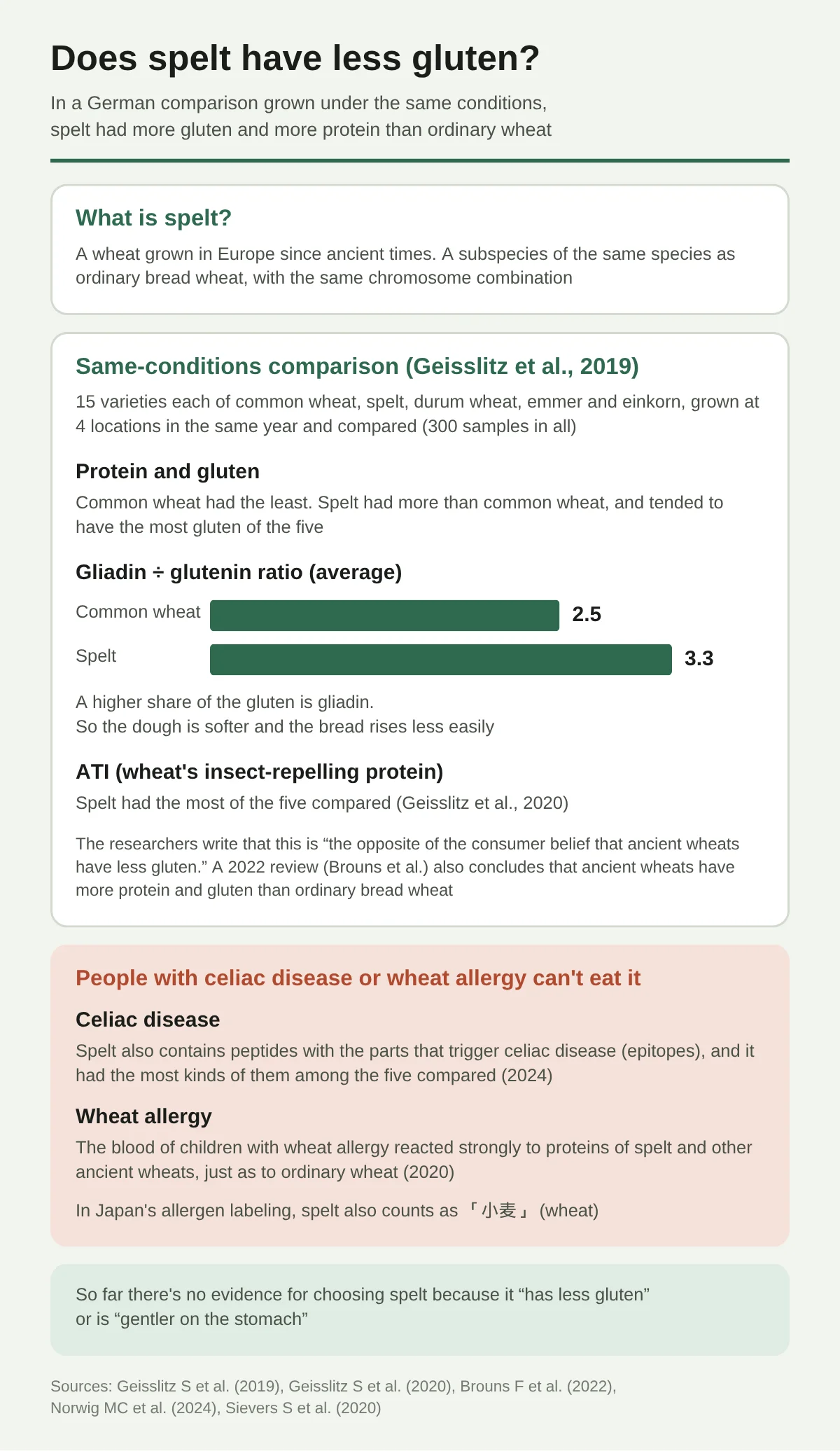
What is spelt
Spelt (also called dinkel wheat) is a wheat that has been grown in Europe since ancient times. It belongs to the same group as ordinary bread wheat (a subspecies of the same species) and has the same chromosome combination. Its grains are enclosed in hard husks, which makes threshing laborious, and the yield is low, so it was grown less in the 20th century.
Gluten is higher than in common wheat
A German study (Geisslitz et al., 2019) grew 15 varieties each of common wheat, spelt, durum wheat, emmer, and einkorn at 4 locations in the same year (300 samples in all) and compared what was in them.
- Common wheat had the least protein and gluten. Spelt had more than common wheat, and tended to have the most gluten of the five
- Within the gluten, the share of gliadin is high (the gliadin-to-glutenin ratio averaged 3.3 for spelt, against 2.5 for common wheat). For this reason the dough is soft and the bread is less likely to rise
The researchers write that this is “the opposite of consumers’ belief that ancient wheats are low in gluten.” A 2022 review (Brouns et al.) also concludes that ancient wheats have more protein and gluten than ordinary bread wheat.
For wheat’s insect-repelling protein “ATI” too, spelt had the most of the five compared (Geisslitz et al., 2020).
People with celiac disease or wheat allergy cannot eat it
| What research shows | |
|---|---|
| Celiac disease | Spelt also contains peptides with the parts (epitopes) that cause celiac disease, and their variety was the greatest of the five compared (2024). In an experiment breaking it down with human digestive fluids, fewer came out than with common wheat, but the researchers say it is “highly toxic to people with celiac disease” (2020) |
| Wheat allergy | The blood of children with wheat allergy reacted strongly to proteins of ancient wheats such as spelt, as it did to ordinary wheat. The study concludes that “ancient wheats are not an escape route for allergy” (2020) |
Under Japanese food labeling too, spelt counts as “wheat” in allergen labeling (the label of the product introduced here also reads “Allergen: wheat”).
Nutrition is close to ordinary whole-grain flour
Using U.S. Department of Agriculture (USDA) food composition data, per 100 g, the comparison is as follows.
| Spelt (grain) | Common wheat whole-grain flour | |
|---|---|---|
| Protein | 14.6 g | 13.2 g |
| Dietary fiber | 10.7 g | 10.7 g |
| Iron | 4.4 mg | 3.6 mg |
| Zinc | 3.3 mg | 2.6 mg |
| Magnesium | 136 mg | 137 mg |
(USDA FoodData Central. The spelt values are for the grain, not flour.)
Protein, iron, and zinc are a little higher, but comparing whole-grain with whole-grain, there is no large difference. A German study (2023) also showed that mineral amounts vary greatly by variety and growing location even within the same kind. If you choose for nutrition, the difference is larger between whole-grain and white flour than between spelt and not spelt.
Domestic, pesticide-free spelt flour
Putting the above together, no basis has been found so far for choosing spelt “because it has less gluten” or “because it is gentler on the stomach.”
On the other hand, for people concerned about residual pesticides in imported wheat, choosing wheat grown in Japan without pesticides is a way of choosing that you can verify yourself. For spelt, there is domestic flour made in that way.
| Whole-grain | White (refined) | |
|---|---|---|
| Name | Kubo-san’s naturally grown spelt flour, whole-grain, 1 kg | Kubo-san’s naturally grown spelt flour, white (refined), 1 kg |
| Ingredients | Spelt (grown in Wakayama Prefecture) | Spelt (grown in Wakayama Prefecture) |
| How it is grown (per the shop’s listing) | No pesticides, herbicides, or chemical fertilizers | No pesticides, herbicides, or chemical fertilizers |
| Price (tax included) | ¥1,944 + ¥800 shipping | ¥2,980 + ¥800 shipping |
| How it arrives | Made to order. Orders up to each monthly deadline are milled and shipped once a month | Same |
| Best-by | 4 months after production | 4 months after production |
| Purchase | See on Rakuten (たまな商店) PR | See on Rakuten (たまな商店) PR |
(Checked on the Rakuten Ichiba sales page on September 29, 2026. The next deadline is October 7, 2026, with shipping planned for October 20. Free shipping on ¥3,980 or more.)
- This is wheat grown by Mr. Kubo (久保智和) of Wakayama City in a field that previously grew soybeans. According to the shop, Mr. Kubo was the first in Wakayama Prefecture to grow spelt without pesticides or fertilizers
- In Japan there is no use of spraying glyphosate before wheat harvest, so it is unrelated to the pre-harvest residues seen above. Because it is not imported, there is no post-harvest treatment during transport either
- Whole-grain flour is flour milled with the bran. With imported wheat, whole-grain flour tends to keep more pesticide, but with wheat grown without pesticides, you can use the flavor and dietary fiber of whole grain as they are
- Because it is high in gliadin, with the same recipe as ordinary bread flour the dough can become soft and may not rise as well. Mixing it into ordinary flour at first is one way to use it
Note Spelt is wheat. People with celiac disease or wheat allergy cannot eat it. It is not a substitute flour for people who need to avoid gluten. The health and allergy explanations written on the sales page are the shop’s and are not supported by the research checked in this article.
Summary
- “Leaky gut syndrome” is not an official diagnosis, and there is not yet human evidence that gluten harms the gut of healthy people
- Pesticides such as glyphosate are found in imported wheat within the standard values. People who are concerned can avoid them by choosing domestic wheat. With imported wheat, white flour tends to keep less than whole-grain flour
- Spelt is not low in gluten. If you choose it, choose by origin and how it is grown, not because it is “an ancient wheat”
Sources
- MAFF, “Results of analysis of mycotoxins and residual pesticides in wheat (for food), by country, first half of fiscal 2025” (published January 30, 2026) https://www.maff.go.jp/j/seisan/boeki/beibaku_anzen/bunsekikekka.html
- Nouminren Food Analysis Center, “Survey of glyphosate residues in wheat products,” “Survey of glyphosate residues in sandwich bread,” “Survey of glyphosate residues in school lunch bread”
- EFSA (2019) Review of the existing maximum residue levels for glyphosate (processing factors, U.S. use patterns)
- Lacy BE, et al. (2024) Leaky Gut Syndrome: Myths and Management. Gastroenterol Hepatol. https://pubmed.ncbi.nlm.nih.gov/39193076/
- Cleveland Clinic “Leaky Gut Syndrome” https://my.clevelandclinic.org/health/diseases/22724-leaky-gut-syndrome
- Drago S, et al. (2006) Scand J Gastroenterol. https://pubmed.ncbi.nlm.nih.gov/16635908/
- Lammers KM, et al. (2008) Gastroenterology. https://pubmed.ncbi.nlm.nih.gov/18485912/
- Hollon J, et al. (2015) Nutrients. https://pubmed.ncbi.nlm.nih.gov/25734566/
- Zimmermann J, et al. (2022) Nutrients. https://pubmed.ncbi.nlm.nih.gov/35889757/
- Skodje GI, et al. (2018) Gastroenterology. https://pubmed.ncbi.nlm.nih.gov/29102613/
- Krouch D, et al. (2025) Int J Biol Macromol. https://pubmed.ncbi.nlm.nih.gov/40288707/
- Ignácio ADC, et al. (2024) Food Funct. https://pubmed.ncbi.nlm.nih.gov/38994673/
- Ye C, et al. (2026) Compr Rev Food Sci Food Saf. https://pubmed.ncbi.nlm.nih.gov/42634103/
- Geisslitz S, et al. (2019) Foods. https://pubmed.ncbi.nlm.nih.gov/31547385/
- Geisslitz S, et al. (2020) Food Chem. https://pubmed.ncbi.nlm.nih.gov/32883982/
- Brouns F, et al. (2022) Nutr Bull. https://pubmed.ncbi.nlm.nih.gov/35915783/
- Norwig MC, et al. (2024) J Agric Food Chem. https://pubmed.ncbi.nlm.nih.gov/38906536/
- Asledottir T, et al. (2020) Nutrients. https://pubmed.ncbi.nlm.nih.gov/32854283/
- Sievers S, et al. (2020) Eur J Nutr. https://pubmed.ncbi.nlm.nih.gov/31654113/
- Longin CFH, et al. (2023) Int J Mol Sci. https://pubmed.ncbi.nlm.nih.gov/36769092/
- USDA FoodData Central (FDC 169745 Spelt, uncooked / 168893 Wheat flour, whole-grain)
- Rakuten Ichiba, Tamana Shoten, “Kubo-san’s naturally grown spelt flour” sales page (checked September 29, 2026)
Related articles and databases
- What Is “果糖ぶどう糖液糖” (High-Fructose Corn Syrup)? Is It Worse for You Than Sugar? How It Differs From Sugar, and Corn and Genetic Modification
- What is carryover? How it differs from processing aids, and the additives that are not listed on labels even on “additive-free” foods
- Were “無添加” (Additive-Free) Labels Banned? Reading the Consumer Affairs Agency Guideline’s 10 Types from the Back Label
- Is Sesame Good for You? Checking Sesamin Research, Allergen Labeling, and Pesticide Residues in Imported Sesame Against Government Data and Studies
- Does Eating Too Much Wheat Flour Cause Colorectal Cancer? Checking the Link Between Wheat and Cancer Against Studies and Government Data