

Diseases Caused by Wheat: How Wheat Allergy, Celiac Disease, and Gluten Sensitivity Differ, and Why They Can Suddenly Start in Adulthood

PR This article contains affiliate links to Rakuten Ichiba, Amazon, Yahoo! Shopping, and A8.net (“See on Rakuten” and others). What is written here is based on government data and studies, regardless of whether there are ads. The “See on Amazon.co.jp” links are also affiliate links.
You feel itchy after eating bread. You break out in hives when you jog after eating udon. Pasta makes your stomach bloated. When you start to think wheat may not agree with you, the first thing you want to know is “what disease is this?”
Several wheat-related diseases have similar-sounding names: “wheat allergy,” “celiac disease,” “gluten intolerance,” and “gluten sensitivity.” On the internet they are sometimes used as if they meant the same thing, but their mechanisms, the ways they are tested, and the dietary precautions are completely different.
In this article we check the following against the Consumer Affairs Agency’s nationwide survey, guidance from MHLW and national research groups, Food Safety Commission of Japan (FSCJ) documents, guidelines from other countries, and studies.
- What diseases does wheat cause? (a comparison table)
- What are the symptoms of wheat allergy? Can it suddenly start in adulthood?
- Do children outgrow wheat allergy?
- What is exercise-induced wheat allergy, and what was the “Cha no Shizuku” soap incident?
- What is celiac disease? Do Japanese people have it? Can you self-check?
- Is gluten sensitivity (non-celiac gluten sensitivity) real?
- Can people with wheat allergy eat soy sauce, barley tea, beer, and miso?
- Is “gluten-free” labeling safe for people with wheat allergy?
This article does not teach you how to tell these diseases apart. If you have symptoms, talk to a doctor (an allergy specialist for skin or breathing symptoms, a gastroenterologist for stomach symptoms) before cutting out wheat on your own.
Conclusion
- Diseases caused by wheat fall into three groups by mechanism: (1) allergies (wheat allergy, exercise-induced wheat allergy, and others), (2) an autoimmune disease (celiac disease), and (3) a condition whose mechanism is unclear (non-celiac gluten sensitivity, NCGS). Besides these, there is irritable bowel syndrome triggered by wheat sugars, and “baker’s asthma,” caused by inhaling wheat flour
- Wheat is the most common cause of food allergy in adults. In the 2023 nationwide survey, wheat was the cause in 21.1% of cases aged 18 and over, ranking first. It is common at age 0 (13.6%), drops in young children, and rises again in adults, a “U shape.” Cases caused by wheat often progress to shock (a severe reaction): 15.7%
- Most children’s wheat allergies are outgrown with age. In a follow-up of 83 children in Japan, 66.3% could eat wheat by age 6. On the other hand, wheat allergy that starts in adulthood is “mostly persistent” (FSCJ)
- There is no single reason it suddenly starts in adulthood. The known clues are that people become sensitized to wheat through the skin or eyes, for example via cosmetics (2,111 definite cases in the “Cha no Shizuku” soap incident), and that there is a type in which symptoms appear only when exercise, painkillers or fever reducers, or poor health coincide (wheat-dependent exercise-induced anaphylaxis)
- Celiac disease is rare in Japan. Among 2,008 people in a Shimane Prefecture health checkup, 1 case (0.05%) was confirmed. Only 0.3 to 0.6% of Japanese people have the gene type (HLA-DQ2) that explains why it is common in the West. You cannot self-check: it requires a blood test while eating gluten and an endoscopic test (biopsy). If you cut gluten first, it can no longer be diagnosed
- For many people who feel “gluten doesn’t agree with me,” gluten may not be the cause. Pooling 10 double-blind trials, gluten-specific symptoms appeared in only 38 of 231 people (16%). Also, about 40% had equal or worse symptoms on a fake (placebo) (the nocebo response). Wheat sugar (fructan) and expectations are thought to play a large part
- Soy sauce, vinegar, and barley tea are “in principle not necessary to avoid” even with wheat allergy (guide from the national research group). However, labels on foods made with soy sauce say “contains wheat.” Beer is outside the allergen labeling rules, so the label does not tell you. Your doctor decides how far you can go
- Japan has no national labeling standard for “gluten-free.” The overseas “gluten-free” standard (20 ppm or less) is looser than Japan’s allergen labeling, and people with severe wheat allergy can have symptoms. The “non-gluten” label on rice flour means 1 ppm or less, and the guide says it is “safe for normal consumption”
Items featured in this article
| Item | When it is useful | Where in this article |
|---|---|---|
| Mitake Rice Flour Powder (domestically certified non-gluten rice flour) | When you are looking for a flour to replace wheat flour for thickening, sweets, and bread | What about gluten-free labeling? |
| Cosmo Naohiyaki Rice Flour Curry Roux (Urayomi ingredient page) | When you are looking for a curry roux made without wheat flour | Substitutes for wheat |
A list of diseases caused by wheat
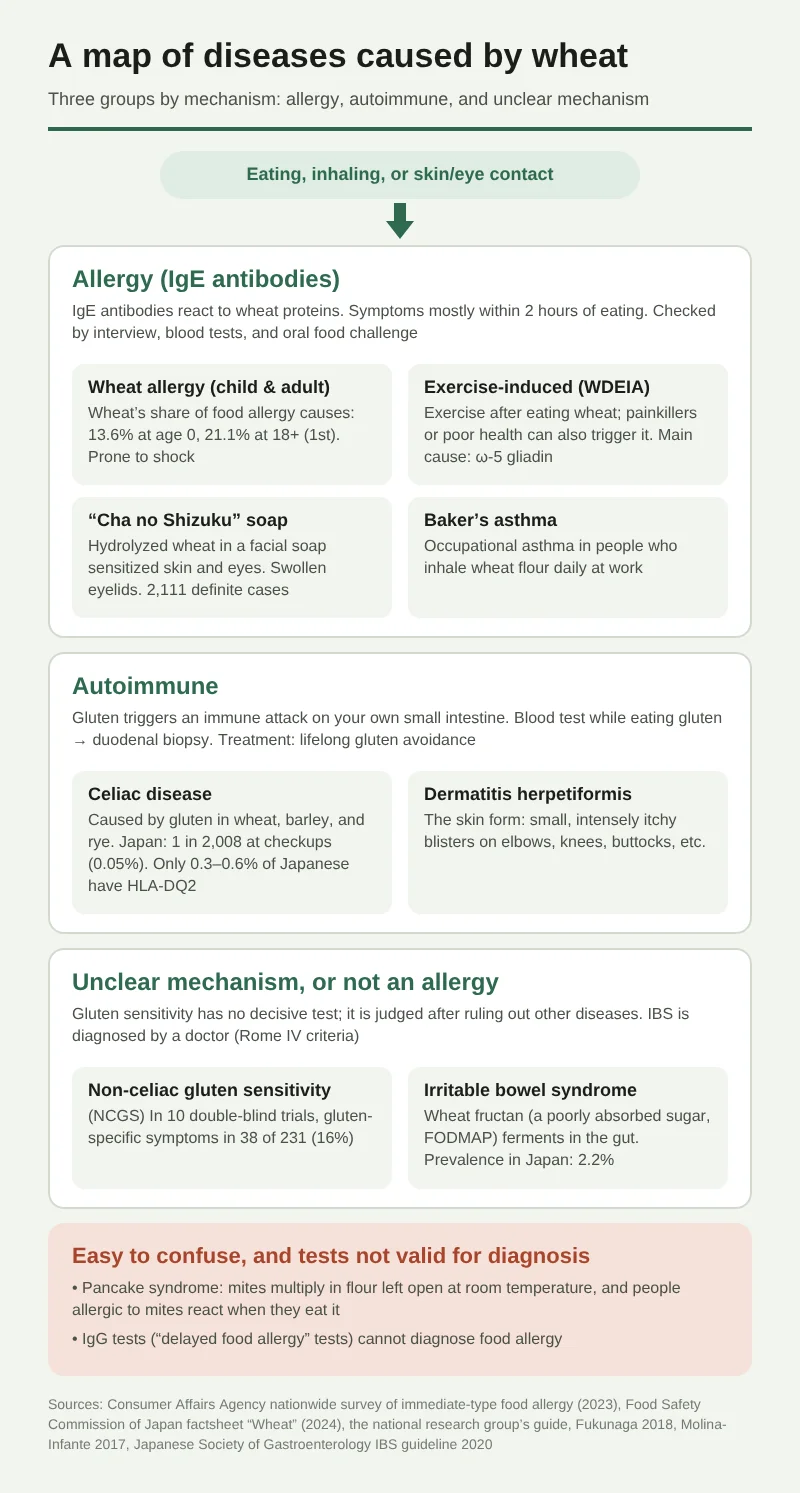
First, here is the whole picture in a table. Dividing the diseases into three groups, “allergy,” “autoimmune,” and “mechanism unknown,” makes the differences clear.
| Disease | Mechanism | Main symptoms | Number / share in Japan | How it is checked |
|---|---|---|---|---|
| Wheat allergy (children) | Allergy (IgE antibodies) | Mostly within 2 hours of eating: hives, cough, vomiting, shock | 13.6% of food allergy causes at age 0 (3rd). 0.07 to 0.70% of ages 0 to 6 (estimated) | Interview, blood tests (IgE to wheat and omega-5 gliadin), oral food challenge |
| Wheat allergy (adults) | Allergy (IgE antibodies) | Same. Shock is more likely | 21.1% of causes at 18 and over (1st). About 0.2% of adults (estimated) | Same |
| Wheat-dependent exercise-induced anaphylaxis (WDEIA) | Allergy plus a trigger such as exercise | Exercising after eating wheat causes hives, difficulty breathing, shock | 56 to 65% of cases with an identified cause are wheat. 0.018% of junior high school students | IgE to omega-5 gliadin, challenge test combined with exercise |
| Wheat allergy from hydrolyzed wheat protein (“Cha no Shizuku”) | Allergy in which people became reactive to wheat through skin and eyes | Swollen eyelids, hives, shock during exercise | 2,111 definite cases (through October 2014) | Society diagnostic criteria (skin tests and others) |
| Celiac disease | Autoimmune (gene type plus gluten) | Diarrhea, weight loss, anemia (iron deficiency), fatigue. Sometimes no symptoms | 1 in 2,008 in a health checkup (0.05%) | Blood test while eating gluten (tTG-IgA), then duodenal biopsy |
| Non-celiac gluten sensitivity (NCGS) | Not understood | Bloating, stomach pain, diarrhea, fatigue, headache | No Japanese survey found | No decisive test. Judged after other diseases are ruled out |
| Irritable bowel syndrome (wheat fructan) | Poorly absorbed sugars ferment in the gut (not an allergy) | Bloating, stomach pain, diarrhea, constipation | Prevalence in Japan 2.2% (international Rome IV criteria) | Doctor’s examination (Rome IV criteria) |
| Baker’s asthma | Allergy caused by inhaling wheat flour | Asthma, rhinitis | No Japanese figure found | Job history, blood tests, and so on |
Sources: the Consumer Affairs Agency’s nationwide survey of immediate-type food allergy (2023), the FSCJ factsheet “Wheat” (2024), Fukunaga 2018, the Japanese Society of Gastroenterology IBS clinical practice guideline 2020, and others (listed at the end of the article).
Wheat can also be the cause of eosinophilic esophagitis (a throat disease), gluten ataxia (which causes unsteadiness), and FPIES (a gastrointestinal allergy in babies) (Other diseases involving wheat).
How “allergy,” “celiac disease,” and “gluten sensitivity” differ
| Wheat allergy | Celiac disease | Non-celiac gluten sensitivity | |
|---|---|---|---|
| What happens in the body | IgE antibodies react to wheat proteins | Gluten triggers an immune reaction that damages your own small intestine | Not understood |
| What causes it | Wheat (omega-5 gliadin and others; also proteins other than gluten) | Gluten in wheat, barley, and rye | Not necessarily gluten (the fructan and expectation theories) |
| Time until symptoms | Mostly within 2 hours of eating | Days to a long period | Hours to days |
| Reacts to tiny amounts? | Depends on the person. Can cause shock | Even tiny amounts damage the small intestine | Unclear |
| Does it go away? | Most children become able to eat it. Adult-onset tends to persist | Lifelong | Not understood |
“Gluten intolerance” is not an official medical diagnosis. It is sometimes used to mean celiac disease and sometimes to mean gluten sensitivity, so take care when you look it up.
What are the symptoms of wheat allergy? Can it suddenly start in adulthood?
Wheat allergy is a disease in which the body reacts to wheat proteins as an “enemy.” Symptoms mostly appear within 2 hours of eating.
What symptoms appear?
- Skin: itching, hives, redness
- Eyes and mouth: swollen eyelids, swollen lips, an itchy throat
- Breathing: cough, wheezing, difficulty breathing
- Stomach: nausea, vomiting, stomach pain, diarrhea
- Whole body: limpness, a hazy mind (anaphylactic shock)
“Anaphylaxis” is when strong symptoms appear in several organs at once, and “anaphylactic shock” is when blood pressure drops and the mind becomes hazy. If there is sudden difficulty breathing or a change in consciousness, call an ambulance without hesitation.
Where does wheat rank among causes of food allergy in Japan?
Every three years, the Consumer Affairs Agency collects cases from allergy specialists across Japan: people who developed symptoms within 60 minutes of eating and saw a doctor. In the 2023 survey (6,033 cases), the causes in order of frequency were as follows.
| Rank | Cause | Share |
|---|---|---|
| 1 | Hen’s eggs | 26.7% |
| 2 | Walnuts | 15.2% |
| 3 | Milk | 13.4% |
| 4 | Wheat | 8.1% (489 cases) |
| 5 | Peanuts | 7.0% |
Wheat ranked in the top 3 up to the 2017 survey, but has been 4th since 2020. The report says eggs, milk, and wheat have tended to fall since 2017 and that tree nuts such as walnuts have increased greatly since 2014. It is more accurate to read this as tree nuts rising and changing the ranking than as wheat decreasing.
Common at age 0, fewer in young children, first again in adults (a U shape)
By age, wheat’s share is 13.6% at age 0 (3rd), 5.2% at ages 1 to 2, falls below 5% at ages 3 to 6, then rises to 8.1% at ages 7 to 17 and 21.1% at 18 and over, ranking 1st.
Looking only at people whose symptoms appeared for the first time (first onset), the shape is even clearer: 13.1% at age 0, 1.4% at ages 1 to 2, 0.5% at ages 3 to 6, 3.9% at ages 7 to 17, and 18.9% at 18 and over (1st). The nationwide figures also show that many people have symptoms from wheat for the first time as adults, even though they were fine as children.
Wheat is likely to cause shock
In the 2023 survey, of the 489 cases caused by wheat, 77 (15.7%) developed shock. Among causative foods this is the second-highest share, after macadamia nuts (18.8%). Also, the share developing shock in the 18 and over group (all causative foods) was 14.8%, the highest of any age group.
Putting five nationwide surveys side by side
| Survey year | Wheat’s share of all cases | Wheat’s share in the adult group |
|---|---|---|
| 2011 | 11.7% (3rd) | 38.6% (19 and over, 1st) |
| 2014 | 12.5% (3rd) | 1st (share not given in the report text) |
| 2017 | 10.6% (3rd) | 19.1% (18 and over, 1st) |
| 2020 | 8.8% (4th) | 22.5% (18 and over, 1st) |
| 2023 | 8.1% (4th) | 21.1% (18 and over, 1st) |
Sources: the report of each round of the Consumer Affairs Agency’s nationwide survey of immediate-type food allergy. The 2020 overall value is from the FSCJ factsheet. In 2011 the adult group was defined as 19 and over.
For the 38.6% in adults in 2011, the report says it is “clear that ‘Cha no Shizuku’ soap was a trigger” (explained later). After the soap was recalled (May 2011), the adult share fell to 19.1% in 2017. But it has stayed first, at around 20%, since. The soap incident alone cannot explain why wheat allergy is so common in adults.
Why can it suddenly start in adulthood?
Not everything is known about why wheat allergy starts in adults. The clues found in research are the following three.
- People become reactive to wheat through the skin or eyes (percutaneous sensitization). While using cosmetics and other products that contain wheat ingredients, the body makes antibodies that react to wheat through the skin or the mucous membranes of the eyes, and then symptoms also appear when wheat is eaten. The “Cha no Shizuku” soap incident is an example
- Symptoms appear only when exercise, medicine, or poor health coincide. In wheat-dependent exercise-induced anaphylaxis (two sections ahead), nothing happens from eating wheat alone or from exercising alone, but symptoms appear when they coincide. It is the type that feels like “suddenly one day” to someone who has always eaten wheat
- Possible cross-reactivity with pollen. The FSCJ says it has been “suggested” that wheat allergy may develop through cross-reactivity with grass pollen. This has not yet been confirmed
If a blood test is “positive,” is it wheat allergy?
A positive blood test alone does not decide wheat allergy. This is because IgE antibodies to wheat can be positive even in people who eat wheat without trouble.
In a Japanese study compiled by the FSCJ, among 311 children and young adults suspected of having wheat allergy, 25% (34) of the 138 who did not have wheat allergy were positive for IgE to omega-5 gliadin (Ebisawa 2012). Conversely, 28% of the 173 who did have wheat allergy were negative.
For this reason, a doctor makes the diagnosis by combining how symptoms appear (the interview), blood tests, and, as needed, an oral food challenge (a test in which you eat small amounts of wheat step by step at a hospital). It is dangerous to “try” eating wheat at home.
Do children outgrow wheat allergy?
Most children become able to eat wheat as they grow. This is called “acquiring tolerance.”
| Study | Subjects | Share who became able to eat wheat |
|---|---|---|
| Koike et al. 2018 (Japan, retrospective cohort study) | 83 children born 2005–06 at NHO Sagamihara Hospital, followed to age 6 | Age 3 20.5%, age 4 33.7%, age 5 54.2%, age 6 66.3% |
| Keet et al. 2009 (US) | 103 children at a Johns Hopkins University specialty clinic | Age 4 29%, age 8 56%, age 12 65%. Half had become able to eat wheat by about age 6.5 |
| Clinical Guide to Food Allergy 2023 | ― | For egg, milk, and wheat allergies that persisted into school age, “about half” acquire tolerance by age 12 |
In the Japanese study, “became able to eat” means being able to eat 200 g of boiled udon (or 1 bread roll) in a hospital challenge test.
Factors linked to a harder-to-outgrow allergy were having had anaphylaxis by age 3 and high IgE antibody levels to wheat or omega-5 gliadin (Koike 2018). However, in the US study, even some children with the highest IgE levels outgrew it (Keet 2009).
The timing and amount for starting to eat wheat are decided by a doctor through challenge tests and similar methods. The guide from the MHLW research group says to do “the minimum necessary elimination” under a doctor’s instructions and to aim to eat what can be eaten.
When it starts in adulthood
The FSCJ factsheet (2024) says that wheat allergy that starts in adulthood is “thought to be mostly persistent.”
On the other hand, in a small study in Italy that followed adult-onset patients for 5 years, 9 of 10 eventually became able to eat wheat (Scibilia 2019). The numbers are small and no conclusion has been reached.
In a Shimane University survey (935 people), the prevalence of wheat allergy among adults in Japan was 0.21% (2 people) (Morita 2012).
What is exercise-induced wheat allergy (FDEIA)?
It is a disease in which exercising after eating wheat causes anaphylaxis. Its formal name is “wheat-dependent exercise-induced anaphylaxis” (WDEIA; FDEIA when the cause is any food).
It does not happen from eating alone or exercising alone
- It often occurs when you exercise within 2 hours of eating wheat (guide from the MHLW research group)
- Eating alone or exercising alone does not usually cause symptoms
- It is common from school age to adulthood and is hard to outgrow. It can cause shock
- Among cases where the causative food was identified, 56 to 65% were wheat, the most common (three reports compiled by the FSCJ)
In a Yokohama City survey, the prevalence was 0.018% of junior high school students and 0.0047% of elementary school students (8 of 170,146, of whom 4 were wheat) (Manabe 2015, 2018).
Triggers other than exercise
The guide says that besides exercise, the following can also be triggers.
| Trigger | |
|---|---|
| Physical condition | A cold, lack of sleep, fatigue, before menstruation |
| Medicine | Fever reducers and painkillers (NSAIDs: aspirin, ibuprofen, and so on) |
| Others | Alcohol, bathing |
The cause is “omega-5 gliadin”
Among wheat proteins, omega-5 gliadin is the main cause. The IgE antibody test for omega-5 gliadin is covered by insurance in Japan (guide).
In a Danish study of 71 people (Christensen 2018):
- In a hospital test in which people ate wheat (gluten), 47 had symptoms, and of them 43 (91.4%) were IgE-positive for omega-5 gliadin
- Even without exercise, 26 people had symptoms. Exercise lowered the amount of gluten needed to cause symptoms (median 48 g to 24 g) and made symptoms more severe
So exercise is thought to be less a “required condition” than a trigger that lowers the amount needed to cause symptoms and makes them worse.
People who are diagnosed take measures under their doctor’s instructions, such as avoiding exercise after eating wheat.
What was the “Cha no Shizuku” soap incident?
It was an incident in which one person after another developed wheat allergy after using a facial soap containing a wheat-derived ingredient. It greatly changed Japan’s wheat allergy figures.
What happened
| Date | Event |
|---|---|
| March 2004 | Sales begin of a facial soap containing 0.3% of the hydrolyzed wheat protein “Glupearl 19S” |
| Autumn 2009 | At the Japanese Society of Allergology, wheat allergy in people who used this soap is reported for the first time |
| October 2010 | The MHLW issues a warning about soaps in general that contain hydrolyzed wheat protein |
| December 2010 | Sales end (by then about 46.5 million units, to about 4.67 million people, had been sold) |
| May 2011 | A voluntary recall begins |
| 2012 | 1,373 plaintiffs file suits in 28 courts across Japan |
| October 2014 | Definite cases confirmed by the society’s special committee reach 2,111 people |
| March 2017 | The government revises the standard for hydrolyzed wheat protein as a raw material |
Sources: Fujita Health University press release (2017), Yagami 2017, MHLW Health and Labour Sciences Research report (fiscal 2019).
Fujita Health University explains that the sales figure works out to “1 in 12 adult women in Japan used it.”
Hydrolyzed wheat protein is wheat gluten broken down with acid and heat to dissolve easily in water, and used as a moisturizing ingredient.
What were the symptoms?
The special committee of the Japanese Society of Allergology (chair: Dr. Kayoko Matsunaga) confirmed 2,111 definite cases at 270 medical institutions between April 2012 and October 2014 (2,025 women and 86 men, average age 45.8). All of them did not have wheat allergy before using the soap (Yagami 2017).
Among the 899 people for whom details were known:
- 25% had anaphylactic shock and 43% had difficulty breathing
- Swollen eyelids were characteristic. This symptom is not common in ordinary exercise-induced wheat allergy, and it is thought that people became reactive to wheat through the mucous membranes of the eyes while washing their faces
- 27% had no noticeable symptoms while they were using the soap
The 2,111 is not “the total number of victims.” It is the number of people who met the society’s criteria and were confirmed at 270 medical institutions; it does not include people who did not see a doctor or did not meet the criteria. Against the roughly 4.67 million people to whom the soap was sold it is about 0.045% (about 1 in 2,200), but the real number may be higher.
Why did a soap make people react to wheat in food?
The patients’ blood had IgE antibodies that bind to Glupearl 19S. These antibodies did not react in the blood of people with ordinary wheat allergy or of healthy people. When people stopped the soap, the antibody levels fell and symptoms eased (Yagami 2017).
In an internet survey, a case-control study compared 157 women who said they had wheat allergy with 449 women who did not. More of the women with wheat allergy had used “Cha no Shizuku” soap, with an adjusted odds ratio of 2.6 (95% confidence interval 1.2 to 5.7) (Fukutomi 2014).
In a genetic study (452 patients, 2,700 controls), HLA-DQ, which determines the immune type, and a gene called RBFOX1 were linked to susceptibility (Noguchi 2019).
Afterward: how many people became able to eat wheat?
- In a follow-up of 110 people, 56.1% were in remission 5 years (60 months) after stopping the soap (Hiragun 2016)
- In a follow-up questionnaire of definite cases at the end of January 2019, 79% or more reported that they could eat foods containing wheat (a conference presentation; it does not include people who stopped visiting a doctor)
What happened in the lawsuits?
| Details | |
|---|---|
| Filing | In 2012, 1,373 plaintiffs in 28 courts across Japan |
| Settlement | Settled in 24 courts |
| Rulings | 4 (Kyoto District Court, February 2018; Tokyo District Court, June 2018; Fukuoka District Court, July 2018; Osaka District Court, March 2019) |
| Defect in the soap | Found in all 4 |
| Liability of the raw material (Glupearl 19S) maker | Denied in Kyoto and Tokyo, affirmed in Fukuoka and Osaka. The decisions split 2 to 2 |
Source: Health and Labour Sciences Research, fiscal 2019 sub-report (Ayako Hatanaka).
After this incident, in March 2017 the government revised the raw material standard for quasi-drugs and set a molecular weight standard for hydrolyzed wheat powder.
What is celiac disease? What about Japanese people?
Celiac disease is not an allergy but an autoimmune disease. When you eat gluten (the proteins of wheat, barley, and rye), the immune system damages your own small intestine, and it becomes harder to absorb nutrients. The American College of Gastroenterology guideline (2023) calls it a “permanent” disease.
Symptoms
Besides stomach symptoms (diarrhea, bloating, weight loss), there may be only non-stomach symptoms, or no symptoms at all. The UK’s National Institute for Health and Care Excellence (NICE) recommends testing people such as the following.
| People NICE recommends testing |
|---|
| Persistent stomach symptoms of unknown cause |
| Slow growth in a child |
| Prolonged fatigue, unexpected weight loss |
| Severe or recurrent mouth ulcers |
| Unexplained iron, vitamin B12, or folate deficiency (anemia and so on) |
| A diagnosis of type 1 diabetes or autoimmune thyroid disease |
| Irritable bowel syndrome in adults |
| A parent, sibling, or child with celiac disease |
It also lists low bone density, unexplained numbness or unsteadiness in the limbs, repeated miscarriage, and abnormal liver values as reasons to “consider testing.”
About 1% worldwide, 0.05% in Japan
| Group | Share | Study |
|---|---|---|
| World (positive blood test) | 1.4% | Pooled analysis of 96 studies (Singh 2018) |
| World (confirmed by biopsy) | 0.7% | Same |
| Asia (confirmed by biopsy) | 0.6% | Same |
| Japan: 2,008 people in Shimane Prefecture health checkups | 0.05% (1 person) | Fukunaga 2018 |
| Japan: 2,055 people in Shimane Prefecture health checkups | 0.19% (4 people) with high antibodies. No prominent symptoms such as diarrhea | Fukunaga 2020 |
In the Shimane checkup, 161 of 2,008 people were positive for antibodies (tTG), but all were negative for another antibody (EMA), and only 1 went on to a biopsy and was confirmed. Among 47 people with stomach symptoms of unknown cause, 1 (2.1%) was confirmed.
Note that the Japanese figures are based on 1 to 4 people, so the range is wide. You cannot say flatly something like “Japanese people have one-twentieth the rate of Westerners.”
It is less common in Japanese people because of a difference in gene type
About 99% of people with celiac disease in the West have an immune type called HLA-DQ2 or HLA-DQ8. Without these types, people almost never develop it.
| Share of people with HLA-DQ2 | |
|---|---|
| White people in Western Europe | 20 to 30% |
| China, Taiwan, Thailand, and others | 5 to 20% |
| Japan | 0.3 to 0.6% (DQ8 is 8 to 10%) |
Source: Tamai 2023 (a review by Japanese researchers).
Furthermore, among 27 cases reported in Japan as celiac disease or antibody-positive, HLA was examined in 13, and 9 of them had neither DQ2 nor DQ8 (0.16 to 2% in the West). Celiac disease in Japan may not be a “milder version of the Western disease,” but may have different characteristics.
The skin form: dermatitis herpetiformis
Celiac disease has a skin form (dermatitis herpetiformis), in which small, intensely itchy blisters appear on the elbows, knees, buttocks, and elsewhere.
In Japan, 91 cases were reported over 35 years (Ohata 2012). However, none of the Japanese patients had DQ2 or DQ8, and only 3 had clear intestinal lesions. It is thought that this may be a different type from Western dermatitis herpetiformis.
Does celiac disease go away?
Treatment is a lifelong, strict diet that avoids gluten (wheat, barley, and rye). Avoiding gluten calms the symptoms, but the disease itself does not disappear (American College of Gastroenterology 2023).
The relationship between celiac disease and cancer is covered in the article on wheat flour and cancer.
Can you self-check for celiac disease?
No. Whether or not you match a symptom checklist, it does not tell you whether you have celiac disease. Diagnosis requires tests at a medical institution.
The order of tests
- Blood test: the first choice is to check total IgA and tTG-IgA (antibodies to tissue transglutaminase) (NICE). People with low IgA (IgA deficiency) have a different antibody checked
- Duodenal biopsy: if the blood test is positive, a tissue sample from the duodenum is taken by endoscope to confirm. In adults, diagnosis is in principle confirmed by biopsy (American College of Gastroenterology 2023)
- In children, if tTG-IgA is at least 10 times the upper limit of the reference range and EMA is also positive on a separate blood draw, diagnosis without a biopsy is possible with the family’s consent (European Society for Paediatric Gastroenterology, Hepatology and Nutrition 2020)
Gene type (HLA) testing is said to be used only at specialist facilities (NICE), because many people who have the type never develop the disease.
We could not confirm whether the tTG-IgA test is covered by insurance in Japan. Ask a gastroenterologist whether you can get tested.
Do not cut gluten first
This is the most important point. NICE recommends the following.
- Tests are accurate only while you are eating a diet that contains gluten
- Before testing, eat gluten-containing foods in at least 2 meals every day for at least 6 weeks
- Do not start a gluten-free diet until a specialist has confirmed the diagnosis (even if the blood test is positive)
If you cut gluten on your own first, the blood test becomes negative and a biopsy also has a harder time confirming it. The order is to get tested before you try going gluten-free because you think “it might be celiac disease.” If you have already cut it out, talk to a specialist.
In a study in which 20 adults with celiac disease ate 3 g or 7.5 g of gluten a day for 14 days, many had changes in the small-intestine tissue and antibodies, and antibodies rose sharply by day 28 (Leffler 2013).
Is gluten sensitivity (NCGS) real?
Many people say “I feel unwell when I eat gluten,” but when it is checked in trials, gluten was the cause in only some of them.
Non-celiac gluten sensitivity (NCGS) is a condition in which symptoms appear after eating wheat-containing foods even though the person has neither celiac disease nor wheat allergy. Because the cause is not necessarily gluten, it is also called “non-celiac wheat sensitivity.”
Self-reports exceed 10%
- About 10% of adults worldwide self-report “symptoms from gluten” (a Lancet review, 2025)
- In an internet survey of 4,002 adults in the US and UK (2023), the figure was 14.2%. Of those, 69.4% also had symptoms of gut-brain disorders such as irritable bowel syndrome, or of eating problems from avoiding too many foods (Shiha 2026)
- At a gastroenterology outpatient clinic in Korea, 33.6% of patients with irritable bowel syndrome and 5.8% of those without it self-reported (Cha 2022)
For the share of the general public in Japan who judge themselves to have “gluten intolerance,” we could not find a survey. Overseas figures cannot be applied to Japan.
When checked in double-blind trials
Here, in order, are the results of trials (double-blind) in which neither the participants nor the doctors knew which food contained gluten.
| Study | Subjects and method | Result |
|---|---|---|
| Biesiekierski 2011 (Australia, randomized controlled trial) | 34 people without celiac disease whose symptoms had improved on a gluten-free diet. Bread with gluten or a fake for up to 6 weeks | The share who said symptoms were not controlled was 68% in the gluten group (13 of 19) and 40% in the fake group (6 of 15). Test values for inflammation and gut permeability did not change |
| Biesiekierski 2013 (same group, crossover trial) | 37 people. First 2 weeks on a low-FODMAP diet (a diet that cuts fermentable sugars found in wheat and other foods), then 1 week each of high gluten, low gluten, and a fake | On the low-FODMAP diet everyone’s symptoms improved, and afterward they worsened about equally with gluten and with the fake. The gluten-specific effect was only 8% |
| Skodje 2018 (Norway, crossover trial) | 59 people who had cut gluten on their own. 1 week each of gluten, fructan, and a fake | The symptom score was highest with fructan (significantly higher than with gluten). There was no difference between gluten and the fake |
| Molina-Infante 2017 (a pooled analysis of 10 trials) | 10 double-blind trials, 1,312 people | Gluten-specific symptoms appeared in 38 of 231 NCGS patients (16%). About 40% had equal or worse symptoms on the fake (nocebo response) |
The Lancet review (2025) says gluten specifically caused symptoms in 16 to 30% in challenge trials, and summarizes that fermentable sugars such as fructan and the expectation that “I will feel bad if I eat this” (the nocebo effect) play a large part. There is no decisive test, and it is a disease diagnosed by ruling out other conditions (diagnosis of exclusion).
For researchers, a method has been proposed in which, after confirming that symptoms improve on a gluten-free diet, people eat 8 g of gluten a day and a fake for 1 week each in a double-blind way, and the judgment depends on whether the main symptoms change by 30% or more (the Salerno criteria, 2015).
The Skodje 2018 trial, and a trial that checked spelt wheat in the same way, are covered in detail in the article on gluten and spelt wheat.
It is not “NCGS does not exist”
The results so far do not mean that “the symptoms of people who feel gluten does not agree with them are a lie.” The symptoms are real, and for many people the cause lies in something other than gluten (such as fructan).
A study of 45 people suspected of gluten sensitivity at a specialist clinic in Japan found that 33.3% were positive for IgG antibodies to gliadin (13.3% of healthy people), meaning this antibody alone could not tell them apart. People suspected of it also tended to have higher scores for depression, anxiety, and physical symptoms (Nutrients 2026).
Before you cut wheat or gluten for a long time, it is important to first confirm with a doctor that you do not have celiac disease or wheat allergy. Other claims that “wheat is bad for you” are checked in the article on the claim that wheat is bad for you.
Diarrhea and bloating from wheat? FODMAP and irritable bowel syndrome
Bloating or diarrhea after eating wheat can involve “wheat sugars” rather than an allergy.
Wheat contains a sugar called fructan. Fructan is poorly absorbed in the small intestine, reaches the large intestine, and is fermented by gut bacteria, producing gas. These fermentable sugars are collectively called FODMAP.
People with irritable bowel syndrome (IBS), in which stomach pain and bowel irregularities persist, are said to be prone to symptoms from FODMAP.
| What is known | Source |
|---|---|
| The prevalence of IBS in Japan is 2.2% (international Rome IV criteria). For functional bowel disorders as a whole, 25.2% | Japanese Society of Gastroenterology IBS clinical practice guideline 2020 |
| A low-FODMAP diet was more effective than ordinary dietary advice in randomized controlled trials in the West. However, “a clear benefit has not yet been shown in Japan” | Same |
| A pooled analysis of 10 randomized controlled trials of diets (939 people): a low-FODMAP diet had a consistent effect in the short term. A gluten-free diet showed no significant difference overall (“effective only in some patients”) | Clin Nutr 2026 |
In other words, for stomach symptoms, “fructan” may be involved more than “gluten,” and many people do not improve even if they go gluten-free. A low-FODMAP diet is a restrictive diet, so do not continue it long on your own; proceed in consultation with a doctor or registered dietitian.
If you have ongoing diarrhea or stomach pain, weight loss, blood in your stool, or pain that wakes you at night, it may be another disease, so see a gastroenterologist.
Baker’s asthma
This is occupational asthma that occurs in people whose work involves inhaling wheat flour every day. It is known among people who work in bakeries, flour milling, and confectionery.
- One of the causes is a wheat protein called alpha-amylase inhibitor (guide from the MHLW research group)
- It is regarded as one of the main causes of occupational asthma (Brant 2007, Jeebhay 2020)
- Countermeasures include reducing dust and reviewing job assignments
We could not find an official figure for the number of patients or the prevalence in Japan.
Other diseases involving wheat
| Disease | What is known |
|---|---|
| Eosinophilic esophagitis | A disease in which a reaction to food causes chronic inflammation of the esophagus and trouble swallowing. A diet removing 6 kinds of food (milk, wheat, egg, soy, and others) improved 72.1% (a pooled analysis of 33 studies and 1,317 people, Arias 2014). In 36 children in whom foods were reintroduced one at a time after elimination to find the cause, the causes were milk 74%, wheat 26%, egg 17%, and soy 10% (Kagalwalla 2011). We found no Japanese wheat-related figures |
| Gluten ataxia | Said to be a disease in which an immune reaction involving gluten causes unsteadiness from the cerebellum. Reports come mainly from a single center in Sheffield, UK, and the lead researcher earns income from patents on related tests. We found no controlled trials, so the evidence is weak |
| FPIES (food protein-induced enterocolitis syndrome) | A gastrointestinal allergy (not mediated by IgE) common in newborns and infants, causing vomiting, bloody stool, and diarrhea. Wheat can also be a cause (guide) |
Foods you cannot eat and can eat with wheat allergy
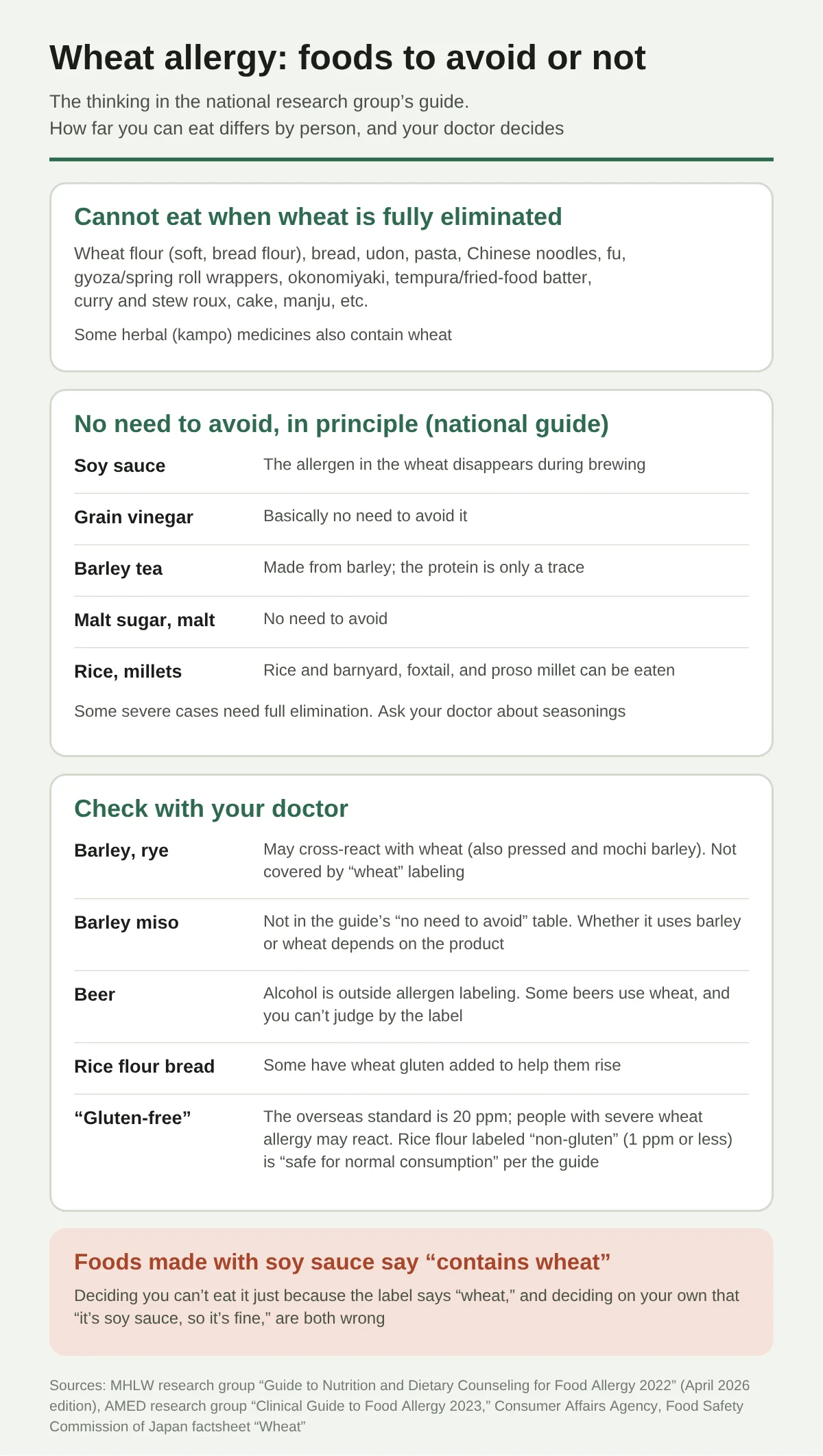
How far you can eat differs from person to person, and your doctor decides. Here we introduce the thinking in the national research group’s guides (“Guide to Nutrition and Dietary Counseling for Food Allergy 2022,” April 2026 edition, and “Clinical Guide to Food Allergy 2023”).
What you cannot eat when wheat is fully eliminated
Wheat flour (soft and bread flour), bread, udon, pasta, Chinese noodles, fu (wheat gluten cake), gyoza and spring roll wrappers, okonomiyaki, tempura and fried-food batter, curry and stew roux, cake, manju, and so on. Some herbal (kampo) medicines also contain wheat.
On food labels, “wheat” (小麦) means all wheat, such as common wheat and durum wheat, and the flour made from it. It may also be written in hiragana or katakana (こむぎ, コムギ). Barley and rye are not covered by the “wheat” labeling.
Soy sauce, vinegar, and barley tea are “not necessary to avoid in principle”
| Food | The guide’s thinking |
|---|---|
| Soy sauce | The wheat used as a raw material has its allergen disappear during brewing. Even if wheat appears in the ingredient labeling, there is basically no need to avoid it |
| Vinegar (grain vinegar) | Basically no need to avoid it |
| Barley tea | The raw material is barley and the protein is very small in amount. It is rare that it needs to be avoided |
| Malt sugar and malt | No need to avoid |
| Barley, rye, pressed barley, mochi barley | They may cross-react with wheat, but it is rarely necessary to avoid all grains. Barley is by your doctor’s instruction |
| Rice and millets such as barnyard millet, foxtail millet, and proso millet | Can be eaten |
That the wheat in soy sauce is broken down was also confirmed in an experiment using serum from 5 children with wheat allergy. During fermentation (moromi), wheat allergens were broken down into amino acids and peptides, and IgE antibodies no longer bound. No wheat allergens were found in 10 commercial soy sauces (Kobayashi 2004). However, the lead author of this study is affiliated with the research laboratory of a soy sauce maker (Higashimaru Shoyu). The main basis is the national research group’s guide. The differences among types of soy sauce and their ingredients are summarized in the article on types of soy sauce.
Yakan no Mugicha from Sokenbicha, which Urayomi covers, also lists six-row barley and barley extract as ingredients and “none” for allergen labeling.
Some severe cases need complete elimination. The guide also says to confirm with a doctor whether you can use seasonings (soy sauce, miso, oil, dashi, and so on).
Soy-sauce-based seasonings labeled “contains wheat”: Urayomi’s tally
Here is a point to be careful about. Soy sauce is “not necessary to avoid,” but labels on foods made with soy sauce say “contains wheat.” Because this is a labeling requirement set by law, the wheat in soy sauce is also labeled.
Of 110 products whose ingredients Urayomi has checked, 37 have “wheat” in the allergen labeling (excluding 2 with only a note saying “made on equipment that uses wheat”). Of these, 16 had no source of wheat other than soy sauce as far as the ingredient list shows (Urayomi’s tally, October 8, 2026).
| Category | Number of products | Examples |
|---|---|---|
| “Wheat” in the allergen labeling | 37 | ― |
| Has a source of wheat other than soy sauce, or may have one | 21 | Curry roux, stew roux, Chinese noodles (wheat flour), hoikoro seasoning (sweet bean sauce), seasonings containing hydrolyzed protein, and so on |
| Soy sauce is the only source of wheat in the ingredient list | 16 | Ajipon, Oigatsuo Tsuyu 2x, ponzu, yakiniku sauce, sesame dressing, nametake mushrooms, furikake, oyster sauce, Worcestershire sauce, white dashi, and so on |
| Of these, labeled with “contains wheat” after soy sauce | 9 | Wording such as “soy sauce (contains wheat and soybeans)” |
For the remaining 7 products, the labeling is the kind that lumps allergens together as “partly contains wheat and soybeans” (collective labeling) or similar, so we cannot say that wheat does not come from something other than soy sauce.
It is not correct either to decide you cannot eat something just by seeing “wheat” on the label, or to decide on your own that “it’s soy sauce, so it’s fine.” Check with your doctor which seasonings you can use.
What about barley miso?
The guide says nothing about wheat allergy for miso (only that people with soy allergy can often eat soy sauce and miso). Quoting the 2021 clinical practice guideline, the FSCJ factsheet says that “soy sauce made from wheat, barley tea from barley, and barley miso made from wheat or barley contain only tiny amounts of allergens, and are considered edible in most cases.”
However, the guide’s “no need to avoid” table (soy sauce, vinegar, barley tea) does not include miso. Whether the raw material of barley miso is barley or wheat depends on the product, so check the label and consult your doctor.
Beer is outside the labeling rules
There is no allergen labeling requirement for alcoholic drinks. This is because it is hard to tell whether symptoms come from the alcohol or from the ingredients (Consumer Affairs Agency).
Beer under the Liquor Tax Act may use “barley and other items specified by Cabinet Order” as adjuncts besides malt, hops, and water. Some beers use wheat. You cannot say “beer is fine because it is barley,” and you cannot judge by the label. If you are concerned, contact the maker. The differences in beer ingredients are summarized in the article on types of beer.
Foods without labeling
The following have no allergen labeling requirement (Consumer Affairs Agency).
- Food not in a container (sold loose or by weight)
- Dishes served at restaurants
- Alcoholic drinks
Wheat is one of the 9 items for which labeling is required (shrimp, cashew nuts, crab, walnuts, wheat, buckwheat, egg, milk, and peanuts). If the wheat protein is below a few μg/g (a few ppm), labeling is not required, and wording such as “may contain” is prohibited.
Rice flour bread can also cause wheat accidents
Some rice flour breads have wheat gluten added to make them rise. In 2015 the Consumer Affairs Agency issued a warning that wheat allergy accidents had occurred through labeling omissions and contamination in rice flour bread. Even if it says “rice flour,” always check the ingredient list and the allergen labeling (guide).
Rye bread may not say “wheat”
In Japanese labeling, rye is not covered by “wheat.” For example, Mestemacher Bio Vollkornbrot, which Urayomi covers, has whole-grain rye, sea salt, and yeast as ingredients and no wheat labeling.
However, rye and barley can cross-react with wheat’s omega-5 gliadin, and one study found that 21 of 23 people (91%) with exercise-induced wheat allergy also had IgE antibodies to rye proteins (Palosuo 2001). Also, people with celiac disease cannot eat rye or barley either.
Substitutes for wheat
The guide introduces the following ways to use other foods in place of wheat.
| Use | Substitutes |
|---|---|
| Roux and thickening | Rice flour, starches such as potato starch, grated potatoes |
| Batter for fried food | Cornflakes, rice flour bread crumbs, crushed harusame (glass noodles) |
| Bread and cake dough | Rice flour, millet flour, soy flour, potatoes, okara |
| Staple foods | Rice, rice noodles, rice flour bread (without wheat) |
For curry, there are roux made with rice flour instead of wheat flour. Cosmo Naohiyaki Rice Flour Curry Roux, Medium Hot, whose ingredients Urayomi has checked, uses rice flour and chickpea flour and has no wheat in its allergen labeling (it contains milk, pork, apple, and chicken).
What about gluten-free labeling?
Japan has no national labeling standard for “gluten-free.” Overseas “gluten-free” differs from Japan’s allergen labeling in both approach and standard.
Standards by country
| Country / system | Standard for “gluten-free” |
|---|---|
| Codex (international food standards) | Gluten does not exceed 20 mg/kg (20 ppm) |
| EU | 20 mg/kg or less |
| US FDA | Less than 20 ppm. Does not use gluten-containing grains such as spelt themselves |
| Australia and New Zealand | No detectable gluten. Does not contain oats or malted grains |
| Japan | No national standard |
| Japanese rice flour “non-gluten” | Gluten 1 ppm or less (third-party certification by the Japan Rice Flour Association, since 2018) |
Sources: MAFF materials (the 2017 six-country survey and the non-gluten rice flour page), EU Regulation No 828/2014 (“no more than 20 mg/kg”), and US Code of Federal Regulations 21 CFR 101.91.
Overseas gluten-free is mainly a standard for people with celiac disease. It is not a standard for people with wheat allergy.
Re-measuring 20 ppm with Japan’s yardstick (Urayomi’s calculation)
The share of gluten in wheat protein varies by source, from about 70 to 80%, but here we calculate with the FSCJ’s figure of about 85%. Using this, let us convert the upper limit of overseas “gluten-free” into Japan’s allergen labeling yardstick (wheat protein).
| Gluten | As wheat protein | Amount that reaches 5 mg | |
|---|---|---|---|
| Upper limit of overseas “gluten-free” | 20 ppm | about 23.5 μg/g | about 212 g |
| Where labeling becomes required in Japanese testing | ― | 10 μg/g | 500 g |
| Upper limit of Japanese rice flour “non-gluten” | 1 ppm | about 1.2 μg/g | about 4.3 kg |
5 mg is the “reference dose” of wheat (a guide amount for thinking about labeling, as wheat protein) proposed at the Codex Committee on Food Labelling (2023).
What this shows:
- A food at the upper limit of overseas “gluten-free” exceeds, if the gluten comes from wheat, the level (10 μg/g) at which Japanese testing requires a “wheat” label
- From oral food challenges in 380 Japanese children, the dose estimated to cause a reaction in 1% of patients was 2.17 mg of wheat protein, and 6.71 mg for 5% (FSCJ). With a “gluten-free” food at the upper limit, 2.17 mg is reached with about 92 g
Actual gluten-free foods often contain far less than the upper limit, so this calculation is the “highest case.” Also, gluten from barley and rye is not the same as wheat protein. Even so, the numbers show why “gluten-free” cannot be said to mean “safe even with wheat allergy.”
The national research group’s guide also says that “people with severe wheat allergy may have symptoms from products labeled gluten-free, while products labeled ‘non-gluten’ on rice flour are safe for normal consumption.” The non-gluten standard is gluten of 1 ppm or less (MAFF).
What is “non-gluten” rice flour?
- It is a third-party certification run by the Japan Rice Flour Association that began in June 2018. A mark can be put on rice flour with gluten of 1 ppm or less (MAFF)
- In October 2020, a standard (JAS0014) for controlling the manufacturing process of non-gluten rice flour was also created. This is a certification for businesses
- Even if a product says “rice flour,” some products lack non-gluten certification. Some are made in factories that handle wheat, so check the label
If you are looking for a flour to use in place of wheat flour, rice flour with a “non-gluten” certification mark is a clue. Whether a person with wheat allergy can use it should be discussed with your doctor.
IgG tests (delayed food allergy tests) cannot be used
IgG antibody tests sold as “delayed food allergy tests” cannot be used to diagnose food allergy.
The national research group’s guide (2023) says:
- IgG (IgG4) antibodies are detected even in many people who do not have food allergy. No diagnostic value based on comparative studies has been reported
- Not only in Japan but also in Europe and the US, it is not recommended for diagnosing food allergy
In other words, even if an IgG test shows “positive for wheat,” it does not mean you have wheat allergy.
If you cut out wheat based only on the result of this test, you may end up with an unnecessary dietary restriction, or the diagnosis of a real disease (such as celiac disease) may be delayed.
“Pancake syndrome,” easily confused with wheat allergy
You are fine with wheat, but get symptoms from okonomiyaki or takoyaki. In such a case, what can be considered is “oral mite anaphylaxis (pancake syndrome).”
If opened okonomiyaki flour, pancake mix, or wheat flour is left at room temperature for a long time, mites can get in and multiply. When a person who is allergic to mites eats a dish made with that flour, hives, difficulty breathing, and anaphylaxis occur. The guide lists it as a “condition easily mistaken for wheat allergy.”
The basics are to close opened flour tightly, store it in the refrigerator, and use it up quickly.
Who to consult when you have symptoms
| Symptoms | Where to consult |
|---|---|
| Hives, cough, or swollen eyelids after eating; symptoms during exercise | Allergy clinic, dermatology (a doctor who treats allergy) |
| Food allergy in a child | Pediatrics (an allergy specialist) |
| Ongoing diarrhea, bloating, weight loss, or anemia | Gastroenterology |
| Cough or asthma at work | Pulmonology |
| Sudden difficulty breathing, limpness, or change in consciousness | Call an ambulance immediately |
Before you go, it helps the examination to note down when, what, and how much you ate, how many minutes later what symptoms appeared, and whether you exercised, took medicine, drank alcohol, or bathed before or after.
Items featured in this article (summary)
Here are the items introduced in the article, gathered once more. The reasons and ingredients are written in each section.
| Item | Where to buy |
|---|---|
| Mitake Rice Flour Powder 300 g (domestically certified non-gluten) | See on Rakuten (【公式】みたけ食品 楽天市場店) PR See on Amazon.co.jp PR |
Summary
| What you want to know | What we found |
|---|---|
| What diseases does wheat cause? | Three groups: allergy (wheat allergy, exercise-induced, “Cha no Shizuku”), autoimmune (celiac disease), and mechanism unknown (gluten sensitivity). Also irritable bowel syndrome, baker’s asthma, and others |
| Is wheat allergy common in adults? | Wheat is first among causes of food allergy at 18 and over (21.1%, 2023). It is first among first-onset cases too. Shock is likely |
| What about suddenly starting in adulthood? | Clues include sensitization through skin and eyes (“Cha no Shizuku”) and a type that appears only when exercise, medicine, or poor health coincide. Not everything is known |
| Do children outgrow wheat allergy? | In a Japanese study, 66.3% could eat wheat by age 6. Adult-onset allergy tends to persist |
| What was the “Cha no Shizuku” soap incident? | A soap sold to about 4.67 million people; 2,111 definite cases. 56.1% in remission at 5 years. The courts found a defect in the soap in all 4 rulings, and the raw material maker’s liability split 2 to 2 |
| Do Japanese people have celiac disease? | It is rare (1 in 2,008 in a health checkup). Only 0.3 to 0.6% have the DQ2 gene type. Cases in Japan also show features different from the West |
| Can you self-check for celiac disease? | No. Blood test and biopsy while eating gluten. Do not cut gluten first |
| Is gluten sensitivity real? | Self-reports exceed 10%, but gluten-specific symptoms appeared in only 16% in double-blind trials. Fructan and expectations play a large part |
| What about soy sauce, barley tea, and beer? | Soy sauce, vinegar, and barley tea need not be avoided in principle (guide). Beer is outside the labeling rules. In the end it is your doctor’s decision |
| Is gluten-free safe? | The overseas standard (20 ppm) is looser than Japan’s allergen labeling. “Non-gluten” rice flour is 1 ppm or less |
| What about IgG tests? | They cannot be used to diagnose food allergy (in Japan, Europe, or the US) |
Sources
Nationwide surveys of food allergy and government materials
- Consumer Affairs Agency, “Fiscal 2024 Report on Research into Food Labeling Related to Food Allergy” (Nationwide Survey of Immediate-Type Food Allergy, 2023) https://www.caa.go.jp/policies/policy/food_labeling/food_sanitation/allergy/assets/food_labeling_cms204_241031_1.pdf
- Consumer Affairs Agency, reports of the same project (fiscal 2012, 2015, 2018, and 2021)
- Consumer Affairs Agency, “Handbook on Food Allergy Labeling for Processed Foods” (April 2026), and “Caution on Wheat Allergy from Rice Flour Products” (2015)
- Food Safety Commission of Japan, Factsheet “Foods Containing Allergens (Wheat)” (July 23, 2024) https://www.fsc.go.jp/foodsafetyinfo_map/allergen.data/factsheets_Allergy_Wheat.pdf
- MHLW Health and Labour Sciences research group, “Guide to Nutrition and Dietary Counseling for Food Allergy 2022” (April 6, 2026 edition); AMED research group, “Clinical Guide to Food Allergy 2023” (April 2026 edition) https://www.foodallergy.jp/
- Liquor Tax Act, Article 3 (e-Gov Laws Search)
Wheat allergy and exercise-induced allergy
- Koike Y, et al. Int Arch Allergy Immunol 2018;176:249-254 (PMID 29870996)
- Keet CA, et al. Ann Allergy Asthma Immunol 2009;102:410-5 (PMID 19492663)
- Morita E, et al. Allergol Int 2012;61:101-5 (PMID 22377522)
- Scibilia J, et al. J Investig Allergol Clin Immunol 2019 (PMID 31017108)
- Ebisawa M, et al. Int Arch Allergy Immunol 2012;158:71-76
- Manabe T, et al. Allergol Int 2015 (PMID 26117264), Pediatr Int 2018 (PMID 29341364)
- Christensen MJ, et al. 2018 (PMID 29524997)
- Palosuo K, et al. Clin Exp Allergy 2001;31:466-473
“Cha no Shizuku” soap (hydrolyzed wheat protein)
- Fujita Health University press release (2017) https://www.fujita-hu.ac.jp/news/dubv6r0000001rc3-att/dubv6r0000001w34.pdf
- Yagami A, et al. J Allergy Clin Immunol 2017;140(3)
- Fukutomi Y, et al. Allergy 2014 (PMID 25040662)
- Noguchi E, et al. J Allergy Clin Immunol 2019 (PMID 31301374), University of Tsukuba press release (July 18, 2019)
- Hiragun M, et al. Allergol Int 2016;65:109-11
- Health and Labour Sciences Research, fiscal 2019 sub-report (Ayako Hatanaka), “Case Law Study on Judging the Onset of Allergy from Cosmetic Soap and Defects in Raw Materials”
Celiac disease
- Rubio-Tapia A, et al. ACG Clinical Guidelines: Diagnosis and Management of Celiac Disease. Am J Gastroenterol 2023 (PMID 36602836)
- NICE guideline NG20 “Coeliac disease: recognition, assessment and management” https://www.nice.org.uk/guidance/ng20/chapter/Recommendations
- Husby S, et al. ESPGHAN Guidelines 2020 (PMID 31568151)
- Singh P, et al. Clin Gastroenterol Hepatol 2018 (PMID 29551598)
- Fukunaga M, et al. J Gastroenterol 2018 (PMID 28389733), JGH Open 2020 (PMID 32782937)
- Tamai T, Ihara K. Int J Mol Sci 2023 (PMC9916540)
- Ohata C, et al. 2012 (PMID 22778765)
- Leffler D, et al. Gut 2013 (PMID 22619366)
Gluten sensitivity and irritable bowel syndrome
- Biesiekierski JR, et al. Am J Gastroenterol 2011 (PMID 21224837), Gastroenterology 2013 (PMID 23648697)
- Skodje GI, et al. Gastroenterology 2018 (PMID 29102613)
- Molina-Infante J, Carroccio A. Aliment Pharmacol Ther 2017 (PMID 27523634)
- Lancet review of non-celiac gluten sensitivity 2025 (PMID 41138740)
- Shiha MG, et al. United European Gastroenterol J 2026 (PMID 42396956)
- Cha RR, et al. 2022 (PMID 35362454)
- Catassi C, et al. Nutrients 2015 (Salerno criteria, PMID 26096570)
- Study of 45 Japanese people with suspected NCGS, Nutrients 2026 (PMID 42197067)
- Japanese Society of Gastroenterology, “Clinical Practice Guidelines for Functional Gastrointestinal Disorders 2020: Irritable Bowel Syndrome” (PMC7932982)
- Meta-analysis of dietary therapies, Clin Nutr 2026 (PMID 42160924)
Others
- Brant A. 2007 (PMID 17351468), Jeebhay MF, et al. 2020 (PMID 31850920)
- Arias A, et al. Gastroenterology 2014 (PMID 24534634), Kagalwalla AF, et al. 2011 (PMID 21788754)
- Gluten ataxia: Nutrients 2026 (PMID 42654224), Cerebellum 2026 (PMID 42518048)
- Kobayashi M, et al. Int J Mol Med 2004;13:821-827 (PMID 15138619)
Gluten-free labeling
- MAFF, “Third-Party Certification System for Non-Gluten Rice Flour” https://www.maff.go.jp/j/seisan/keikaku/komeko/nonglu.html, and the MAFF materials on “JAS for Manufacturing Process Control of Non-Gluten Rice Flour”
- MAFF commissioned survey, “Survey of Six Countries on Gluten-Free Labeling” (2017)
- European Commission Implementing Regulation (EU) No 828/2014 (labeling of foods free of or reduced in gluten)
- US Code of Federal Regulations 21 CFR 101.91 (Gluten-free labeling of food) https://www.ecfr.gov/current/title-21/chapter-I/subchapter-B/part-101/subpart-F/section-101.91
Urayomi’s tally
- Urayomi product data (ingredient lists and allergen labeling of 110 products, tallied on October 8, 2026)
Related articles and databases
- Is wheat bad for you? Checking the effects of going “wheat-free” and “gluten-free” against the research. What happens if you quit?
- Does Eating Too Much Wheat Flour Cause Colorectal Cancer? Checking the Link Between Wheat and Cancer Against Studies and Government Data
- What is spelt wheat? Does gluten make holes in the gut? Checking “leaky gut” and pesticides in imported wheat against papers and national data
- Which foods raise the risk of stomach cancer? Salt, H. pylori, wheat, and charred grilled fish, checked against national evaluations and studies