

Is wheat bad for you? Checking the effects of going “wheat-free” and “gluten-free” against the research. What happens if you quit?

PR This article contains affiliate links to Rakuten Ichiba, Amazon, Yahoo! Shopping, and A8.net (“See on Rakuten”, etc.). What is written here is based on public-agency materials and research papers, whether or not there are ads. The “See on Amazon.co.jp” links are also affiliate links.
“Wheat is bad for you.” “I lost weight when I quit bread.” “Wheat is addictive.” “Quitting wheat cleared up my skin and my hay fever.” “Gluten sticks to your intestines.” “People abroad have already stopped eating wheat.” You see claims like these in books and online all the time.
Yet most people eat bread, udon, and ramen almost every day. Is wheat really bad for you?
In this article we check the following, one by one, against research papers and national statistics:
- Where did the claim that “wheat is bad for you” spread from?
- Is it true that “modern wheat was changed by breeding and is nothing like the old wheat”?
- Is wheat addictive?
- What happens to the body of a healthy person who quits wheat (gluten)? Do they lose weight?
- Are there downsides to going gluten-free?
- The relationship between wheat and diabetes, heart disease, dementia, depression, autism, atopic dermatitis, rheumatoid arthritis, and hay fever
- How has the way Japanese people eat wheat changed over the past 50 years?
- Is it true that “people abroad have stopped eating wheat”?
Note This article is about people who do not have a disease such as wheat allergy or celiac disease. Diseases caused by wheat, and what those people can and cannot eat, are covered in the article on diseases caused by wheat. If you have ongoing symptoms, talk to a doctor (gastroenterology, allergy, etc.) before cutting out wheat on your own.
Conclusion
- Much of the “wheat is bad for you” idea spread from three American books: Wheat Belly (2011; Japanese edition “小麦は食べるな!”, 2013), Grain Brain (2013; Japanese edition “「いつものパン」があなたを殺す”, 2015), and Novak Djokovic’s book Serve to Win (2013; Japanese edition “ジョコビッチの生まれ変わる食事”, 2015). Japanese books on “quitting wheat” came out one after another from 2013 to 2016
- “Modern wheat has more gluten and is a different thing” is not supported by the data. In a comparison that grew 60 varieties registered in Germany between 1891 and 2010 in the same field, the amount of gluten did not change. The genes behind the short modern wheat come from Japan’s “小麦農林10号” (Norin 10), bred in Iwate Prefecture in 1935. Not a single genetically modified wheat variety has passed a safety review in Japan
- There is no evidence of wheat addiction in humans. Opioid-like substances called “exorphins” do exist, but they were found in test-tube and rat experiments
- In trials where healthy people reduced gluten, body weight was on average 0.8 kg lower after 8 weeks than after the high-gluten period, and bloating eased, but inflammation markers did not change. The authors think most of the effect was “because the type of dietary fiber changed.” On the other hand, there are also trials in which bacteria regarded as beneficial gut microbes decreased
- People who ate more gluten had less type 2 diabetes (20% fewer among about 200,000 people) and no relationship with heart disease. For whole grains, results consistently point toward less diabetes, heart disease, and death. In Japanese people, what shows “more diabetes with higher intake” is not wheat but white rice (1.65 times in women)
- For dementia, depression, autism, atopic dermatitis, rheumatoid arthritis, rough skin, and hay fever, no solid evidence was found, in ordinary people without disease, that “quitting wheat cures it.” People with wheat allergy or celiac disease are a different matter and need a doctor’s diagnosis
- The amount of wheat Japanese people eat has been almost unchanged for 50 years (1975: 90.2 g, 2024: 102.4 g per day). And about half of it is noodles, not bread. Estimated from national statistics, Japanese people eat about 4 to 6 g of gluten a day, which is on the low side compared with the people in US and Danish studies
- “People abroad have stopped eating wheat” is only partly true. The number of people avoiding gluten in the US has grown, but it is still under 2% of the population. Americans still eat nearly twice as much wheat flour as Japanese people
Items featured in this article
| Item | When it is useful | Where in the article |
|---|---|---|
| Whole-wheat flour made from Japanese-grown wheat | When you want to swap part of your white flour for whole wheat | Choosing whole-wheat flour |
| Organic whole-wheat spaghetti | When you want to swap part of your noodles for a whole-grain one | Choosing whole-wheat flour |
Overview of the “wheat is bad for you” claims: what the research shows
Here is a list of the claims you hear often, and what the research shows. The details are explained under each heading. The “Verdict” is this article’s summary for ordinary people without disease.
| Claim | Where it comes from | What the research shows | Verdict |
|---|---|---|---|
| Modern wheat was changed by breeding, has more gluten, and is a different thing | Wheat Belly | Gluten has not increased, in US statistics or in a comparison of 60 German varieties | No supporting study found |
| Modern wheat is genetically modified | Subtitle of the Japanese edition of Wheat Belly | No genetically modified wheat has passed a safety review in Japan | Wrong (not sold in Japan) |
| Wheat is addictive | Wheat Belly | Opioid-like substances are a test-tube and rat story. No study has shown dependence in humans | No evidence in humans |
| Whole-wheat bread raises blood sugar more than sugar does | Wheat Belly | GI: bread 75, whole-wheat bread 74, sugar 65. But white rice is also 73 | The numbers are partly true. Not just a wheat issue |
| Quitting wheat makes you lose weight | Books, blogs | In a trial of healthy people, body weight was 0.8 kg lower after 8 low-gluten weeks than after 8 high-gluten weeks. In a trial that removed only gluten, no difference | No long-term trials |
| Gluten-free is good for you | Books, blogs, athletes | Fiber and B vitamins tend to drop. Beneficial gut bacteria dropped in some trials | Little basis for recommending it to people without disease |
| Wheat causes diabetes and heart disease | Wheat Belly | People who eat more gluten have less diabetes and no relationship with heart disease | Few studies support it |
| Wheat causes inflammation in the body | Books, blogs | In trials of healthy people, inflammation markers (CRP, etc.) did not change | Few studies support it |
| Wheat causes dementia | Grain Brain | The study cited was about the “proportion of carbohydrate.” Gluten intake and cognitive function were unrelated | No supporting study found |
| Quitting wheat improves depression | Books, blogs | One small trial (22 people, 3 days). No evidence outside patients with celiac disease and similar conditions | Inconclusive |
| A gluten-free diet improves autism | Overseas therapy | Meta-analyses are split, and high-quality trials show “no difference” | No basis to recommend it in general |
| It cures atopic dermatitis and rough skin | Books, blogs | Elimination diets for atopic dermatitis give at most “a possible slight improvement.” Elimination may cause food allergy | Self-directed elimination is not recommended |
| It cures hay fever | Blogs | No study found | No supporting study |
| It improves rheumatoid arthritis | Books, blogs | Only small trials of diets that also removed meat and dairy. No gluten-only trial | Inconclusive |
| Gluten sticks to your intestines | Japanese web | No study that tested this was found | No supporting study |
| People abroad have stopped eating wheat | Web | 1.69% of Americans avoid gluten (2013–14) | Only partly true |
What is gluten? What is it said to do wrong?
Gluten is what forms when two wheat proteins, gliadin and glutenin, link up into a net when water is added and the dough is kneaded. Gluten is why bread rises and udon gets its chewiness. Roughly 70–80% of wheat protein goes into making gluten (Kasarda 2013 says 70–75%, Brouns 2013 says up to 80%; the Food Safety Commission of Japan (FSCJ) fact sheet says about 85%). Barley and rye also have similar proteins (Brouns 2013).
“Gluten is bad” is claimed mainly for these three reasons:
- Breeding increased gluten, making wheat a different thing from old wheat
- Gluten produces a substance that acts on the brain and boosts appetite (addiction)
- Gluten damages the intestines and causes inflammation
This article checks these three in order. Note that gluten is clearly harmful for people with celiac disease (an autoimmune disease in which gluten causes inflammation in the small intestine), wheat allergy, and similar conditions. Whether the same happens in people without disease is the question of this article.
Where does “wheat is bad for you” come from? Book publication years and claims
The idea that “wheat is bad for you” spread after books published in the US in the early 2010s. The Japanese editions came out at about the same time as a run of Japanese books on “quitting wheat” and “gluten-free” (checked in National Diet Library bibliographic records).
| Book (original) | Author | Original year | Japanese edition |
|---|---|---|---|
| Wheat Belly | William Davis (American cardiologist) | 2011 | “小麦は食べるな!” (Nihon Bungeisha, 2013) |
| Grain Brain | David Perlmutter (American physician) and another author | 2013 | “「いつものパン」があなたを殺す” (Mikasa Shobo, 2015; new edition 2021) |
| Serve to Win | Novak Djokovic (tennis player) | 2013 | “ジョコビッチの生まれ変わる食事” (Sangokan, 2015; reissued by Fusosha in 2018) |
Books by Japanese authors followed. In 2016 came “2週間で体が変わるグルテンフリー健康法” (a gluten-free health method that “changes your body in two weeks”; Seishun Publishing) and “2週間、小麦をやめてみませんか?” (“Why not quit wheat for two weeks?”; Sangokan), and in 2020 “長生きしたけりゃ小麦は食べるな” (“If you want to live long, don’t eat wheat”; Ascom). We could not confirm print runs from the publishers’ official materials, so we do not state them.
The claims of Wheat Belly
Davis’s main claims are as follows (Brouns et al. 2013 examine them, quoting from the book and interviews):
- Modern wheat is a “different thing” created by breeding in the 1960s and 70s, and contains unnatural proteins
- Wheat protein (gliadin) binds to opioid receptors in the brain and boosts appetite, making you eat 440 kcal more per day. Quitting causes withdrawal symptoms
- Wheat starch (amylopectin A) raises blood sugar easily, and the GI of whole-wheat bread is higher than that of sugar
- As wheat intake rose, waistlines grew
The subtitle of the Japanese edition is “遺伝子組み換えの恐怖!” (“The horror of genetic modification!”). We check this point in the next section.
The claims of Grain Brain
Perlmutter claimed that carbohydrates and gluten cause dementia, ADHD, anxiety, headaches, and more. One piece of evidence presented was a study of older adults at the Mayo Clinic in the US. We check what that study actually contained in the later section “Does wheat cause dementia?”
Djokovic’s book and the “bread on the belly test”
Djokovic’s book tells of a nutrition specialist in 2010 who had him do a muscle-strength test, pressing his arm down while holding bread against his belly, and told him he was “gluten intolerant” (according to an overseas newspaper’s coverage).
- This test is called “applied kinesiology,” and is classified as a test that has not been proven as a diagnostic method for food allergy (review by Hammond & Lieberman 2018). It has been pointed out that it can lead to unnecessary dietary restrictions
- We could not confirm information that Djokovic himself was diagnosed with celiac disease
- This does not deny his personal experience. However, in a trial of similar endurance athletes, performance did not change with or without gluten (introduced in the later section “What happens if you quit wheat?”)
Gluten-free eating has spread among athletes. In a survey of 910 athletes, 41% of athletes without celiac disease were gluten-free “at least half the time,” and 57% of those decided to do so on their own (Lis 2015).
Is modern wheat a different thing from old wheat? Did gluten increase?
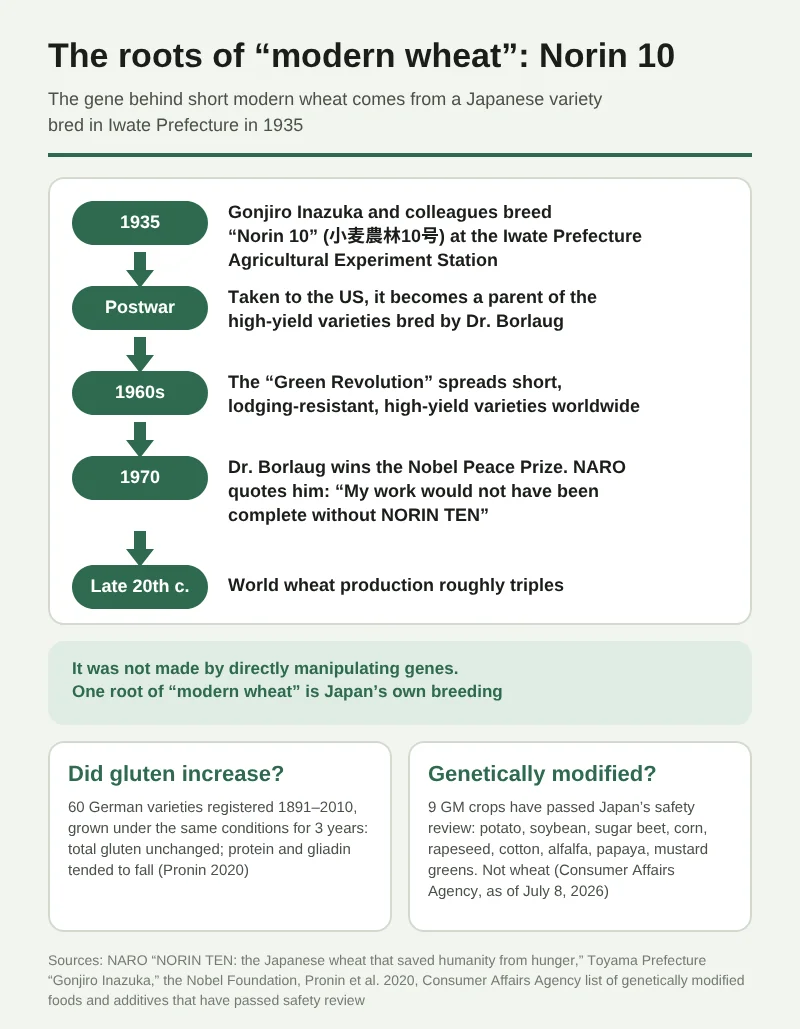
To put it up front, we found no data showing that “breeding increased the gluten in wheat.”
Breeding has not increased gluten
| Study | What was examined | Result |
|---|---|---|
| Kasarda 2013 (researcher at the US Department of Agriculture) | US wheat protein statistics for the 20th–21st centuries | No evidence that breeding increased protein (≈ gluten). Year-to-year differences are mainly due to growing conditions such as weather |
| Pronin et al. 2020 (Germany) | 60 varieties registered between 1891 and 2010, grown under the same conditions for 3 years | Yield rose, but protein and gliadin tended to decrease. Total gluten did not change |
| Pronin et al. 2021 | Peptides that trigger celiac disease in the same 60 varieties | About the same in old and new varieties |
| Geisslitz et al. 2023 | ATIs (non-gluten proteins) in the same 60 varieties | Total amount did not differ between old and new varieties |
| Shewry 2020 (UK) | Varieties from the 18th century to today | Apart from dilution of minerals (micronutrients), no clear evidence of changes in an unhealthy direction. In recent UK varieties dietary fiber had increased, and asparagine in white flour (a precursor of acrylamide when baked) had decreased |
More than the variety, the weather that year and field conditions have a larger effect on the amount of gluten (Pronin 2020). Also, “ancient wheats” such as spelt do not have less gluten than ordinary wheat (article on gluten and spelt).
Short “modern wheat” comes from Japan’s Norin 10
What Davis calls “unnatural modern wheat” is the short, lodging-resistant, high-yield varieties that spread around the world in the “Green Revolution” of the 1960s. The gene that makes them short comes from Japan’s “小麦農林10号” (Norin 10) (NARO).
- Norin 10 is a variety bred in 1935 at the Iwate Prefecture Agricultural Experiment Station by Gonjiro Inazuka and colleagues (Toyama Prefecture)
- After the war it went to the US and became a parent of the world’s high-yield varieties bred by Dr. Borlaug
- Dr. Borlaug received the Nobel Peace Prize in 1970 (the Nobel Foundation), and NARO says he is quoted as saying “My work would not have been complete without NORIN TEN”
- In the second half of the 20th century, world wheat production roughly tripled
In other words, one of the roots of “modern wheat” is Japan’s own breeding. It was not made by directly manipulating genes.
Genetically modified wheat is not sold in Japan
The subtitle of the Japanese edition of Wheat Belly is “遺伝子組み換えの恐怖!” (“The horror of genetic modification!”), but:
- The Consumer Affairs Agency’s list of “genetically modified foods that have gone through the safety review procedure” (as of July 8, 2026) has nine crops: potato, soybean, sugar beet, corn, rapeseed, cotton, alfalfa, papaya, and mustard greens. Wheat is not among them. Genetically modified foods that have not passed review cannot be sold in Japan
- When the book came out in 2013, no genetically modified wheat was being grown commercially in any country in the world (Brouns 2013)
- Afterward, a drought-tolerant genetically modified wheat (HB4) was approved in Argentina in 2020, and it is reported to have been approved in a few other countries too. It is not on Japan’s list
How genetically modified crops are labeled is covered in the article on genetically modified foods and high-fructose corn syrup.
What increased is the addition of “vital gluten”
What increased in the US was not what is inside wheat but “vital gluten” added to bread and other foods. Kasarda’s estimate is about three times more per person per year: 136 g in 1977 → 408 g in 2012. However, compared with the gluten eaten directly from wheat flour (about 5 kg a year), it is under 10%, and the author says “we do not know whether it is related to the increase in celiac disease.”
Celiac disease is increasing, but the reason is not known
Celiac disease (an autoimmune disease in which gluten causes inflammation in the small intestine) really has increased. Among Finnish adults, counting people already diagnosed plus those found by blood tests, it went from 1.05% in 1978–80 to 1.99% in 2000–01 (Lohi 2007; same blood test method). In the US, undiagnosed celiac disease was 0.2% in stored serum from Air Force recruits around 1950, versus 0.8–0.9% in recent populations (Rubio-Tapia 2009).
However, there is no evidence that the increase is because “the contents of wheat changed.” The cause is still unknown. Celiac disease is explained in detail in the article on diseases caused by wheat.
Is wheat addictive?
No study has tested “wheat is addictive” in humans.
“Exorphins” are a test-tube and rat story
It is known from experiments that when wheat gluten is broken down by digestive enzymes, peptides with opioid-like (morphine-like) activity are produced.
| Year | What happened | Source |
|---|---|---|
| 1979 | Researchers at the US National Institutes of Health (NIH) found opioid-like activity in breakdown products of gluten and milk proteins and named them “exorphins” (experiments in cells and animal tissue) | Zioudrou 1979 |
| 1992–1993 | Fukudome and colleagues at the research department of a Japanese flour miller (Nisshin Seifun) isolated four kinds of exorphin from gluten breakdown products in 1992 and one more in 1993 | Fukudome & Yoshikawa 1992, 1993 |
| 1995 | When given to rats by mouth, post-meal insulin rose | Fukudome 1995 |
The substances behind “wheat addiction” were isolated by Japanese researchers. But that research was also a test-tube and rat experiment, and did not show that humans become dependent.
For humans, the thinking is as follows (review by Brouns & Shewry 2022):
- Even if food-derived peptides enter the blood, the amounts are tiny and enzymes in the blood quickly break them down
- There are no data on how much gluten peptide is absorbed, how much stays in the blood, and whether it reaches and acts on the brain
- There is no evidence that it changes appetite or body weight. In observational studies, the amount of gluten eaten is related neither to energy intake nor to BMI
We also found no study that tested the claim that “quitting wheat causes withdrawal symptoms.”
An old theory linking “wheat and mental illness”
The idea linking wheat and mental illness has an old source. In 1966, Dohan reported country-level data showing that hospital admissions for schizophrenia fell in countries where wheat consumption dropped during World War II (Dohan 1966). A later meta-analysis found that patients with psychosis have slightly more antibodies to wheat gliadin (odds ratio 2.3–2.6), but cause and effect are not known (Lachance 2014). Country-level data cannot be separated from the many other things that changed over the same period, so this alone cannot say that wheat is the cause.
What stands out in research on “foods you can’t stop eating”
In a study that asked 120 US university students and 384 members of the general public, the foods linked to “can’t stop” eating were highly processed, high in fat, and quick to raise blood sugar (Schulte 2015). That is a feature of processed foods that combine oil, sugar, and salt, not of wheat itself.
Does wheat raise blood sugar easily? Is it true that “whole-wheat bread has a higher GI than sugar”?
GI (glycemic index) is a number that expresses how quickly blood sugar rises after eating, with glucose as 100. In the averages from the international GI tables (2008 edition):
- White wheat bread 75, whole-wheat bread 74, sugar (sucrose) 65
- White rice (boiled) 73, brown rice 68
- Udon 55, spaghetti 49
So “bread has a higher GI than sugar” is true as far as the numbers go. However:
- White rice is about the same as bread. It is not that blood sugar rises easily “because it is wheat”
- Sugar’s GI is lowish because half of it is fructose (GI about 15). A low GI does not mean it is good for you (for fructose, see the article on fructose in fruit)
- The “whole-wheat bread 72, sugar 59” that Davis cited does not match the values in the international tables (Brouns 2013)
- Against the claim that “amylopectin A raises blood sugar especially,” Brouns and colleagues counter that starch composition (amylose 20–25%, amylopectin 70–75%) differs little between crops, except for waxy varieties. How blood sugar rises depends more on the form of the food, such as bread (breaks apart easily) versus noodles (digested more slowly), than on the type of starch
We could not find an official Japanese GI table (the Standard Tables of Food Composition in Japan have no GI entry). In a study that measured Japanese foods against white rice, the GI of udon, soba, and spaghetti was low (Sugiyama 2003).
What happens if you quit wheat? Do you lose weight? (Trials of healthy people)
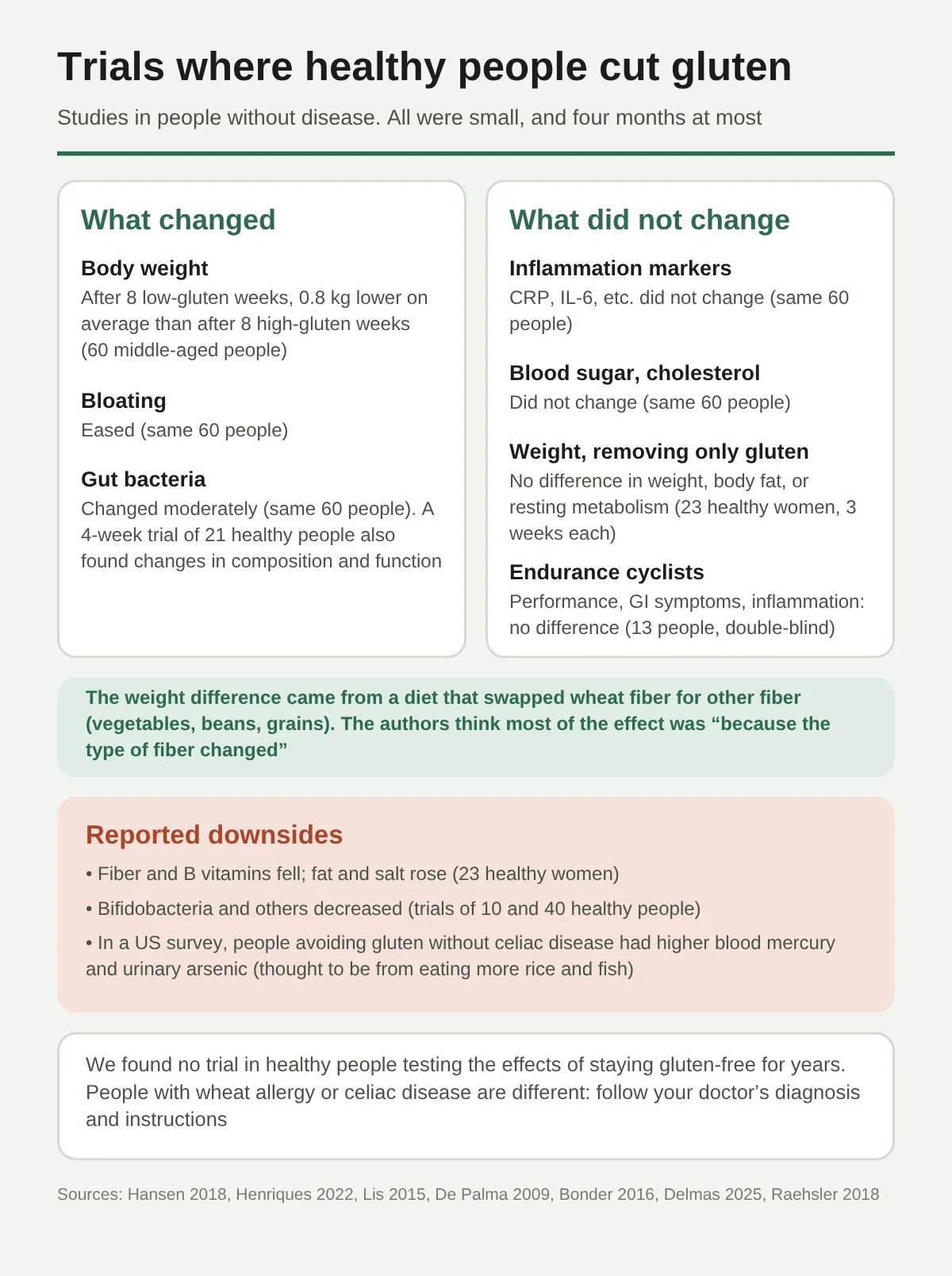
This is probably what you most want to know. We gathered studies that actually tested what happens when people without disease reduce gluten or wheat.
Trials in which healthy people reduced gluten
| Study | Who and how much | Result |
|---|---|---|
| Hansen et al. 2018 (Denmark) | 60 middle-aged people with no chronic disease. Compared a diet with 2 g of gluten a day and one with 18 g, swapping every 8 weeks (usual intake 12 g) | After the low-gluten 8 weeks, body weight was on average 0.8 kg lower and bloating eased compared with after the high-gluten 8 weeks. Gut bacteria changed moderately. Inflammation markers such as CRP, blood sugar, and cholesterol did not change. The authors think “most of the effect was because the type of dietary fiber changed” |
| Henriques et al. 2022 (Brazil) | 23 healthy women. On a gluten-free diet, muffins with 20 g of gluten a day or without, for 3 weeks each | Body weight, body fat, and resting metabolism did not differ with or without gluten. During the gluten-free period, fiber and B vitamins fell and fat and salt rose compared with usual |
| Lis et al. 2015 (Australia) | 13 endurance cyclists without celiac disease. Bars with and without gluten for 7 days each, in a way neither the athlete nor the researcher knew (double-blind) | No difference in performance, gastrointestinal symptoms, how they felt, or inflammation markers |
| De Palma et al. 2009 (Spain) | 10 healthy people, 1 month gluten-free | Bifidobacteria, lactobacilli, and others decreased; E. coli increased |
| Bonder et al. 2016 (Netherlands) | 21 healthy people, 4 weeks | The composition and function of gut bacteria changed |
| Delmas et al. 2025 (France) | 40 healthy people, a low-gluten diet for 16 weeks in total | Gut bacteria diversity fell, and bifidobacteria and others decreased |
All the trials were small and lasted four months at most. We found no trial in healthy people testing the effects of staying gluten-free for years. We also found no trial of Japanese people.
Do you lose weight?
- The 0.8 kg lower weight after 8 low-gluten weeks compared with 8 high-gluten weeks was the result of a diet in which wheat fiber was reduced and replaced with other fiber (vegetables, beans, grains) (Hansen 2018). Total fiber was the same
- In a trial that removed only gluten and kept everything else the same, body weight did not change (Henriques 2022)
- Many experiences of “I lost weight after quitting wheat” are thought to be because high-energy processed foods such as sweet buns, cake, pizza, and fried foods decreased. When you cut wheat, the store-bought foods you can eat are limited, meals become monotonous, and you eat less. This happens with any fad diet (Brouns 2013)
- In a review of studies on diet therapy for rheumatoid arthritis, people who changed their diet lost on average 3.2 kg more (Hagen 2009). In other words, body weight can drop whatever you cut out
We found no long-term trial in healthy people confirming that “gluten-free makes you lose weight.” We also found no study that tested the time frames in book titles, such as “your body changes in 2 weeks.”
Why might you feel better?
It is true that some people feel their “stomach got better” after cutting wheat. Research suggests at least two reasons:
- Not gluten but a type of sugar in wheat called “fructan” is linked to bloating and gas in some people (it is one of the group called FODMAPs; onions and garlic are also high in it)
- Symptoms get stronger just from eating something you think “contains gluten” (the nocebo effect)
On the second point, a Dutch and British study (de Graaf 2024) split 84 people who think they are sensitive to gluten into four groups, “told it contains gluten / not told” × “actually contains gluten / does not,” and had them eat bread. Symptoms were strongest in the group “told it contained gluten, and it actually did,” and the group “not told, but it contained gluten” was about the same as the group “not told, and it did not contain gluten.” This study was funded through a Dutch public-private framework, with money from companies in baking and milling and from the International Association for Cereal Science and Technology, among others.
Pooling 10 blinded trials in which people ate gluten without knowing it (1,312 people), of the 231 people classed as “gluten sensitive,” symptoms from gluten could be confirmed in 38 (16%) (Molina-Infante 2017).
Some people really do get symptoms from gluten or wheat. Celiac disease, wheat allergy, non-celiac gluten sensitivity (NCGS), and irritable bowel syndrome (IBS) and FODMAPs are explained in the article on diseases caused by wheat. Celiac disease cannot be found by a blood test unless you are eating gluten at the time, so the right order is to talk to a doctor before cutting wheat on your own.
The downsides of going gluten-free
When people without disease go gluten-free, studies have reported the following:
| Downside | What the research shows | Source |
|---|---|---|
| Fiber and B vitamins tend to drop | During a gluten-free period in healthy women, fiber and vitamins B1, B6, B12, and folate fell, and fat and salt rose | Henriques 2022 |
| Self-directed “quitting wheat” unbalances nutrition | In Australia, 34 people avoiding wheat because of symptoms were short on fiber and calcium and high in fat. Even among those who said they avoided “all wheat,” a third of their grain dishes contained wheat | Golley 2019 |
| Bacteria regarded as beneficial gut microbes decrease | In trials of healthy people, bifidobacteria and others decreased | De Palma 2009, Delmas 2025 |
| More rice tends to mean more arsenic and mercury | In a US national survey (2009–2012, 11,354 people), people who avoided gluten without having celiac disease had higher blood mercury (1.40 vs. 0.93 μg/L), lead, and urinary arsenic. This is thought to be because they eat more rice and fish | Raehsler 2018 |
| The nutrition of gluten-free foods differs from regular ones | In Spain, comparing 206 gluten-free foods with 289 regular ones, energy, fiber, salt, and more differed | Miranda 2014 |
| Fewer whole grains | Explained in the next section | Lebwohl 2017 |
US results cannot be applied directly to Japan. Still, if you eat more rice in place of wheat, the intake of inorganic arsenic, which is high in rice, tends to rise. Arsenic levels by food are collected in the Heavy Metals in Food database.
Wheat and diabetes and heart disease: the results split by whole grain versus refined
Research does not lump everything together as “wheat.” It separates whole grains (whole-wheat flour, brown rice, oatmeal, and others that keep the bran and germ) from refined grains (white flour, white rice, etc.).
Diabetes: people who ate more gluten had less
| Study | Subjects | Result |
|---|---|---|
| Zong et al. 2018 | Three follow-up studies of US health professionals, about 200,000 people (4.24 million person-years, 15,947 cases of diabetes) | The fifth of people who ate the most gluten had 20% less type 2 diabetes. The more, the less, up to about 12 g a day. Even after adjusting for the grain fiber, 13% less |
| Aune et al. 2013 (meta-analysis) | 16 follow-up studies | Whole grains: 32% less type 2 diabetes for every 3 additional servings a day. Refined grains: no relationship (0.95). White rice was on the “more” side; whole-grain bread, bran, and brown rice on the “less” side |
| Hu et al. 2020 | Three US follow-up studies, about 195,000 people | 29% less diabetes among those who ate more whole grains. People who ate 1 or more servings a day of dark bread had 21% less than those who ate less than 1 serving a month |
| JPHC Study (Nanri et al. 2010, Japan) | 25,666 men and 33,622 women aged 45–75, followed for 5 years | Among women who ate the most white rice, type 2 diabetes was 1.65 times higher. Not clear for men |
In diabetes, it is whole grains that show “the more, the less,” and white rice that has been reported on the “more” side. We found no result showing that wheat or gluten in particular is bad. “Quitting wheat and eating more white rice” could go in the opposite direction from the Japanese study’s results.
Heart disease: avoiding gluten reduces whole grains
In a study that followed about 110,000 US health professionals for 26 years (Lebwohl 2017, BMJ):
- Between the people who ate the most gluten and those who ate little, there was no difference in coronary heart disease such as myocardial infarction (hazard ratio 0.95)
- After adjusting for refined grains, that is, limited to gluten from whole grains, those who ate more had 15% less (0.85)
- The authors conclude that “avoiding gluten may reduce healthy whole grains, and gluten-free eating should not be recommended to people without celiac disease”
This study did not examine “people who avoided gluten”; it split people by the amount of gluten. You may see it described as “heart disease increased in people who avoided gluten,” but that is not accurate.
Death and cancer: whole grains on the “less” side
| Study | Subjects | Result |
|---|---|---|
| Aune et al. 2016 (BMJ, meta-analysis) | 45 follow-up studies | For every 90 g (3 servings) a day of additional whole grains: coronary heart disease 0.81, cardiovascular disease 0.78, cancer mortality 0.85, all-cause mortality 0.83. Whole-grain bread and bread overall were also on the “less” side. Refined grains, white rice, and grains overall were almost unrelated |
| PURE Study 2021 (21 countries) | About 148,000 people, median 9.5 years | People who ate 350 g or more a day of refined grains (about 7 servings) had 1.27 times the mortality and 1.33 times the cardiovascular disease of those who ate less than 50 g. Whole grains and white rice were unrelated |
| Takayama Study (Japan, Wada 2022) | About 29,000 men and women in Takayama, Gifu Prefecture | Bread and noodles were unrelated to death from cardiovascular disease. For rice, more was linked to less in men (they tended to eat it with soybeans and seaweed) |
The PURE Study’s “350 g or more a day” cannot be compared directly with Japanese intake, because each country’s questionnaire counts amounts differently. The relationship between wheat and colorectal or stomach cancer is summarized in the article on flour and cancer and article on stomach cancer and diet.
Choosing whole-wheat flour
What fits the research results is not “quitting wheat” but replacing part of your white flour and white bread and noodles with whole-grain versions. Options include mixing whole-wheat flour into your usual bread flour or all-purpose flour, or swapping part of your pasta for a whole-wheat one. Whole-grain rye bread (Mestemacher Bio Vollkornbrot) and oatmeal (Nissoku Premium Pure Oatmeal) are also whole grains.
It is known that pesticides remaining in the bran are more likely to remain in whole-wheat flour than in white flour (article on gluten and spelt), so one option is to choose products whose origin and growing method are known. Here we introduce a whole-wheat flour made from Japanese-grown wheat and an organically grown whole-wheat spaghetti.
Note Most research on whole grains is observational, looking at “what kind of diet the people with fewer diseases had.” It has not been proven that switching to whole-wheat flour prevents disease. People with wheat allergy or celiac disease cannot eat whole-wheat flour either.
Does wheat cause inflammation? Is it bad for the gut?
Inflammation
On the claim that “wheat causes inflammation in the body,” the research in people without disease is as follows:
- In an 8-week trial in which healthy people cut gluten to 2 g a day, inflammation markers such as CRP and IL-6 did not change (Hansen 2018)
- In the double-blind trial of endurance athletes, there was no difference in inflammation markers either (Lis 2015)
- A pooled analysis of 14 trials that increased whole grains (1,238 people) found CRP tended to fall slightly, but not clearly (Rahmani 2020)
We found no trial in healthy people that supports “wheat causes inflammation.”
What about “holes in the gut” and “sticking to the intestines”?
- Studies saying “gluten widens the gaps in the gut (leaky gut)” are mainly experiments on isolated intestinal tissue and cells, and it is not known what happens inside the body of a healthy person. Details are in the article on gluten and spelt
- We found no study or public document that tested “gluten sticks to the intestines.” Gluten is broken down by enzymes in the stomach, pancreas, and small intestine. However, some peptides resist breakdown, and in people with celiac disease they trigger an immune reaction (Shan 2002)
- If wheat gives you bloating or diarrhea, FODMAPs or irritable bowel syndrome may be the cause (article on diseases caused by wheat)
Does wheat cause dementia? What about depression?
Dementia
The Mayo Clinic study featured in Grain Brain (Roberts 2012) followed 937 older adults in the US (median age 79.5) for about 3.7 years.
- The result was that people with a high share of dietary energy from carbohydrate had 1.89 times the mild cognitive impairment and dementia, and people with a high share from fat had 0.56 times
- It was not a study of gluten or wheat. The “3.6 times” figure you see in articles about it was not in the paper’s abstract
In studies that examined gluten itself:
- Among 13,494 female nurses in the US (mean age 60.6, mean gluten intake 6.3 g a day), there was no relationship between the amount of gluten eaten and cognitive function (Wang 2021)
- Even among 8,846 people with celiac disease, dementia overall was not increased (Lebwohl 2016)
We found no study showing a relationship between gluten and dementia in people without disease. Dietary oils and dementia are covered in the article on oils and dementia/depression.
Depression
- In a trial of 22 people with irritable bowel syndrome who think they are sensitive to gluten and whose symptoms had settled on a gluten-free diet, they ate gluten, whey, and a placebo for 3 days each. With gluten, depression scores were slightly higher than with the placebo (Peters 2014). There was no difference from whey, and gastrointestinal symptoms were the same in all three
- A pooled analysis of 13 studies (1,139 people) found that depressive symptoms improved with a gluten-free diet in patients with celiac disease and similar conditions, but in trials where people who think they are sensitive to gluten ate gluten blind, there was no clear difference (Busby 2018)
We found no study showing that “quitting wheat improves depression” in people other than patients with celiac disease and similar conditions. If a low mood persists, talk to a doctor before changing your diet.
Wheat and autism: studies of gluten-free, casein-free diets
Overseas, diets without gluten (wheat) and casein (a milk protein) have been tried in children with autism spectrum disorder.
| Study | What it was | Result |
|---|---|---|
| Keller et al. 2021 (meta-analysis) | 6 randomized controlled trials, 143 people | No effect on core autism symptoms, daily functioning, or behavior. Possible gastrointestinal side effects. Quality of evidence “low to very low” |
| Quan et al. 2022 (meta-analysis) | 8 studies, 297 people | Reports improved stereotyped behavior and cognition, but most were trials in which the person or rater knew the diet (single-blind) |
| Piwowarczyk et al. 2020 | 66 people for 6 months, randomized controlled trial | No difference |
| Hyman et al. 2016 | 14 people, double-blind challenge with gluten and casein | No difference |
| Pusponegoro et al. 2015 | 74 people, 7 days eating gluten and casein | No worsening of symptoms |
The pooled studies reached split conclusions, and the high-quality trials showed “no difference.” We found no basis to recommend it in general. Restricting the diet may also unbalance nutrition, so it should be decided in consultation with the child’s doctor.
Does quitting wheat cure atopic dermatitis, rough skin, and hay fever?
Atopic dermatitis
A pooled analysis of 10 trials of food-elimination diets in atopic dermatitis (599 people, median age 1.5 years) (Oykhman 2022) found that 50% versus 41% improved, a “slight, possibly unimportant improvement” (low certainty). It also points out:
- Eliminating foods may instead cause IgE-mediated food allergy
- Treatment that works better may be delayed
If wheat allergy has been diagnosed, that is a different matter and you follow the doctor’s instructions (article on diseases caused by wheat).
Rough skin and acne
A review of studies on skin diseases and gluten (Chakraborty 2024) says gluten restriction is unnecessary for the great majority of skin diseases, and that the evidence for acne and atopic dermatitis was of the lowest grade. For psoriasis, there are reports that a gluten-free diet may help people who have specific antibodies. The skin disease seen in celiac disease (dermatitis herpetiformis) is a separate matter.
Hay fever
We found no study showing that quitting wheat improves hay fever.
There is a story in the opposite direction. Of 72 children with grass-pollen hay fever, 60% also had IgE antibodies to wheat (none of the 72 had a diagnosis of wheat allergy, and all were children who usually ate wheat) (Nilsson 2018). In Japan, 6 cases of “pollen-related wheat allergy,” in which antibodies to grass pollen also react to wheat proteins, have been reported (Ogino 2021). If you have hay fever and feel symptoms from wheat, you need a doctor’s diagnosis.
Wheat and rheumatoid arthritis and headaches
Rheumatoid arthritis
- In a one-year trial (Hafström 2001) that split 66 people with active rheumatoid arthritis into a “gluten-free vegan diet” group and a normal diet group, the proportion whose symptoms improved was higher among those who kept it up for 9 months or more (40.5% versus 4%). However, it was a diet that also removed meat and dairy, so the effect of gluten alone is unknown
- A Cochrane review of 15 diet-therapy trials (837 people) (Hagen 2009) concluded that the effect was unclear, many people dropped out because they could not keep it up, and body weight fell
We found no trial that removed gluten alone.
Headaches
There are reports that 26% of adults with celiac disease have headaches, and that 2.4% of children with headaches of unknown cause had celiac disease. In people with celiac disease, a gluten-free diet is said to relieve headaches in many cases (Zis 2018). On the other hand, we found no trial testing whether quitting wheat reduces headaches in people without celiac disease. If headaches persist, the right order is to consult a doctor, including whether you need a test for celiac disease.
Has the way Japanese people eat wheat changed? (National Health and Nutrition Survey)
Almost flat for 50 years
In the MHLW National Health and Nutrition Survey, “wheat and wheat products” per person per day went from 90.2 g in 1975 to 102.4 g in 2024. It has barely changed in 50 years.
| Year | Wheat and products (g/day) | Rice and products (g/day) |
|---|---|---|
| 1975 | 90.2 | 248.3 (raw rice) |
| 1995 | 93.7 | 167.9 (raw rice) |
| 2001 | 99.6 | 356.3 (cooked rice) |
| 2010 | 100.1 | 332.0 (cooked rice) |
| 2019 | 99.4 | 301.4 (cooked rice) |
| 2024 | 102.4 | 293.5 (cooked rice) |
Since 2001, rice has been counted by “the weight of cooked rice,” so it cannot be compared with 2000 and earlier. Even so, over the 23 years from 2001, rice fell by about 18% and wheat stayed about the same. In the MAFF Food Balance Sheet too, the supply of wheat per person has been roughly constant at 31–33 kg a year since fiscal 1975 (the article on flour and cancer graphs the 50-year trend).
There is a story that “disease increased as Japanese people started eating wheat,” but wheat increased only until the 1960s and early 1970s, and has been flat for the 50 years since.
Japanese wheat is “more noodles than bread”
Looking at the breakdown of the 102.4 g of wheat and products in 2024:
- Noodles, about 55 g (54%): udon and Chinese noodles 39.1 g, pasta 11.4 g, instant noodles 4.8 g
- Bread, about 38 g (37%): bread 33.3 g, sweet bread 4.7 g
- Other, about 9 g: other wheat products 5.3 g, flours 3.8 g
The same pattern held in 2018, 2019, 2022, and 2023. We tend to think “quitting wheat = quitting bread,” but more than half of the wheat Japanese people eat is noodles. In terms of GI too, udon (55) and spaghetti (49) have lower values than bread (75) and white rice (73). The salt in noodle broth is calculated in the article on stomach cancer and diet.
Our own estimate: Japanese people eat about 4 to 6 g of gluten a day
How much gluten do Japanese people eat a day? There is no official figure, so we estimated it from the breakdown in the National Health and Nutrition Survey (2024) and the protein values in the Standard Tables of Food Composition in Japan (8th revised edition).
| Item | Intake (g/day) | Assumed protein share | Protein (g) |
|---|---|---|---|
| Bread (excl. sweet bread) | 33.3 | Shokupan and dinner rolls 7.8–10.1% | 2.6–3.4 |
| Sweet bread | 4.7 | Anpan and melon pan 6.6–8.0% | 0.3–0.4 |
| Udon and Chinese noodles | 39.1 | Boiled udon to boiled Chinese noodles 2.6–4.9% | 1.0–1.9 |
| Pasta | 11.4 | Boiled 5.8% | 0.7 |
| Instant noodles | 4.8 | Boiled to dry 3.4–10.1% | 0.2–0.5 |
| Other wheat products | 5.3 | 6–10% | 0.3–0.5 |
| Flours | 3.8 | Cake flour to bread flour 8.3–11.8% | 0.3–0.4 |
| Total | 102.4 | about 5.4–7.8 |
Taking gluten as 70–80% of wheat protein (Kasarda, Brouns), 5.4 g × 70% = about 3.8 g to 7.8 g × 80% = about 6.2 g, so Japanese people eat about 4 to 6 g of gluten a day (using the FSCJ’s figure of about 85%, the upper end is about 6.6 g).
| Whose figure | Gluten (g/day) |
|---|---|
| Japanese average (this article’s estimate) | about 4–6 |
| Average of female US nurses (Wang 2021) | 6.3 |
| Usual intake of Danish adults (Hansen 2018) | 12 |
| The “low-gluten” period in the Danish trial | 2 |
| The range over which “more means less diabetes” continued in the US study (Zong 2018) | up to 12 |
It is hard to say Japanese people eat “too much gluten.” However, this is a rough estimate, with a range that depends on which food composition values are chosen and how the weight of instant noodles is handled. The US figures are estimates from questionnaires and use different methods.
More than 80% of wheat is imported
- Japan’s wheat self-sufficiency rate is 16% (MAFF)
- In 2024, wheat imports were 5.21 million tons, almost all from three countries: 2.11 million tons from the US, 2.01 million tons from Canada, and 1.09 million tons from Australia (wheat grain only)
- The share using Japanese-grown wheat is under 10% for bread and Chinese noodles, and about 60% for Japanese noodles such as udon (MAFF, “Circumstances Surrounding Wheat Production,” May 2026 [Reiwa 8]; interviews with end users in fiscal 2023)
Pesticide residues in imported wheat are summarized in the article on gluten and spelt and the article on post-harvest pesticides.
Is it true that “people abroad have stopped eating wheat”?
Only partly.
| Country | What is known | Source |
|---|---|---|
| US | People who are gluten-free without having celiac disease: 0.52% in 2009–10 → 0.99% in 2011–12 → 1.69% in 2013–14. Celiac disease over the same period was flat: 0.70% → 0.77% → 0.58% | Analysis of the US National Health and Nutrition Examination Survey (NHANES) (Kim 2016; as a research letter, the figures were confirmed through news reports) |
| US | In a 2015 poll, about 1 in 5 people said they “actively include gluten-free foods” (25% of those under 50) | Gallup |
| Australia | Of 1,184 adults, 7.3% excluding celiac disease avoided wheat because it “makes them feel unwell.” Only 5.7% of them had a formal diagnosis | Golley 2015 |
| Athletes | 41% of athletes without celiac disease were gluten-free at least half the time | Lis 2015 |
In the US, the number of people avoiding gluten has tripled. Still, it is under 2% of the population. And American wheat flour intake was reported in 2023 at about 58 kg per person (the lowest in 37 years) (a US Department of Agriculture estimate reported by an industry paper), about 1.8 to 1.9 times the Japanese figure for wheat (about 31–32 kg a year) (an approximate comparison, since the counting methods differ). “Some people have started avoiding it, but overall they still eat more than Japan” is closer to reality than “people abroad have stopped eating wheat.”
Is it true that bread is bad for you? Or a lie?
“Bread is bad for you” is also a commonly searched phrase. Here is what the research shows:
- The GI (how easily blood sugar rises) is 75 for white bread and 74 for whole-wheat bread, about the same as white rice (73)
- In a pooled analysis of 45 follow-up studies, not only whole-grain bread but bread overall was on the “less” side for cardiovascular disease and death (Aune 2016)
- In Japan’s Takayama Study, bread and noodles were unrelated to death from cardiovascular disease (Wada 2022)
- On the other hand, there are reports that people who eat a lot of white bread have slightly more colorectal cancer. However, the number of studies is small, and it has not been possible to tell whether white bread is the cause or whether the lack of whole-grain foods is (article on flour and cancer)
- Sweet bread is bread dough with sugar, fat, red bean paste, and so on added. The “refined grains” in studies often include sweets and processed foods such as cakes, doughnuts, and pizza, so it is said to be hard to separate them from the effect of wheat flour itself (article on flour and cancer)
We found no data that lets you lump together “bread is bad for you.” What makes the difference is whole grain versus white, and what you eat it with and how much. How to read the ingredient labels can be checked on Urayomi’s bread product pages.
So how should you deal with wheat? (Only the facts the research shows)
Here are the facts the research has established, and nothing more.
- We found no basis in research for people without disease to avoid gluten. Avoiding it makes fiber, B vitamins, and whole grains more likely to drop
- Results split by whole grain versus refined. For whole grains, results consistently point toward less diabetes, heart disease, and death. For refined grains, many studies show “no relationship,” but in the PURE Study, mortality was higher among people who ate a very large amount, 350 g or more a day
- Amount: Japanese people eat about 100 g of wheat a day, and an estimated 4–6 g of gluten, which is on the low side compared with the countries in the research
- What you eat it with: what is linked to foods you can’t stop eating was processed foods high in fat, sugar, and salt. If you lump together sweet buns, fried foods, and pizza with udon and whole-wheat bread as “wheat,” you get the wrong answer
- People with wheat allergy or celiac disease are a separate case. Follow a doctor’s diagnosis and instructions (article on diseases caused by wheat)
- If you have ongoing symptoms, talk to a doctor before cutting out wheat on your own, because the test for celiac disease does not give a correct result unless you are eating gluten
Items featured in this article (summary)
Here are the items featured in the article, once more. The reasons and ingredients are given in each section.
| Item | Where to buy |
|---|---|
| Ebetsu Seifun Whole-Wheat Flour for Bread, 1 kg (100% Hokkaido wheat) | See on Rakuten (こだわり食材 572310.com) PR |
| Alce Nero Organic Whole-Wheat Spaghetti 1.6 mm, 500 g | See on Rakuten (楽天24) PR See on Amazon.co.jp PR |
Summary
| Question | What we found |
|---|---|
| Where does “wheat is bad for you” come from? | The US books Wheat Belly (2011), Grain Brain (2013), and Djokovic’s book (2013). The Japanese editions came out in 2013–2015, and Japanese books followed around 2016 |
| Is modern wheat a different thing from old wheat? | Breeding has not increased gluten (comparison of 60 German varieties, etc.). The source of the short varieties is Japan’s Norin 10. No genetically modified wheat has passed review in Japan |
| Is wheat addictive? | Exorphins are a test-tube and rat story. No study has shown dependence in humans |
| What happens if you quit wheat? Do you lose weight? | In trials of healthy people with 8 weeks each, body weight was 0.8 kg lower in the low-gluten period than in the high-gluten period and bloating eased, but inflammation markers did not change. In a trial that removed only gluten, no difference in weight. No long-term trials |
| What are the downsides of going gluten-free? | Fiber, B vitamins, and whole grains tend to drop. Bacteria regarded as beneficial gut microbes decreased in some trials. More rice tends to mean more arsenic |
| Diabetes and heart disease? | People who ate more gluten had less diabetes and no relationship with heart disease. Whole grains are on the “less” side. The result on the “more” side in Japan is for white rice |
| Dementia, depression, autism, atopic dermatitis, hay fever? | No solid study showing that “quitting wheat cures it” in ordinary people without disease was found |
| Has Japanese wheat intake increased? | Almost flat for 50 years (90 g → 102 g a day). More than half is noodles. Gluten is an estimated 4–6 g a day |
| Have people abroad stopped eating wheat? | 1.69% of Americans avoid gluten (2013–14). Americans still eat nearly twice as much wheat flour as Japanese people |
Sources
Where the claims come from
- National Diet Library Search (“小麦は食べるな!” Nihon Bungeisha 2013; “「いつものパン」があなたを殺す” Mikasa Shobo 2015 and 2021; “ジョコビッチの生まれ変わる食事” Sangokan 2015; and others)
- Original works: Perlmutter D, Loberg K. Grain Brain. Little, Brown and Company, 2013 / Djokovic N. Serve to Win. Bantam Press (UK), 2013
- Brouns FJ, et al. Does wheat make us fat and sick? J Cereal Sci 2013
- Hammond C, Lieberman JA. Unproven diagnostic tests for food allergy. Immunol Allergy Clin North Am 2018 (PMID 29132671)
- Lis D, et al. Exploring the popularity, experiences, and beliefs surrounding gluten-free diets in nongluten athletes. Int J Sport Nutr Exerc Metab 2015 (PMID 24901744)
Modern wheat and genetic modification
- Kasarda DD. Can an increase in celiac disease be attributed to an increase in the gluten content of wheat as a consequence of wheat breeding? J Agric Food Chem 2013 (PMID 23311690)
- Pronin D, et al. J Agric Food Chem 2020 (PMID 32648759) / Pronin D, et al. Food Chem 2021 (PMID 33152854) / Geisslitz S, et al. NPJ Sci Food 2023 (PMID 37612428) / Shewry PR. Nutr Bull 2020 (PMID 33380903)
- NARO, “NORIN TEN: the Japanese wheat that saved humanity from famine” https://www.naro.go.jp/topimg/norinten.pdf
- Toyama Prefecture, “Gonjiro Inazuka (the miracle wheat that produced a Nobel Prize)” https://www.pref.toyama.jp/documents/11861/p70-71.pdf (breeding at the Iwate Prefecture Agricultural Experiment Station, development in 1935, Dr. Borlaug’s 1970 Nobel Peace Prize)
- The Nobel Prize, “The Nobel Peace Prize 1970: Norman Borlaug” https://www.nobelprize.org/prizes/peace/1970/borlaug/
- Consumer Affairs Agency, “List of genetically modified foods and additives that have been announced as having gone through the safety review procedure” (as of July 8, 2026)
- Lohi S, et al. Aliment Pharmacol Ther 2007 (PMID 17944736) / Rubio-Tapia A, et al. Gastroenterology 2009 (PMID 19362553)
Addiction and GI
- Zioudrou C, et al. J Biol Chem 1979 (PMID 372181) / Fukudome S, Yoshikawa M. FEBS Lett 1992 (PMID 1309704), 1993 (PMID 8422933) / Fukudome S, et al. Life Sci 1995 (PMID 7637543)
- Brouns F, Shewry PR. Do gluten peptides stimulate weight gain in humans? Nutr Bull 2022 (PMID 35915782)
- Schulte EM, et al. PLoS One 2015 (PMID 25692302)
- Dohan FC. Am J Clin Nutr 1966 (PMID 5900428) / Lachance LR, et al. Schizophr Res 2014 (PMID 24368154)
- Atkinson FS, et al. International Tables of Glycemic Index and Glycemic Load Values: 2008. Diabetes Care 2008 (PMC2584181)
- Sugiyama M, et al. Eur J Clin Nutr 2003 (PMID 12792658)
Trials that reduced gluten, and downsides
- Hansen LBS, et al. A low-gluten diet induces changes in the intestinal microbiome of healthy Danish adults. Nat Commun 2018 (PMID 30425247)
- Henriques HKF, et al. J Am Nutr Assoc 2022 (PMID 34516338) / Lis DM, et al. Med Sci Sports Exerc 2015 (PMID 25970665)
- De Palma G, et al. Br J Nutr 2009 (PMID 19445821) / Bonder MJ, et al. Genome Med 2016 (PMID 27102333) / Delmas C, et al. Nutrients 2025 (PMID 40805974)
- de Graaf MCG, et al. Lancet Gastroenterol Hepatol 2024 (PMID 38040019) / Molina-Infante J, et al. Clin Gastroenterol Hepatol 2017 (PMID 27523634)
- Raehsler SL, et al. Clin Gastroenterol Hepatol 2018 (PMID 28223206) / Miranda J, et al. Plant Foods Hum Nutr 2014 (PMID 24578088) / Golley S, et al. Nutr Diet 2019 (PMID 30873744)
Diabetes, heart disease, and death
- Zong G, et al. Diabetologia 2018 (PMID 30074058) / Aune D, et al. Eur J Epidemiol 2013 (PMID 24158434) / Hu Y, et al. BMJ 2020 (PMID 32641435) / Nanri A, et al. Am J Clin Nutr 2010 (PMID 20980490)
- Lebwohl B, et al. Long term gluten consumption in adults without celiac disease and risk of coronary heart disease. BMJ 2017 (PMID 28465308)
- Aune D, et al. BMJ 2016 (PMID 27301975) / Swaminathan S, et al. BMJ 2021 (PMID 33536317) / Wada K, et al. Nutrients 2022 (PMID 35684091)
Inflammation, dementia, depression, autism, skin, rheumatoid arthritis, headaches
- Rahmani S, et al. Adv Nutr 2020 (PMID 31301131) / Shan L, et al. Science 2002 (PMID 12351792)
- Roberts RO, et al. J Alzheimers Dis 2012 (PMID 22810099) / Wang Y, et al. JAMA Netw Open 2021 (PMID 34019084) / Lebwohl B, et al. J Alzheimers Dis 2016 (PMID 26444775)
- Peters SL, et al. Aliment Pharmacol Ther 2014 (PMID 24689456) / Busby E, et al. Nutrients 2018 (PMID 30413036)
- Keller A, et al. Nutrients 2021 (PMID 33573238) / Quan L, et al. 2022 (PMID 34617108) / Piwowarczyk A, et al. 2020 (PMID 31659595) / Hyman SL, et al. 2016 (PMID 26343026) / Pusponegoro HD, et al. 2015 (PMID 26148018)
- Oykhman P, et al. J Allergy Clin Immunol Pract 2022 (PMID 35987995) / Chakraborty A, et al. Indian J Dermatol 2024 (PMID 38841247)
- Nilsson N, et al. Int Arch Allergy Immunol 2018 (PMID 29894999) / Ogino R, et al. Allergol Int 2021 (PMID 33616048)
- Hafström I, et al. Rheumatology 2001 (PMID 11600749) / Hagen KB, et al. Cochrane Database Syst Rev 2009 (PMID 19160281) / Zis P, et al. Nutrients 2018 (PMID 30301194)
Japanese people and wheat, and trends abroad
- MHLW, National Health and Nutrition Survey (1975–2024, e-Stat)
- MEXT, Standard Tables of Food Composition in Japan (8th revised edition), 2023 supplement, Cereals
- MAFF Tokai Regional Agricultural Administration Office, “Wheat,” and “Outlook for Wheat Supply and Demand” (March 2026 [Reiwa 8]), and MAFF Food Balance Sheet
- Kim HS, et al. JAMA Intern Med 2016 (PMID 27598396) / Gallup, “One in Five Americans Include Gluten-Free Foods in Diet” (July 2015) / Golley S, et al. Public Health Nutr 2015 (PMID 24739252)
- US Department of Agriculture Economic Research Service, per-person wheat flour supply (2023; confirmed through an industry paper’s report)
(Checked October 8, 2026)
Related articles and databases
- Diseases Caused by Wheat: How Wheat Allergy, Celiac Disease, and Gluten Sensitivity Differ, and Why They Can Suddenly Start in Adulthood
- Does Eating Too Much Wheat Flour Cause Colorectal Cancer? Checking the Link Between Wheat and Cancer Against Studies and Government Data
- What is spelt wheat? Does gluten make holes in the gut? Checking “leaky gut” and pesticides in imported wheat against papers and national data
- Which foods raise the risk of stomach cancer? Salt, H. pylori, wheat, and charred grilled fish, checked against national evaluations and studies