
Does Eating Too Much Oil Cause Dementia or Depression? What Studies Show

PR This article contains ads. The “See on Rakuten” and “See on Amazon” links are affiliate ads for Rakuten Ichiba and Amazon. What is written here is based on published studies and materials from public agencies, whether or not there is an ad. The “See on Amazon.co.jp” and “See on Yahoo! Shopping” links are also affiliate links.
There is a view that we should avoid polyunsaturated fatty acids (PUFA) such as the linoleic acid that is abundant in vegetable oils (sometimes called “PUFA-free”; among books, 『[図解]その油が寿命を縮める』 (an illustrated guide: “That Oil Shortens Your Life”) and 『オメガ3神話の真実』 (“The Truth About the Omega-3 Myth”) are examples). Within that view, it is also said that “eating too much oil causes Alzheimer’s disease and depression.”
This article sorts out how much is actually known, focusing on studies in people.
Differences in what is in each type of vegetable oil, and how to read “vegetable oils and fats” (植物油脂) on a label, are covered in the article on vegetable oils and fats.
First, a Few Terms
- Polyunsaturated fatty acids (PUFA): Fatty acids with two or more double bonds in the molecule. They oxidize easily
- n-6 (omega-6): Represented by linoleic acid, which is abundant in soybean oil, corn oil, and similar oils
- n-3 (omega-3): Alpha-linolenic acid in canola oil, perilla oil, and similar oils, and the EPA and DHA that are abundant in fish
- 4-HNE (4-hydroxynonenal): A substance formed when polyunsaturated fatty acids oxidize (a type of aldehyde formed from lipid peroxides)
Dementia (Alzheimer’s Disease)
What is certain: lipid peroxides are increased in the brains of people with Alzheimer’s disease
In studies that examined the brains of people after death, 4-HNE was increased in places such as the hippocampus of people with Alzheimer’s disease. There are also reports that it was increased in the hippocampus even in people at a stage before symptoms appear.
However, this shows that “oxidation is occurring in the brain,” and whether the oil people ate is the cause is a separate question. In an experiment that increased the linoleic acid in mouse feed, oxidation products derived from linoleic acid in the brain increased, but 4-HNE in the brain did not.
Follow-up studies in people: the results do not agree
| Study | Result |
|---|---|
| 815 older adults in Chicago, U.S. (2003) | People who ate more saturated fat had 2.2 times the Alzheimer’s disease, and people who ate more trans fat had 2.4 times. On the other hand, the more vegetable fat people ate, the lower the risk. n-6 fatty acids also tended to be lower (not statistically clear) |
| Cognitive function of 2,560 older adults in the same Chicago study, followed for 6 years (2004) | People who ate more saturated and trans fat had faster cognitive decline. The amount of vegetable fat itself was not related. Decline was slower in people with a higher ratio of polyunsaturated to saturated fat (an analysis limited to some people) |
| 8,085 older adults in three French cities (2007) | People who always used n-6-rich oils and did not make up for it with n-3 oils or fish had 2.12 times the dementia (among people without the gene type that makes Alzheimer’s disease more likely). People who ate fish at least once a week had less Alzheimer’s disease |
| A study using genes (2024) | The more a person’s constitution makes linoleic acid a larger share of the fatty acids in the blood, the better their score on cognitive function tests |
There is no consistent result that lets us say “eating vegetable oil causes dementia.” On the other hand, as in the French study, there are also reports that a diet skewed toward n-6 and low in fish and n-3 carried a higher risk.
Depression
People who ate fried food often had more anxiety and depression
In a study that followed about 140,000 people (2023), people who ate fried food often had 12% more anxiety and 7% more depression than those who did not, and the link was strongest for French fries. However, what this study examined as a mechanism was not the oil itself but acrylamide formed in the frying process (in an experiment on a type of fish). It is also an observational study, so it could not separate the effect from that of the whole diet of people who eat a lot of fried food.
Linoleic acid and depression: few studies, and not settled
| Study | Result |
|---|---|
| 4,856 adults in Finland, followed for about 10 years (2009) | In men who ate more linoleic acid, major depressive state was 2.34 times as common. In women, those who ate more oleic acid, abundant in olive oil, had less |
| 3,362 adults in Iran (2022, a one-time survey) | Depression was 1.41 times as common in people with more linoleic acid. The authors themselves say “confirmation in follow-up studies is needed” |
There are studies showing a link, but they are few, and the same result has not yet been confirmed repeatedly.
Do n-3 (omega-3) supplements improve depression?
In a Cochrane analysis that pooled clinical trials (2021), depression symptoms improved slightly, but it could not be called a clinically meaningful difference, and the certainty of the evidence was judged “very low.” At present we can say neither that “omega-3 cures depression” nor that “omega-3 makes depression worse.”
Often Cited, but Worth Handling with Care
Among the studies often brought up in the talk about vegetable oil and the brain, some are presented in a way that does not match what the paper says.
- A mouse study in which soybean oil changed genes in the brain (2020): It is true that in mice fed soybean oil, the activity of genes in the brain (the hypothalamus) changed. However, similar changes occurred even with a soybean oil reduced in linoleic acid, so the authors presume, for the change in the oxytocin (hormone) gene that was at the center of the changes, that “linoleic acid is not the cause”
- A study in which mice lost memory after eating a high-fat diet for 3 days (2024): The change occurred only in mice genetically modified to develop Alzheimer’s disease, and not in ordinary mice. It was also not a study of vegetable oil alone
- A study saying formaldehyde formed in the brain by stress is involved in depression (2025): What the paper examined was the relationship between stress and formaldehyde, and it did not examine a relationship with the oil people ate
Summary
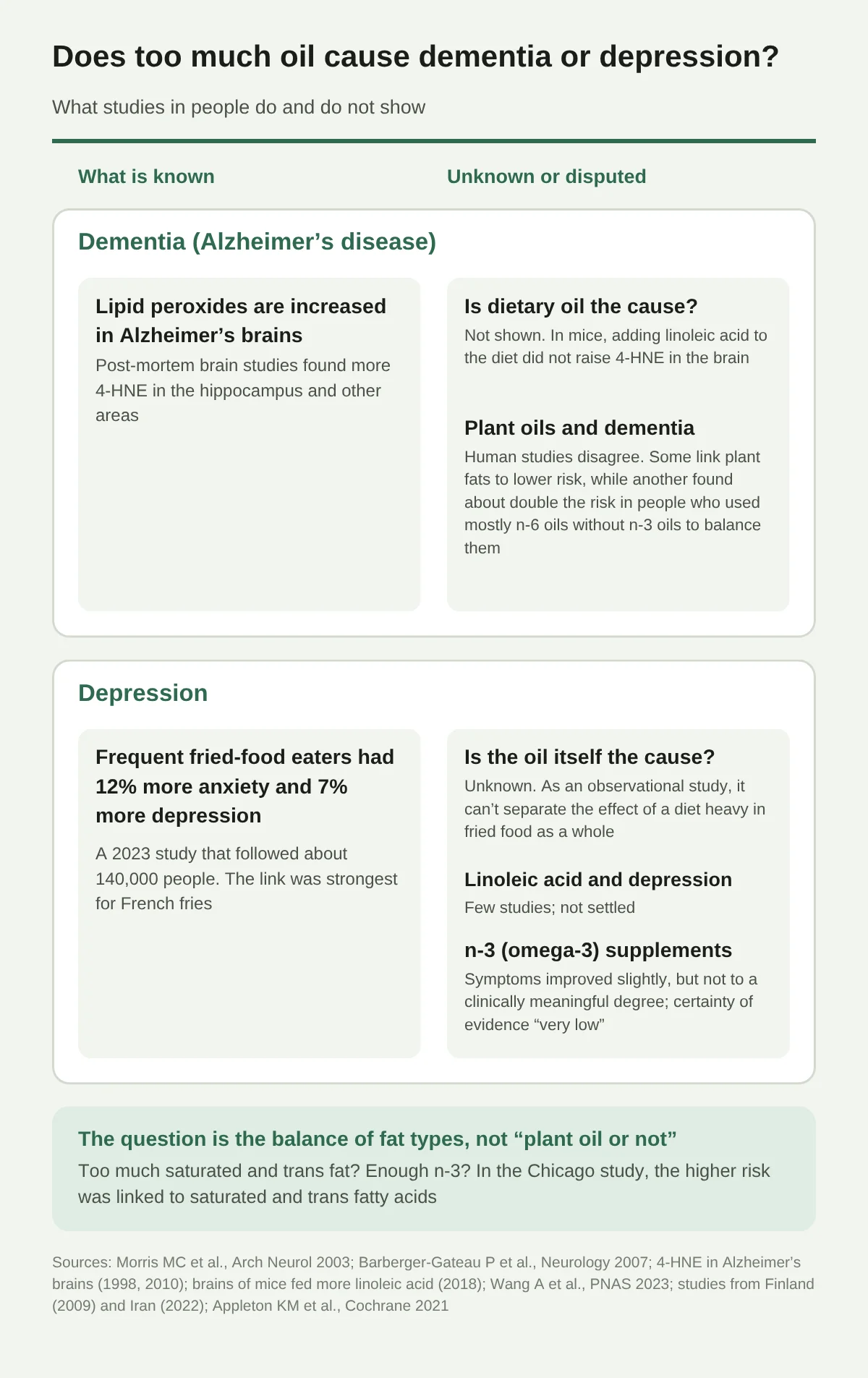
- It is certain that lipid peroxides are increased in the brains of people with Alzheimer’s disease. However, it has not been shown that the oil people ate is the cause
- Studies of vegetable oil and people with dementia are divided. There are studies in which vegetable fat was actually linked to lower risk, and also a study in which people who used mostly n-6 oils without making up for it with n-3 had about twice the risk. In the Chicago studies, it was saturated fat and trans fat that carried the higher risk
- In other words, what matters is less “vegetable oil or not” than the balance of types of fat (whether saturated and trans fat are too high, and whether n-3 is sufficient)
- A link between a diet heavy in fried food and anxiety and depression has appeared in a large study. However, it is not known whether the oil itself is the cause
- Eating n-3 foods such as fish, rather than skewing toward n-6, does not contradict the studies on either side
Foods that make it easy to get n-3
If you want to add n-3 to your everyday diet, there are fish (EPA and DHA) and oils rich in alpha-linolenic acid. These are chosen as foods, not supplements.
| What it contains | Ingredient list (原材料名) | Where to buy | |
|---|---|---|---|
| Umios さば水煮 食塩不使用 (Umios boiled mackerel, no salt added) | Fish fat (EPA and DHA) | さば (mackerel, domestic) | See on Rakuten PR See on Amazon.co.jp PR See on Yahoo! Shopping PR |
| ニップン アマニ油 (Nippn flaxseed oil) | 57 g of every 100 g is n-3 (alpha-linolenic acid). Used drizzled on food without heating | アマニ (flaxseed) | See on Rakuten PR See on Amazon.co.jp PR See on Yahoo! Shopping PR |
Note The foods introduced here do not prevent or cure dementia or depression. The numbers are from the fatty acid composition table in the MEXT “Standard Tables of Food Composition in Japan (Eighth Revised Edition), 2023 Supplement” (for details, see the article on vegetable oils and animal fats).
Urayomi’s Way of Thinking
There are no studies in people that say “oil damages the brain.” On the other hand, there are warning signs for a diet heavy in fried food and for a diet skewed toward n-6. Either way, unless you first know what oil is being used, you cannot even think about balance. On product pages, Urayomi will check whether the type of oil is shown and write about it. For how to tell oils apart, see the article on vegetable oils and fats.
Sources
- Morris MC, et al. Arch Neurol 2003, doi:10.1001/archneur.60.2.194 (types of fat and Alzheimer’s disease)
- Morris MC, et al. Neurology 2004, doi:10.1212/01.WNL.0000123250.82849.B6 (fat intake and changes in cognitive function over 6 years)
- Barberger-Gateau P, et al. Neurology 2007, doi:10.1212/01.wnl.0000278116.37320.52 (the Three-City Study in France)
- J Alzheimers Dis 2024, doi:10.3233/jad-240715 (blood fatty acids and cognitive function, NHANES and Mendelian randomization)
- Free Radic Biol Med 2010, doi:10.1016/j.freeradbiomed.2010.02.016 (4-HNE and acrolein in the brain in preclinical Alzheimer’s disease)
- J Neuropathol Exp Neurol 1998, doi:10.1097/00005072-199805000-00005 (4-HNE in the brain in Alzheimer’s disease)
- Biochim Biophys Acta Mol Cell Biol Lipids 2018, doi:10.1016/j.bbalip.2018.07.007 (oxidized lipids and 4-HNE in the brains of mice given more linoleic acid)
- Wang A, et al. PNAS 2023, doi:10.1073/pnas.2221097120 (fried food and anxiety and depression)
- Prog Neuropsychopharmacol Biol Psychiatry 2009, doi:10.1016/j.pnpbp.2009.05.002 (linoleic acid and major depressive state in Finland)
- Front Nutr 2022, doi:10.3389/fnut.2022.841282 (linoleic acid and psychological distress in Iran)
- Appleton KM, et al. Cochrane Database Syst Rev 2021, doi:10.1002/14651858.CD004692.pub5 (omega-3 and depression)
- Endocrinology 2020, doi:10.1210/endocr/bqz044 (soybean oil and hypothalamic genes in mice)
- Brain Behav Immun 2024, doi:10.1016/j.bbi.2024.07.021 (short-term high-fat diet and Alzheimer’s disease model mice)
- Mol Psychiatry 2025, doi:10.1038/s41380-025-03405-2 (stress-derived formaldehyde and depression)
Note: This article does not claim health effects of any particular food or oil, or prevention of disease. If low mood or forgetfulness continues, please consult a doctor.