
What Is “植物油脂” (Vegetable Fat)? How True Is “Vegetable Oils Are Bad for You,” and What the Back Label Does and Does Not Tell You

PR This article contains advertisements. The “See on Rakuten” and “See on Amazon” links are affiliate links to Rakuten Ichiba and Amazon. What is written here is based on government materials and papers, whether or not there is an ad. The “See on Amazon.co.jp” and “See on Yahoo! Shopping” links are also affiliate links.
Turn over bread, sweets, instant noodles, or prepared side dishes, and there is a good chance you will see “植物油脂” (vegetable fat/oil). But it does not say whether it is soybean oil, rapeseed (canola) oil, or palm oil.
This article uses public materials and papers to sort out:
- Why the kind of oil does not have to be written (the labeling rule)
- How much the contents differ depending on the kind of oil
- How far research supports the claim that “vegetable oils are bad for you”
Conclusion: “植物油脂” is a label that lets the kind of oil go unnamed
Under a national rule, the Food Labeling Standards, edible fats and oils used as ingredients in processed foods may be written together under the following names.
| Oil used | Name that may be written |
|---|---|
| Plant oil | 植物油 / 植物脂 / 植物油脂 (vegetable oil / vegetable fat / vegetable fats and oils) |
| Animal oil | 動物油 / 動物脂 / 動物油脂 (animal oil / animal fat / animal fats and oils) |
| Processed oil | 加工油 / 加工脂 / 加工油脂 (processed oil / processed fat / processed fats and oils) |
(Food Labeling Standards, Article 3, paragraph 1, table, “ingredient list (原材料名)” item.)
Because the rule says “may be written,” whether to also write the kind, as in “植物油脂(なたね油、パーム油)” (vegetable fat (rapeseed oil, palm oil)), is up to the manufacturer. For that reason, when only “植物油脂” is written, you cannot tell the kind of oil from the label.
Salad oil and the like sold in bottles are sold under names that show the kind, such as “食用なたね油” (edible rapeseed oil) or “食用調合油” (edible blended oil), under a separate rule. The rules for these oils themselves were reviewed in April 2026, but the fact that “植物油脂” may be written collectively in the ingredient list of processed foods has not changed.
Contents differ this much by kind of oil
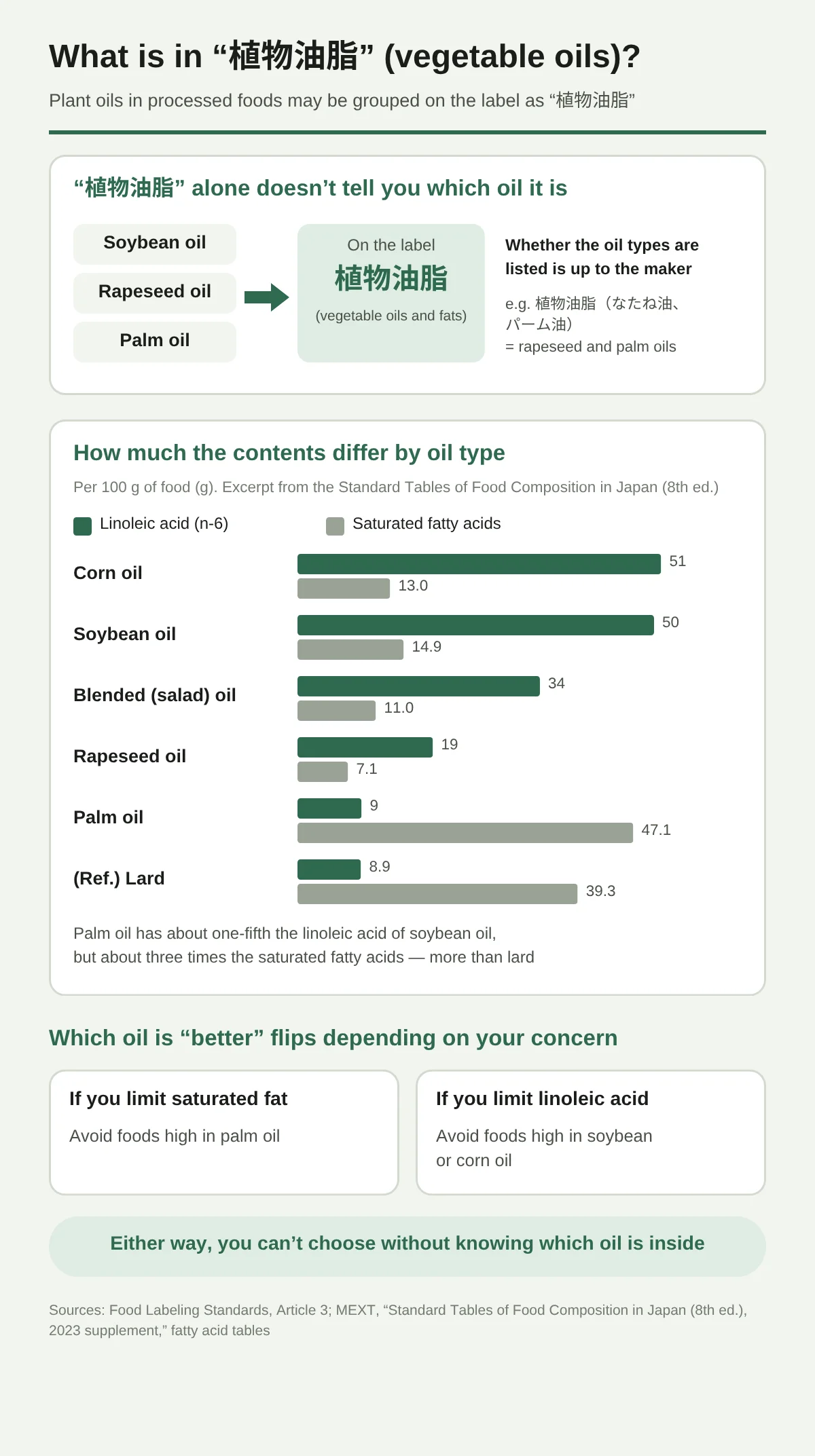
Even when grouped together as “植物油脂,” the fatty acid contents differ greatly depending on the kind of oil. From the Standard Tables of Food Composition in Japan by the Ministry of Education, Culture, Sports, Science and Technology (MEXT), here are commonly used oils.
Per 100 g of food (g)
| Oil | Linoleic acid (n-6) | α-linolenic acid (n-3) | Saturated fat |
|---|---|---|---|
| Corn oil | 51 | 0.8 | 13.0 |
| Soybean oil | 50 | 6.1 | 14.9 |
| Sesame oil | 41 | 0.3 | 15.0 |
| Blended oil (salad oil, etc.) | 34 | 6.8 | 11.0 |
| Rice bran oil | 32 | 1.2 | 18.8 |
| Rapeseed oil | 19 | 7.5 | 7.1 |
| Palm oil | 9 | 0.2 | 47.1 |
| Olive oil | 6.6 | 0.6 | 13.3 |
| Perilla (egoma) oil | 12 | 58 | 7.6 |
| Flaxseed (linseed) oil | 14 | 57 | 8.1 |
| (For reference) shortening (household) | 11 | 1.0 | 46.2 |
| (For reference) lard | 8.9 | 0.5 | 39.3 |
| (For reference) salted butter | 1.7 | 0.3 | 50.5 |
Note: linoleic acid and α-linolenic acid are the amounts of each fatty acid alone (slightly different from the totals for the n-6 and n-3 groups).
Even among what are all “植物油脂”:
- Soybean oil and corn oil are about half linoleic acid
- Palm oil has about one fifth the linoleic acid of soybean oil. In exchange, its saturated fat is about three times higher, more than lard
- Rapeseed oil is low in saturated fat and relatively high in the n-3 α-linolenic acid
- Perilla oil and flaxseed oil are mainly n-3 α-linolenic acid. However, they are rarely used in the “植物油脂” of processed foods
Their characters are entirely different.
The important thing here is that “which oil is better” reverses depending on what you are concerned about.
- For people who want to limit saturated fat, foods high in palm oil are to be avoided
- For people who want to limit linoleic acid, foods high in soybean oil and corn oil are to be avoided
In either position, you cannot choose unless you first know “which oil it is.” This is the biggest problem with the label “植物油脂.”
How true is the claim that “vegetable oils are bad for you”?
There is a view that polyunsaturated fatty acids (PUFA) such as the linoleic acid abundant in plant oils are “bad oils” to be avoided (sometimes called “PUFA-free”). In books there are titles such as 『[図解]その油が寿命を縮める』 (an illustrated book whose title says that oil shortens your lifespan) and 『オメガ3神話の真実』 (the truth about the omega-3 myth).
Looking at the research, it divides into parts that are correct, parts not yet settled, and parts at odds with public materials.
The correct part: polyunsaturated fatty acids oxidize easily
Polyunsaturated fatty acids have many double bonds in the molecule and are easily damaged by oxygen and heat. When heated at high temperature for a long time, or when they get old, lipid peroxides and aldehydes, which cause odors, form.
For that reason, in Japan the Food Sanitation Act sets for fried instant noodles a specification showing oil deterioration of acid value of 3 or less and peroxide value of 30 or less. Also, the former hygiene code for lunch boxes and prepared side dishes (abolished in 2021) gave guidance such as replacing frying oil when the acid value exceeds 2.5.
“Old oil, or frying oil used many times, has deteriorated” is certain both as chemistry and as an administrative standard.
The part not settled: does vegetable oil increase or decrease heart disease?
Here, conclusions differ by study.
| Studies unfavorable to vegetable oils | Studies favorable to vegetable oils |
|---|---|
| Studies that dug up clinical trials from the 1960s and 1970s and reanalyzed them. In people whose saturated fat was replaced with vegetable oil (linoleic acid), cholesterol fell but deaths did not decrease (Minnesota, US, about 9,400 people). In men with a history of heart disease, deaths were higher (Sydney, Australia, 458 people). Also, a UK study (about 320,000 people) that used a genetic tendency toward higher blood linoleic acid found more coronary artery disease | In 30 follow-up studies from 13 countries (about 69,000 people), when linoleic acid in blood or fat tissue was measured, people with more linoleic acid had fewer deaths from cardiovascular disease. In a study following 220,000 people in the US for up to 33 years, too, people who ate more vegetable oil had fewer deaths |
One reason they differ is differences in study methods.
- The old clinical trials used a strong method of randomly dividing people and comparing, but problems have been pointed out, such as that the margarine of the time contained trans fat and that many people did not keep to the diet partway through (the American Heart Association excluded some trials from its assessment for this reason. On the other hand, the researchers who reanalyzed them counter that the trans fat was greater in the diet of the comparison group)
- The new large studies have many participants, but they are observational studies that cannot completely remove the point that “people who eat vegetable oil probably differ in other lifestyle habits as well”
- Results also differ by whether the replacement oil contained n-3. According to a paper reanalyzing the Sydney study, pooling trials that increased only linoleic acid showed a tendency toward more deaths (barely not statistically significant), while pooling trials that increased n-3 as well showed about 20% fewer deaths from cardiovascular disease
Japan’s “Dietary Reference Intakes for Japanese (2025 edition)” summarizes n-6 fatty acids (mostly linoleic acid) as follows.
- In follow-up studies, linoleic acid is suggested to possibly prevent coronary artery disease
- When saturated fat is replaced with polyunsaturated fat, there are analyses finding that onset decreased significantly, in both follow-up studies and clinical trials of 2 years or more
- On the other hand, in analyses of clinical trials looking at n-6 fatty acids themselves and prevention of cardiovascular disease, no meaningful association was found
- Overall, there is a possibility it helps prevent disease, but it is difficult to set a target amount
In other words, the national standard says neither that “the more vegetable oil, the better” nor that it “should be reduced.” For n-6 fatty acids there is neither an upper limit for excess nor a target to reduce; only an “adequate intake” to avoid deficiency is set (for example, for ages 18 to 29, 12 g/day for men and 9 g/day for women). By contrast, saturated fat has a target of “7% or less of energy.” What the national standard says to keep modest is saturated fat, not vegetable oil.
Parts at odds with public materials
Among the views that avoid vegetable oils are also the following claims. They are at odds with clinical trials and public materials.
- “Linoleic acid strengthens inflammation in the body” → In a study pooling 15 clinical trials in healthy people, increasing linoleic acid did not raise markers of inflammation
- “Omega-3 (n-3) is not an essential fatty acid” → The Ministry of Health, Labour and Welfare (MHLW) says n-3 fatty acids are essential fatty acids that the body cannot make
- “The problem is not trans fat” → MHLW says trans fat is one of the clear risk factors for coronary artery disease. However, the average intake of Japanese people is small, about 0.3% of energy, and the Food Safety Commission of Japan (FSCJ) assesses that the effect on health in a normal diet is small
Is it true that “oil causes dementia and depression”?
The views that avoid vegetable oils also say that “too much oil causes Alzheimer’s disease and depression.” There is a lot of research on this, so we have put it together separately in the article on oil, dementia, and depression. In short:
- It is true that lipid peroxides are increased in the brains of people with Alzheimer’s disease, but it has not been shown that eaten oil is the cause
- Studies of vegetable oil and people with dementia are split, and what is being asked is less “vegetable oil or not” than the balance of kinds of fat (whether saturated and trans fats are too high, and whether n-3 is sufficient)
- An association between a diet heavy in fried food and anxiety and depression has appeared in large studies, but it is not known whether the oil itself is the cause
How Urayomi (ウラヨミ) approaches this
To sum up so far:
- It is certain that polyunsaturated fatty acids oxidize easily. Using fresh oil and avoiding deteriorated oil makes sense
- Whether vegetable oil itself is bad or good for you is not settled, because research is split. The national standard also does not say either way
- It is the same for the relationship with dementia and depression: there is no human study that can say “oil destroys the brain.” There is a warning sign for a diet heavy in fried food (article on oil, dementia, and depression)
- That is exactly why it matters to know the kind of oil, so you can choose according to what you care about (saturated fat or linoleic acid)
Urayomi does not treat “植物油脂” uniformly as bad. Instead, on product pages we check and write down whether the kind of oil is shown.
How to find out the kind of oil
- Look at the ingredient list (原材料名): some products write the kind, as in “植物油脂(なたね油、パーム油),” “なたね油,” or “パーム油.” The ingredient list is in order of the amount used, largest first
- Look at the manufacturer’s website: even if it is not on the label, the official website or product information sometimes discloses the kind of oil
- Ask the manufacturer: formulations may change, so noting the date you checked gives peace of mind
For oil you use at home, you can choose the kind
You cannot choose what is in the “植物油脂” of processed foods, but for oil used at home, choosing a bottle whose ingredient list has only one item makes the contents clear. These are oils chosen from the composition-table figures in Urayomi’s article on vegetable oils and animal fats.
| Use | Oil | Ingredient list (原材料名) | Purchase |
|---|---|---|---|
| Everyday stir-frying and deep-frying | 平田産業 国産なたねサラダ油(圧搾一番しぼり) (Hirata Sangyo domestic rapeseed salad oil, first-press) | 食用なたね油(国産なたね) (edible rapeseed oil (domestic rapeseed)) | See on Rakuten PR See on Amazon.co.jp PR See on Yahoo! Shopping PR |
| Stir-frying and drizzling | アルチェネロ 有機エキストラバージンオリーブオイル (Alce Nero organic extra virgin olive oil) | 有機食用オリーブ油 (organic edible olive oil) | See on Rakuten PR See on Amazon.co.jp PR See on Yahoo! Shopping PR |
| Deep-frying and stir-frying | 三和油脂 まいにちのこめ油 (Sanwa Yushi everyday rice bran oil) | 食用こめ油 (edible rice bran oil) | See on Rakuten PR See on Amazon.co.jp PR See on Yahoo! Shopping PR |
| Drizzling without heating | ニップン アマニ油 (Nippn flaxseed oil) | アマニ (flaxseed) | See on Rakuten PR See on Amazon.co.jp PR See on Yahoo! Shopping PR |
Note Every oil has about 9 kcal per gram. With any oil, using too much means taking in too much energy. Flaxseed oil is not suited to cooking with heat (a caution on the sales page).
Related reading
- Labels for genetic modification are, in principle, not attached: for soybean oil, rapeseed oil, corn oil, and the like, the modified DNA can no longer be detected after refining, so they are outside the scope of mandatory genetic modification labeling. However, labeling is required when crops whose oil composition itself has been changed, such as high-oleic genetically modified soybeans, are used → Article on genetic modification and isomerized sugar
- Additives used in oil may also go unlabeled: antifoaming agents and the like used in frying oil are exempt from labeling as “carry-over” when conditions are met → Article on carryover
- The raw materials are almost all imported: according to the Japan Oilseed Processors Association (日本植物油協会), almost all raw materials for vegetable oil are imported. Soybeans for crushing come mainly from the US and Brazil, and rapeseed from Canada and Australia. Palm oil is imported as oil → Article on postharvest treatment
Sources
- Consumer Affairs Agency, “Food Labeling Standards,” Article 3 (e-Gov Laws and Regulations Search)
- Consumer Affairs Agency, “On the Review of Labeling Rules for Individual Items of Edible Vegetable Oils and Fats” (August 2025)
- MEXT, “Standard Tables of Food Composition in Japan (8th revised edition), 2023 Supplement,” Fatty Acid Tables
- MHLW, “Dietary Reference Intakes for Japanese (2025 edition),” 1-3 Lipids
- MAFF, “Health Effects of Trans Fatty Acids”
- Japan Instant Food Industry Association, “Laws and Rules That Protect Quality”
- Ministry of Health and Welfare, “On the Hygiene Code for Lunch Boxes and Prepared Side Dishes” (1979; abolished 2021)
- FSCJ, Q&A “On Labeling of Edible Oils” (2011)
- Japan Oilseed Processors Association, “Imports of Vegetable Oil Raw Materials” and “Vegetable Oil Supply in Japan”
- Ramsden CE, et al. BMJ 2016;353:i1246 (reanalysis of the Minnesota Coronary Experiment)
- Ramsden CE, et al. BMJ 2013;346:e8707 (reanalysis of the Sydney Diet Heart Study)
- Marklund M, et al. Circulation 2019;139:2422–2436 (pooled analysis of 30 follow-up studies)
- Zhang Y, et al. JAMA Intern Med 2025;185:549–560 (butter and vegetable oil intake and mortality)
- Sacks FM, et al. Circulation 2017;136:e1–e23 (American Heart Association advisory)
- Johnson GH, Fritsche K. J Acad Nutr Diet 2012;112:1029–1041 (linoleic acid and markers of inflammation)
- PLoS Med 2022, doi:10.1371/journal.pmed.1004141 (genetically predicted fatty acids and 845 diseases, UK Biobank)
This article does not claim health benefits for any particular food or oil. If you have a medical condition and are restricting your diet, please consult your doctor.
Related articles and databases
- Does Eating Too Much Oil Cause Dementia or Depression? What Studies Show
- What is carryover? How it differs from processing aids, and the additives that are not listed on labels even on “additive-free” foods
- What Is “果糖ぶどう糖液糖” (High-Fructose Corn Syrup)? Is It Worse for You Than Sugar? How It Differs From Sugar, and Corn and Genetic Modification
- Is Garlic Good for You? How Allicin Forms, the Smell, Research on Blood Pressure and Cancer, Drug Interactions, and the Cautions on Garlic in Oil
- Is Sesame Good for You? Checking Sesamin Research, Allergen Labeling, and Pesticide Residues in Imported Sesame Against Government Data and Studies
- Are Lard and Butter Bad for You? 16 Plant Oils and Animal Fats (Beef Tallow, Fish Oil) Compared by Fatty Acids, and Which to Use Every Day
- Why Is Lung Cancer Rising When Fewer People Smoke? Smoking, Lung Cancer Types, and What You Can Do for Your Lungs, Checked Against National Data and Studies
- Does Eating Too Much Wheat Flour Cause Colorectal Cancer? Checking the Link Between Wheat and Cancer Against Studies and Government Data
- ポストハーベスト農薬と輸入食品