

Chocolate vs. quasi chocolate in Japan: how to read the label

PR This article contains affiliate links to Rakuten Ichiba, Amazon and Yahoo! Shopping. The content is based on Japan’s Fair Competition Code for chocolate labeling and the makers’ own published labels, regardless of any advertising. The “See on Amazon.co.jp” links are also affiliate links.
Walk down a Japanese candy aisle and you will see bars that look the same, yet the “category” line on the back says either チョコレート (chocolate) or 準チョコレート (jun-chocolate, literally “quasi chocolate”). Snack-type products add a fourth and fifth word: チョコレート菓子 (chocolate confectionery) and 準チョコレート菓子 (quasi chocolate confectionery).
These names are not marketing choices. They are set by numbers — cacao content, cocoa butter, milk solids, total fat and moisture — in the “Fair Competition Code concerning the Labeling of Chocolates” (チョコレート類の表示に関する公正競争規約). It is run by an industry council (the National Chocolate Industry Fair Trade Council) and approved by Japan’s Consumer Affairs Agency and Fair Trade Commission. Most products sold in Japan follow it.
“Quasi chocolate” is a category that has no direct equivalent in the EU or the US. It is not a fake or a defect: it simply means the chocolate base has less cacao than the “chocolate” threshold, usually with vegetable fat making up the fat content. You will find it on many everyday products, from strawberry chocolates to wafer bars.
This article uses the exact figures in the Code to explain:
- where the four category names split (try the interactive bar below)
- what actually differs when you put ten real Japanese labels side by side
- what “vegetable fat”, “emulsifier” and “flavoring” on the label mean here
- how Japan’s rules compare with the EU and US standards
It is not about whether chocolate is good or bad for you. It is about reading the label in the shop.
Key points
- On the back label, look at two places: the category line (chocolate / quasi chocolate / chocolate confectionery / quasi chocolate confectionery), and the first ingredient (the heaviest one)
- Chocolate vs. quasi chocolate is decided by the cacao content of the chocolate base. A chocolate base needs 35% cacao or more (cocoa butter 18%+). If milk solids replace part of the cacao, it still needs at least 21% cacao. A quasi chocolate base needs 15% cacao (7% for the milk-rich “quasi milk” type), plus total fat of 18% or more
- “Confectionery” is added when the chocolate part is less than 60% of the product’s weight
- A bar can contain vegetable fat and still be “chocolate”. The Code allows edible fats other than cocoa butter in the base; the category depends on whether the cacao thresholds are met
- The EU and US restrict non-cocoa vegetable fats more tightly. Neither has a category that matches Japan’s “quasi chocolate”
Products mentioned in this article
We point to a few products whose back labels you can compare yourself. For each one, the category and ingredients were checked on the maker’s official website.
| If you want to | Products | Where |
|---|---|---|
| Taste “chocolate” and “quasi chocolate” in the same bar shape | Meiji Milk Chocolate / Meiji High Milk | Put the labels side by side |
| See “chocolate” with vegetable fat, and a bar that lists cacao mass first | Meiji Black Chocolate / Meiji Chocolate Kouka Cacao 72% | Put the labels side by side |
| Check quasi chocolate labels on snacks | Apollo / Takenoko no Sato / KitKat Otona no Amasa / Black Thunder | Back-label quiz |
| Choose a bar made without emulsifiers | SOIL CHOCOLATE Standard 3-item set | What are vegetable fat, emulsifier and flavoring for? |
What is quasi chocolate? The four names are set by numbers
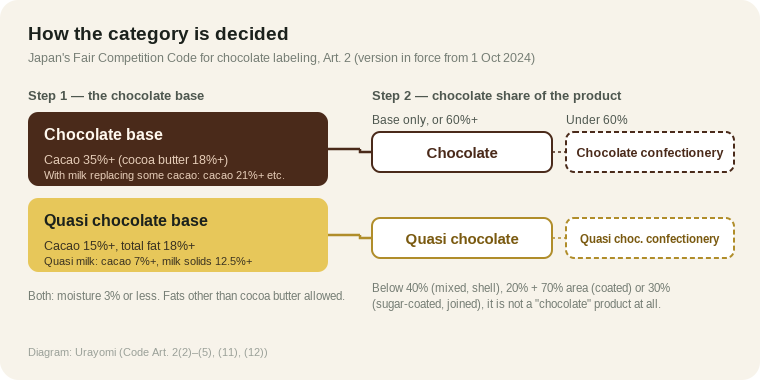
The Code works in two steps: first it classifies the chocolate base, then it looks at how much of the product is that base.
Step 1: the chocolate base
All percentages are by weight of the base. “Cacao content” is the moisture-free total of cacao nibs, cacao mass, cocoa butter, cocoa cake and cocoa powder (Code Art. 2(17)). Cocoa butter counts as cacao content.
| Base | Cacao content | of which cocoa butter | Total fat | Milk solids | of which milk fat | Moisture | Article |
|---|---|---|---|---|---|---|---|
| Chocolate base | 35%+ | 18%+ | — | — | — | 3% or less | Art. 2(12)(i) |
| Chocolate base (milk replaces part of the cacao) | 21%+ | 18%+ | — | cacao + milk solids 35%+ | 3%+ | 3% or less | Art. 2(12)(i), proviso |
| Quasi chocolate base | 15%+ | 3%+ | 18%+ | — | — | 3% or less | Art. 2(12)(ii)(a) |
| Quasi milk chocolate base | 7%+ | 3%+ | 18%+ | 12.5%+ | 2%+ | 3% or less | Art. 2(12)(ii)(b) |
Source: Fair Competition Code concerning the Labeling of Chocolates (version in force from 1 October 2024). Both quasi bases exclude anything that already qualifies as a chocolate base. The council’s summary says “total fat” includes cocoa butter and milk fat; the interactive bar below adds cocoa butter, milk fat and vegetable fat together.
Move the sliders. The red dotted marks under each slider are the thresholds in the Code. When the category stamp changes, the message below tells you which line you crossed.
Step 2: the share of the product decides “confectionery”
Products that mix in nuts, coat a biscuit and so on are “processed chocolate products”. If the chocolate part is below these shares, the product does not count as a processed chocolate product at all (Code Art. 2(11)).
| Type of product | Example given in the Code | Chocolate part by weight |
|---|---|---|
| Edible items mixed or kneaded into the chocolate | Puffed-rice chocolate | 40%+ |
| Chocolate shell with a filling | Shell chocolate | 40%+ |
| Edible item coated with chocolate | Nut chocolate | 20%+, and covering 70%+ of the surface |
| Chocolate coated with something else (e.g. sugar shell) | Sugar-coated chocolate | 30%+ |
| Chocolate joined to an edible item | Wafer chocolate | 30%+ |
If the chocolate part is 60% or more of the total weight, the name stays “chocolate” or “quasi chocolate”; under 60% it becomes “chocolate confectionery” or “quasi chocolate confectionery” (Code Art. 2(2)–(5)). That is why biscuit and wafer products so often carry the “confectionery” names. The Code also excludes baked goods and other items listed in an annex of its implementing rules from “processed chocolate products”, and a separate code covers foods that use chocolate as an ingredient.
“Milk chocolate” is not a category name
“Milk chocolate” and “quasi milk chocolate” are rules for product names; they may not be written as the category (Code Art. 4(1)). A product may be called “milk chocolate” only if its chocolate base has milk solids of 14% or more (milk fat 3%+).
Likewise, “nama chocolate” (生チョコレート, “fresh chocolate”) can be used only when the chocolate base is 60%+ of the weight, cream 10%+ and moisture 10%+, among other conditions (Art. 4(1)(iii)). “Pure” (純良) requires, among other things, sucrose of 55% or less, lecithin of 0.5% or less, and no additives other than vanilla-type flavorings (Art. 4(5)).
Put the labels side by side
Here are the ingredient lists of ten bars and snacks commonly found in Japanese supermarkets and convenience stores, copied from each maker’s official website. Ingredients shared by every item shown are grey; ingredients that only some items have are colored. Pick two products and the shared ones disappear, leaving only the differences.
| Product | Category | First ingredient | Vegetable fat etc. | Additives |
|---|---|---|---|---|
| Meiji Milk Chocolate 50g | Chocolate | Sugar | None | Lecithin, flavoring |
| Meiji Black Chocolate 50g | Chocolate | Sugar | Vegetable fat | Lecithin, flavoring |
| Meiji Chocolate Kouka Cacao 72% | Chocolate | Cacao mass | None | Emulsifier, flavoring |
| Meiji High Milk 50g | Quasi chocolate | Sugar | Vegetable fat | Lecithin, flavoring |
| Meiji White Chocolate stick pack | Quasi chocolate | Sugar | Vegetable fat | Emulsifier, flavoring |
| Meiji Apollo | Quasi chocolate | Sugar | Vegetable fat | Emulsifier, color, flavoring |
| Glico Almond Crush Pocky | Chocolate confectionery | Wheat flour | Vegetable fat, shortening | Emulsifier, flavoring, leavening |
| Meiji Takenoko no Sato | Quasi chocolate confectionery | Sugar | Vegetable fat, shortening, margarine | Emulsifier, leavening, flavoring |
| Nestlé KitKat Otona no Amasa | Quasi chocolate confectionery | Sugar | Vegetable fat (shortening in the biscuit) | Emulsifier, leavening, flavoring, baking soda, yeast food |
| Yuraku Seika Black Thunder Mini Bar | Quasi chocolate confectionery | Quasi chocolate | Vegetable fat, shortening, processed fat product | Sweetener (sorbitol), leavening, emulsifier, flavoring |
Category and ingredients are taken from each maker’s official Japanese website (check dates are on each card in the comparison). Place-of-manufacture notes and allergen lines are omitted. Recipes and labels can change. Photos of the back labels taken in stores will be added to the cards above as we collect them.
Three things stand out:
- Two 50g Meiji bars of the same shape fall into different categories. Milk Chocolate is “chocolate”, High Milk is “quasi chocolate”. The only differences in the ingredient list are vegetable fat and skimmed milk powder (try “Milk vs High Milk” in the comparison above; the recipe percentages are not published)
- Black Chocolate contains vegetable fat and is still “chocolate”. Vegetable fat alone does not decide the category
- The white chocolate lists no cacao mass. Its cacao content is cocoa butter only, and this product is “quasi chocolate”
To compare the labels yourself, the two 50g Meiji bars make the difference in category and ingredients easiest to see.
A “chocolate” with vegetable fat and a bar that lists cacao mass first also show the difference side by side.
Back-label quiz
Five questions built from the ten labels above. The answers are computed from the data, so if a label changes, the answer changes too.
The quasi chocolate and quasi chocolate confectionery from the quiz can be checked on their own back labels.
What are vegetable fat, emulsifier and flavoring for?
These three are where labels differ most. Each has its own article; here we cover only what matters for chocolate.
- Vegetable fat: the Code defines “edible fats” as fats other than cocoa butter, such as illipe butter, shea butter, palm oil, coconut oil and cottonseed oil (Art. 2(15)). On the label they may be grouped as “vegetable fat” (植物油脂) or named individually, e.g. “palm oil” (implementing rules Art. 5(i)). See our article on vegetable oils and fats
- Emulsifier (lecithin): additives may be listed in the ingredients field, clearly separated from foods (implementing rules Art. 15, note 2). Meiji’s official labels for its Milk, Black and High Milk bars separate them with a slash. Those three say “lecithin”; the others say “emulsifier”. See our article on emulsifiers
- Flavoring: all ten labels list it. In Japan, flavorings are usually declared simply as “flavoring” (香料) without saying what the flavor is. See our article on flavorings
If you simply prefer chocolate without an emulsifier, check that neither “乳化剤” (emulsifier) nor “レシチン” (lecithin) appears after the slash (this is about preference, not safety). Even a bar labeled “Pure” may contain lecithin up to 0.5% of its weight.
As an example of bars made without emulsifiers, there is the set from a Sapporo bean-to-bar shop that we also mention in our article on emulsifiers. Its Rakuten product page lists no emulsifier or lecithin.
How Japan differs from the EU and the US
The EU and the US also have rules for chocolate names. Because the figures are not measured on exactly the same basis, read the table as a comparison of how the rules are built, not as a like-for-like conversion.
| Japan (Fair Competition Code) | EU (Directive 2000/36/EC) | US (21 CFR Part 163) | |
|---|---|---|---|
| Chocolate (dark) | Cacao content 35%+, cocoa butter 18%+ | Total dry cocoa solids 35%+, cocoa butter 18%+, dry non-fat cocoa solids 14%+ (Annex I A.3) | Semisweet/bittersweet: chocolate liquor 35%+ (§163.123) |
| Milk chocolate | A product-name rule, not a category (milk solids 14%+, milk fat 3%+) | Dry cocoa solids 25%+, milk solids 14%+, milk fat 3.5%+, total fat 25%+ (A.4) | Chocolate liquor 10%+, milkfat 3.39%+, milk solids 12%+ (§163.130) |
| White chocolate | No separate name (chocolate or quasi chocolate if the base qualifies) | Cocoa butter 20%+, milk solids 14%+ (milk fat 3.5%+) (A.6) | Cacao fat 20%+, milk solids 14%+, milkfat 3.5%+, sweeteners 55% or less (§163.124) |
| Vegetable fats other than cocoa butter | Allowed in the base; category depends on cacao thresholds | Only six listed fats (illipe, palm oil, sal, shea, kokum gurgi, mango kernel), up to 5% of the finished product, with a prominent “contains vegetable fats in addition to cocoa butter” (Art. 2) | Not allowed in standardized chocolate; products with them are named “… and vegetable fat coating” (§163.153, §163.155) |
| A category like “quasi chocolate” | Yes | No | No (products with vegetable fat take separate “coating” names) |
EU: consolidated text of Directive 2000/36/EC (EUR-Lex, as of 18 November 2013). US: 21 CFR §163.123, 163.124, 163.130, 163.155 (text on Cornell LII). We could not check the original text of the international Codex standard (CXS 87-1981) this time, so it is not included.
How to read a chocolate label in the shop
Check the category
"チョコレート" or "準チョコレート" is written here. If the category is printed on the front, it may be left out of the box on the back (implementing rules Art. 15, note 8).
Check the first ingredient
Ingredients run heaviest first. "カカオマス" (cacao mass) first means a cacao-rich recipe; "砂糖" (sugar) first means sugar is the largest ingredient. Biscuit-type snacks may start with "小麦粉" (wheat flour).
Check where vegetable fat appears
A bar with "植物油脂" can still be chocolate. Its position in the list tells you roughly how much there is compared with the other ingredients.
Check after the slash
Additives such as emulsifier (lecithin), flavoring and color come after the slash "/" (or on a new line or in a separate field), kept apart from foods.
The Code’s rules for specific claims (Art. 4) contain no item on how to state a cacao percentage such as “Cacao 72%”. Where a bar shows one, read it together with the order of the ingredient list.
Frequently asked questions
What is quasi chocolate (jun-chocolate)?
A chocolate base with 15%+ cacao (cocoa butter 3%+), 18%+ total fat and 3% or less moisture (or, for milk-rich types, 7%+ cacao and 12.5%+ milk solids) that does not reach the chocolate standard. If the base is 60%+ of the product, it is labeled “quasi chocolate”.
Can a bar with vegetable fat be called chocolate in Japan?
Yes. The Japanese Code allows fats other than cocoa butter in the chocolate base. If it meets 35%+ cacao (cocoa butter 18%+) and the other thresholds, it is “chocolate”. Meiji Black Chocolate is an example.
What is the difference between “chocolate” and “chocolate confectionery”?
The base is the same type; if it makes up less than 60% of the product’s weight, the product is “chocolate confectionery”.
Is white chocolate chocolate in Japan?
Japan has no separate “white chocolate” category. Cacao content is counted as cocoa butter only, and the product is “chocolate” or “quasi chocolate” depending on the thresholds. The Meiji white chocolate compared here is labeled “quasi chocolate”.
Items featured in this article (summary)
Here are the products mentioned above. Categories and ingredients are in each section.
| Product | Where to buy |
|---|---|
| Meiji Milk Chocolate 50g | See on Rakuten (Matsumoto Kiyoshi) PR |
| Meiji High Milk 50g | See on Rakuten (PLANT Online) PR |
| Meiji Black Chocolate 50g | See on Rakuten (Matsumoto Kiyoshi) PR |
| Meiji Chocolate Kouka Cacao 72% (225g bag) | See on Rakuten (Rakuten 24) PR See on Amazon.co.jp PR See on Yahoo! Shopping PR |
| Meiji Apollo (226g pouch) | See on Rakuten (Matsumoto Kiyoshi) PR See on Amazon.co.jp PR See on Yahoo! Shopping PR |
| Meiji Takenoko no Sato 63g | See on Rakuten (Matsumoto Kiyoshi) PR See on Amazon.co.jp PR |
| Nestlé KitKat Otona no Amasa (10 pieces) | See on Rakuten (soku-hai) PR See on Amazon.co.jp PR See on Yahoo! Shopping PR |
| Yuraku Seika Black Thunder Mini Bar 139g | See on Rakuten (Matsumoto Kiyoshi) PR See on Yahoo! Shopping PR |
| SOIL CHOCOLATE Standard 3-item set | See on Rakuten (GELATERIA GELABO) PR See on Amazon.co.jp PR |
Sources
- National Chocolate Industry Fair Trade Council, “Fair Competition Code and Implementing Rules concerning the Labeling of Chocolates” (in Japanese) (https://www.chocokoutori.org/cont3/13.html); full text PDF, version in force from 1 October 2024 (https://toriaez-hp.jp/assets/1-B030000067/uploader/GL7rEvrWoc.pdf)
- National Chocolate Industry Fair Trade Council, “Fair Competition Code concerning the Labeling of Foods Using Chocolate” (in Japanese) (https://www.chocokoutori.org/cont3/15.html)
- Directive 2000/36/EC relating to cocoa and chocolate products intended for human consumption (consolidated version 02000L0036-20131118, EUR-Lex) (https://eur-lex.europa.eu/eli/dir/2000/36/oj/eng)
- 21 CFR Part 163 Cacao Products, §163.123, §163.124, §163.130, §163.155 (https://www.law.cornell.edu/cfr/text/21/part-163)
- Makers’ official product pages (Meiji, Ezaki Glico, Nestlé Japan, Yuraku Seika); URLs and check dates are on each card in the label comparison
Products related to this article PR
Products whose labels Urayomi has read, picked because their ingredients or category relate to this article. This is not a recommendation or a safety rating. The shop buttons are affiliate links; prices are reference prices on the date we checked.
- 江崎グリコ メンタルバランスチョコレートGABA<ミルク>スタンドパウチ 51gRead the label (in Japanese) →
- 江崎グリコ ジャイアントカプリコ<いちご>Read the label (in Japanese) →
- ロッテ パイの実 シェアパックRead the label (in Japanese) →
- 明治 アポロ シンプル包装 大容量パウチ 226gRead the label (in Japanese) →
- 明治 チョコレート効果 カカオ72% 1kg(大容量ボックス)Read the label (in Japanese) →
- 明治 たけのこの里 シンプル包装大容量パウチ 188gRead the label (in Japanese) →
Frequently asked questions
- What are the key findings on: Chocolate vs. quasi chocolate in Japan: how to read the label?
- Why some Japanese bars say "quasi chocolate" (jun-chocolate): the cacao and fat thresholds in the industry code, ten real labels, and EU/US rules.
- What is quasi chocolate? The four names are set by numbers?
- The Code works in two steps: first it classifies the chocolate base, then it looks at how much of the product is that base.
- What does the evidence show regarding: Put the labels side by side?
- Here are the ingredient lists of ten bars and snacks commonly found in Japanese supermarkets and convenience stores, copied from each maker’s official website. Ingredients shared by every item shown are grey; ingredients that only some items have are colored…
- What does the evidence show regarding: Back-label quiz?
- Five questions built from the ten labels above. The answers are computed from the data, so if a label changes, the answer changes too.
Related articles and databases
- Are emulsifiers bad for you? The history that began with egg yolk lecithin, types and uses, gut microbiota research (mice and humans), and how Japan and the EU label them
- What Is “植物油脂” (Vegetable Fat)? How True Is “Vegetable Oils Are Bad for You,” and What the Back Label Does and Does Not Tell You
- Are Flavorings Bad for You? What “香料” (Flavoring) Contains, Why It Is Written as One Word, and Japanese vs. Overseas Rules
- Types of Sugar and Their Effects on the Body: History, Production and Composition of Jōhakutō, Granulated Sugar, Sanontō, Kibi-zatō, Tensai-tō, Kokutō and Wasanbon — Is "White Sugar Is Bad for You" True?
- Are Dairy Products Bad for Japanese People? The Effects of Eating Too Much, Differences from Foreigners, Dairy in Japan and Abroad, and Bulgaria, the “Land of Yogurt”