
Types of Sugar and Their Effects on the Body: History, Production and Composition of Jōhakutō, Granulated Sugar, Sanontō, Kibi-zatō, Tensai-tō, Kokutō and Wasanbon — Is "White Sugar Is Bad for You" True?

PR This article contains affiliate links to Rakuten Ichiba, Amazon, Yahoo! Shopping and A8.net (“See on Rakuten”, etc.). What we write is based on public-agency materials and research papers, whether or not there is an ad. The “See on Amazon.co.jp” links are also affiliate links.
On a supermarket sugar shelf, you will find many kinds: jōhakutō (Japanese soft white sugar, the standard household sugar in Japan), granulated sugar, sanontō (brown sugar made from re-boiled syrup), kibi-zatō (cane sugar), tensai-tō (beet sugar), kokutō (non-centrifugal cane sugar, often called “brown sugar” or “black sugar”), and wasanbon (a very fine, traditional Japanese sugar).
And all sorts of claims follow sugar around.
- “White sugar is bleached, so it is bad for you.”
- “Brown sugar is rich in minerals, so it is good for you.”
- “Tensai-tō is rich in oligosaccharides and warms the body.”
- “Kokutō and kibi-zatō have a low glycemic index (GI), so they don’t raise blood sugar much.”
- “Jōhakutō exists only in Japan.”
- “Sugar is addictive.” “Sugar makes children restless.”
In this article we look at:
- When and where sugar began, and how it reached Japan
- What decides the differences between types, and how each is made
- How the naming rules for sugar differ between Japan and other countries
- Whether sugar is bad for you, checking the research behind each claim
- Whether “brown sugar is good for you” is true (we calculate it at Urayomi)
- What the word “sugar” on an ingredient list does and does not tell you
- In the end, what to choose
We check these against national statistics, laws, public-agency materials and research papers. High-fructose corn syrup is covered in our article on isomerized sugar, the sugars in fruit in our article on fructose in fruit, and sugar substitutes in our article on sweeteners.
Conclusion
- Sugar began as a “medicine.” The oldest reliable record in Japan is “蔗糖” (sugarcane sugar) in the Shōsōin’s 756 medicine inventory, the “Shūshu Yakuchō” (種々薬帳). The story that “Ganjin (Jianzhen) brought it” has no firm evidence
- Sugar per person in Japan peaked in fiscal 1973 at 28.1 kg and was 16.8 kg in fiscal 2024 (MAFF, Food Balance Sheet). The US also peaked in 1972. Both countries peaked in the early 1970s
- Differences between types are differences in how they are made. Sugars split into “centrifugal sugar” (分蜜糖, bunmitsutō: only the crystals are taken out of the syrup — jōhakutō, granulated sugar and sanontō) and “non-centrifugal sugar” (含蜜糖, ganmitsutō: set together with its molasses — kokutō, wasanbon, etc.). Sanontō is brown but still centrifugal sugar; its color comes from caramelization during boiling
- “Jōhakutō is bleached” is wrong. The color is “removed” with lime, charcoal and the like. Some of that charcoal is “bone char,” made from animal bones, and it has been used in Japanese plants (2010 industry technical material)
- Jōhakutō does not meet the EU definition of “white sugar.” It is mixed with about 1.4% invert sugar, about 35 times the EU limit of 0.04%. But international standards and China have similar sugars, so “jōhakutō exists only in Japan” goes too far. In domestic production, granulated sugar overtook jōhakutō in fiscal 2023
- “Brown sugar has more minerals” is true only of kokutō. The minerals in tensai-tō non-centrifugal sugar (beet sugar set with its molasses) were nearly the same as in jōhakutō. Even for kokutō, a teaspoon provides less than 2% of the daily reference intake of any mineral (our calculation)
- The GI of sucrose is around 65. We found no measured GI values for kokutō, tensai-tō or wasanbon in the international database. For health, what matters is amount, not type. WHO recommends keeping free sugars (added sugars) below 10% of daily energy, and ideally below 5% (about 25 g)
- The word “sugar” (砂糖) on an ingredient list tells you almost nothing about the type. Of Urayomi’s 71 products, 35 contained sugars, and only 4 showed the type. “Sugar (made in Japan)” (砂糖(国内製造)) does not mean where the sugarcane was grown
What we introduce in this article
| What we introduce | When it helps | Where in this article |
|---|---|---|
| Cup-jirushi Kibi-zatō (Nisshin Seito) | You want a sugar with more color and flavor than jōhakutō for cooking | Kibi-zatō and sensō-tō |
| Sensō-tō (Tanegashima) | You want a light brown sugar whose cane origin is known | Kibi-zatō and sensō-tō |
| Hokuren Tensai-tō (Hokkaido-grown sugar beet) | You want a brown sugar made from sugar beet | Tensai-tō comes in two kinds |
| Hateruma Kokutō (Hateruma Island, Okinawa) | You want a kokutō whose only ingredient is sugarcane | Kokutō and processed kokutō |
| Processed kokutō | You want to compare taste and ingredients with pure kokutō | Kokutō and processed kokutō |
| Awa Wasanbontō (Okada Seitōsho) | You want to make dry confections or wagashi with a smooth melt in the mouth | Wasanbon |
The history of sugar: from medicine to a daily seasoning
Sugar went from an expensive “medicine” and luxury to a seasoning used every day. Along the way, it is also tied to the history of colonies and slavery.
Sugarcane from New Guinea; crystals in India
The leading theory is that sweet sugarcane was domesticated from wild species in New Guinea. One source gives the date as “up to about 8,000 years ago” (Pompidor 2021). A review says cultivation goes back about 10,000 years in New Guinea (Lu 2024), so the dating varies.
The technique of turning sugar into “crystals” arose in ancient India. The English word sugar comes from the Sanskrit “sarkara.” Records of Alexander the Great’s Indian campaign in 327 BC mention “a reed that gives a juice as sweet as honey” (Japan Sugar Refiners’ Association; Agriculture & Livestock Industries Corporation, ALIC).
When crystallization began differs by source: “around the 5th century BC,” “around the 2nd–3rd century BC,” or “around the 4th century.” We could not settle it.
Persia, the Mediterranean, the Age of Discovery and slavery
Indian sugar spread west to Persia (now Iran) and Egypt, and east to China. In Europe, it is said to have begun when the Crusaders brought it back in the 11th–13th centuries (Japan Sugar Refiners’ Association).
In 1493, on his second voyage, Columbus planted sugarcane on the Caribbean island of Hispaniola. From there, large sugar plantations spread across the colonies of the Americas.
The people forced to work on the plantations were Africans who had been taken from their homes. By the estimates of the database of slave-ship records (SlaveVoyages), about 12.5 million people were put on slave ships in Africa between 1525 and 1866, and about 10.7 million arrived in the Americas. Most were taken to the Caribbean and South America (from an article by H.L. Gates on the US public broadcaster PBS and an article by the National Endowment for the Humanities). We could not confirm what share of them were sent to sugar plantations.
Beet sugar and Napoleon
Sugar can be made not only from sugarcane but also from “sugar beet,” which grows in cool regions.
- In 1747, Marggraf in Germany extracted sugar from beets
- His student Achard built a beet sugar factory in Silesia (now southwestern Poland) (some sources say founded 1801, operating 1802)
- In 1806, when Napoleon stopped trade with Britain by the Continental Blockade, France ran short of sugar. A 1811 decree by Napoleon ordered beet cultivation, and in 1812 the banker Delessert succeeded in making beet sugar industrially in Paris (Fondation Napoléon)
Of today’s world sugar production (about 180.4 million t in 2024), about 78% comes from sugarcane and about 22% from sugar beet (Japan Sugar Refiners’ Association).
Japan: sugar as a “medicine” in the Nara period
| Year | Event | Source |
|---|---|---|
| 743 | The cargo of Ganjin’s second attempt to cross included “500 kin of sugarcane sugar and the like.” But the ship was wrecked | Arao Miyo (ALIC series, 2012) |
| 753 | Ganjin succeeded in reaching Japan. No inventory of this cargo survives | Same |
| 756 | The inventory of medicines that Empress Dowager Kōmyō donated to Tōdai-ji, the “Shūshu Yakuchō,” lists “蔗糖” (sugarcane sugar). The oldest reliable record | Nihon Daihyakka Zensho, “Shōsōin medicines” (donated 756); Arao Miyo (the word “蔗糖” in the ledger) |
| Muromachi period | Imported through the Japan–Ming trade. Used in the tea ceremony for “sugar manjū” and “sugar yōkan” | Japan Sugar Refiners’ Association |
| After 1543 | Through the Nanban trade, castella and konpeitō (sugar candies) arrive | Japan Sugar Refiners’ Association |
It is often said that “Ganjin brought sugar,” but there is no cargo record from his successful crossing, so there is no firm evidence. Envoys to Tang China may also have brought it back. In this article we say “the 756 Shūshu Yakuchō is the oldest reliable record.”
The Edo period: kokutō from Amami and Ryukyu, the Satsuma domain, and Yoshimune and wasanbon
In the Edo period, sugar was among the major imports, and gold and silver were flowing out of the country. In 1715 the shogunate restricted imports and promoted domestic production.
| Year | Event | Source |
|---|---|---|
| 1623 | Gima Shinjō of Ryukyu sends people to China to learn sugar making and begins making kokutō | Kagoshima Prefecture; ALIC |
| 1596–1614 or around 1688 | Kokutō making begins in Amami. One theory says Sunaokawachi brought it from China; another says Sanwa Ryō learned it in Ryukyu. The view that it became an industry from the latter onward is now the main one | Kagoshima Prefecture, “Kokutō Daijiten” |
| 1727 | At the request of the Satsuma retainer Ochiai Magoemon, the shogunate grows sugarcane at the Hama Goten (now Hama Rikyū) (the domestic-production policy of the 8th shogun, Yoshimune) | Arao Miyo (citing the “Gyōkōroku”) |
| 1777 (to 1787) and 1830 | The Satsuma domain buys all of Amami’s sugar under the “sō-kaire-sei” (total purchase system) (first and second systems) | Kagoshima Prefecture |
| 1798 | Sugar from Sanuki (Kagawa) goes on sale in the Osaka market for the first time | Kagoshima Prefecture |
| 1804 | Mitani Seito Hane Sanuki Honpo in Kagawa is founded. It still makes wasanbon by the traditional method | Chugoku-Shikoku Regional Agricultural Administration Office |
The people of Amami were forbidden to sell sugar to anyone but the domain and were made to buy daily necessities in exchange for sugar. In an 1830 record, those prices were about 4 to 90 times the Osaka market price (Kagoshima Prefecture, “Kokutō Daijiten”).
In March 2024, “kokutō-making techniques of the Satsunan Islands” became a nationally registered intangible folk cultural property.
From Meiji to the postwar years: the birth of jōhakutō, rationing, and import liberalization
| Year | Event | Source |
|---|---|---|
| Late Edo to early Meiji | Cheap imported sugar comes in, and domestic sugar making almost disappears outside Amami and Okinawa | ALIC |
| 1880 | The government-run Monbetsu sugar mill in Date, Hokkaido. It lacked raw material and technology and was later dissolved | Same |
| 1900 | In Taiwan, then under Japanese rule, Taiwan Sugar is founded. Taiwanese sugar can now cover domestic demand | Same; Japan Sugar Refiners’ Association |
| Around 1907 | Jōhakutō begins to be made | Japan Sugar Refiners’ Association |
| 1919–1920 | In Hokkaido, Hokkaido Seito and the (old) Nippon Tensai Seito are founded, and beet sugar making starts again (today’s Nippon Beet Sugar Manufacturing was founded in 1947 from these two companies) | ALIC |
| 1940–1952 | Sugar rationing. Per person it fell from about 17 kg in 1939 to 0.6 kg in 1945 | Japan Sugar Refiners’ Association |
| August 31, 1963 | Imports of raw sugar (the brown sugar used as a raw material) are liberalized | Japan Sugar Refiners’ Association; ALIC |
| 1965 | The Sugar Price Stabilization Act. The start of today’s “sugar price adjustment system” | Same |
In 1947, just after the war, sugar per person was only 0.36 kg, and 2.9 kg of artificial sweeteners (dulcin and saccharin) were used instead (Japan Sugar Refiners’ Association).
Why jōhakutō was born is undecided. One theory says it was to keep sugar from caking in humid Japan; another says it was modeled on how wasanbon is made (Japan Sugar Refiners’ Association).
Per-person sugar peaked in fiscal 1973. The US peaked at about the same time
Per-person sugar (supply) in Japan rose from 15.1 kg in fiscal 1960 and peaked in fiscal 1973 at 28.1 kg (77.0 g a day). It has fallen since, and in fiscal 2024 it was 16.8 kg (46.1 g a day). That is about 40% below the peak.
In the US, too, refined sugar peaked in 1972 at 102.3 pounds (about 46 kg) and fell to 60.0 pounds (about 27 kg) by 1986. In 2023 it was 68.4 pounds (about 31 kg) (USDA Economic Research Service).
In both countries, what grew after the peak was “isomerized sugar” (such as high-fructose corn syrup), made from corn starch. The Japan Sugar Refiners’ Association also writes that in the 1970s–80s isomerized sugar ate into sugar demand. Isomerized sugar is covered in our article on isomerized sugar.
One caution: this is “supply.” It is the amount that came onto the domestic market divided by population, and it includes what was thrown away. The national surveys introduced later are closer to what people actually ate.
How is sugar made?
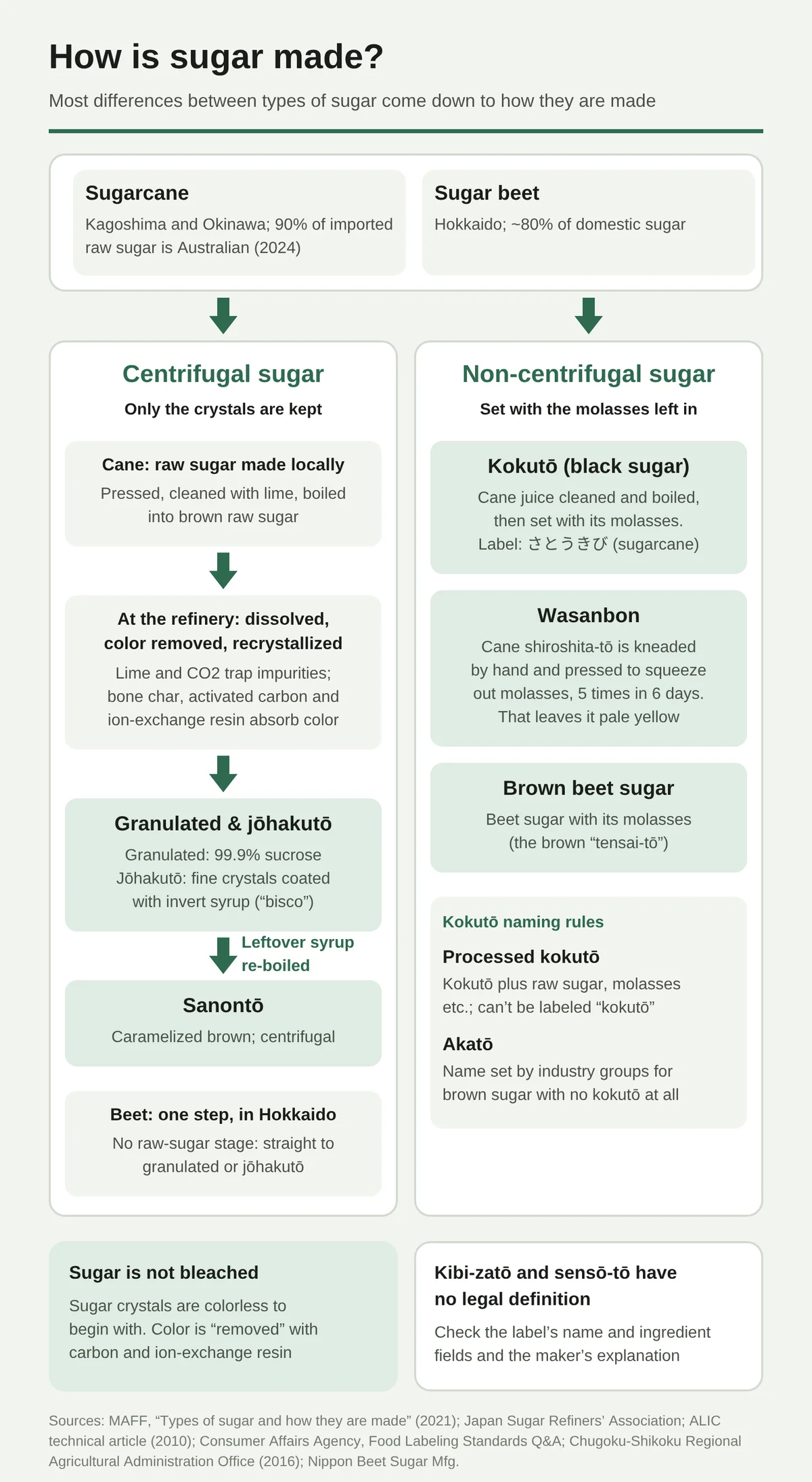
Most of the differences between sugars are differences in how they are made. Even from the same sugarcane, the method can produce jōhakutō, granulated sugar, or kokutō.
Centrifugal and non-centrifugal sugar
| Category | How it is made | Main types |
|---|---|---|
| Centrifugal sugar (分蜜糖, bunmitsutō) | The boiled syrup goes through a centrifuge, which separates crystals from molasses, and only the crystals are taken out | Granulated sugar, jōhakutō, sanontō, white coarse crystal sugar (shiro-zarato), yellow coarse crystal sugar (chū-zarato), sugar cubes, rock sugar |
| Non-centrifugal sugar (含蜜糖, ganmitsutō) | Crystals and molasses are not separated; everything is set together with the molasses | Kokutō (kuro-zatō, “black sugar”), wasanbon, tensai-tō non-centrifugal sugar, maple sugar |
Sources: MAFF, “Types of sugar and how they are made” (November 2021); a column by Nippon Beet Sugar Manufacturing (Nitten)
The molasses retains minerals and the sources of color and aroma. That is why non-centrifugal sugar, set with its molasses, is brown and has a distinctive flavor.
How white sugar is made
Japan’s white sugar (refined sugar) is made in two stages.
- Raw sugar is made where the cane grows. Sugarcane loses sugar soon after harvest and is bulky. So the mill near the farms presses it, adds lime to settle the impurities, and boils it into a brown “raw sugar” (粗糖) of crystals before shipping
- A refinery makes it white. The raw sugar is dissolved, impurities and color are removed, and it is crystallized again
The main steps at the refinery are as follows (a technical explanation by a director of the Japan Sugar Refiners’ Association, in an ALIC publication, 2010).
| Step | What happens |
|---|---|
| Washing (洗糖) | Raw sugar is mixed with concentrated syrup to wash the color off the crystal surface |
| Dissolving and carbonation (溶解・炭酸飽充) | Dissolved in warm water, then lime and CO2 are added. The calcium carbonate that forms traps impurities, and the liquid is filtered |
| Decolorization (脱色) | Bone char (charcoal from burned animal bones), granular activated carbon and ion-exchange resin adsorb the color |
| Crystallization (結晶化) | Boiled in a vacuum pan, then fine seed crystals are added and grown |
| Repeated separation (分蜜) | Crystals and molasses are separated, and more crystals are taken from the molasses. Later rounds are heated longer and take on more color (→ sanontō) |
Sugar beet in Hokkaido does not go through raw sugar; the factory near the farms makes white sugar directly (called “kōchi hakutō,” farmland white sugar).
“Jōhakutō is bleached” is wrong
Sugar crystals are colorless and transparent to begin with. Fine crystals scatter light in every direction, so they look white (Japan Sugar Refiners’ Association; ALIC).
As in the table above, the color is “removed” with charcoal and ion-exchange resin. It is not “bleaching,” in which chemicals change the pigment to white. A method that changes the pigment with sulfurous acid (the sulfitation method) is still used in some countries’ plants, but a director of the Japan Sugar Refiners’ Association writes that it is not used in Japan, the EU or the US (2010).
Is bone char used?
There is a story that “white sugar is whitened with charcoal from cattle bones.” When we looked, consumer explanations and industry technical materials describe it differently.
| Source | What it says |
|---|---|
| Technical explanation by a director of the Japan Sugar Refiners’ Association (ALIC, 2010) | Many Japanese plants treat the sugar after carbonation in the order “bone char filtration, then decolorizing ion-exchange resin” |
| Consumer explanations (ALIC 2014, etc.) | They say only “activated carbon” and “ion-exchange resin” |
| Mitsui Sugar (now DM Mitsui Sugar) | Its 2019 earnings presentation lists “Fukuoka Plant: granular activated carbon equipment introduced” and “Halal certification obtained.” A January 2018 report (FoodNavigator-Asia) said the Fukuoka plant would stop using bone char and switch to activated carbon, with operations starting in mid-2018 |
| Nippon Beet Sugar Manufacturing (beet sugar) | “We use no animal-derived raw materials, including bone char and chitosan” |
Bone char has been used in Japan too. But whether the other refined-sugar makers still use it could not be confirmed from public materials. If you care, asking the maker is the surest way. In the US as well, some plants use bone char and some do not (company interviews by the Vegetarian Resource Group, 2019 and 2021).
Bone char is used to adsorb color, not added as an ingredient. Those who care are mainly people who want to avoid animal-derived products (vegans and halal). Wasanbon, by the traditional method, does not use bone char (a report by the Kagawa broadcaster KSB, 2025).
Differences by type, and how to choose
We summarize the main sugars using explanations from MAFF and the Japan Sugar Refiners’ Association. Composition is from the Standard Tables of Food Composition in Japan (8th revision).
| Type | Category | Grain and feel | Taste and best uses |
|---|---|---|---|
| Jōhakutō | Centrifugal | 0.1–0.2 mm. Moist | Moderate richness. Wide use in cooking, confectionery and drinks |
| Granulated sugar | Centrifugal | 0.2–0.7 mm. Free-flowing | Clean, light taste. Jam, Western-style sweets, coffee and tea |
| Sanontō | Centrifugal | Fine. Moist | Distinctive flavor and richness. Simmered dishes, tsukudani (foods simmered in soy sauce) |
| Yellow coarse crystal sugar (中ざら糖, chū-zarato) | Centrifugal | 2–3 mm. Yellow-brown | Mellow flavor. Simmered dishes, sukiyaki, pickles |
| Kokutō (kuro-zatō) | Non-centrifugal | Lumps and powder | Distinctive flavor; sweetness feels strong. Karinto, cheap traditional sweets (dagashi) |
| Wasanbon | Non-centrifugal | Very fine | Melts smoothly in the mouth. High-grade wagashi |
Source: MAFF, “Know the differences and cook better! Types of sugar and how they are made” (November 2021; photos and supervision by the Japan Sugar Refiners’ Association)
Jōhakutō: the standard household sugar in Japan
Jōhakutō is fine crystals coated with a liquid called “bisuko.” Bisuko is a solution of “invert sugar,” sucrose split into glucose and fructose (Japan Sugar Refiners’ Association).
- Its composition is sucrose 97.9%, glucose 0.7%, fructose 0.7% and water 0.7%
- The invert sugar and water keep it moist
- When it dries, tiny crystals form from the liquid on the surface and bind the crystals together, so it cakes
- It is explained that it tastes sweeter than granulated sugar because small amounts of components other than sucrose act as a stimulus (Japan Sugar Refiners’ Association)
When it cakes, put it in a bag, spray it with water, close the bag, and leave it for a few hours to loosen it (Japan Sugar Refiners’ Association).
Jōhakutō and granulated sugar swap places
For a long time it was said that “jōhakutō is the most produced sugar in Japan.” But in the Japan Sugar Refiners’ Association statistics, in fiscal 2023 granulated sugar (492,825 t) overtook jōhakutō (482,420 t). In fiscal 2024 the gap widened, with granulated sugar at 512,948 t and jōhakutō at 479,391 t.
Counting Hokkaido’s beet sugar, the gap is larger still. In ALIC’s tally (crop year 2020), it was granulated sugar 43.9%, jōhakutō 27.1%, liquid sugar 20.8%.
One reason is who uses it. Household use is only 8.7% of sugar consumption (fiscal 2024); the biggest users are confectionery at 27.8%, soft drinks at 17.4% and bread at 11.5% (Japan Sugar Refiners’ Association and ALIC survey). Even if jōhakutō is the household standard, factories use more granulated sugar and liquid sugar.
Incidentally, a September 2026 MAFF document still describes jōhakutō as “about half of domestic sugar consumption,” which did not match the statistics.
Granulated sugar: the “ordinary sugar” of the world
Granulated sugar is a pure, free-flowing sugar that is 99.9% sucrose. MAFF writes that “in many countries around the world, sugar means granulated sugar.”
It has no off-notes and does not get in the way of the flavor of coffee or tea. The sugar in stick sugar packets and sugar cubes is also granulated sugar (Japan Sugar Refiners’ Association).
Sanontō: the brown color is “caramelization”
Sanontō is made by boiling the syrup left after the crystals of jōhakutō or granulated sugar are taken out, again and again.
- It is often mistaken for non-centrifugal sugar like kokutō, but it is centrifugal sugar (Nitten)
- The brown color comes from the sugars caramelizing as the boiling is repeated
- The name is said to come from “sanon-guruma-tō,” imported in early Meiji (the “on” means the number of times it is boiled; Nitten)
- Some commercial sanontō and yellow coarse crystal sugar are coated on the surface with caramel color or a dark molasses to even out the color (Nitten; a note in the food composition tables)
Types of caramel color and how they are assessed are covered in our article on caramel color.
Kibi-zatō and sensō-tō
Kibi-zatō has no definition set by law. We checked the Consumer Affairs Agency’s Food Labeling Standards Q&A and found no definition of “kibi-zatō,” “tensai-tō,” “jōhakutō” or “granulated sugar.” Japan Agricultural Standards (JAS) also have no standard for sugar (Japan Sugar Refiners’ Association).
Many articles explain it as “a sugar made, during the refining of sugarcane raw sugar, by boiling it down as is into crystals,” but we could not confirm a maker’s official explanation of the process this time. It is safer to assume that color and flavor strength differ by product.
When choosing, check on the package how it was made and from what, using the name field, the ingredient list and the maker’s explanation. Because it is a brown sugar, using it in place of jōhakutō adds color and flavor to the result.
As an example, we give Nisshin Seito’s “Cup-jirushi Kibi-zatō.” Please check how it is made and how it tastes from the maker’s explanation.
Sensō-tō (洗双糖) is also a name with no official definition. It is often described as a light brown sugar close to raw sugar, but we could not confirm this from a primary source.
Domestic sugarcane sugar (kanshā-tō, 甘しゃ糖) is made mainly in Kagoshima and Okinawa prefectures. In fiscal 2024/25 it was 161,156 t, of which Kagoshima produced 64,102 t (Japan Sugar Refiners’ Association). The one we introduce here is a sensō-tō from Tanegashima in Kagoshima.
Tensai-tō comes in two kinds
When people say “tensai-tō,” two different things are actually mixed together.
| White beet sugar | Brown “tensai-tō” | |
|---|---|---|
| What it is | Granulated sugar or jōhakutō made from sugar beet | A brown sugar that keeps beet molasses (in the food composition tables, “tensai non-centrifugal sugar,” てんさい含蜜糖) |
| Appearance | The same as white sugar from sugarcane | Light brown |
| The maker’s description | “It uses a high-purity syrup, and almost no oligosaccharides or minerals remain” (Nippon Beet Sugar Manufacturing) | “It took on its color naturally during boiling” and “a mellow taste with no sharp edge” (Nitten “Hokkaido Mellow Tensai-tō”) |
About 80% of Japan’s domestic sugar is Hokkaido beet sugar. Beet sugar is made by three companies with seven plants: Hokuren, Hokkaido Sugar and Nippon Beet Sugar Manufacturing (ALIC, 2025).
The brown “tensai-tō” is sometimes described as “rich in minerals and oligosaccharides.” A Hokkaido Regional Development Bureau pamphlet also says it “contains natural minerals and oligosaccharides.” But in the food composition tables, tensai non-centrifugal sugar had trace calcium and 0 magnesium, almost the same as jōhakutō (we look at this in detail in Is brown sugar good for you?).
We think it is better to choose not for health effects but by whether the color and mellow flavor suit your cooking. Nitten describes its tensai-tō as “makes both cooking and sweets come out gentle” and “also for flavoring drinks, yogurt and so on.”
The one we introduce here is Hokuren’s brown tensai-tō; Hokuren is one of the three beet sugar makers in Hokkaido. We could not load Hokuren’s official site this time and could not confirm the composition figures. If you are curious, check the nutrition facts on the bag.
Kokutō and processed kokutō
Kokutō (kuro-zatō, “black sugar”) is sugar made by boiling down sugarcane juice and setting it together with its molasses.
What can be called “kokutō” is set by the Consumer Affairs Agency’s Food Labeling Standards Q&A.
- Kokutō (黒糖 / 黒砂糖): sugarcane juice with impurities removed, boiled down, then cooled and set without separating the molasses. The ingredient list must say “さとうきび” (sugarcane)
- Processed kokutō (加工黒糖): kokutō with raw sugar (粗糖) or molasses (糖みつ) and the like added. The ingredient list says things like “黒糖、粗糖、糖みつ” (kokutō, raw sugar, molasses). It must not say just “黒糖”
- A brown sugar that uses no kokutō at all cannot use names like “黒糖○○” or “○○黒糖.” For such sugars, an industry group set the name “akatō” (赤糖, “red sugar”)
These rules were set in 2010–2011. Before that, some products labeled “黒砂糖” used no kokutō. In a Consumer Affairs Agency survey, about a third each answered that “kokutō and kuro-zatō are the same,” “different,” and “don’t know” (ALIC, 2011). In March 2011 “黒砂糖 = 黒糖” was settled, and for kokutō and kokutō products (50% or more kokutō), the place where the raw material was grown must be labeled (fully in force from April 2013).
Domestic kokutō (non-centrifugal sugar) was 10,756 t in fiscal 2024/25, of which 10,175 t was made in Okinawa Prefecture (Japan Sugar Refiners’ Association). According to Kagoshima Prefecture, the peak season for kokutō making is winter, and the shape differs by finish, such as blocks or powder.
To choose pure kokutō, look for one whose ingredient list says only “さとうきび”. As an example, we give kokutō from Hateruma Island in Okinawa.
For comparison, there is also processed kokutō. Its ingredient list reads “黒糖、粗糖、糖みつ” and the like. Placing it next to pure kokutō shows the labeling rules clearly.
Wasanbon
Wasanbon is a sugar handed down in Sanuki (Kagawa) and Awa (Tokushima). The method at a long-established Kagawa maker is as follows (Chugoku-Shikoku Regional Agricultural Administration Office, 2016).
- Sugarcane harvested in December is pressed right away and boiled in a pot
- Skimming off the scum, said to “decide the taste,” is repeated until the liquid is clear
- It is cooled in unglazed jars for about two weeks to make the raw material, “shirashitatō” (白下糖)
- “Togi” (研ぎ), kneading by hand by craftsmen, and “oshibune” (押し船), pressing the molasses out with weights, are repeated 5 times over 6 days
The name is said to come from kneading it for three days on a tray (bon). Its composition is 98.0% sucrose, and it is classed as non-centrifugal sugar, but because the molasses is pressed out in the kneading, its color is a pale yellow (MAFF).
It melts smoothly in the mouth and is used for dry confections pressed in wooden molds and for wagashi. Recently it is used in Western-style sweets too. Rather than a sugar to use lavishly in simmered dishes, it is suited to confectionery, for enjoying the melt and the aroma.
Here we introduce wasanbon from Awa (Tokushima).
Sugar cubes, rock sugar and powdered sugar
| Type | How it is made | Best uses |
|---|---|---|
| Sugar cubes | Granulated sugar with a small amount of concentrated syrup, pressed into shape | Each piece has a set weight, so no measuring is needed |
| Rock sugar | Grown into large crystals over a long time | Dissolves slowly, so it suits making fruit liqueurs |
| Powdered sugar | Granulated sugar ground into powder. Some add a little starch to keep it from caking | Decorating sweets |
Source: Japan Sugar Refiners’ Association “FAQ”; MAFF
Sugar cube production fell by more than half in five years, from 1,172 t in fiscal 2020 to 569 t in fiscal 2024 (Japan Sugar Refiners’ Association).
Japan and overseas: naming rules and amounts of sugar
The rules for naming sugar differ by country. How does Japan’s jōhakutō look by overseas standards?
Jōhakutō does not qualify as EU “white sugar”
The EU has a directive that defines the names of sugars (2001/111/EC).
| EU name | Main criteria |
|---|---|
| Semi-white sugar | Invert sugar 0.1% or less |
| White sugar (sugar, white sugar) | Invert sugar 0.04% or less, loss on drying 0.06% or less, etc. |
| Extra-white sugar | Meets the white sugar criteria, with even lower color and other points |
Source: EU Directive 2001/111/EC (checked in the original text held in the UK legislation database; we have not checked EU-side amendments since 2021)
Jōhakutō’s invert sugar (glucose + fructose) is about 1.4%. That is about 35 times the EU white sugar limit of 0.04%, and it does not even meet semi-white sugar (0.1%). In the EU, these names can be used only for sugars that meet the definition (result of Urayomi’s comparison).
“Jōhakutō exists only in Japan” goes too far
But similar sugars exist overseas.
- The international food standard (Codex, CXS 212-1999) has categories for “soft white sugar” (fine, moist white sugar, 97% or more sucrose plus invert sugar) and “soft brown sugar” (88% or more of the same)
- China has “绵白糖” (mián bái táng, soft white sugar), a sugar under a national standard (GB/T 1445). In a draft standard (open for comments) issued in 2026 by an industry group in Guangdong, reducing sugars (glucose, fructose, etc.) are 1.5–4.5 g per 100 g (1.0–4.5 g in another draft), which is about the same as or more than jōhakutō (about 1.4 g)
The Japan Sugar Refiners’ Association describes jōhakutō as “a sugar unique to Japan.” What we can say is only this: “we found no other country where a sugar like jōhakutō is the household mainstream.”
The US: no need to state sugarcane or beet
In the US, sucrose (sugar, cane sugar, beet sugar) is “generally recognized as safe” (GRAS), and there is no obligation to state in the name whether it is from sugarcane or sugar beet (US federal regulation 21 CFR 184.1854).
How Japan’s sugar system works: about 60% is imported raw sugar
Of Japan’s sugar, about 60% is imported raw sugar and about 40% is domestic (sugar year 2024: about 1.1 million t of imported raw sugar and about 700,000 t of domestic sugar; MAFF). About 80% of the domestic share is Hokkaido beet sugar, and the rest is sugarcane sugar from Kagoshima and Okinawa. 90% of the raw sugar imported in 2024 was from Australia (the Japan Sugar Refiners’ Association’s tally of Ministry of Finance trade statistics).
Domestic sugar costs more than imports. So the government, through the “sugar price adjustment system,” collects an adjustment levy on imported raw sugar and passes it on as subsidies to domestic sugarcane and sugar beet farmers and mills (MAFF). 83% of farms in the Nansei Islands of Kagoshima and 84% of farms in Okinawa grow sugarcane, which is regarded as an “irreplaceable crop” that stands up to typhoons and drought.
The system that also collects the levy from isomerized sugar is described in detail in our article on isomerized sugar.
Compared with the world, Japan is on the low side
By the International Sugar Organization’s 2024 figures, Japan’s sugar consumption per person is 15.2 kg, below the world average of 22.3 kg. Among the 20 countries and regions listed, only China (11.2 kg) is lower than Japan. The US is 29.9 kg, the EU 35.1 kg and Brazil 55.6 kg.
What the “sugar” on the back label can and cannot tell you
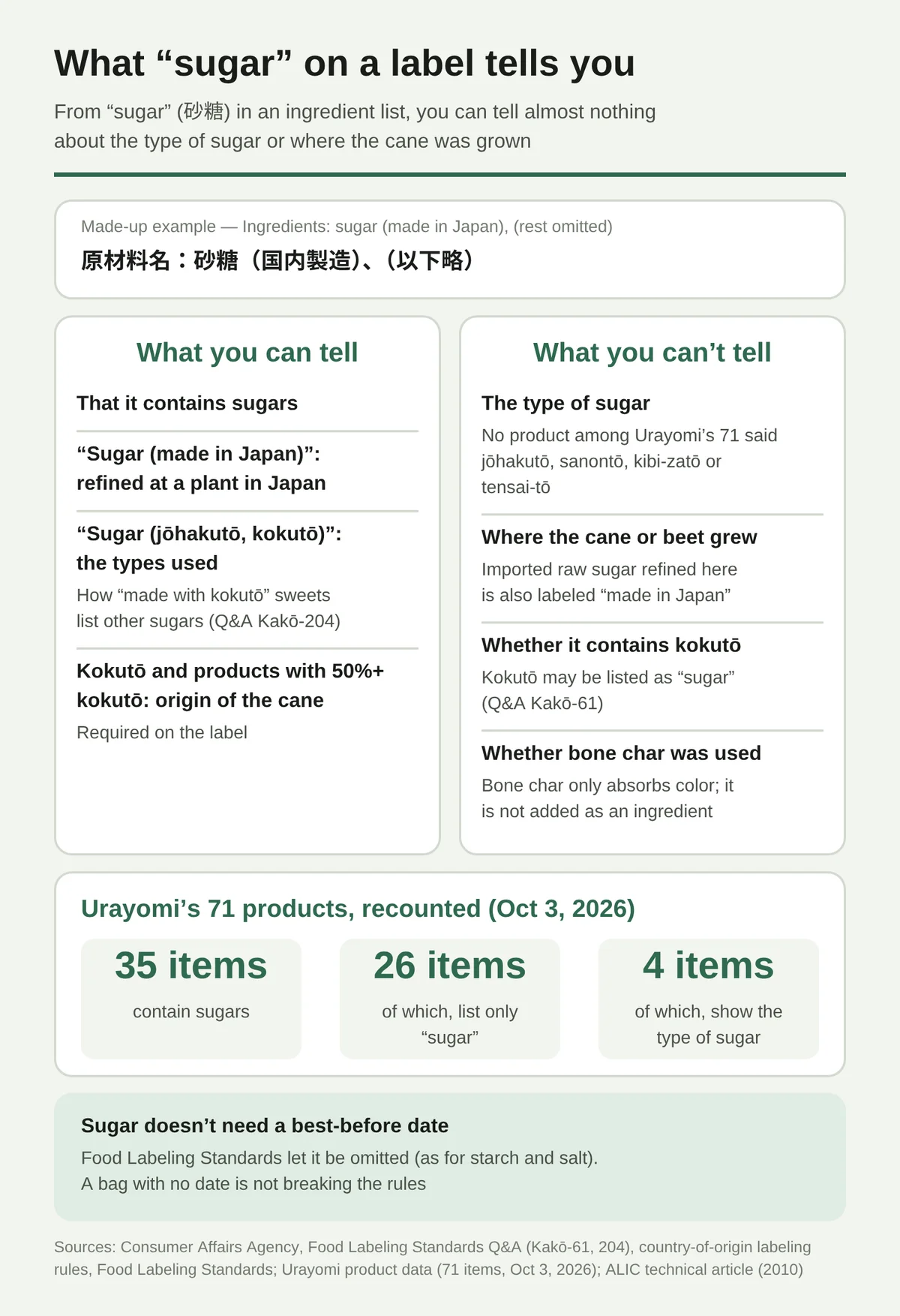
From the word “sugar” (砂糖) in an ingredient list, you can tell almost nothing about the type of sugar or where the sugarcane grew. We checked this against Urayomi’s product data.
We recounted Urayomi’s 71 products
We recounted the ingredients of the 71 products listed on Urayomi (October 3, 2026).
| Item | Count |
|---|---|
| Contains sugars (sugar, granulated sugar, coarse crystal sugar, kokutō, etc.) | 35 products (of 71) |
| Of those, the ingredient name is just “砂糖” (sugar) | 26 products |
| Wording that shows the type of sugar | Only 4 products |
The four whose type could be told were “グラニュー糖” (granulated sugar; a furikake rice seasoning), “ザラメ糖” (coarse crystal sugar; a yakiniku sauce), “砂糖(黒糖)” (sugar (kokutō); a mayonnaise-style seasoning) and “糖類(有機糖みつ、砂糖)” (sugars (organic molasses, sugar); a yakisoba sauce). Not one product wrote jōhakutō, sanontō, kibi-zatō or tensai-tō.
“Kokutō” may be written as “sugar”
The Consumer Affairs Agency’s Food Labeling Standards Q&A sets the following.
- Kokutō may be written as “砂糖” (sugar) (Processed Foods-61). So even if kokutō is used, the ingredient list may say only “砂糖”
- Even if a sweet says “黒糖使用” (made with kokutō), it is not necessarily 100% kokutō. However, if other sugars are also used, it is written like “砂糖(上白糖、黒糖)” (sugar (jōhakutō, kokutō)) (Processed Foods-204; sanontō is treated the same way)
- When there are several ingredients of the same kind, they can be grouped, as in “糖類(砂糖、水あめ)” (sugars (sugar, starch syrup)) (Processed Foods-58)
The Urayomi product with “砂糖(黒糖)” is an example of this rule.
“Sugar (made in Japan)” is not where the sugarcane grew
For processed foods, there is a rule to state the place of origin of the ingredient that makes up the largest share. For a food in which sugar is the largest, the place where the sugar was made is written, as in “砂糖(国内製造)” (sugar (made in Japan)) (an example in the Consumer Affairs Agency Q&A).
“Made in Japan” means the plant that refined the sugar is in Japan. Sugar made by refining raw sugar imported from Australia at a Japanese plant is also “made in Japan” (an explanation from how the system works; it is not a label showing where the sugarcane grew).
Kokutō and kokutō products (50% or more kokutō), on the other hand, must state the origin of the raw material under a separate rule. Where kokutō is less than 50%, as in kokutō karinto, it does not apply.
Sugar has no best-before date
Under the Food Labeling Standards, sugar is a food for which the best-before date may be omitted (the same as starch, salt and the like). If a bag has no date, it is not a labeling violation.
How “無添加” (additive-free) is written on food labels is covered in our article on the rules for “無添加” labeling.
Is sugar bad for you? Checking each claim
What matters when thinking about effects on the body is the “amount” of sugar, not the “type.” Neither WHO nor the US guidelines distinguish white sugar from brown sugar.
WHO’s “10% and 5%,” and the numbers Japan’s standard declined to set
| Guideline | What it says |
|---|---|
| WHO (2015) | Free sugars below 10% of daily energy (strong recommendation). Below 5%, about 25 g (about 6 teaspoons), is better still (conditional recommendation) |
| Japan, Dietary Reference Intakes 2025 | On setting a target amount for sugars, it “decided to postpone” |
| US Dietary Guidelines 2025–2030 (January 2026) | For added sugars, “there is no amount that is healthy.” Up to 10 g per meal |
| American Heart Association (2016) | Added sugars for children (ages 2–18) 25 g or less; avoid under age 2 |
“Free sugars” are the sugars added by the maker or the eater, plus the sugars in honey, syrups and fruit juice. Kokutō, tensai-tō and honey all count as the same free sugars. The new US guidelines also list cane sugar, beet sugar, honey and molasses as examples of added sugars.
The reasons Japan’s Dietary Reference Intakes 2025 did not set a number include:
- Japan’s food composition tables have no values for added sugar or free sugar, so intake cannot easily be estimated
- The average intake of Japanese people is low, and more than half may be below other countries’ recommended values
However, the same document says “some Japanese people have a very high sugar intake” and that attention must be paid to actual intake.
Japanese free sugar intake is low. A little over 20% comes from “seasonings”
In a study using the 2016 National Health and Nutrition Survey (about 9,900 adults, with one-day weighed food records), Japanese free sugar intake was 4.8% for men and 5.8% for women (as a share of daily energy) (Fujiwara 2020). British adults are at 10.4% (2019–2023 survey), and US adults’ added sugars at 14.9% (2005–2010).
What is distinctive in Japan is where the sugar comes from.
| Source of free sugars | Men | Women |
|---|---|---|
| Sugar and jams | 30.1% | 29.8% |
| Seasonings | 24.4% | 21.3% |
| Confectionery | 17.0% | 23.0% |
| Soft drinks | 11.3% | 9.4% |
Source: Fujiwara A, et al. Nutrients 2020 (no conflicts of interest)
Overseas, soft drinks and confectionery dominate, but in Japan “seasonings” such as simmered dishes and sauces made up a little over 20%. Mirin and soy sauce are covered in our article on mirin and our article on types of soy sauce.
In another analysis by the same research group (16,652 adults), people with more free sugars tended to take in less of 16 of the 24 vitamins and minerals (Fujiwara 2020). A sugar-heavy diet “dilutes” the nutrients from other foods.
Cavities: WHO’s evidence includes Japanese wartime and postwar data
The link between sugar and cavities is the best supported.
- In a systematic review for WHO (55 studies), 42 of 50 studies in children and all 5 studies in adults showed more cavities with more sugar. Fewer cavities below 10% were rated “moderate” quality evidence, and below 5% “very low” quality (Moynihan & Kelly 2014). In a 2022 update, the evidence for below 5% rose to “low” (Moores 2022)
- One basis for WHO’s “5%” is data on Japanese children. A reanalysis of nationwide Japanese cavity data, including the wartime period when sugar could not be had, found cavities increasing across the range of 0–10% of energy from sugar (Sheiham & James 2014)
In other words, data on the teeth of Japanese children during and after the war became one of the materials that set today’s global guideline.
Body weight: it rises “because energy rises”
In a meta-analysis commissioned by WHO (30 randomized controlled trials and 38 cohort studies),
- Reducing sugar lowered body weight by 0.80 kg on average
- Increasing sugar raised it by 0.75 kg on average
- But when sugar was swapped for other carbohydrates at the same energy, weight did not change
(Te Morenga 2013). The main reason sugar makes people gain weight is thought to be taking in too much energy from sweet things.
Diabetes and heart disease: the evidence centers on “sweet drinks”
| Study | Type and size | What was found |
|---|---|---|
| Imamura 2015 | Meta-analysis of 17 cohort studies | One more sugar-sweetened drink a day means 18% more type 2 diabetes (13% after adjusting for body mass) |
| Huang 2023 | Umbrella review of 73 meta-analyses | Showed links between sugar and many diseases, but the quality of evidence was mostly “low.” For example, 17% more coronary heart disease per 250 mL a day of sugar-sweetened drinks |
| Takayama Study (Japan, Nagata 2019) | 29,079 people in Takayama, Gifu, followed for 16 years | In men, mortality in the group with the highest sugar intake was 1.27 times higher. In women, only free sugars were linked |
All of them are mainly observational studies, so we cannot say that “sugar caused the disease.” The best-supported evidence is for sweet drinks. Japan’s Dietary Reference Intakes 2025 also cite the link with sugar-sweetened drinks for type 2 diabetes and say “no clear threshold has been reported.”
The difference between the fructose in fruit and the fructose in sweet drinks is covered in our article on fructose in fruit.
“Sugar is addictive” and “sugar makes children hyperactive”
| Claim | What research has found | Verdict |
|---|---|---|
| Sugar is addictive like a drug | When rats were given sugar “intermittently,” binge eating and brain changes were seen (Avena 2008). A review says there is little evidence for this in humans (Westwater 2016) | Little evidence in humans |
| Eating sugar makes children hyperactive | A pooled result of 23 double-blind trials found no effect on behavior or cognition (Wolraich 1995, JAMA). The influence of parents’ expectations has also been pointed out | No evidence |
Industry money and research
Sugar research has a history of industry money being involved.
- In 2016 it came to light that in 1965 the US Sugar Research Foundation had funded a review that pointed the blame for heart disease at fat and made the risks of sugar look small (Kearns 2016). The funding was not disclosed at the time
- A 2017 paper that said “national sugar guidelines rest on weak evidence” (Erickson 2017) was funded by an organization largely financed by the food and agriculture industries (ILSI North America)
In Japan, the Japan Sugar Refiners’ Association’s “Sugar and Health” research group puts out claims such as “relaxing effect” and “also good for dieting and mental health.” These are claims of an industry group, and we do not treat them as fact in this article.
Overseas measures: the UK drinks tax, and a retracted paper
In April 2018 the UK began a tax on sugary soft drinks (the Soft Drinks Industry Levy). It is charged to the companies that make them, and makers reduced the sugar in their drinks.
| Study | What was found |
|---|---|
| Bandy 2020 | From 2015 to 2018, sugar sold from soft drinks fell by 4.6 g per person per day (30%). The average sugar content of drinks went from 4.4 g to 2.9 g per 100 mL |
| Rogers 2024 | Eleven months after the tax began, free sugars fell by 4.8 g a day for children and 10.9 g for adults |
| Rogers 2023 | Obesity among girls in Year 6 of primary school (ages 10–11) fell by 1.6 percentage points. There was no change in boys |
On the other hand, a 2021 analysis of purchase volumes in the BMJ (British Medical Journal) was found to contain data errors and was retracted in 2023. In the corrected version, the fall in sugar across all soft drinks shrank from 9.8% to 2.7%. When you cite a number, you need to check that it has not been retracted.
Japan has no tax on sugar or sweet drinks for health purposes.
Is brown sugar good for you? Urayomi’s calculation
We checked the claim that “white sugar is bad for you and brown sugar is good for you” against the numbers in the food composition tables.
Per 100 g, only kokutō has more
| Per 100 g | Calcium | Potassium | Iron | Magnesium |
|---|---|---|---|---|
| Kuro-zatō (kokutō) | 240 mg | 1,100 mg | 4.7 mg | 31 mg |
| Wasanbon | 27 mg | 140 mg | 0.7 mg | 17 mg |
| Sanontō | 6 mg | 13 mg | 0.1 mg | 2 mg |
| Tensai non-centrifugal sugar | trace | 27 mg | 0.1 mg | 0 |
| Jōhakutō | 1 mg | 2 mg | trace | trace |
| Granulated sugar | trace | trace | trace | 0 |
- Only kuro-zatō, which keeps all of its molasses, was rich in minerals
- Tensai non-centrifugal sugar, though brown, is almost the same as jōhakutō. The only thing higher was sodium (48 mg)
- The minerals (ash) in sanontō are 0.1%, and the Japan Sugar Refiners’ Association itself says “it cannot be said that sanontō is better for the body”
What percent of the daily reference is one teaspoon?
Sugar is a food used in small amounts at a time. So we calculated what percent of the daily reference for ages 30–49 the minerals in one teaspoon come to.
- One teaspoon weighs 3 g for jōhakutō, 4 g for granulated sugar (the weight guide of the National Institute of Health and Nutrition), and 3.2 g for sanontō (from the specific gravity in the composition tables)
- For kuro-zatō, wasanbon and tensai non-centrifugal sugar, there are no values in public weight tables, so we assumed 3 g, the same as jōhakutō
| One teaspoon | Potassium | Calcium | Iron | Magnesium |
|---|---|---|---|---|
| Kuro-zatō (3 g, assumed) | 33 mg (1.7%) | 7.2 mg (1.1%) | 0.14 mg (1.3%) | 0.93 mg (0.3%) |
| Wasanbon (3 g, assumed) | 4.2 mg (0.2%) | 0.81 mg (0.1%) | 0.02 mg (0.2%) | 0.51 mg (0.2%) |
| Tensai non-centrifugal sugar (3 g, assumed) | 0.81 mg (0.04%) | 0 | 0.003 mg (0.03%) | 0 |
| Jōhakutō (3 g) | 0.06 mg (almost 0%) | 0.03 mg (almost 0%) | 0 | 0 |
The figures in parentheses are the share of the reference for women aged 30–49 (potassium adequate intake 2,000 mg, calcium recommended intake 650 mg, iron recommended intake 10.5 mg [menstruating], magnesium recommended intake 290 mg).
Even the highest, kuro-zatō, gave less than 2% of the daily reference for every mineral.
Conversely, to meet a woman’s daily reference from kuro-zatō alone, you would need
- for calcium (650 mg), 271 g of kuro-zatō, 953 kcal
- for iron (10.5 mg), 223 g of kuro-zatō, 786 kcal
Even if all of WHO’s “desirable upper limit” of 25 g were kuro-zatō, calcium would reach only 9% of the reference and iron 11%. For reference, 100 g of komatsuna (Japanese mustard spinach) has 170 mg of calcium (13 kcal) (food composition tables).
The sugar makers themselves say the same thing. In a column on its own site, Nippon Beet Sugar Manufacturing (Nitten), a beet sugar maker, says that to get an adult man’s adequate intake of potassium (2,500 mg) from kuro-zatō you would need about 230 g (about 810 kcal), and writes that “choosing among sugars for the purpose of taking in minerals actually makes no sense.”
The oligosaccharides in tensai-tō differ greatly by product
The “oligosaccharide” in tensai-tō means a sugar in sugar beet called “raffinose.”
| Source | Oligosaccharide amount (per 100 g) |
|---|---|
| Food composition tables, “tensai non-centrifugal sugar” | Raffinose 4.7 g, 1-kestose 0.6 g |
| Nutrition label of Nitten “Hokkaido Mellow Tensai-tō” | Oligosaccharides 0.4 g |
Between the composition tables and an actual product’s label, there was about a 12-fold difference. The tables themselves note that “the amounts of raffinose and kestose contained may differ by product type.” Even calculated with the table value, the raffinose in one teaspoon (3 g) is 0.14 g.
Also, on Nitten’s product label, potassium is 136 mg per 100 g, higher than the table value (27 mg). Even so, one teaspoon gives about 4 mg, which is 0.2% of a woman’s adequate intake. The contents of brown tensai-tō differ by product, so the surest way is to check the nutrition facts on the bag. In the Consumer Affairs Agency’s list of FOSHU (Foods for Specified Health Uses; September 2026), there was no product with raffinose as its functional ingredient.
GI: sugar is around 65. We could not find values for kokutō or tensai-tō
GI (glycemic index) compares how readily blood sugar rises after eating, with glucose set at 100.
| Sweet | GI | Source |
|---|---|---|
| Glucose | 103 (average of 7 trials) | International GI tables (Atkinson 2008) |
| Sucrose (sugar) | 65 (average of 6 trials; 58–84 by trial; the Japanese trial gave 60) | Same |
| Panela (sugarcane non-centrifugal sugar) | 69 | University of Sydney database (an Italian trial) |
| Honey | 61 (average of 17 kinds; 35–87) | International GI tables |
| Maple syrup | 54 | Same |
| Fructose | 15 (average of 3 trials) | Same |
- Sugar (sucrose) is glucose and fructose joined together. Because fructose has a low GI, the GI of sugar comes out at a “medium” level of around 65
- For kokutō, tensai-tō, wasanbon and kibi-zatō, no measured GI values were registered in the University of Sydney’s GI database
- Numbers often seen online, such as “jōhakutō GI 109,” could not be traced to a source. In the international tables, sucrose does not exceed 100
More important is the amount. GI is a comparison for eating 50 g of carbohydrate at once (25–50 g for sugar). Looking at “GL (glycemic load),” which multiplies in the amount eaten, one teaspoon (3 g) of jōhakutō is about 1.9 and one tablespoon (9 g) is about 5.8; if the amount doubles, GL doubles too (our calculation). “Reducing the amount you use” has a far bigger effect than “switching to a low-GI sugar.”
The Dietary Reference Intakes 2025 write that even though fructose has a low GI, taking too much raises concerns about higher triglycerides and weight gain.
Kokutō has somewhat more acrylamide. But think in terms of amount
Acrylamide is a substance formed when sugars and amino acids are heated at high temperature. In a MAFF survey, non-centrifugal sugar (such as kokutō) contained more than French fries, close to the level of potato-based snacks.
| Food | Average (mg/kg) | Survey year |
|---|---|---|
| Non-centrifugal sugar | 0.42 (max 1.5) | Fiscal 2015 (120 samples) |
| Sugars | 0.02 | Fiscal 2022 |
| French fries | 0.24 | Fiscal 2023–24 |
| Potato-based snacks | 0.47 | Fiscal 2022–23 |
Even for the same sweets, there was a difference depending on whether non-centrifugal sugar was used (fiscal 2010 averages). Candy: 1.0 versus 0.005; yōkan (sweet bean jelly): 0.42 versus 0.008 (mg/kg, with versus without non-centrifugal sugar).
But thinking in terms of amount, one teaspoon (3 g) of kokutō is about 1.3 μg (micrograms). That is about one-twentieth of the roughly 28 μg in one bag (60 g) of potato-based snacks (our calculation). For people who often eat lumps of kokutō, we think it is enough to remember to watch the amount.
“Tensai-tō warms the body”: no study has confirmed it in people
There are claims that “tensai-tō warms the body” and “white sugar cools the body.”
- The apparent source is the macrobiotics of Nyoichi Sakurazawa. It is a way of sorting foods into “yin” and “yang” by, for example, the warmth or cold of where they grow, and macrobiotics is said to use rice syrup, amazake, beet sugar and maple syrup instead of sugar
- This yin–yang sorting has no scientific basis
- We searched PubMed for human trials examining beet sugar or raffinose and body temperature or skin temperature, and found none
Note that beetroot (the vegetable) and the sugar beet from which sugar is taken are different varieties of the same species. Studies of beetroot juice cannot be applied to tensai-tō.
What about “avoid kokutō too for babies under 1”?
For “infant botulism” in babies under 1 year, the only thing the government names is honey. A 1987 notice from the Ministry of Health and Welfare advised “not to give honey to infants under 1 year,” and a MAFF document (updated September 2026) also lists honey as the preventive measure.
You may see “avoid kokutō too for under 1” online, but we found no public material that supports it. In this article, we cannot say that kokutō is either dangerous or safe. For how to give babies sugar itself, please consult your regular pediatrician. The US dietary guidelines recommend avoiding added sugars in infancy and early childhood.
In the end, how to choose and use it?
What decides your choice of sugar is not a health effect but taste, color, how easily it dissolves, and how well it suits the dish.
Use different sugars in cooking
| What you want to do | Suitable sugar | Reason (official explanation) |
|---|---|---|
| Sweeten without adding color (jelly, syrup, Western-style sweets) | Granulated sugar, white coarse crystal sugar | No off-notes; colorless and transparent |
| Coffee and tea | Granulated sugar, sugar cubes | Does not spoil the flavor of the drink |
| Everyday cooking in general | Jōhakutō | Moist, moderate richness. Widely usable in cooking, sweets and drinks |
| Simmered dishes, tsukudani, sukiyaki | Sanontō, yellow coarse crystal sugar | Distinctive flavor and richness |
| You want to use the brown color and flavor | Kibi-zatō, tensai-tō | Adds color and flavor (differs by product) |
| Sweets with a kokutō flavor (karinto, kuromitsu syrup) | Kokutō | Distinctive flavor; sweetness feels strong |
| Dry confections, wagashi enjoyed for their melt | Wasanbon | Fine crystals, melts smoothly |
| Fruit liqueurs | Rock sugar | Dissolves slowly |
Source: MAFF; Japan Sugar Refiners’ Association
If you use a colored sugar (sanontō, kibi-zatō, tensai-tō, kokutō) in place of jōhakutō, the color and flavor of the result change. For sweets, making it once with the type in the recipe before switching makes the difference easier to see.
Looking at the price
The retail price of jōhakutō in Tokyo (annual average) rose from 213 yen per kg in 2022 to 279 yen in 2025 (Japan Sugar Refiners’ Association’s tally of Ministry of Internal Affairs and Communications statistics). The international raw sugar price hit a record high of 109 yen per kg in November 2023 and has fallen since (MAFF).
Kibi-zatō, tensai-tō, kokutō and wasanbon come in bags of varied sizes. When comparing, it is easiest to convert to the price per kg. Wasanbon is made by repeating hand kneading for 6 days, and MAFF describes it as “a raw material for high-grade wagashi.”
Storage, and when it cakes
- Sugar bags (polyethylene) let air and moisture through. Putting the sugar in an airtight tin or container makes it less likely to cake (MAFF; Japan Sugar Refiners’ Association)
- If it cakes, put it in a bag, spray it with water, close the bag, and leave it for a few hours. Another method is to leave it overnight in a container with a slice of bread
- If left for a long time, it can take on color through a reaction with the small amount of amino acids in the sugar (Japan Sugar Refiners’ Association)
A guide to amounts
WHO explains its “desirable upper limit” of about 25 g as “about 6 teaspoons.” Counted with the Japanese weight guide for jōhakutō (3 g per teaspoon), it is about 8 teaspoons. However, free sugars include not only the sugar you add yourself but also the sugars in sweets, drinks, sauces and dressings. Japan’s “Food Guide Spinning Top” (Shokuji Balance Guide) gives about “200 kcal a day” as a guide for confectionery and favorite beverages.
For sweeteners to use when you want to cut sugar and keep the sweetness, see our article on sweeteners.
What we introduced in this article (summary)
Here is a recap of what we introduced in the article. The reasons and the ingredients are in each section.
| What we introduced | Where to buy |
|---|---|
| Nisshin Seito Cup-jirushi Kibi-zatō 750 g | See on Rakuten (クイックファクトリー) PR See on Amazon.co.jp PR See on Yahoo! Shopping PR |
| Yūki Ichiba Sensō-tō 1 kg (from Tanegashima) | See on Rakuten (楽天24) PR See on Amazon.co.jp PR See on Yahoo! Shopping PR |
| Hokuren Tensai-tō 650 g (a listing where you choose the number of bags; from 1 bag) | See on Rakuten (asuraito) PR See on Amazon.co.jp PR See on Yahoo! Shopping PR |
| Hateruma Kokutō (powder) 450 g | See on Rakuten (泡盛商店) PR See on Amazon.co.jp PR See on Yahoo! Shopping PR |
| Processed kokutō (powder) 750 g (from Okinawa) | See on Rakuten (こだわり食材 572310.com) PR |
| Okada Seitōsho Awa Wasanbontō 100 g (bag) | See on Rakuten (徳島県物産館) PR See on Amazon.co.jp PR See on Yahoo! Shopping PR |
Summary
| Question | What we found |
|---|---|
| When did sugar come to Japan? | The oldest reliable record is “蔗糖” (sugarcane sugar), a medicine, in the Shōsōin’s “Shūshu Yakuchō” of 756. There is no firm evidence that Ganjin brought it |
| Is the amount per person rising? | In Japan it peaked at 28.1 kg in fiscal 1973 and was 16.8 kg in fiscal 2024. The US also peaked in 1972 |
| What are the differences between types? | Differences in how they are made. Centrifugal sugar, with only crystals taken out (jōhakutō, granulated sugar, sanontō), and non-centrifugal sugar, set with its molasses (kokutō, wasanbon, etc.). The brown of sanontō is caramelization |
| Is jōhakutō bleached? | No. The crystals are colorless and transparent. The color is removed with charcoal and the like. Bone char has been used in Japan too |
| Is jōhakutō only in Japan? | It does not meet the EU “white sugar” criteria, but similar sugars exist in international standards and in China. In domestic production, granulated sugar overtook it in fiscal 2023 |
| Is brown sugar good for you? | Only kokutō is rich in minerals. Even so, one teaspoon gives less than 2% of the daily reference. Tensai non-centrifugal sugar is close to jōhakutō |
| Is there a low-GI sugar? | Sucrose is around 65. We found no values for kokutō or tensai-tō. “Jōhakutō 109” has no known source. What matters is the amount |
| Is sugar bad for you? | Amount, more than type. WHO says free sugars below 10%, ideally below 5% (about 25 g). The evidence is strong for cavities and body weight; for diabetes and the like it centers on sweet drinks |
| Can you tell the type from the back label? | Almost not. Of Urayomi’s 71 products, only 4 showed the type. “Made in Japan” (国内製造) is not where the raw material was grown |
Sources
History
- Pompidor N, et al. Three founding ancestral genomes involved in the origin of sugarcane. Ann Bot 2021 (PMC8103802) / Lu G, et al. Sugarcane breeding: a fantastic past and promising future driven by technology and methods. Front Plant Sci 2024 (PMC10957636)
- Japan Sugar Refiners’ Association, “The history of the spread of sugar,” “Main raw materials and classification of sugar,” “The sugar production process,” “FAQ” https://seitokogyokai.com/
- Agriculture & Livestock Industries Corporation (ALIC), pamphlet “Sugar,” Consumer Corner (2010), and articles in “Sugar and Starch Information” (Arao Miyo, “Traditional sugar-making methods in Japan and abroad,” 2011 and 2012; Kiyama Kuniki, 2025; and others)
- Kotobank, Nihon Daihyakka Zensho, “Shōsōin medicines”
- Kagoshima Prefecture, “Kokutō Daijiten” (2026); Chugoku-Shikoku Regional Agricultural Administration Office, Kagawa Office, “Wasanbon, still made by the traditional method” (2016)
- NEH Humanities, “Gross Injustice” (2010); PBS, “How Many Slaves Landed in the U.S.?”
- Fondation Napoléon, “La bataille du sucre”
- MAFF, Food Balance Sheet, item-by-item long-term table (fiscal 2024); USDA Economic Research Service, Charts of Note (2021, 2022, 2024)
Production and types
- MAFF, “Know the differences and cook better! Types of sugar and how they are made,” aff, November 2021 issue
- Saito Shoji, “The whiteness of sugar is a natural color,” Sugar Information (ALIC, 2010)
- Nippon Beet Sugar Manufacturing (Nitten), “Types of sugar,” “What is sanontō?,” “FAQ,” and the product page for “Hokkaido Mellow Tensai-tō”
- Mitsui Sugar, earnings presentation for the fiscal year ended March 2019; FoodNavigator-Asia (January 15, 2018)
- Vegetarian Resource Group, “Sugar Update” (2019 and 2021)
- KSB Setonaikai Broadcasting, “Wasanbon appears in the vegan experience program at Expo Osaka-Kansai” (2025)
Systems, statistics and labeling
- MAFF, “The situation surrounding sugar and starch” (September 2026)
- Japan Sugar Refiners’ Association, “Statistics” (domestic refined sugar production, consumption by use, raw sugar imports, per-person sugar consumption in major countries [from the International Sugar Organization yearbook], jōhakutō retail prices)
- Consumer Affairs Agency, Food Labeling Standards Q&A, processed foods (Processed Foods-9, 58, 61, 69, 70, 204), country-of-origin labeling for raw materials (amended October 1, 2026), Food Labeling Standards (e-Gov)
- Nakamura (中村祥典), “On the labeling of kokutō,” Sugar Information (ALIC, 2011)
- EU Directive 2001/111/EC (as held on legislation.gov.uk); Codex Standard for Sugars CXS 212-1999; US federal regulation 21 CFR 184.1854; China, Guangdong Provincial Association for the High-Quality Development of the Biomedical Industry, group standard “绵白糖” draft for comment (2026)
Composition and GI
- MEXT, Standard Tables of Food Composition in Japan (8th revision), 2023 supplement, main tables and carbohydrate tables https://www.mext.go.jp/a_menu/syokuhinseibun/mext_00001.html
- MHLW, Dietary Reference Intakes for Japanese (2025 edition) https://www.mhlw.go.jp/stf/newpage_44138.html
- National Institute of Health and Nutrition, “Weight guide table” (2009 edition, revised 2013)
- Atkinson FS, et al. International tables of glycemic index and glycemic load values: 2008. Diabetes Care 2008 (PMC2584181)
- University of Sydney GI database https://glycemicindex.com/gi-search/ (checked October 3, 2026)
- Consumer Affairs Agency, “List of approved Foods for Specified Health Uses (FOSHU)” (September 1, 2026)
- Hokkaido Regional Development Bureau, “Food Catalog: Sugar Beet”
Effects on the body
- WHO, “Guideline: Sugars intake for adults and children” (2015) and press release
- US, “Dietary Guidelines for Americans 2025–2030” (January 2026)
- Vos MB, et al. Circulation 2017 (PMID 27550974)
- Fujiwara A, et al. Nutrients 2020 (PMID 33255814) / Fujiwara A, et al. Eur J Nutr 2020 (PMID 32162042)
- UK National Diet and Nutrition Survey 2019 to 2023 (2025) / Yang Q, et al. JAMA Intern Med 2014 (PMID 24493081)
- Moynihan PJ, Kelly SA. J Dent Res 2014 (PMID 24323509) / Moores CJ, et al. J Dent Res 2022 (PMID 35302414) / Sheiham A, James WP. BMC Public Health 2014 (PMID 25228012)
- Te Morenga L, et al. BMJ 2013 (PMID 23321486) / Imamura F, et al. BMJ 2015 (PMID 26199070) / Huang Y, et al. BMJ 2023 (PMID 37019448) / Nagata C, et al. Br J Nutr (PMID 32124712)
- Avena NM, et al. Neurosci Biobehav Rev 2008 (PMID 17617461) / Westwater ML, et al. Eur J Nutr 2016 (PMID 27372453) / Wolraich ML, et al. JAMA 1995 (PMID 7474248)
- Kearns CE, et al. JAMA Intern Med 2016 (PMID 27617709) / Erickson J, et al. Ann Intern Med 2017 (PMID 27992898)
- Bandy L, et al. BMC Med 2020 (PMID 31931800) / Rogers NT, et al. J Epidemiol Community Health 2024 (PMID 38981684) / Rogers NT, et al. PLoS Med 2023 (PMID 36701272) / BMJ 2023;383:p2705 (retracted), Rogers NT, et al. BMJ Open 2023 (PMID 38052469)
- MAFF, “Survey of acrylamide content in foods” (updated March 31, 2026)
- Ministry of Health and Welfare, Notice Ken-i-kan No. 71 and others (October 20, 1987); MAFF, “Clostridium botulinum” hazard sheet (updated September 15, 2026)
- MHLW and MAFF, “Food Guide Spinning Top” (Shokuji Balance Guide) (2005)
Related articles and databases
- What Is “果糖ぶどう糖液糖” (High-Fructose Corn Syrup)? Is It Worse for You Than Sugar? How It Differs From Sugar, and Corn and Genetic Modification
- Does Fruit Fructose Make You Gain Weight? How It Differs from the Fructose in “果糖ぶどう糖液糖” (High-Fructose Corn Syrup), and a Comparison of Sugar and Fiber in 22 Fruits
- Are Artificial Sweeteners Bad for You? Aspartame and Cancer, What “Zero Calorie” and “Zero Sugars” Really Mean, and Japanese vs. Overseas Rules
- Is Caramel Color Dangerous? The Carcinogen Claim About “4-MEI” and the Four Types, Checked Against Japan, EU, and US Assessments