

Do Artificial Sweeteners Harm Gut Bacteria? Blood Sugar Trials, Sugar Alcohol Laxative Thresholds, and 2023–2026 EFSA ADIs

PR This article contains an affiliate link to A8.net (a co-op home-delivery service). What is written here is based on documents from public agencies and on studies, regardless of whether there are ads.
When picking up a zero-calorie soda, protein bar, or low-carb dessert, many people wonder about headlines claiming that “artificial sweeteners disrupt gut bacteria,” “zero-calorie sweeteners raise blood sugar,” or “erythritol increases blood clot risk.”
At the same time, in scientific re-evaluations published between 2024 and 2026, the European Food Safety Authority (EFSA) actually raised the Acceptable Daily Intake (ADI) for saccharin and acesulfame K and maintained the ADI for sucralose. Why do studies reporting gut microbiome shifts coexist with regulatory conclusions that maintain or raise safety thresholds?
Using peer-reviewed clinical trials and primary assessments from Japan’s Food Safety Commission (FSCJ), EFSA, JECFA, and the US FDA, this article sorts out:
- What the landmark human clinical trials on sweeteners, gut microbiota, and blood sugar (2014 and 2022) actually found
- Why some randomized controlled trials show microbiome changes while others find none at all
- How sugar alcohols such as erythritol and xylitol cause osmotic laxative effects, and how regulators view the 2023–2024 cardiovascular risk papers
- The latest 2023–2026 ADI updates from EFSA and JECFA, and practical ways to choose in daily life
Conclusion: Results depend on whether a sweetener reaches the colon and whether glucose sachets are used
- Not all sweeteners reach the gut bacteria in the large intestine. Aspartame is rapidly broken down into amino acids in the upper small intestine, and acesulfame K and erythritol (~90%) are absorbed in the small intestine. Only substances such as sucralose, unabsorbed saccharin, stevia, and unabsorbed sugar alcohols reach the colon in meaningful amounts
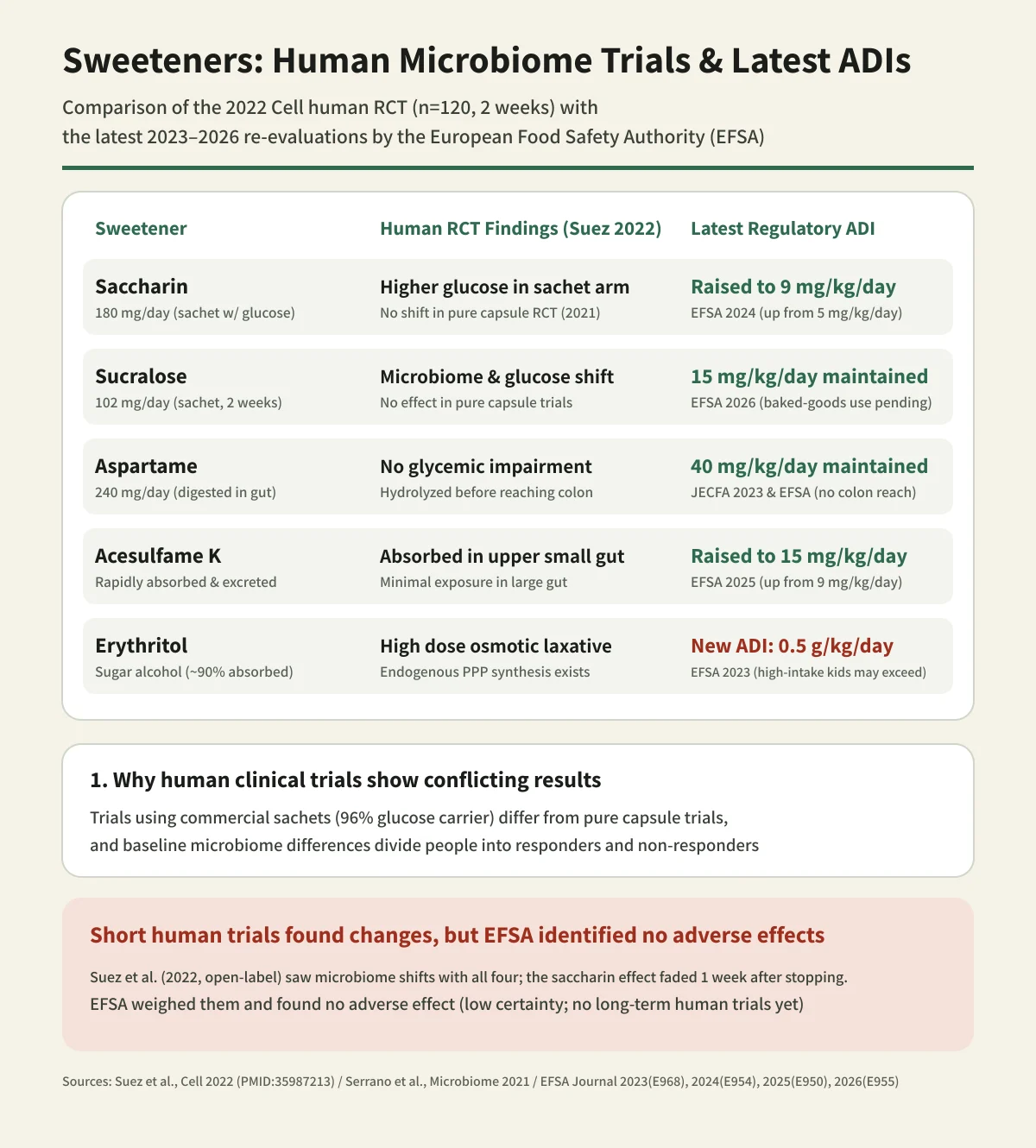
- In the landmark 2022 Cell trial (120 healthy adults for 2 weeks), commercial sachets of all four sweeteners shifted the microbiome, and the saccharin and sucralose groups showed higher glycemic responses. In the saccharin group, the difference was no longer statistically significant at the end of the 1-week follow-up, but long-term effects were not studied. Furthermore, independent double-blind trials using pure sweetener capsules without glucose fillers found no changes in gut bacteria or blood sugar
- Sugar alcohols draw water into the gut by osmosis when consumed in large single doses. In December 2023, EFSA established a new numerical ADI of 0.5 g per kg of body weight per day for erythritol to prevent osmotic diarrhea (30 g/day for a 60 kg adult)
- In its 2024–2026 re-evaluations, after reviewing these human trials, EFSA raised the ADI for saccharin from 5 to 9 mg/kg bw/day and for acesulfame K from 9 to 15 mg/kg bw/day, while maintaining sucralose at 15 mg/kg bw/day (while unable to conclude on extending sucralose to fine bakery wares because of uncertainty over chlorinated compounds formed during baking)
Do sweeteners even reach the large intestine? (Differences in digestion and absorption)
To evaluate claims that “sweeteners alter the gut microbiome,” we first need to check where each sweetener is absorbed or broken down along the digestive tract (ADME). Because over 90% of gut bacteria reside in the large intestine (colon), compounds that disappear in the upper small intestine have minimal direct contact with colonic microbes.
| Sweetener | Small intestine absorption / digestion | Reach into the colon (gut microbiota) | Main excretion pathway |
|---|---|---|---|
| Aspartame | Rapidly and completely hydrolyzed by digestive enzymes in the upper small intestine into L-phenylalanine, L-aspartic acid, and a trace of methanol | Virtually none (never reaches the colon intact) | Metabolized and utilized just like amino acids from ordinary foods |
| Acesulfame K | Rapidly and almost 100% absorbed in the small intestine; not metabolized in the body | Minimal reach | Over 99% excreted unchanged in urine within 24 hours |
| Saccharin sodium | About 85–95% absorbed in the small intestine | Remaining 5–15% reaches the colon | Absorbed fraction excreted unchanged in urine; unabsorbed fraction in stool |
| Sucralose | Only about 15% absorbed in the small intestine | About 85% passes intact through the colon | Excreted mostly unchanged in stool |
| Stevia (steviol glycosides) | Not broken down by human digestive enzymes in the stomach or small intestine | Nearly 100% reaches the colon, where gut bacteria (Bacteroides, etc.) cleave the sugar units into steviol | Steviol is absorbed, glucuronidated in the liver, and excreted in urine/stool |
| Erythritol (sugar alcohol) | Small 4-carbon polyol; about 90% absorbed by passive diffusion in the small intestine | About 10% reaches the colon (and is resistant to bacterial fermentation) | Absorbed ~90% is excreted unchanged in urine |
| Xylitol, Sorbitol, Maltitol | Slowly absorbed in the small intestine (about 20–50%) | 50–80% reaches the colon and is fermented by gut bacteria into short-chain fatty acids and gas | Partly metabolized in the liver; unabsorbed fraction exerts osmotic effects in the colon |
As this table shows, aspartame and acesulfame K barely reach the large intestine, whereas sucralose, stevia, and larger sugar alcohols pass directly through the colon.
Why human clinical trials disagree on blood sugar and gut microbiota
The two studies that sparked the debate (2014 Nature and 2022 Cell)
The hypothesis that non-nutritive sweeteners impair glucose tolerance through the gut microbiome originated in two famous studies by Eran Elinav, Jotham Suez, and colleagues at the Weizmann Institute of Science:
- The 2014 Nature paper (PMID: 25231862): Feeding mice high doses of saccharin, sucralose, or aspartame in drinking water altered their gut microbiota and impaired glucose tolerance. In a small human pilot within the same paper, 7 healthy volunteers who did not normally consume sweeteners took the maximum ADI of saccharin (5 mg/kg bw/day) for 6 days: 4 of the 7 (“responders”) showed higher post-meal blood glucose responses, while the other 3 (“non-responders”) showed no change.
- The 2022 Cell paper (PMID: 35987213):
Because the 2014 human pilot had only 7 participants and no control group, the researchers conducted a 2-week randomized controlled trial (RCT) in 120 healthy adults who strictly avoided sweeteners, split into 6 groups of 20 (saccharin, sucralose, aspartame, stevia, glucose vehicle control, and no-supplement control).
- Participants consumed commercial sweetener sachets providing daily doses well below the ADI: 180 mg/day of saccharin, 102 mg/day of sucralose, 240 mg/day of aspartame, or 180 mg/day of stevia.
- Each of the four sweeteners altered the stool and oral microbiome, and the saccharin and sucralose sachet groups showed a statistically significant increase in glycemic response (incremental area under the curve on oral glucose tolerance tests), whereas the aspartame and stevia groups did not show significant impairment.
- Transplanting stool from human “top responders” into germ-free mice largely reproduced the glycemic patterns in the mice. According to EFSA’s summary, in the saccharin group no statistically significant differences remained at the end of the 1-week follow-up after stopping. EFSA also describes the trial as open-label, and it lasted only 2 weeks.
Human clinical trials that found “no change”
In contrast, several well-controlled randomized trials conducted by independent groups found no changes in either gut microbiota or blood glucose control:
| Study (Year) | Participants & Design | Sweetener & Form Tested | Findings |
|---|---|---|---|
| Serrano et al. (2021, Microbiome, PMID: 33431052) | 46 healthy adults (placebo, saccharin, lactisole, or both); 2-week double-blind, placebo-controlled RCT | Pure saccharin capsules (maximum ADI, 400 mg/day, no glucose bulking agent) | No effect on gut microbiota diversity or composition, fecal short-chain fatty acids, or glucose and hormone responses |
| Ahmad et al. (2020, Nutrients, PMID: 33171964) | 17 healthy adults (aged 18–45); two 14-day periods, double-blind randomized crossover trial (secondary outcomes) | Aspartame (425 mg/day, 14% of ADI) and sucralose (136 mg/day, 20% of ADI) | No differences in major gut bacterial taxa, community structure, or fecal short-chain fatty acids (one author received an honorarium for a talk sponsored by a sweetener-using company) |
| Thomson et al. (2019, British Journal of Nutrition, PMID: 31258108) | 34 healthy adult men; 7-day double-blind RCT | Pure sucralose capsules (780 mg/day) | No change in glycemic control, insulin resistance, or phylum-level gut microbiome |
Three reasons why trial outcomes differ
Comparing the trial designs suggests three main reasons for these seemingly contradictory results:
- Commercial sachets (96% glucose carrier + 4% sweetener) vs. pure capsules: Tabletop sweetener packets (1 g per sachet) contain only a few milligrams of high-intensity sweetener; 95–96% of the powder is a glucose or maltodextrin bulking agent. In Suez et al. (2022), participants consumed commercial sachets containing 5–6 g/day of glucose co-administered with the sweetener multiple times daily. Although a “glucose-only” control group was included, co-ingesting glucose alongside sweet-taste receptor stimulation differs from taking pure saccharin or sucralose in capsules (as in Serrano 2021 and Thomson 2019), where no glycemic or microbiome shifts occurred.
- Baseline microbiome differences (responders vs. non-responders): Even within the Suez trials, participants split into responders and non-responders depending on their baseline gut bacterial composition and habitual dietary fiber intake.
- Reversible physiological fluctuations vs. toxicological harm: In its November 2024 re-evaluation of saccharin (EFSA Journal 2024;22:e9044), EFSA reviewed the human trials including Suez et al. (2022), noting that effects on glucose were seen in that study but not in several others. For glucose/insulin homeostasis it identified no adverse effects (with “low” confidence in the evidence) and named the lack of long-term human intervention studies as the main uncertainty. The ADI itself was based on decreased body weight in animal studies.
Sugar alcohols (erythritol, xylitol, sorbitol) and the gut & cardiovascular debate
Low-carb chocolates, protein bars, throat lozenges, and chewing gum frequently use sugar alcohols (polyols) such as erythritol, xylitol, D-sorbitol, and maltitol.
Why eating too much at once causes a laxative effect
Because sugar alcohols are absorbed more slowly in the small intestine than regular sugar, unabsorbed molecules travel into the large intestine. There, they raise osmotic pressure and draw water across the intestinal wall into the lumen (osmotic diarrhea), while colonic bacteria ferment them into hydrogen, methane, and carbon dioxide gas, causing bloating.
However, digestive tolerance varies widely depending on the size of the molecule:
| Sugar alcohol | Small intestine absorption | Colonic fermentation | Typical single-serving tolerance threshold | Key characteristics |
|---|---|---|---|---|
| Erythritol | About 90% | Virtually unfermented | ~0.5–0.66 g/kg bw (~30–40 g for a 60 kg adult) | Highest digestive tolerance among polyols; 0 kcal/g |
| Xylitol | About 50% | Fermented | ~0.3–0.4 g/kg bw (~20 g per serving, 30–40 g/day) | Common in gum and mints. Strictly toxic to dogs (triggers severe hypoglycemia and liver failure) |
| D-Sorbitol | About 20–40% | Fermented | ~0.15–0.25 g/kg bw (can cause gas from ~10 g) | Occurs naturally in prunes and pears; also used as a humectant in prepared foods |
| Maltitol | About 40% | Fermented | ~0.3 g/kg bw (~15–20 g per serving) | Widely used as the bulk base of “sugar-free” chocolate and baked goods |
EFSA’s new 2023 ADI for erythritol (0.5 g/kg bw/day)
Historically, JECFA assigned erythritol an ADI “not specified.” In December 2023, however, EFSA published a re-evaluation (EFSA Journal 2023;21:e8430) establishing a numerical ADI of 0.5 g per kg of body weight per day based on the human No-Observed-Adverse-Effect Level (NOAEL) for osmotic diarrhea.
- This equals 30 g/day for a 60 kg adult or 10 g/day for a 20 kg child.
- EFSA found that exposure estimates (which it considered overestimates) exceeded the ADI for high consumers among children and adolescents, meaning they may be at risk of adverse effects, and it rejected a request to exempt erythritol from the mandatory EU warning label (“excessive consumption may produce laxative effects”).
How regulators evaluated the 2023–2024 erythritol & xylitol blood-clotting papers
In February 2023, Marco Witkowski, Stanley Hazen, and colleagues at the Cleveland Clinic reported in Nature Medicine (PMID: 36849732) that higher fasting plasma erythritol levels were associated with major adverse cardiovascular events (MACE) and enhanced platelet reactivity. In June 2024, the same group published a parallel study on xylitol in the European Heart Journal (PMID: 38842092).
When EFSA (December 2023) and independent toxicologists evaluated these papers, they highlighted two critical points:
- The human body produces erythritol endogenously (without eating it): Humans naturally synthesize erythritol from glucose via the pentose phosphate pathway (PPP). Endogenous erythritol production rises in people with high blood sugar, oxidative stress, obesity, or impaired kidney function. Because the observational cohorts in Witkowski et al. consisted of older cardiology patients with existing cardiovascular risk factors—and blood was drawn while fasting—elevated plasma erythritol is widely considered a biomarker of underlying metabolic dysregulation rather than proof of dietary intake.
- Causality from dietary intake has not been established: EFSA concluded in its 2023 opinion that the available studies do not demonstrate a causal relationship between dietary erythritol and cardiovascular disease, adding that further studies could help clarify the association. In the Witkowski study, a drink containing 30 g of erythritol caused a large rise in plasma levels. Spreading intake out within the 0.5 g/kg bw/day ADI rather than taking 30 g at once is sensible at least for digestive comfort.
Summary of 2024–2026 international ADI updates (EFSA & JECFA)
Over the past three years, major international food safety bodies completed comprehensive re-evaluations of low-calorie sweeteners:
| Sweetener | Previous EU ADI | Latest ADI (EFSA / JECFA) | Year & key basis of update |
|---|---|---|---|
| Saccharin (E954) | 5 mg/kg bw/day | 9 mg/kg bw/day (Raised) | EFSA Nov 2024. Noted scientific agreement that the male-rat bladder tumors behind the old ADI are specific to male rats and not relevant to humans; based the new ADI on decreased body weight in animals (the old 5 mg was expressed as sodium saccharin, 3.8 mg as free saccharin) |
| Acesulfame K (E950) | 9 mg/kg bw/day | 15 mg/kg bw/day (Raised) | EFSA Apr 2025. Based on the highest dose without adverse effects in a chronic toxicity/carcinogenicity rat study, aligning the EU ADI with JECFA and Japan at 15 mg/kg bw/day |
| Sucralose (E955) | 15 mg/kg bw/day | 15 mg/kg bw/day (Maintained) | EFSA Feb 2026. No safety concern at currently authorized uses and levels, but could not conclude on extension to fine bakery wares because of uncertainty over chlorinated compounds forming under the wide range of baking processes |
| Aspartame (E951) | 40 mg/kg bw/day | 40 mg/kg bw/day (Maintained) | JECFA Jul 2023. At the same time IARC classified aspartame as “possibly carcinogenic to humans” (Group 2B), but JECFA kept the ADI. According to WHO, this equals more than 9–14 cans of diet soda (200–300 mg each) per day for a 70 kg adult. Japan’s FY2019 market-basket survey estimated adult intake at about 0.06 mg/day, under 0.01% of the ADI |
| Erythritol (E968) | Not specified | 0.5 g (500 mg)/kg bw/day (New) | EFSA Dec 2023. Established to prevent osmotic diarrhea |
For label rules on “zero calorie” and “zero sugars” claims, see Are Artificial Sweeteners Bad for You? What “Zero Calorie” and “Zero Sugars” Really Mean and Types of Sugar and Sweeteners.
Practical tips for choosing sweeteners in daily life
Rather than viewing sweeteners as “completely toxic in any amount” or “limitless free foods,” the clinical and regulatory evidence points to three practical habits:
- If you experience bloating or loose stools, check the type and gram amount of sugar alcohols: Digestive discomfort after eating “sugar-free” chocolates or gummies is almost always caused by gram-level sorbitol, maltitol, or xylitol rather than milligram-level high-intensity sweeteners. Among sugar alcohols, erythritol (~90% absorbed in the small intestine) is the gentlest, especially when kept under 15–20 g per serving.
- Be cautious about using sucralose in oven baking: In its 2026 opinion, EFSA could not conclude on the safety of sucralose in fine bakery wares because of uncertainty over chlorinated compounds that may form during baking. For home baking, traditional sugar, mirin, or heat-stable erythritol/monk fruit are alternatives.
- Step down habitual sweetness rather than relying on multiple tabletop packets a day: The glycemic shifts in Suez et al. (2022) occurred with repeated daily use of glucose-based sachets. WHO’s 2023 guideline also conditionally recommends against using non-sugar sweeteners for weight control and encourages reducing the overall sweetness of the diet, starting early in life. Pairing unsweetened sparkling water or tea with occasional sweetened items is a realistic approach.
Some home-delivery services narrow down what they sell under their own standards, beyond what the label tells you.
Sources and references
- Suez J, et al. Artificial sweeteners induce glucose intolerance by altering the gut microbiota. Nature. 2014;514(7521):181-186. (PMID: 25231862)
- Suez J, et al. Personalized microbiome-driven effects of non-nutritive sweeteners on human glucose tolerance. Cell. 2022;185(18):3307-3328.e19. (PMID: 35987213)
- Serrano J, et al. High-dose saccharin supplementation does not induce gut microbiota changes or glucose intolerance in healthy humans and mice. Microbiome. 2021;9(1):11. (PMID: 33431052)
- Ahmad SY, Friel J, Mackay D. The Effects of Non-Nutritive Artificial Sweeteners, Aspartame and Sucralose, on the Gut Microbiome in Healthy Adults: Secondary Outcomes of a Randomized Double-Blinded Crossover Clinical Trial. Nutrients. 2020;12(11):3408. (PMID: 33171964)
- Thomson P, et al. Short-term impact of sucralose consumption on the metabolic response and gut microbiome of healthy adults. British Journal of Nutrition. 2019;122(8):856-862. (PMID: 31258108)
- Witkowski M, et al. The artificial sweetener erythritol and cardiovascular event risk. Nature Medicine. 2023;29(3):710-718. (PMID: 36849732)
- Witkowski M, et al. Xylitol is prothrombotic and associated with cardiovascular risk. European Heart Journal. 2024;45(27):2439-2452. (PMID: 38842092)
- EFSA Panel on Food Additives and Flavourings (FAF). Re-evaluation of erythritol (E 968) as a food additive. EFSA Journal. 2023;21(12):e8430.
- EFSA FAF Panel. Re-evaluation of saccharin and its sodium, potassium and calcium salts (E 954) as food additives. EFSA Journal. 2024;22(11):e9044.
- EFSA FAF Panel. Re-evaluation of acesulfame K (E 950) as food additive. EFSA Journal. 2025;23(4):e9317.
- EFSA FAF Panel. Re-evaluation of sucralose (E 955) as a food additive and evaluation of a new application on extension of use of sucralose (E 955) in fine bakery wares. EFSA Journal. 2026;24(2):e9854. (doi: 10.2903/j.efsa.2026.9854)
- WHO. Use of non-sugar sweeteners: WHO guideline. May 2023.
- WHO, IARC and JECFA. Aspartame hazard and risk assessment results released. 14 July 2023.
- Rowland I, et al. Gut microbiota functions: metabolism of nutrients and other food components. European Journal of Nutrition. 2018;57(1):1-24. (PMID: 28393285)
- Ministry of Health, Labour and Welfare (Japan). Results of the FY2019 market-basket survey of sweetener intake (Japanese): https://www.mhlw.go.jp/content/000920072.pdf
- Food Safety Commission of Japan (FSCJ), Aspartame Q&A and Food Additive Risk Assessment Reports.
Products related to this article PR
Products whose labels Urayomi has read, picked because their ingredients or category relate to this article. This is not a recommendation or a safety rating. The shop buttons are affiliate links; prices are reference prices on the date we checked.
- アサヒ ドデカミンのゼロが好きだと叫びたい PET 500mlRead the label (in Japanese) →
- アサヒグループ食品 ミンティア コールドスマッシュ 50粒(7g)Read the label (in Japanese) →
- アサヒグループ食品 ミンティア+VOiCE レモンジンジャー 30粒(20g)Read the label (in Japanese) →
- 森下仁丹 鼻・のど甜茶飴 38gRead the label (in Japanese) →
- 亀田製菓 技のこだ割り 110gRead the label (in Japanese) →
- キユーピー 焙煎胡麻ドレッシング 1000ml(業務用)Read the label (in Japanese) →
Frequently asked questions
- What are the key findings on: Do Artificial Sweeteners Harm Gut Bacteria? Blood Sugar Trials, Sugar Alcohol Laxative Thresholds, and 2023–2026 EFSA ADIs?
- Aspartame and acesulfame K are absorbed before the colon; sucralose and saccharin reach gut bacteria. EFSA set erythritol's ADI at 0.5 g/kg in 2023.
- Do sweeteners even reach the large intestine? (Differences in digestion and absorption)?
- To evaluate claims that “sweeteners alter the gut microbiome,” we first need to check where each sweetener is absorbed or broken down along the digestive tract (ADME). Because over 90% of gut bacteria reside in the large intestine (colon), compounds that dis…
- Why human clinical trials disagree on blood sugar and gut microbiota?
- The hypothesis that non-nutritive sweeteners impair glucose tolerance through the gut microbiome originated in two famous studies by Eran Elinav, Jotham Suez, and colleagues at the Weizmann Institute of Science:
- What does the evidence show regarding: Sugar alcohols (erythritol, xylitol, sorbitol) and the gut & cardiovascular debate?
- Low-carb chocolates, protein bars, throat lozenges, and chewing gum frequently use sugar alcohols (polyols) such as erythritol, xylitol, D-sorbitol, and maltitol.
Related articles and databases
- Are Artificial Sweeteners Bad for You? Aspartame and Cancer, What “Zero Calorie” and “Zero Sugars” Really Mean, and Japanese vs. Overseas Rules
- Types of Sugar and Their Effects on the Body: History, Production and Composition of Jōhakutō, Granulated Sugar, Sanontō, Kibi-zatō, Tensai-tō, Kokutō and Wasanbon — Is "White Sugar Is Bad for You" True?
- What Is “果糖ぶどう糖液糖” (High-Fructose Corn Syrup)? Is It Worse for You Than Sugar? How It Differs From Sugar, and Corn and Genetic Modification
- Are emulsifiers bad for you? The history that began with egg yolk lecithin, types and uses, gut microbiota research (mice and humans), and how Japan and the EU label them
- Diabetes and Pancreatic Cancer: Why Sudden Blood Sugar Worsening Can Be an Early Sign, and What Studies Show About GLP-1 Drugs and Insulin
- 添加物データベース
- Lactic acid bacteria and bifidobacteria (Supplement ingredient database)
- Xylitol (FOSHU for teeth) (Supplement ingredient database)