

Diabetes and Pancreatic Cancer: Why Sudden Blood Sugar Worsening Can Be an Early Sign, and What Studies Show About GLP-1 Drugs and Insulin

PR This article contains an affiliate link to A8.net (a restricted-diet meal delivery). What is written here is based on documents from public agencies and on studies, regardless of whether there are ads.
When a routine checkup shows a sudden jump in blood sugar or HbA1c — or when someone over age 50 is diagnosed with diabetes for the first time — doctors sometimes recommend an abdominal ultrasound, contrast CT, or MRI to check the pancreas.
This is because diabetes and pancreatic cancer have an unusual two-way relationship: diabetes can be a long-term cause of pancreatic cancer, and an unseen pancreatic cancer can also cause sudden-onset diabetes. At the same time, with the widespread use of GLP-1 receptor agonists (such as semaglutide — Ozempic/Wegovy — and tirzepatide — Mounjaro) and insulin, many patients wonder whether diabetes medications themselves raise the risk of pancreatitis or pancreatic cancer.
In this article, we examine:
- Why long-standing diabetes raises pancreatic cancer risk (~1.5×), whereas risk in the first year after a new diabetes diagnosis is about 5× higher
- How a still-small pancreatic tumor begins raising blood sugar 2 to 3 years before cancer is diagnosed (exosomes, adrenomedullin, and Type 3c pancreatogenic diabetes)
- Which blood sugar patterns warrant pancreatic imaging (the ENDPAC score and “weight loss + rising blood sugar”)
- What large cohort studies and meta-analyses of randomized controlled trials (RCTs) show about GLP-1 receptor agonists, DPP-4 inhibitors, metformin, and insulin
This article does not replace medical advice. Never stop prescribed diabetes medications on your own; consult your physician or a gastroenterologist if your blood sugar changes suddenly or you have worrying symptoms.
Conclusion: Long-Standing Diabetes Raises Risk About 1.5×, but New-Onset Diabetes After 50 or Rising Blood Sugar with Weight Loss Is an Important Early Sign
- The link between diabetes and pancreatic cancer is rated “probable” by the National Cancer Center Japan. A pooled analysis of 8 Japanese cohort studies found a 1.85× higher risk in people with diabetes (and a meta-analysis of 35 cohorts worldwide found 1.94×).
- The meaning of the link depends heavily on how long someone has had diabetes. In people who have had diabetes for 5 years or more, risk is ~1.5× (the part thought to reflect diabetes acting as a cause, e.g., via hyperinsulinemia). In contrast, in the first year after a diabetes diagnosis, risk is about 5.4× higher. Much of this is thought to be reverse causation: an already present, hidden pancreatic tumor impaired insulin and triggered diabetes (an early warning sign).
- A key clinical red flag is “rising blood sugar / HbA1c accompanied by unintentional weight loss.” Ordinary type 2 diabetes typically worsens with weight gain, whereas pancreatic-cancer-related diabetes (Type 3c) raises blood sugar while body fat and muscle are lost. New-onset diabetes after 50, or unexplained weight loss with worsening blood sugar, is an important clue for early detection.
- There is no evidence that GLP-1 receptor agonists (semaglutide, liraglutide, etc.) increase pancreatic cancer risk. A 2026 meta-analysis of 48 RCTs (~94,000 participants) found an odds ratio of 0.84 (95% CI 0.53–1.35) — no sign of an increase. A meta-analysis that also included observational studies (24 studies, ~3.96 million patients) reported an association with lower risk, although observational data cannot prove cause and effect.
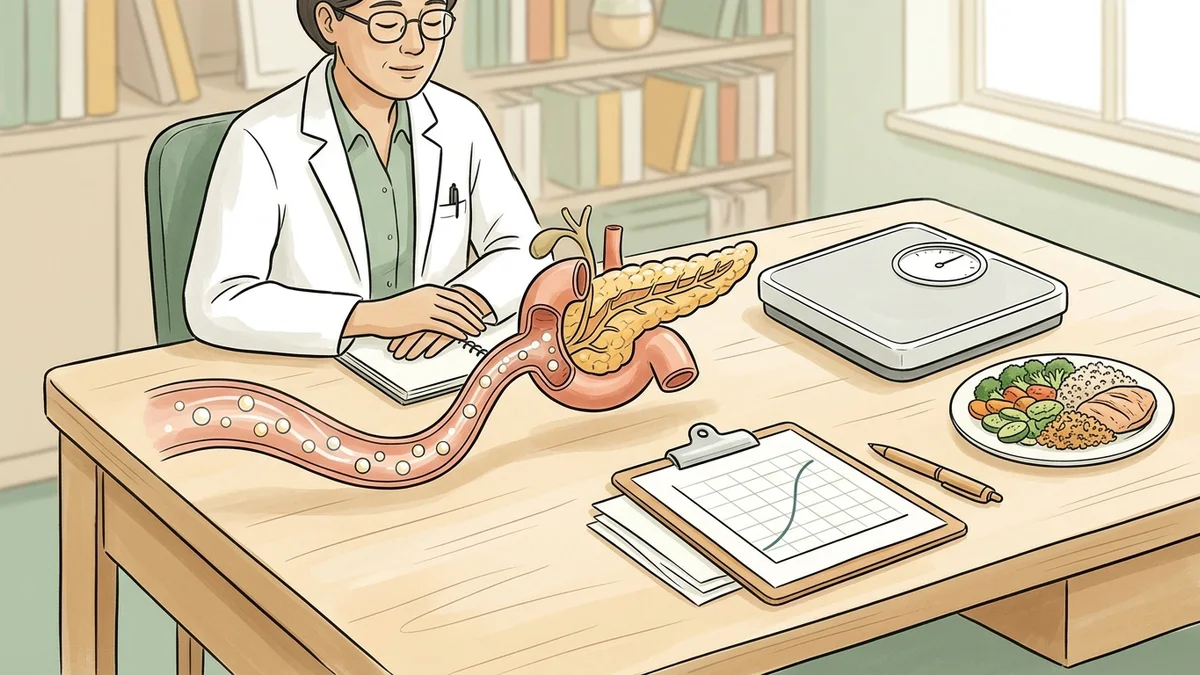
Diabetes as a “Cause” vs. Diabetes as an “Early Sign (Reverse Causation)”
A meta-analysis of 35 cohort studies by Ben et al. (European Journal of Cancer 2011, PMID: 21458985) and a Mayo Clinic population study show how relative risk shifts depending on time since diabetes diagnosis.
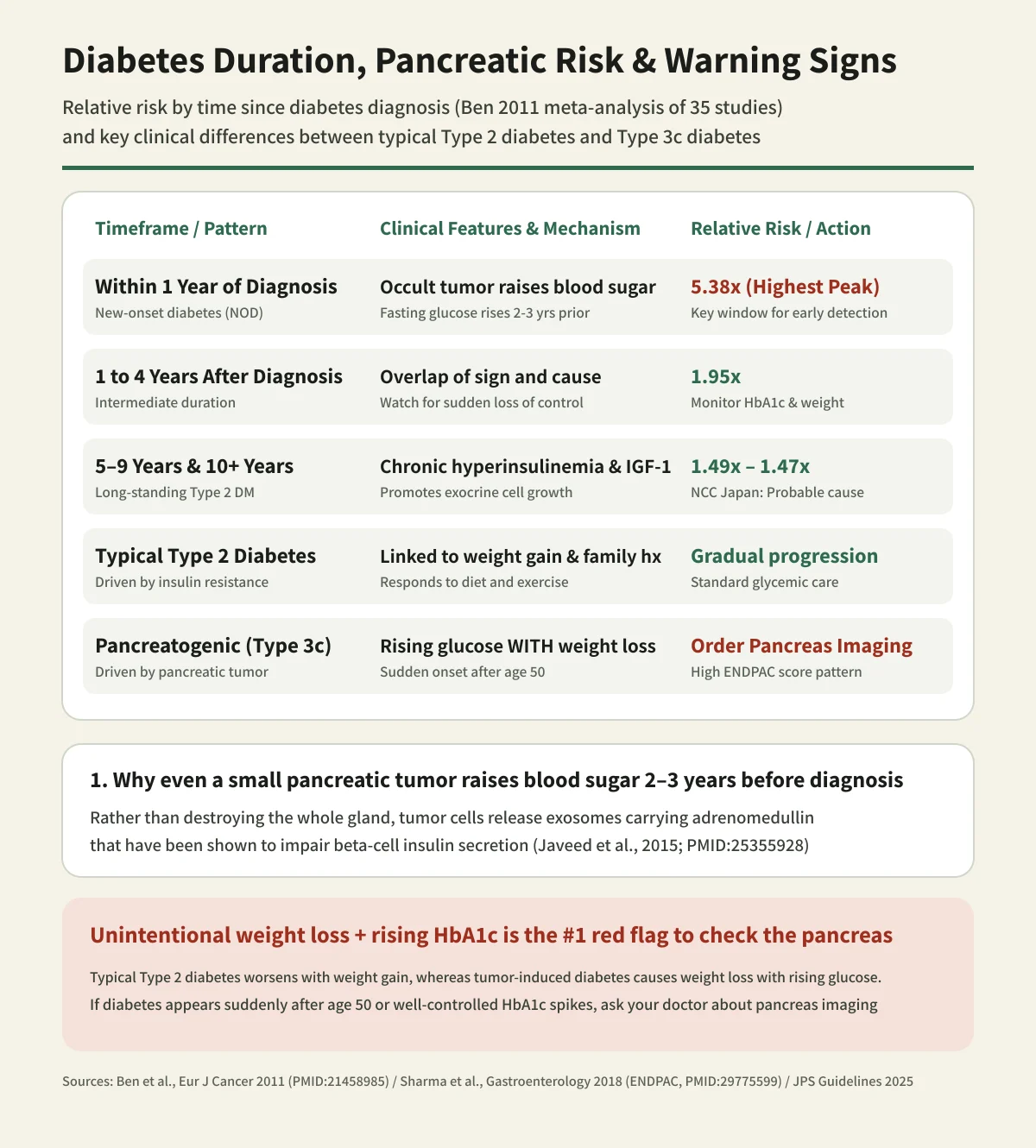
| Time since diabetes diagnosis | Relative risk of pancreatic cancer (Ben 2011 meta-analysis) | Direction of causality in the body |
|---|---|---|
| Less than 1 year (New-Onset Diabetes: NOD) | 5.38× (in a Mayo Clinic study, people aged ≥50 who newly met diabetes criteria had ~8× the expected rate of pancreatic cancer within 3 years) | [Tumor → Diabetes (Early Sign)] A pancreatic tumor not yet diagnosed releases substances that impair insulin and raise blood sugar |
| 1 to 4 years | 1.95× | A mix of hidden-tumor effects and diabetes promoting cancer |
| 5 to 9 years | 1.49× (1.83× for all ≥5 years combined) | [Diabetes → Tumor (Cause)] Chronic hyperinsulinemia, hyperglycemia, and inflammation may promote ductal cell proliferation |
| 10 years or more | 1.47× | Long-standing type 2 diabetes acting as a moderate ~1.5× risk factor |
Sources: Ben Q, et al. Eur J Cancer 2011 (PMID: 21458985); Chari ST, et al. Gastroenterology 2005 (PMID: 16083707).
How Can a Still-Small Tumor Cause Diabetes?
It is often assumed that pancreatic cancer causes diabetes only when a large tumor destroys the pancreas, but that does not explain why blood sugar rises before most of the pancreas is damaged.
Research by Aggarwal et al. (2012), Sah et al. (2013), and Javeed et al. (2015) suggests the following mechanism:
- Tumor cells release exosomes carrying adrenomedullin: Pancreatic cancer cells produce large amounts of the peptide adrenomedullin and release it in exosomes that reach beta cells in the islets of Langerhans, as shown in cell and animal experiments.
- Beta-cell dysfunction: Acting on beta cells, this is thought to impair insulin secretion without destroying the islets (one form of cancer-caused Type 3c pancreatogenic diabetes).
- Blood glucose begins rising 30 to 36 months before cancer diagnosis: A Mayo Clinic study (Sharma et al. 2018) found that fasting blood glucose in patients with pancreatic cancer began rising 30–36 months before diagnosis and kept rising until diagnosis. Hyperglycemia appeared once tumors reached a certain size (a volume of roughly 1–2 mL or more); very small tumors under 1 mL showed no difference. Resection of the cancer resolved hyperglycemia even though part of the pancreas was removed.
Two Red Flags Not to Miss & the ENDPAC Score
Most diabetes is ordinary type 2 diabetes unrelated to pancreatic cancer, and it is not practical to give everyone over 50 with new diabetes a full work-up. Still, a Mayo Clinic study found that about 0.85% (roughly 1 in 120) of people aged 50 or older who newly met diabetes criteria were diagnosed with pancreatic cancer within 3 years. The Japan Pancreas Society’s Clinical Practice Guidelines for Pancreatic Cancer also list new-onset or worsening diabetes as a risk factor and a trigger for diagnosis. If either of the following applies to you, discuss pancreatic imaging (contrast CT, MRCP, or endoscopic ultrasound) with your doctor.
Red Flag 1: First-Time Diabetes Diagnosis After Age 50
Especially when someone was not overweight when younger and has no family history of diabetes, yet develops elevated blood glucose or HbA1c for the first time in their 50s, 60s, or later.
Red Flag 2: Rising HbA1c / Blood Sugar Accompanied by Unintentional Weight Loss Without Changes in Diet or Exercise
| Clinical feature | Typical worsening of Type 2 diabetes | Diabetes with a hidden pancreatic cancer (Type 3c / NOD) |
|---|---|---|
| Body weight over past 6–12 months | Weight gain or stable weight (with overeating or inactivity) | Unintentional weight loss of 2–3+ kg despite no dieting |
| Pace of HbA1c / glucose rise | Gradual increase over several years | Rapid jump over 6–12 months (e.g., HbA1c from the low 6% range to the 8% range) |
| Response to medication | Responds predictably to oral therapy and diet | Previously effective diabetes drugs suddenly stop working |
| Accompanying changes | None in particular | Loss of appetite, upper abdominal or back discomfort, loose (fatty) stools |
The ENDPAC score (Enriching New-Onset Diabetes for Pancreatic Cancer; Sharma et al., Gastroenterology 2018, PMID: 29775599), developed in the US, scores three factors in people aged 50+ with new-onset diabetes: (1) age at diabetes onset, (2) change in blood glucose over the prior year, and (3) change in weight over the prior year (more weight loss gives a higher score). In the validation cohort, 3.6% of people scoring ≥3 had pancreatic cancer — about 4.4 times the rate among all people with new-onset diabetes. A score of ≥3 caught 78% of the cancers, but recent steroid use or other cancers also produced high scores. The authors call for prospective validation.
Do Diabetes & Weight-Loss Drugs (GLP-1 Agonists, Insulin, Metformin) Cause Pancreatic Cancer?
| Medication class | Current conclusion on pancreatic cancer risk | Key evidence |
|---|---|---|
| GLP-1 receptor agonists (semaglutide, liraglutide, dulaglutide, tirzepatide) |
No evidence of increased risk | • 543,595-patient cohort (Dankner 2024 JAMA Netw Open): HR 0.50 (95% CI 0.15–1.71) vs. basal insulin — no support for an increase • Meta-analysis of 48 RCTs (Ko 2026 Ann Intern Med): OR 0.84 (0.53–1.35) — no increase |
| DPP-4 inhibitors (sitagliptin, linagliptin, vildagliptin) |
No evidence of increased risk | Meta-analyses of large cardiovascular outcome trials (TECOS, SAVOR-TIMI 53, CARMELINA, etc.) show no significant difference vs. placebo |
| Metformin | No evidence of increased risk (lower risk in observational studies; neutral in RCTs) | Observational meta-analyses suggested 20–30% lower risk, but analyses that remove time-related biases are close to neutral (~1.0×) |
| Insulin & sulfonylureas | Not thought to cause cancer directly (watch for reverse-causation bias) | Diagnoses cluster soon after insulin is started largely because a hidden pancreatic tumor worsened blood sugar, leading to insulin initiation shortly before the tumor was found |
1. Why Were GLP-1 Receptor Agonists Linked to Pancreatic Cancer Concerns?
In the early 2010s, an analysis of the US adverse-event reporting database (Elashoff et al. 2011) suggested more reports of acute pancreatitis and pancreatic cancer with early GLP-1 receptor agonists (e.g., exenatide) and DPP-4 inhibitors. Adverse-event report counts, however, are prone to reporting bias.
The US FDA and the European Medicines Agency (EMA) then reviewed animal and clinical-trial data and stated that current evidence did not support a causal association (NEJM 2014). Long-term follow-up studies of tens to hundreds of thousands of patients followed.
- Israeli cohort of 543,595 people (Dankner et al., JAMA Network Open 2024, PMID: 38175642): Adults with type 2 diabetes were followed from 2009 to 2017. Compared with basal insulin, GLP-1 receptor agonist use had a pancreatic cancer HR of 0.50 (95% CI 0.15–1.71), emphasizing years 5–7 after use to avoid reverse causation. The wide confidence interval means a reduction cannot be claimed, but no support for an increase over 7 years was found. The authors note that monitoring beyond 7 years is still needed.
- 2026 meta-analyses (PMID: 41359966, 41722869): A meta-analysis of 48 RCTs (Ko et al., Annals of Internal Medicine) found a pancreatic cancer OR of 0.84 (0.53–1.35), concluding GLP-1 receptor agonists probably have little or no effect (moderate certainty); the trials were not designed to assess cancer and had short follow-up. A meta-analysis including observational studies (Ateiwi et al., 24 studies, ~3.96 million patients) reported lower risks for several obesity-related cancers including pancreatic cancer, but called for prospective confirmation. A retrospective study of non-diabetic patients with chronic pancreatitis (Dhali et al. 2026, PMID: 42645931) also exists, but its authors state the findings are hypothesis-generating and should not guide prescribing.
Clinicians do, however, use these drugs with caution in people with a history of acute pancreatitis or gallstones (rapid weight loss can trigger gallstone pancreatitis), watching for rare acute pancreatitis.
2. “Pancreatic Cancer Was Found After Starting Insulin”: Reverse-Causation Bias
People sometimes worry: “An acquaintance was diagnosed with pancreatic cancer a few months after starting insulin injections — did insulin cause it?”
Epidemiological studies show that pancreatic cancer diagnoses are more frequent shortly after insulin is started, and the difference narrows with longer use. In many such cases, insulin did not create the cancer; rather, a hidden pancreatic tumor made oral drugs stop working, the doctor switched to insulin, and the tumor was found on CT a few months later — a time lag (reverse-causation bias) that is thought to play a large role.
What People with High Blood Sugar Can Do, and How to Get Tested
- If you have new-onset diabetes after 50, or weight loss with rising HbA1c, ask about pancreatic imaging at least once: Along with blood tests (the tumor marker CA19-9 and the APOA2 isoform test insured in Japan since 2024), checking the pancreas for main-duct dilation or cysts with contrast CT, MRCP, or endoscopic ultrasound (EUS) — not just abdominal ultrasound — helps with early detection (see our article on early detection, pancreatic cysts (IPMN), and the new blood test).
- Do not stop prescribed diabetes medication on your own: Chronic high blood sugar and high insulin levels themselves strain the pancreas and blood vessels. If you have concerns about a drug, always talk to your doctor.
- In your diet, avoid liquid fructose, heavy drinking, and smoking, and include dietary fiber, magnesium, and fish: We review the data on foods and blood sugar spikes in our article on pancreatic cancer and diet and our article on alcohol and pancreatic cancer.
If keeping up with dietary management is hard, a restricted-diet meal delivery is one option. Ask your doctor or registered dietitian which course suits you.
Pancreatic Cancer Series: Related Articles
- Alcohol and Pancreatic Cancer: Drinking Amounts, 66-Year Trends, and Latest Treatments
- What Foods Are Linked to Pancreatic Cancer? Sugar, Fructose, Coffee, Processed Meat, and Oils
- Why Is Pancreatic Cancer Hard to Find? Early Symptoms, Pancreatic Cysts (IPMN), Ultrasound Limits, and the APOA2-i Blood Test
- Periodontal Disease, Blood Type, and Genetics in Pancreatic Cancer: Blood Type O, Oral Bacteria, and BRCA
- Types of Pancreatic Cancer and Survival Rates: 90% Ductal Adenocarcinoma vs. Steve Jobs’s PNET
- Acute and Chronic Pancreatitis and Pancreatic Cancer: Alcohol, Gallstones, Triglycerides, and Post-Surgery MCT Oil
- Latest Treatments for Pancreatic Cancer: Conversion Surgery, NALIRIFOX, KRAS Inhibitors, Carbon-Ion Radiotherapy, and mRNA Vaccines
References
- Japan Pancreas Society. Clinical Practice Guidelines for Pancreatic Cancer 2025. Kanehara & Co., 2025.
- National Cancer Center Japan, Institute for Cancer Control. Evaluation of cancer risk and preventive factors (Japanese). https://epi.ncc.go.jp/can_prev/outcome/index.html
- Kasuga M, et al. Report of the Japan Diabetes Society/Japanese Cancer Association Joint Committee on Diabetes and Cancer. Cancer Sci. 2013;104(7):965-976. (PMID: 23879470)
- Ben Q, et al. Diabetes mellitus and risk of pancreatic cancer: A meta-analysis of cohort studies. Eur J Cancer. 2011;47(13):1928-1937. (PMID: 21458985)
- Chari ST, et al. Probability of pancreatic cancer following diabetes: a population-based study. Gastroenterology. 2005;129(2):504-511. (PMID: 16083707)
- Sharma A, et al. Fasting Blood Glucose Levels Provide Estimate of Duration and Progression of Pancreatic Cancer Before Diagnosis. Gastroenterology. 2018;155(2):490-500. (PMID: 29723506)
- Sah RP, et al. New insights into pancreatic cancer-induced paraneoplastic diabetes. Nat Rev Gastroenterol Hepatol. 2013;10(7):423-433. (PMID: 23528347)
- Aggarwal G, et al. Adrenomedullin is up-regulated in patients with pancreatic cancer and causes insulin resistance in β cells and mice. Gastroenterology. 2012;143(6):1510-1517. (PMID: 22960655)
- Javeed N, et al. Pancreatic Cancer-Derived Exosomes Cause Paraneoplastic β-cell Dysfunction. Clin Cancer Res. 2015;21(7):1722-1733. (PMID: 25355928)
- Sharma A, et al. Model to Determine Risk of Pancreatic Cancer in Patients With New-Onset Diabetes (ENDPAC). Gastroenterology. 2018;155(3):730-739. (PMID: 29775599)
- Egan AG, et al. Pancreatic safety of incretin-based drugs — FDA and EMA assessment. N Engl J Med. 2014;370(9):794-797. (PMID: 24571751)
- Dankner R, et al. Glucagon-Like Peptide-1 Receptor Agonists and Pancreatic Cancer Risk in Patients With Type 2 Diabetes. JAMA Netw Open. 2024;7(1):e2350408. (PMID: 38175642)
- Ko A, et al. Risk for Cancer With Glucagon-Like Peptide-1 Receptor Agonists and Dual Agonists: A Systematic Review and Meta-analysis. Ann Intern Med. 2026;179(2):216-229. (PMID: 41359966)
- Ateiwi YA, et al. Glucagon-like peptide-1 receptor agonists and the risk of obesity-related cancers: a systematic review and meta-analysis. Diabetes Res Clin Pract. 2026;234:113158. (PMID: 41722869)
- Dhali A, et al. Clinical Outcomes Associated with GLP-1 Receptor Agonist Exposure in Non-Diabetic Patients with Chronic Pancreatitis: A Retrospective Cohort Study. J Pers Med. 2026;16(8). (PMID: 42645931)
Frequently asked questions
- What are the key findings on: Diabetes and Pancreatic Cancer: Why Sudden Blood Sugar Worsening Can Be an Early Sign, and What Studies Show About GLP-1 Drugs and Insulin?
- Pancreatic cancer risk is about 5x in the first year after new diabetes, vs about 1.5x for long-standing diabetes. ENDPAC red flags and GLP-1 data.
- What does the evidence show regarding: Diabetes as a “Cause” vs. Diabetes as an “Early Sign (Reverse Causation)”?
- A meta-analysis of 35 cohort studies by Ben et al. (European Journal of Cancer 2011, PMID: 21458985) and a Mayo Clinic population study show how relative risk shifts depending on time since diabetes diagnosis.
- What does the evidence show regarding: Two Red Flags Not to Miss & the ENDPAC Score?
- Most diabetes is ordinary type 2 diabetes unrelated to pancreatic cancer, and it is not practical to give everyone over 50 with new diabetes a full work-up. Still, a Mayo Clinic study found that about 0.85% (roughly 1 in 120) of people aged 50 or older who n…
- Do Diabetes & Weight-Loss Drugs (GLP-1 Agonists, Insulin, Metformin) Cause Pancreatic Cancer?
- In the early 2010s, an analysis of the US adverse-event reporting database (Elashoff et al. 2011) suggested more reports of acute pancreatitis and pancreatic cancer with early GLP-1 receptor agonists (e.g., exenatide) and DPP-4 inhibitors. Adverse-event repo…
Related articles and databases
- Is Alcohol a Cause of Pancreatic Cancer? Drinking Amounts, Other Causes, and the Latest Treatments, Checked Against National Data and Studies
- What Foods Are Linked to Pancreatic Cancer? Sugar, Fructose, Coffee, Processed Meat, and Plant Oils Checked Against National Data and Studies
- Why Is Pancreatic Cancer So Hard to Find Early? Early Symptoms, Pancreatic Cysts (IPMN), Ultrasound Limits, and the New APOA2-i Blood Test
- What Are Tumor Markers? Origins, Types, Positive Rates by Cancer, Cost, and How to Read Results, Checked Against Society Guidelines and Studies
- Do Artificial Sweeteners Harm Gut Bacteria? Blood Sugar Trials, Sugar Alcohol Laxative Thresholds, and 2023–2026 EFSA ADIs
- Acute and Chronic Pancreatitis and Pancreatic Cancer: How Alcohol, Gallstones, and Triglycerides Damage the Pancreas, Plus Post-Surgery Nutrition and MCT Oil
- Latest Pancreatic Cancer Treatments & Clinical Trials: Perioperative Chemo, Conversion Surgery, KRAS Inhibitors, Carbon-Ion Therapy & mRNA Vaccines