

What Foods Are Linked to Pancreatic Cancer? Sugar, Fructose, Coffee, Processed Meat, and Plant Oils Checked Against National Data and Studies

PR This article contains an affiliate link to A8.net (a frozen dish delivery). What is written here is based on documents from public agencies and on studies, regardless of whether there are ads.
In 2024, 41,235 people in Japan died of pancreatic cancer, making it the third leading cause of cancer death after lung and colorectal cancer (National Cancer Center Japan, Cancer Statistics). As we saw in our article on alcohol and pancreatic cancer, even though per-capita alcohol consumption and smoking rates in Japan have fallen since the 1990s, the age-adjusted death rate for pancreatic cancer has risen by 12% in men and 35% in women.
Because of this rise, many claims circulate online and in books about diet and pancreatic cancer:
- “Eating a lot of sweets (sugar, pastries, soft drinks) wears out the pancreas and causes cancer.”
- “The postwar increase in wheat, plant oils, dairy, and sweets (the so-called ‘Four Poisons’) caused the surge in pancreatic cancer.”
- “A famous study showed that drinking coffee doubles or triples pancreatic cancer risk.”
- “Processed meats like bacon and sausage, or charred meat, damage the pancreas.”
- “Eating fish, vegetables, folate, or vitamin D can help prevent it.”
In this article, we check the following against official statistics, international assessments, and peer-reviewed cohort studies:
- How the National Cancer Center Japan and the World Cancer Research Fund (WCRF/AICR) evaluate foods and nutrients in relation to pancreatic cancer
- Whether 60 years of dietary shifts in Japan (Ministry of Agriculture, Forestry and Fisheries Food Balance Sheets) actually match the trend in pancreatic cancer mortality
- Follow-up studies on sweets (fructose, sucrose, sugar-sweetened beverages, artificial sweeteners, and glycemic index)
- Why the famous 1981 New England Journal of Medicine paper linking coffee to a 2–3× risk of pancreatic cancer was overturned and is now judged “no association”
- Processed meat (nitrites), red meat, high-temperature charring (heterocyclic amines), saturated fat, and plant oils
- Nutrients studied for lower risk: fish (omega-3 DHA/EPA), dietary folate, magnesium, and whole grains
This article does not replace medical diagnosis or treatment. If you have persistent symptoms, please consult a gastroenterologist.
Conclusion: No Single Food Is a “Convincing” Cause, but Excess Fructose, Processed Meat, and Saturated Fat Combined with Obesity and High Blood Sugar Matter
- In the National Cancer Center Japan’s assessment (May 2026 edition), no specific food or nutrient is rated a “convincing” or “probable” cause of pancreatic cancer. For Japanese people, smoking is “convincing,” diabetes is “probable,” and obesity is “possible” in men, meaning diet likely acts largely indirectly through excess calories, visceral fat, and type 2 diabetes.
- In the World Cancer Research Fund (WCRF/AICR, revised 2018) assessment, body fatness is “convincing” and adult attained height is “probable,” while the highest rating for individual foods and drinks is “limited-suggestive.” Factors rated “limited-suggestive” for increasing risk are foods and beverages containing fructose, foods containing saturated fatty acids, red meat, processed meat, and heavier drinking (more than about three drinks, or roughly 30–45 g of pure alcohol, per day).
- The claim that “rising sugar and plant oil intake caused the recent rise in pancreatic cancer” does not match national statistics. According to MAFF’s Food Balance Sheets, per-capita sugar supply in Japan peaked at 28.1 kg/year in fiscal 1973 and fell by about 40% to 16.7 kg/year in fiscal 2023. Plant oils, wheat, and dairy have also been flat since the mid-1990s. The recent rise among older women likely reflects overlapping factors including greater longevity (more women reaching their 80s and 90s) and wider use of CT and MRI imaging.
- The claim that coffee causes pancreatic cancer is not supported by later research. The 1981 study did adjust for smoking, but its hospital controls included many patients who had cut back on coffee because of gastrointestinal illness (control-selection bias), and the finding was not replicated. WCRF’s meta-analysis (13 studies), a 14-cohort pooled analysis, and Japan’s 100,000-person JPHC Study all found no association between coffee and pancreatic cancer risk; WCRF rates the evidence “limited – no conclusion.”
- On the protective side, Japan’s JPHC Study found ~30% lower risk in the highest intake group for marine omega-3 fatty acids (DHA/EPA), a US cohort linked lower magnesium intake to higher risk, and mostly case-control studies link whole grains to lower risk. However, dietary folate showed no association in a 14-cohort pooled analysis, and WCRF rates fish and folate as “limited – no conclusion,” so no specific food can be said to prevent pancreatic cancer.
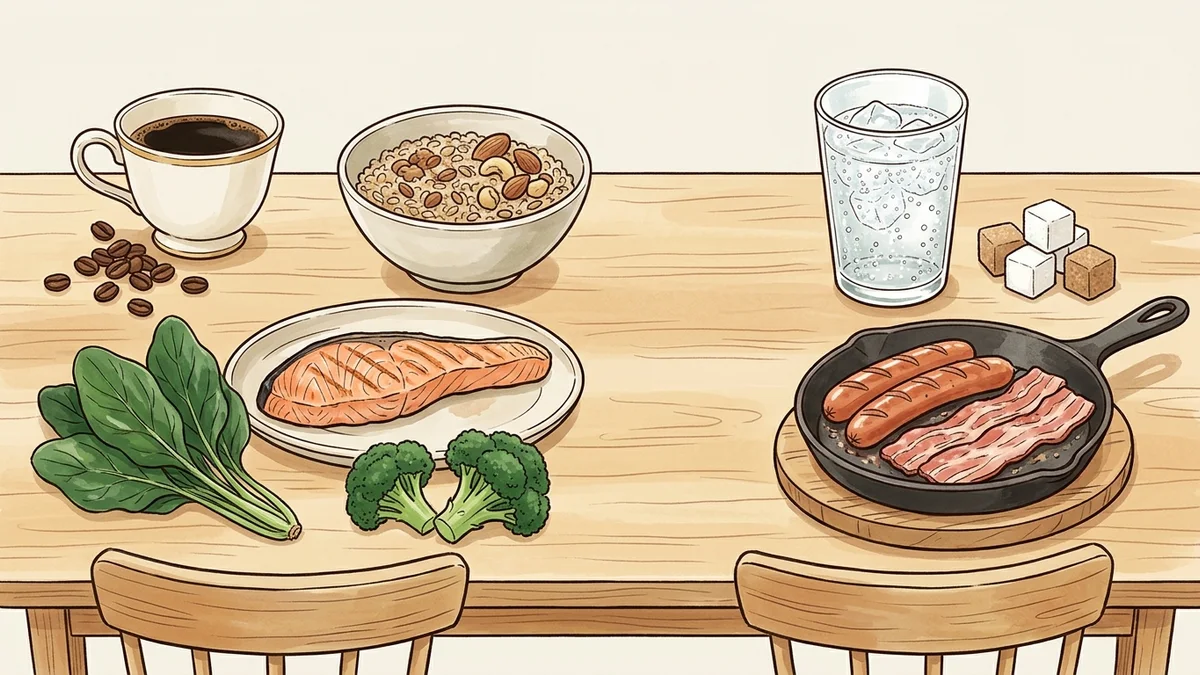
Assessments by the National Cancer Center Japan and WCRF/AICR
First, let us compare the evaluations by the National Cancer Center Japan (based on studies of Japanese populations) and the World Cancer Research Fund / American Institute for Cancer Research (WCRF/AICR, pooling global prospective cohorts).
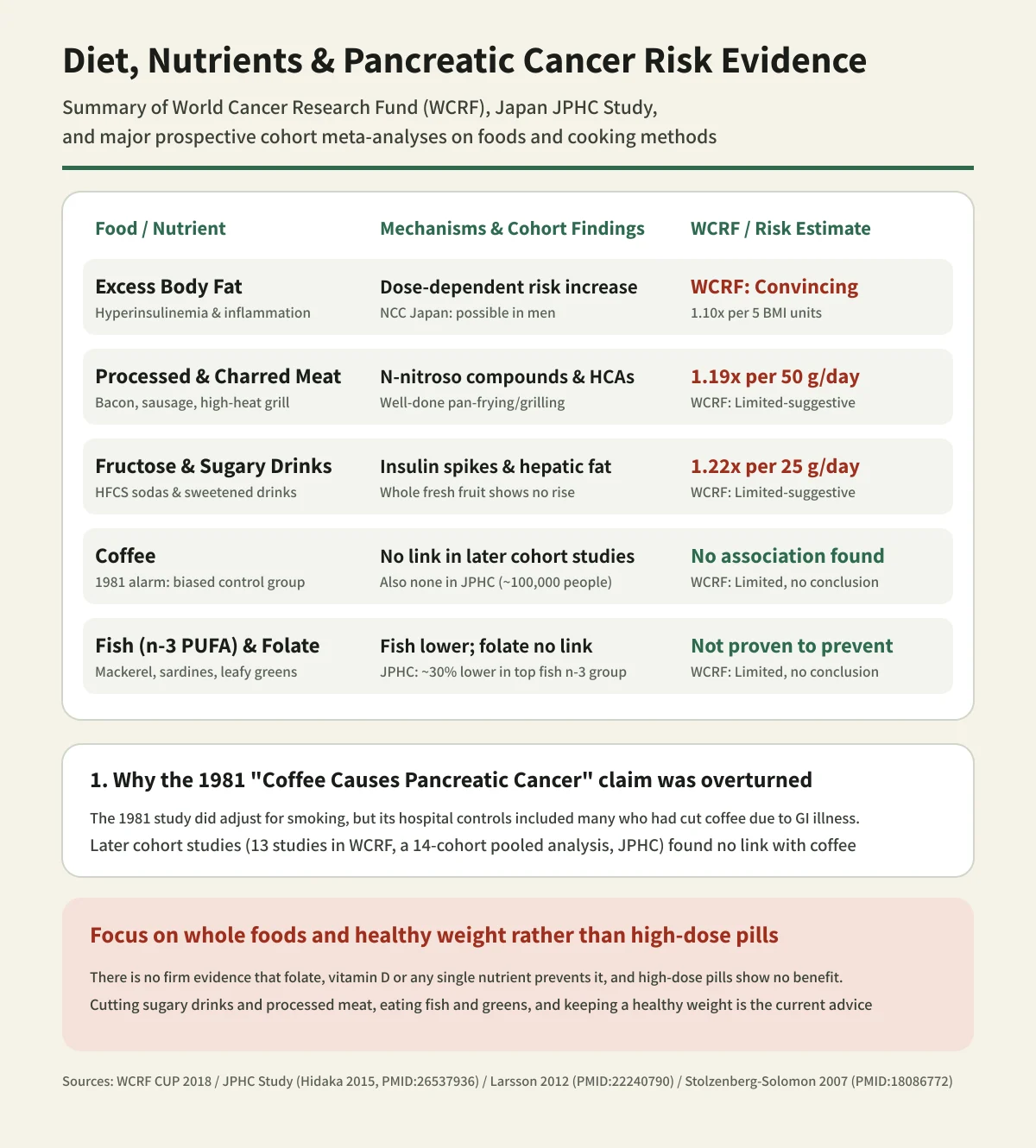
| Food, nutrient, or body size | National Cancer Center Japan | WCRF/AICR (Global, 2018) | Key meta-analysis & cohort figures |
|---|---|---|---|
| Body fatness (obesity) | Possible increase in men (1.71× at BMI ≥ 30 in men; Koyanagi 2018) | Convincing increase | 1.10× per 5 BMI units (WCRF, 23 studies) |
| Fructose | Insufficient data | Limited-suggestive increase | 1.22× per 25 g/day of fructose (Aune 2012, meta-analysis of 10 cohorts) |
| Sucrose (table sugar), GI, GL | Insufficient data | Limited-no conclusion | No significant increase for sucrose (1.05× per 25 g/day), GI, or GL (Aune 2012; Turati 2019) |
| Red meat (beef, pork, etc.) | Insufficient data | Limited-suggestive increase | 1.13× per 120 g/day overall (not significant); 1.29× in men, null in women (Larsson 2012) |
| Processed meat (bacon, ham, sausage) | Insufficient data | Limited-suggestive increase | 1.17–1.19× per 50 g/day (WCRF; Larsson 2012) |
| Saturated fatty acids | Insufficient data | Limited-suggestive increase | 1.11× per 10 g/day (WCRF CUP analysis, 5 studies) |
| Coffee | Insufficient data (null in JPHC) | Limited-no conclusion (changed in 2018 from “substantial effect unlikely” in 2012) | 1.02× per cup (240 mL)/day, not significant (WCRF, 13 studies); null in a 14-cohort pooled analysis |
| Milk and dairy products | Insufficient data | Not graded | No association in 14-cohort pooled analysis (~860k people, Genkinger 2014) |
| Wheat, gluten, whole grains | Insufficient data | Not graded | Gluten intake unrelated (Wang 2022, 3 US cohorts); whole grains associated with 0.76× risk (mostly case-control studies) |
| Fish (marine omega-3: DHA/EPA) | Insufficient data (lower in JPHC) | Limited-no conclusion | Highest marine omega-3 group had 0.70× risk in Japan’s JPHC Study (~82k people); total fish not significant |
| Dietary folate & magnesium | Insufficient data | Folate: Limited-no conclusion | Folate: 0.66× in a meta-analysis including case-control studies, but null (1.06×) in a 14-cohort pooled analysis. Magnesium: 1.24× per 100 mg/day lower intake (US VITAL study) |
Sources: National Cancer Center Japan (May 2026 edition); WCRF/AICR Continuous Update Project Pancreatic Cancer Report (2012, revised 2018). “Not graded” means the exposure does not appear in WCRF’s pancreatic cancer matrix.
Unlike stomach cancer (where salt-preserved foods are rated “probable”) or colorectal cancer (where processed meat is “convincing”), for pancreatic cancer body fatness is the only diet-related factor rated “convincing” worldwide, while individual foods remain at “limited-suggestive” or below.
Checking the “Four Poisons” Claim Against 60 Years of Japanese Food Supply Data
A popular claim on Japanese social media argues that pancreatic cancer keeps rising because of postwar increases in wheat, plant oils, dairy, and sugar (often called the “Four Poisons”). Let us compare per-capita net food supply from MAFF’s Food Balance Sheets with age-adjusted pancreatic cancer death rates over 60 years.
| Fiscal year | Sugar (kg/yr) | Oils & fats (kg/yr) | Milk & dairy (kg/yr) | Wheat (kg/yr) | Meat (kg/yr) | Age-adjusted death rate (Men / Women) |
|---|---|---|---|---|---|---|
| 1960 | 15.1 | 4.3 | 22.2 | 25.8 | 5.2 | 4.1 / 2.5 |
| 1973 (sugar peak) | 28.1 | 11.1 | 52.9 | 30.9 | 17.1 | 8.0 / 4.7 |
| 1985 | 22.0 | 14.0 | 70.6 | 31.7 | 25.2 | 11.6 / 6.5 |
| 1996 | 21.2 | 14.9 | 93.3 | 33.0 | 30.9 | 12.4 / 7.2 |
| 2010 | 18.9 | 13.7 | 86.2 | 32.7 | 29.1 | 13.0 / 8.2 |
| 2023 | 16.7 | 14.1 | 92.5 | 30.6 | 33.9 | 13.9 / 9.7 (2024) |
Sources: MAFF Food Balance Sheets (net food supply per person per year); National Cancer Center Japan (age-adjusted death rate per 100,000 using the 1985 Japanese model population).
Three important facts stand out from these 60-year figures:
- Per-capita sugar consumption in Japan has fallen by about 40% from its peak 50 years ago: Japanese sugar supply peaked in fiscal 1973 at 28.1 kg/year (~77 g/day) and fell steadily to 16.7 kg/year (~46 g/day) in fiscal 2023 — a 41% reduction. Even between 1996 and 2023, sugar supply dropped by about 20% (21.2 → 16.7 kg), while women’s age-adjusted pancreatic cancer death rate rose by 35% (note that the “sugars” category in the Food Balance Sheets excludes high-fructose corn syrup).
- Wheat, plant oils, and dairy have been flat for the past 30 years: During Japan’s rapid economic growth (1960s–1980s), fat, dairy, and meat consumption rose sharply alongside rising male smoking rates and the introduction of ultrasound and CT scanners. However, since 1996, per-capita supplies of wheat (30–33 kg), oils and fats (~14 kg), and dairy (~90 kg) have not increased.
- Why pancreatic cancer rates continue to rise in older Japanese women: Four overlapping factors are thought to contribute (their relative weights are not known): (1) extreme longevity (66% of pancreatic cancer deaths occur at age 75 or older, and far more women now reach their late 80s and 90s), (2) birth-cohort smoking patterns among women born in the mid-20th century, (3) rising obesity and type 2 diabetes in men, and (4) improved diagnostic detection via routine abdominal CT and MRI in elderly patients whose deaths would previously have been recorded as senility or unspecified jaundice.
For a broader verification of the “Four Poisons” theory, see our article checking the Four Poisons claim.
1. Sweets (Sugar, Fructose, Soft Drinks, and Artificial Sweeteners)
Fructose Is the Only Sugar Rated “Limited-Suggestive” by WCRF
In WCRF’s evaluation and the underlying meta-analysis by Aune et al. (Annals of Oncology 2012, 10 prospective cohorts, PMID: 22539563), fructose was the only carbohydrate sub-type associated with higher pancreatic cancer risk, at 1.22× per 25 g/day (95% CI 1.08–1.37). The authors noted that the finding needs confirmation in studies with better adjustment for confounding and in non-American populations.
- Why fructose behaves differently from glucose in lab studies: Cell-culture research (Liu et al., Cancer Research 2010, PMID: 20647326) showed that pancreatic tumor cells metabolize fructose via transketolase in the non-oxidative pentose phosphate pathway to synthesize nucleic acids (DNA and RNA) for cell proliferation.
- Fruit intake has not been linked to higher risk: A pooled analysis of 14 cohorts (~860,000 people; Koushik et al. 2012, PMID: 22875754) found no association between fruit or vegetable intake and pancreatic cancer risk. The concern centers on high-fructose corn syrup (HFCS) and other sugars in sweetened beverages, which may promote visceral fat and insulin resistance (see our article on fruit fructose vs. HFCS).
Table Sugar (Sucrose), Glycemic Index, and Artificial Sweeteners
- Total sucrose, GI, and GL: Meta-analyses by Aune et al. (2012) and Turati et al. (2019) found no significant association between total sucrose intake, glycemic index (GI), or glycemic load (GL) and pancreatic cancer risk (Aune 2012: RR 1.05 per 25 g/day sucrose, 1.02 per 10 GI units, 1.03 per 50 GL units).
- Sugar-sweetened beverages: The Singapore Chinese Health Study (Mueller 2010; ≥2 soft drinks/week) and a Swedish cohort (Larsson 2006; ≥2 servings/day) reported 1.87–1.93× higher risk, whereas a 14-cohort pooled analysis (~850,000 people, Genkinger 2012, PMID: 22194529) found a non-significant 1.19× for ≥250 g/day and a small 1.06× increase when intake was modeled continuously. Sweetened drinks may contribute through obesity and type 2 diabetes.
- Artificial sweeteners: Studies such as an Italian case-control study (Bosetti et al. 2009) found no significant association between artificial sweeteners (aspartame, sucralose, acesulfame K) and pancreatic cancer. In 2023, IARC classified aspartame as “possibly carcinogenic” (Group 2B), based mainly on liver cancer data (see artificial sweeteners safety and artificial sweeteners and gut bacteria).
2. Does Coffee Cause Pancreatic Cancer? The 1981 Controversy and Modern Resolution
The persistent rumor that coffee causes pancreatic cancer began with a famous 1981 paper in the New England Journal of Medicine by MacMahon et al. at Harvard (PMID: 7453739).
- What happened in 1981: Comparing 369 hospitalized pancreatic cancer patients with 644 control patients, the authors reported — after adjusting for cigarette smoking — a 1.8× risk for up to 2 cups of coffee per day and a 2.7× risk for 3 or more cups.
- Why the result was doubted: The study did adjust for smoking, and the authors themselves called for confirmation. The main weakness identified later was control selection bias: many hospital controls had gastrointestinal disorders that caused them to avoid coffee, artificially lowering coffee intake in the control group. A follow-up study by the same group (Hsieh et al., NEJM 1986, PMID: 3736647) did not reproduce the original strength of association.
- Modern evidence (no association found): WCRF’s meta-analysis of 13 studies found RR 1.02 per cup (240 mL)/day (not significant); a 14-cohort pooled analysis adjusting for smoking, alcohol, diabetes, and BMI (Genkinger et al. 2012) and Japan’s JPHC Study (~100,000 participants followed ~11 years, Luo et al. 2007) also found no overall association. WCRF rated coffee “substantial effect on risk unlikely” in 2012 but revised this to “limited – no conclusion” in 2018. In any case, there is no evidence that coffee increases pancreatic cancer risk.
3. Red Meat, Processed Meat, High-Temperature Charring, and Oils
Processed Meat and Red Meat
A meta-analysis of 11 prospective cohorts (6,643 pancreatic cancer cases) by Larsson & Wolk (British Journal of Cancer 2012, PMID: 22240790) reported:
- Processed meat (bacon, ham, sausage): 1.19× higher risk per 50 g/day (95% CI 1.04–1.36).
- Red meat (beef, pork, lamb): 1.13× per 120 g/day overall (not significant); 1.29× in men, with no association in women. The US Multiethnic Cohort (Nöthlings et al. 2005) also found higher risk with red and processed meat.
As explained in our article on sodium nitrite, one proposed mechanism is that nitrites used in cured meats can form N-nitroso compounds (nitrosamines), some of which induce pancreatic ductal tumors in animal models.
Charred Meat, Saturated Fat, Plant Oils, and Fish
- High-temperature cooking and charring: In the US NIH-AARP Diet and Health Study (~500,000 participants, Stolzenberg-Solomon et al., Cancer Epidemiol Biomarkers Prev 2007, PMID: 18086772), men in the highest quintile of total, red, and high-temperature-cooked meat had 1.41–1.52× the risk of the lowest quintile, and the highest quintile of overall meat-mutagenic activity (including heterocyclic amines) had about double the risk. No association was seen in women.
- Saturated fat vs. plant oils and marine omega-3s: WCRF rates saturated fatty acids (1.11× per 10 g/day) as “limited-suggestive,” whereas monounsaturated and polyunsaturated fats are “limited – no conclusion.” In Japan’s JPHC Study (Hidaka et al., Am J Clin Nutr 2015, PMID: 26537936, ~82,000 participants), people in the highest quartile of marine omega-3 polyunsaturated fatty acids (EPA, DPA, DHA from fish) had a 0.70× (30% lower) risk of pancreatic cancer compared with the lowest quartile, after excluding cases in the first 3 years; total fish intake was not significantly associated (see comparing cooking oils).
- Milk and dairy products: A pooled analysis of 14 cohorts (~862,000 people, Genkinger et al., Ann Oncol 2014, PMID: 24631943) found no association between milk, cheese, yogurt, calcium, or vitamin D intake and pancreatic cancer (see milk and dairy).
4. Nutrients Studied for Lower Risk: Folate, Magnesium, and Whole Grains
No food is proven to prevent pancreatic cancer. Some nutrients have been linked to lower risk, but results are inconsistent, and WCRF rates them “limited – no conclusion” or does not grade them.
- Dietary folate (spinach, broccoli, edamame, natto, nori): A meta-analysis of 4 case-control and 6 cohort studies (Lin et al. 2013) found 0.66× risk with high dietary folate intake, but a pooled analysis of 14 cohorts (~860,000 people; Bao et al., JNCI 2011, PMID: 22034634) found no association (1.06×). Folic acid supplements showed no protective effect.
- Magnesium (brown rice, seaweed, tofu, nuts): In the US VITAL study (~67,000 people followed ~6.8 years; Dibaba et al., Br J Cancer 2015), each 100 mg/day decrement in magnesium intake was associated with a 24% higher risk of pancreatic cancer. However, there were only 151 cases, and the association appeared limited to people also taking magnesium supplements.
- Whole grains: A meta-analysis of 8 observational studies (Lei et al., Medicine 2016, PMID: 26945361) found a 0.76× (~24% lower) risk with high whole-grain intake, but most were case-control studies and the authors called for prospective confirmation. Blunting post-meal glucose and insulin spikes is a possible mechanism.
One way to plan daily meals is a frozen dish delivery with menus designed by registered dietitians. If you have a medical condition, consult your doctor or dietitian before using one.
5. Pancreatic Cancer Series: Explore Causes, Early Signs, and Screening
- Alcohol and Pancreatic Cancer: Drinking Amounts, 66-Year Trends, and Latest Treatments
- Diabetes and Pancreatic Cancer: Why Sudden Blood Sugar Worsening Can Be an Early Sign, plus GLP-1 Drugs
- Why Is Pancreatic Cancer Hard to Find? Early Symptoms, Pancreatic Cysts (IPMN), Ultrasound Limits, and the APOA2-i Blood Test
- Periodontal Disease, Blood Type, and Genetics in Pancreatic Cancer: Blood Type O, Oral Bacteria, and BRCA
- Types of Pancreatic Cancer and Survival Rates: 90% Ductal Adenocarcinoma vs. Steve Jobs’s PNET
- Acute and Chronic Pancreatitis and Pancreatic Cancer: Alcohol, Gallstones, Triglycerides, and Post-Surgery MCT Oil
- Latest Treatments for Pancreatic Cancer: Conversion Surgery, NALIRIFOX, KRAS Inhibitors, Carbon-Ion Radiotherapy, and mRNA Vaccines
References
- National Cancer Center Japan, Institute for Cancer Control. Evaluation of Cancer Risk and Preventive Factors (May 26, 2026 edition). https://epi.ncc.go.jp/can_prev/outcome/index.html
- WCRF/AICR Continuous Update Project. Diet, nutrition, physical activity and pancreatic cancer (2012, revised 2018). https://www.wcrf.org/resources/pancreatic-cancer-report
- Ministry of Agriculture, Forestry and Fisheries (MAFF). Food Balance Sheets, long-term series by item. https://www.maff.go.jp/j/zyukyu/fbs/
- Aune D, et al. Ann Oncol. 2012;23(10):2536-2546. (PMID: 22539563)
- Liu H, et al. Cancer Res. 2010;70(15):6368-6376. (PMID: 20647326)
- Turati F, et al. Nutrients. 2019;11(10):2342. (PMID: 31581675)
- Koushik A, et al. Am J Epidemiol. 2012;176(5):373-386. (PMID: 22875754)
- Genkinger JM, et al. Cancer Epidemiol Biomarkers Prev. 2012;21(2):305-318. (PMID: 22194529)
- MacMahon B, et al. N Engl J Med. 1981;304(11):630-633. (PMID: 7453739)
- Hsieh CC, et al. N Engl J Med. 1986;315(9):587-589. (PMID: 3736647)
- Luo J, et al. Eur J Cancer Prev. 2007;16(6):542-548. (PMID: 18090127)
- Larsson SC, Wolk A. Br J Cancer. 2012;106(3):603-607. (PMID: 22240790)
- Nöthlings U, et al. J Natl Cancer Inst. 2005;97(19):1458-1465. (PMID: 16204695)
- Stolzenberg-Solomon RZ, et al. Cancer Epidemiol Biomarkers Prev. 2007;16(12):2664-2675. (PMID: 18086772)
- Hidaka A, et al. Am J Clin Nutr. 2015;102(6):1490-1497. (PMID: 26537936)
- Genkinger JM, et al. Ann Oncol. 2014;25(6):1106-1115. (PMID: 24631943)
- Wang Y, et al. Clin Gastroenterol Hepatol. 2022;20(9):1986-1996. (PMID: 34800737)
- Bao Y, et al. J Natl Cancer Inst. 2011;103(24):1840-1850. (PMID: 22034634)
- Lin HL, et al. Public Health. 2013;127(7):607-613. (PMID: 23769243)
- Dibaba D, et al. Br J Cancer. 2015;113(11):1615-1621. (PMID: 26554653)
- Lei Q, et al. Medicine (Baltimore). 2016;95(9):e2747. (PMID: 26945361)
Products related to this article PR
Products whose labels Urayomi has read, picked because their ingredients or category relate to this article. This is not a recommendation or a safety rating. The shop buttons are affiliate links; prices are reference prices on the date we checked.
Frequently asked questions
- What are the key findings on: What Foods Are Linked to Pancreatic Cancer? Sugar, Fructose, Coffee, Processed Meat, and Plant Oils Checked Against National Data and Studies?
- Japan's assessment rates no food a convincing or probable cause of pancreatic cancer; smoking is convincing and diabetes probable. Sugar, coffee, fish.
- What does the evidence show regarding: Assessments by the National Cancer Center Japan and WCRF/AICR?
- First, let us compare the evaluations by the National Cancer Center Japan (based on studies of Japanese populations) and the World Cancer Research Fund / American Institute for Cancer Research (WCRF/AICR, pooling global prospective cohorts).
- What does the evidence show regarding: Checking the “Four Poisons” Claim Against 60 Years of Japanese Food Supply Data?
- A popular claim on Japanese social media argues that pancreatic cancer keeps rising because of postwar increases in wheat, plant oils, dairy, and sugar (often called the “Four Poisons”). Let us compare per-capita net food supply from MAFF’s Food Balance Shee…
- What does the evidence show regarding: Sweets (Sugar, Fructose, Soft Drinks, and Artificial Sweeteners)?
- In WCRF’s evaluation and the underlying meta-analysis by Aune et al. (Annals of Oncology 2012, 10 prospective cohorts, PMID: 22539563), fructose was the only carbohydrate sub-type associated with higher pancreatic cancer risk, at 1.22× per 25 g/day (95% CI 1…
Related articles and databases
- Is Alcohol a Cause of Pancreatic Cancer? Drinking Amounts, Other Causes, and the Latest Treatments, Checked Against National Data and Studies
- Diabetes and Pancreatic Cancer: Why Sudden Blood Sugar Worsening Can Be an Early Sign, and What Studies Show About GLP-1 Drugs and Insulin
- Does Eating Too Much Wheat Flour Cause Colorectal Cancer? Checking the Link Between Wheat and Cancer Against Studies and Government Data
- Does Fruit Fructose Make You Gain Weight? How It Differs from the Fructose in “果糖ぶどう糖液糖” (High-Fructose Corn Syrup), and a Comparison of Sugar and Fiber in 22 Fruits
- Is the Color Fixer (Sodium Nitrite) Bad for You? Cancer Evaluations, Why Ham Is Red, and How Japanese and Overseas Rules Differ
- Are Lard and Butter Bad for You? 16 Plant Oils and Animal Fats (Beef Tallow, Fish Oil) Compared by Fatty Acids, and Which to Use Every Day
- Periodontal Disease, Blood Type, and Genetics in Pancreatic Cancer: Does Blood Type O Lower Risk? Oral Bacteria, BRCA Genes, and Familial Risk
- Acute and Chronic Pancreatitis and Pancreatic Cancer: How Alcohol, Gallstones, and Triglycerides Damage the Pancreas, Plus Post-Surgery Nutrition and MCT Oil
- Latest Pancreatic Cancer Treatments & Clinical Trials: Perioperative Chemo, Conversion Surgery, KRAS Inhibitors, Carbon-Ion Therapy & mRNA Vaccines
- DHA and EPA (Supplement ingredient database)
- Folate (folic acid) (Supplement ingredient database)
- Vitamin D (Supplement ingredient database)
- Magnesium (Supplement ingredient database)
- Chlorogenic acids (Supplement ingredient database)