

Types of Pancreatic Cancer and Survival Rates: How Pancreatic Ductal Adenocarcinoma Differs from Steve Jobs’s Neuroendocrine Tumor (PNET)

Many people have wondered: “If Apple co-founder Steve Jobs had pancreatic cancer, how did he live for 8 years after his diagnosis?” or “Why was an acquaintance told their pancreatic tumor had a good outlook with surgery?”
In everyday conversation, “pancreatic cancer” almost always refers to invasive pancreatic ductal adenocarcinoma (PDAC), which accounts for about 90% of all pancreatic malignancies and arises from the exocrine ducts that carry digestive juices. However, the pancreas also contains hormone-producing endocrine cells (the islets of Langerhans), which give rise to a different family of tumors called pancreatic neuroendocrine tumors (PNET / PanNET; a few percent — under 2% of pancreatic cancers in American Cancer Society statistics), alongside rarer types such as acinar cell carcinoma and solid pseudopapillary neoplasms (SPN).
In this article, we compare:
- How tumors arising from the pancreas’s “two factories” (exocrine ducts vs. endocrine islets) differ in growth speed, 5-year survival rate, and treatment
- Functional PNETs (insulinoma, gastrinoma) vs. non-functional PNETs, and WHO grading (NET G1, G2, G3 vs. NEC)
- Why Steve Jobs lived 8 years with a PNET, and what oncology studies show about delaying or refusing standard treatment in favor of alternative therapies
- Modern treatments for PNET, including everolimus, sunitinib, and Peptide Receptor Radionuclide Therapy (PRRT: 177Lu-dotatate / Lutathera)
This article does not replace medical diagnosis or treatment. Always confirm your exact pathology classification and treatment options with your oncologist.
Conclusion: Common Ductal Adenocarcinoma (~90%) and Steve Jobs’s PNET (a Few Percent) Are Biologically Distinct Diseases
- The pancreas has two distinct functions: exocrine (~95% of volume, making digestive enzymes) and endocrine (~1–2% of volume, making hormones like insulin). Exocrine ducts give rise to pancreatic ductal adenocarcinoma (PDAC, ~90%), whereas endocrine islets give rise to pancreatic neuroendocrine tumors (PNET, a few percent).
- Survival rates and growth speeds differ dramatically. Overall 5-year relative survival for pancreatic cancer in Japan is 13.2% (though the Japan Pancreas Society registry reports 80.4% for tumors ≤10 mm). By contrast, well-differentiated PNETs (NET G1/G2) often grow slowly; in US data, 5-year relative survival is ~91% when localized, ~19% with distant spread, and ~48% across all stages.
- Steve Jobs was diagnosed in October 2003 with a PNET, not common PDAC. It was found incidentally on an abdominal CT, and his doctors urged prompt surgery. However, Jobs postponed surgery for about 9 months while pursuing a strict vegan, fruit- and juice-heavy diet and other alternative therapies, undergoing resection in July 2004.
- PNET treatments have advanced rapidly, including somatostatin analogs, targeted agents (everolimus, sunitinib), and PRRT (177Lu-dotatate / Lutathera, approved in Japan in 2021), which delivers beta-radiation directly to somatostatin-receptor-positive tumor cells.

Comparison of Pancreatic Tumor Types, Share, 5-Year Survival, and Treatments
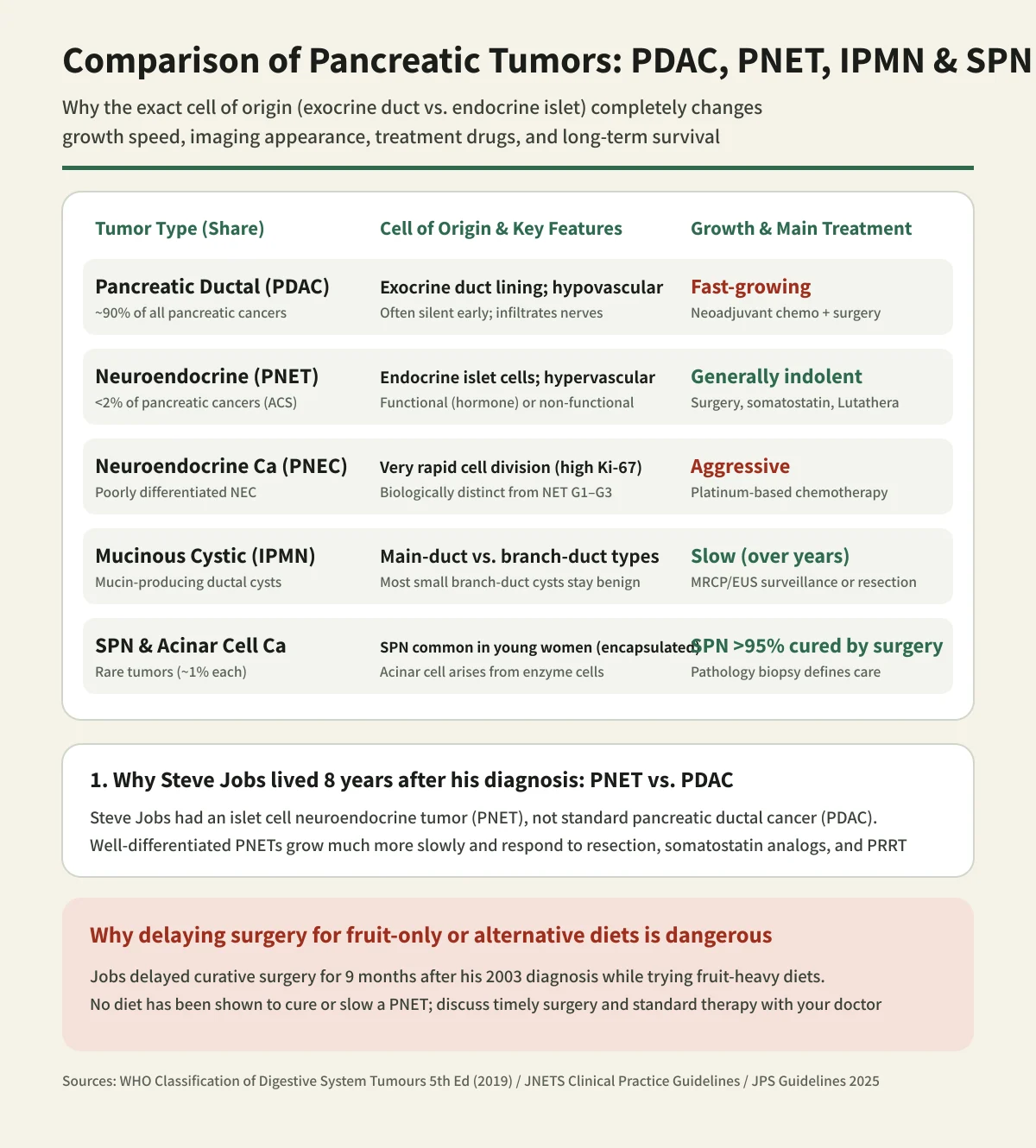
| Tumor type | Cell of origin | Share of pancreatic tumors | Growth speed & 5-year survival | Main treatments |
|---|---|---|---|---|
| Invasive Pancreatic Ductal Adenocarcinoma (PDAC) | Exocrine: pancreatic ductal epithelium | ~85–90% | Rapid growth and early vascular/neural invasion. Overall 5-year survival for pancreatic cancer: 13.2% (Japan Pancreas Society registry: Stage 0 85.8%; tumors ≤10 mm 80.4%) |
Neoadjuvant GS + surgery + adjuvant S-1; FOLFIRINOX, gemcitabine + nab-paclitaxel, NALIRIFOX, olaparib |
| Pancreatic Neuroendocrine Tumor (PNET / PanNET) | Endocrine: islet cells of Langerhans | A few percent (under 2% of pancreatic cancers in the US) | Well-differentiated NET G1/G2 often grows slowly. US 5-year relative survival: localized ~91%, regional ~64%, distant ~19% (all stages ~48%). Poorly differentiated NEC is aggressive |
Surgery, somatostatin analogs (lanreotide, octreotide), everolimus, sunitinib, streptozocin, PRRT (177Lu-dotatate) |
| IPMN & Mucinous Cystic Neoplasm (MCN) | Exocrine: mucin-producing ductal cells (MCN mainly in middle-aged women, body/tail) | ~3–5% (far more common if benign and precursor lesions are included) | Spectrum from benign adenoma to invasive carcinoma; 85–95%+ 5-year survival if resected before invasion | Managed per 2024 Kyoto Guidelines; MCN is generally resected |
| Acinar Cell Carcinoma | Exocrine: enzyme-secreting acinar cells | <1% | Usually better prognosis than PDAC, but reported 5-year survival varies widely by center and stage (many reports in the 30–40% range overall); higher rate of BRCA2 / DNA-repair variants |
Surgical resection; platinum- or fluoropyrimidine-based regimens |
| Solid Pseudopapillary Neoplasm (SPN) | Low-grade tumor of uncertain origin, predominantly in young women (teens to 30s) | <1% | Well-circumscribed; >95% 5-year survival after complete surgical resection | Function-preserving or standard surgical resection |
Sources: Japan Pancreas Society Registry (Egawa 2004, 2012); National Cancer Center Japan; Japan Neuroendocrine Tumor Society (JNETS) Guidelines; American Cancer Society, “Survival Rates for Pancreatic Neuroendocrine Tumor” (SEER data for diagnoses 2015–2021). Shares and survival rates vary by country, period, and staging definitions, so treat them as approximate.
Functional vs. Non-Functional PNETs
PNETs (now also grouped under the umbrella term “pancreatic NEN” in guidelines) are divided by whether they produce hormone symptoms.
- Functional PNETs (roughly 10–40% depending on the report): Secrete excess hormones that cause distinctive clinical syndromes even when the tumor is small — such as insulinoma (the most common; fasting or exercise-related hypoglycemia with sweating, palpitations, tremors, and confusion relieved by sugar; ~90% benign or low-grade and curable by surgery), gastrinoma (Zollinger-Ellison syndrome: refractory peptic ulcers and watery diarrhea; more than half have malignant potential and spread to lymph nodes or the liver), and glucagonoma, VIPoma, and somatostatinoma (characteristic rash — necrolytic migratory erythema — diabetes, or profuse watery diarrhea).
- Non-Functional PNETs (roughly 60–90%): Do not cause hormone syndromes and are increasingly discovered incidentally on ultrasound, CT, or MRI during health checkups. When found small, surgery offers a good chance of cure.
Under the WHO classification, PNETs are graded by how fast the cells proliferate (Ki-67 index and mitotic count): NET G1 (Ki-67 under 3%), NET G2 (3–20%), and NET G3 (over 20%) are well-differentiated, while neuroendocrine carcinoma (NEC) is poorly differentiated, has a different genetic background, and progresses quickly. The grade guides drug selection.
Why Steve Jobs Lived 8 Years — and What Studies Show About Delaying Standard Treatment
Steve Jobs’s course (1955–2011) is widely known from his authorized biography by Walter Isaacson and press reports. His detailed pathology and medical records have not been made public, so the following is based on the biography and reporting.
- October 2003 — Incidental discovery of a PNET: During an abdominal CT scan related to kidney stones, doctors found a shadow on Steve Jobs’s pancreas. Biopsy showed a pancreatic neuroendocrine tumor (PNET) — a minority type that often progresses relatively slowly — not standard PDAC. His physicians urged prompt surgical resection.
- About nine months of alternative therapy: Reluctant to undergo surgery, Jobs postponed it for about 9 months. According to the biography, he relied on a strict vegan diet with large quantities of fresh fruit and carrot juices (close to a fruitarian diet), acupuncture, herbal remedies, and bowel cleansings. (As noted in our article on fruit and fructose, actor Ashton Kutcher has said he was hospitalized with pancreas problems after imitating this fruit-only diet for a film role.)
- July 2004 surgery and subsequent liver metastasis: After a CT scan suggested the tumor had grown and possibly spread, Jobs underwent a modified Whipple procedure (pancreaticoduodenectomy) at Stanford on July 31, 2004; according to the biography, small liver metastases were found during the operation. The liver disease later progressed, and after a liver transplant from a deceased donor in 2009 and drug therapy, he died in October 2011 at age 56 — 8 years after diagnosis.
Survival data on choosing alternative medicine over standard treatment
Two analyses of the US National Cancer Database by Johnson et al. at Yale examined patients with non-metastatic breast, prostate, lung, or colorectal cancer — pancreatic tumors were not included:
- Patients who chose alternative medicine alone without any conventional treatment had about a 2.5-fold higher risk of death than those receiving conventional treatment (HR 2.50; JNCI 2018, PMID: 28922780).
- Patients who used complementary medicine alongside conventional treatment were much more likely to refuse parts of it (surgery, chemotherapy, radiotherapy, or hormone therapy) and had about a 2.1-fold higher risk of death (HR 2.08). Once treatment refusal and delay were accounted for, the difference was no longer significant, suggesting the excess risk was driven by refusing standard therapy (JAMA Oncol 2018, PMID: 30027204).
Whether operating 9 months earlier would have changed Jobs’s outcome cannot be determined, because his pathology details are not public. Still, because localized PNETs often do well when resected, his case is frequently cited as an illustration of the risks of postponing standard treatment. If you want to try a diet or supplement, do not stop or delay standard treatment — discuss it with your doctor first.
Modern Testing and Therapy for PNET: PRRT (177Lu-Dotatate / Lutathera)
Most well-differentiated PNETs express many somatostatin receptors (SSTR) on their cell surface, and tests and treatments that exploit this property are available in Japan.
- Somatostatin receptor scintigraphy (OctreoScan): A somatostatin-like compound tagged with a small amount of radioactive isotope is injected to show where PNET lesions are located throughout the body.
- Targeted agents (everolimus / Afinitor, sunitinib / Sutent) and streptozocin (Zanosar): Oral drugs that block tumor growth signals (the mTOR pathway and angiogenesis), and an intravenous drug for pancreatic and gastrointestinal NETs, are approved.
- Peptide Receptor Radionuclide Therapy (PRRT: 177Lu-dotatate / Lutathera, approved in Japan in 2021): A somatostatin analog linked to the beta-emitting radionuclide Lutetium-177, which irradiates only a few millimeters around it. Infused intravenously, it binds to receptor-positive tumor cells and irradiates them from within. In phase 3 trials, NETTER-1 (2017, in midgut NETs) reduced the risk of progression or death by about 79% (HR 0.21), and NETTER-2 (2024, first-line in higher-grade G2 [Ki-67 ≥10%] to G3 gastroenteropancreatic NETs, including pancreatic tumors) reduced it by about 72% (HR 0.276). The primary endpoint in both was progression-free survival; the final NETTER-1 analysis did not show a statistically significant overall survival benefit. It is used for eligible patients after receptor positivity is confirmed by imaging.
Pancreatic Cancer Series: Related Articles
- Alcohol and Pancreatic Cancer: Drinking Amounts, 66-Year Trends, and Latest Treatments
- What Foods Are Linked to Pancreatic Cancer? Sugar, Fructose, Coffee, Processed Meat, and Oils
- Diabetes and Pancreatic Cancer: Why Sudden Blood Sugar Worsening Can Be an Early Sign, plus GLP-1 Drugs
- Why Is Pancreatic Cancer Hard to Find? Early Symptoms, Pancreatic Cysts (IPMN), Ultrasound Limits, and the APOA2-i Blood Test
- Periodontal Disease, Blood Type, and Genetics in Pancreatic Cancer: Blood Type O, Oral Bacteria, and BRCA
- Acute and Chronic Pancreatitis and Pancreatic Cancer: Alcohol, Gallstones, Triglycerides, and Post-Surgery MCT Oil
- Latest Treatments for Pancreatic Cancer: Conversion Surgery, NALIRIFOX, KRAS Inhibitors, Carbon-Ion Radiotherapy, and mRNA Vaccines
References
- Japan Neuroendocrine Tumor Society (JNETS). Clinical Practice Guidelines for Pancreatic and Gastrointestinal Neuroendocrine Neoplasms (NEN), 2nd ed. Kanehara & Co.
- Japan Pancreas Society. Clinical Practice Guidelines for Pancreatic Cancer 2025. Kanehara & Co., 2025.
- National Cancer Center Japan, Rare Cancer Center. “Pancreatic and gastrointestinal neuroendocrine tumors” (Japanese). https://www.ncc.go.jp/jp/rcc/about/neuroendocrine_tumor_2/index.html
- American Cancer Society. Survival Rates for Pancreatic Neuroendocrine Tumor. https://www.cancer.org/cancer/types/pancreatic-neuroendocrine-tumor/detection-diagnosis-staging/survival-rates.html
- Egawa S, et al. Clinicopathological aspects of small pancreatic cancer. Pancreas. 2004;28(3):235-240. (PMID: 15084963) / Egawa S, et al. Japan Pancreatic Cancer Registry; 30th year anniversary. Pancreas. 2012;41(7):985-992. (PMID: 22750974)
- Isaacson W. Steve Jobs. Simon & Schuster; 2011.
- Strosberg J, et al. Phase 3 Trial of 177Lu-Dotatate for Midgut Neuroendocrine Tumors (NETTER-1). N Engl J Med. 2017;376(2):125-135. (PMID: 28076709)
- Singh S, et al. (NETTER-2). Lancet. 2024;403(10446):2807-2817. (PMID: 38851203)
- Johnson SB, et al. Use of Alternative Medicine for Cancer and Its Impact on Survival. J Natl Cancer Inst. 2018;110(1):121-124. (PMID: 28922780)
- Johnson SB, et al. Complementary Medicine, Refusal of Conventional Cancer Therapy, and Survival Among Patients With Curable Cancers. JAMA Oncol. 2018;4(10):1375-1381. (PMID: 30027204)
Frequently asked questions
- What are the key findings on: Types of Pancreatic Cancer and Survival Rates: How Pancreatic Ductal Adenocarcinoma Differs from Steve Jobs’s Neuroendocrine Tumor (PNET)?
- About 90% of pancreatic cancers are ductal adenocarcinoma (13.2% 5-year survival in Japan); neuroendocrine tumors often grow slowly. Jobs's case, PRRT.
- What does the evidence show regarding: Comparison of Pancreatic Tumor Types, Share, 5-Year Survival, and Treatments?
- Sources: Japan Pancreas Society Registry (Egawa 2004, 2012); National Cancer Center Japan; Japan Neuroendocrine Tumor Society (JNETS) Guidelines; American Cancer Society, “Survival Rates for Pancreatic Neuroendocrine Tumor” (SEER data for diagnoses 2015–2021…
- What does the evidence show regarding: Functional vs. Non-Functional PNETs?
- PNETs (now also grouped under the umbrella term “pancreatic NEN” in guidelines) are divided by whether they produce hormone symptoms.
- Why Steve Jobs Lived 8 Years — and What Studies Show About Delaying Standard Treatment?
- Steve Jobs’s course (1955–2011) is widely known from his authorized biography by Walter Isaacson and press reports. His detailed pathology and medical records have not been made public, so the following is based on the biography and reporting.
Related articles and databases
- Is Alcohol a Cause of Pancreatic Cancer? Drinking Amounts, Other Causes, and the Latest Treatments, Checked Against National Data and Studies
- Why Is Pancreatic Cancer So Hard to Find Early? Early Symptoms, Pancreatic Cysts (IPMN), Ultrasound Limits, and the New APOA2-i Blood Test
- Thyroid Cancer: Symptoms, Types, Rates in Japan and Abroad, the Effects of Iodine (Kombu) and Radiation, and Thyradin, TSH, Thyroglobulin and Tumor Markers
- Does Fruit Fructose Make You Gain Weight? How It Differs from the Fructose in “果糖ぶどう糖液糖” (High-Fructose Corn Syrup), and a Comparison of Sugar and Fiber in 22 Fruits
- What Are Tumor Markers? Origins, Types, Positive Rates by Cancer, Cost, and How to Read Results, Checked Against Society Guidelines and Studies
- Latest Pancreatic Cancer Treatments & Clinical Trials: Perioperative Chemo, Conversion Surgery, KRAS Inhibitors, Carbon-Ion Therapy & mRNA Vaccines