

Periodontal Disease, Blood Type, and Genetics in Pancreatic Cancer: Does Blood Type O Lower Risk? Oral Bacteria, BRCA Genes, and Familial Risk

Why do some people who never smoke, rarely drink, and have neither obesity nor diabetes develop pancreatic cancer? Over the past decade, genome-wide association studies (GWAS) and large prospective cohorts have revealed three biological factors beyond everyday diet and lifestyle: oral bacteria linked to periodontal disease (Porphyromonas gingivalis), inherited blood groups (ABO and Lewis systems), and familial or germline genetic variants (BRCA1/2, ATM, PALB2, and Lynch syndrome).
In this article, we check the scientific evidence on:
- Why periodontal disease and tooth loss are linked to a 1.5–1.7× higher risk of pancreatic cancer, and what prospective oral-wash studies found about Porphyromonas gingivalis
- Whether people with blood type O really have a lower risk of pancreatic cancer than types A, AB, and B
- How a separate blood group system — the Lewis blood type — determines whether your body can produce the tumor marker CA19-9
- Familial pancreatic cancer and hereditary syndromes (
BRCA2, etc.): how breast, ovarian, and prostate cancer in relatives connect to pancreatic risk, PARP inhibitor therapy (olaparib), and surveillance of high-risk relatives
This article does not replace medical advice or genetic counseling. If you have a strong family history of cancer, consult a gastroenterologist or clinical genetics clinic.
Conclusion: Oral P. gingivalis (~1.6×), Non-O Blood Types (~1.3–1.7×), and Germline BRCA Variants Inform Screening and Treatment Choices
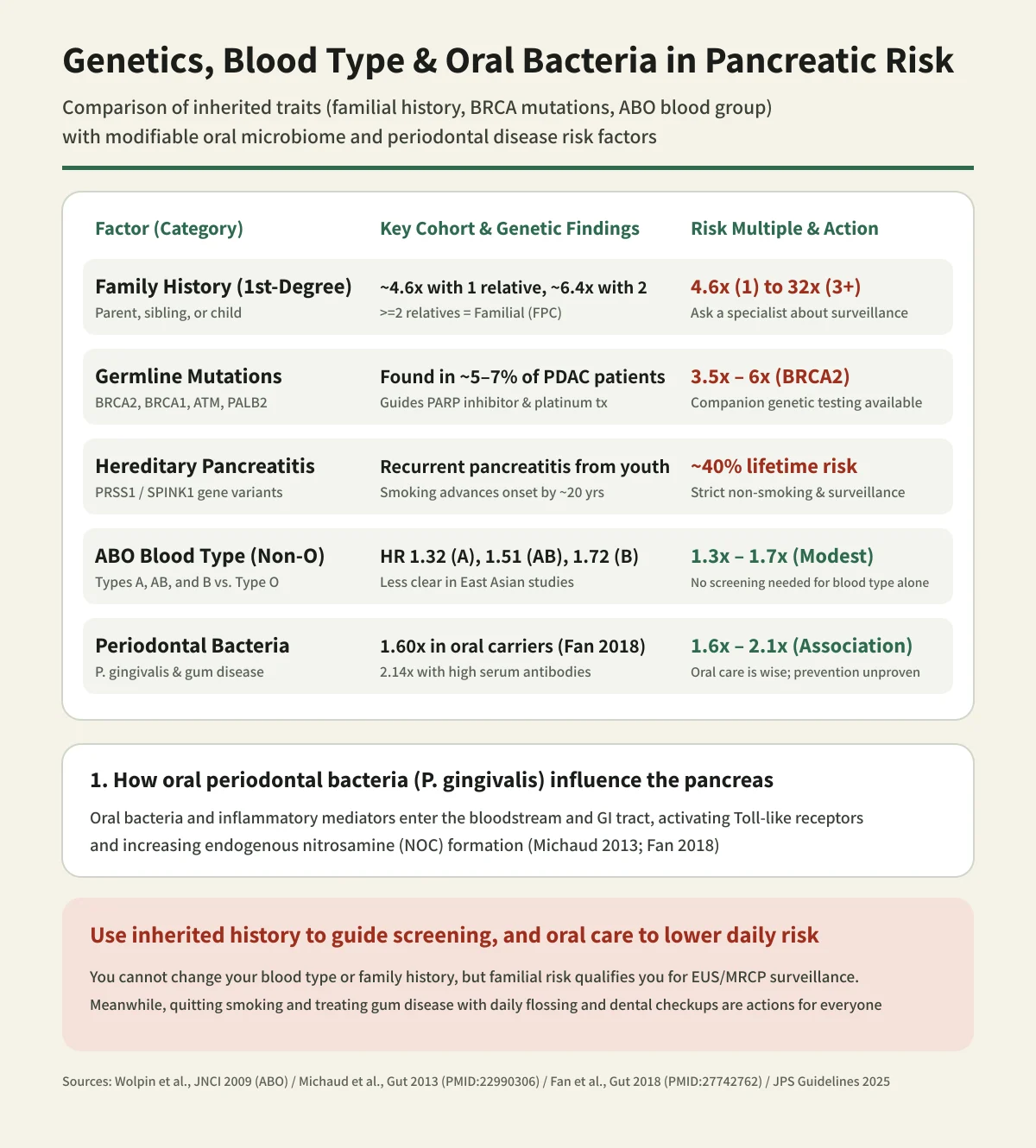
- Periodontal disease and oral Porphyromonas gingivalis were associated with pancreatic cancer risk after adjusting for smoking, diabetes, and other factors. In a case-control study nested within two prospective US cohorts, carrying P. gingivalis in pre-diagnostic mouthwash samples was associated with a 1.60× higher risk, and high serum antibodies against P. gingivalis in the European EPIC cohort carried a 2.14× risk. These are observational findings: no trial has shown that treating periodontitis lowers pancreatic cancer risk. Daily oral hygiene and professional periodontal care remain worthwhile for oral and general health.
- People with blood type O have a modestly lower risk of pancreatic cancer — a finding replicated in genome-wide association studies (GWAS) and large cohorts. In ~107,000 US health professionals, hazard ratios versus type O (1.00) were 1.32 for type A, 1.51 for AB, and 1.72 for B; a 24-study meta-analysis found 1.40× for type A, while increases for types B and AB were not clear in East Asian populations, including Japan. The difference is modest, so blood type O does not guarantee protection.
- In clinical testing, the “Lewis blood group” is even more important: about 10% of Japanese people are Lewis-negative (Lea−b−) and produce almost no CA19-9 even when cancer is present (DUPAN-2 or APOA2-iTQ can be used as alternatives).
- Roughly 5–10% of pancreatic cancer patients have a familial predisposition or a germline pathogenic variant (most commonly
BRCA2,ATM, orPALB2). Having two first-degree relatives with pancreatic cancer was associated with ~6.4-fold risk in a US registry, and such high-risk relatives undergo MRI (MRCP) and EUS surveillance at specialist centers and in clinical studies.BRCA1/2carriers tend to respond to platinum chemotherapy and can receive maintenance olaparib (Lynparza), which prolonged progression-free survival but has not been shown to improve overall survival.
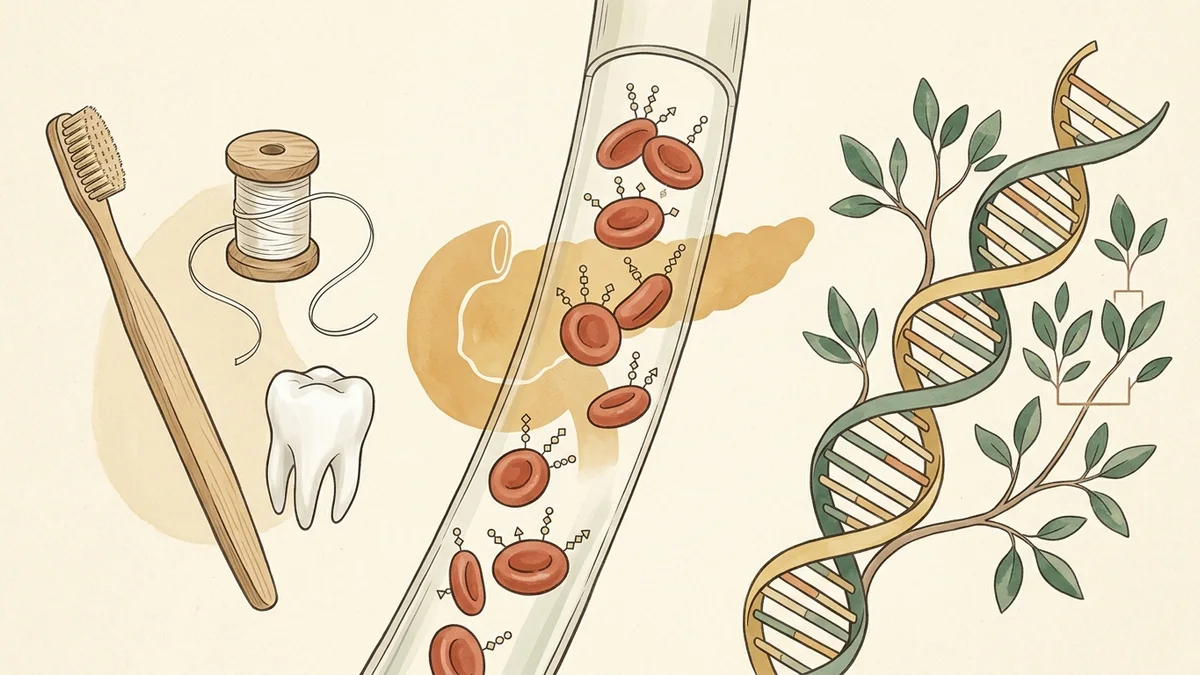
Overview of Oral Microbiome, Blood Type, and Genetic Risk Factors
1. Periodontal Disease and Porphyromonas gingivalis
| Study (Year) | Cohort & design | Key findings (adjusted for smoking, diabetes, BMI, age) |
|---|---|---|
| Health Professionals Follow-Up Study (HPFS) Michaud et al., JNCI 2007 (PMID: 17228001) |
51,529 US male health professionals followed for 16 years (216 cases) | History of periodontal disease: 1.64× risk (2.09× among never-smokers); number of teeth and tooth loss during follow-up were not strongly associated |
| European EPIC Cohort (Serum Antibodies) Michaud et al., Gut 2013 (PMID: 22990306) |
Pre-diagnostic blood samples from 405 cases and 416 controls | High serum antibodies (>200 ng/mL) against Porphyromonas gingivalis: 2.14× risk |
| CPS-II & PLCO Cohorts (Oral Wash DNA) Fan et al., Gut 2018 (PMID: 27742762) |
Pre-diagnostic mouthwash bacterial 16S rRNA sequencing in 361 cases and 371 controls followed up to 10 years | Oral carriage of Porphyromonas gingivalis: 1.60× risk; carriage of Aggregatibacter actinomycetemcomitans: 2.20× risk |
| Meta-Analysis of 8 Studies Maisonneuve et al., Ann Oncol 2017 (PMID: 28453689) |
Pooled cohort and case-control studies | Periodontitis: 1.74× risk; edentulism (complete tooth loss): 1.54× risk |
All of these are observational studies, and residual confounding (for example, by smoking or diabetes) cannot be ruled out.
Researchers have proposed three biological pathways connecting periodontal pathogens to the pancreas — all still hypotheses: (1) translocation of oral bacteria and lipopolysaccharide (LPS) via the bloodstream or duodenum into pancreatic ducts, (2) activation of Toll-like receptors (TLR2/TLR4) that may promote chronic pancreatic inflammation and tumorigenesis, and (3) increased oral reduction of nitrate to nitrite, promoting endogenous formation of carcinogenic nitrosamines.
2. ABO Blood Type (“Does Type O Lower Risk?”) and the Lewis Blood Group
ABO Blood Group: Type A and Other Non-O Types Carry ~1.3–1.7× Higher Risk Than Type O
In 2009, the PanScan genome-wide association study (Amundadottir et al., Nature Genetics 2009, PMID: 19648918) discovered that single-nucleotide polymorphisms at the ABO locus on chromosome 9q34.2 are significantly associated with pancreatic cancer susceptibility. A Japanese case-control study at Aichi Cancer Center (Nakao et al., Cancer Sci 2011, 185 patients, PMID: 21306478) found a similar association with non-O blood types.
In the US Nurses’ Health Study and Health Professionals Follow-Up Study (107,503 participants, Wolpin et al., JNCI 2009, PMID: 19276450), hazard ratios compared with blood type O (1.00) were 1.32× for type A (95% CI 1.02–1.72), 1.51× for type AB, and 1.72× for type B. A meta-analysis of 24 studies (Risch et al., Am J Epidemiol 2013, PMID: 23652164) found a pooled 1.40× risk for type A; types B and AB carried 1.38× and 1.52× risk in Western populations but were not significantly associated with risk (1.05× and 1.13×) in East Asian populations where CagA-positive H. pylori is endemic. The ABO gene encodes a glycosyltransferase that attaches A or B sugar antigens not only to red blood cells, but also to the surface of pancreatic ductal epithelial cells, altering systemic inflammatory adhesion molecules (such as soluble ICAM-1 and E-selectin).
Lewis Blood Group: Why ~10% of People Cannot Produce CA19-9
As covered in our tumor marker guide and our screening & APOA2-i article, roughly 10% of Japanese people carry inactivating variants in both copies of the FUT3 gene, making them Lewis blood group negative (Lea−b−). Because the FUT3 fucosyltransferase is required to synthesize sialyl Lewis-a (CA19-9), Lewis-negative individuals have near-zero CA19-9 (usually ≤2 U/mL) even when pancreatic cancer is present. In a study of 2,418 patients with resected pancreatic cancer at nine Japanese centers (Omiya et al., JAMA Surgery 2026, PMID: 42234435), 7.7% were CA19-9 nonexpressors, and DUPAN-2 worked as a surrogate marker for monitoring treatment. DUPAN-2, SPan-1, and Toray APOA2-iTQ (covered by Japanese public insurance since 2024) are alternatives to discuss with a physician.
3. Familial Pancreatic Cancer & Germline BRCA1/2, PALB2, and ATM Variants
Roughly 5–10% of pancreatic cancers arise in patients with a family history or an inherited germline pathogenic variant:
- Familial Pancreatic Cancer (FPC): In a prospective US registry study (Klein et al., Cancer Res 2004, PMID: 15059921), having 1 first-degree relative (parent, sibling, or child) with pancreatic cancer was associated with ~2–4.6× risk (estimates vary between studies); having 2 first-degree relatives with ~6.4× risk; and having 3 with ~32× risk. These estimates are based on only 19 incident cancers and have wide confidence intervals.
- Shared Hereditary Genes (
BRCA2,ATM,PALB2,BRCA1, Lynch Syndrome): Sequencing of 27 cancer-predisposing genes in 1,005 Japanese pancreatic cancer patients (Mizukami et al., EBioMedicine 2020, PMID: 32980694) found germline pathogenic variants in 6.7% of all patients (5.1% inBRCA1,BRCA2, orATM; 3.4% inBRCA1/2). In a US study of 3,030 patients (Hu et al., JAMA 2018), odds ratios were ~6.2 forBRCA2, ~5.7 forATM, and ~2.6 forBRCA1. Families with multiple cases of breast, ovarian, or prostate cancer may carry the sameBRCA2variant. - Actionable Treatment & Surveillance: Patients with germline
BRCA1/2variants respond well to platinum-based chemotherapy and, if the disease is controlled on platinum, are eligible for maintenance therapy with the oral PARP inhibitor olaparib (Lynparza). In the POLO trial, olaparib roughly doubled progression-free survival (7.4 vs 3.8 months; Golan et al., NEJM 2019), but overall survival did not differ significantly (Kindler et al., JCO 2022). Japan’s clinical practice guidelines list familial pancreatic cancer and hereditary syndromes as risk factors, and high-risk relatives undergo MRI (MRCP) and EUS surveillance at specialist centers and in multicenter studies; intervals (every 6–12 months) and costs vary.
Pancreatic Cancer Series: Related Articles
- Alcohol and Pancreatic Cancer: Drinking Amounts, 66-Year Trends, and Latest Treatments
- What Foods Are Linked to Pancreatic Cancer? Sugar, Fructose, Coffee, Processed Meat, and Oils
- Diabetes and Pancreatic Cancer: Why Sudden Blood Sugar Worsening Can Be an Early Sign, plus GLP-1 Drugs
- Why Is Pancreatic Cancer Hard to Find? Early Symptoms, Pancreatic Cysts (IPMN), Ultrasound Limits, and the APOA2-i Blood Test
- Types of Pancreatic Cancer and Survival Rates: 90% Ductal Adenocarcinoma vs. Steve Jobs’s PNET
- Acute and Chronic Pancreatitis and Pancreatic Cancer: Alcohol, Gallstones, Triglycerides, and Post-Surgery MCT Oil
- Latest Treatments for Pancreatic Cancer: Conversion Surgery, NALIRIFOX, KRAS Inhibitors, Carbon-Ion Radiotherapy, and mRNA Vaccines
References
- Japan Pancreas Society. Clinical Practice Guidelines for Pancreatic Cancer 2025.
- Michaud DS, et al. J Natl Cancer Inst. 2007;99(2):171-175 (PMID: 17228001); Gut. 2013;62(12):1764-1770 (PMID: 22990306).
- Fan X, et al. Gut. 2018;67(1):120-127. (PMID: 27742762)
- Maisonneuve P, et al. Ann Oncol. 2017;28(5):985-995. (PMID: 28453689)
- Amundadottir L, et al. Nat Genet. 2009;41(9):986-990. (PMID: 19648918)
- Wolpin BM, et al. J Natl Cancer Inst. 2009;101(6):424-431. (PMID: 19276450)
- Nakao M, et al. Cancer Sci. 2011;102(5):1076-1080. (PMID: 21306478)
- Risch HA, et al. Am J Epidemiol. 2013;177(12):1326-1337. (PMID: 23652164)
- Omiya K, et al. JAMA Surg. 2026;161(8):805-815. (PMID: 42234435)
- Klein AP, et al. Cancer Res. 2004;64(7):2634-2638. (PMID: 15059921)
- Mizukami K, et al. EBioMedicine. 2020;60:103033. (PMID: 32980694)
- Hu C, et al. JAMA. 2018;319(23):2401-2409. (PMID: 29922827)
- Golan T, et al. N Engl J Med. 2019;381(4):317-327. (PMID: 31157963)
- Kindler HL, et al. J Clin Oncol. 2022;40(34):3929-3939. (PMID: 35834777)
Frequently asked questions
- What are the key findings on: Periodontal Disease, Blood Type, and Genetics in Pancreatic Cancer: Does Blood Type O Lower Risk? Oral Bacteria, BRCA Genes, and Familial Risk?
- Oral P. gingivalis was linked to about 1.6x pancreatic cancer risk, and blood type A to about 1.3x vs type O. Lewis-negative CA19-9 and BRCA2 variants.
- What does the evidence show regarding: Periodontal Disease and Porphyromonas gingivalis?
- All of these are observational studies, and residual confounding (for example, by smoking or diabetes) cannot be ruled out.
- What does the evidence show regarding: ABO Blood Type (“Does Type O Lower Risk?”) and the Lewis Blood Group?
- In 2009, the PanScan genome-wide association study (Amundadottir et al., Nature Genetics 2009, PMID: 19648918) discovered that single-nucleotide polymorphisms at the ABO locus on chromosome 9q34.2 are significantly associated with pancreatic cancer susceptib…
- What does the evidence show regarding: Familial Pancreatic Cancer & Germline BRCA1/2, PALB2, and ATM Variants?
- Roughly 5–10% of pancreatic cancers arise in patients with a family history or an inherited germline pathogenic variant:
Related articles and databases
- Is Alcohol a Cause of Pancreatic Cancer? Drinking Amounts, Other Causes, and the Latest Treatments, Checked Against National Data and Studies
- Why Is Pancreatic Cancer So Hard to Find Early? Early Symptoms, Pancreatic Cysts (IPMN), Ultrasound Limits, and the New APOA2-i Blood Test
- What Are Tumor Markers? Origins, Types, Positive Rates by Cancer, Cost, and How to Read Results, Checked Against Society Guidelines and Studies
- What Foods Are Linked to Pancreatic Cancer? Sugar, Fructose, Coffee, Processed Meat, and Plant Oils Checked Against National Data and Studies
- Oropharyngeal cancer: tobacco, alcohol, HPV — and does diet (dairy, sugar, wheat) matter? Why it is rising in Japan, latest treatments and survival rates
- Latest Pancreatic Cancer Treatments & Clinical Trials: Perioperative Chemo, Conversion Surgery, KRAS Inhibitors, Carbon-Ion Therapy & mRNA Vaccines