

Why Is Pancreatic Cancer So Hard to Find Early? Early Symptoms, Pancreatic Cysts (IPMN), Ultrasound Limits, and the New APOA2-i Blood Test

It is not uncommon to hear that someone underwent an annual health checkup with an abdominal ultrasound and standard blood tests, only to be diagnosed months later with advanced pancreatic cancer. Conversely, many people are told after an MRI or checkup that they have a “pancreatic cyst,” “IPMN (intraductal papillary mucinous neoplasm),” or “main pancreatic duct dilation,” leaving them unsure whether they need immediate surgery.
Although overall 5-year relative survival for pancreatic cancer in Japan is 13.2%, nationwide registry data from the Japan Pancreas Society report 5-year survival of 80.4% when the tumor is 10 mm or smaller, and 85.8% at Stage 0 (carcinoma in situ). Whether a lesion is caught at 1 cm or less makes a large difference to prognosis.
In this article, we cover:
- Why standard abdominal ultrasound and conventional CA19-9 blood tests frequently miss early pancreatic cancer
- How early symptoms differ depending on whether a tumor forms in the pancreatic head vs. the body or tail
- How to read a diagnosis of “pancreatic cyst (IPMN)” under the 2024 International Kyoto Guidelines
- How endoscopic ultrasound (EUS) and Japan’s “Onomichi Project” help find sub-centimeter tumors
- The APOA2 isoform blood test (Toray APOA2-iTQ), covered by Japanese national health insurance since February 2024, and who is eligible
This article does not replace medical diagnosis or treatment. If you have symptoms or abnormal imaging findings, please consult a gastroenterologist or pancreatic specialist.
Conclusion: Covering Ultrasound Blind Spots with MRCP and EUS, and Not Missing Cysts, Duct Dilation, or Sudden Diabetes, Is Key to Early Detection
- Most pancreatic cancers caught at 10 mm or smaller or at Stage 0 are discovered not from symptoms, but from “indirect findings” such as main pancreatic duct dilation (around ≥2.5–3 mm) or pancreatic cysts. Even when the tumor itself is invisible on ultrasound, following these signs up with MRCP (MRI) and endoscopic ultrasound (EUS) can sometimes find tumors at 1 cm or less.
- Routine abdominal ultrasound has blind spots caused by stomach and colon gas and visceral fat, and parts of the pancreas (especially the tail) are often not fully visualized. So even with a “normal” ultrasound, back pain or a sudden rise in blood sugar calls for contrast CT or MRCP.
- Pancreatic cysts (including branch-duct IPMN) become more common with age on MRI — some reports find them in more than 10% of older adults — and most do not require immediate surgery. The 2024 International Kyoto Guidelines separate findings into “High-Risk Stigmata” (jaundice, enhancing nodule ≥5 mm, main duct ≥10 mm, suspicious or positive cytology → consider surgery) and “Worrisome Features” (cyst ≥30 mm, main duct 5–9 mm, growth ≥2.5 mm/year, new-onset or worsening diabetes, etc. → evaluate with EUS).
- In February 2024, Japan began insurance coverage (335 points) for the APOA2 isoform blood test (Toray APOA2-iTQ). Because it works on a different principle from carbohydrate-antigen markers such as CA19-9, it is positioned as a complementary diagnostic aid used together with CA19-9. Insurance covers it only for people who meet set criteria, such as being at high risk for pancreatic cancer.
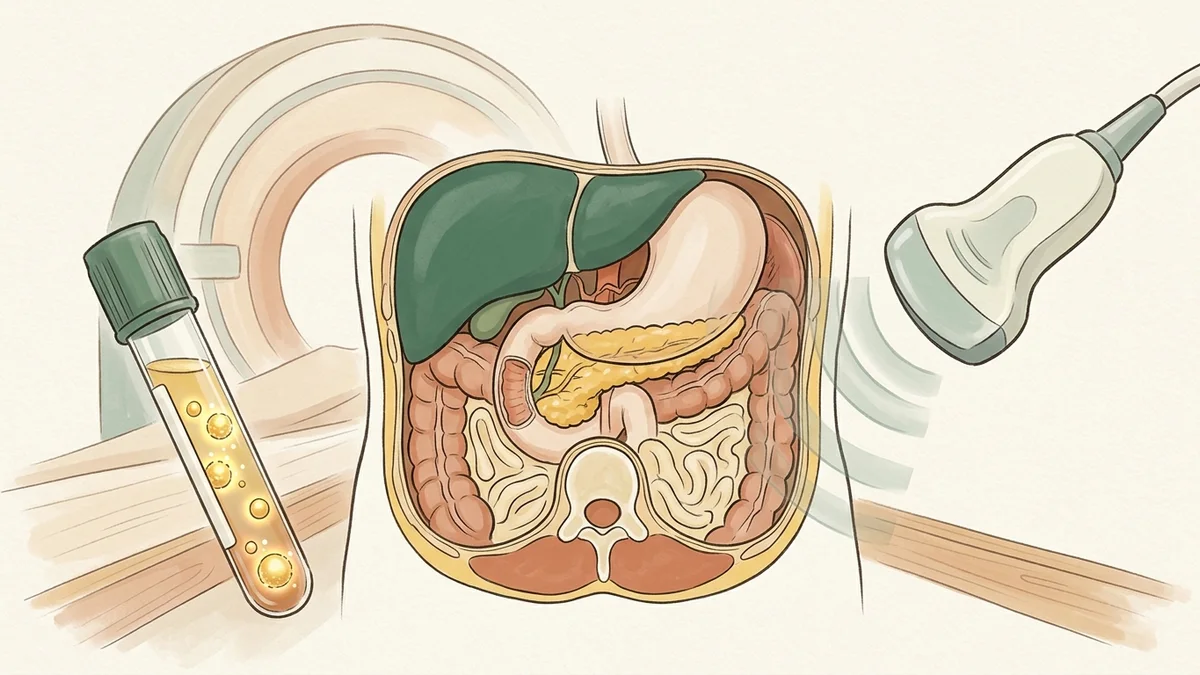
How Symptoms Differ by Location: Pancreatic Head vs. Body and Tail
The pancreas is a 15–20 cm organ behind the stomach, divided into the head (nestled in the curve of the duodenum), the body, and the tail (extending toward the spleen). The first signs differ greatly depending on where the cancer forms.
| Location (% of cases) | Anatomical feature | Typical early signs and symptoms |
|---|---|---|
| Pancreatic Head (~60–65% of cases) |
The common bile duct passes directly through the head of the pancreas on its way from the liver to the duodenum | • Painless obstructive jaundice: dark brown/tea-colored urine, pale clay-colored stools, yellowing of the whites of the eyes and skin, and generalized itching • Mild acute pancreatitis or rising blood glucose from main pancreatic duct blockage |
| Pancreatic Body & Tail (~35–40% of cases) |
Located away from the bile duct, adjacent to the spleen, large vessels, and the nerve plexus near the back | • Almost no early symptoms (no jaundice because the bile duct is not blocked) • Unexplained weight loss, loss of appetite, or sudden worsening of blood sugar • Dull upper abdominal or mid-back pain (often worse when lying flat and eased by leaning forward; by the time back pain appears, the tumor has often spread to the nerve plexus outside the pancreas) |
Many patients with upper abdominal discomfort undergo an upper GI endoscopy (gastroscopy), are told their stomach looks normal, and lose several months before the pancreas behind the stomach is imaged. If upper abdominal or back discomfort, weight loss, or rising blood sugar persists despite a normal gastroscopy, it is important to have the pancreas imaged.
Why Surface Ultrasound Misses Tumors: Comparing Tests
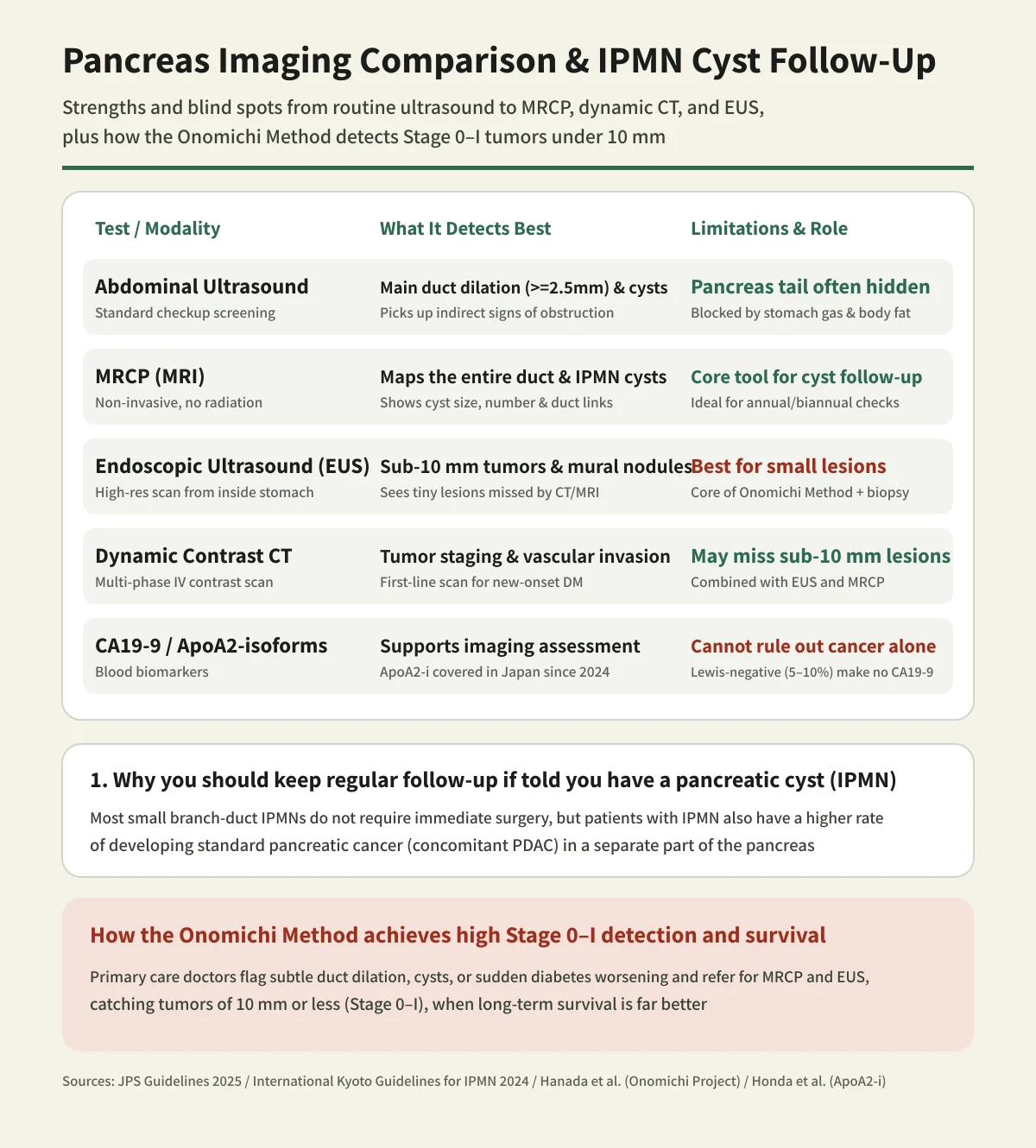
| Modality | Detection of ≤10 mm tumors | Strengths | Limitations |
|---|---|---|---|
| Abdominal Ultrasound (US) (checkups) |
Difficult to see tiny tumors directly, but can pick up main pancreatic duct dilation (≥2.5 mm) and cysts as an entry point | Non-invasive, no radiation, inexpensive | Stomach/colon gas and fat block the ultrasound, so parts of the pancreas (especially the tail) are often not fully visualized |
| Dynamic Contrast CT | Smaller tumors are harder to see; at ≤10 mm the tumor itself is often invisible (indirect findings such as duct dilation are the clue) | Rapidly evaluates the entire pancreas, vascular invasion, and distant spread | Small tumors may be indistinguishable from surrounding tissue; caution with contrast allergy or reduced kidney function |
| MRI / MRCP | Excellent for ductal changes (narrowing, dilation) and cysts | Visualizes the pancreatic duct tree and cysts (IPMN) in 3D without radiation or contrast injection | Takes 20–30 minutes; restricted with certain metal implants such as pacemakers |
| Endoscopic Ultrasound (EUS) | Considered the most sensitive imaging test and essential for finding tumors under 10 mm | Scans the pancreas from just behind the stomach/duodenal wall, avoiding bowel gas, to detect 5–10 mm tumors and mural nodules; enables EUS-FNA biopsy | Requires sedation and an experienced endosonographer |
Some centers also have patients drink water or other fluids to fill the stomach with liquid instead of gas, or change body position during ultrasound, to see more of the pancreatic tail.
Told You Have a “Pancreatic Cyst (IPMN)”? The 2024 International Kyoto Guidelines
Small fluid-filled pancreatic cysts are a common finding on MRI or ultrasound. On MRI (MRCP), the proportion of people with cysts rises with age, and some reports find them in more than 10% of older adults. The most important mucin-producing cyst is IPMN (intraductal papillary mucinous neoplasm). In main-duct IPMN, about 60% of resected cases show malignancy (high-grade dysplasia or cancer), so surgery is generally considered; most cysts found at checkups, however, are branch-duct IPMNs, which rarely progress rapidly.
The 2024 International Kyoto Guidelines for IPMN (Ohtsuka et al., Pancreatology 2024, PMID: 38182527) classify risk in two tiers:
1. High-Risk Stigmata (HRS — Strong Indication to Consider Surgery)
- Obstructive jaundice in a patient with a cystic lesion of the pancreatic head
- Enhancing mural nodule ≥5 mm inside the cyst
- Main pancreatic duct (MPD) diameter ≥10 mm
- Suspicious or positive cytology when EUS-guided fine-needle aspiration (EUS-FNA) is performed (the 2024 guidelines newly incorporate EUS and cytology findings into the assessment)
2. Worrisome Features (WF — Indication for EUS Evaluation & Close Surveillance)
- Cyst size ≥30 mm (3 cm)
- Enhancing mural nodule under 5 mm
- Thickened or enhancing cyst walls
- Main pancreatic duct diameter 5–9 mm
- Abrupt change in MPD caliber with distal pancreatic atrophy
- Lymphadenopathy
- Elevated serum CA19-9
- Acute pancreatitis caused by IPMN
- New-onset or acute exacerbation of diabetes mellitus within the past year (added in the 2024 Kyoto Guidelines)
- Cyst growth rate ≥2.5 mm/year (changed from “≥5 mm over 2 years” in the 2017 version)
3. Why Regular Follow-Up Matters: “Concomitant Pancreatic Cancer”
A small cyst without high-risk stigmata or worrisome features (for example, under 1 cm) has a low chance — under 1% per year — of turning into cancer.
However, Japanese studies have reported that people with IPMN have a higher-than-average risk of developing ordinary pancreatic ductal adenocarcinoma at a separate spot in the pancreas (“concomitant PDAC”), in addition to IPMN-derived carcinoma (the magnitude varies between studies). The 2024 Kyoto Guidelines accordingly offer two options for small branch-duct IPMNs unchanged after 5 years: “stop surveillance” or “continue surveillance for possible concomitant PDAC.” Continuing MRCP or EUS at intervals agreed with your doctor raises the chance that any such cancer is found at a smaller stage. In Onomichi, Hiroshima, the “Onomichi Project” — a network linking local clinics with specialist centers that uses slight duct dilation or small cysts as triggers for EUS/MRCP work-up — has been reported to increase the number of pancreatic cancers found at early stages.
The APOA2 Isoform Blood Test (Covered by Japanese Health Insurance Since February 2024)
As detailed in our article on tumor markers, conventional CA19-9 has two major blind spots:
- It is often negative in Stage I cancers (it tends to rise as the cancer progresses).
- People who are Lewis blood group negative (Le(a−b−)) can produce almost no CA19-9, so the value stays very low even in advanced cancer. (In a Japanese study of 2,418 patients with resected pancreatic cancer, 7.7% were CA19-9 “nonexpressors” at ≤2 U/mL; such patients make up about 5–10% of pancreatic cancer cases.)
Developed by Dr. Kazufumi Honda’s group (National Cancer Center Japan, now Nippon Medical School) and Toray Industries, the apolipoprotein A2 (APOA2) isoform test (Toray APOA2-iTQ) received Japanese national health insurance coverage in February 2024 (335 reimbursement points).
| Feature | Conventional CA19-9 | APOA2 isoform test (Toray APOA2-iTQ, insured Feb 2024) |
|---|---|---|
| Target molecule | Sialyl Lewis-a (Lea) carbohydrate antigen shed by tumor cells | Balance of the C-terminal isoforms (ATQ and AT) of apolipoprotein A2 (APOA2), a protein in HDL cholesterol |
| Why it changes early | Rises mainly as tumor burden grows | Tumor-related changes in pancreatic exocrine function are thought to alter the C-terminal structure of circulating APOA2; levels fall in early pancreatic cancer, and changes are also reported in high-risk conditions such as IPMN |
| Performance | Often negative in Stage I | In Japan’s clinical performance study, comparable to CA19-9 (area under the ROC curve 0.879 vs. 0.849). Because the principle differs, it is regarded as complementary to CA19-9 (one study found better performance than CA19-9 for early-stage cancer: Honda 2015) |
| Lewis-negative patients | Barely rises (false-negative) | Not a carbohydrate-antigen test, so in principle unaffected by Lewis blood type |
| Insurance coverage in Japan | Covered when pancreatic cancer or similar disease is suspected | 335 points (about ¥1,000 at 30% copay, plus a separate test-interpretation fee) Covered only for patients meeting set criteria, such as high risk for pancreatic cancer under academic society guidance, in principle once before a definitive diagnosis |
Sources: Ministry of Health, Labour and Welfare (Central Social Insurance Medical Council document on Toray APOA2-iTQ, listed February 2024); Honda K, et al. Sci Rep 2015; Omiya K, et al. JAMA Surg 2026.
The self-paid “nematode cancer test (N-NOSE)” seen in TV commercials has been criticized because a positive result does not indicate which organ is affected, and whole-body work-ups after a positive result sometimes find no cancer. It is not a test recommended by clinical practice guidelines for pancreatic cancer. If you are worried about your pancreas, ask a gastroenterologist which of the imaging tests (MRCP, EUS, contrast CT) and insurance-covered blood tests (CA19-9, DUPAN-2, elastase-1, APOA2 isoforms, etc.) suit you.
Pancreatic Cancer Series: Related Articles
- Alcohol and Pancreatic Cancer: Drinking Amounts, 66-Year Trends, and Latest Treatments
- What Foods Are Linked to Pancreatic Cancer? Sugar, Fructose, Coffee, Processed Meat, and Oils
- Diabetes and Pancreatic Cancer: Why Sudden Blood Sugar Worsening Can Be an Early Sign, plus GLP-1 Drugs
- Periodontal Disease, Blood Type, and Genetics in Pancreatic Cancer: Blood Type O, Oral Bacteria, and BRCA
- Types of Pancreatic Cancer and Survival Rates: 90% Ductal Adenocarcinoma vs. Steve Jobs’s PNET
- Acute and Chronic Pancreatitis and Pancreatic Cancer: Alcohol, Gallstones, Triglycerides, and Post-Surgery MCT Oil
- Latest Treatments for Pancreatic Cancer: Conversion Surgery, NALIRIFOX, KRAS Inhibitors, Carbon-Ion Radiotherapy, and mRNA Vaccines
References
- Japan Pancreas Society. Clinical Practice Guidelines for Pancreatic Cancer 2025. Kanehara & Co., 2025.
- Egawa S, et al. Clinicopathological aspects of small pancreatic cancer. Pancreas. 2004;28(3):235-240. (PMID: 15084963) / Egawa S, et al. Japan Pancreatic Cancer Registry; 30th year anniversary. Pancreas. 2012;41(7):985-992. (PMID: 22750974)
- Ohtsuka T, et al. International evidence-based Kyoto guidelines for the management of intraductal papillary mucinous neoplasm of the pancreas. Pancreatology. 2024;24(2):255-270. (PMID: 38182527)
- Ministry of Health, Labour and Welfare (MHLW), Central Social Insurance Medical Council. Insurance coverage category and price for in-vitro diagnostics: Toray APOA2-iTQ (apolipoprotein A2 isoforms, 335 points), listed February 2024 (Japanese). https://www.mhlw.go.jp/content/12404000/001197880.pdf
- Honda K, et al. Plasma biomarker for detection of early stage pancreatic cancer and risk factors for pancreatic malignancy using antibodies for apolipoprotein-AII isoforms. Sci Rep. 2015;5:15921. (PMID: 26549697)
- Honda K, et al. CA19-9 and apolipoprotein-A2 isoforms as detection markers for pancreatic cancer: a prospective evaluation. Int J Cancer. 2019;144(8):1877-1887. (PMID: 30259989)
- Kashiro A, et al. Clinical development of a blood biomarker using apolipoprotein-A2 isoforms for early detection of pancreatic cancer. J Gastroenterol. 2024;59(3):263-278. (PMID: 38261000)
- Hanada K, et al. Early diagnosis of pancreatic cancer: Current trends and concerns. Ann Gastroenterol Surg. 2017;1(1):44-51. (PMID: 29863166)
- Omiya K, et al. Duke Pancreatic Monoclonal Antigen Type 2 for Monitoring Carbohydrate Antigen 19-9 Nonexpressor Pancreatic Cancer. JAMA Surg. 2026;161(8):805-815. (PMID: 42234435)
Frequently asked questions
- What are the key findings on: Why Is Pancreatic Cancer So Hard to Find Early? Early Symptoms, Pancreatic Cysts (IPMN), Ultrasound Limits, and the New APOA2-i Blood Test?
- Pancreatic cancer found at 10 mm or less has over 80% reported 5-year survival, but ultrasound often misses it behind stomach gas. IPMN, EUS, APOA2-i.
- How Symptoms Differ by Location: Pancreatic Head vs. Body and Tail?
- The pancreas is a 15–20 cm organ behind the stomach, divided into the head (nestled in the curve of the duodenum), the body, and the tail (extending toward the spleen). The first signs differ greatly depending on where the cancer forms.
- Why Surface Ultrasound Misses Tumors: Comparing Tests?
- Some centers also have patients drink water or other fluids to fill the stomach with liquid instead of gas, or change body position during ultrasound, to see more of the pancreatic tail.
- What does the evidence show regarding: Told You Have a “Pancreatic Cyst (IPMN)”? The 2024 International Kyoto Guidelines?
- Small fluid-filled pancreatic cysts are a common finding on MRI or ultrasound. On MRI (MRCP), the proportion of people with cysts rises with age, and some reports find them in more than 10% of older adults. The most important mucin-producing cyst is IPMN (in…
Related articles and databases
- Is Alcohol a Cause of Pancreatic Cancer? Drinking Amounts, Other Causes, and the Latest Treatments, Checked Against National Data and Studies
- What Are Tumor Markers? Origins, Types, Positive Rates by Cancer, Cost, and How to Read Results, Checked Against Society Guidelines and Studies
- Diabetes and Pancreatic Cancer: Why Sudden Blood Sugar Worsening Can Be an Early Sign, and What Studies Show About GLP-1 Drugs and Insulin
- Periodontal Disease, Blood Type, and Genetics in Pancreatic Cancer: Does Blood Type O Lower Risk? Oral Bacteria, BRCA Genes, and Familial Risk
- Types of Pancreatic Cancer and Survival Rates: How Pancreatic Ductal Adenocarcinoma Differs from Steve Jobs’s Neuroendocrine Tumor (PNET)
- Latest Pancreatic Cancer Treatments & Clinical Trials: Perioperative Chemo, Conversion Surgery, KRAS Inhibitors, Carbon-Ion Therapy & mRNA Vaccines