

Acute and Chronic Pancreatitis and Pancreatic Cancer: How Alcohol, Gallstones, and Triglycerides Damage the Pancreas, Plus Post-Surgery Nutrition and MCT Oil

Many people worry after experiencing severe upper abdominal and back pain following heavy drinking or a fatty meal, being told their amylase, lipase, or triglyceride levels are high, or receiving a diagnosis of chronic pancreatitis.
The pancreas produces about 1.5 liters of powerful digestive juice every day. When digestive enzymes become prematurely activated inside the pancreas rather than in the duodenum, the pancreas begins digesting its own tissue (autodigestion) — causing acute pancreatitis. When inflammation recurs over years, healthy tissue is replaced by scar tissue and calcifications (chronic pancreatitis).
In this article, we cover:
- The top causes of acute and chronic pancreatitis in Japan and worldwide — and why alcohol predominates in men while gallstones and idiopathic cases predominate in women
- Why blood triglycerides above 500–1,000 mg/dL can trigger severe acute pancreatitis even without alcohol
- How much acute and chronic pancreatitis raise pancreatic cancer risk (~8–12×), and how quitting alcohol and smoking changes that trajectory
- Managing pancreatic exocrine insufficiency (PEI) after chronic pancreatitis or pancreatic surgery: why extreme fat restriction can cause dangerous malnutrition, and how pancreatic enzyme replacement therapy (pancrelipase) and MCT oil (medium-chain triglycerides) support recovery
This article does not replace medical diagnosis or treatment. Severe abdominal or back pain is a medical emergency; seek immediate care.
Conclusion: Chronic Pancreatitis Raises Pancreatic Cancer Risk ~8–12×; Quitting Alcohol & Smoking Matters, Enzyme Replacement Is the Mainstay, and MCT Oil Is a Supplementary Option
- The leading causes of pancreatitis differ sharply by sex: in Japanese nationwide surveys, alcohol causes ~43% of acute and ~70% of chronic pancreatitis in men, whereas gallstones (~38%) lead in women’s acute pancreatitis and idiopathic factors (~50%) lead in women’s chronic pancreatitis. Severe hypertriglyceridemia (≥1,000 mg/dL) is the third major trigger.
- Patients with chronic pancreatitis have an ~8–12× higher risk of pancreatic cancer (11.8× in a Japanese nationwide study; in a 13-study meta-analysis, ~7.9× from 5 years and ~3.5× from 9 years after diagnosis; ~50–70× in hereditary pancreatitis). A pancreatic cancer diagnosis within 2 years of acute pancreatitis often reflects reverse causation (a small tumor blocking the main pancreatic duct and triggering pancreatitis).
- In a Japanese nationwide study, patients who kept drinking after a chronic pancreatitis diagnosis developed pancreatic cancer significantly more often than those who stopped. Smoking is an established (“convincing”) risk factor for pancreatic cancer, so quitting smoking matters too.
- In late-stage chronic pancreatitis or after pancreatic cancer surgery, preventing weight and muscle loss (sarcopenia) is vital. The mainstay is high-titer pancreatic enzyme replacement therapy (pancrelipase) with meals, without unnecessary fat restriction. MCT oil (medium-chain triglycerides) depends less on pancreatic lipase, but the ESPEN 2020 guideline positions it as an option only when malabsorption persists despite adequate enzyme therapy.
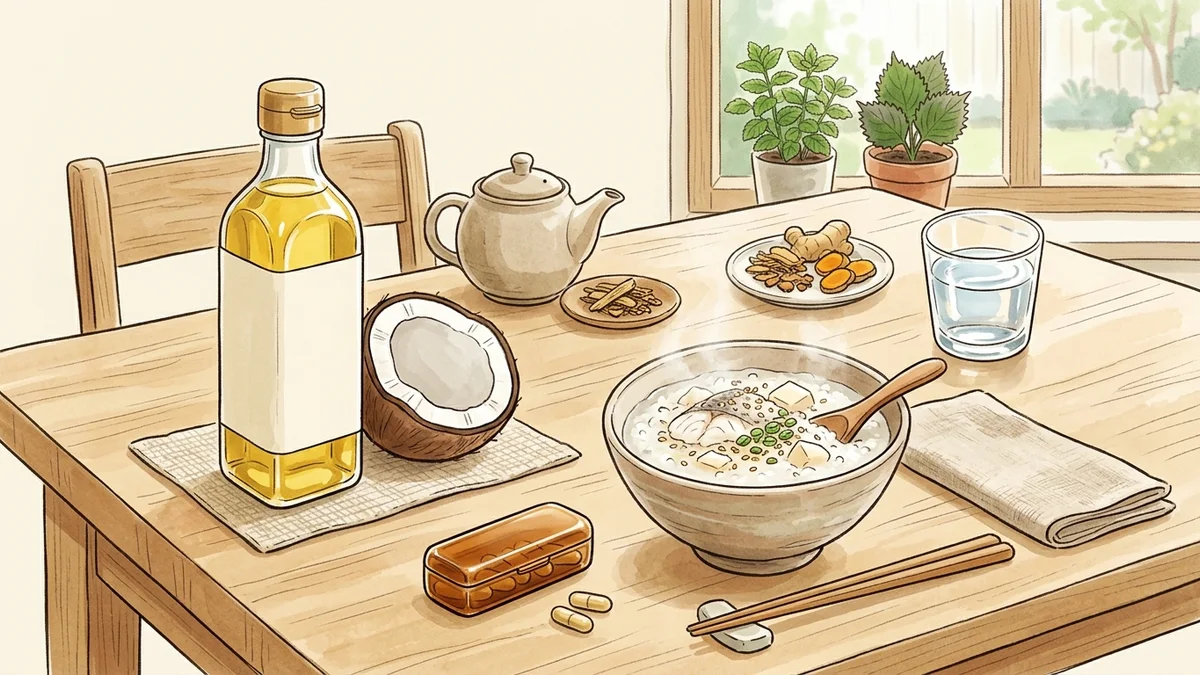
Causes of Pancreatitis, Cancer Progression Risk, and MCT vs. LCT Absorption
1. Sex Differences in Pancreatitis Causes & Hypertriglyceridemia
| Condition | Top causes in men (Japan) | Top causes in women (Japan) | Mechanism |
|---|---|---|---|
| Acute Pancreatitis (~78,000 estimated patients in 2016) |
1. Alcohol (~43%) 2. Gallstones (~20%) 3. Idiopathic (~16%) |
1. Gallstones (~38%) 2. Idiopathic (~29%) 3. Alcohol (~9%) |
A small gallstone migrating from the gallbladder blocks the ampulla of Vater, causing bile/pancreatic juice reflux and acute autodigestion |
| Chronic Pancreatitis (~57,000 estimated patients in 2016) |
1. Alcohol (~70–75%) 2. Idiopathic (~20%) |
1. Idiopathic (~50–55%) 2. Alcohol (~25–30%) |
Years of heavy drinking (≥60–80 g pure alcohol/day) or genetic variants (SPINK1, PRSS1) drive progressive fibrosis and calcification |
Additionally, hypertriglyceridemia (serum triglycerides ≥500–1,000 mg/dL) is a major cause of acute pancreatitis: pancreatic capillary lipase breaks excess triglycerides down into toxic concentrations of free fatty acids that directly injure acinar cells and capillaries.
2. Risk of Progression from Pancreatitis to Pancreatic Cancer
- After acute pancreatitis (~32× within 2 years, ~2.7× at 2–5 years, ~1.7× beyond 5 years): In a meta-analysis of 61 studies (Lee et al., Clin Transl Gastroenterol 2026, PMID: 41066080), the very high early risk likely includes cases where an occult early pancreatic tumor or IPMN mucus plug obstructed the main pancreatic duct and presented as acute pancreatitis. Idiopathic acute pancreatitis carried higher odds of cancer, so follow-up MRCP or EUS after the inflammation subsides is advisable, especially in middle-aged and older adults.
- Chronic pancreatitis (~8–12×): A Japanese nationwide study found a standardized incidence ratio of 11.8 (Ueda et al., Surgery 2013), and a meta-analysis (Kirkegård et al., Am J Gastroenterol 2017, PMID: 28762376) found ~7.9× risk from 5 years and ~3.5× from 9 years after diagnosis. In the international PanC4 consortium (Duell et al. 2012), a history of pancreatitis (acute or chronic) more than 2 years earlier carried 2.7× risk. The proposed mechanism is chronic inflammation, stellate cell activation, and oxidative DNA damage. In the Japanese study, patients who continued drinking after diagnosis had significantly higher cancer incidence than those who stopped.
- Hereditary pancreatitis (
PRSS1mutations, ~50–70×): Begins in childhood and carries a 20–40% cumulative lifetime risk of pancreatic cancer by age 70.
Managing Pancreatic Exocrine Insufficiency (PEI): Enzyme Replacement & MCT Oil
When chronic pancreatitis advances or after pancreatic surgery (such as a Whipple procedure or distal pancreatectomy), the pancreas secretes too little pancreatic lipase, causing fat malabsorption (steatorrhea), weight loss, sarcopenia, and deficiencies of fat-soluble vitamins (A, D, E, K).
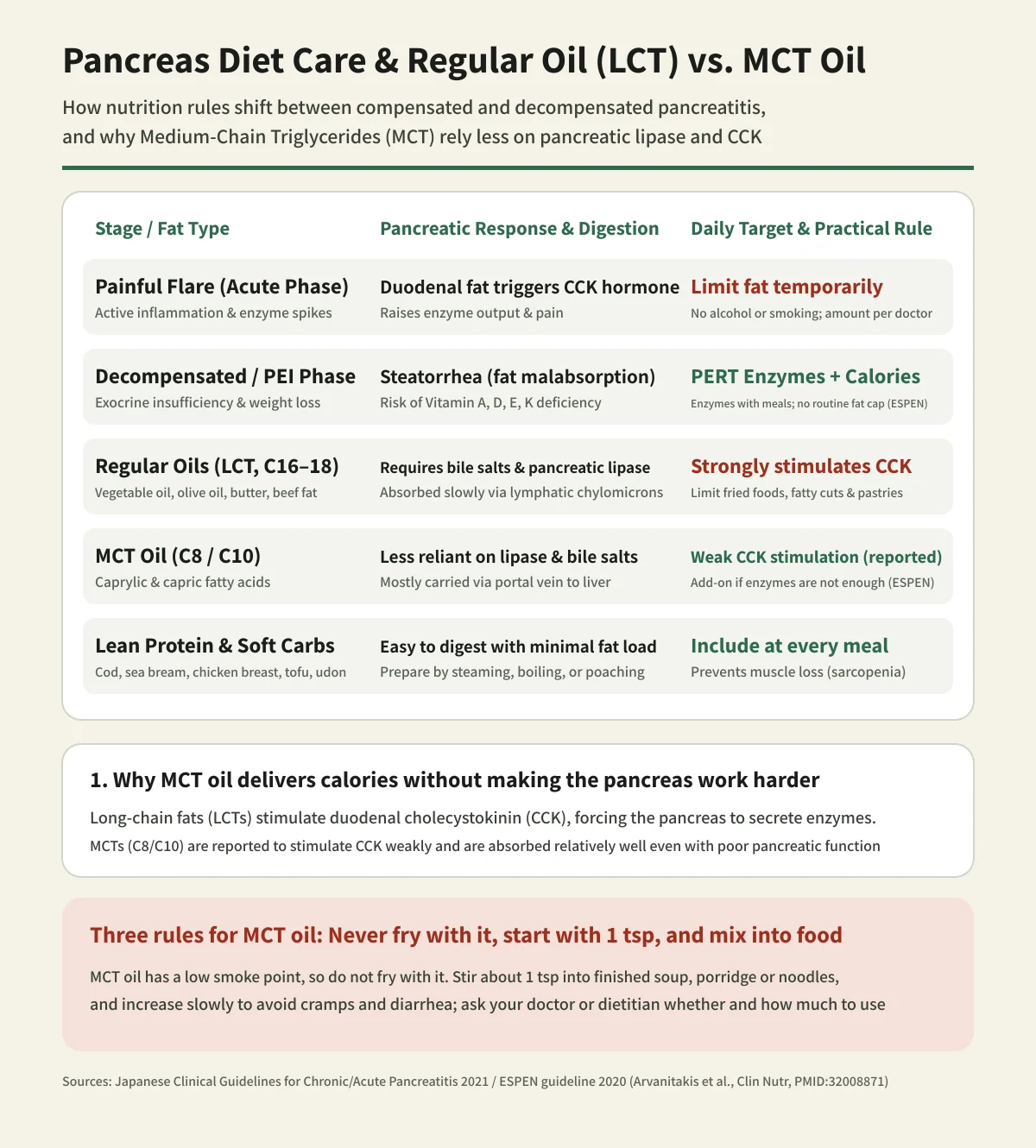
Rather than restricting patients to ultra-low-fat diets, current practice is to take high-titer pancreatic enzyme replacement therapy (PERT: pancrelipase / Lipacreon) with every meal while maintaining near-normal energy and protein intake. The ESPEN 2020 guideline states that dietary fat restriction is unnecessary unless steatorrhea cannot be controlled, and Japan’s Clinical Practice Guidelines for Chronic Pancreatitis 2021 also recommend enzyme replacement for exocrine insufficiency. MCT oil (medium-chain triglycerides, C8 caprylic and C10 capric acids) differs from ordinary fats as follows:
| Property | Standard Fats & Oils (Long-Chain Triglycerides: LCT) Vegetable oil, olive oil, butter, meat fat |
MCT Oil (Medium-Chain Triglycerides) Caprylic (C8) & capric (C10) acids from coconut/palm kernel |
|---|---|---|
| Pancreatic stimulation (CCK release) | Strongly stimulates cholecystokinin (CCK), forcing the pancreas to secrete enzymes | Considered a weaker CCK stimulus; gentler on the pancreas |
| Requirement for bile acids & pancreatic lipase | Requires both bile acids and pancreatic lipase. Causes diarrhea/steatorrhea when lipase is low | Less dependent on bile acids and pancreatic lipase, so relatively well absorbed when pancreatic function is reduced (though some studies show enzyme supplements are still needed in exocrine insufficiency) |
| Absorption pathway & speed | Packaged into chylomicrons and transported slowly via the lymphatic system | Largely transported via the portal vein to the liver and used for energy more quickly |
| Culinary use | Suitable for frying and sautéing | Low smoke point — do not use for frying. Stir 1 teaspoon (3–5 g) into cooked porridge, soup, udon, or yogurt. Large doses commonly cause cramps, nausea, and diarrhea, so start small and increase gradually |
However, the ESPEN 2020 guideline notes that studies have not shown a clear benefit of MCT over standard fats when combined with enzyme supplementation; MCT-containing oral supplements are an option only if adequate enzyme therapy (and exclusion of small-intestinal bacterial overgrowth) has not relieved malabsorption. Replacing dietary fat with MCT can also reduce total energy intake, so discuss whether and how much to use with your physician or dietitian.
Four Everyday Checkpoints for Protecting the Pancreas
- Get gallstones and the pancreatic duct checked if you have upper abdominal or back pain or jaundice — especially women with pain after meals.
- Do not ignore triglycerides above 500 mg/dL on a health checkup: levels above 1,000 mg/dL can trigger acute pancreatitis without warning, so review your diet and see a physician early.
- If you are diagnosed with pancreatitis, stopping alcohol and smoking are the most important steps you can take against the ~8–12× cancer risk.
- In late-stage chronic pancreatitis or after pancreatic surgery, plan to avoid weight loss with your physician and dietitian (enzyme replacement, 5–6 smaller meals a day, easily digestible proteins such as white fish, chicken, tofu, and eggs, and MCT oil if needed).
Pancreatic Cancer Series: Complete 8-Article Guide
- Alcohol and Pancreatic Cancer: Drinking Amounts, 66-Year Trends, and Latest Treatments
- What Foods Are Linked to Pancreatic Cancer? Sugar, Fructose, Coffee, Processed Meat, and Oils
- Diabetes and Pancreatic Cancer: Why Sudden Blood Sugar Worsening Can Be an Early Sign, plus GLP-1 Drugs
- Why Is Pancreatic Cancer Hard to Find? Early Symptoms, Pancreatic Cysts (IPMN), Ultrasound Limits, and the APOA2-i Blood Test
- Periodontal Disease, Blood Type, and Genetics in Pancreatic Cancer: Blood Type O, Oral Bacteria, and BRCA
- Types of Pancreatic Cancer and Survival Rates: 90% Ductal Adenocarcinoma vs. Steve Jobs’s PNET
- Latest Treatments for Pancreatic Cancer: Conversion Surgery, NALIRIFOX, KRAS Inhibitors, Carbon-Ion Radiotherapy, and mRNA Vaccines
References
- Japan Pancreas Society. Clinical Practice Guidelines for Chronic Pancreatitis 2021 (3rd ed.) & Clinical Practice Guidelines for Acute Pancreatitis 2021 (5th ed.).
- Kirkegård J, Mortensen FV, Cronin-Fenton D. Am J Gastroenterol. 2017;112(9):1366-1372. (PMID: 28762376)
- Duell EJ, et al. Ann Oncol. 2012;23(11):2964-2970. (PMID: 22767586)
- Lee J, et al. Clin Transl Gastroenterol. 2026;17(1):e00927. (PMID: 41066080)
- Ueda J, et al. Surgery. 2013;153(3):357-364. (PMID: 22989892)
- Masamune A, et al. Pancreatology. 2020;20(4):629-636. (PMID: 32409278)
- Masamune A, et al. J Gastroenterol. 2020;55(11):1062-1071. (PMID: 32676800)
- Arvanitakis M, et al. ESPEN guideline on clinical nutrition in acute and chronic pancreatitis. Clin Nutr. 2020;39(3):612-631. (PMID: 32008871)
- Shah ND, Limketkai BN. Pract Gastroenterol. 2017;41(2):20-28.
Products related to this article PR
Products whose labels Urayomi has read, picked because their ingredients or category relate to this article. This is not a recommendation or a safety rating. The shop buttons are affiliate links; prices are reference prices on the date we checked.
Frequently asked questions
- What are the key findings on: Acute and Chronic Pancreatitis and Pancreatic Cancer: How Alcohol, Gallstones, and Triglycerides Damage the Pancreas, Plus Post-Surgery Nutrition and MCT Oil?
- Chronic pancreatitis raises pancreatic cancer risk about 8-12x, and patients who kept drinking got more cancer. Causes, enzyme therapy and MCT oil.
- What does the evidence show regarding: Causes of Pancreatitis, Cancer Progression Risk, and MCT vs. LCT Absorption?
- Additionally, hypertriglyceridemia (serum triglycerides ≥500–1,000 mg/dL) is a major cause of acute pancreatitis: pancreatic capillary lipase breaks excess triglycerides down into toxic concentrations of free fatty acids that directly injure acinar cells and…
- What does the evidence show regarding: Managing Pancreatic Exocrine Insufficiency (PEI): Enzyme Replacement & MCT Oil?
- When chronic pancreatitis advances or after pancreatic surgery (such as a Whipple procedure or distal pancreatectomy), the pancreas secretes too little pancreatic lipase, causing fat malabsorption (steatorrhea), weight loss, sarcopenia, and deficiencies of f…
Related articles and databases
- Is Alcohol a Cause of Pancreatic Cancer? Drinking Amounts, Other Causes, and the Latest Treatments, Checked Against National Data and Studies
- What Foods Are Linked to Pancreatic Cancer? Sugar, Fructose, Coffee, Processed Meat, and Plant Oils Checked Against National Data and Studies
- Are Lard and Butter Bad for You? 16 Plant Oils and Animal Fats (Beef Tallow, Fish Oil) Compared by Fatty Acids, and Which to Use Every Day
- Diabetes and Pancreatic Cancer: Why Sudden Blood Sugar Worsening Can Be an Early Sign, and What Studies Show About GLP-1 Drugs and Insulin
- What Are Tumor Markers? Origins, Types, Positive Rates by Cancer, Cost, and How to Read Results, Checked Against Society Guidelines and Studies
- Latest Pancreatic Cancer Treatments & Clinical Trials: Perioperative Chemo, Conversion Surgery, KRAS Inhibitors, Carbon-Ion Therapy & mRNA Vaccines
- Medium-chain fatty acids (Supplement ingredient database)