

Latest Pancreatic Cancer Treatments & Clinical Trials: Perioperative Chemo, Conversion Surgery, KRAS Inhibitors, Carbon-Ion Therapy & mRNA Vaccines

The notion that “there are almost no treatments for pancreatic cancer” is rapidly becoming outdated. Over the past few years, treatment options and clinical trial outcomes have shifted substantially: chemotherapy before and after surgery has markedly improved survival for resectable tumors; “conversion surgery” allows some patients initially diagnosed as unresectable to undergo curative resection after tumor shrinkage; an oral RAS (KRAS) inhibitor—a target long considered “undruggable” for over 30 years—achieved US FDA approval in August 2026 (not yet approved in Japan); carbon-ion and proton beam therapies have been covered by Japan’s national health insurance for locally advanced pancreatic cancer since April 2022; and personalized mRNA neoantigen vaccines tailored to each patient’s tumor mutations are being tested in clinical trials (still investigational).
Based on the Clinical Practice Guidelines for Pancreatic Cancer 2025 (Japan Pancreas Society) and major Phase III trials and peer-reviewed papers worldwide, this article organizes 6 major treatment advances, concrete clinical examples, survival numbers, and insurance coverage status in Japan (this article summarizes public guidelines and peer-reviewed studies; always discuss individual treatment choices with your oncologist and surgical team).

Key Takeaways (Summary of Conclusions)
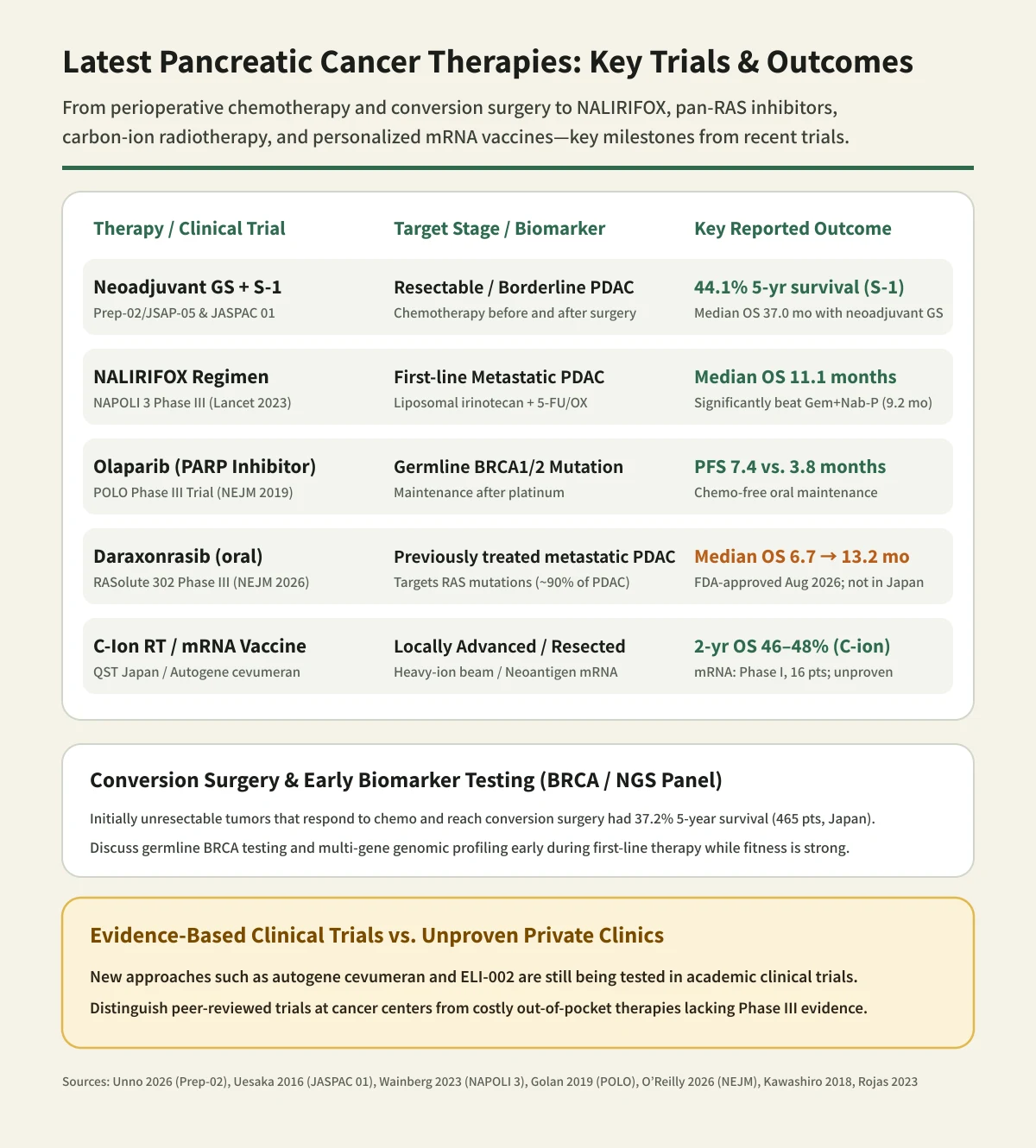
- For resectable pancreatic cancer, giving chemotherapy before and after surgery has markedly improved survival: In Japanese randomized trials, 2 courses of preoperative gemcitabine + S-1 (GS therapy) extended median overall survival from 26.6 months to 37.0 months (Prep-02/JSAP-05 trial), and 6 months of postoperative oral S-1 raised 5-year survival from 24.4% to 44.1% (JASPAC 01 trial).
- More patients initially told their tumor is “unresectable” are reaching curative “conversion surgery”: When intensive multi-agent chemotherapy (FOLFIRINOX or gemcitabine + nab-paclitaxel) shrinks the tumor and tumor markers such as CA19-9 fall and stay controlled for more than 6 months, selected patients undergo curative resection (conversion surgery). A Japanese nationwide study of 465 such patients with locally advanced disease reported median survival of 43.8 months from the start of treatment and 37.2% 5-year survival—results limited to responders who made it to surgery.
- Nanoliposomal irinotecan (NALIRIFOX regimen) has expanded 1st- and 2nd-line chemotherapy: Encapsulating irinotecan inside ~100 nm lipid vesicles allows the drug to accumulate inside dense pancreatic tumors. In the Phase III NAPOLI 3 trial, first-line NALIRIFOX extended median survival from 9.2 months to 11.1 months compared with gemcitabine + nab-paclitaxel. The 2025 Japanese guidelines list it with the note “off-label in Japan”; a first-line application was filed in Japan in December 2025.
- Daraxonrasib, an oral RAS inhibitor targeting the RAS (KRAS) mutations found in >90% of pancreatic cancers, was approved by the US FDA in August 2026: In the Phase III RASolute 302 trial of 500 previously treated metastatic patients, daraxonrasib nearly doubled median survival from 6.7 months with chemotherapy to 13.2 months (not approved in Japan as of October 2026; no Japanese filing date has been announced).
- Comprehensive genomic profiling (gene panel testing) can identify targeted therapies for specific mutations: Patients with germline BRCA1/2 mutations (a few percent) can receive maintenance olaparib, while MSI-High (pembrolizumab), NTRK fusions, RET fusions, and BRAF V600E mutations have insurance-covered targeted drugs in Japan—though only a minority of patients have any of these changes.
- Carbon-ion and proton beam therapies are covered by Japanese health insurance for locally advanced unresectable disease: Since April 2022, national insurance covers particle therapy for locally advanced pancreatic cancer, where carbon-ion therapy achieved 46% 2-year survival and a median survival of 21.5 months in a Japanese multi-institutional retrospective analysis. Meanwhile, personalized mRNA cancer vaccines (autogene cevumeran) were linked to fewer recurrences among vaccine responders in about 3 years of follow-up of a 16-patient Phase I trial, and a global Phase II trial is underway (still investigational).
The Foundation: The 3 “Resectability” Categories Beyond Stage I–IV
When planning treatment for pancreatic cancer, doctors look not only at Stage I–IV, but also at dynamic contrast CT scans to determine how closely the tumor contacts the major blood vessels running immediately beside the pancreas (the portal vein, superior mesenteric vein/artery, celiac artery, and common hepatic artery). This is called the Resectability Classification:
| Category | What It Means | Standard Initial Treatment Flow |
|---|---|---|
| 1. Resectable (R) | The tumor is confined to or near the pancreas without major contact with key arteries or veins | Preoperative chemo (2 courses of GS) → Surgery → Postoperative chemo (6 months of oral S-1) |
| 2. Borderline Resectable (BR) | The tumor partially contacts the portal vein or a major artery; operating immediately carries a high risk of leaving microscopic cancer cells behind (R1 resection) | Intensive preoperative therapy (chemo or chemoradiation) to shrink the tumor → Surgery (often with vascular resection) → Postoperative chemo |
| 3-A. Unresectable – Locally Advanced (UR-LA) | No distant metastasis, but the tumor encases critical arteries by more than 180 degrees and cannot be safely removed up front | Multi-agent chemotherapy or chemo + carbon-ion / proton / radiation therapy. If the tumor responds well, conversion surgery is considered |
| 3-B. Unresectable – Metastatic (UR-M) | The cancer has spread to distant organs such as the liver, peritoneum, or lungs | Systemic therapy (chemotherapy, targeted drugs, genomic medicine) is the cornerstone; in exceptional responders, conversion surgery may be considered |
The sections below walk through the newer treatments and concrete examples for each category.
Example 1: Perioperative Chemotherapy & “Conversion Surgery”
Why Give Chemotherapy Before Surgery Even When the Tumor Is Resectable?
For decades, the standard rule for resectable (R) pancreatic cancer was to operate as quickly as possible. However, even when surgeons achieved a clean resection of the visible tumor, invisible micrometastases already circulating in blood or lymph vessels frequently caused recurrence. Moreover, major pancreatic surgery (such as a Whipple procedure / pancreatoduodenectomy) takes a heavy physical toll, leaving many patients too weak after surgery to complete postoperative chemotherapy.
To solve this, Japanese investigators tested a new strategy: giving 2 courses of chemotherapy before surgery while the patient is still strong, attacking micrometastases early, then performing surgery, and following up with 6 months of oral chemotherapy.
| Clinical Trial (Subjects) | Regimens Compared | Key Survival Results | Status in Japan |
|---|---|---|---|
| Prep-02 / JSAP-05 (364 resectable patients in Japan, Unno 2026) | Upfront surgery + post-op S-1 vs. Pre-op Gemcitabine + S-1 (GS, 2 courses) → Surgery → Post-op S-1 | Median overall survival rose from 26.6 months to 37.0 months (hazard ratio for death 0.73, about a 27% reduction); median relapse-free survival rose from 11.3 to 14.3 months | “Suggested” (weak recommendation) in the 2025 JPS Guidelines and widely used in Japan |
| JASPAC 01 (385 resected patients in Japan, Uesaka 2016) | 6 months of post-op IV gemcitabine vs. 6 months of post-op oral S-1 | Median survival rose from 25.5 months to 46.5 months, and 5-year survival nearly doubled from 24.4% to 44.1% | Standard postoperative adjuvant therapy in Japan |
| PRODIGE 24 (493 resected patients in France/Canada, Conroy 2018) | 6 months of post-op gemcitabine vs. 6 months of post-op mFOLFIRINOX | Median survival rose from 35.0 months to 54.4 months (5-year survival 31.4% → 43.2%, from the 2022 long-term follow-up) | Standard option in Western guidelines for fit patients |
- Concrete treatment flow (resectable disease):
- After diagnosis, about 6 weeks (2 three-week courses) of gemcitabine (IV) + S-1 (oral), “GS therapy.”
- A CT scan confirms the cancer has not spread, followed by curative surgery.
- After recovery, oral S-1 for 6 months to reduce the risk of recurrence. Among trial participants (who met fitness and disease criteria), this “pre-op GS + surgery + post-op S-1” sequence has pushed median survival beyond 3 years.
From “Unresectable” to Curative Resection: Conversion Surgery
When a patient is initially diagnosed with locally advanced (UR-LA) or metastatic (UR-M) disease, upfront surgery is not possible. However, with modern multi-agent regimens (FOLFIRINOX, gemcitabine + nab-paclitaxel, NALIRIFOX) and carbon-ion radiotherapy, a growing number of patients experience dramatic tumor shrinkage, separation of the tumor from major arteries, and normalization of tumor markers.
Switching the treatment plan from palliative systemic therapy to curative surgical resection in these responders is called conversion surgery.
- Criteria that predict successful conversion surgery:
A nationwide study by the Japanese Society of Hepato-Biliary-Pancreatic Surgery (465 patients with locally advanced disease who underwent conversion surgery, Yasuda 2026) and an international expert consensus (Oba 2023) indicate that outcomes are better—rather than operating as soon as the tumor looks slightly smaller on imaging—when:
- Preoperative chemotherapy has continued for more than 6 months (median survival 50.4 months with >6 months vs. 29.7 months with ≤6 months in the nationwide study).
- CT/MRI/PET shows tumor shrinkage with no new metastatic lesions.
- Tumor markers (CA19-9 and CEA) have returned to normal.
- A complete resection (R0) is likely and the patient’s strength and nutrition are maintained (a prognostic nutritional index ≥45 was also linked to better outcomes).
- Survival outcomes: In that nationwide study, patients who underwent conversion surgery had a median survival of 43.8 months from the start of treatment and a 5-year survival rate of 37.2%. A Japan Pancreas Society study of 90 patients with liver metastases at diagnosis (Hashimoto 2026) reported a median survival of 53.1 months from the start of treatment. These figures, however, are retrospective results for only those patients who responded well enough to reach surgery, not the outlook for everyone initially diagnosed as unresectable.
Example 2: First- and Second-Line Chemotherapy Advances (NALIRIFOX & Nanoliposomes)
For unresectable or recurrent pancreatic cancer, new drug combinations have also arrived for systemic chemotherapy.
The Two Long-Standing Standard Regimens (FOLFIRINOX and GnP)
For nearly 10 years, first-line treatment for patients in good general condition rested on two backbones:
- FOLFIRINOX (or dose-modified mFOLFIRINOX): an IV combination of 5-FU, leucovorin (levoleucovorin in Japan), irinotecan, and oxaliplatin (median survival about 11.1 months, Conroy 2011).
- GnP (gemcitabine + nab-paclitaxel [Abraxane]): nab-paclitaxel is paclitaxel bound to the protein albumin as nanoparticles, combined with gemcitabine to help the drugs reach tumors surrounded by dense stroma (median survival about 8.5 months in the pivotal trial, Von Hoff 2013).
How Nanoliposomal Irinotecan (Onivyde) and NALIRIFOX Work
Pancreatic tumors are surrounded by an exceptionally dense fibrous stroma (desmoplasia) with poor blood flow, making it hard for conventional chemotherapy drugs to penetrate deep into the tumor. Nanoliposomal irinotecan (nal-IRI, brand name Onivyde) encapsulates irinotecan inside ~100 nm lipid bilayer spheres (liposomes).
- Mechanism: The lipid capsule shields the drug from rapid breakdown in the bloodstream, slips through leaky tumor blood vessels (the Enhanced Permeability and Retention, or EPR, effect), and is taken up by tumor-associated macrophages inside the pancreatic stroma, where it is gradually converted into its active metabolite (SN-38) to kill surrounding cancer cells.
- Clinical trial results:
- Second-Line Therapy (NAPOLI-1 trial, Wang-Gillam 2016): In 417 patients whose disease progressed after gemcitabine-based therapy, adding nanoliposomal irinotecan to 5-FU + leucovorin extended median survival from 4.2 months to 6.1 months. In Japan it was approved in March 2020 for unresectable pancreatic cancer that has progressed after chemotherapy.
- First-Line Therapy (NAPOLI 3 trial, Wainberg 2023): In 770 previously untreated metastatic patients, the NALIRIFOX regimen (nanoliposomal irinotecan + oxaliplatin + 5-FU + leucovorin) was compared head-to-head against standard gemcitabine + nab-paclitaxel (GnP). NALIRIFOX significantly extended median overall survival from 9.2 months to 11.1 months (HR 0.83) and progression-free survival from 5.6 months to 7.4 months. The 2025 Japanese guidelines “suggest” (weak recommendation) NALIRIFOX for first-line metastatic disease with the note “off-label in Japan,” and an application to add first-line use was filed in Japan in December 2025 (no approval had been announced as of October 2026).
Example 3: Cracking the “Undruggable” Target — Oral KRAS (RAS) Inhibitors
The biggest scientific breakthrough in pancreatic cancer over the past decade is the arrival of oral targeted drugs that directly inhibit mutated KRAS (RAS) proteins.
Why KRAS Is the Central Driver of Pancreatic Cancer
When researchers sequence standard pancreatic ductal adenocarcinoma (PDAC), 90% to 95% of tumors carry a mutation in the KRAS gene. Normally, the KRAS protein acts as an on/off molecular switch for cell division, but a mutation locks the switch permanently in the “ON” position, driving relentless tumor growth. Because the surface of the KRAS protein is smooth and lacks deep binding pockets, it was deemed “undruggable” for more than 30 years.
In pancreatic cancer, KRAS mutations occur in several distinct subtypes based on the 12th amino acid:
| KRAS Mutation Subtype | Share in Pancreatic Cancer | Key Features & Targeted Drug Development |
|---|---|---|
| KRAS G12D | ~40% (Most common) | Covered by the oral multi-selective RAS inhibitor daraxonrasib; selective G12D inhibitors (MRTX1133, HRS-4642, etc.) and protein degraders (ASP3082) are being studied in clinical trials (none approved) |
| KRAS G12V | ~30% | Second most common subtype; included in the RAS G12 population of the daraxonrasib Phase III trial |
| KRAS G12R | ~15% | Rare in lung/colon cancer but common in pancreatic cancer; covered by daraxonrasib |
| KRAS G12C | ~1–2% | Common in lung cancer but rare in PDAC; selective G12C inhibitors sotorasib and adagrasib showed clinical activity (neither is approved for pancreatic cancer in Japan) |
1. Multi-Selective RAS Inhibitor Daraxonrasib (RMC-6236): US FDA Approval in August 2026
Whereas first-generation KRAS drugs (sotorasib and adagrasib) only targeted the 1–2% of patients with G12C mutations, daraxonrasib (RMC-6236; US brand name Rasonque), developed by Revolution Medicines, is a once-daily oral RAS(ON) multi-selective inhibitor that binds an intracellular chaperone protein (cyclophilin A) to form a complex that blocks active, “switched-on” RAS—mutant forms such as G12D, G12V, and G12R as well as normal (wild-type) RAS.
- Phase III RASolute 302 Trial (O’Reilly 2026, N Engl J Med): In 500 patients with metastatic pancreatic ductal adenocarcinoma that had progressed after prior therapy (91.8% with RAS G12 mutations), randomized to oral daraxonrasib or investigator’s-choice chemotherapy, median overall survival was 6.7 months with chemotherapy vs. 13.2 months with daraxonrasib (hazard ratio 0.40). In the RAS G12 population it was 6.6 vs. 13.2 months, and median progression-free survival was 3.5 vs. 7.3 months. Japanese centers also took part in the trial.
- Approval status and side effects: Based on these results, the US FDA approved daraxonrasib on August 26, 2026 for adults with metastatic pancreatic adenocarcinoma who have received at least one prior systemic therapy or are not candidates for multiagent systemic therapy. Common side effects include rash, diarrhea, stomatitis, nausea, fatigue, vomiting, abdominal pain, edema, decreased appetite, and hemorrhage. In the trial, grade 3 or higher adverse events occurred in 61.8% of the daraxonrasib group vs. 69.6% of the chemotherapy group, and treatment-related discontinuation in 1.2% vs. 11.2%; skin and mouth care to manage side effects remains essential. The trial was funded by the developer (Revolution Medicines). It is not approved in Japan as of October 2026. The company says it is in discussions with regulators in various countries, but no Japanese filing date has been announced; for now, patients in Japan can receive it only by joining a clinical trial.
2. KRAS G12C Inhibitors (Sotorasib & Adagrasib) and G12D Degraders (ASP3082)
- Sotorasib (CodeBreaK 100, Strickler 2023) & Adagrasib (KRYSTAL-1, Bekaii-Saab 2023): In the 1–2% of pancreatic cancer patients carrying a KRAS G12C mutation, sotorasib (38 patients) achieved a 21% objective response rate and 84% disease control rate, while adagrasib (21 patients) achieved a 33.3% response rate, 5.4-month median progression-free survival, and 8.0-month median survival in pretreated patients (both small trials).
- KRAS G12D Protein Degrader ASP3082: Developed by Astellas Pharma, ASP3082 is an IV drug that uses targeted protein degradation to tag mutated KRAS G12D proteins for destruction by the cell’s own ubiquitin–proteasome machinery; it is in early-phase clinical trials.
Example 4: Comprehensive Genomic Profiling & Precision Medicine
In Japan, both companion BRCA1/2 blood testing (BRACAnalysis) and multigene panel tests (FoundationOne CDx, OncoGuide NCC Oncopanel, GenMineTOP, Guardant360) are covered by national health insurance. Insurance covers panel testing for people with “solid tumors with no standard treatment” or “locally advanced or metastatic solid tumors whose standard treatment has ended (or is expected to end)” who wish to receive further drug therapy, among other conditions (National Cancer Center Japan, Cancer Information Service).
The 2025 Clinical Practice Guidelines “suggest” (weak recommendation) germline BRCA testing (BRACAnalysis) for unresectable pancreatic cancer. For panel testing, the guidelines treat it as a future research question: it may expand treatment options but the evidence is still insufficient, and testing before standard treatment ends is reasonable for access to therapy but needs more pancreatic cancer data.
| Biomarker / Gene Alteration | Frequency in PDAC | Targeted / Immune Therapy (Approved in Japan) | Pivotal Trial & Clinical Highlights |
|---|---|---|---|
| Germline BRCA1 / BRCA2 mutation | A few percent (~4–7%) | Olaparib (Lynparza) (oral PARP inhibitor) | POLO trial (Golan 2019; Kindler 2022): Maintenance therapy for patients whose tumor did not progress after ≥16 weeks of first-line platinum chemo (e.g., FOLFIRINOX). Progression-free survival rose from 3.8 to 7.4 months. Median overall survival did not differ (19.0 vs. 19.2 months), but estimated 3-year survival was 17.8% vs. 33.9%, and some patients controlled their disease for a long time on oral maintenance without IV chemotherapy (approved in Japan Dec 2020) |
| MSI-High (Mismatch Repair Deficient) or TMB-High | ~1% or less (0.5% in an analysis of 3,594 tumors) | Pembrolizumab (Keytruda) (anti-PD-1 immunotherapy) | Tumors with defective DNA mismatch repair accumulate numerous mutations that make them visible to the immune system, enabling durable responses to checkpoint blockade |
| NTRK gene fusion | <1% (enriched in KRAS wild-type) | Entrectinib (Rozlytrek) / Larotrectinib (Vitrakvi) | Oral TRK inhibitors with high response rates (>50–70%) across NTRK fusion-positive solid tumors |
| RET gene fusion | <1% | Selpercatinib (Retevmo) | Approved tumor-agnostically in Japan for RET fusion-positive solid tumors |
| BRAF V600E mutation | ~1–2% (enriched in KRAS wild-type) | Dabrafenib + Trametinib (Tafinlar + Mekinist) | Oral BRAF + MEK inhibitor combination approved tumor-agnostically in Japan in 2023 |
- Why “KRAS Wild-Type” patients have the highest rate of actionable targets: While ~90% of pancreatic cancers carry a KRAS mutation, the remaining ~10% of KRAS wild-type tumors (10.7% in an analysis of 2,483 patients) are enriched for alterations that may be targetable, such as BRAF mutations (13.0% of wild-type tumors) and gene fusions involving NTRK, RET, ALK, or NRG1 (Singhi 2019; Philip 2022). In a study of 3,594 tumors, about 17% of all pancreatic ductal adenocarcinomas carried alterations that might make them susceptible to existing drugs.
Example 5: Carbon-Ion & Proton Beam Therapy (Covered by Japanese Insurance Since April 2022)
In April 2022, Japan’s Ministry of Health, Labour and Welfare approved national health insurance coverage for carbon-ion radiotherapy and proton beam therapy in locally advanced pancreatic cancer for which curative surgery is difficult (UR-LA).
Why Particle Beams Succeed Where Conventional X-Rays Struggle
The pancreas sits immediately against the stomach, duodenum, small intestine, and colon, organs that ulcerate or bleed easily when exposed to high-dose radiation. Conventional X-ray beams pass all the way through the body, limiting the dose radiation oncologists can safely deliver to the pancreas.
By contrast, carbon-ion beams (carbon nuclei accelerated to about 70% of the speed of light) and proton beams (hydrogen nuclei) release very little energy as they enter the body, deposit a sharp burst of maximum energy at the exact depth of the tumor (the Bragg peak), and stop abruptly before hitting organs behind it. In addition, heavy carbon ions have a 2- to 3-fold higher biological effectiveness than X-rays, severing both strands of cancer DNA even inside oxygen-poor (hypoxic), fibrotic pancreatic tumors.
Clinical Outcomes (J-CROS Multi-Center Study and Others) and Proper Patient Selection
- Who is eligible: People with locally advanced pancreatic cancer (UR-LA) that has no distant metastasis but has spread around major blood vessels so that surgery cannot remove it.
- Treatment schedule and cost in Japan: Carbon-ion therapy for locally advanced pancreatic cancer is typically delivered in 12 fractions over about 3 weeks (outpatient or inpatient), often with concurrent chemotherapy (such as gemcitabine or S-1). Previously costing over 3 million yen out of pocket under “Advanced Medical Care,” it is now covered by public insurance and eligible for Japan’s High-Cost Medical Expense Benefit (Kogaku Ryoyohi), reducing monthly out-of-pocket costs to tens of thousands of yen for standard-income households (available at 7 heavy-ion centers in Japan: QST Hospital in Chiba, Gunma University, Kanagawa Cancer Center, Osaka Heavy Ion Therapy Center, Hyogo Ion Beam Medical Center, SAGA HIMAT in Kyushu, and Yamagata University).
- Survival data: In the three-institution J-CROS Study 1403 Pancreas (Kawashiro 2018; a retrospective analysis of 72 patients, 78% of whom received concurrent chemotherapy), locally advanced patients treated with carbon-ion radiotherapy had a median overall survival of 21.5 months and 2-year survival of 46%. In QST Hospital’s dose-escalation trial, the high-dose group (42 patients) had a median survival of 23.9 months and 2-year survival of 48%. These numbers are generally better than those reported for X-ray chemoradiotherapy, but patient selection differs and the two have not been compared head-to-head.
- Important caveat: Resectable tumors should still undergo surgery + chemotherapy: A comparison in patients with resectable pancreatic cancer (Yamamoto 2023; a single-center retrospective study at Kanagawa Cancer Center) found that perioperative chemotherapy plus surgery resulted in longer overall survival than carbon-ion therapy alone (carbon-ion monotherapy was considered an option for people who cannot undergo standard surgery). Thus, surgery + chemo remains the standard for resectable disease, while carbon-ion/proton therapy is an option for locally advanced unresectable disease.
Example 6: Personalized mRNA Cancer Vaccines & Next-Generation Immunotherapy
Because pancreatic tumors are surrounded by immunosuppressive cells and dense stroma, they have traditionally been “immunologically cold” tumors that do not respond to standard immunotherapy alone. A major breakthrough changing this paradigm is postoperative mRNA cancer vaccination designed to prevent recurrence.
1. Personalized mRNA Neoantigen Vaccine (Autogene cevumeran / BNT122)
Developed jointly by Memorial Sloan Kettering Cancer Center (MSKCC), BioNTech, and Genentech using mRNA-lipoplex technology (Rojas 2023 Nature; Sethna 2025 Nature):
- How it works step by step:
- The patient undergoes surgical resection of their pancreatic tumor.
- The resected tumor and the patient’s normal blood are sequenced to identify up to 20 patient-specific mutations (neoantigens) unique to that person’s cancer.
- A custom personalized mRNA vaccine (autogene cevumeran) encoding those neoantigens is manufactured for each patient.
- After surgery, the patient receives a single dose of the checkpoint inhibitor atezolizumab, followed by IV priming doses of the personalized mRNA vaccine, then standard postoperative mFOLFIRINOX chemotherapy, and finally a vaccine booster.
- Phase I clinical trial and about 3 years of follow-up: In the Phase I trial of 16 resected patients, 8 of 16 patients (50%) developed a large new T-cell response against the vaccine’s neoantigens (Rojas 2023). In the follow-up published in Nature in 2025 (median follow-up 3.2 years, Sethna 2025), the 8 non-responders had a median recurrence-free survival of 13.4 months, whereas among the 8 responders the median had not been reached (2 recurred), and vaccine-induced T cells were still present about 3 years later. Because this was a 16-patient trial comparing responders and non-responders after the fact, it does not prove that the vaccine prevents recurrence.
- Current status: A global randomized Phase II trial (IMCODE003) comparing standard postoperative mFOLFIRINOX alone versus autogene cevumeran + atezolizumab + mFOLFIRINOX is underway (investigational; not available outside clinical trials).
2. Off-the-Shelf Lymph-Node-Targeted KRAS Vaccine (ELI-002)
Unlike custom mRNA vaccines that take weeks to manufacture for each patient, ELI-002 is a ready-to-use (“off-the-shelf”) amphiphile peptide vaccine targeting common KRAS mutations (the ELI-002 2P version covers G12D and G12R; a 7-peptide version, 7P, is also in development), engineered with an albumin-binding lipid tail that carries it into lymph nodes. In the Phase I AMPLIFY-201 trial (Nature Medicine 2024, Pant et al.) of 25 patients (20 pancreatic, 5 colorectal) with residual disease markers (ctDNA and/or serum tumor antigen) after local treatment, 84% showed KRAS-specific T-cell responses, 84% had tumor-biomarker responses, and 24% had biomarker clearance (a small Phase I trial; efficacy is not yet established).
How to Tell Regulated Clinical Trials Apart from Unproven “Private Immunotherapy Clinics”
When searching online for “latest pancreatic cancer treatment,” official hospital clinical trials often appear alongside advertisements for expensive out-of-pocket private clinics offering unproven cell therapies (such as private dendritic cell or NK cell infusions, high-dose vitamin C drips, or unapproved phototherapy). Keep three distinctions in mind:
- Regulated Clinical Trials (Chiken) vs. Unproven Self-Pay Clinics (Jiyu Shinryo): In regulated clinical trials (such as trials of daraxonrasib or mRNA vaccines, filed with Japan’s PMDA or the US FDA), the investigational drug is in principle paid for by the sponsoring company (or by research funds in investigator-initiated trials), and safety is rigorously monitored (how routine visit and test costs are handled is explained for each trial). Trials have detailed eligibility criteria, so not everyone who wishes to join can. By contrast, most private clinics charging millions of yen out of pocket for immune-cell infusions have not shown in clinical trials that they extend survival in pancreatic cancer.
- “Standard of Care” Means the Proven Champion Therapy, Not “Average Care”: In oncology, “standard treatment” refers to the therapy proven in large randomized trials to give patients the best results available today. The most reliable path is to build on standard care (pre-op GS + surgery + post-op S-1, FOLFIRINOX, GnP, second-line therapy with Onivyde, olaparib, insurance-covered carbon-ion therapy) and then look into comprehensive genomic profiling and official clinical trials.
- Official Places to Search for Clinical Trials in Japan: Pancreatic cancer trials currently recruiting in Japan can be searched on the National Cancer Center’s Cancer Information Service “Search for Cancer Clinical Trials” (https://ganjoho.jp/public/dia_tre/clinical_trial/search2.html, in Japanese) and the Ministry of Health, Labour and Welfare’s jRCT (Japan Registry of Clinical Trials) (https://jrct.mhlw.go.jp/). For trials worldwide, see the US National Library of Medicine’s ClinicalTrials.gov (https://clinicaltrials.gov/). Whether you can join is decided with your doctor, so start by talking to your oncologist or the cancer consultation and support center at a designated cancer hospital.
Summary: A Checklist of Latest Treatments to Discuss with Your Doctor
- If you are diagnosed as resectable (R) or borderline resectable (BR): Rather than immediate surgery, the standard is now preoperative chemotherapy (such as GS therapy) + surgery + postoperative chemotherapy (such as S-1). Confirm the treatment plan at a specialist hospital with high pancreatic surgery volume (such as a board-certified training institution of the Japanese Society of Hepato-Biliary-Pancreatic Surgery).
- If you are told the tumor is locally advanced and “cannot be removed now” (UR-LA): Ask your doctor—or a second-opinion specialist—whether, in addition to chemotherapy (FOLFIRINOX, GnP, etc.), carbon-ion or proton beam therapy (insurance-covered since April 2022) is appropriate, and whether conversion surgery might become possible if treatment works well.
- If there are distant metastases (UR-M) or the cancer has recurred: Discuss with your doctor when to have germline BRCA1/2 testing (BRACAnalysis) and, if the insurance criteria are met, comprehensive genomic profiling, to see whether olaparib, pembrolizumab, or fusion-targeted drugs could be used. Also review first- and second-line options (FOLFIRINOX, GnP, Onivyde; NALIRIFOX is not yet approved for first-line use in Japan) and whether you might be eligible for clinical trials of RAS inhibitors (such as daraxonrasib).
- Nutritional and digestive care is a pillar of treatment: Even the most advanced surgery or chemotherapy cannot continue if severe weight loss or muscle wasting sets in. For guidance on pancreatic enzyme replacement therapy (pancrelipase) and medium-chain triglyceride (MCT) oil, see Part 7: Acute and Chronic Pancreatitis and Pancreatic Cancer (diet and MCT oil to protect the pancreas).
Pancreatic Cancer Series (8 Parts)
- Part 1: Is Alcohol a Cause of Pancreatic Cancer? Drinking Amounts, Other Causes, and the Latest Treatments
- Part 2: What Foods Are Linked to Pancreatic Cancer? Sugar, Fructose, Coffee, Processed Meat, and Plant Oils
- Part 3: Diabetes and Pancreatic Cancer: Why Sudden Blood Sugar Worsening Can Be an Early Sign, and What Studies Show About GLP-1 Drugs and Insulin
- Part 4: Why Is Pancreatic Cancer So Hard to Find Early? Early Symptoms, Pancreatic Cysts (IPMN), Ultrasound Limits, and the New APOA2-i Blood Test
- Part 5: Periodontal Disease, Blood Type, and Genetics in Pancreatic Cancer: Does Blood Type O Lower Risk? Oral Bacteria, BRCA Genes, and Familial Risk
- Part 6: Types of Pancreatic Cancer and Survival Rates: How Pancreatic Ductal Adenocarcinoma Differs from Neuroendocrine Tumors (PNET)
- Part 7: Acute and Chronic Pancreatitis and Pancreatic Cancer: How Alcohol, Gallstones, and Triglycerides Damage the Pancreas, Plus Diet and MCT Oil
- Part 8 (This article): Latest Pancreatic Cancer Treatments & Clinical Trials: Perioperative Chemo, Conversion Surgery, KRAS Inhibitors, Carbon-Ion Therapy & mRNA Vaccines
Sources
- Japan Pancreas Society, Clinical Practice Guidelines for Pancreatic Cancer 2025 (Kanehara & Co., July 2025) (in Japanese)
- National Cancer Center Japan, Cancer Information Service, “Pancreatic Cancer: Treatment” (in Japanese) https://ganjoho.jp/public/cancer/pancreas/treatment.html
- National Cancer Center Japan, Cancer Information Service, “Search for Cancer Clinical Trials” (in Japanese) https://ganjoho.jp/public/dia_tre/clinical_trial/search2.html
- National Cancer Center Japan, Cancer Information Service, “Cancer Genomic Medicine and Gene Testing” (in Japanese) https://ganjoho.jp/public/dia_tre/treatment/genomic_medicine/genmed02.html
- Ministry of Health, Labour and Welfare, jRCT (Japan Registry of Clinical Trials) https://jrct.mhlw.go.jp/ / US National Library of Medicine, ClinicalTrials.gov https://clinicaltrials.gov/
- Japanese Society for Radiation Oncology (JASTRO), “Diseases Covered by National Health Insurance for Particle Beam Therapy (Proton and Carbon-Ion Therapy)” (in Japanese) https://www.jastro.or.jp/medicalpersonnel/particle_beam/2022/07/post-10.html
- QST Hospital (National Institutes for Quantum Science and Technology), “Pancreatic Cancer” (carbon-ion therapy indications and outcomes) (in Japanese) https://www.qst.go.jp/site/hospital/rt-indications-09.html
- CareNet, “Key revisions in the Clinical Practice Guidelines for Pancreatic Cancer 2025” (in Japanese) https://www.carenet.com/news/general/carenet/61255
- US FDA, “FDA approves daraxonrasib for metastatic pancreatic adenocarcinoma” (August 26, 2026) https://www.fda.gov/drugs/resources-information-approved-drugs/fda-approves-daraxonrasib-metastatic-pancreatic-adenocarcinoma
- US FDA, “FDA Approves First in Class Targeted Therapy for Metastatic Pancreatic Cancer” (August 26, 2026) https://www.fda.gov/news-events/press-announcements/fda-approves-first-class-targeted-therapy-metastatic-pancreatic-cancer
- Unno M et al. (2026) Ann Surg (Prep-02/JSAP05 randomized Phase II/III trial of neoadjuvant gemcitabine + S-1). https://pubmed.ncbi.nlm.nih.gov/40235447/
- Uesaka K et al. (2016) Lancet (JASPAC 01 Phase III trial of adjuvant S-1 vs. gemcitabine). https://pubmed.ncbi.nlm.nih.gov/27265347/
- Conroy T et al. (2018) N Engl J Med (PRODIGE 24 Phase III trial of adjuvant mFOLFIRINOX). https://pubmed.ncbi.nlm.nih.gov/30575490/ / 5-year outcomes: Conroy T et al. (2022) JAMA Oncol. https://pubmed.ncbi.nlm.nih.gov/36048453/
- Yasuda S et al. (2026) Ann Surg (Conversion surgery in 465 patients with locally advanced pancreatic cancer: a nationwide JSHBPS study). https://pubmed.ncbi.nlm.nih.gov/41559871/
- Hashimoto D et al. (2026) J Gastroenterol (Conversion surgery in 90 patients with liver metastasis at diagnosis: a Japan Pancreas Society nationwide study). https://pubmed.ncbi.nlm.nih.gov/42081099/
- Oba A et al. (2023) Pancreatology (IAP/JPS position paper on conversion surgery for locally advanced pancreatic cancer). https://pubmed.ncbi.nlm.nih.gov/37336669/
- Conroy T et al. (2011) N Engl J Med (FOLFIRINOX for metastatic pancreatic cancer). https://pubmed.ncbi.nlm.nih.gov/21561347/ / Von Hoff DD et al. (2013) N Engl J Med (nab-paclitaxel + gemcitabine). https://pubmed.ncbi.nlm.nih.gov/24131140/
- Wainberg ZA et al. (2023) Lancet (NAPOLI 3 Phase III trial of first-line NALIRIFOX vs. nab-paclitaxel + gemcitabine). https://pubmed.ncbi.nlm.nih.gov/37708904/
- Wang-Gillam A et al. (2016) Lancet (NAPOLI-1 Phase III trial of nanoliposomal irinotecan). https://pubmed.ncbi.nlm.nih.gov/26615328/
- O’Reilly EM et al. (2026) N Engl J Med (RASolute 302 Phase III trial of daraxonrasib in metastatic pancreatic adenocarcinoma). https://pubmed.ncbi.nlm.nih.gov/42223072/
- Strickler JH et al. (2023) N Engl J Med (CodeBreaK 100 trial of sotorasib in KRAS p.G12C-mutated pancreatic cancer). https://pubmed.ncbi.nlm.nih.gov/36546651/
- Bekaii-Saab TS et al. (2023) J Clin Oncol (KRYSTAL-1 trial of adagrasib in KRAS G12C-mutated gastrointestinal tumors). https://pubmed.ncbi.nlm.nih.gov/37099736/
- Golan T et al. (2019) N Engl J Med (POLO Phase III trial of maintenance olaparib in germline BRCA-mutated pancreatic cancer). https://pubmed.ncbi.nlm.nih.gov/31157963/ / Final overall survival analysis: Kindler HL et al. (2022) J Clin Oncol. https://pubmed.ncbi.nlm.nih.gov/35834777/
- Singhi AD et al. (2019) Gastroenterology (Real-time targeted genome profile analysis of 3,594 pancreatic ductal adenocarcinomas). https://pubmed.ncbi.nlm.nih.gov/30836094/
- Philip PA et al. (2022) Clin Cancer Res (Molecular characterization of KRAS wild-type pancreatic adenocarcinoma in 2,483 patients). https://pubmed.ncbi.nlm.nih.gov/35302596/
- Kawashiro S et al. (2018) Int J Radiat Oncol Biol Phys (J-CROS Study 1403 Pancreas: multi-institutional study of carbon-ion radiotherapy for locally advanced pancreatic cancer). https://pubmed.ncbi.nlm.nih.gov/29907490/
- Yamamoto N et al. (2023) Anticancer Res (Carbon-ion radiotherapy vs. surgery for resectable pancreatic cancer). https://pubmed.ncbi.nlm.nih.gov/36697091/
- Rojas LA et al. (2023) Nature (Personalized RNA neoantigen vaccines stimulate T cells in pancreatic cancer). https://pubmed.ncbi.nlm.nih.gov/37165196/
- Sethna Z et al. (2025) Nature (RNA neoantigen vaccines prime long-lived CD8+ T cells in pancreatic cancer: 3-year follow-up). https://pubmed.ncbi.nlm.nih.gov/39972124/
- Pant S et al. (2024) Nat Med (AMPLIFY-201 Phase I trial of lymph-node-targeted amphiphile vaccine ELI-002). https://pubmed.ncbi.nlm.nih.gov/38195752/
Frequently asked questions
- What are the key findings on: Latest Pancreatic Cancer Treatments & Clinical Trials: Perioperative Chemo, Conversion Surgery, KRAS Inhibitors, Carbon-Ion Therapy & mRNA Vaccines?
- Preoperative GS chemo raised median survival to 37.0 months in a Japanese trial; the RAS inhibitor daraxonrasib got US FDA approval in August 2026.
- What does the evidence show regarding: The Foundation: The 3 “Resectability” Categories Beyond Stage I–IV?
- When planning treatment for pancreatic cancer, doctors look not only at Stage I–IV, but also at dynamic contrast CT scans to determine how closely the tumor contacts the major blood vessels running immediately beside the pancreas (the portal vein, superior m…
- What does the evidence show regarding: Example 1: Perioperative Chemotherapy & “Conversion Surgery”?
- For decades, the standard rule for resectable (R) pancreatic cancer was to operate as quickly as possible. However, even when surgeons achieved a clean resection of the visible tumor, invisible micrometastases already circulating in blood or lymph vessels fr…
- What does the evidence show regarding: Example 2: First- and Second-Line Chemotherapy Advances (NALIRIFOX & Nanoliposomes)?
- For unresectable or recurrent pancreatic cancer, new drug combinations have also arrived for systemic chemotherapy.
Related articles and databases
- Is Alcohol a Cause of Pancreatic Cancer? Drinking Amounts, Other Causes, and the Latest Treatments, Checked Against National Data and Studies
- Why Is Pancreatic Cancer So Hard to Find Early? Early Symptoms, Pancreatic Cysts (IPMN), Ultrasound Limits, and the New APOA2-i Blood Test
- Periodontal Disease, Blood Type, and Genetics in Pancreatic Cancer: Does Blood Type O Lower Risk? Oral Bacteria, BRCA Genes, and Familial Risk
- Types of Pancreatic Cancer and Survival Rates: How Pancreatic Ductal Adenocarcinoma Differs from Steve Jobs’s Neuroendocrine Tumor (PNET)
- Acute and Chronic Pancreatitis and Pancreatic Cancer: How Alcohol, Gallstones, and Triglycerides Damage the Pancreas, Plus Post-Surgery Nutrition and MCT Oil
- What Foods Are Linked to Pancreatic Cancer? Sugar, Fructose, Coffee, Processed Meat, and Plant Oils Checked Against National Data and Studies
- Diabetes and Pancreatic Cancer: Why Sudden Blood Sugar Worsening Can Be an Early Sign, and What Studies Show About GLP-1 Drugs and Insulin