
Is the Color Fixer (Sodium Nitrite) Bad for You? Cancer Evaluations, Why Ham Is Red, and How Japanese and Overseas Rules Differ

PR This article contains affiliate links to Rakuten Ichiba (“See on Rakuten”). What is written here is based on official sources and research papers, whether or not there are ads. The “See on Yahoo! Shopping” links are also affiliate links.
Ham, sausage, bacon, tarako (salted pollock roe), ikura (salmon roe). Turn the package over, and you may see “発色剤(亜硝酸Na)” (“color fixer (sodium nitrite)”).
Because of the word “発色” (color development), it is often thought of as an additive used only to make food look better. In fact, it also helps hold back Clostridium botulinum, one of the most serious causes of food poisoning. On the other hand, because it is a starting material for carcinogenic substances (nitrosamines), overseas the amounts allowed are being lowered.
In this article, using materials from public agencies in Japan and abroad, we sort out:
- What color fixers are used for, and how they are written on the package
- How “無塩せき” (muen-seki) and “additive-free ham” differ
- How much is known about the cancer question
- How the rules differ in Japan, the EU, and the U.S.
Conclusion: An additive that serves both “color” and “food poisoning prevention.” Overseas, amounts are being reduced
- Color fixers (sodium nitrite and others) are used to keep meat red and hold back the growth of Clostridium botulinum. The rule for labeling is to write the purpose name and the substance name together, as in “発色剤(亜硝酸Na)” (color fixer (sodium nitrite))
- Japan sets an upper limit on the amount remaining in the product (for meat products such as ham and sausage, up to 0.070 g per kg = 70 mg)
- The International Agency for Research on Cancer (IARC) classifies processed meat as “carcinogenic to humans” (Group 1), and nitrate and nitrite ingested under conditions that result in endogenous nitrosation as “probably carcinogenic to humans” (Group 2A)
- From October 2025, the EU lowered both the amount that may be added and the amount that may remain. In the U.S., ham made with celery powder being labeled “uncured” (muen-seki) has become an issue
- Nitrate is also abundant in vegetables. Most of the nitrate Japanese people take in comes from vegetables
What are color fixers used for?
The three kinds of color fixers, and the foods they can be used in
Japan allows three substances as color fixers.
| Substance | Foods it can be used in | Upper limit (amount remaining in the product, as nitrite ion) |
|---|---|---|
| Sodium nitrite | Meat products (ham, sausage, bacon, etc.), whale meat bacon | 0.070 g per kg |
| Fish sausage, fish ham | 0.050 g per kg | |
| Ikura, sujiko (salmon roe in the sac), tarako | 0.0050 g per kg | |
| Potassium nitrate, sodium nitrate | Meat products, whale meat bacon | Less than 0.070 g per kg |
| Cheese, sake (for the purpose of regulating fermentation) | 0.20 g per liter of raw milk; 0.10 g per liter of sake starter (shubo) |
(From the April 2026 revision of “Standards for Use and Storage of Each Additive” by the Japan Food Chemical Research Foundation. The limits are written as in that document’s table. “Tarako” in the usage standards means salted ovaries of walleye pollock.)
- They cannot be used in raw meat or fish. The Tokyo Metropolitan Government explains that use in fresh meat and fresh fish and shellfish is prohibited
- Potassium nitrate and sodium nitrate take effect only after being converted to nitrite by bacteria in the food
The three roles of color fixers
- Keeping the color: They bind to myoglobin, the red pigment in meat, and keep a pink color that stays stable even when heated. This is why ham made without a color fixer looks grayish
- Holding back Clostridium botulinum: This bacterium grows where there is little oxygen and produces a very powerful toxin. Its spores (the dormant form of the bacterium) resist heat and are not killed by ordinary cooking. Nitrite is one of several layered safety measures (the “hurdle” approach) that hold back the growth of this bacterium
- Creating flavor and holding back fat oxidation: It is also involved in the characteristic flavor of ham and bacon
The EU regulation likewise explains that color fixers have been used “for decades to protect the microbiological safety and preservation of meat, fish, and cheese.”
Often used together with vitamin C
On the package you often see them written alongside “酸化防止剤(ビタミンC)” (“antioxidant (vitamin C)”) or “ビタミンC” (“vitamin C”). The Tokyo Metropolitan Government explains that sodium nitrite is often used together with color-development aids such as ascorbic acid (vitamin C).
Vitamin C also acts to suppress the formation of nitrosamines. In an experiment frying bacon, adding vitamin C compounds (ascorbate and erythorbate) reduced the nitrosamines formed on frying, or prevented them from forming (a 1976 study; however, in some cases raising the concentration too far increased them instead). In the U.S., regulations require that vitamin C compounds be used together when sodium nitrite is used in bacon (550 ppm of sodium ascorbate and the like for 120 ppm of sodium nitrite).
How it is written on the package, and “無塩せき”
Labeling rules
- For color fixers, the rule is to write the purpose name (発色剤, color fixer) and the substance name together. Examples: “発色剤(亜硝酸Na)” (color fixer (sodium nitrite)), “発色剤(硝酸K)” (color fixer (potassium nitrate))
- “亜硝酸Na” is the shortened form of sodium nitrite, and “硝酸K” of potassium nitrate
“無塩せき” does not mean “no salt used”
“塩せき” (enseki) is the process of soaking meat in salt, a color fixer, and so on. “無塩せき” (muen-seki) does not mean that no salt is used; it means the meat was salt-cured without a color fixer.
This term is now set not by law (the Food Labeling Standards) but by an industry rule based on the Act against Unjustifiable Premiums and Misleading Representations, the “Fair Competition Code on Labeling of Hams and Sausages” (it originally began in 1977 as “無塩漬ソーセージ” (unsalted-cured sausage) in the JAS standard).
- The 2021 revision defined “無塩せき” as “curing in salt without using color fixers and the like (ingredients or additives containing substances that have a color-developing effect)”
- In other words, the Japanese rule is that not only color fixers as additives, but also ingredients with a color-developing action (such as vegetable powders), cannot be used
- A parenthetical may be added, as in “無塩せきハム(亜硝酸塩無添加)” (muen-seki ham (no nitrite added))
無塩せき does not equal additive-free. Muen-seki ham may also contain binding enhancers (phosphates), antioxidants, preservatives, and so on. Look at the additives section on the package too.
Take care with storage of muen-seki ham
Ham made without nitrite has one less measure against Clostridium botulinum and the like. To make up for that, manufacturers ensure safety through stricter hygiene control, heating, salt content, and cold storage. Following the storage method and the date shown on the label matters even more than with ham made with a color fixer.
How much is known about the cancer question?
IARC’s classifications are for “processed meat” and for “conditions under which N-nitroso compounds form in the body”
| What was evaluated | Classification | Year |
|---|---|---|
| Processed meat (meat that has been salted, smoked, fermented, etc., such as ham, sausage, and bacon) | Group 1 (carcinogenic to humans) | 2015 |
| Nitrate and nitrite ingested under conditions that result in endogenous nitrosation | Group 2A (probably carcinogenic to humans) | Evaluated in 2006 (Monographs Volume 94, published 2010) |
- The Group 1 classification for processed meat is an evaluation of processed meat as a whole food; it does not identify nitrite alone as the cause
- The evaluation of nitrite and nitrate is limited to ingestion under conditions in which N-nitroso compounds form in the body (in the stomach, etc.), not “nitrite eaten” itself. IARC says this was the first time it put the in-body reaction that leads to cancer into the wording of a classification
- IARC’s groups express the “strength of evidence that something causes cancer,” not “how dangerous it is”
EFSA’s evaluation: “Safe at the set amounts. But caution is needed overall”
In 2017, the European Food Safety Authority (EFSA) re-evaluated nitrite and nitrate as food additives.
- The amount that can be taken in daily (ADI) is 0.07 mg per kg of body weight for nitrite and 3.7 mg for nitrate (both as ions). The nitrite ADI was set not on carcinogenicity but on the effect of increased “methemoglobin,” which keeps blood from carrying oxygen
- The amount taken as additives is within the ADI (for nitrite, only slightly exceeded by children who often eat foods containing many additives)
- However, when the amounts from the whole diet, including vegetables and water, are added together, some people exceed the ADI
- For nitrosamines formed in the body from nitrite used at the set amounts, the “concern is low.” On the other hand, for nitrosamines contained in meat products, it says there is a concern for people who eat a lot
- It says epidemiological studies show some evidence linking dietary nitrite to stomach cancer, and nitrite plus nitrate from processed meat to colorectal cancer
In 2023, EFSA also assessed nitrosamines in food as a whole and concluded that there is a health concern for people who eat a lot, and that the main source of intake is meat and meat products.
In Japan, a Food Safety Commission of Japan (FSCJ) document (2013), based on an MHLW research study, reports that the intake of sodium nitrite per person per day is 0.284 mg, which is 9.4% of the ADI. As of the same document, the FSCJ had not carried out its own risk assessment of nitrite (it had considered it as a candidate for assessment).
Recent studies
- A French study of about 100,000 people (2022): People who took in more nitrite from additives tended to have more prostate cancer, and people who took in more nitrate from additives tended to have more breast cancer. No association was seen for natural sources such as vegetables. The authors say confirmation in other large studies is needed
- A follow-up from the same research group (2026, BMJ): Associations have been reported between sodium nitrite and prostate cancer, and between potassium nitrate and overall cancer and breast cancer
- A Danish study of about 55,000 people (2025): Over 27 years of follow-up, no association was seen between nitrate and nitrite from food (vegetables, meat, and meat products where additives are allowed) and colorectal cancer. On the other hand, colon cancer tended to be more common in areas with more nitrate in tap water
All are observational studies; even when an association exists, it cannot be called a cause. Results differ from study to study, which is where things stand now.
Nitrate in vegetables, and cautions for babies
Most of the nitrate Japanese people take in comes from vegetables
Because plants take in nitrogen from the soil, nitrate is abundant in leafy vegetables.
| Vegetable (per 100 g) | Nitrate ion |
|---|---|
| Komatsuna, bok choy (chingensai) | 0.5 g |
| Shungiku (garland chrysanthemum) | 0.3 g |
| Spinach, leaf lettuce, celery, mizuna | 0.2 g |
| Cabbage, napa cabbage (hakusai), lettuce | 0.1 g |
(From MAFF “Nitrate Intake from Food” and the Standard Tables of Food Composition in Japan, 2020 edition.)
According to MAFF, in an MHLW survey (reported in 2000), the nitrate intake of Japanese people exceeded the ADI in every age group (218% for ages 1 to 6), with nearly all of it coming from vegetables and only a very small part from additives. In the EU too, nitrate taken as additives is said to be only about 2% of nitrate from the whole diet (Regulation (EU) 2023/2108).
However, JECFA (the international evaluation body) says the benefits of eating vegetables are well known, and that it is not appropriate to compare nitrate from vegetables directly with the ADI. Washing and boiling reduce nitrate, so actual intake is thought to be lower.
Babies are sensitive to “nitrite”
Taking too much nitrite can cause methemoglobinemia, in which the blood cannot carry oxygen. Babies a few months old in particular are known to be more affected because the enzyme activity that reverses this is 40 to 50% lower than in adults.
- JECFA says nitrite should not be used as an additive in foods for infants under 3 months of age
- The American Academy of Pediatrics says that making formula with well water high in nitrate is the major risk. It says there is almost no risk from commercial baby food, but reports of poisoning from home-made vegetable baby food continue
- A case has also been reported of a 6-month-old baby who developed methemoglobinemia after eating a vegetable puree stored in the refrigerator for a long time (a single case report)
→ When making baby food at home, it is safer not to keep leafy-vegetable purees for long.
Differences between Japan and overseas
Comparing the rules
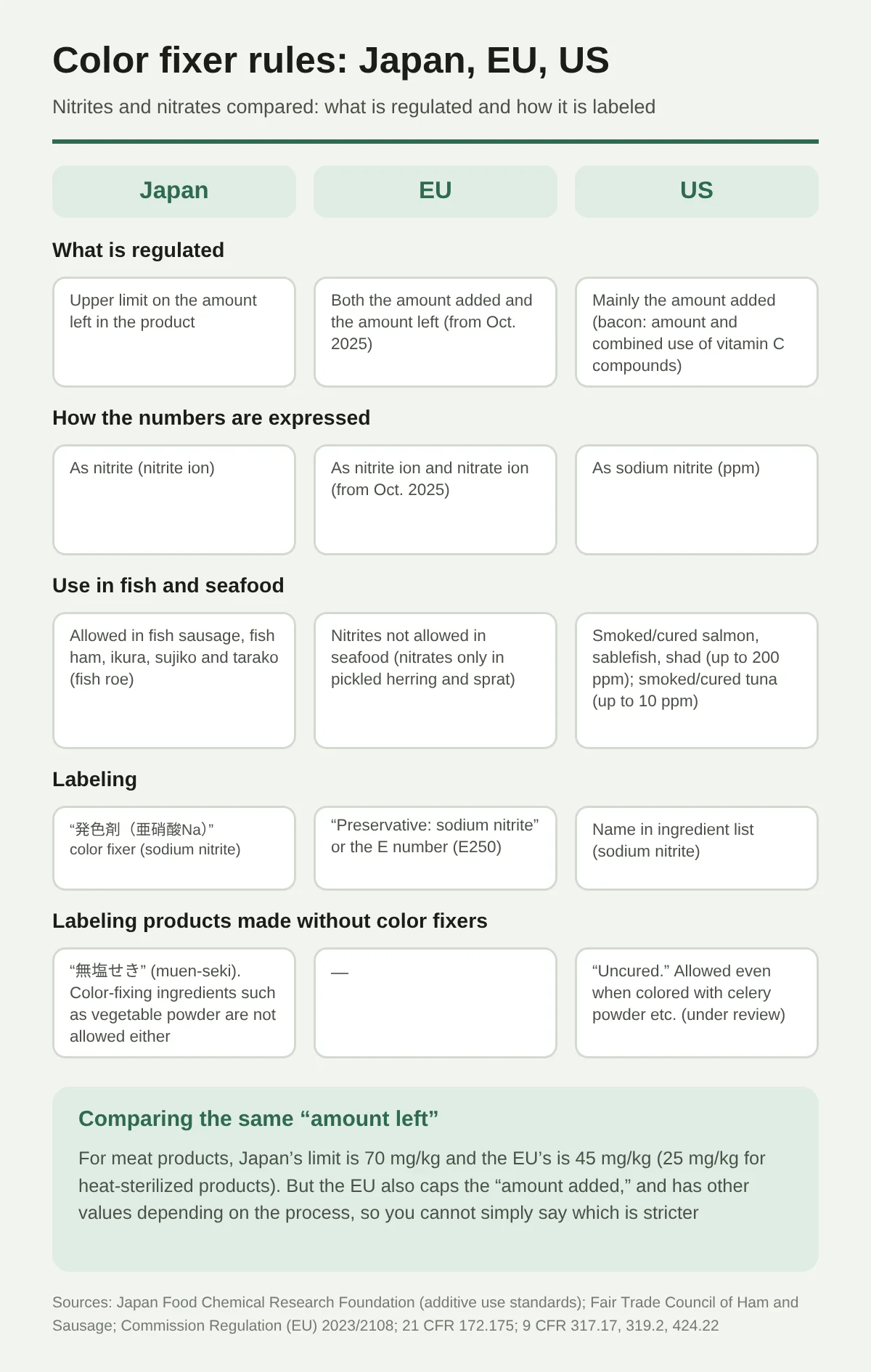
| Japan | EU | U.S. | |
|---|---|---|---|
| What is regulated | Upper limit on the amount remaining in the product | Both the amount added and the amount remaining (from October 2025) | Mainly the amount added (for bacon, the amount and the combined use of vitamin C compounds) |
| How numbers are expressed | As nitrite radical (nitrite ion) | As nitrite ion and nitrate ion (from October 2025) | As sodium nitrite (ppm) |
| Use in fish and shellfish | Can be used in fish sausage, fish ham, ikura, sujiko, and tarako | Nitrite cannot be used in fish and shellfish (nitrate only in pickled herring and sprats) | Smoked and salted salmon, sablefish, and shad (up to 200 ppm); smoked and salted tuna (up to 10 ppm) |
| Labeling | “発色剤(亜硝酸Na)” (color fixer (sodium nitrite)) | “Preservative sodium nitrite” or the E number (E250) | The substance name in the ingredient list (sodium nitrite) |
| Labeling for no color fixer | “無塩せき.” Ingredients with a color-developing action, such as vegetable powders, also cannot be used | ― | “Uncured.” Can be used even when the color is developed with celery powder or the like (under review) |
Compared on the same “amount remaining,” for meat products Japan’s limit is 70 mg/kg and the EU’s is 45 mg/kg (25 mg/kg for heat-sterilized products). However, the EU also has an upper limit on the “amount added” on top of this, and there are other values depending on the production method, so it cannot be said flatly which is stricter.
EU: Upper limits lowered from October 2025
In 2023 the EU adopted Regulation (EU) 2023/2108 and from October 9, 2025 lowered the upper limits for color fixers (for aged cheese and the like, taking the ripening period into account, from October 9, 2026; for some traditional Swedish cheeses there is a transition period until October 9, 2027).
The trigger was EFSA’s 2017 re-evaluation and its 2023 assessment of nitrosamines (a health concern for people who eat a lot, with meat and meat products as the main source). The EU explains that it needs to achieve both of the following.
- Reduce the risk of nitrosamine formation as much as possible
- Keep the effect against Clostridium botulinum
The main changes are as follows.
| Food | Before (as sodium nitrite) | From October 2025 (as nitrite ion) |
|---|---|---|
| Unheated meat products, heated meat products | Amount added 150 mg/kg | Amount added 80 mg/kg, amount remaining up to 45 mg/kg |
| Heat-sterilized meat products (canned goods, etc.) | Amount added 100 mg/kg | Amount added 55 mg/kg, amount remaining up to 25 mg/kg |
- The unit of the numbers has also changed. Before, the weight was given as “sodium nitrite”; now it is given as “nitrite ion” (sodium nitrite × 0.67 = nitrite ion). Converting the new 80 mg/kg back to sodium nitrite gives about 120 mg/kg, so it is not “halved from 150 mg to 80 mg” but a reduction of about 20%
- Traditionally made dry-cured ham, bacon, and the like have separate upper limits for each product
- Denmark had long been allowed national upper limits stricter than the EU’s, and these were also drawn on in this review
U.S.: “Uncured” (muen-seki) but with nitrite in it?
In the U.S., regulations require that ham and bacon made without adding sodium nitrite be labeled “Uncured” and “No Nitrate or Nitrite Added”.
However, many “uncured” products are cured by using celery powder or other vegetable ingredients rich in nitrate together with bacteria, producing nitrite during production. The nitrite that forms is the same substance.
- In 2019, the U.S. consumer group CSPI petitioned the Department of Agriculture (USDA FSIS) to stop such products from being labeled “Uncured” and “No Nitrate or Nitrite Added”
- In December 2020, FSIS partly granted the petition and indicated it would review the labeling rules. The fall 2024 regulatory agenda said a proposal setting a new definition of “Cured” was planned for March 2025, but as of September 2026, the proposal has still not been published. This item does not appear in the agendas from spring 2025 on
In Japan’s “無塩せき,” ingredients with a color-developing action also cannot be used, so a product like the U.S. “uncured” ones, in which the color is developed with vegetable-derived nitrite, cannot be labeled “無塩せき” under Japanese rules.
Watch for “no color fixer” and “additive-free ham” labels
- The Consumer Affairs Agency’s “Guidelines on Labeling of Non-Use of Food Additives” (2022) lists, as an example highly likely to mislead, labels that say “no ○○ used” while using an ingredient that does the same job (type 5). It gives no example naming color fixers, but if the color is developed with vegetable powder or the like and the label says “no color fixer,” it may fall under this
- The same guidelines say that labels linking “additive-free” to “good for you” or “safe” may also mislead (type 6). The full set of 10 types in the guidelines is covered in our article on the rules for “additive-free” labels
- Even ham made without a color fixer may contain other additives, such as phosphates and preservatives
Urayomi’s approach
To sum up so far:
- Color fixers are used not only for color but to hold back Clostridium botulinum. At the set amounts, public agencies’ evaluation is that intake as an additive is within the ADI
- On the other hand, processed meat is IARC Group 1, and EFSA also shows concern about the nitrosamines in meat products. The EU has actually reduced the amounts
- Far more nitrate comes from vegetables. But vegetables have many benefits too, so the two cannot be compared simply
At Urayomi we do not write color fixers off as “dangerous” across the board. Instead, on product pages we list whether “発色剤(亜硝酸Na)” appears as it is printed on the package, and for muen-seki products we also introduce the storage method. As for processed meat itself, whether or not a color fixer is used, paying attention to how much and how often you eat it is the surest approach.
Points for checking the package
- Look for “発色剤” (color fixer) in the additives section: It is written like “発色剤(亜硝酸Na)” or “発色剤(硝酸K)”
- Not only ham and sausage, but also tarako, ikura, sujiko, and fish sausage: It is also used in fish roe and fish paste products
- “無塩せき” means a color fixer was not used: Salt is used. Look at the other additives too
- Follow the storage method and date for muen-seki and additive-free ham
- Don’t make too much vegetable puree for baby food ahead of time
Ham and sausage made without a color fixer
These are products for which we checked on Rakuten Ichiba sales pages that no color fixer is used, and checked the ingredients (checked October 2, 2026).
| Shinshu Ham Green Mark Muen-seki Set (3 kinds, 4 pieces) | Saito Ham Additive-Free Natural Wiener | |
|---|---|---|
| Color fixer | Not used (the Green Mark is a mark the maker puts on ham and sausage made without color fixers, colorings, preservatives, or phosphates) | Not used (muen-seki) |
| Ingredient list (原材料名) | Differs by product. For example, the coarse-ground pork wieners: pork, pork fat, reduced starch syrup, soy protein, salt, starch syrup, pork extract, powdered brewed vinegar, yeast extract, spices, and others | Pork (domestic), chicken (domestic), salt, raw cane sugar, spices, potato starch (non-GMO), seaweed powder |
| How it arrives | Assortment (coarse-ground pork wieners, hanging-smoked bacon, pork shoulder loin chashu) | Frozen delivery (6 months frozen from shipment) |
| Price | 3,240 yen (tax included) | 682 yen (tax included, shipping separate) |
| Buy | See on Rakuten (産直お取り寄せNセレクト) PR See on Yahoo! Shopping PR |
See on Rakuten (サイトウハム) PR See on Yahoo! Shopping PR |
Note Even without a color fixer, it is still processed meat (IARC Group 1 is an evaluation of “processed meat” as a whole). Follow the storage method and date shown on the label for muen-seki ham and sausage.
Also worth knowing
- Rules for “additive-free” and “non-use” labels (the 10 types in the guidelines) → Article on the rules for “additive-free” labels
- The difference between preservatives and “shelf-life extenders” → Article on preservatives
- Additives carried over from ingredients may not be labeled → Article on carryover
- Overseas rules for each additive → Additives database
Sources
- Japan Food Chemical Research Foundation, “Standards for Use and Storage of Each Additive” (covers revisions through April 7, 2026)
- Tokyo Metropolitan Government Bureau of Health and Medical Services, “Shokuhin Eisei no Mado” (Food Sanitation Window), main food additives by purpose: “Color fixers”
- Ham and Sausage Fair Trade Council, “History of ‘無塩せき’ in relation to the JAS standard and the Fair Competition Code for Hams and Sausages”
- Japan Meat Processors Association / Meat Science and Technology Institute, “On the food additive ‘nitrite’ used as a color fixer in meat products” (2015)
- MAFF, “Nitrate Intake from Food”
- Food Safety Commission of Japan, Planning Expert Committee, Document 2-1 (2013)
- Consumer Affairs Agency, “Guidelines on Labeling of Non-Use of Food Additives” (March 2022)
- Commission Regulation (EU) 2023/2108 (October 6, 2023)
- EFSA, “EFSA confirms safe levels for nitrites and nitrates added to food” (June 15, 2017) / EFSA ANS Panel. Re-evaluation of potassium nitrite (E 249) and sodium nitrite (E 250) as food additives. EFSA J 2017 (PMID 32625504) / Re-evaluation of sodium nitrate (E 251) and potassium nitrate (E 252) (PMID 32625505)
- EFSA CONTAM Panel. Risk assessment of N-nitrosamines in food. EFSA J 2023 (PMID 36999063)
- IARC Monographs Volume 94 (2010) / Grosse Y, et al. Carcinogenicity of nitrate, nitrite, and cyanobacterial peptide toxins. Lancet Oncol 2006 (PMID 16900606) / Bouvard V, et al. Carcinogenicity of consumption of red and processed meat. Lancet Oncol 2015 (PMID 26514947)
- Chazelas E, et al. Nitrites and nitrates from food additives and natural sources and cancer risk: results from the NutriNet-Santé cohort. Int J Epidemiol 2022 (PMID 35303088)
- Hasenböhler A, et al. Intake of food additive preservatives and incidence of cancer: NutriNet-Santé. BMJ 2026 (PMID 41500678)
- Erichsen et al. Source-specific nitrate and nitrite intake and association with colorectal cancer in the Danish Diet, Cancer and Health Cohort. Environ Int 2025 (PMID 40628182)
- Greer FR, et al. Infant methemoglobinemia: the role of dietary nitrate in food and water. Pediatrics 2005 (PMID 16140723)
- Bryk T, et al. Methemoglobinemia induced by refrigerated vegetable puree in conjunction with supraventricular tachycardia. Acta Paediatr 2003 (PMID 14632342)
- Walters CL, et al. The effect of antioxidants on the production of volatile nitrosamines during the frying of bacon. 1976 (PMID 1034383)
- Majou D, et al. Mechanisms of the bactericidal effects of nitrate and nitrite in cured meats. Meat Sci 2018 (PMID 30005374)
- 21 CFR 172.175 (sodium nitrite in fish and shellfish)
- 9 CFR 317.17, 319.2 (labeling of Uncured / No Nitrate or Nitrite Added), 424.22 (sodium nitrite and vitamin C compounds in bacon)
- USDA FSIS Petition 19-03 (CSPI, filed August 29, 2019, partly granted December 10, 2020) / Unified Agenda RIN 0583-AD92 (Fall 2024)
This article does not make a definitive claim about the safety or danger of any particular food or additive. For infant feeding, or for the diet of people with a medical condition, please consult a doctor or a registered dietitian.
Related articles and databases
- Are preservatives bad for you? Types such as sorbic acid, what “preservative-free” hides, and how Japanese and overseas rules differ
- Are Flavorings Bad for You? What “香料” (Flavoring) Contains, Why It Is Written as One Word, and Japanese vs. Overseas Rules
- What is carryover? How it differs from processing aids, and the additives that are not listed on labels even on “additive-free” foods
- 添加物データベース