

Are Sorbic Acid and Benzoates Bad for You? Latest ADI Re-evaluations of Preservatives Including Parabens, Gut Bacteria, and US/EU/Japan Rules

PR This article contains an affiliate link to A8.net (a frozen meal delivery and a kamaboko shop). What is written here is based on documents from public agencies and on studies, regardless of whether there are ads.
When checking back labels on fish cake, ham, energy drinks, or sliced bread, you often spot entries like “保存料(ソルビン酸K)” (potassium sorbate), “安息香酸Na” (sodium benzoate), or “プロピオン酸Ca” (calcium propionate). Many shoppers wonder: “If preservatives stop bacteria from growing in food, do they also harm beneficial bacteria in my gut?” or “Aren’t some of these banned overseas?”
In recent years, international risk assessment bodies (JECFA and EFSA) and US regulators (the FDA and California state law) have completed major re-evaluations of preservatives and antioxidants. As a result, some preservatives—such as benzoic acid and sorbic acid—had their Acceptable Daily Intakes (ADIs) raised after new reproductive studies confirmed their safety, whereas others—such as calcium sorbate in the EU and propylparaben in the EU and California—have been delisted or banned.
Using primary toxicological reports from Japan’s Food Safety Commission (FSCJ), JECFA, EFSA, and the US FDA, this article sorts out:
- Why petri-dish (in vitro) experiments on gut bacteria differ fundamentally from how preservatives are absorbed and metabolized in the human digestive tract (in vivo)
- The latest international re-evaluations (2016–2026) of sorbic acid, benzoic acid, propionates, and parabens
- How regulators evaluate synthetic antioxidants (BHA and BHT) and why rodent “forestomach” tumors do not apply to humans
- How “no preservatives added” ready meals stay fresh using pH adjusters and shelf-life extenders, and how regulators weigh trace additives against foodborne illness
Conclusion: Major preservatives are absorbed in the small intestine, and global rules now separate each compound by data
- Sorbic acid and benzoic acid barely reach the bacteria in the large intestine. Both are small weak organic acids that are rapidly and nearly 100% absorbed in the stomach and upper small intestine. Sorbic acid is broken down into water and carbon dioxide just like dietary fatty acids, while benzoic acid is conjugated with glycine in the liver into hippuric acid and excreted in urine within half a day
- Recent toxicological data led international bodies to raise the ADI for key preservatives. In 2021, JECFA (WHO/FAO) quadrupled the ADI for benzoic acid and its salts from 5 to 20 mg/kg bw/day based on a new extended one-generation reproductive toxicity study. In 2019, EFSA raised the ADI for sorbic acid and potassium sorbate from a temporary 3 to 11 mg/kg bw/day (Japan and JECFA set it at 25 mg/kg bw/day)
- At the same time, specific compounds with data gaps or reproductive effects have been excluded. The EU delisted calcium sorbate (E203) in 2018 due to missing genotoxicity data. Propylparaben was dropped from the group ADI by EFSA in 2004 and removed from the EU list of food additives in 2006, and will be banned in California under the California Food Safety Act (AB 418) starting January 2027 (in Japan it is still a designated additive, but there are almost no shipments and Japan’s JAS standard for soy sauce does not allow it)
- “No preservatives added” does not mean no antimicrobial additives are used. Ready meals and bakery items often use sodium acetate (pH adjuster) or glycine (seasoning / shelf-life extender) to inhibit bacterial growth without listing a “preservative”
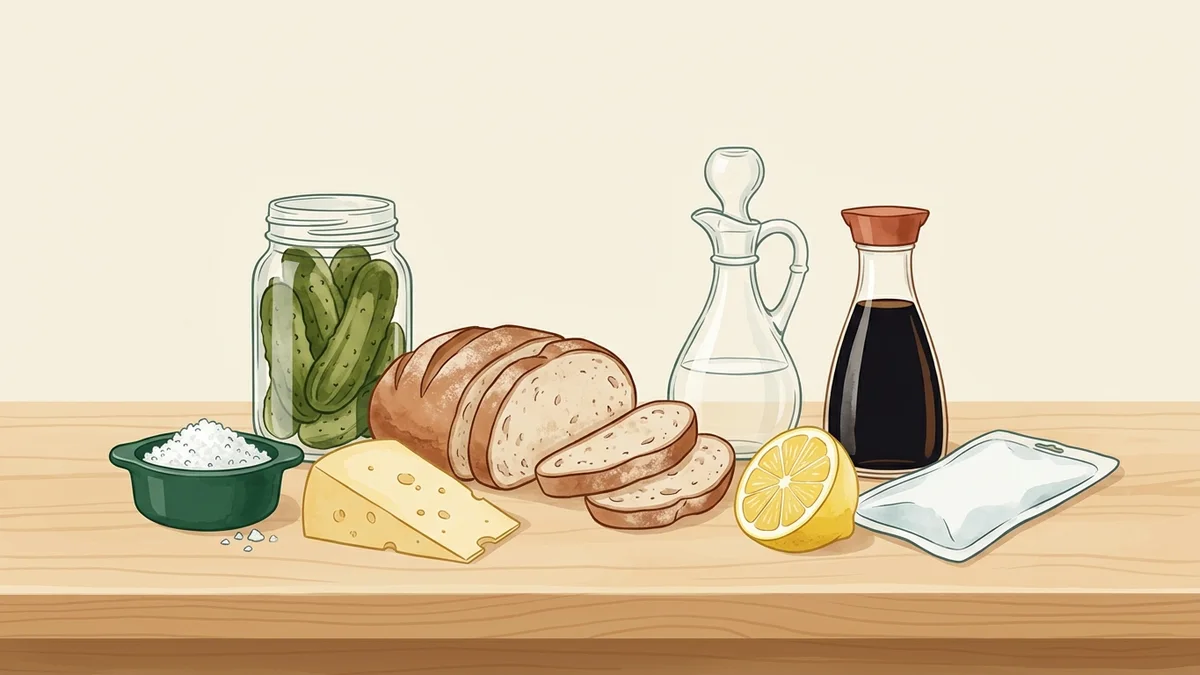
Do preservatives kill gut bacteria? (Petri dishes vs. the human digestive tract)
A common concern is that because preservatives inhibit microbes in food, eating them must also wipe out beneficial bacteria in the human gut. Indeed, laboratory studies such as Irwin et al. (2017, PLOS ONE, PMID: 29045472) reported that adding sulfites directly to bacterial culture media (in vitro) inhibited the growth of Lactobacillus and Bifidobacterium species.
However, regulatory pharmacokinetic assessments (ADME: Absorption, Distribution, Metabolism, and Excretion) emphasize a crucial difference between dropping a preservative directly onto bacteria in a petri dish (in vitro) and eating it in food (in vivo).
Rapid absorption and digestion in the small intestine prevent intact reach into the colon
Over 90% of the human gut microbiota lives in the large intestine (colon). For an ingested preservative to alter colonic bacteria, it must survive the stomach and small intestine intact. In humans, major preservatives are absorbed or digested long before reaching the colon:
| Preservative | Fate in the stomach & small intestine | Liver metabolism & excretion | Reach into the colon (gut microbiota) |
|---|---|---|---|
| Sorbic acid & Potassium sorbate | Rapidly and nearly 100% absorbed in the stomach and upper small intestine via passive diffusion | Metabolized via β-oxidation—the same pathway as fatty acids in butter or cooking oil—into water and carbon dioxide (CO₂) | Virtually none at normal dietary intake levels |
| Benzoic acid & Sodium benzoate | Rapidly and nearly 100% absorbed in the upper small intestine | Conjugated with the amino acid glycine in the liver to form hippuric acid, with nearly 100% excreted in urine within 10–14 hours | Virtually none at normal dietary intake levels |
| Parabens (p-hydroxybenzoates) | Rapidly absorbed from the upper gastrointestinal tract | Quickly hydrolyzed by esterases in the intestinal mucosa and liver into p-hydroxybenzoic acid and excreted in urine | Minimal reach |
| Nisin (designated additive) & ε-Polylysine (existing additive) | Because both are peptides (chains of amino acids), they are digested into amino acids and small peptides by proteolytic enzymes (pepsin, trypsin, pancreatin) in the stomach and small intestine | Absorbed and utilized as ordinary amino acid nutrients | Thought to be mostly digested before the colon, so activity there is likely limited (nisin: EFSA 2017) |
| Sulfites (antioxidant / wine preservative) | Reacts with food components and gastric acid; absorbed in the small intestine | Rapidly oxidized by the enzyme sulfite oxidase into sulfate and excreted in urine | Inhibits bacteria in direct petri-dish tests (PMID: 29045472); how much reaches the colon is not well established |
Because sorbic acid and benzoic acid are absorbed in the upper small intestine, they do not act like oral broad-spectrum antibiotics that sweep through the large intestine.
Latest international re-evaluations of major preservatives & antioxidants (2016–2026)
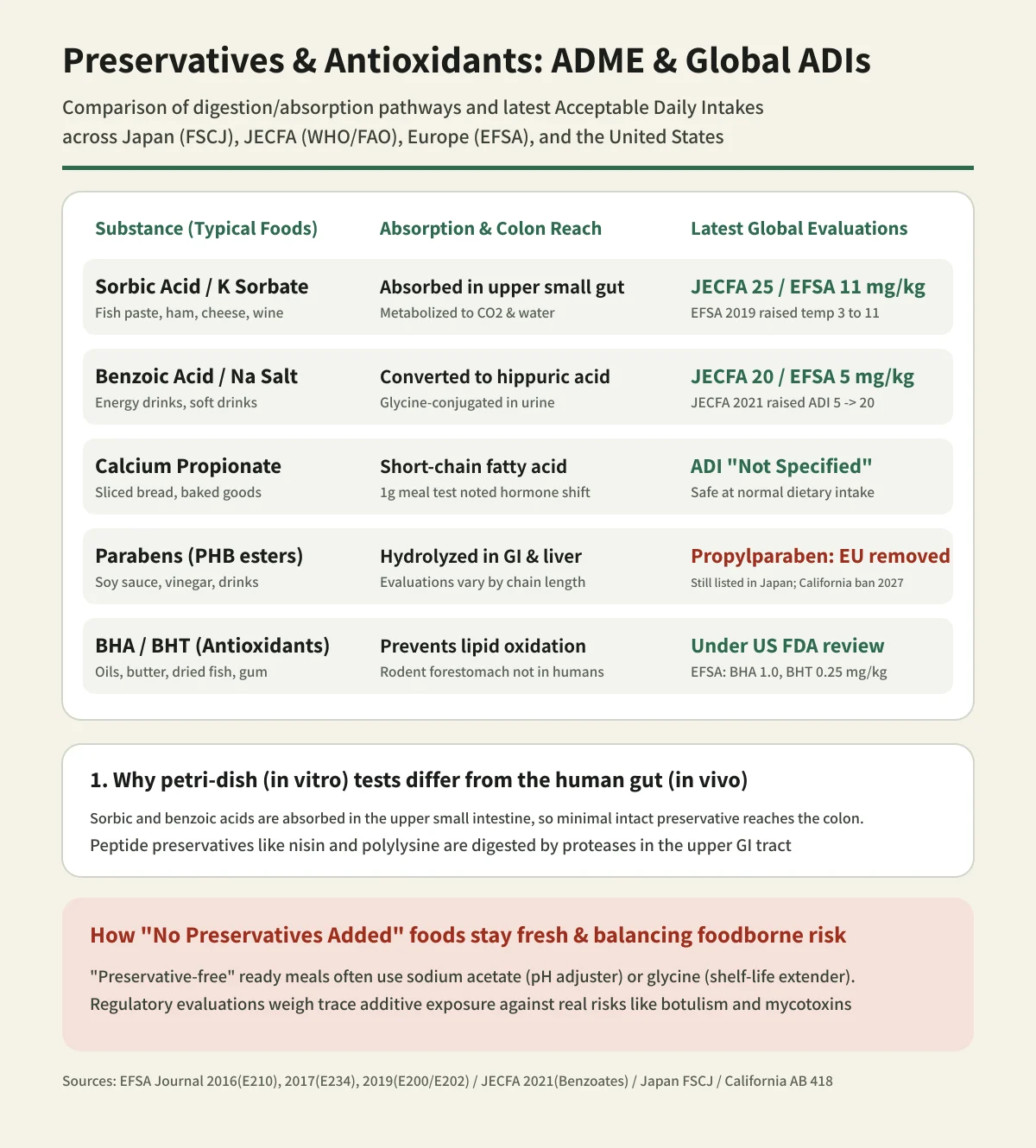
1. Sorbic acid & Potassium sorbate: EFSA raised the ADI in 2019, while delisting Calcium sorbate
Sorbic acid and potassium sorbate are the most widely used preservatives in fish paste products (kamaboko), ham, sausage, cheese, and wine.
- Japan (FSCJ) and JECFA ADI: 25 mg per kg of body weight per day (expressed as sorbic acid). In MHLW’s FY2020 market-basket survey, estimated intake for adults (20+) was about 4.3 mg/day—roughly 0.3% of the ADI (MHLW, Japanese).
- EU (EFSA) 2015 → 2019 update: In 2015, EFSA set a temporary lower ADI of 3 mg/kg bw/day while awaiting new reproductive toxicity data. After reviewing a newly conducted Extended One-Generation Reproductive Toxicity Study (EOGRTS), EFSA published a follow-up opinion in March 2019 (EFSA Journal 2019;17(3):5625) raising the group ADI to 11 mg/kg bw/day (BMDL of 1,110 mg/kg ÷ 100).
- EU delisting of Calcium sorbate (E203) in 2018: Because food industry applicants did not submit requested genotoxicity data specifically for calcium sorbate, the European Commission removed E203 from the EU authorized list in 2018 (Regulation (EU) 2018/98). Calcium sorbate is also a designated additive in Japan, but potassium sorbate and sorbic acid are mainly used.
2. Benzoic acid & Sodium benzoate: JECFA quadrupled the ADI from 5 to 20 mg/kg in 2021
Benzoic acid and sodium benzoate are used in energy drinks, soft drinks, syrups, and margarine (and also occur naturally in cranberries, prunes, cinnamon, and aged cheese).
- JECFA’s 2021 quadrupling of the ADI: For decades, the international ADI for benzoates stood at 5 mg/kg bw/day. At its 92nd meeting in 2021, JECFA evaluated a modern EOGRTS study in rats that found no adverse reproductive or developmental effects up to the highest tested dose (1,000 mg/kg bw/day). JECFA consequently raised the group ADI fourfold from 5 to 20 mg/kg bw/day (while EFSA’s earlier 2016 opinion remains at 5 mg/kg bw/day).
- Preventing trace benzene formation with Vitamin C: In the mid-2000s, regulators found that sodium benzoate could react with ascorbic acid (Vitamin C) in beverages exposed to heat, light, and trace metal ions to form parts-per-billion traces of benzene. In Japan, MHLW tested 31 soft drinks containing both in 2006 and one product exceeding the tap-water benzene standard (10 µg/L) was recalled (MHLW, Japanese). Formulations have since been revised, but this does not guarantee that every product always stays below the standard.
3. Calcium propionate: How regulators view the 2019 hormone and insulin study
Propionic acid, calcium propionate, and sodium propionate prevent mold and bacterial “rope” spoilage in sliced bread and baked goods (propionic acid is also produced naturally by Propionibacterium during the ripening of Swiss Emmental cheese).
- The 2019 Tirosh et al. study (Science Translational Medicine, PMID: 31019023): Researchers gave 14 healthy adults a single test meal containing 1 g (1,000 mg) of calcium propionate vs. placebo in a randomized crossover trial. After the 1 g dose, participants showed a transient post-meal rise in glucagon, norepinephrine, and FABP4 (fatty acid-binding protein 4), shifting acute insulin sensitivity.
- Regulatory and scientific perspective: A single 1,000 mg dose in one meal corresponds to about 400 g of bread even at Japan’s maximum level (2.5 g/kg), and the human arm tested only acute post-meal hormone levels in 14 people. Moreover, propionic acid is one of the major short-chain fatty acids produced by our own colonic bacteria when fermenting dietary fiber. Neither JECFA nor EFSA has set a numerical ADI for propionates (JECFA: “not limited”; EFSA 2014: no need for a numerical ADI), while Japan limits use to 2.5 g/kg in bread and Western confectionery (3.0 g/kg in cheese). Long-term human studies on metabolic effects remain limited.
4. Parabens (p-hydroxybenzoates): Why rules differ by alkyl chain length across Japan, the EU, and the US
Parabens (p-hydroxybenzoate esters) are used in soy sauce, vinegar, and beverages. Their safety evaluations depend heavily on the length and branching of the attached alkyl chain (methyl, ethyl, propyl, or butyl):
| Paraben type | Status in Japan | EU (EFSA) | United States (FDA & California) |
|---|---|---|---|
| Ethylparaben & Methylparaben | Ethylparaben is a designated additive (methylparaben is not designated for food) | Authorized (E214, E218); group ADI 0–10 mg/kg bw/day (EFSA 2004) | Methylparaben is GRAS (21 CFR 184.1490) |
| Propylparaben (p-hydroxybenzoic acid propyl ester) | Still a designated additive, but no shipments were found in a 2004 survey and the JAS standard for soy sauce does not allow it | Dropped from the group ADI by EFSA in 2004 and removed from the EU list in 2006 after juvenile rat studies showed effects on sperm counts and other reproductive endpoints without a clear no-effect level (JECFA also excluded it from the group ADI in 2006) | GRAS at the federal level (21 CFR 184.1670), but banned in food in California starting January 1, 2027 under the California Food Safety Act (AB 418) |
| Butylparaben, Isobutylparaben & Isopropylparaben | Designated additives (Japan designates five: ethyl, propyl, butyl, isobutyl and isopropyl) | Not authorized as food additives | No federal food-use provision was found |
Notably, propylparaben—the paraben removed in the EU and banned by California’s AB 418—remains designated in Japan but is practically unused (FSCJ Q&A, Japanese). Japan’s JAS standard for soy sauce allows up to three of sodium benzoate and isobutyl, isopropyl and butyl parabens, and in the FY2020 market-basket survey none of the five parabens was detected.
Antioxidants often confused with preservatives: BHA and BHT
Shoppers often confuse preservatives with synthetic antioxidants such as BHA (butylated hydroxyanisole) and BHT (butylated hydroxytoluene), which are used in fats, oils, butter, dried fish, and chewing gum.
- Different roles: Preservatives stop bacteria and mold from growing; antioxidants prevent fats and oils from reacting with oxygen and turning into rancid lipid peroxides.
- Why BHA was classified as IARC Group 2B (the rodent “forestomach” mechanism): In the early 1980s, high-dose feeding studies in rats (first reported in Japan) and hamsters showed tumors in the forestomach, leading IARC to classify BHA as Group 2B (“possibly carcinogenic to humans”). Later work indicated that humans have no equivalent of the rodent forestomach (a non-glandular food-storage region), that BHA is not genotoxic, and that the tumors are considered the result of chronic irritation of the forestomach lining at very high doses; on this basis EFSA judged them not relevant to human risk.
- Latest ADIs and the US FDA post-market review: In its 2011–2012 re-evaluations, EFSA concluded that rodent forestomach tumors are not relevant to human risk, raising the ADI for BHA from 0.5 to 1.0 mg/kg bw/day and setting BHT at 0.25 mg/kg bw/day (JECFA sets BHA at 0.5 and BHT at 0.3 mg/kg bw/day). In 2025–2026, the US FDA initiated a Request for Information (RFI) on BHA and BHT as part of its modernized Post-market Chemical Review of 1950s–1970s GRAS listings.
How “No Preservatives Added” foods stay fresh, and how to read labels wisely
Why do convenience-store bento boxes, salads, and pastries labeled “保存料不使用” (no preservatives used) stay fresh for days?
- Shelf-life extenders and pH adjusters replace traditional preservatives: Under Japanese labeling rules, only specific substances (like sorbic acid and benzoic acid) are labeled as “保存料” (preservative). Manufacturers frequently use “pH調整剤” (pH adjusters such as sodium acetate or citric acid), “グリシン” (glycine; labeled by name when used for shelf life, or under “調味料(アミノ酸等)” [seasoning (amino acids, etc.)] when used for flavor), or fermentation alcohol (“酒精”) to suppress bacterial growth without using a designated preservative.
- Japan’s 2022 “No Additive Claims” Guidelines: Under the Consumer Affairs Agency’s March 2022 guidelines on additive-free claims, displaying “No Preservatives” on a package that uses non-preservative additives such as glycine or sodium acetate to extend shelf life is given as an example highly likely to mislead (Type 4: claims on foods using additives with the same or similar function).
- Weighing trace additives against real foodborne pathogens: Measured intakes of preservatives in Japan are about 1% of the ADI or less (FY2020 adults: highest were sulfites at 0.57% and benzoic acid at 0.45%; FY2022 children aged 1–6: sorbic acid 0.4%, benzoic acid 0.3%), whereas omitting preservatives or pH control can raise the risk of food poisoning from Clostridium botulinum, Clostridium perfringens or Staphylococcus aureus, and of mold toxins (mycotoxins). Without preservatives, temperature control and use-by dates matter even more.
For basic labeling rules and intake surveys in Japan, see Are preservatives bad for you? Types such as sorbic acid, what “preservative-free” hides, and how Japanese and overseas rules differ and Were “無添加” (Additive-Free) Labels Banned? The Consumer Affairs Agency Guideline’s 10 Types.
Some dishes are kept fresh by freezing instead of preservatives, and some fish cakes are made without relying on preservatives. Whether other additives are used, check the ingredient list of each product.
Sources and references
- EFSA Panel on Food Additives and Nutrient Sources added to Food (ANS). Scientific Opinion on the re-evaluation of sorbic acid (E 200), potassium sorbate (E 202) and calcium sorbate (E 203) as food additives. EFSA Journal. 2015;13(6):4144.
- EFSA Panel on Food Additives and Flavourings (FAF). Follow-up of the re-evaluation of sorbic acid (E200) and potassium sorbate (E202) as food additives. EFSA Journal. 2019;17(3):e05625.
- EFSA ANS Panel. Scientific Opinion on the re-evaluation of benzoic acid (E 210), sodium benzoate (E 211), potassium benzoate (E 212) and calcium benzoate (E 213) as food additives. EFSA Journal. 2016;14(3):4433.
- Joint FAO/WHO Expert Committee on Food Additives (JECFA). Ninety-second meeting (June 2021): Summary and conclusions — Benzoic acid and its salts (group ADI 0–20 mg/kg bw). https://cdn.who.int/media/docs/default-source/food-safety/jecfa/summary-and-conclusions/jecfa92-7to18june2021-summary-and-conclusions.pdf
- Tirosh A, et al. The short-chain fatty acid propionate increases glucagon and FABP4 production, impairing insulin action in mice and humans. Science Translational Medicine. 2019;11(489):eaav0120. (PMID: 31019023)
- Irwin SV, et al. Sulfites inhibit the growth of four species of beneficial gut bacteria at concentrations regarded as safe for food. PLOS ONE. 2017;12(10):e0186629. (PMID: 29045472)
- EFSA ANS Panel. Safety of nisin (E 234) as a food additive in the light of new toxicological data and the proposed extension of use. EFSA Journal. 2017;15(12):e05063.
- EFSA ANS Panel. Scientific Opinion on the re-evaluation of butylated hydroxyanisole – BHA (E 320) and butylated hydroxytoluene – BHT (E 321). EFSA Journal. 2011;9(10):2392 / 2012;10(3):2588.
- California Assembly Bill No. 418 (AB 418), The California Food Safety Act (Propylparaben prohibition effective January 1, 2027).
- Food Safety Commission of Japan (FSCJ), Risk Assessment Reports on Sorbic Acid/Salts and Benzoic Acid/Salts; Q&A on p-hydroxybenzoate esters (Japanese).
- MHLW (Japan). Results of the FY2020 and FY2022 market-basket surveys of preservative intake (Japanese): https://www.mhlw.go.jp/content/000872729.pdf / https://www.mhlw.go.jp/content/001212316.pdf
- Consumer Affairs Agency of Japan, Guidelines on “Not Added / Free From” Labeling of Food Additives (March 2022).
Products related to this article PR
Products whose labels Urayomi has read, picked because their ingredients or category relate to this article. This is not a recommendation or a safety rating. The shop buttons are affiliate links; prices are reference prices on the date we checked.
- ダイアン パーフェクトビューティー エクストラダメージリペア シャンプー 450mLRead the label (in Japanese) →
- 不二の昆布 葉わさび昆布 80gRead the label (in Japanese) →
- ダヴ 洗い流す 濃密ミルク ヘアトリートメント 180gRead the label (in Japanese) →
- I-ne ボタニスト ボタニカルシャンプー モイスト 本体 460mLRead the label (in Japanese) →
- I-ne ボタニスト ボタニカルシャンプー スカルプクレンズ 本体 460mLRead the label (in Japanese) →
- ジョンソンヴィル オリジナルスモークRead the label (in Japanese) →
Frequently asked questions
- What are the key findings on: Are Sorbic Acid and Benzoates Bad for You? Latest ADI Re-evaluations of Preservatives Including Parabens, Gut Bacteria, and US/EU/Japan Rules?
- JECFA raised benzoic acid's ADI from 5 to 20 mg/kg/day in 2021; sorbic acid and benzoates are absorbed before gut bacteria. Parabens, BHA/BHT, rules.
- Do preservatives kill gut bacteria? (Petri dishes vs. the human digestive tract)?
- A common concern is that because preservatives inhibit microbes in food, eating them must also wipe out beneficial bacteria in the human gut. Indeed, laboratory studies such as Irwin et al. (2017, PLOS ONE, PMID: 29045472) reported that adding sulfites direc…
- What does the evidence show regarding: Latest international re-evaluations of major preservatives & antioxidants (2016–2026)?
- Sorbic acid and potassium sorbate are the most widely used preservatives in fish paste products (kamaboko), ham, sausage, cheese, and wine.
- What does the evidence show regarding: Antioxidants often confused with preservatives: BHA and BHT?
- Shoppers often confuse preservatives with synthetic antioxidants such as BHA (butylated hydroxyanisole) and BHT (butylated hydroxytoluene), which are used in fats, oils, butter, dried fish, and chewing gum.
Related articles and databases
- Are preservatives bad for you? Types such as sorbic acid, what “preservative-free” hides, and how Japanese and overseas rules differ
- Is the Color Fixer (Sodium Nitrite) Bad for You? Cancer Evaluations, Why Ham Is Red, and How Japanese and Overseas Rules Differ
- Were “無添加” (Additive-Free) Labels Banned? Reading the Consumer Affairs Agency Guideline’s 10 Types from the Back Label
- What is carryover? How it differs from processing aids, and the additives that are not listed on labels even on “additive-free” foods
- 添加物データベース