
What is carryover? How it differs from processing aids, and the additives that are not listed on labels even on “additive-free” foods

PR This article contains ads. The “See on Rakuten Books” and “See on Amazon” links are affiliate ads for Rakuten Ichiba and Amazon. What is written here is based on materials from public bodies such as the Consumer Affairs Agency, regardless of whether an ad is attached. The “See on Amazon.co.jp” and “See on Yahoo! Shopping” links are also affiliate links.
Have you ever looked at the ingredient list on the back of a package and thought, “there are few additives”? In fact, not every additive used in a food is written on the back label.
The Food Labeling Standards set out cases in which an additive may be used without being listed. The best known are “carryover” (キャリーオーバー) and “processing aids” (加工助剤).
This article sorts out the following, based on laws and materials from the national and local governments:
- What carryover and processing aids are, and examples
- In what cases listing is still required
- Who decides an “amount with no effect,” and how
- Whether overseas has the same mechanism
- How all this relates to “additive-free” and “not used” labeling
Bottom line: unlisted additives exist as a matter of the rules
- The Food Labeling Standards require, in principle, that all additives be listed. However, “carryover” and “processing aids” need not be listed
- Carryover is an additive that was used in making an ingredient and remains in the finished food only in an amount too small to have any effect. A typical example is a preservative in the soy sauce used to flavor senbei (rice crackers)
- However, allergen labeling is not exempted. Local governments also explain that additives detectable by the five senses such as color, aroma, and taste, and cases where an ingredient containing an additive remains in its original form, do not count as carryover
- There is no numerical standard for “an amount with no effect”; the business making the food judges it case by case
- The EU, the US, and the international standard (Codex) have the same idea, so it is not a mechanism unique to Japan
- The Consumer Affairs Agency’s guideline lists labeling “additive-free” or “not used” on a food in which additives are used as carryover as an example highly likely to mislead
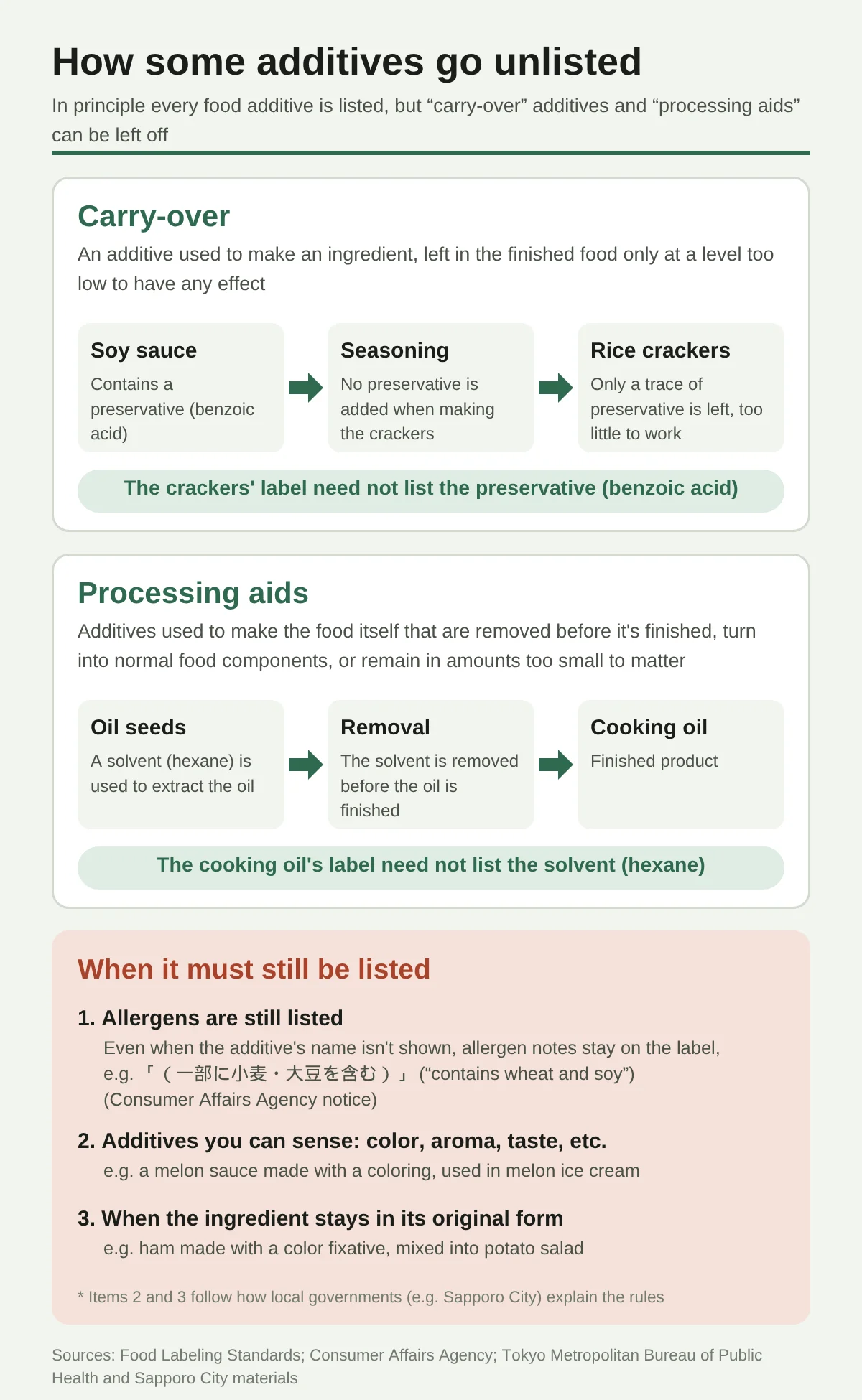
What is carryover?
The legal definition
The Food Labeling Standards define carryover as follows.
An additive that is used in the process of manufacturing or processing an ingredient of the food, and is not used in the process of manufacturing or processing that food, and is contained in that food only in an amount smaller than the amount at which the additive can take effect
In other words, it is an additive that meets all three of the following.
- It was used in making the ingredient
- It was not used in making that food
- In that food, only an amount smaller than that at which it can take effect as an additive remains
“Carry over” (キャリーオーバー) means “to be carried across.” It refers to an additive carried over from an ingredient.
Examples from national and local government materials
| Finished food | Ingredient used | Additive brought in from the ingredient |
|---|---|---|
| Senbei (rice crackers) | Soy sauce for flavoring | Preservative (benzoic acid) |
| Fried bread, doughnuts | Frying oil | Antifoaming agent (silicone resin) |
| Cream puffs | Margarine used in small amounts | Emulsifier |
| Beer | Starch, hops | Sulfur dioxide |
(Senbei is an example from the Consumer Affairs Agency and the City of Sapporo; the other three are from the Tokyo Metropolitan Bureau of Public Health and Medical Services)
In the senbei example, even though the soy sauce contains a preservative, it becomes a very small amount inside the senbei and has no effect of making the senbei last longer. That is the thinking.
How it differs from processing aids
Another additive that need not be listed is the “processing aid.” These are additives used when making that food, not in an ingredient.
| Carryover | Processing aid | |
|---|---|---|
| Stage where it is used | When making an ingredient | When making that food |
| Why it need not be listed | In the finished food, it is less than the amount at which it can take effect | It meets one of the following • It is removed before completion • It changes into a component naturally contained in the food and does not clearly increase its amount • The amount is small and has no effect on the food |
| Examples | The table above | Solvent used to extract oil (hexane) = removed before completion Antifoaming agent when making tofu (silicone resin) = small amount, no effect |
(Examples from the Tokyo Metropolitan Bureau of Public Health and Medical Services and the City of Sapporo)
The exemption for “nutrient fortification” is gone
Previously, additives used to fortify nutrition, such as vitamins and minerals, also did not have to be listed. This exemption ended with the March 2025 revision of the Food Labeling Standards, and today only two exemptions remain in the text: “processing aids” and “carryover.”
However, there is a grace period for the switch: processed foods for general consumers and similar items manufactured, processed, or imported until March 31, 2030 may still be labeled under the old rules. For a while, products without nutrient-fortification additives listed will still be on store shelves.
Cases that are not carryover
Even when an additive was brought in from an ingredient, listing is required in the following cases.
Allergens are not exempt
A Consumer Affairs Agency notice states that even where additive labeling is exempt as a processing aid or carryover, the allergen derived from that additive (a specified ingredient) must be labeled. Even if the additive’s name is not written, allergen labeling such as “(contains wheat and soybeans)” remains.
Additives detectable by the five senses
Explanations from the City of Sapporo, Fukushima Prefecture, and Kanagawa Prefecture say that additives whose effect is apparent in appearance, taste, or aroma, such as seasonings, coloring agents, flavorings, and sweeteners, do not count as carryover even in small amounts. This is because their effect remains in the finished food as color or taste.
- Example: when a melon sauce made with coloring is used in melon ice cream → the ice cream also has the coloring’s effect, so listing is required (City of Sapporo)
Where an ingredient remains in its original form
- Example: when ham made with a color fixative is put in potato salad → the ham is in it in its original form, so listing is required (City of Sapporo)
The ideas of “additives detectable by the five senses” and “cases where it remains in original form” are practice written in local government explanations. They are not written in those words in the text of national laws.
Who decides “an amount with no effect”?
The phrase “smaller than the amount at which it can take effect,” which separates carryover from other cases, has no numerical standard.
- The Consumer Affairs Agency explains that whether something counts as carryover is judged case by case by each food business, based on the definition and in line with the usage standards and actual use (reply to the Food Safety Commission of Japan Q&A, 2011)
- A Consumer Affairs Agency notice likewise says it is judged case by case in line with the additive’s usage standards and actual use
- When in doubt, local governments advise checking with the public health center with jurisdiction (Tokyo)
For this reason, voices saying “the judgment seems vague” and “views differ from one public health center to another” have also been sent to the Food Safety Commission’s Q&A. The current system is not to draw a line with a number, but to judge case by case against how each additive is used.
Differences between Japan and overseas
The idea that additives brought in from ingredients may be omitted from labeling exists overseas too.
| Treatment of additives brought in from ingredients | |
|---|---|
| Japan | Under the Food Labeling Standards, carryover is exempt from listing |
| International standard (Codex) | Has a “carry-over principle.” Carry-over is permitted under conditions such as the additive being one allowed in the ingredient, the amount being within the limit, and being well below the amount needed to take effect in the finished food |
| EU | Under Regulation 1169/2011 Article 20, an additive that is present based on the carry-over principle and has no technological function in the finished food need not be included in the ingredient list |
| US | Under 21 CFR 101.100(a)(3)(i), trace amounts of an additive that is brought in as an ingredient of another food and has no technical or functional effect in the finished food are exempt from labeling |
The EU additives regulation (1333/2008) Article 18 also has a “carry-over principle.” It provides that an additive carried over from an ingredient may be present in the food, and it is the labeling regulation (1169/2011) that provides the labeling exemption.
Carryover is not a “loophole” unique to Japan. However, without knowing such a mechanism exists, it is easy to misread “not written in the ingredient list” as “not used.”
The same idea exists in cosmetics and household products
The “full ingredient labeling” of cosmetics also has the idea of carryover.
- A Ministry of Health, Labour and Welfare (MHLW) notice (2001) says that ingredients that come along with a blended ingredient and are present in the product in less than an effective amount (so-called carryover ingredients) need not be listed
- An industry group’s guideline gives as examples antioxidants (such as BHT) added to raw material oils and fats and preservatives (such as sorbic acid) added to raw material plant extracts
The “full ingredients” of shampoos and body soaps are not necessarily literally “all” (→ Article on “transdermal toxins” and household products).
How this relates to “additive-free” and “not used” labeling
The Consumer Affairs Agency’s “Guidelines on Labeling of Food Additives as Not Used” (drawn up in March 2022; the review period for businesses ended at the end of March 2024) divides labeling highly likely to mislead into 10 types. Type 9 is the one related to carryover.
- Labeling “additive-free” or “not used” on a food in which additives are used as processing aids or carryover (or in which it cannot be confirmed that they are not used)
- Example: using a preservative in part of the ingredients but labeling the finished product “preservative-free”
The guideline says that for additive labeling, it is necessary to trace back and check the stages of ingredient manufacturing and processing, and that even a “not used” written outside the labeling box may mislead people about the contents if it is not based on the results of such checking.
Note that this guideline does not uniformly ban “additive-free” and “not used” labeling. If you trace back through the ingredients, check, and make clear what is not used, you may label it. The full set of 10 types in the guideline is introduced in the article on “additive-free” labeling rules.
Back-label checkpoints
- The additives section mainly lists “additives used when making that food”: additives that were in an ingredient may not be written as carryover
- Look for ingredients that are themselves processed foods: soy sauce, margarine, frying oil, etc. Additives used in them may not be written (however, additives whose effect on color, aroma, or taste remains are written; see 4)
- Allergen labeling is not exempt: when there is allergen labeling for a food not found in the ingredient list, it is a clue that something used in an ingredient is in it (this is not an official system but Urayomi’s way of reading, and it is not necessarily an additive)
- Additives for color, aroma, and taste are written even when derived from ingredients: coloring agents, flavorings, sweeteners, seasonings, etc. are subject to labeling even when brought in from an ingredient
- If you want to know more, ask the party responsible for the labeling: the Consumer Affairs Agency guides people to contact the manufacturer, seller, etc. shown in the labeling box. It also gives “please tell me the food additives omitted from the labeling” as an example inquiry
- Do not judge by the words “additive-free” or “not used” alone
Urayomi’s approach
To sum up so far:
- Carryover and processing aids are labeling exemptions set as rules, based on an idea shared internationally
- On the other hand, because there is no numerical standard and businesses judge, the back label alone cannot tell you what was used in an ingredient
- Allergens, additives detectable by the five senses, and ingredients that remain in original form are labeled even when derived from ingredients
Urayomi does not write about carryover as a “hidden danger.” We introduce it as a system worth knowing, because without knowing it you can misread labels.
On that basis, product pages distinguish the following:
- “Not used” (不使用) statements the maker has put on the label are quoted as is, as the maker’s labeling
- Things that Urayomi looked at in the ingredient list and confirmed are not written are listed as “not found in the ingredient list”. This does not mean “not contained.” It is because, as with carryover, there can be unlisted additives
How to read the back label of soy sauce itself is introduced in the Marunaka Shoyu article.
Also worth knowing
- Rules for “additive-free” and “not used” labeling (the 10 types in the guideline) → Article on “additive-free” labeling rules
- Preservatives and “preservative-free” labeling → Article on preservatives
- Coloring agents are listed even when derived from ingredients, if the color remains → Article on food colorings
- “Flavoring” (香料) is a label that can be written as one word covering many → Article on flavorings
- Additives in frying oil and the “vegetable fats and oils” label → Article on vegetable oils
- Things about ingredients that do not appear on labels: isomerized sugar and genetic modification → Article on isomerized sugar
- Overseas rules for each additive → Additives database
If you want to check the labeling rules as a whole, including the exemptions for additive labeling (carryover, processing aids, etc.), the official textbook for the Food Labeling Certification exam brings them together.
Sources
- Food Labeling Standards (Cabinet Office Order), Article 3, paragraph 1, table, “additives” entry (e-Gov Law Search, checked September 2026) / supplementary provisions (transitional measures for the March 2025 revision)
- Consumer Affairs Agency, “On the Food Labeling Standards” (Annex on additives; Annex on allergens)
- Consumer Affairs Agency, “Handy tips on food additive labeling”
- Consumer Affairs Agency, “Guidelines on Labeling of Food Additives as Not Used” (March 2022)
- Food Safety Commission of Japan Q&A, “On the concept of carryover” (2011) and “On the criteria for judging carryover of food additives” (2008)
- Tokyo Metropolitan Bureau of Public Health and Medical Services, “Window on Food Hygiene,” processed foods (additives)
- Sapporo City Public Health Office, “Additives (processed foods for general use)”
- Fukushima Prefecture Soso Health and Welfare Office, “On food labeling”
- Kanagawa Prefecture, “Food Labeling Act (hygiene matters): on additive labeling”
- Consumer Affairs Agency, “On the labeling of food additives” (materials for the study group on the food additive labeling system, 2019; comparison with Codex, the EU, and the US)
- Regulation (EU) No 1169/2011 Article 20 / Regulation (EC) No 1333/2008 Article 18
- 21 CFR 101.100(a)(3)
- Ministry of Health, Labour and Welfare, “On the labeling method for full ingredient labeling of cosmetics” (March 6, 2001) / Japan Cosmetic Industry Association, “Guidelines for describing full ingredient labeling of cosmetics”
This article explains labeling rules and does not judge the safety or danger of any particular food or additive. If you have a food allergy, always check the product’s labeling, and ask the manufacturer or seller about anything you do not understand.
Related articles and databases
- Are preservatives bad for you? Types such as sorbic acid, what “preservative-free” hides, and how Japanese and overseas rules differ
- Are Food Colorings (Red No. 102, Yellow No. 4) Bad for You? Cancer Assessments and Whether They Are Banned Abroad, Checked Against Rules in Japan and Overseas
- Are Flavorings Bad for You? What “香料” (Flavoring) Contains, Why It Is Written as One Word, and Japanese vs. Overseas Rules
- Is the Color Fixer (Sodium Nitrite) Bad for You? Cancer Evaluations, Why Ham Is Red, and How Japanese and Overseas Rules Differ
- What Is “植物油脂” (Vegetable Fat)? How True Is “Vegetable Oils Are Bad for You,” and What the Back Label Does and Does Not Tell You
- Are Artificial Sweeteners Bad for You? Aspartame and Cancer, What “Zero Calorie” and “Zero Sugars” Really Mean, and Japanese vs. Overseas Rules
- Are Lard and Butter Bad for You? 16 Plant Oils and Animal Fats (Beef Tallow, Fish Oil) Compared by Fatty Acids, and Which to Use Every Day
- What is spelt wheat? Does gluten make holes in the gut? Checking “leaky gut” and pesticides in imported wheat against papers and national data
- How to Choose Additive-Free Shampoo and Body Soap: Soap-Based vs. Amino Acid-Based, and How to Read the Full Ingredient List
- Were “無添加” (Additive-Free) Labels Banned? Reading the Consumer Affairs Agency Guideline’s 10 Types from the Back Label
- Why Did “No Chemical Seasoning” Disappear? Is Yeast Extract a Chemical Seasoning? How to Read Umami Seasonings and Hydrolyzed Protein
- Reading Oisix’s Trial Set and Subscription Down to the Back Label: Vegetable Pesticide Standards, the Trial Set, and How Cancellation Works
- Choosing an additive-free detergent: soap vs. synthetic detergent, and how to read the back label
- Are “transdermal toxins” (経皮毒) a myth or real? Do ingredients in shampoo and detergent enter through the skin, and what labels leave out
- What Is “果糖ぶどう糖液糖” (High-Fructose Corn Syrup)? Is It Worse for You Than Sugar? How It Differs From Sugar, and Corn and Genetic Modification
- 添加物データベース