
Choosing an additive-free detergent: soap vs. synthetic detergent, and how to read the back label

PR The comparison tables in this article contain affiliate links to Rakuten Ichiba and A8.net (“See on Rakuten” and the All things in Nature link). Which products are listed, and in what order, is decided regardless of whether an ad is attached. The “See on Amazon.co.jp” and “See on Yahoo! Shopping” links are also affiliate links.
“Additive-free,” “plant-derived,” “no petroleum-based ingredients.” Laundry and dish detergents come with all kinds of wording. But even when two products are both “additive-free,” the type of cleaning ingredient and what they leave out can be completely different.
This article sorts out the following, based on the Consumer Affairs Agency’s labeling rules and the makers’ official pages:
- How to tell soap from synthetic detergent by the “product category” (品名) on the back label
- The difference between “plant-derived” / “no petroleum-based ingredients” and “soap”
- What “additive-free” actually refers to
- What must always be written on the back label, and what may be left off
- A comparison of the labels on laundry detergents, finishing agents, and dish detergents that claim to be additive-free
This is not an article that judges which product is “safe” or “gentle on skin.” It lays out the material you need to choose.
Bottom line: look at the “product category” and at “what is free of what”
- The “product category” (品名) on the back label tells you whether a product is a soap, a composite soap, or a synthetic detergent. These categories are set by the Household Goods Quality Labeling Act
- “Plant-derived” and “no petroleum-based ingredients” do not mean soap. Some products made with 100% plant-derived cleaning ingredients still have “synthetic detergent” as their product category
- Soap (pure soap content) is also classified as an anionic surfactant under the labeling rules
- What “additive-free” means differs from maker to maker. Read what exactly is left out
- Fluorescent whitening agents, enzymes, and bleach must be listed on the back label whenever they are included, regardless of amount. On the other hand, small amounts of fragrance and other minor ingredients may not be listed
The “product category” on the back label shows the type
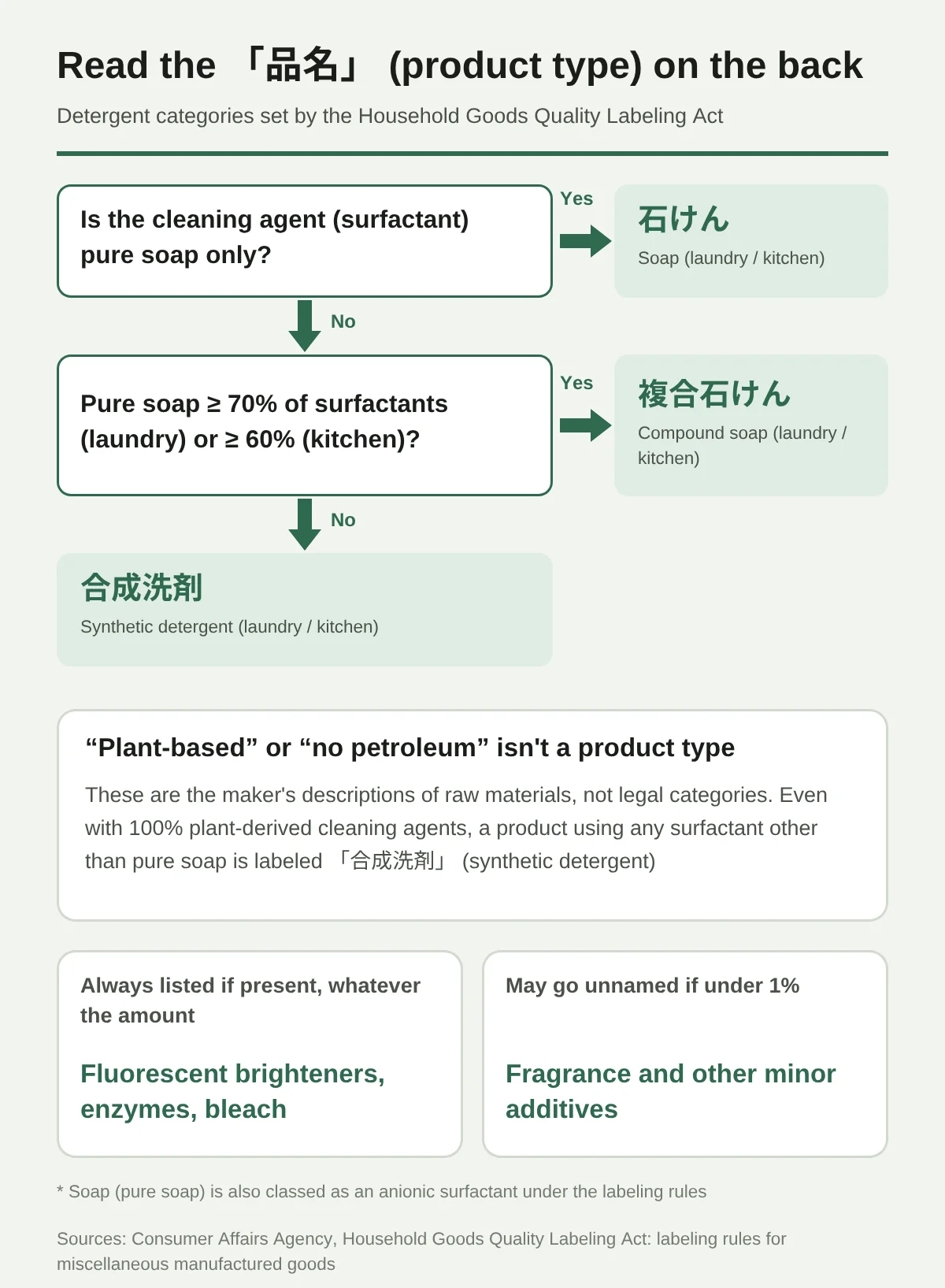
Under the Household Goods Quality Labeling Act, laundry and dish detergents must show a “product category” on the back label. The categories are as follows.
| Product category | What it is |
|---|---|
| Laundry soap / dish soap (洗濯用石けん/台所用石けん) | The cleaning ingredient (surfactant) is pure soap content only |
| Laundry composite soap / dish composite soap (洗濯用複合石けん/台所用複合石けん) | Also contains surfactants other than pure soap content. However, pure soap content makes up at least 70% of the surfactants for laundry products, or at least 60% for dish products |
| Laundry synthetic detergent / dish synthetic detergent (洗濯用合成洗剤/台所用合成洗剤) | Anything that fits neither of the above |
(Consumer Affairs Agency, Household Goods Quality Labeling Act, Miscellaneous Industrial Goods Quality Labeling Regulations)
In the ingredient section, the share and type of the cleaning ingredient are written like “純石けん分(30% 脂肪酸カリウム)” (pure soap content, 30% potassium fatty acid salt) for soap, and “界面活性剤(16%、アルキルエーテル硫酸エステルナトリウム…)” (surfactant, 16%, sodium alkyl ether sulfate…) for synthetic detergent.
Soap is also a kind of “surfactant”
In the Consumer Affairs Agency’s labeling table, pure soap content (sodium fatty acid salts and potassium fatty acid salts) is classified as an “anionic surfactant.” It is not the case that “soap is not a surfactant.”
The Japanese Dermatological Association’s guideline names anionic surfactants as a main cause of hand eczema from detergents and similar products (irritant contact dermatitis) → Article on “transdermal toxins” and household products
pH (liquid property)
The “liquid property” (液性) on the back label is determined by pH.
| Liquid property | pH |
|---|---|
| Weakly acidic (弱酸性) | 3.0 to under 6.0 |
| Neutral (中性) | 6.0 to 8.0 |
| Weakly alkaline (弱アルカリ性) | Over 8.0 to 11.0 |
| Alkaline (アルカリ性) | Over 11.0 |
In the comparison tables below, every soap that lists a liquid property is weakly alkaline. Among synthetic dish detergents, some are neutral and some are weakly acidic.
What “plant-derived” and “no petroleum-based ingredients” mean
“Plant-derived” and “no petroleum-based surfactants” are not categories defined by law. They are statements by the maker about the raw materials.
For example, Saraya’s “Yashinomi” dish detergent (ヤシノミ洗剤) is explained by the maker as derived from coconuts and free of petroleum-based synthetic surfactants, but its product category is “dish synthetic detergent” (台所用合成洗剤). “Yashinomi laundry detergent” (ヤシノミ洗たく洗剤) is also described as 100% plant-derived cleaning ingredients, and its product category is “laundry synthetic detergent” (洗濯用合成洗剤). Even if the raw materials are plants, a product that uses surfactants other than pure soap content is categorized as “synthetic detergent.”
The key is to read them separately: “is it soap?” by the product category, and “what is the raw material?” by the maker’s explanation.
What must always be written, and what may not be
| How it is written | Examples |
|---|---|
| Always written if included, regardless of amount | Fluorescent whitening agents, enzymes, bleach |
| At 1% or more, the function name is written; at 10% or more, the type is also written | Stabilizers, pH adjusters, sequestering agents, etc. |
| Under 1%, the name may not be written | Fragrance and other small-amount ingredients |
(Consumer Affairs Agency, Household Goods Quality Labeling Act, Miscellaneous Industrial Goods Quality Labeling Regulations)
You can check on the back label whether a product contains fluorescent whitening agents. On the other hand, you may not be able to tell from the back label alone whether fragrance is included. Check the “fragrance-free” (無香料) claim and the maker’s explanation.
What “additive-free” means differs by maker
There is no legal definition of “additive-free” (無添加) for detergents. In the comparison tables below, even among products that are all “additive-free,” the number and kinds of ingredients listed vary widely.
- One product lists “fluorescent whitening agents, fragrance, coloring, antioxidants, synthetic surfactants”
- Another lists “fragrance, coloring, preservatives”
- Some products advertise a count, such as “9 additive-free items” or “10 additive-free items”
The cosmetics industry guideline says that writing just “additive-free” is inaccurate because it does not say what has been left out (these are cosmetics rules, but they are a useful reference for reading) → Article on “transdermal toxins” and household products
“Additive-free” does not mean “gentle on skin.” Even for products labeled as skin-irritation tested, the maker itself sometimes writes that “skin problems will not occur in everyone.”
Comparison table: labels of detergents that claim to be additive-free
Products are lined up exactly as shown on the makers’ official pages. The order is not a ranking. “See on Rakuten” is an affiliate ad (PR) link. The All things in Nature link is an A8.net affiliate ad (PR). If the maker has an official store on Rakuten Ichiba, the link goes there; if not, it goes to a retailer that sells the single item (checked September 28, 2026). Prices on Rakuten may differ from the prices in the table (maker’s official price). (Checked September 28, 2026. Prices are tax-included prices from the makers’ official pages or official online shops. “―” means not stated on the official page. Actual back labels and prices may change.)
Laundry detergents
| Name (maker) | Product category & liquid property | Cleaning ingredients (as labeled) | Additive-free claims by the maker | Size & price |
|---|---|---|---|---|
| シャボン玉スノール ボトル (Shabondama Soap) See on Rakuten (シャボン玉石けん公式) PR See on Amazon.co.jp PR See on Yahoo! Shopping PR |
Laundry soap | Pure soap content (30% potassium fatty acid salt, sodium fatty acid salt) | Fluorescent whitening agents, fragrance, coloring, antioxidants, synthetic surfactants such as LAS | 1000 mL, 1,100 yen |
| お肌のための洗濯用せっけん (Laundry Soap for Skin; Miyoshi Soap) See on Rakuten (サンドラッグ) PR See on Amazon.co.jp PR See on Yahoo! Shopping PR |
Laundry soap, weakly alkaline | Pure soap content (30% potassium fatty acid salt) | Fragrance, coloring, preservatives | 1.1 L, 1,210 yen |
| アラウ.洗たく用せっけん (arau. Laundry Soap; Saraya) See on Rakuten (サラヤ公式) PR See on Amazon.co.jp PR See on Yahoo! Shopping PR |
Laundry soap, weakly alkaline | Pure soap content (30% potassium fatty acid salt). Also natural aroma oils (lavender & spearmint) | Synthetic surfactants, synthetic fragrance, coloring, preservatives | 1.2 L, ― |
| ヤシノミ洗たく洗剤 濃縮タイプ (Yashinomi Laundry Detergent, concentrated; Saraya) See on Rakuten (サラヤ公式) PR See on Amazon.co.jp PR See on Yahoo! Shopping PR |
Laundry synthetic detergent, weakly alkaline | Surfactants (32%: polyoxyethylene alkyl ether, polyoxyalkylene alkylamine, alkylamine oxide, pure soap content (potassium fatty acid salt)), stabilizer | Petroleum-based surfactants, fluorescent agents, bleach, synthetic fragrance, coloring, antibacterial agents | 520 mL, ― |
| 無添加ピュア ベビー洗たく洗剤 (Additive-Free Pure Baby Laundry Detergent; Pigeon) See on Rakuten (ピジョン公式) PR See on Amazon.co.jp PR See on Yahoo! Shopping PR |
― (no product category stated on the official page) | Surfactants (7.6%: polyoxyethylene alkyl ether, pure soap content (potassium fatty acid salt)), stabilizer, pH adjuster, sequestering agent | Petroleum-based synthetic surfactants, fluorescent agents, antibacterial agents, bleach, preservatives, fragrance, coloring, phosphorus, silicone | 800 mL, 657 yen |
| All things in Nature laundry detergent (Slow Village) 100%植物由来の洗浄成分!!湘南生まれの洗剤【All things in Nature】  PR PR |
Laundry synthetic detergent, neutral | Surfactants (16%: higher alcohol type (nonionic), coconut oil fatty acid alkanolamide), fragrance | Synthetic fragrance, phosphorus, fluorescent agents, bleach, preservatives | 500 g, 3,707 yen |
- Saraya’s “arau. Laundry Soap” is labeled by the maker as free of “synthetic fragrance,” but it is scented with natural aroma oils. That is different from “fragrance-free”
- Yashinomi and Pigeon contain pure soap content, but they also use surfactants other than soap, such as polyoxyethylene alkyl ether
- “All things in Nature” uses only plant essential oils (such as lavender, 1%) for fragrance, and states that its coconut oil fatty acid alkanolamide is “MEA type only.” It is made by Ganko Honpo and sold by Slow Village. We checked this one product on October 2, 2026, against the listing on the official online shop
Finishing agents (as a substitute for fabric softener, etc.)
Some makers recommend an acidic finishing agent for clothes washed with soap.
| Name (maker) | Product category & liquid property | Ingredients (as labeled) | Additive-free claims by the maker | Size & price |
|---|---|---|---|---|
| アラウ.やわらか消臭仕上げ剤 (arau. Soft Deodorizing Finishing Agent; Saraya) See on Rakuten (サラヤ公式) PR See on Yahoo! Shopping PR |
Finishing agent for soap (石けん専用仕上げ剤), acidic | Citric acid, potassium hydroxide, ethanol, natural essential oils | Synthetic softening ingredients (cationic surfactants), synthetic fragrance, coloring, preservatives | 720 mL, ― |
| パックス 衣類のリンス (Pax Clothes Rinse; Taiyo Yushi) See on Rakuten (ナチュリアス) PR See on Amazon.co.jp PR See on Yahoo! Shopping PR |
Finishing agent exclusively for soap laundry (石けん洗濯専用仕上げ剤), acidic | Citric acid, natural gum, ethyl alcohol, green tea extract, hinokitiol, natural fragrance | Petroleum-derived ingredients, synthetic surfactants, fluorescent whitening agents, cationic surfactants, silicone, mineral oil, synthetic polymers, synthetic preservatives, synthetic fragrance, synthetic coloring | 600 mL, 1,122 yen |
| クエン酸 (Citric Acid; Shabondama Soap) See on Rakuten (シャボン玉石けん公式) PR See on Amazon.co.jp PR See on Yahoo! Shopping PR |
― | Citric acid | ― (single ingredient) | 300 g, 550 yen. The maker says to use about 1 teaspoon in the rinse |
| ヤシノミ柔軟剤 (Yashinomi Fabric Softener; Saraya) See on Rakuten (サラヤ公式) PR See on Amazon.co.jp PR See on Yahoo! Shopping PR |
Fabric softener finishing agent (柔軟仕上げ剤) | Surfactants (ester-type dialkylammonium salt, alkylimidazoline-type cationic) | Petroleum-based surfactants, silicone, fragrance, coloring | 520 mL, ― |
- The softening ingredient in “Yashinomi Fabric Softener” is explained by the maker as coconut-derived, but it is a cationic (positively charged) surfactant, the same type as in ordinary fabric softeners. The two finishing agents above advertise being free of this as part of their “additive-free” claims
- The two finishing agents are scented with natural essential oils or natural fragrance
Dish detergents
| Name (maker) | Product category & liquid property | Cleaning ingredients (as labeled) | Additive-free claims by the maker | Size & price |
|---|---|---|---|---|
| 台所用せっけん 泡タイプ (Dish Soap, Foam Type; Shabondama Soap) See on Rakuten (シャボン玉石けん公式) PR See on Amazon.co.jp PR See on Yahoo! Shopping PR |
Dish soap | Pure soap content (23% potassium fatty acid salt, sodium fatty acid salt) | Fragrance, coloring, antioxidants, synthetic surfactants | 300 mL, 550 yen |
| 食器洗いせっけん (Dishwashing Soap; Miyoshi Soap) See on Rakuten (サンドラッグ) PR See on Amazon.co.jp PR See on Yahoo! Shopping PR |
Dish soap, weakly alkaline | Pure soap content (28% potassium fatty acid salt) | Fragrance, coloring, preservatives | 370 mL, 495 yen |
| ヤシノミ洗剤 (Yashinomi Detergent; Saraya) See on Rakuten (サラヤ公式) PR See on Amazon.co.jp PR See on Yahoo! Shopping PR |
Dish synthetic detergent, neutral | Surfactants (16%: sodium alkyl ether sulfate, fatty acid alkanolamide) | Fragrance-free, coloring-free, no petroleum-based synthetic surfactants | 500 mL, ― |
| ディッシュウォッシュ リキッド 無香料 (Dishwash Liquid, Fragrance-Free; Ecostore) See on Rakuten (エコストア公式) PR See on Amazon.co.jp PR See on Yahoo! Shopping PR |
Dish synthetic detergent, weakly acidic | Surfactants (10%: alkyl glucoside, sodium alkyl sulfate, alkylamine oxide), thickener | Free of petroleum-based surfactants, synthetic fragrance, synthetic coloring | 500 mL, 660 yen |
| 白雪の詩 (Shirayuki no Uta; Nebajuku) See on Rakuten (ねば塾直営) PR See on Amazon.co.jp PR See on Yahoo! Shopping PR |
Bar soap | Sodium fatty acid salt 98% | No pigments, fragrance, or additives of any kind | 180 g × 2, 495 yen |
- “Shirayuki no Uta” is a bar soap, and the maker describes it as “ideal for kitchen soap” as well
Checkpoints when choosing
- Look at the product category: Is it “soap,” “composite soap,” or “synthetic detergent”? If you care about soap, confirm by the product category
- “Plant-derived” and “no petroleum-based ingredients” describe raw materials: That is separate from whether it is soap
- Read what “additive-free” covers: What is left out differs from product to product
- Fluorescent whitening agents, enzymes, and bleach can be checked on the back label: They are always listed if included
- If you want to avoid scents, look for a “fragrance-free” claim: Even with “no synthetic fragrance,” a product may be scented with natural essential oils or fragrances. Fragrance may not appear in the ingredient section of the back label
- If hand irritation is a concern, think about soap too: Soap is also an anionic surfactant. If hand eczema or rashes persist, see a dermatologist
Urayomi’s approach
- This article does not judge whether soap or synthetic detergent is “safe” or “gentle on skin.” It lines up the labeling rules and what the makers write
- The makers’ “additive-free” and “plant-derived” claims are presented as the makers’ own labeling
- The Rakuten Ichiba links in the comparison tables are ads. We do not change which products we list or what we write depending on whether a link exists
- Prices and labels may change. When you buy, check the actual back label and the maker’s page
Also worth knowing
- Comparison of the full ingredient lists of additive-free shampoos and body soaps → Article on additive-free shampoos and body soaps
- The “transdermal toxin” theory, hand eczema and rashes, and ingredients that do not appear on labels → Article on “transdermal toxins” and household products
- Why ingredients used in raw materials are not listed → Article on carryover
Sources
- Consumer Affairs Agency, Household Goods Quality Labeling Act, Miscellaneous Industrial Goods Quality Labeling Regulations (synthetic detergents / soap for laundry or dishes)
- Japanese Dermatological Association, “Contact Dermatitis Clinical Practice Guidelines 2020”
- Japan Cosmetic Industry Association, “Guidelines for Proper Advertising of Cosmetics, 2020 edition”
- Official pages and official online shops of each maker (the links on product names in the tables; checked September 28, 2026)
This article introduces labeling rules and the makers’ own labeling. It does not judge the safety or effectiveness of any specific product.
Related articles and databases
- Are “transdermal toxins” (経皮毒) a myth or real? Do ingredients in shampoo and detergent enter through the skin, and what labels leave out
- What is carryover? How it differs from processing aids, and the additives that are not listed on labels even on “additive-free” foods
- What are surfactants? Types, history, rules in Japan and abroad, effects on the body, and what the “strength rankings” really are
- How to Choose Additive-Free Shampoo and Body Soap: Soap-Based vs. Amino Acid-Based, and How to Read the Full Ingredient List