
What are surfactants? Types, history, rules in Japan and abroad, effects on the body, and what the “strength rankings” really are

PR This article contains affiliate links to Rakuten Ichiba, Amazon, and A8.net (“See on Rakuten” and others). What it says is based on official documents, laws, and papers, regardless of whether an ad is attached. The “See on Amazon.co.jp” and “See on Yahoo! Shopping” links are also affiliate links.
Laundry detergent, shampoo, toothpaste, fabric softener. Turn the package over and almost every product says “surfactant” (界面活性剤). The “emulsifiers” (乳化剤) in mayonnaise and bread are also members of the surfactant family.
You also hear things like “surfactants are bad for your skin,” “synthetic surfactants are dangerous and soap is safe,” and “they are banned overseas.”
In this article, we check the following against official documents, laws, and papers:
- What a surfactant is, how surfactants came about, and what types there are
- What they are used for, and which familiar products contain them
- Whether the “strength rankings” you often see online are true
- What is known and not known about their effects on the body
- How they are treated in Japan and abroad, and whether any are banned
For how to read the back label of a detergent, see the article on additive-free detergents. For the full ingredient lists of shampoo, see the article on additive-free shampoo and body wash. For the “transdermal toxins” (経皮毒) claim, see the article on transdermal toxins and household products.
Bottom line
- “Surfactant” is the general name for substances that have a “water-loving part” and an “oil-loving part” within a single molecule. They gather at the boundary (interface) between water and oil, wrap up dirt to wash it away, and mix water with oil. Soap is also a kind of surfactant, and the law (the Household Goods Quality Labeling Act) lists it as one of the “anionic surfactants”
- The labeling rules for detergents have no category called “synthetic surfactant.” What the law divides is the product itself: “soap,” “synthetic detergent,” and “composite soap.” Many “plant-derived” detergents have “synthetic detergent” as their product category
- Among the countries we checked (Japan, the EU, the US, and Canada), none bans “surfactants” as a whole. What is banned or restricted is individual substances and uses: those that do not break down easily (the EU Detergents Regulation), nonylphenol-based ones, fluorinated ones (PFOS, PFOA, and others), and POE tallowamine, a herbicide adjuvant
- The “strength rankings” reshuffle when you change the yardstick. The order differs for skin irritation, effectiveness against the new coronavirus, and toxicity to fish and water plants. Most of the ranking tables you see online do not state the test conditions
- The effects confirmed in people are hand eczema and contact dermatitis (skin), eye injury, and poisoning from accidental ingestion. With pod-type liquid laundry detergents, accidents involving accidental ingestion by children and older adults continue. On the other hand, it has not been confirmed in people that surfactants “enter through the skin and build up in the body,” or that emulsifiers in food cause disease
- When choosing, rather than “soap or synthetic,” it is more reliable to look at the type written in the “surfactant” field on the back label, and at how you use the product (whether you wear gloves, whether you rinse, whether it is within a child’s reach)
Products featured in this article
| Featured | When it fits | Where in this article |
|---|---|---|
| Shabondama Snowl (liquid laundry soap) | You want laundry detergent made of “pure soap content” only | Soap is also a surfactant |
| Eco Depa Japan (online shop for soap and eco goods) | You want to browse Miyoshi and Shabondama soaps in one place | Soap is also a surfactant |
| Saraya Yashinomi dish detergent | You want an unscented, uncolored synthetic dish detergent | Uses and commonly used products |
| All things in Nature (laundry detergent) | You want to try a synthetic laundry detergent with plant-derived surfactants | Uses and commonly used products |
| Showa Nice Hand Mu (household gloves) | Your hands are bothered by washing dishes | Skin: hand eczema |
| Shabondama Soap Toothpaste | You are looking for a toothpaste that does not use sodium lauryl sulfate | Mouth: toothpaste and mouth ulcers |
| 『図解入門 よくわかる最新 界面活性剤の基本と仕組み』 (an illustrated introduction to surfactants) | You want to learn how they work from the chemistry | What is a surfactant? |
What is a surfactant?
A surfactant is a substance that has both a “water-loving part” (hydrophilic group) and an “oil-loving part” (lipophilic group, also called a hydrophobic group) within a single molecule. It gathers at a “boundary” (interface) such as water and oil, water and air, or water and dirt, and changes its properties.
The Japan Soap and Detergent Association (JSDA, an industry group) sums up what surfactants do in four functions.
| Function | What it means |
|---|---|
| Penetration (浸透) | Lowers the surface tension of water so water soaks more easily into the gaps between fibers |
| Emulsification (乳化) | Breaks oil into tiny droplets and disperses them in water |
| Dispersion (分散) | Disperses solid particles such as soot in water |
| Prevention of redeposition (再付着防止) | Keeps dirt that has come off from sticking to the fabric again |
When the concentration of a surfactant dissolved in water exceeds a certain value (the critical micelle concentration), the molecules start to form particles (micelles) with their oil-loving sides pointing inward. As micelles take oily dirt inside, the dirt is pulled away into the water. The assessment document from the WHO’s International Programme on Chemical Safety (IPCS) says, for linear alkylbenzene sulfonates (LAS), that micelles form at low concentrations and dissolve oils and stains.
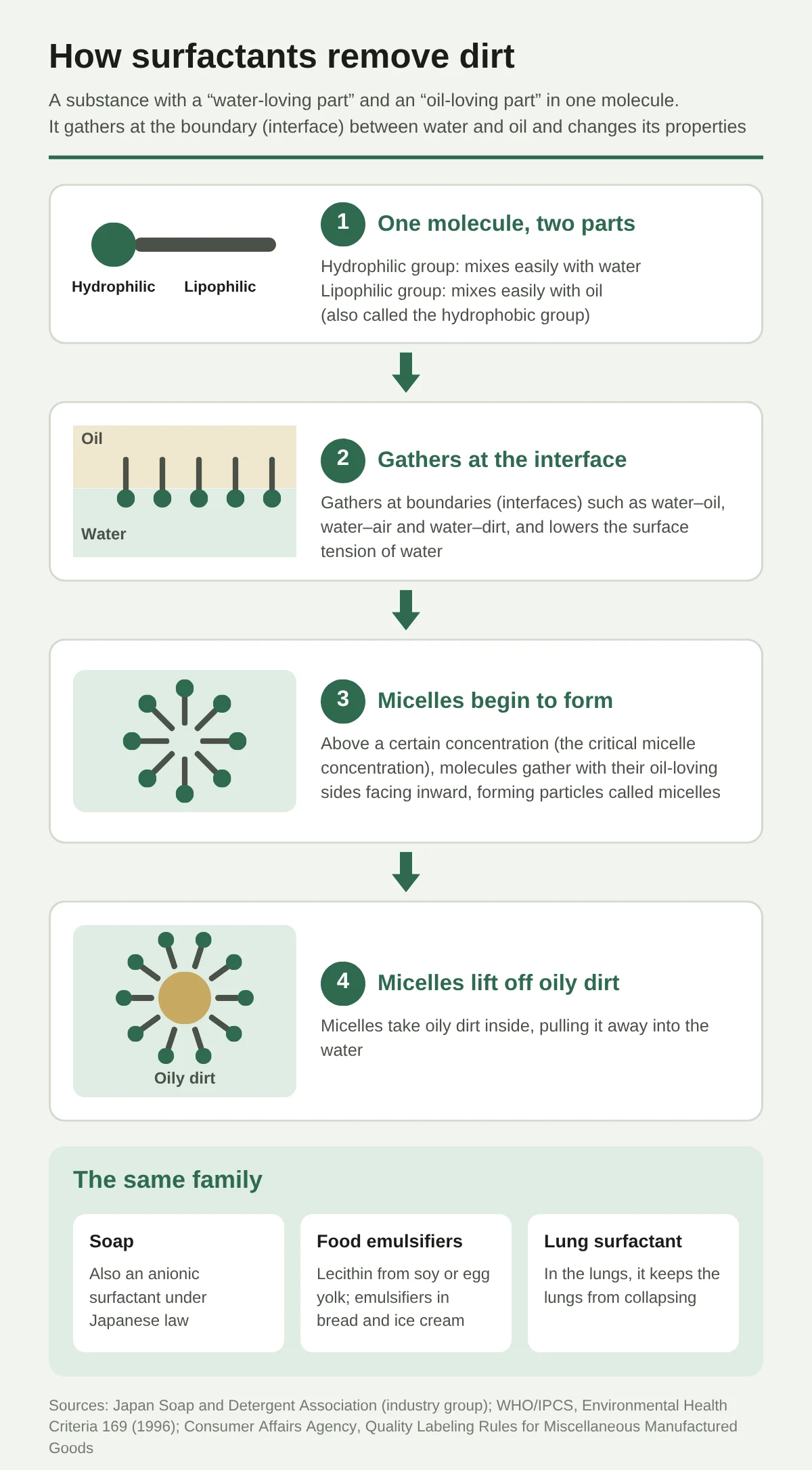
In its new Detergents Regulation of 2026, the EU defined surfactants in law. A surfactant is a substance that “consists of one or more hydrophilic groups and one or more hydrophobic groups, lowers the surface tension of water to below 45 mN/m, forms films or micelles, and adsorbs onto solid surfaces.”
Surfactants are not only for detergents.
- Food: The industry group explains that mayonnaise and butter contain “natural surfactants.” The lecithin in soybeans and egg yolk, and the “emulsifiers” in bread and ice cream, are surfactants too
- Inside the body: They are also made in the body to digest fat (the industry group’s explanation). The lungs contain “pulmonary surfactant,” which keeps the lungs from collapsing
- Medicine: Artificial surfactant is used to treat premature babies who lack pulmonary surfactant (a 1980 Japanese report, described later)
For readers who want to learn how they work from the chemistry, there is an introduction with many illustrations.
Soap is also a surfactant
You may come across pages saying “soap is not a surfactant,” but even in the eyes of the law, soap is a kind of surfactant. The rules that set the labeling for detergents under the Household Goods Quality Labeling Act (the Miscellaneous Industrial Goods Quality Labeling Regulations) divide surfactants into “anionic, nonionic, amphoteric, and cationic,” and list soap (pure soap content = sodium fatty acid salts and potassium fatty acid salts) as one of the “anionic, fatty acid type”.
The same regulations divide products as follows.
| Product category (品名) | The rule (Household Goods Quality Labeling Act) |
|---|---|
| Laundry soap / dish soap (洗濯用石けん・台所用石けん) | The main cleaning action comes from pure soap content. Pure soap content makes up at least 70% (laundry) or at least 60% (dish) of the surfactants, and no other surfactants are included |
| Laundry composite soap / dish composite soap (洗濯用複合石けん・台所用複合石けん) | As above, but also contains surfactants other than pure soap content (on the label, those ingredients are underlined) |
| Laundry synthetic detergent / dish synthetic detergent (洗濯用合成洗剤・台所用合成洗剤) | The main cleaning action comes from surfactants other than pure soap content (those other than pure soap content are over 30% (laundry) or over 40% (dish)) |
These regulations have no category called “synthetic surfactant” (as far as Urayomi has been able to confirm). The phrase “free of synthetic surfactants,” often seen in advertising, is not a term set by law; it is wording that makers use on their own.
The Japan Soap and Detergent Association (an industry group) also explains that “Japan is the only country in the world with a law that treats soap separately from other surfactants” (this is the industry group’s explanation, and Urayomi has not checked the laws of every country).
If you want laundry detergent made of “pure soap content” only, choose a product whose product category is “laundry soap.” Shabondama Soap’s “Snowl” is a liquid laundry soap whose ingredient list is only “純石けん分(30%、脂肪酸カリウム、脂肪酸ナトリウム)” (pure soap content, 30%, potassium fatty acid salt, sodium fatty acid salt).
Soaps from Miyoshi Soap and Shabondama Soap (for laundry, hand soap, shampoo, and more) are also gathered at the eco goods online shop “Eco Depa Japan.”
History and origins
| Year | Event | Source |
|---|---|---|
| 3000s BCE | Soap appears as a medicine on clay tablets from Sumer (present-day Iraq) | JSDA (industry group) |
| Late Sengoku period | Soap reaches Japan on Portuguese ships. Until then, people washed with the fruit skin of the soapberry (mukuroji), the pods of the soap-pod tree (saikachi), lye from ashes, and the like | Same as above |
| 1791 | Leblanc of France opens a plant for soda ash (sodium carbonate), a raw material for soap. In 1861 the Solvay plant in Belgium starts production, and soda can be made cheaply in large quantities | Science History Institute |
| 1870 | The first domestic production of solid soap, at the Kyoto Seimi-kyoku. Two years later, Tsutsumi Isoemon of Yokohama becomes the first private maker | JSDA |
| 1890 | Kao launches the toilet soap “Kao Sekken” | Kao |
| During World War I | In Germany, synthetic detergent begins with the search for a substitute for soap, which uses fats and oils | JSDA |
| 1933 | Alkylbenzene sulfonate (ABS) is developed in Germany and later becomes the mainstream | Same as above |
| 1934 | Daiichi Kogyo Seiyaku’s “Monogen” becomes Japan’s first synthetic detergent | Same as above |
| 1951 | Kao launches “Kao Kona Sentaku” (renamed “Wonderful” in 1953). It spreads along with electric washing machines | Kao |
| 1959 | Domestic soap production peaks at 380,205 tons | JSDA |
| Late 1950s onward | Because ABS does not break down easily, mountains of foam form on European rivers. In its 1961 Detergent Act, Germany sets a minimum standard for the biodegradability of surfactants | Bavarian State Ministry of the Environment |
| 1960s | Easily degraded straight-chain LAS is introduced in place of ABS, and anionic surfactants in rivers decrease in Europe, Japan, and the US. In Japan, foam on rivers becomes a problem around 1964, and the switch to straight-chain types advances around 1966 | WHO/IPCS, JSDA |
| 1963 | In Japan, production of synthetic detergent exceeds that of soap | JSDA |
| 1977 | A large-scale freshwater red tide occurs in Lake Biwa, and a soap movement arises urging people to “use powdered soap.” The 1979 Lake Biwa Ordinance (in force 1980) bans the use and sale of “household synthetic detergents containing phosphorus.” Phosphorus is a builder (an ingredient that aids washing), not a surfactant itself | Shiga Prefecture |
| 1980 | Tetsuro Fujiwara and colleagues report in The Lancet that artificial surfactant was used on 10 premature babies with severe respiratory failure from a lack of pulmonary surfactant, and 8 survived | Fujiwara 1980 |
| 2005 | The EU Detergents Regulation (648/2004) takes effect. It requires the surfactants in detergents to be “ultimately biodegradable” | EU regulation |
| 2011 | In Japan, liquid overtakes powder in synthetic laundry detergent | METI, JSDA |
| 2020 | NITE (National Institute of Technology and Evaluation) announces that 9 types of surfactants in household detergents are effective for “disinfecting objects” against the new coronavirus | NITE |
| 2026 | The EU promulgates a new Detergents Regulation (2026/405). It applies from September 2029 | EU regulation |
Explanations that put the origin of soap at “2800 BCE in Babylon” are also common, but we could not check the original paper, so here we use the industry group’s explanation (3000s BCE).
Research on pulmonary surfactant began in 1959, when Avery and Mead in the US showed that “respiratory distress syndrome in premature babies is caused by a lack of pulmonary surfactant.” A review of the history of medicine places the introduction of replacement therapy in 1980, by Fujiwara and colleagues in Japan. Pulmonary surfactant preparations (Surfacten) are still used today.
Types
Surfactants are divided into four kinds, according to what electric charge the water-loving part carries when dissolved in water.
| Type | When dissolved in water | Main examples (names on detergent labels) | Examples of cosmetic label names | Main uses |
|---|---|---|---|---|
| Anionic | Carries a negative charge | Pure soap content (sodium and potassium fatty acid salts), sodium linear alkylbenzene sulfonate (LAS), sodium alkyl sulfate (AS), sodium alkyl ether sulfate (AES), sodium alpha-olefin sulfonate (AOS) | 石ケン素地 (soap base), カリ石ケン素地 (potassium soap base), ラウリル硫酸Na (sodium lauryl sulfate), ラウレス硫酸Na (sodium laureth sulfate), ココイルグルタミン酸Na (sodium cocoyl glutamate; the so-called amino acid type) | Laundry and dish detergents, shampoo, body wash, foaming agent in toothpaste |
| Cationic | Carries a positive charge | Alkyltrimethylammonium salts, dialkyldimethylammonium salts (quaternary ammonium salts) | ベヘントリモニウムクロリド (behentrimonium chloride), ベンザルコニウムクロリド (benzalkonium chloride) | Fabric softener, rinse and conditioner, disinfection (invert soap) |
| Amphoteric | Changes with the nature of the liquid | Alkyl betaine, alkylamine oxide | コカミドプロピルベタイン (cocamidopropyl betaine) | Dish detergent, shampoo (adjusting foaming and mildness) |
| Nonionic | Carries no charge | Polyoxyethylene alkyl ether (AE), fatty acid alkanolamide, sucrose fatty acid ester, alkyl glycoside | ラウリルグルコシド (lauryl glucoside), ポリソルベート80 (polysorbate 80), コカミドDEA (cocamide DEA) | Liquid laundry detergent, dish detergent, emulsifiers in food, cosmetics, and medicines |
Cationic surfactants stick to the surfaces of hair and fabric, which tend to be negatively charged, so they are used in fabric softeners and rinses. In 1962, Kao launched “Kao Softer,” a softening finish and antistatic agent (renamed “Humming” in 1966).
There are also surfactants made by plants and microorganisms. Saponin, found in the fruit skin of the soapberry and the bark of the quillaja tree, and lecithin from soybeans and egg yolk, are used in Japan as food additives (existing additives). In 1968, Kei Arima and colleagues reported “surfactin,” a surfactant made by Bacillus subtilis.
“Amino acid type,” “plant-derived,” and “naturally derived” are not different ways of saying the type of surfactant; they are statements about raw materials. For example, most amino acid types are anionic surfactants, made from coconut oil fatty acids and amino acids.
How much are they used in Japan?
According to the Ministry of Economy, Trade and Industry (METI) production dynamics statistics, Japan’s production of surfactants (the weight of the surfactants themselves) was about 1.02 million tons in 2025. Compared with 2003, the share of nonionic has risen and the share of anionic has fallen.
Synthetic laundry detergent has shifted greatly over the past 20-odd years from powder to liquid.
Among the surfactants covered by the estimates of household emissions (PRTR), the ones with the largest shipment volumes are, in order, AE (polyoxyethylene alkyl ether), LAS, and AES. According to the Ministry of the Environment’s estimate, of the chemicals released from households in fiscal 2023 (about 34 thousand tons), AE alone made up 35%, LAS 14%, and AES 7.3% (these are amounts before sewage treatment).
Uses and commonly used products
Surfactants are not only for washing.
| Field | Examples |
|---|---|
| Household products | Detergents for clothing, kitchen, home, toilet, and bath; fabric softener |
| Cosmetics and quasi-drugs | Shampoo, body wash, facial cleanser, makeup remover, toothpaste (foaming agent), milky lotion and cream (emulsifier) |
| Food | Emulsifiers (glycerin fatty acid esters, sucrose fatty acid esters, polysorbates, lecithin, and others). Margarine, bread, ice cream, chocolate, coffee creamer, and so on |
| Medicine | Pulmonary surfactant preparations, emulsifiers in injections and ointments |
| Agriculture | Spreaders and emulsifiers for pesticides |
| Industry and others | Textiles, metalworking, paints, foam fire-fighting agents, and so on |
Let’s look at what is actually in products whose makers publish their ingredients (publishing ingredients of household products follows a voluntary standard of the industry group).
| Product group | Product (as published by the maker) | Surfactants listed |
|---|---|---|
| Liquid synthetic laundry detergent | Kao Attack ZERO (380 g bottle) | Polyoxyalkylene alkyl ether, a mixture of hydroxyalkane sulfonate and alkene sulfonate, polyoxyalkylene alkyl ether sulfate, fatty acid salt, polyoxyethylene alkyl ether (no LAS) |
| Synthetic dish detergent | Kao CuCute (220 ml bottle) | Sodium polyoxyalkylene alkyl ether sulfate, alkyl betaine, alkyl glyceryl ether, alkyl glycoside, sodium dialkyl sulfosuccinate |
| Fabric softener | Kao Humming, unscented | Ester-type dialkylammonium salt (cationic), polyoxyethylene alkyl ether, sorbitan fatty acid ester |
| Laundry soap | Shabondama Snowl | 純石けん分(30%、脂肪酸カリウム、脂肪酸ナトリウム) (pure soap content, 30%, potassium fatty acid salt, sodium fatty acid salt) |
There is no fixed pairing such as “liquid detergents contain LAS” or “dish detergents contain amine oxide.” Even within the same kind of product, the makers and products differ. Looking at the “surfactant” field on the back label is the most reliable way (for how to read it, see the article on additive-free detergents).
For a dish detergent that is unscented and uncolored but synthetic, there is Saraya’s “Yashinomi” dish detergent. The maker describes it as “free of petroleum-based synthetic surfactants,” but its product category is “dish synthetic detergent” (台所用合成洗剤), and the surfactants are “16%, sodium alkyl ether sulfate, fatty acid alkanolamide.” It is an example where, even though it is plant-derived, the legal category is “synthetic detergent.”
The same goes for laundry. The All things in Nature laundry detergent is a synthetic laundry detergent (neutral) whose surfactants are “16%, higher alcohol type (nonionic), coconut oil fatty acid alkanolamide.”
What the “strength rankings” really are
Online you often see “cleaning power rankings” and “irritation rankings” such as “higher alcohol type > olefin type > … > amino acid type.” But most of these ranking tables do not say at what concentration, or by what yardstick, the comparison was made.
When you line up studies and official assessments that compared under the same conditions, the order reshuffles each time you change the yardstick.
| Yardstick | “Strong” side | “Weak” side | Source |
|---|---|---|---|
| Skin irritation (people, patch test at the same concentration) | Sodium lauryl sulfate (SLS) | Sodium laureth sulfate (SLES), and further alkyl glycoside (APG) | Löffler & Happle 2003 |
| Skin irritation (people, occluded patch test at 20% for 4 hours) | Betaine type: 94% of people reacted; SLS (SDS): 84% | Mixing both: 44% | Hall-Manning 1998 (researchers at Unilever) |
| Effectiveness against the new coronavirus (disinfecting objects) | Effective: LAS 0.1%, APG 0.1%, amine oxide 0.05%, benzalkonium chloride 0.05%, AE 0.2%, soap 0.22 to 0.24%, and others | Not judged effective: AES (up to 0.5%), alkyl betaine (up to 0.5%), fatty acid alkanolamide (up to 0.2%) | NITE 2020 |
| Toxicity to fish, water fleas, and algae (acute, value for the most sensitive organism) | Cationic type, LAS, SLS, straight-chain AE (1 mg/L or less) | Soap, SLES, betaine (1 to 10 mg/L), APG (carbon 8 to 10) (10 to 100 mg/L) | Danish Environmental Protection Agency 2001 |
| Ease of breakdown (ready biodegradability) | Hard to break down: disinfecting cationic types (benzalkonium and others) | Easy to break down: LAS, SLS, SLES, soap, APG, betaine | Same as above |
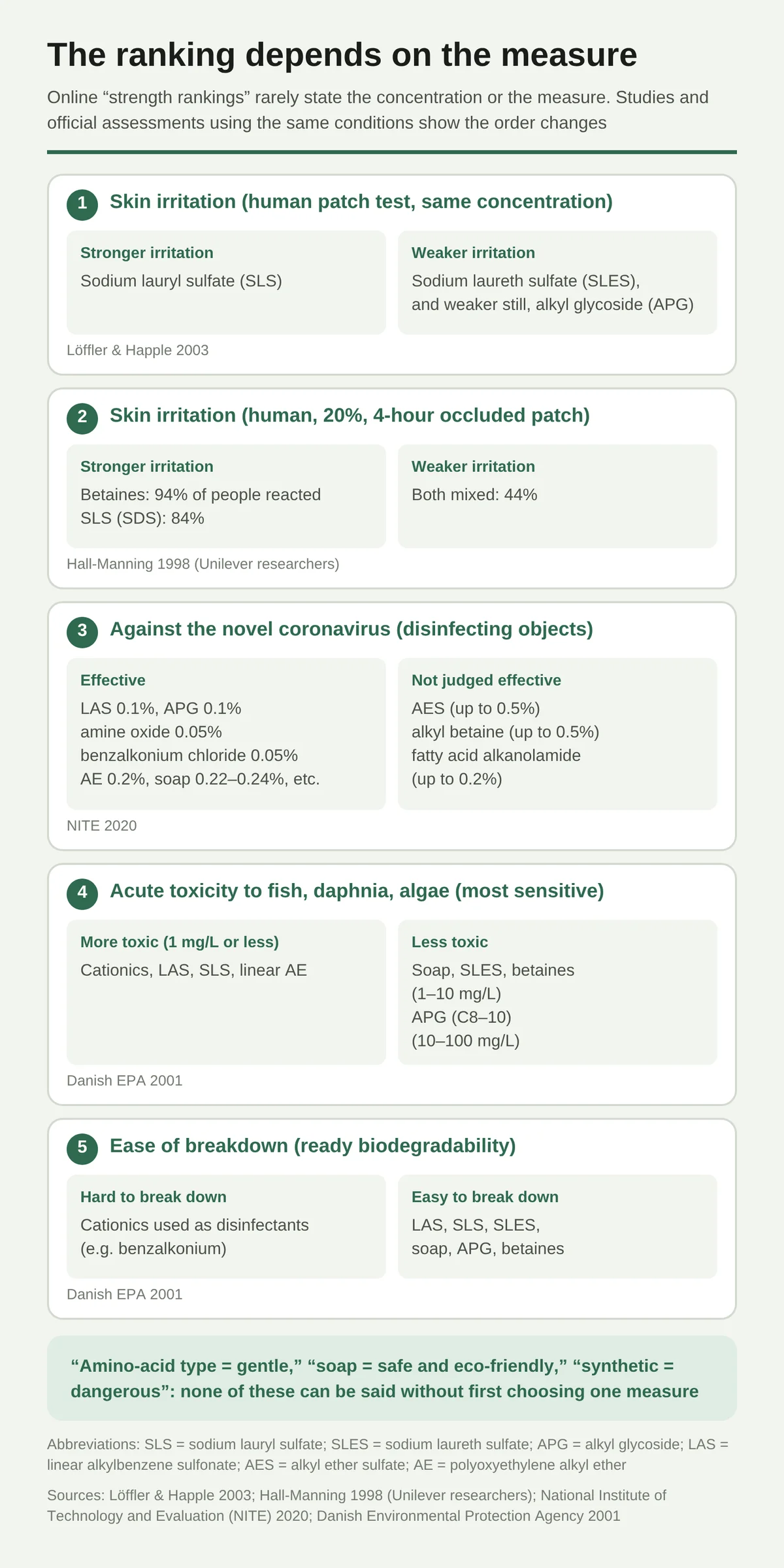
Here is what this table tells us.
- Neither “betaine (amphoteric) is gentle” nor “soap is gentle” holds regardless of conditions: it depends on the conditions. In a test with a 24-hour patch, betaine was less irritating than SLS (Nicander 2003), but with a long application at a high concentration, betaine reacted in more people
- There are differences even within the same type. Among alkyl sulfates, the one with 12 carbons (SLS) was the most irritating, and chains both longer and shorter were weaker (Wilhelm 1993)
- A dermatology review (Effendy & Maibach 1995) states, as a rough trend, that “anionics are widely recognized as irritants, cationics are at least as irritating and more toxic to cells, and nonionics are the least irritating.” It also states that this classification cannot accurately determine how irritating an individual substance is
- We found no official data comparing the cleaning power of each type of surfactant under the same conditions. Cleaning power varies greatly with the kind of dirt (oil, sebum, mud), the hardness of the water, the temperature, and whether builders are present
- There is also the “zein test,” which estimates irritation from how much protein (corn zein) dissolves, but we found no peer-reviewed paper with a table of numbers lining up many surfactants under the same conditions. Raw-material makers’ documents have such tables, but with cautions, such as readings coming out lower than the real value when magnesium is present
In short, “amino acid type = gentle,” “soap = safe and eco-friendly,” and “synthetic = dangerous” are all things that cannot be said unless you first fix a single yardstick.
Effects on the body
First, a summary of what is known and how far.
| Effect | Main substances | Strength of evidence |
|---|---|---|
| Skin irritation (hand eczema, worsening of hand eczema) | Anionics such as SLS; disinfecting cationics | Confirmed in people |
| Contact dermatitis (allergic contact dermatitis) | Cocamidopropyl betaine (mainly impurities), alkyl glucosides, cocamide DEA | Confirmed in people (around 1 to 2% of people who visited a dermatologist) |
| Eye injury | High concentrations of SLS, concentrated detergents | Confirmed in people (accident cases) plus animal studies |
| Poisoning from accidental ingestion | Concentrated liquid detergents, pod-type detergents | Confirmed in people (including deaths) |
| Carcinogenicity | Cocamide DEA (International Agency for Research on Cancer classification 2B) | Animal studies only (no evidence in people) |
| Worsening of mouth ulcers | SLS in toothpaste | There are human trials, but the results are inconsistent |
| Asthma | Spray detergents, disinfecting cationics | Observational studies in people (inconsistent) |
| Gut bacteria and intestinal inflammation | Emulsifiers in food (polysorbate 80 and others) | Mouse studies plus observational studies in people only |
| Entering through the skin and building up in the body | SLS, LAS | Absorption is very small, and what is absorbed is metabolized and excreted (mainly animal and test-tube studies) |
Skin: hand eczema
The clearest effect on the body from surfactants is hand eczema.
- SLS is used as the “standard irritant” in studies of skin irritation. The European Society of Contact Dermatitis has issued guidelines for tests that use SLS, and in dermatology clinics in Germany and elsewhere, 0.25% SLS is applied in patch tests as a control to see how easily the skin reacts. In an analysis of patch tests on 43,478 people, 22.4% were positive (mostly weak redness), and strong reactions were more common in men, people aged 40 and over, people with work-related dermatitis, and people with hand eczema (Forkel 2026)
- The WHO/IPCS assessment says that LAS, AOS, and AS “remove fats from the skin surface, dissolve out natural moisturizing factors, denature proteins in the outer layer of the epidermis, and make the skin more permeable to water and other substances.” It also says that solutions of up to 1% applied for 24 hours caused only mild irritation
- The Japanese Dermatological Association’s “Guidelines for the Management of Hand Eczema” (2018) say that irritant hand eczema is caused by “everyday items such as chemicals and detergents,” and that such reactions occur more readily where the skin barrier is already weakened. It says protective gloves for wet work “may be considered” (strength of recommendation C1), and, because wearing them for a long time can instead damage the skin, recommends wearing cotton gloves underneath
If hand eczema from washing dishes bothers you, there are household gloves. Showa Glove’s “Nice Hand Mu” is a medium-thickness glove made of vinyl chloride.
Contact dermatitis (allergy)
Separate from irritant hand eczema, there is also “contact dermatitis” (allergic contact dermatitis, かぶれ), which occurs when the body reacts to a specific ingredient.
- Cocamidopropyl betaine (an amphoteric surfactant in shampoos and the like) was chosen as the American Contact Dermatitis Society’s “Allergen of the Year” for 2004. The cause is thought to be impurities left over from manufacturing (amidoamine and dimethylaminopropylamine)
- Alkyl glucosides (decyl glucoside and lauryl glucoside) were the “Allergen of the Year” for 2017. In a test on 24,097 people at North American dermatology clinics, 2.0% were positive
- In a North American test of 10,877 people from 2009 to 2014, 1.4% were positive for cocamidopropyl betaine, 0.8% for cocamide DEA, and so on
These are figures for people who visited a dermatologist for dermatitis and were tested, not how many people in the general population react. They also show that contact dermatitis can occur even with alkyl glucosides and betaines, which are often described as “plant-derived.”
Eyes
In a US cosmetic ingredient review report (CIR 1983), when 10% SLS was put into rabbits’ eyes and not rinsed out, the cornea was damaged. The explanation from the Japan Poison Information Center, which the National Consumer Affairs Center of Japan cites, also says that liquid laundry detergents “may damage the cornea if they get into the eyes.” If it gets into the eyes, rinse immediately and thoroughly with water.
Accidental ingestion: pod-type liquid detergents
“Pod-type liquid detergents” (so-called gel balls), which wrap concentrated liquid detergent in a water-soluble film, continue to cause accidental ingestion by children and older adults.
- According to the Consumer Affairs Agency and the National Consumer Affairs Center of Japan, from April 2014, when the leading products appeared, to the end of January 2015, 152 accident reports were collected. 72.4% involved children aged 3 or under; 68.4% were put in the mouth or swallowed, and 30.3% got into the eyes
- In 2024, the National Consumer Affairs Center of Japan announced that accidents in which older adults aged 70 and over accidentally put them in the mouth were also occurring, and that there were 2 cases of death after putting one in the mouth
- Synthetic liquid laundry detergents contain about 20 to 75% anionic and nonionic surfactants (about 50 to 75% for concentrated types) (from a book edited by the Japan Poison Information Center and materials from the National Consumer Affairs Center of Japan)
- In 2024 the Japan Poison Information Center received 22,475 consultations, of which 296 were about clothing detergents (192 of them for children aged 5 and under)
Since June 2015, the EU has legally required pod-type liquid detergents to have an opaque outer package, a lid that is hard for children to open, a bitter taste that makes them spit it out within 6 seconds of putting it in the mouth, and a film that does not dissolve for 30 seconds in water. The US takes similar measures through a voluntary industry standard. We could not check the content of the voluntary measures of the Japanese industry this time.
In homes with children or people with dementia, keep pod types out of reach with the lid closed.
If swallowed: effects on the whole body
- According to the WHO/IPCS assessment, LAS, AOS, and AS are absorbed from the digestive tract, reach the whole body, are metabolized, and are excreted mainly in urine
- The guide values for acute toxicity (the dose at which half of the rats die, LD50) are 404 to 1,470 mg per kg of body weight for LAS, 1,000 to 4,120 mg for AS, and 0.8 to 1.1 g for SLS. These are values for animals and cannot be directly translated into dangerous doses for people
- The International Agency for Research on Cancer (IARC) classifies cocamide DEA (coconut oil fatty acid diethanolamide) as “possibly carcinogenic to humans (2B)” (2013). The basis is animal studies; there is no evidence in people. LAS, SLS, SLES, and quaternary ammonium salts have not been evaluated by IARC
Mouth: toothpaste and mouth ulcers
Many toothpastes contain SLS to make them foam. Study results on the link between recurrent mouth ulcers (recurrent aphthous stomatitis) and SLS are inconsistent.
- A systematic review (Alli 2019) pooling four randomized controlled trials (124 people) found that toothpaste without SLS reduced the number, duration, and pain of mouth ulcers, and concluded “there may be a benefit, but higher-quality trials are needed”
- In a 90-person trial (Shim 2012), the number of ulcers did not change, and only the duration and pain decreased. In a 47-person trial (Healy 1999), there was no difference
If you have recurring mouth ulcers and want to try a toothpaste without SLS, look at the “foaming agent” (発泡剤) and “cleaning agent” (洗浄剤) fields on the label. Shabondama Soap’s “Soap Toothpaste” (せっけんハミガキ) has soap base (石ケン素地) as its cleaning agent and contains no sodium lauryl sulfate (ラウリル硫酸Na).
Breathing: sprays and disinfectants
In a survey across 10 European countries, among people who used spray detergents at home at least once a week, new asthma symptoms or medication use occurred 1.49 times as often, and doctor-diagnosed asthma 2.11 times as often among those using them at least 4 days a week. No association was seen with non-spray detergents (Zock 2007). It is not known which ingredient is responsible.
For cationic surfactants in disinfectants (quaternary ammonium salts), there are case reports and surveys suggesting a link with asthma among health care workers. On the other hand, a large follow-up study of nurses in the US found no association with asthma (though there was one with COPD), so the results are inconsistent.
Emulsifiers in food and the gut
Some of the emulsifiers in food are also surfactants.
- In a 2015 study in Nature, mice given drinking water containing 1% of the emulsifier polysorbate 80 (a surfactant) or carboxymethylcellulose (CMC, a thickener, not a surfactant) for 12 weeks developed mild intestinal inflammation and obesity (Chassaing 2015)
- In people, there is a small trial comparing 7 people who took 15 g of CMC a day for 11 days (14 days for the first 3 people) with 9 who did not; the diversity of gut bacteria dropped (Chassaing 2022). We found no trial that gave polysorbate 80 to people
- In a follow-up study of about 100,000 people in France (NutriNet-Santé), links have been reported between emulsifier intake and cardiovascular disease, cancer, and type 2 diabetes. However, this is an observational study and does not show that emulsifiers cause disease. Also, the “emulsifiers” in this study include things that are not surfactants, such as CMC, carrageenan, and guar gum, and polysorbate 80 was eaten by few people and was not examined individually
Does it “enter through the skin and build up in the body”?
The WHO/IPCS assessment says that LAS and others “seem to be absorbed only very slightly through intact skin” and that what is absorbed is metabolized and excreted. It also says that long contact can damage the skin barrier and increase absorption. The details are in the article on transdermal toxins and household products.
Treatment in Japan and abroad: is anything banned?
To put the bottom line first, among the countries we checked (Japan, the EU, the US, and Canada), none bans “surfactants” as a whole. Regulation is decided by “which substance,” “for what use,” and “at what concentration.”
| Topic | Japan | EU | US |
|---|---|---|---|
| Ban on surfactants as a whole | None | None (for detergents, ease of breakdown is a condition) | None |
| Biodegradability of surfactants in detergents | No legal requirement | Required. At least 60% (or 70%) must break down in 28 days (since 2005; new regulation from September 2029) | No federal legal requirement found |
| Labeling of surfactants in detergents | Total content (%) and the names of the types included at 3% or more | Ranges of “less than 5% / 5 to 15% / 15 to 30% / 30% or more” for each class (anionic, nonionic, and so on) | No federal labeling requirement found |
| Nonylphenol type (NPE) | Class II Specified Chemical Substance under the Chemical Substances Control Law (CSCL) since April 2025 (labeling required for water-based cleaners). For household detergents, the industry has voluntarily stopped using it since around 1982 | Since 2005, banned at 0.1% or more in 9 uses including cleaning and cosmetics. Since 2021, textile products such as clothing are also banned at 0.01% or more | Proposed rule (2014); the industry voluntarily stopped using it in commercial laundry detergents |
| Fluorinated types (PFOS, PFOA, and others) | Manufacture and import in principle banned under the CSCL (PFOS 2010, PFOA 2021) | Regulated in line with the international treaty (Stockholm Convention). PFAS banned in fire-fighting foam from October 2030 | Drinking water limits (2024) |
| Herbicide adjuvant (POE tallowamine) | Not confirmed whether it is on the banned list (33 substances) | Banned in glyphosate products in 2016, and not allowed in any pesticide from 2021 | — |
| 1,4-Dioxane (an impurity that gets mixed in during manufacturing) | No upper limit in cosmetics standards (0.05 mg/L for tap water) | A banned substance in cosmetics (technically unavoidable traces allowed) | New York State: 1 ppm or less for household cleaning and personal care products, 10 ppm or less for cosmetics |
| Antibacterial soap | In 2016 the MHLW asked for a switch of medicated soaps containing 19 ingredients including triclosan | — | In 2016 the FDA did not recognize 19 ingredients. Judgment deferred on 3 ingredients including benzalkonium chloride |
| Emulsifiers in food | Only permitted ones may be used. They can be labeled together as “emulsifier” (乳化剤) | Only permitted ones (E numbers). EFSA is re-evaluating them | — |
A short note on the reason for each.
- EU biodegradability: Based on its experience with foam on rivers in the 1950s and 60s, the EU requires the surfactants used in detergents to be “ultimately biodegradable.” Those that do not meet this cannot be used in detergents, so they are in effect shut out. The new regulation promulgated in March 2026 (2026/405) extends the biodegradability requirement to the film of detergent capsules and the like
- Nonylphenol ethoxylates (NPE): These are nonionic surfactants that break down in the environment into nonylphenol. Nonylphenol is highly toxic to fish and others, and hormone-disrupting effects have been reported in fish. In 2012, Japan added nonylphenol to its environmental standards for protecting aquatic life
- Fluorinated types: They are part of the “PFAS” that do not break down and accumulate in the body and the environment. For the story of frying pan coatings, see the article on Teflon coating
- POE tallowamine: In 2015, the European Food Safety Authority (EFSA) said it was “more toxic than glyphosate in every item examined” and that the data on human poisoning from herbicides could possibly be explained by this adjuvant
- 1,4-Dioxane: A substance that can be mixed in a little as a by-product when making surfactants to which ethylene oxide has been added, such as sodium laureth sulfate (SLES) (it is not an ingredient put in on purpose). IARC classifies it as 2B
- Allowable amounts of emulsifiers in food: The acceptable daily intake (ADI) for polysorbates is 10 mg per kg of body weight in the Food Safety Commission of Japan’s draft assessment and 25 mg in EFSA’s, because the studies they relied on differ
Tap water quality standards include limits to prevent foaming: anionic surfactants at 0.2 mg/L or less and nonionic surfactants at 0.02 mg/L or less.
Environment: what is the state of foam on rivers now?
- In March 2013, Japan added LAS to its “environmental standards for the conservation of aquatic life.” The limits are 0.03 mg/L or less for river and lake waters where char and salmon live, and 0.05 mg/L or less for waters where carp and crucian carp live, and so on. In fiscal 2023, the achievement rate was 100% for rivers, lakes, and seas
- At a sewage treatment plant in Kitakyushu City (measured in December 2021), LAS in the incoming water was 0.5 to 1.3 mg/L, and in the treated water discharged it was about 0.001 to 0.002 mg/L
- Soap is also toxic to aquatic life (the 1 to 10 mg/L band in the table above). It is sometimes pointed out that “soap is used in larger amounts and puts a heavier organic load on rivers,” but we could not confirm official comparison data
The new coronavirus and surfactants
In 2020, a committee of NITE (National Institute of Technology and Evaluation) and the Ministry of Economy, Trade and Industry judged, based on tests by the National Institute of Infectious Diseases and others, that 9 types of surfactants in household detergents are effective for disinfecting objects against the new coronavirus.
| Surfactant | Concentration judged effective |
|---|---|
| Sodium linear alkylbenzene sulfonate (LAS) | 0.1% or more |
| Alkyl glycoside | 0.1% or more |
| Alkylamine oxide | 0.05% or more |
| Benzalkonium chloride | 0.05% or more |
| Benzethonium chloride | 0.05% or more |
| Dialkyldimethylammonium chloride | 0.01% or more |
| Polyoxyethylene alkyl ether | 0.2% or more |
| Pure soap content (potassium fatty acid salt) | 0.24% or more |
| Pure soap content (sodium fatty acid salt) | 0.22% or more |
There are also points to note.
- The target is objects; use as a spray on hands, skin, or in the air was not examined. Also, safety was not evaluated
- Sodium alkyl ether sulfate (AES) and alkyl betaine up to 0.5%, and fatty acid alkanolamide up to 0.2%, were “not judged effective”
- The committee included officers of an industry group (the Japan Soap and Detergent Association) as members
- The list of products containing effective surfactants stopped being updated at the end of October 2021
The words “additive-free,” “plant-derived,” and “amino acid type”
- For cosmetics advertising, the Japan Cosmetic Industry Association’s guideline (a voluntary industry standard) says that for “additive-free” (無添加), you should state what has not been added, and not emphasize it. It also gives as an example of unusable wording phrases that guarantee safety, such as “safe even for sensitive skin”
- Detergents (as miscellaneous goods) are not covered by the Pharmaceuticals and Medical Devices Act; the Household Goods Quality Labeling Act and the Act against Unjustifiable Premiums and Misleading Representations apply. In April 2021, the Consumer Affairs Agency issued a cease-and-desist order under the Act against Unjustifiable Premiums and Misleading Representations to the seller of the laundry product “Sentaku Mag-chan” (洗たくマグちゃん), which claimed to wash without detergent. This was because no reasonable basis was shown for statements such as “weakly alkaline ionized water has a surface-active action that breaks down fats and oils, just like detergent”
- Baking soda (sodium bicarbonate), sodium sesquicarbonate, and citric acid are alkalis or acids and are not surfactants
Points to check on the back label
- Look at the product category (品名): “soap,” “composite soap,” or “synthetic detergent” tells you what the main cleaning ingredient is
- Look at the “surfactant” (界面活性剤) field: for detergents, it gives the total content (%) and the names of the types included at 3% or more. For cosmetics, look near the start of the full ingredient list
- “Plant-derived,” “amino acid type,” and “free of synthetic surfactants” are statements about raw materials or phrasing. They do not mean that no surfactant is included
- If your hands are bothered, review how you use the product before the ingredients (gloves, rinsing, amount used). The guidelines also recommend gloves
- If you have ever had contact dermatitis from a specific ingredient, remember its label name (cocamidopropyl betaine, decyl glucoside, and so on)
- Keep pod-type detergents out of reach of children and older adults
Urayomi’s approach
Surfactants, soap included, are useful substances that link water and oil. By the same token, they also remove the oils of the skin, and at high concentrations they injure the eyes and mouth. This is the same for soap and for synthetic types.
On the other hand, when you look into claims such as “synthetic surfactants are dangerous” and “they are banned overseas,” they are often about regulation of specific substances (such as NPE and PFAS) for specific uses, and the main surfactants in familiar detergents (LAS, AES, AE, soap, and so on) are not banned as a group.
Urayomi does not decide which is “safe” or “dangerous.” It lays out what is written on the back label and what is known about it.
Summary
| Featured | What kind of product | Link |
|---|---|---|
| Shabondama Snowl, bottle 1000 mL | Laundry soap (pure soap content 30%) | See on Rakuten (シャボン玉石けん公式) PR See on Amazon.co.jp PR See on Yahoo! Shopping PR |
| Eco Depa Japan | Online shop for eco goods carrying Miyoshi and Shabondama soaps | エコロジー雑貨のオンラインショップ エコデパジャパン PR PR |
| Saraya Yashinomi dish detergent, bottle 500 mL | Synthetic dish detergent (16% surfactants), unscented and uncolored | See on Rakuten (サラヤ公式) PR See on Amazon.co.jp PR See on Yahoo! Shopping PR |
| All things in Nature laundry detergent | Synthetic laundry detergent (16% surfactants, plant-derived) | 100%植物由来の洗浄成分!!湘南生まれの洗剤【All things in Nature】 PR PR |
| Showa Glove Nice Hand Mu, medium-thick, M | Household gloves (vinyl chloride) | See on Rakuten (スグル屋本舗) PR See on Amazon.co.jp PR See on Yahoo! Shopping PR |
| Shabondama Soap Toothpaste (せっけんハミガキ) 140 g | Toothpaste whose cleaning agent is soap base | See on Rakuten (シャボン玉石けん公式) PR See on Amazon.co.jp PR See on Yahoo! Shopping PR |
| 『図解入門 よくわかる最新 界面活性剤の基本と仕組み』 | An introductory book on surfactants (Katsuhiro Saito, Shuwa System) | See on Rakuten (楽天ブックス) PR See on Amazon.co.jp PR |
Sources
Official bodies and laws
- Consumer Affairs Agency, “Miscellaneous Industrial Goods Quality Labeling Regulations (No. 27: synthetic detergents, laundry or dish soaps, and cleaning agents for housing or furniture)”
- Ministry of Economy, Trade and Industry (METI), “Production Dynamics Statistics, Chemical Industry Statistics” (e-Stat, 2003 to 2025)
- Ministry of the Environment, “Fiscal 2023 PRTR Estimation Method for Non-Notified Emissions, Reference 7: Emissions from Cleaning Agents, Cosmetics, and the Like” and “Overview of Fiscal 2023 PRTR Data” (2025)
- Ministry of the Environment, “Addition of Items to the Water Quality Environmental Standards for the Conservation of Aquatic Life” (2013), “Fiscal 2023 Results of Water Quality Measurements in Public Water Areas” (2025), the revision of the CSCL Enforcement Order (NPE, 2024), and “Q&A Collection on PFOS and PFOA” (2024)
- NITE (National Institute of Technology and Evaluation), “Evaluation of the Effectiveness of Alternative Disinfection Methods against the New Coronavirus (Final Report)” (2020) and “Current Status and Future Direction of Risk Management of Nonylphenol and Nonylphenol Ethoxylates” (2004)
- Consumer Affairs Agency and the National Consumer Affairs Center of Japan, “Watch Out for Pod-Type Liquid Laundry Detergents!” (2015); the National Consumer Affairs Center of Japan, “Accidents from Pod-Type Liquid Laundry Detergents Do Not Stop” (2024); Consumer Affairs Agency, “On the Cease-and-Desist Order under the Act against Unjustifiable Premiums and Misleading Representations against Miyamoto Seisakusho Co., Ltd.” (2021)
- Japan Poison Information Center, “2024 Annual Report on Inquiries Received”
- Japanese Dermatological Association, “Guidelines for the Management of Hand Eczema” (2018)
- MHLW, “Ministerial Ordinance on Water Quality Standards,” “Standards for Cosmetics,” and “On the Handling of Medicated Soaps” (2016)
- Food Safety Commission of Japan, “Draft Assessment of Polysorbates” (2007)
- Shiga Prefecture, “What Is Biwako Day?” and “Shiga Prefecture Ordinance on Preventing Eutrophication of Lake Biwa”
- Bavarian State Ministry of the Environment (Germany), explanation of the “Detergent Act”
- WHO/IPCS, “Environmental Health Criteria 169: Linear alkylbenzene sulfonates and related compounds” (1996)
- International Agency for Research on Cancer (IARC), list of classifications
- Danish Environmental Protection Agency, “Environmental Project No. 615” (2001)
- EU regulations 648/2004 and 2026/405 (detergents), Directive 2003/53/EC and Regulations 2016/26 and 2017/999 (NPE), Regulation 1297/2014 (pod-type detergents), Implementing Regulation 2016/1313 and Regulation 2021/383 (co-formulants in pesticides), Regulation 2025/1988 (fire-fighting foam), Cosmetics Regulation 1223/2009 and Regulation 866/2014
- EFSA (European Food Safety Authority), re-evaluations of polysorbates (2015), lecithins (2017), and E471 (2017)
- New York State Department of Environmental Conservation, “1,4-Dioxane Limits”; the US FDA final rule on antibacterial soaps (2016); California OEHHA (Proposition 65)
- Stockholm Convention Secretariat, “The new POPs”
Papers
- Fujiwara T et al. Lancet 1980 (artificial surfactant); Obladen M. Biol Neonate 2005; Avery ME, Mead J 1959; Arima K et al. 1968 (surfactin)
- Löffler H, Happle R. Contact Dermatitis 2003; Nicander I et al. Skin Res Technol 2003; Hall-Manning TJ et al. Food Chem Toxicol 1998; Wilhelm KP et al. J Invest Dermatol 1993; Effendy I, Maibach HI. Contact Dermatitis 1995; Goffin V et al. 1995; Ward RK et al. 1998
- Tupker RA et al. Contact Dermatitis 1997 (guidelines for SLS tests); Forkel S et al. Contact Dermatitis 2026
- Jacob SE, Amini S. Dermatitis 2008; Fowler JF et al. Dermatitis 2015; Sasseville D. Dermatitis 2017; Warshaw EM et al. J Am Acad Dermatol 2022
- Valdez AL et al. Pediatrics 2014 (pod-type detergent accidents in the US)
- Alli BY et al. J Oral Pathol Med 2019; Shim YJ et al. Oral Dis 2012; Healy CM et al. Oral Dis 1999
- Zock JP et al. Am J Respir Crit Care Med 2007; Dumas O et al. Am J Ind Med 2020 and JAMA Netw Open 2019
- Chassaing B et al. Nature 2015 and Gastroenterology 2022; Sellem L et al. BMJ 2023 and PLoS Med 2024; Salame C et al. Lancet Diabetes Endocrinol 2024
- CIR, “Final Report on the Safety Assessment of Sodium Lauryl Sulfate and Ammonium Lauryl Sulfate,” 1983 (the CIR is an assessment body funded by the industry group)
Industry groups and makers
- Japan Soap and Detergent Association (JSDA), “What Are Surfactants?”, “Detergent Memo Sheets (History of Products; Detergents and the Law),” “From the Origins of Soap to Its Arrival in Japan,” “History,” and “Trends in Detergent Sales”
- Japan Cosmetic Industry Association, “Guidelines for Proper Advertising of Cosmetics and the Like,” 2020 edition
- Kao, “History of Products” and the ingredient information for Attack ZERO, CuCute, and Humming
- Science History Institute, “Making the Process”
Related articles and databases
- Choosing an additive-free detergent: soap vs. synthetic detergent, and how to read the back label
- How to Choose Additive-Free Shampoo and Body Soap: Soap-Based vs. Amino Acid-Based, and How to Read the Full Ingredient List
- Are “transdermal toxins” (経皮毒) a myth or real? Do ingredients in shampoo and detergent enter through the skin, and what labels leave out
- Are Teflon (Fluoropolymer) Nonstick Pans Harmful? History, Types, How PFAS Rules Have Changed, Overheating and Food Transfer, and How to Choose Alternative Materials
- Are Microwave Ovens Bad for You? History, How They Work, Use Around the World, Safety, Nutrition (vs. Boiling and Stir-Frying), the “Microwave Cover” Claim, and How to Use and Choose One