
Are Microwave Ovens Bad for You? History, How They Work, Use Around the World, Safety, Nutrition (vs. Boiling and Stir-Frying), the “Microwave Cover” Claim, and How to Use and Choose One

PR This article contains affiliate links to Rakuten Ichiba, Amazon, Yahoo! Shopping and A8.net (“See on Rakuten”, etc.). What is written here is based on official sources and studies, whether or not there is an ad. The “See on Amazon.co.jp” links are also affiliate links.
Warming rice, warming frozen food, prepping vegetables. In Japan, almost every home has a microwave oven.
At the same time, you often hear things like “microwaving destroys nutrients,” “electromagnetic waves stay in the food,” “eating microwaved food changes your blood,” and “some countries have banned them.” You may also see products described as “nutrients don’t drop if you use a microwave cover.”
In this article, we check the following against national statistics, laws, official sources and studies:
- When, where and how was the microwave oven invented?
- How does it heat food?
- How widely is it used around the world, and which country has the highest ownership?
- Do attitudes differ between Japan and other countries?
- Is the microwave oven safe? Is there any harm in eating microwaved food over and over?
- What happens to nutrients? How does it compare with boiling, grilling and stir-frying (gas flame or open fire)?
- Is it true that “nutrients don’t drop if you use a microwave cover”?
- How to use it well, what not to do, power costs, and how to choose one
For cookware materials, see our articles on Teflon-coated cookware and aluminum products and food.
Conclusions
- The microwave oven came from a radar component (the magnetron). Spencer of Raytheon in the US filed a patent in October 1945. In Japan, Toshiba completed the first unit in 1959, and Sharp began mass production in 1962. The “chin” (ding) sound is said to have been chosen by a Sharp developer from the sound of a bicycle bell
- Food heats because “water molecules try to turn to follow the direction of the microwaves.” The frequency (2,450 MHz) is set by Japan’s Radio Act. The explanation “2.45 GHz is the resonant frequency of water” is wrong
- Household ownership in Japan is 97.8% (2014, households of two or more people). The US is also 96.1% (2020); in both countries almost every home has one. By contrast, Germany is 72.2% (2023) and Italy is 53.0% (2018), which is lower. However, survey years and counting methods differ by country, so there is no statistic that can name a “world No. 1”
- Both Japan and the US set a limit on microwave leakage (5 mW/cm² or less at 5 cm from the surface). Measured in practice, leakage was about 1% of the limit (German Federal Office for Radiation Protection). No microwaves or radioactivity remain in food (US FDA and others)
- The accidents that really are common come from “heat” and “fire,” not microwaves. The National Consumer Affairs Center of Japan (NCAC) receives 80 to 100 consultations a year about microwave oven accidents. The causes include frozen food, dirt inside the oven, eggs and sweet potatoes
- No study has shown that eating microwaved food over time causes disease. The often-cited study claiming “blood changes” (Switzerland, 1992) examined only 8 people and was published in a journal without peer review. However, there are studies showing that heating plastic containers makes chemicals and very small plastic particles more likely to be released
- Nutrients are not lost because “it is a microwave oven.” They decrease because they dissolve into water and because heat breaks them down. Calculated from the Standard Tables of Food Composition in Japan, broccoli keeps 44% of its vitamin C when boiled and 91% when microwaved. However, for some foods, such as sweet corn, more remains when boiled
- “Microwave covers eliminate the loss of nutrients” cannot be claimed. We found no study comparing only with and without a cover. Even in microwave cooking without water, vitamin C and folate decrease
Items featured in this article
| Item featured | When it helps | Where in this article |
|---|---|---|
| イワキ パック&レンジ and HARIO heat-resistant glass storage containers | When you are concerned about heating plastic containers | ガラスや陶磁器の容器に移す |
| Skater official shop (microwave-safe containers) | When looking for microwave-safe resin containers and lunch boxes | ガラスや陶磁器の容器に移す |
| Tanita cooking thermometer | When you want to check that reheated food reached 75°C | 温め直しは75℃を目安に |
| Frozen rice containers | When you want to freeze rice in portions | 冷凍ごはんの温め方 |
| FIT FOOD HOME (additive-free frozen side dishes) | When you want to choose side dishes to microwave by their ingredients | 冷凍食品は表示のワット数で |
| レンジメート プロ (microwave cooker) | When you want to make grilled fish without using a fish grill | 電子レンジで焼き魚を作る調理器 |
| Microwave-only models (Panasonic, Sharp, Iris Ohyama) | When you mainly warm, defrost and prep food | 単機能レンジ |
| Microwave ovens with oven (combination ovens) (Panasonic, Toshiba) | When you also want to bake bread and make grilled dishes | オーブンレンジ(23L クラス) |
| Steam combination ovens (Sharp Healsio, Panasonic Bistro) | When you also want to steam food and use superheated steam | スチーム(過熱水蒸気)オーブンレンジ(30L) |
How was the microwave oven invented?
It came from a radar component (US)
The heart of a microwave oven is a vacuum tube called a “magnetron.” It was originally used during World War II to generate radar waves.
Percy Spencer, an engineer at Raytheon in the US, is said to have noticed that a sweet in his pocket had melted while he stood near a magnetron. He then tried popcorn and an egg (American Physical Society, National Inventors Hall of Fame).
- The kind of sweet is unclear. It is often said to be a “chocolate bar,” but his grandson says it was a peanut sweet he carried to give to squirrels
- The patent was filed on October 8, 1945, and granted on January 24, 1950 (US Patent 2,495,429, “Method of Treating Foodstuffs”). Some sources give the discovery as “1946,” but that does not match the patent filing date
- The patent text compares cooking one egg at 2 kW·seconds (versus 36 kW·seconds with earlier methods)
The first product, the “Radarange,” came out in 1947. It was about 1.8 m tall, weighed about 340 kg and cost about $5,000, and was for commercial use such as restaurants. A model small enough for a home kitchen was released in 1967 by Amana (a Raytheon subsidiary) at $495 (IEEE Spectrum, Smithsonian Magazine).
In Japan, Toshiba and Sharp
| Year | Event | Source |
|---|---|---|
| 1959 | Toshiba completes Japan’s first unit (DO-2273A) | Toshiba Lifestyle |
| 1961 | Toshiba launches a commercial model. It was used in dining cars of Japanese National Railways and in department-store restaurants | Toshiba Lifestyle |
| 1961–62 | Sharp develops the R-10 and begins mass production in 1962 (mainly commercial use, such as hotels) | Sharp |
| 1966 | Sharp releases the R-600, Japan’s first domestically made turntable-type home model | Sharp |
| 1987 | Household ownership in Japan exceeds half for the first time (52.2%) | Cabinet Office |
Both Toshiba and Sharp claim to be “Japan’s first.” Toshiba was first to complete and release a unit; Sharp was first to mass-produce one. Some sources call the turntable a “world first,” but Sharp’s official description says “Japan’s first.”
The “chin” sound came from a bicycle bell
People who used the Sharp R-10 said things like “I didn’t notice it was done and the food got cold,” and the developer is said to have visited bicycle shops and compared bell sounds to choose a sound to signal the end (Kaden Watch’s Sharp company history series). “Chin suru” (to “ding” something) is even listed in dictionaries as “to heat in a microwave oven (slang).”
How a microwave oven works
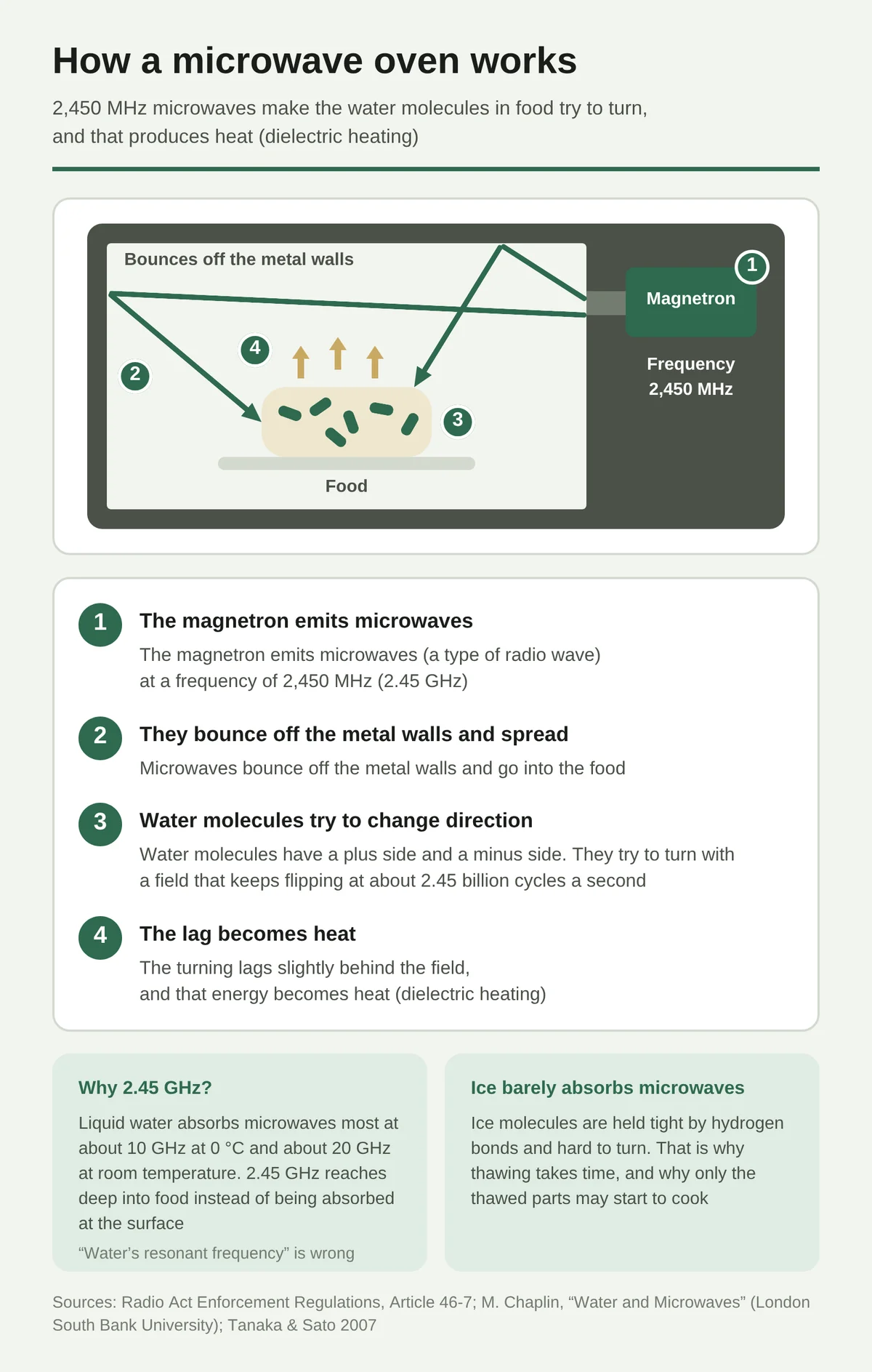
- The magnetron emits microwaves (a type of radio wave) at a frequency of 2,450 MHz (2.45 GHz)
- The microwaves bounce off the metal walls, spread through the cavity and enter the food
- The water molecules in food have an uneven distribution of positive and negative charge. The electric field of the microwaves switches direction about 2.45 billion times per second, so water molecules try to rotate to follow it
- The rotation lags slightly behind the electric field, and that energy becomes heat (dielectric heating)
An explanation often used is “water molecules rub against each other and warm up from friction.” Encyclopedias word it similarly, but strictly speaking the heat comes from “the lag as molecules try to rotate (dielectric loss)”; friction is an analogy.
People also say “a microwave oven heats from the inside.” In fact, everything within the depth the microwaves reach (about a few centimeters) heats at the same time, and heat then spreads from there to the center of a large piece of food (NITE, explanation from London South Bank University).
Why 2.45 GHz?
You may see the explanation “2.45 GHz is the resonant frequency of water,” but this is wrong. The frequency at which liquid water absorbs microwaves most strongly changes with temperature: about 10 GHz at 0°C and about 20 GHz at room temperature. 2.45 GHz was chosen so that the waves are not all absorbed at the surface and reach deep into the food (explanation by Chaplin of London South Bank University).
The band around 2,450 MHz (2,400–2,500 MHz) is internationally allocated as the “ISM band” (industrial, scientific and medical use). Wi-Fi (the 2.4 GHz band) and Bluetooth use the same band. This is why Wi-Fi can become unstable while a microwave oven is running, and manufacturers recommend moving the router away from the microwave oven or switching to the 5 GHz band.
Why frozen food is slow to thaw and why metal sparks
- Ice absorbs almost no microwaves. The molecules in ice are locked tightly by hydrogen bonds and rotate poorly (Tanaka & Sato 2007). This is why thawing frozen food takes time and why only the parts that have melted may start to boil
- Salty food heats more easily. Dissolved ions move and collide with water molecules (same source)
- Metal reflects microwaves, and electric charge collects at sharp points and thin spots, causing sparks. You cannot use aluminum foil, metal containers, or dishes with gold or silver patterns (Hitachi)
What does the law require?
Legally, a microwave oven in Japan is “high-frequency utilization equipment,” and installing one would normally require government permission. Because manufacturers obtain the government’s “type verification,” households can use them without a permit (Article 46-7 of the Radio Act Enforcement Regulations).
| What is set | Details | Law |
|---|---|---|
| Frequency | 2,450 MHz ± 50 MHz | Radio Act Enforcement Regulations, Article 46-7 |
| Output | Rated 2 kW or less | Same as above |
| Leaked microwaves | 5 mW/cm² or less at 5 cm from the surface, even after the door has been opened and closed 100,000 times | Same as above; technical standards under the Electrical Appliance and Material Safety Act |
| Device that stops operation when the door opens | Two or more. Must not be operable from outside with a rod or the like | Technical standards under the Electrical Appliance and Material Safety Act |
Microwave-only models, microwave ovens with oven, and steam combination ovens
| Type | How it heats | Suited for |
|---|---|---|
| Microwave-only model | Microwaves only | Mainly warming, defrosting and prep |
| Microwave oven with oven (combination oven) | Microwaves + heater (oven and grill) | When you also want to bake bread and sweets, or make grilled dishes |
| Steam (superheated steam) combination oven | The above plus steam | Steaming; reducing dryness in reheated food |
NITE explains that “microwave heating” warms food from the inside with electromagnetic waves, while “heater heating” cooks it from the outside with heat from a heater. A combination oven has both in one unit. We cover how to choose in Recommended microwave ovens and how to choose.
Microwave ovens around the world: Which country has the highest ownership?
Japan: Passed half in 1987, now almost every household
In the Cabinet Office survey, ownership among Japanese households (two or more people) was 2.1% in 1970. It passed half for the first time in 1987 at 52.2% and reached 96.5% in 2004. The Cabinet Office stopped asking about microwave ovens after that year; the later Ministry of Internal Affairs and Communications (MIC) survey gives 97.5% in 2009 and 97.8% in 2014. The 97.8% in 2014 was the fifth highest, after refrigerators, washing machines, TVs and vacuum cleaners. For one-person households it is 92.4%.
Ownership by country
| Country | Ownership | Year | Source |
|---|---|---|---|
| Japan | 97.8% | 2014 (households of two or more people) | MIC National Survey of Family Income, Consumption and Wealth |
| US | 96.1% | 2020 | US Energy Information Administration (RECS) |
| Canada | 94.2% | 2009 | Statistics Canada |
| UK | 93% | FY 2017/18 | Office for National Statistics |
| Ireland | 91.8% | 2019 | Central Statistics Office, Ireland |
| France | 89.3% | 2017 (provisional) | National Institute of Statistics and Economic Studies (INSEE) |
| Germany | 72.2% | 2023 | Federal Statistical Office of Germany |
| Italy | 53.0% | 2018 | Censis (a private research institute) |
| China (urban) | 60.65 units per 100 households | 2011 | National Bureau of Statistics of China |
We cannot name the “country with the highest ownership.” We found no official international statistic that lines countries up on the same basis. As far as we could verify, Japan and the US are in the highest group, with almost every household owning one. Note, however, that Japan’s 97.8% is for households of two or more people and drops slightly when one-person households are included.
What we can say clearly is that there is a large gap even within Europe. In Germany, more households own a dishwasher (78.0%) than a microwave oven (72.2%), and in Italy only about half of homes have one. In urban China, ownership differed widely by region: 98 units per 100 households in Shanghai versus 37 in Heilongjiang Province (2011). A research firm gives a figure of “less than 4%” for India, but we could not verify the original source.
Do attitudes differ between Japan and other countries?
| Japan | Abroad | |
|---|---|---|
| How it is used | About two-thirds of the microwave ovens sold are combination ovens (a trade-paper article reporting manufacturers’ data). There is a word, “chin suru” | In the US, about 30% of households that own one use it 15 or more times a week (US Energy Information Administration). In Germany and Italy, many households do not own one |
| Frozen food | Per-person consumption reached a record 24.6 kg in 2025 (Japan Frozen Food Association) | ― |
| Worry that it is “bad for you” | We found no survey measuring the share | In England, 19% believe “using a microwave oven causes cancer” (2016, survey of 1,330 people) |
“The USSR (Russia) banned microwave ovens” is a myth
The story that “the Soviet Union banned microwave ovens by law in 1976” still circulates online. Traced back, it comes from a 1998 magazine article that gave no evidence. A former Raytheon engineer, who bought a Soviet-made microwave oven, the “Elektronika” (around 1980), wrote that “there is no evidence of a ban” (IEEE history site, 2013). An Australian news agency’s fact-check (2024) also rated it “false,” noting that more than 2 million microwave ovens were sold in Russia in the first half of 2024.
| Common claim | Verdict |
|---|---|
| It was discovered when a chocolate bar melted | Several sources agree that a sweet melted. Whether it was chocolate is unclear |
| 2.45 GHz is the resonant frequency of water | Wrong (water absorbs most strongly at about 10 GHz at 0°C and about 20 GHz at room temperature) |
| Food heats from the friction of water | Used as an analogy, but strictly it is dielectric heating |
| The USSR banned it in 1976 | Myth (no evidence) |
| Sharp’s turntable was the world’s first | Cannot be verified (Sharp’s description says “Japan’s first”) |
Is the microwave oven safe?
Leaked microwaves have a limit
| Limit | Rule | |
|---|---|---|
| Japan | At 5 cm from the surface, 1 mW/cm² or less with the door closed; 5 mW/cm² or less with the door opened up to just before the point where it stops operation; 5 mW/cm² or less even after the door has been opened and closed 100,000 times | Technical standards under the Electrical Appliance and Material Safety Act; Radio Act Enforcement Regulations |
| US | At 5 cm or more from the surface, 1 mW/cm² or less before sale and 5 mW/cm² or less afterward | Federal regulation 21 CFR 1030.10 (FDA) |
| Germany | 5 mW/cm² (50 W/m²) or less at 5 cm from the surface | German Federal Office for Radiation Protection (BfS) |
When the German Federal Office for Radiation Protection measured them, the amount leaking was about 1% of the limit on average. At 30 cm away it falls to 5–10% of the level at the surface, and at 1 m away to 1/30–1/100. The office states that “with technically sound equipment, there is no health risk, including for pregnant women and babies.” The FDA cautions, however, that you should not use a microwave oven whose door is warped or does not close properly.
No microwaves or radioactivity remain in food
Microwaves are not “ionizing radiation” like the X-rays used in medical imaging. They disappear when the power is switched off; they do not remain in food, and food does not become radioactive (US FDA, US Environmental Protection Agency, Cancer Research UK). The Tokyo Metropolitan Government also explains that “the electromagnetic waves of a microwave oven do not change food into something harmful to the body.”
The FDA says that most microwave oven injuries are burns from hot containers, overheated food and splattering liquid, not from microwaves.
The accidents that really are common come from “heat” and “fire”
From April 2020 through December 2025, the National Consumer Affairs Center of Japan (NCAC) received 521 consultations about accidents while using a microwave oven (80 to 100 a year).
| Food or item involved | Cases |
|---|---|
| Frozen food and ingredients | 37 |
| Dirt inside the oven | 30 |
| Deli food containers | 30 |
| Microwave grill cookers | 30 |
| Eggs | 26 |
| Sweet potatoes | 18 |
| Retort-pouch food | 18 |
| Lunch box containers | 16 |
| Bread | 14 |
| Rice | 9 |
Source: NCAC (published March 25, 2026). Only the main items are extracted.
Among cooking appliance accidents reported to the National Institute of Technology and Evaluation (NITE) from 2019 to 2023, microwave ovens were the most common at 149 of 494 cases, and about 40% of those whose cause was identified involved incorrect use or carelessness. In the Tokyo Fire Department’s jurisdiction, there were 84 microwave oven fires in 2024, and in 76 of them the fire started inside the oven.
In the NCAC’s reproduction tests:
- When about 100 g of sweet potato was heated continuously at 500 W, smoke appeared in about 8 minutes and it caught fire in about 11 minutes, and the pressure inside the oven pushed the door open
- When food residue was stuck on the cover over the microwave outlet, the microwaves concentrated there and it caught fire (in the 2021 test, in about 20 seconds)
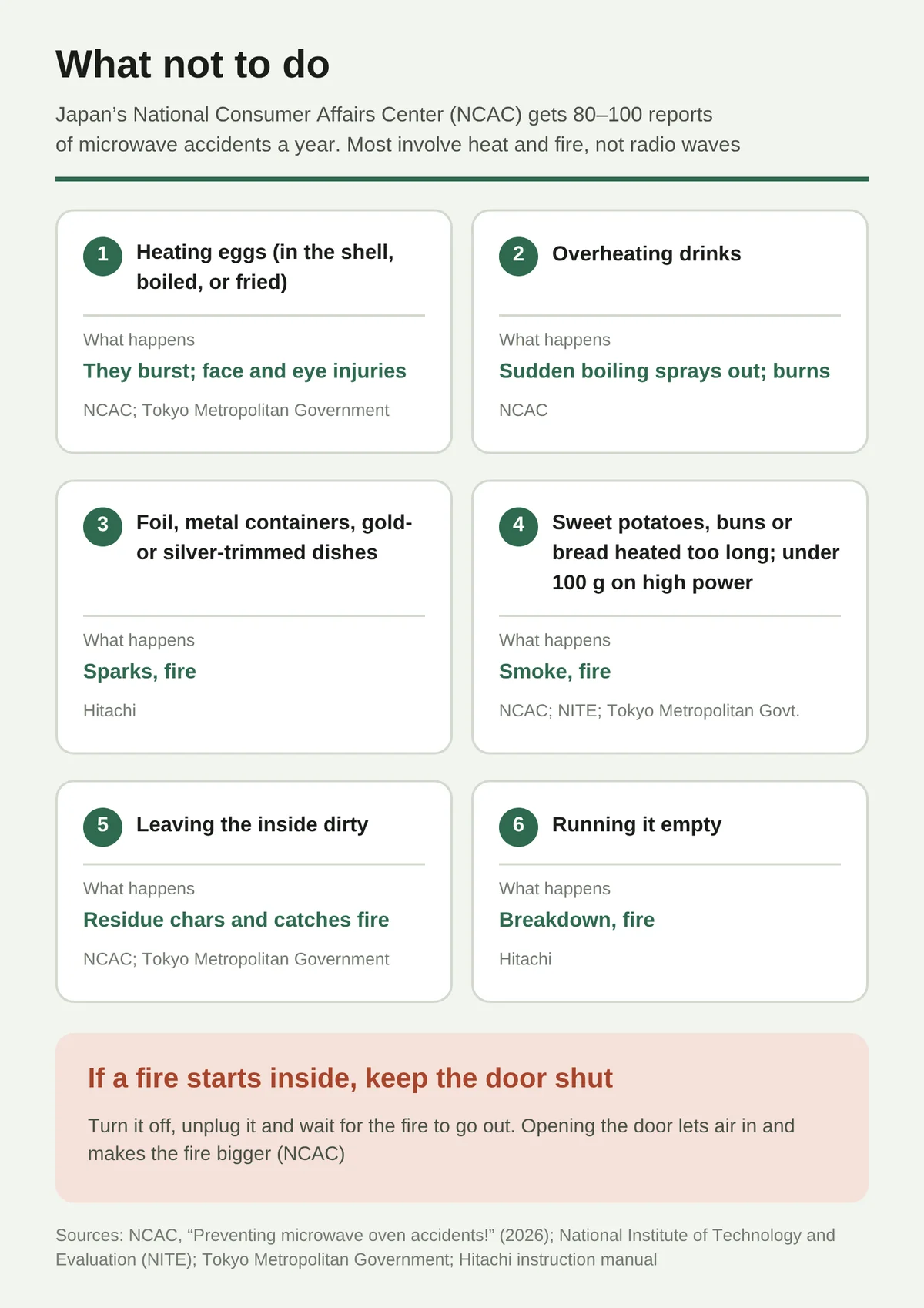
If a fire starts inside the oven, do not open the door. Switch it off, unplug it, and wait for the fire to go out. Opening the door lets air in and makes the fire stronger (NCAC).
Sudden boiling (bumping): drinks suddenly erupt
If you overheat water, milk, coffee, miso soup and the like, they can erupt all at once when you take them out or put a spoon in. In an NCAC test, about 150 mL of coffee heated for 2 minutes at 1000 W erupted in about a minute and a half.
- Heat for a shorter time. Use the drink function if there is one
- Stir before heating. Use a short container with a wide mouth
- If you have overheated it, leave it in the oven for 1 to 2 minutes before taking it out
Eggs can burst even when hard-boiled
Steam has nowhere to escape inside the shell and membrane, so pressure rises and the egg bursts. In a test heating one raw egg at 500 W, the white spurted out in about 1 minute and the egg burst about 15 seconds later (NCAC). Even a peeled hard-boiled egg or a fried egg can burst after you take it out or when you put it in your mouth (Tokyo Metropolitan Government). There are also reports of facial burns and eye injuries (Wolf 2001 and others). Beat eggs before heating them.
What about pacemakers?
In the 1970s there were reports of microwave ovens affecting pacemakers. The FDA says that “today’s pacemakers are built to prevent electrical interference, and this problem has been largely solved.” If you are concerned, check with your doctor and the pacemaker’s instructions.
Is there any harm in eating microwaved food over and over?
The Swiss study claiming “blood changes if you keep eating it”
A frequently cited study online is by Hertel et al. in Switzerland (published in a journal in 1992). It claims that after eating food cooked in a microwave oven, hemoglobin in the blood decreased and cholesterol increased.
- Only 8 people were examined. It was also published in a journal without expert review (peer review), and it is not listed in PubMed, the medical literature database
- In 1998 the European Court of Human Rights ruled that Switzerland’s decision violated the Convention, but that ruling is about whether banning the researcher from speaking infringed “freedom of expression.” The judgment says speech should not be restricted even if “the opinion is a minority view and appears to lack basis,” and it did not recognize the study as correct
The report that “amino acids in milk change into a harmful form”
In 1989, Lubec et al. in Austria sent a short letter to the medical journal The Lancet reporting that the form of amino acids changed (L-form to D-form) in infant formula heated in a microwave oven. In later research, when milk was heated in the same way in a microwave oven and in a hot water bath and compared, there was no difference (Petrucelli 1994). Another study also says “the microwave oven is an appropriate way to heat milk” (Vasson 1998).
Do not heat breast milk or formula in a microwave oven
The Ministry of Health, Labour and Welfare (MHLW; its Japanese translation of the WHO and FAO guidelines) says not to use a microwave oven when warming milk. The reason is that heating is uneven and some parts become hot (hot spots), which could burn a baby’s mouth. The US CDC also says not to use a microwave oven to thaw or warm breast milk. The CDC also gives “nutrients are destroyed” as a reason.
As for components, one study found that when breast milk was heated to 72°C or above, the components that protect against bacteria (lysozyme and IgA) decreased substantially (Quan 1992). On the other hand, another study found no difference between microwave and hot water bath heating below 60°C (Ovesen 1996), so the issue is not “the microwave oven” itself but “the temperature getting too high” and “uneven heating.”
What about substances formed by charring?
| Substance | What is known | Source |
|---|---|---|
| Heterocyclic amines (from charred meat) | Microwaving for 1 to 3 minutes before grilling cut the amount after grilling to 1/3 to 1/9 | Felton 1994. Sugimura et al. of the National Cancer Center Japan also recommend using a microwave oven in cooking (2004) |
| Acrylamide (formed when potatoes and grains are heated at high temperature) | Not detected in vegetables heated in a microwave oven or boiled | National Institute of Health Sciences (2004) |
| Acrylamide (when heated until charred) | When potato chips were microwaved until charred, the amount was higher than in fried ones | Yuan 2007, Michalak 2011 |
If you only warm or steam food in a microwave oven, almost no substances from charring are formed. However, they can form in a microwave oven too if you heat food until it burns.
What really deserves care is the “container”
What studies point to as a problem is not the microwave oven itself but plastic containers and plastic wrap.
| What is known | Source |
|---|---|
| When a food-simulating liquid (water or acetic acid) was put in a polypropylene container and microwaved for 3 minutes, up to 4.22 million microplastic particles and 2.1 billion nanoplastic particles were released per cm² of container | Hussain 2023 (University of Nebraska, US) |
| Additives released by heat may be miscounted as plastic particles | Gerhard 2022 (including researchers at the German Federal Institute for Risk Assessment) |
| 42 intentionally added substances and more than 100 non-intentionally added substances were released from microwave-safe containers | He 2021 |
| The longer a container had been used and the longer it was heated, the more phthalates (plasticizers) were released | Moreira 2014 |
The effects on the body of eating microplastics are not yet known. We cover this in more detail in the Microplastics and Food Database.
Where Japan and other regions differ is bisphenol A (BPA). BPA is a raw material of polycarbonate and other plastics. In the EU, the European Food Safety Authority (EFSA) sharply lowered the tolerable intake in 2023, and in December 2024 the use of BPA in food-contact materials was banned. Japan began a system in June 2020 that manages the raw materials of food containers and utensils with a government-set list (the positive list system), but it has not banned BPA.
Heat resistance of plastic wrap
| Wrap material | Heat resistance |
|---|---|
| Polyvinylidene chloride (common for households) | 140°C |
| Polyethylene (common for households) | 110°C |
| Polyvinyl chloride (common for commercial use) | 130°C |
| Polyolefin-based (common for commercial use) | 150°C |
Source: FSCJ “Food wrap film” fact sheet (2014). Values published by major manufacturers.
The Food Safety Commission of Japan (FSCJ) says that wrapping oily food (meat, fish, tempura, croquettes) directly in wrap and heating it can push the temperature above 140°C, and recommends putting it in a deeper container so the wrap does not touch the food. Do not use wrap with the oven function.
Transfer food to glass or ceramic containers
If you are concerned about what comes out of plastic, the easiest approach is to transfer food to heat-resistant glass or a ceramic dish before heating. When buying a container, check the heat-resistance temperature and “microwave safe” on the label required by the Household Goods Quality Labeling Act. Do not heat plastic containers with no label, or disposable containers from deli food and bento (Hitachi, US Department of Agriculture). Even ceramics cannot be used if they have gold or silver patterns, because they spark.
Are there studies that followed people who kept eating it?
As far as we could find on PubMed, no study followed the relationship between how much people use a microwave oven and diseases such as cancer or heart disease. As a close example, a Canadian pancreatic cancer study (179 people) reported that microwave cooking was associated with lower risk (Ghadirian 1995), but it was one item among many dietary habits asked about, and cannot be called a cause.
The World Health Organization (WHO) says “microwave ovens that meet the standards are not harmful to health,” and the German Federal Office for Radiation Protection says “heating in a microwave oven is no more harmful than conventional cooking methods.”
On the other hand, note that a microwave oven tends to heat unevenly, and bacteria can survive. In Alaska, US, all 10 people who reheated takeout pork in a microwave oven got Salmonella food poisoning, while the 20 who reheated it in an oven or frying pan did not (Gessner 1994). In 2007, 401 people in 41 US states got Salmonella food poisoning, mainly people who ate frozen pot pies heated in a microwave oven (CDC). We cover how to heat food in How to use it well.
Does a microwave oven destroy nutrients? Comparison with boiling, grilling and stir-frying
Comparing with the Standard Tables of Food Composition in Japan
The MEXT “Standard Tables of Food Composition in Japan (Eighth Revised Edition), 2023 Supplement” lists the components of the same food raw, boiled, microwaved, grilled, stir-fried in oil and so on. Microwave cooking is listed for 5 foods: potatoes, sweet corn, broccoli, salmon and tuna (8 items when counted separately, such as with or without skin, or lean and fatty tuna).
The table values are “per 100 g after cooking,” so they cannot be compared as they are. Boiled food absorbs water and gets heavier, while microwaved food loses moisture and gets lighter. Using the formula given in the tables (value per 100 g after cooking × weight change rate ÷ value per 100 g raw), we calculated how much remains in the amount made from 100 g of raw food.
Broccoli (percentage when raw is 100, %)
| Component | Boiled | Grilled | Stir-fried in oil | Microwaved |
|---|---|---|---|---|
| Vitamin C | 44 | 59 | 71 | 91 |
| Potassium | 51 | 98 | 98 | 99 |
| Vitamin B1 | 39 | 87 | 89 | 96 |
| Folate | 61 | 113※ | 118※ | 66 |
| β-carotene | 102※ | 104※ | 101※ | 101※ |
Sweet corn (same)
| Component | Boiled | Microwaved |
|---|---|---|
| Vitamin C | 83 | 66 |
| Folate | 100 | 90 |
| Vitamin B1 | 88 | 94 |
※ Values above 100 come from variation in analysis or from heating making components easier to extract; they do not mean the amount “increased.”
- When broccoli is boiled, vitamin C, potassium and vitamin B1 drop to around half. They dissolve into the cooking water, and the water is thrown away. With the microwave oven, more than 90% remained
- But the microwave oven is not always the best. For sweet corn, more vitamin C and folate remained when boiled. Vitamin D in salmon and vitamin B6 in tuna were also lower with the microwave oven than with grilling
- β-carotene (a fat-soluble vitamin) hardly dropped with any cooking method
- The tables give analysis values for single cooking runs and do not state the microwave oven’s power, time or whether wrap was used (only sweet corn: 600 W, 5 minutes). You will not necessarily get the same result at home
Summary of studies
Kojima et al. of the National Institute of Health and Nutrition compiled about 1,300 data points from 49 papers published up to 2014. The average vitamin C retention was 46% for boiling, 63% for deep-frying, 71% for pan-frying/stir-frying, 80% for microwave ovens and 83% for steaming. The institute concludes that “steaming” and “microwave cooking” retain it relatively well. For spinach, it was 57% for boiling (83 data points) and 88% for microwave ovens (6 data points).
| Study | What was found |
|---|---|
| Ohba 1988 (potatoes) | Vitamin C: microwave oven 96%, steaming 67%, oven 62%, boiling 28% |
| Song & Thornalley 2007 (cruciferous vegetables) | Glucosinolates (components that give pungency and aroma) hardly decreased with steaming, microwaving or stir-frying. About 90% moved into the water when boiled |
| Pellegrini 2010 (cruciferous vegetables) | With the microwave oven, color and glucosinolates were retained well. Vitamin C dropped substantially with every cooking method |
| Lee 2018 (Korean vegetables) | Vitamin C was retained well with the microwave oven and dropped the most when boiled. For vitamin K, the microwave oven caused the biggest drop in some vegetables |
| US FDA | Microwave cooking does not lower nutritional value more than ordinary cooking |
Where did “microwave ovens destroy nutrients” come from?
The study often cited is by Vallejo et al. of a Spanish research institute (2003). It was reported that flavonoids (a type of polyphenol) dropped by 97% in microwaved broccoli. According to reports, however, in this experiment only the microwave group had the broccoli heated while soaked in water. López-Berenguer et al. of the same institute later varied the microwave time, power and water amount and concluded that the main causes of loss are “long heating time” and “a large amount of water” (2007).
In other words, what determines the loss is not “whether it is a microwave oven” but the amount of water, heating time and temperature. Even boiling retains more with a small amount of water and a short time, and even in a microwave oven, nutrients wash out if you add plenty of water and heat for a long time. In the National Institute of Health and Nutrition’s summary as well, when chickpeas were microwaved for 15 minutes with 10 times their weight in water, only 14% of the niacin remained.
What about oxalic acid in spinach?
When spinach is boiled, oxalic acid, a component of its harsh taste (aku), goes out into the water. The Tokyo Metropolitan Government explains that oxalic acid remains with microwave cooking. On the other hand, NARO introduces a study showing that cutting spinach into 1 cm pieces and microwaving it (for example, 600 W for 2 minutes) reduced oxalic acid about as much as boiling did, without reducing lutein. For vegetables with a strong aku, soak them in water after heating (Agency for Natural Resources and Energy).
Is it true that “nutrients don’t drop if you use a microwave cover”?
What the sales pages say
On the sales pages for microwave lids and covers and for dedicated microwave cookers, we found claims such as “doesn’t let nutrients and flavor escape” and “nutrients and umami don’t escape.” For example, the hometown-tax donation (furusato nozei) site description for the dedicated microwave cooker “レンジメート プロ プラス” says, “because it keeps microwaves from reaching the ingredients directly… nutrients and flavor don’t escape.” As far as we checked, none of the pages showed data from a comparison test.
Also, when you search Rakuten Ichiba for “レンジプロテクター” (microwave protector), what comes up is mainly stain-guard mats and covers that go on top of or inside the microwave oven. In this article, we check “lids, covers and dedicated cookers” used for cooking.
Is there research to back it up?
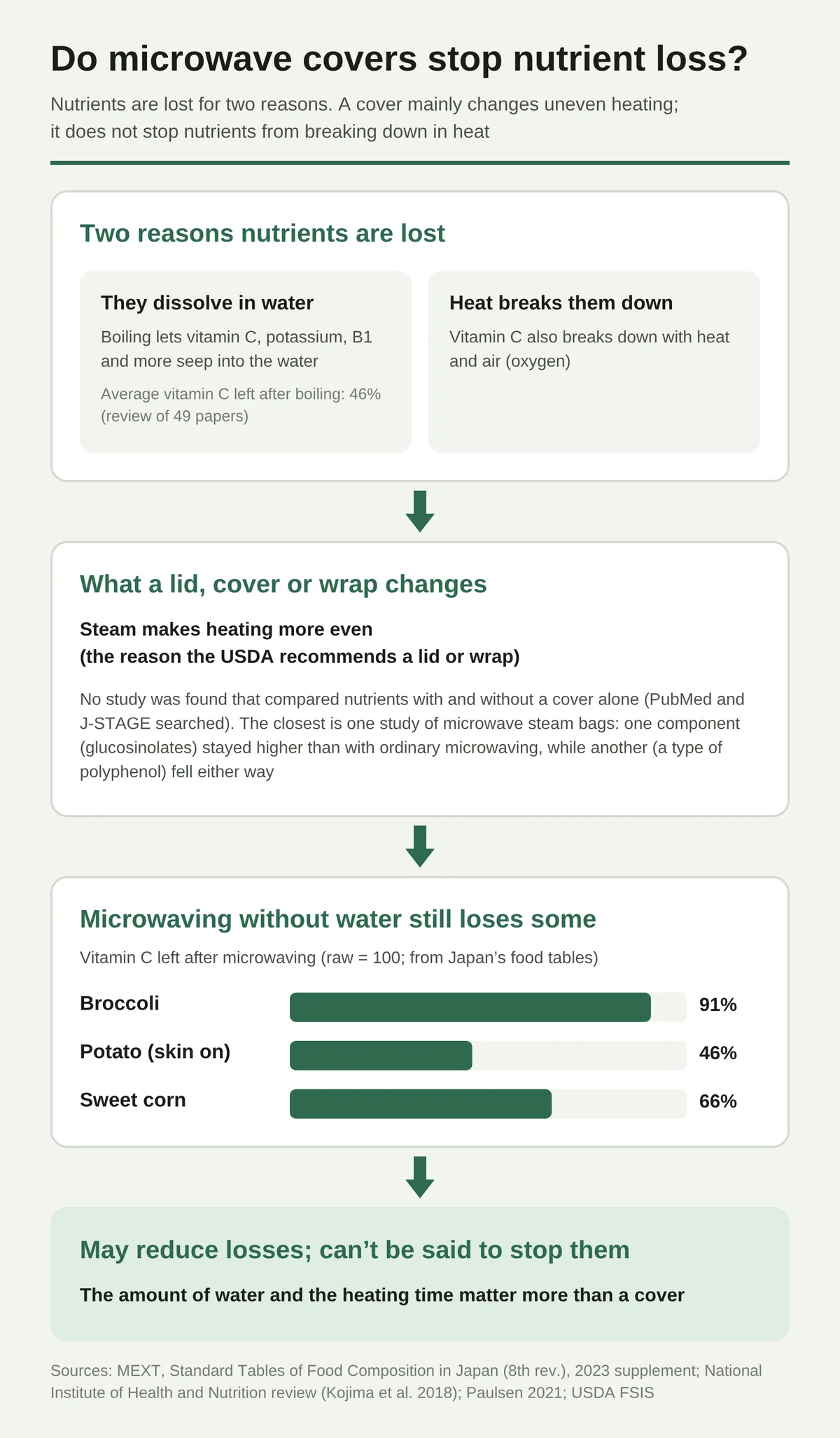
- We found no study that compared nutrients while changing only whether a lid or cover was used (searched PubMed and J-STAGE)
- The closest is a study on steam bags for microwave ovens. When broccoli was heated in a bag, more glucosinolates remained than with ordinary microwave heating. However, other polyphenols (hydroxycinnamic acid types) decreased both in the bag and with ordinary heating (Paulsen 2021)
- Components decrease even in microwave cooking without water. In the food composition tables, only 91% of vitamin C in broccoli, 46% in unpeeled potatoes and 66% in sweet corn remained after microwave cooking. This is because vitamin C also breaks down with heat and air (oxygen)
Conclusion: it may “make losses smaller,” but we cannot say they “disappear”
| What can be said | What cannot be said |
|---|---|
| For many foods, microwaving with a small amount of water for a short time retains more water-soluble nutrients (vitamin C, B1, potassium and others) than boiling in plenty of water and discarding the water | That using a cover makes nutrient loss “disappear” |
| Heating in a steam bag left more of some components than ordinary microwave heating (one study) | “Nutrients aren’t destroyed because microwaves don’t hit the food” (microwaves hitting food does not by itself reduce nutrients) |
| Lids and wrap reduce uneven heating through steam (the reason the US Department of Agriculture recommends lids and wrap) |
What greatly affects how much remains is not the cover but the amount of water and the heating time. Even if a product description flatly states that it “keeps nutrients in,” if it does not say compared with what, which components, and how much remains, there is no way to verify it.
The Act against Unjustifiable Premiums and Misleading Representations prohibits labeling that makes a product’s quality look significantly better than it is, and the Consumer Affairs Agency can require the submission of materials supporting a claim (the rule on advertisements lacking substantiation). Among cooking appliances, cease-and-desist orders were issued to 7 companies over “carb-cut rice cookers” in 2023–2024 (one company’s order was finally revoked by a court ruling in June 2026).
How to use it well
Converting wattage
Calculate the time as “labeled wattage × labeled time ÷ wattage you are using” (Panasonic). If something labeled for 600 W is heated at 500 W, about 20% longer is a guide (Yamagata Prefecture).
| When the label says 600 W | 500 W | 600 W | 700 W | 800 W | 1000 W | 1500 W (commercial) |
|---|---|---|---|---|---|---|
| 1 min | 1 min 12 s | 1 min | 51 s | 45 s | 36 s | 24 s |
| 2 min | 2 min 24 s | 2 min | 1 min 43 s | 1 min 30 s | 1 min 12 s | 48 s |
| 3 min | 3 min 36 s | 3 min | 2 min 34 s | 2 min 15 s | 1 min 48 s | 1 min 12 s |
| 4 min | 4 min 48 s | 4 min | 3 min 26 s | 3 min | 2 min 24 s | 1 min 36 s |
| 5 min | 6 min | 5 min | 4 min 17 s | 3 min 45 s | 3 min | 2 min |
| When the label says 500 W | 600 W | 700 W | 800 W | 1000 W |
|---|---|---|---|---|
| 1 min | 50 s | 43 s | 38 s | 30 s |
| 2 min | 1 min 40 s | 1 min 26 s | 1 min 15 s | 1 min |
| 3 min | 2 min 30 s | 2 min 9 s | 1 min 53 s | 1 min 30 s |
These are calculated guides. There are three points to note:
- The Japan Frozen Food Association recommends heating frozen food at 500 W or 600 W. High power such as 1000 W, or the automatic “warm” button, can cause overheating and uneven heating
- Some household “1000 W” models offer it only for up to 3 minutes and only for set menus (Hitachi’s instruction manual). You may not be able to set times exactly as converted
- What you use for conversion is the “high-frequency output.” It is different from the “power consumption” printed on the unit (for example, 1,450 W)
Using wrap
Panasonic’s instruction manual explains: “snug at the rim of the container, loose (fluffy) over the food.” Stretching it tight could cause bursting. Hitachi publishes a list of which foods to wrap and which not to.
| Wrap | Do not wrap |
|---|---|
| Grilled fish and simmered fish, deep-fried shrimp and squid (they splatter), curry and stew, frozen steamed dishes, blanching vegetables, frozen rice | Yakitori and grilled meat, hamburger steak (wrap if frozen), tempura and fried food, simmered dishes, stir-fried dishes, noodles (wrap if frozen), thawing raw foods |
Source: Hitachi, “Do I need wrap when reheating?”
Use 75°C as a guide when reheating
Microwave ovens tend to heat unevenly, and bacteria can remain in cold spots.
- The MHLW gives “75°C or above” as the guide for reheating, and the US Department of Agriculture gives “165°F (74°C)”
- Stir or rotate partway through. After heating ends, let it stand a moment before checking the temperature (US Department of Agriculture)
- For a large piece of meat, heat it longer at lower power rather than briefly at high power (same source)
- Do not heat partway and finish heating the rest later (same source)
How to heat frozen rice
- Wrap freshly cooked rice in portions of one bowl (about 150 g), flattened to 2–3 cm thick (Hitachi). If it is rolled into a ball or thick, it is harder to heat through
- Use “warm” rather than “defrost.” About 2 minutes 40 seconds to 3 minutes at 600 W is a guide (an example for a Hitachi model)
- Storage is about 1 month (Panasonic)
- One study found that a 150 g portion tasted close to rice before freezing, while a 300 g portion lost flavor because of uneven heating (Shibata et al. 2010; the co-authors include a manufacturer’s employee)
If you keep rice warm in a rice cooker for 4 hours or more, freezing it and reheating it in a microwave oven uses less energy (Agency for Natural Resources and Energy).
Microwaving is the cheaper way to prep vegetables
According to the Agency for Natural Resources and Energy, prepping 100 g of vegetables in a microwave oven instead of boiling them on a gas stove, once a day, saves about ¥860 to ¥1,000 a year.
Hitachi’s tips include wrapping the vegetables snugly in plastic wrap without draining off the wash water, arranging broccoli florets with no gaps, placing whole potatoes around the edge with the center left open, flipping root vegetables over after heating and letting them stand 3 to 5 minutes, and putting spinach in water right after heating. For vegetables in simmered dishes too, microwaving them first and then adding them to the pot reduces gas cost and cuts down on breaking apart (Agency for Natural Resources and Energy).
Thawing meat and fish
Hitachi gives the following guidance:
- Thaw right after taking it out of the freezer (if it starts melting from the outside, heating becomes uneven)
- Remove the wrap or packaging and place it in the center
- Cover thin or narrow parts with aluminum foil (be careful: if the foil touches the walls or door inside the oven, it will spark)
The US Department of Agriculture recommends cooking meat and fish thawed in a microwave oven right away, because some parts have started to warm.
Heat frozen food at the wattage on the label
For frozen food, the basic rule is to heat it manually at the wattage and time printed on the package (Japan Frozen Food Association). Using the automatic “warm” button, high power, or heating different frozen foods together can lead to under-heating or overheating. Thawing a product that is meant to be heated frozen before heating it is also a cause of overheating.
For people who want to choose frozen side dishes by their ingredients, there is a home-delivery frozen side dish service that says its food is cooked without additives. We compare grocery delivery services in our grocery delivery comparison article.
A cooker for making grilled fish in the microwave oven
Instead of a fish-grilling grill, there are dedicated cookers that can grill fish in a microwave oven. The manufacturer explains that the best-known one, “レンジメート プロ,” uses a ceramic-coated lid to keep microwaves from reaching the food directly, and gives food a browned surface as if pan-fried. The inside of the body has a “fluoropolymer coating” (ふっ素樹脂塗膜加工; so-called Teflon coating; see our Teflon-coated cookware article for details).
Because this is a different kind of heating from warming with microwaves alone, follow the times and usage in the instruction manual. The manufacturer writes that it should not be used with the oven or grill functions or automatic menus. Among the accident consultations received by the NCAC, there were also 30 involving “microwave grill cookers.”
Is it OK to use it to sanitize a sponge?
In an experiment at a US Department of Agriculture laboratory, heating a wet sponge in a microwave oven for 1 minute killed 99.99999% of bacteria (2007; paper by Sharma et al. 2009). However, the paper notes that a dry sponge or a sponge with a metal scrubber is a fire hazard. Also, in a 2017 German study, even the sponges of people who said they “sanitize regularly” did not have fewer bacteria, and the study recommends replacing sponges regularly, such as once a week (Cardinale 2017).
The instruction manuals of Japanese manufacturers say “do not heat anything other than food” (Hitachi). Because this is a use the manufacturers do not approve, we do not recommend it in this article.
What not to do
| What not to do | What happens | Source |
|---|---|---|
| Heating eggs (including in the shell, and reheating hard-boiled or fried eggs) | They burst and injure the face or eyes | NCAC, Tokyo Metropolitan Government |
| Overheating drinks | Sudden boiling makes them erupt and burn | NCAC |
| Aluminum foil, metal containers, dishes with gold or silver patterns | Sparks and fire | Hitachi |
| Heating sweet potatoes, steamed meat buns, bread and the like for a long time / a small amount (under 100 g) at high power | Smoke and fire | NCAC, NITE, Tokyo Metropolitan Government |
| Leaving dirt inside the oven | The dirt turns to carbon and catches fire | NCAC, Tokyo Metropolitan Government |
| Running it with nothing inside (running empty) | Breakdown and fire | Hitachi |
| Jars with lids or stoppers, canned food, retort pouches left sealed, bags containing oxygen absorbers | Bursting and sparks | Hitachi |
| Containers without a microwave-safe label, disposable containers | They melt or deform | Hitachi, US Department of Agriculture |
| Heating breast milk or formula | Hot spots burn the baby | MHLW, CDC |
| Using a microwave oven with a warped door or one that is hard to close | Microwaves may leak | FDA |
In a Tokyo Metropolitan Government survey of 1,012 people (2015), about 80% had used it in a way that required caution, and more than 60% had used it with a dirty interior. About 30% used it without looking at the instruction manual or the warnings on the unit.
Care, power costs, lifespan and disposal
Cleaning the interior
According to the Tokyo Metropolitan Government, about 40% of microwave oven accidents are caused by dirt such as food residue turning to carbon. The basic approach is to wipe often with a tightly wrung damp cloth.
For cleaning with baking soda or citric acid, manufacturers say different things. Iris Ohyama introduces a method of heating baking soda water or citric acid water to loosen dirt with the steam. Hitachi advises against using them, saying that wiping hard with citric acid or baking soda can peel the paint and leave white stains. Checking the instruction manual for your own model is the surest way.
Power costs
| Use | Approximate electricity cost |
|---|---|
| 1 minute on a 1,000 W model (power consumption) | About ¥0.5 |
| 3 minutes on a 1,000 W model (power consumption) | About ¥1.6 |
| 1 year (national standard: microwave-only model, 60.1 kWh) | About ¥1,860 |
| 1 year (national standard: combination oven with hot-air circulation, 73.5 kWh) | About ¥2,280 |
| Standby power (display stays lit showing “0”, about 2 W) | About ¥400 a year |
Calculated at ¥31 per kWh (a guide from the Electric Home Appliances Fair Trade Council). The national energy-saving standard calculates annual power consumption assuming the microwave oven is used 1,164 times a year (about 3.2 times a day). Heating at high power shortens the time, so the electricity cost does not change much (Panasonic).
Watch out for 50 Hz and 60 Hz
The electricity frequency differs between eastern Japan (50 Hz) and western Japan (60 Hz) (the boundary is roughly Itoigawa in Niigata Prefecture and the Fuji River in Shizuoka Prefecture). Most combination ovens are “hertz-free” and work on both, but some microwave-only models are still 50 Hz-only or 60 Hz-only (Hitachi, Haier). If the nameplate on the unit says “50-60Hz,” it works on either. If you move between east and west, some models need parts replaced.
Lifespan and disposal
- Microwave ovens are not among the 5 products (electric fans, ventilation fans, air conditioners, washing machines, CRT TVs) that are required to display a “designed standard period of use.” In creating the national energy-saving standard, the years of use were assumed to be about 10. Manufacturers keep repair parts for 8 years after production ends (Hitachi, Panasonic)
- If the door is cracked or warped, the turntable doesn’t turn, or it makes strange noises, stop using it and ask for an inspection
- It is not one of the 4 items under the Home Appliance Recycling Law (air conditioners, TVs, refrigerators, washing machines). It is covered by the Small Home Appliance Recycling Act, but how it is collected differs by municipality. For example, in Sakai City it does not go in the small-appliance collection boxes and is bulky waste (fee of ¥800)
Recommended microwave ovens and how to choose
What to decide first
| What to decide | Guide / facts | Source |
|---|---|---|
| Type | A microwave-only model if you mainly warm, defrost and prep. A combination oven if you also want to bake bread and sweets or grill. A steam (superheated steam) combination oven if you want to steam food or reduce dryness in reheated food | The “type” field in each manufacturer’s specifications |
| Capacity | Under 20 L for 1 person, 20–25 L for 2, 25–30 L for 3–4, and 30 L or more for 5 or more is average (varies by model) | Iris Ohyama |
| Interior | Flat (no turntable) is easier to wipe clean. All mid-range to high-end models on sale now are flat, and turntable types remain among low-priced microwave-only models | Hitachi, Iris Ohyama, each company’s specifications |
| Frequency | “50/60Hz” means it works in both eastern and western Japan. However, even on models that work on both, some have lower maximum output at 50 Hz (example: 500 W at 50 Hz, 650 W at 60 Hz) | Sharp; specifications from Iris Ohyama and Toshiba |
| Sensors | A weight sensor measures only weight, an infrared sensor only surface temperature, and a humidity (steam) sensor measures the steam that comes out. On models that judge by steam, heating a sealed container or bag with an automatic menu can overheat it and risk smoke and fire | Hitachi, Sharp |
| “1000 W” label | Depending on the model, 1000 W runs continuously for only 1 minute 30 seconds to 5 minutes. After that it automatically drops to 600 W, and some manufacturers write “rated continuous output is 600 W” | Each company’s specifications |
Because the basic rule is to heat frozen food at 500 W or 600 W (Japan Frozen Food Association), it also helps to check that you can choose 600 W and 500 W manually. On price, in Kakaku.com’s best sellers (2024), about 80% were ¥60,000 or less. Sales-volume share by manufacturer was not published in the range that can be viewed for free.
Example models (official specifications and Rakuten Ichiba prices checked on October 2, 2026)
| Model | Type | Capacity | Maximum microwave output | Sensor |
|---|---|---|---|---|
| Panasonic NE-FL1E | Microwave-only | 22 L | 1000 W (auto menus only, up to 1 min 30 s). Manual: 600, 500, 150 W equivalent | Steam sensor |
| Sharp RE-TD186 | Microwave-only | 18 L | 1000 W (up to 3 min). Manual: 1000, 600, 500, 200 W equivalent | Absolute humidity sensor |
| Iris Ohyama IMB-FD2204 (タイパレンジ) | Microwave-only | 22 L | 900 W (up to 3 min). Manual: 900, 600, 500, 200 W equivalent | Humidity sensor |
| Panasonic NE-FS3E | Combination oven | 23 L | 1000 W (up to 3 min) | Humidity sensor |
| Toshiba ER-60C | Steam combination oven (square-tray type) | 23 L | 1000 W (up to 3 min) | Temperature sensor |
| Sharp Healsio AX-N1D | Superheated steam combination oven | 30 L | 1000 W (up to 3 min continuous) | Infrared, absolute humidity and temperature sensors |
| Panasonic Bistro NE-UBS10E | Steam combination oven (superheated steam) | 30 L | 1000 W (switches to 600 W after about 5 min) | 64-eye Speed Sensor |
Source: each manufacturer’s specifications page. Prices may change.
Microwave-only models
If you mainly warm, defrost and prep vegetables, a microwave-only model is enough. All three have a flat interior and work on both 50 Hz and 60 Hz.
Microwave ovens with oven (23 L class)
For people who also want to bake bread and sweets or make grilled dishes. The capacity suits about two people.
Steam (superheated steam) combination ovens (30 L)
Higher-end models for people who also want to steam food and cook in the oven using steam.
Summary
| What you may wonder | What we found |
|---|---|
| Where did the microwave oven come from? | Spencer of Raytheon in the US discovered it from a radar magnetron. Patent filed in October 1945. In Japan, Toshiba made the first unit in 1959 and Sharp began mass production in 1962 |
| How does it heat? | Water molecules try to change direction in 2,450 MHz microwaves, which produces heat (dielectric heating). “The resonant frequency of water” is wrong |
| Which country has the highest ownership? | Japan (97.8%) and the US (96.1%) have almost every household. But with no international statistic on the same basis, a “world No. 1” cannot be named. Germany is 72.2% and Italy is 53.0% |
| Do attitudes differ between Japan and other countries? | In Japan, combination ovens are the mainstream and “chin suru” is an everyday word. In Europe, many homes in some countries do not own one. “The USSR banned it” is a myth |
| Is it safe? | Both Japan and the US set a limit on leaked microwaves, and measured leakage is about 1% of the limit. No microwaves or radioactivity remain in food. The common accidents are “heat” ones such as fires, sudden boiling and bursting eggs |
| Is there harm in eating it over time? | No study has shown a link to disease. The “blood changes” study had 8 people and no peer review. What deserves care is migration from plastic containers and food poisoning from uneven heating |
| What about nutrients? | Water and heat are what reduce them. Vitamin C in broccoli is 44% when boiled and 91% when microwaved. But for some foods, like corn, more remains when boiled |
| Do microwave covers stop nutrient loss? | They do not. No study compared with and without a cover, and nutrients drop with heat even without water. What makes the difference is the amount of water and the heating time |
Items featured in this article
| Item featured | When it helps | Where to buy |
|---|---|---|
| イワキ パック&レンジ (heat-resistant glass) | When you are concerned about heating plastic containers | See on Rakuten (sobani) PR See on Amazon.co.jp PR See on Yahoo! Shopping PR |
| HARIO heat-resistant glass storage containers | Same as above | See on Rakuten (HARIO公式NETSHOP) PR See on Amazon.co.jp PR See on Yahoo! Shopping PR 【HARIO NETSHOP】  PR PR |
| Skater official shop | Microwave-safe resin containers and lunch boxes | 【スケーター公式ショップ】  PR PR |
| タニタ デジタル温度計 TT-583 (Tanita digital thermometer) | When you want to check that reheated food reached 75°C | See on Rakuten (楽天24 ヘルスケア館) PR See on Amazon.co.jp PR See on Yahoo! Shopping PR |
| Frozen rice containers | When you want to freeze rice one bowl at a time | See on Rakuten (お弁当グッズのカラフルボックス) PR |
| FIT FOOD HOME | When you want to choose side dishes to microwave by their ingredients | 【国産素材】無添加調理“FIT FOOD HOME”。  PR PR |
| レンジメート プロ | When you want to make grilled fish in the microwave oven | See on Rakuten (MUK ショップ(公式)) PR See on Amazon.co.jp PR See on Yahoo! Shopping PR |
| Panasonic NE-FL1E (microwave-only, 22 L) | When you mainly warm, defrost and prep | See on Rakuten (Panasonic Store Plus(公式)) PR See on Amazon.co.jp PR See on Yahoo! Shopping PR |
| Sharp RE-TD186 (microwave-only, 18 L) | Same as above (1 to 2 people) | See on Rakuten (イーベストPC・家電館) PR See on Yahoo! Shopping PR |
| Iris Ohyama IMB-FD2204 (microwave-only, 22 L) | Same as above | See on Rakuten (アイリスオーヤマ公式) PR See on Amazon.co.jp PR See on Yahoo! Shopping PR |
| Panasonic NE-FS3E (combination oven, 23 L) | When you also want to bake bread and make grilled dishes | See on Rakuten (Panasonic Store Plus(公式)) PR See on Amazon.co.jp PR See on Yahoo! Shopping PR |
| Toshiba ER-60C (square-tray steam combination oven, 23 L) | Same as above | See on Rakuten (ケーズデンキ) PR See on Yahoo! Shopping PR |
| Sharp Healsio AX-N1D (30 L) | When you also want to steam food and use superheated steam | See on Rakuten (楽天ビック) PR See on Yahoo! Shopping PR |
| Panasonic Bistro NE-UBS10E (30 L) | Same as above | See on Rakuten (Panasonic Store Plus(公式)) PR See on Amazon.co.jp PR See on Yahoo! Shopping PR |
Sources
History and how it works
- US Patent US 2,495,429, “Method of Treating Foodstuffs” (P. L. Spencer, filed October 8, 1945; granted January 24, 1950) https://patents.google.com/patent/US2495429A/en
- IEEE Spectrum, “A Brief History of the Microwave Oven” (2016); American Physical Society, APS News (October 2015); Smithsonian Magazine (2017)
- Toshiba Lifestyle, “PRODUCT HISTORY: Microwave Ovens and Combination Ovens” and “The Story of Japan’s First Unit”; Sharp, “Product Story”; Kaden Watch, “Sharp: Tracing the History of ‘Sincerity and Creativity,’ Part 5” (2010)
- M. Chaplin, “Water and Microwaves” (London South Bank University) https://water.lsbu.ac.uk/water/microwave_water.html
- Tanaka M, Sato M. Microwave heating of water, ice, and saline solution. J Chem Phys 2007;126:034509 (PMID 17249886)
- Radio Act Enforcement Regulations, Article 46-7 (e-Gov Law Search); Ministry of Economy, Trade and Industry (METI), “Interpretation of the Ministerial Ordinance Establishing Technical Standards for Electrical Appliances and Materials,” Appended Table 8
- National Institute of Technology and Evaluation (NITE), Accidents involving cooking appliances (September 26, 2024 and September 25, 2025)
Ownership around the world and attitudes
- Cabinet Office, “Consumer Confidence Survey,” ownership rates of major durable consumer goods (1970–2004); Ministry of Internal Affairs and Communications (MIC), “National Survey of Family Income, Consumption and Wealth” (2009 and 2014)
- US Energy Information Administration, “Residential Energy Consumption Survey 2020,” Table HC3.1
- Statistics Canada (2009); UK Office for National Statistics, Family Spending Table A45; Central Statistics Office, Ireland, SILC (2019); France INSEE, “Tableaux de l’économie française 2019”; Federal Statistical Office of Germany, “Ausstattung mit elektrischen Haushaltsgeräten”; Censis, “1° Rapporto Auditel-Censis” (2018); National Bureau of Statistics of China, China Statistical Yearbook 2012
- Shahab L, et al. Prevalence of beliefs about actual and mythical causes of cancer. Eur J Cancer 2018;103:308-316 (PMID 29705530)
- J. Osepchuk, “There Was No Ban on Microwave Ovens in the USSR,” ETHW (2013); AAP FactCheck (December 23, 2024)
Safety and health
- US FDA, “Microwave Ovens”; US federal regulation 21 CFR 1030.10; US Environmental Protection Agency, RadTown; German Federal Office for Radiation Protection, “Microwave ovens”; WHO, “Radiation: Electromagnetic fields” Q&A
- Tokyo Metropolitan Government Bureau of Public Health, Food Safety FAQ; Tokyo Metropolitan Government Bureau of Citizens and Cultural Affairs, materials on preventing hazards from “microwave ovens” (2015 and 2026)
- NCAC, “Prevent Accidents Caused by Microwave Ovens!” (March 25, 2026); NCAC, “From Tests for Resolving Consultations,” Nos. 150 and 151 (2021)
- European Court of Human Rights, Hertel v. Switzerland judgment (August 25, 1998, application no. 25181/94)
- Lubec G, et al. Lancet 1989 (PMID 2574327) / Petrucelli L, Fisher GH. J Am Coll Nutr 1994 (PMID 7911811) / Vasson MP, et al. Amino Acids 1998 (PMID 9891762)
- Quan R, et al. Pediatrics 1992 (PMID 1557249) / Ovesen L, et al. Int J Food Sci Nutr 1996 (PMID 8889628)
- MHLW, “Guidelines for the Safe Preparation, Storage and Handling of Powdered Infant Formula” (provisional translation); US CDC, “Breast Milk Storage and Preparation”
- Felton JS, et al. Food Chem Toxicol 1994 (PMID 7959444) / Sugimura T, et al. Cancer Sci 2004 (PMID 15072585) / Takatsuki et al. J Food Hyg Soc Jpn 2004 (PMID 15168561) / Yuan Y, et al. J Food Sci 2007 (PMID 17995763)
- Hussain KA, et al. Environ Sci Technol 2023 (PMID 37343248) / Gerhard MN, et al. Food Addit Contam A 2022 (PMID 34732109) / He YJ, et al. J Hazard Mater 2021 (PMID 34015709) / Moreira MA, et al. 2014 (PMID 24380980)
- FSCJ, “Food wrap film” fact sheet (2014); Consumer Affairs Agency, “Positive list system for food utensils, containers and packaging”; EFSA, “Bisphenol A”
- Ghadirian P, et al. Cancer Epidemiol Biomarkers Prev 1995 (PMID 8634663) / Gessner BD, Beller M. Am J Epidemiol 1994 (PMID 8166140) / CDC MMWR 2008 (PMID 19037195)
Nutrition and covers
- MEXT, “Standard Tables of Food Composition in Japan (Eighth Revised Edition), 2023 Supplement,” main table and Table 12, “Summary of cooking methods and weight change rates” https://www.mext.go.jp/a_menu/syokuhinseibun/mext_00001.html
- Kojima A, et al. “Literature survey on losses of water-soluble vitamins by cooking.” Vitamins 2018;91(2):87-112
- Ohba K. Journal of Home Economics of Japan 1988;39(10):1051 / Song L, Thornalley PJ. Food Chem Toxicol 2007 (PMID 17011103) / Pellegrini N, et al. J Agric Food Chem 2010 (PMID 20218674) / Lee S, et al. Food Sci Biotechnol 2018 (PMID 30263756)
- Vallejo F, et al. J Sci Food Agric 2003;83:1511-1516 / López-Berenguer C, et al. J Agric Food Chem 2007 (PMID 17979232) / Paulsen E, et al. Food Res Int 2021 (PMID 33648297)
- NARO, “A heating method to reduce oxalic acid in spinach” (research exhibits 2019 and 2022)
- Consumer Affairs Agency, “What is misleading representation of quality?” and the cease-and-desist orders on “carb-cut rice cookers” (2023 and 2024)
Use, power costs and lifespan
- Panasonic, “What is the ‘wattage’ of a microwave oven?”; Hitachi, “Microwave Oven FAQ” (wrap, blanching, thawing, frozen rice, frequency, care); Hitachi MRO-VS8 instruction manual
- Yamagata Prefecture Okitama Public Health Center, “Easy Microwave Menu Collection”; Japan Frozen Food Association, “How to Cook Frozen Food Well” and “Frozen Food Production and Consumption in Reiwa 7 (Preliminary Report)”
- MHLW, “Six Points for Preventing Food Poisoning at Home”; US Department of Agriculture FSIS, “Cooking Safely in the Microwave Oven”
- Shibata et al. Journal of Cookery Science of Japan 2010;43(2):87
- Agency for Natural Resources and Energy, “Energy Saving Portal,” Kitchen; Energy-saving product information site, “How to Use and Choose Energy-Saving Appliances: Microwave Ovens” (2025); Advisory Committee for Natural Resources and Energy, Microwave Oven Judgment Criteria Subcommittee, final summary
- US Department of Agriculture Agricultural Research Service, “Best Ways to Clean Kitchen Sponges” (2007); Sharma M, et al. Food Control 2009; Cardinale M, et al. Sci Rep 2017;7:5791 (PMID 28725026)
- METI, “Long-Term Product Safety Labeling System”; Sakai City, “Small Appliance Collection Box Quick Reference” and “Bulky Waste Disposal Fee Schedule”
Choosing one
- Specifications pages from Panasonic (NE-FL1E, NE-FS3E, NE-UBS10E), Sharp (RE-TD186, AX-N1D), Toshiba Lifestyle (ER-60C) and Iris Ohyama (IMB-FD2204) (checked October 2, 2026)
- Iris Ohyama, “How to Choose a Microwave Oven”; Hitachi, “Differences Between Sensors”; Sharp, “About Frequency (50 Hz and 60 Hz)” and “Containers You Can and Cannot Use”; Panasonic, “Is It OK to Heat Plastic in a Microwave Oven?”
- Kakaku.com Magazine, “How to Choose a Microwave Oven or Combination Oven” (September 2024)
- Consumer Affairs Agency, “Synthetic Resin Products Quality Labeling Regulations”
Related articles and databases
- Are Teflon (Fluoropolymer) Nonstick Pans Harmful? History, Types, How PFAS Rules Have Changed, Overheating and Food Transfer, and How to Choose Alternative Materials
- Does aluminum leach from aluminum pans and foil? How it is made, why it is used, what happens when it builds up in the body, and how to choose alternative pans
- What are surfactants? Types, history, rules in Japan and abroad, effects on the body, and what the “strength rankings” really are
- Comparing 5 additive-conscious grocery delivery services: trial sets, ongoing costs, and additive standards (2026)