
Are Teflon (Fluoropolymer) Nonstick Pans Harmful? History, Types, How PFAS Rules Have Changed, Overheating and Food Transfer, and How to Choose Alternative Materials

PR This article contains affiliate links to Rakuten Ichiba, Amazon, and A8.net (“See on Rakuten”, etc.). What is written here is based on public agency documents and studies, regardless of whether there are ads. The “See on Amazon.co.jp” and “See on Yahoo! Shopping” links are also affiliate links.
Nonstick pans coated with fluoropolymer (what people call “Teflon-coated”) let you fry an egg without it sticking and are easy to wash. They are one of the most familiar cooking tools.
At the same time, you often hear things like “an empty pan on the heat gives off toxic gas,” “you might eat flakes of the peeled coating,” and “PFAS (organic fluorine compounds) are a problem.”
In this article, we check the following against public agency documents and studies:
- What Teflon is, and when and how it was born
- How coated frying pans began, and what types there are
- The problem of PFOA, which was used in manufacturing, and how regulation has changed. What fluoropolymer coating is like today
- What effects there are on the body from long use, from overheating an empty pan, and from transfer into food
- Whether any product has been “proven to have no problem for the body”
- Alternative materials and the caveats of each
For aluminum pots and aluminum foil, see our article on aluminum products and food.
Conclusions
- “Teflon” is a trademark; the name of the substance is PTFE (polytetrafluoroethylene). The label set by Japanese law is “ふっ素樹脂塗膜加工” (fluoropolymer coating). Even for “diamond coat” and “marble coat,” the domestic products we checked were labeled “ふっ素樹脂塗膜加工”
- PTFE itself is approved for food-contact use in Japan, the US, and the EU. If you swallow a flake that has peeled off, it is not absorbed by the body and is said to pass straight through (the German Federal Institute for Risk Assessment BfR, the US FDA, the Food Safety Commission of Japan). However, there are no data on people eating it over a long period
- The problem is “heat.” The upper limit for PTFE service temperature is 260°C, and above 360°C it gives off toxic vapor. An empty pan on high heat reaches that temperature within a few minutes. In Japan, too, three cases of polymer fume fever (flu-like symptoms) have been reported from overheating an empty pan or leaving it on the heat. Birds such as parakeets die at much lower temperatures than humans
- PFOA, which was used in manufacturing, is a different substance. Domestic fluoropolymer makers stopped using it by the end of 2013, and since 2021 its manufacture and import have been banned in principle by law. “PFOA-free” is now the normal state of domestic products. However, PTFE itself is also a type of PFAS under the international definition, and “PFOA-free” does not mean the same thing as “PFAS-free”
- The amount that transfers into food differs between products from the era when PFOA was used and products today. In German testing in 2024, none of the PFAS tested were detected in any of the five frying pans. There are studies showing that microplastics come off scratched coatings, but how they affect the body when eaten is not known
- There is no fluoropolymer-coated product “proven to have no problem for the body.” This is because there is no system for “proving” safety. What can be checked is limited to conformity with the legal standards, the label, and the manufacturer’s instruction manual
- Alternative materials also have things that leach out of them (iron leaches iron, stainless steel leaches nickel and chromium, ceramic coatings release titanium and silicon particles). It is less a matter of one being “safe” than of choosing by what you cook and how you use it
Products featured in this article
| Product featured | When it suits you | Where in the article |
|---|---|---|
| WMF Fusiontec Mineral frying pan | When you want a pan without fluoropolymer and with a long warranty | WMF Silargan and Fusiontec |
| GreenPan (ceramic-coated frying pans) | When you want to keep the nonstick feel but use a coating other than fluoropolymer | Ceramic coating |
| Riverlight Kiwame JAPAN (iron frying pan) | When looking for an uncoated iron pan that resists rust | Iron |
| Lodge skillet (cast iron) | When you want a thick iron pan for searing, or one that goes in the oven | Iron |
| Vita Craft Pro (5-ply stainless steel) | When you want a pan with no coating that could peel | Stainless steel |
| Staub (Zwilling official) | When looking for an enameled cast-iron pot for stewing | Enamel |
What is Teflon?
Teflon™ is a trademark of the US chemical company Chemours. It was originally a DuPont trademark and passed to Chemours when Chemours was spun off from DuPont on July 1, 2015. In Japan, it is made under license by Mitsui Chemours Fluoroproducts, which is owned half by Mitsui Chemicals and half by Chemours.
The name of the substance is PTFE (polytetrafluoroethylene). It is a very long chain of carbon and fluorine only (–CF₂–CF₂–), and the carbon-fluorine bond is one of the strongest in organic chemistry. As a result, it has these properties:
- Resists heat (upper service temperature limit 260°C, melting point 327°C)
- Resists chemicals and hardly reacts with anything
- Repels both water and oil, so things do not stick
- Is very slippery
(Japan Fluoropolymer Industry Association; fact sheet of the Food Safety Commission of Japan.) The PTFE used in one frying pan is usually about 3 g. Fluoropolymers also include relatives such as PFA and FEP, and the ones used in cookware are mainly PTFE and PFA.
The Japanese label is “ふっ素樹脂塗膜加工” (fluoropolymer coating)
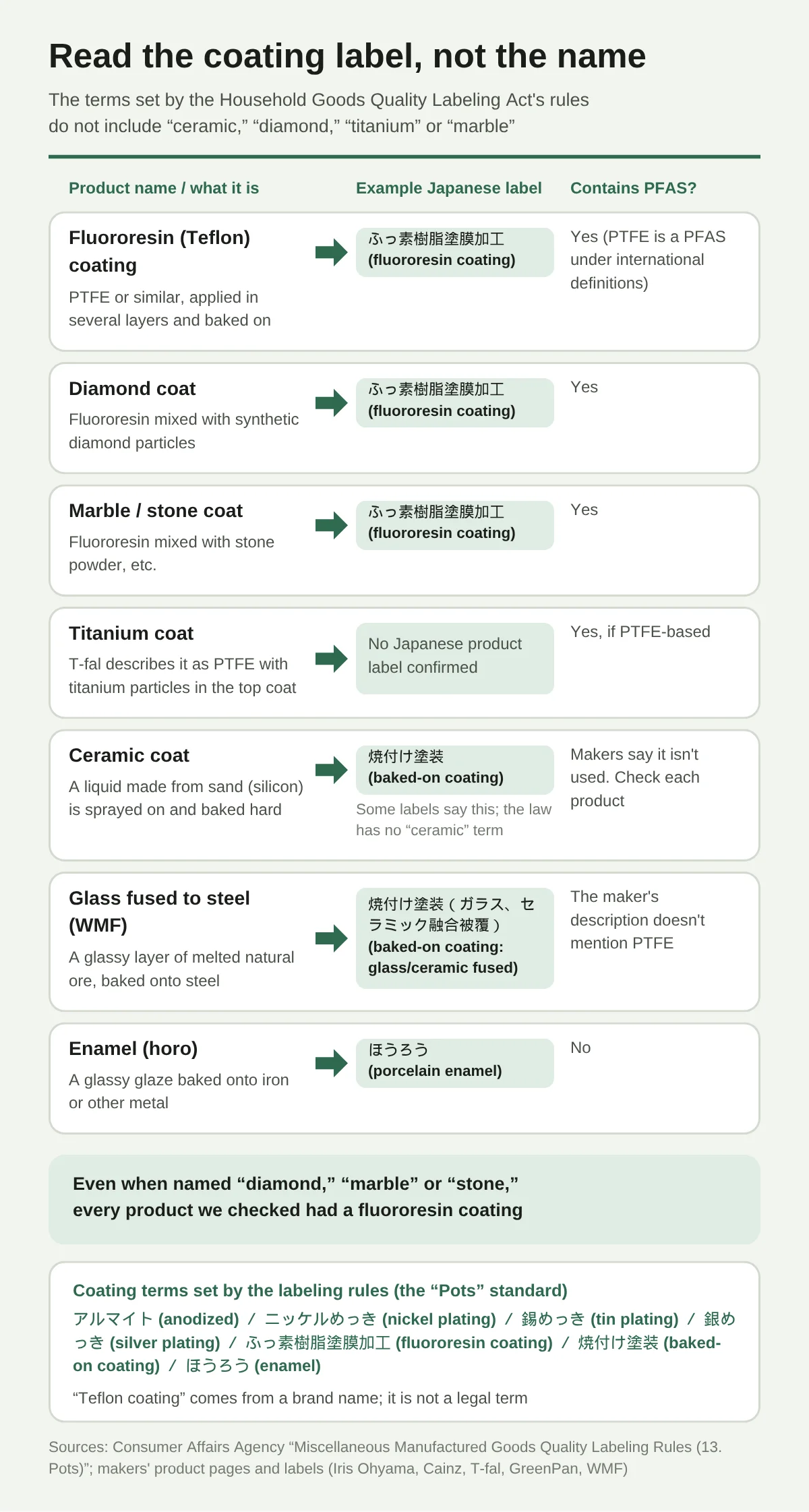
“Teflon coating” is a way of speaking derived from the brand name and is not a legal term. Under the labeling rules based on the Household Goods Quality Labeling Act (the Miscellaneous Industrial Goods Quality Labeling Regulations, “pots and pans”), processing in which fluoropolymer is applied and baked on must be labeled “ふっ素樹脂塗膜加工” (fluoropolymer coating).
The surface-treatment terms set by the same rules are only “アルマイト” (anodized aluminum), “ニッケルめっき” (nickel plating), “錫めっき” (tin plating), “銀めっき” (silver plating), “ふっ素樹脂塗膜加工,” “焼付け塗装” (baked-on paint), and “ほうろう” (enamel), and there are no terms such as “ceramic,” “diamond,” “titanium,” or “marble.” Look at this label field, not the product name, to see what it is made of.
History of Teflon
| Year | Event |
|---|---|
| April 6, 1938 | While researching refrigerant (freon) for refrigerators, Dr. Roy Plunkett of DuPont finds that tetrafluoroethylene, which had been stored cooled in a cylinder, has turned into a white waxy solid (an accidental discovery) |
| February 4, 1941 | US patent granted |
| Early 1940s | Used in the atomic bomb project (the Manhattan Project) as a material that withstands the fluorine gas used to enrich uranium |
| 1945–1946 | “TEFLON” filed as a trademark (February 1945) and registered (January 1946). Records of the US Patent and Trademark Office |
| 1947 | Sales of Teflon paint (coating agent) begin |
There is a story that “Teflon was made for the Apollo program,” but this is a myth. NASA itself explains, “Teflon was invented by DuPont in 1938. Its fame grew when NASA used it in heat shields, spacesuits, and cargo-bay liners.”
How coated frying pans began
| Year | Event |
|---|---|
| 1954 | Frenchman Marc Grégoire, at his wife’s suggestion, is said to have devised a way to apply the PTFE he used on fishing tackle to cookware |
| 1956 | Grégoire founds Tefal (from TEFlon and ALuminium) |
| 1961 | The first Teflon-coated frying pan in the US, “The Happy Pan,” goes on sale. Tefal also begins exporting to the US |
| 1963 | In Japan, a joint venture of DuPont and Nitto Chemical Industry (today’s Mitsui Chemours Fluoroproducts) is formed and begins selling Teflon |
| 1965 | The Shimizu plant in Shizuoka Prefecture starts up, and domestic production of Teflon begins |
In this survey, we could not confirm from documents which maker first sold fluoropolymer-coated frying pans in Japan, or in what year.
Types of coating
The “nonstick frying pans” sold today fall broadly into the following types.
| Type | What it is | Example of Japanese label | Contains PFAS? |
|---|---|---|---|
| Fluoropolymer coating (Teflon coating) | PTFE and similar applied in several layers (primer, midcoat, topcoat) and baked on | ふっ素樹脂塗膜加工 | Yes (PTFE is a PFAS under the international definition) |
| Diamond coat | Fluoropolymer mixed with artificial diamond particles (Iris Ohyama) | ふっ素樹脂塗膜加工 | Yes |
| Marble / stone coat | Fluoropolymer mixed with stone powder and the like (Cainz, Iris Ohyama) | ふっ素樹脂塗膜加工 | Yes |
| Titanium coat | Tefal describes the topcoat as PTFE mixed with titanium particles | No label confirmed on Japanese products | Yes, if PTFE-based |
| Ceramic coat | A liquid made from sand (silicon) sprayed on and baked hard (sol-gel method; GreenPan and others) | “Ceramic” is not a legal term. Some are labeled “焼付け塗装” (baked-on paint) | The maker says it does not use any. Needs checking product by product |
| Glassy layer fused to steel (WMF Fusiontec, Silit Silargan) | A glassy layer of melted natural minerals baked onto a steel sheet | 焼付け塗装 (glass, ceramic fusion coating) | No PTFE in the maker’s description |
| Enamel (hōrō) | A glassy glaze baked onto iron or similar | ほうろう | No |
| Nitrided iron (Riverlight “Kiwame”) | Not a coating; the iron surface is nitrided with gas to resist rust | (Iron) | No |
Even with names like “diamond,” “marble,” and “stone,” every product we checked was a fluoropolymer coating. It is a mistake to read the name as meaning “not fluoropolymer.”
The PFOA problem and how regulation has changed
PFOA is a “processing aid used in making,” not the coating itself
When fluoropolymer is made, PFOA (perfluorooctanoic acid) was used as a processing aid (emulsifier) to disperse the raw material finely in water and polymerize it. PFOA is a different substance from PTFE. It dissolves in water, builds up in the body, and is hardly broken down in the environment.
Pollution from a US plant, and lawsuits
- From the 1950s, PFOA escaped from DuPont’s plant in West Virginia into nearby rivers and tap water. The C8 Science Panel, a committee of epidemiologists created through the settlement of a residents’ class-action lawsuit, reported in 2011–2012 a “probable link” between PFOA and six diseases (pregnancy-induced hypertension, testicular cancer, kidney cancer, thyroid disease, ulcerative colitis, and high cholesterol)
- In 2005, the US Environmental Protection Agency (EPA) settled with DuPont for a total of $16.5 million for failing to report information on the hazards of PFOA. It was the largest penalty the EPA had obtained at the time
From voluntary industry phase-out to bans by international treaty and law
| Year | Event |
|---|---|
| 2006 | The EPA starts the “PFOA Stewardship Program.” Eight companies, including Japan’s Daikin Industries and Asahi Glass, pledge to eliminate PFOA emissions and its residue in products by 2015 (all companies reported “achieved” in 2015) |
| October 2012 | Daikin Industries’ Yodogawa Plant (Settsu City, Osaka Prefecture) stops using PFOA |
| End of 2013 | Three domestic fluoropolymer makers (Asahi Glass, Daikin Industries, and Mitsui-DuPont Fluorochemicals) stop using PFOA in fluoropolymer products (Japan Fluoropolymer Industry Association) |
| 2019 | PFOA is listed for elimination under the Stockholm Convention (the treaty on persistent organic pollutants) |
| 2020 | EU restrictions on the manufacture and use of PFOA begin |
| 2021 | In Japan, PFOA becomes a Class I Specified Chemical Substance under the Chemical Substances Control Law (manufacture and import banned in principle) |
| 2023 | The International Agency for Research on Cancer (IARC) classifies PFOA as “carcinogenic to humans (Group 1)” (PFOS as “possibly carcinogenic (Group 2B)”) |
| June 2024 | The Food Safety Commission of Japan sets the tolerable daily intake (TDI) for PFOS and PFOA at 20 ng/kg body weight/day each |
| April 2026 | In Japan’s tap water, a combined 50 ng/L for PFOS and PFOA becomes a water quality standard (until then a provisional target value) |
In addition, PTFE itself is IARC “Group 3 (not classifiable as to its carcinogenicity to humans)” (assessed in 1987).
Replacement processing aids: GenX and ADONA
Other processing aids came into use in place of PFOA, such as GenX (HFPO-DA, with six carbons; Chemours) and ADONA (3M). The EPA says that GenX builds up in the body less than PFOA, but persists in the environment about as long and moves easily. In its 2021 assessment, animal studies showed effects on the liver, kidneys, immunity, and offspring development. The EU’s food safety agency (EFSA) evaluated ADONA, for use in fluoropolymers baked at 280°C or higher for 10 minutes or more, as “no safety concern” (2011).
What is fluoropolymer coating like today?
- Domestic makers stopped using PFOA by the end of 2013, and since 2021 it has been banned in principle by law. The Ministry of the Environment also explains that “use in the manufacturing process of fluorine coating agents has been completely abolished.” For domestic products today, “PFOA-free” and “no PFOA used” are nothing special
- At the same time, PTFE itself is a type of PFAS. Under the definition the Organisation for Economic Co-operation and Development (OECD) set out in 2021, any substance containing even one fully fluorinated carbon (–CF₂– and so on) counts as PFAS, so PTFE is included
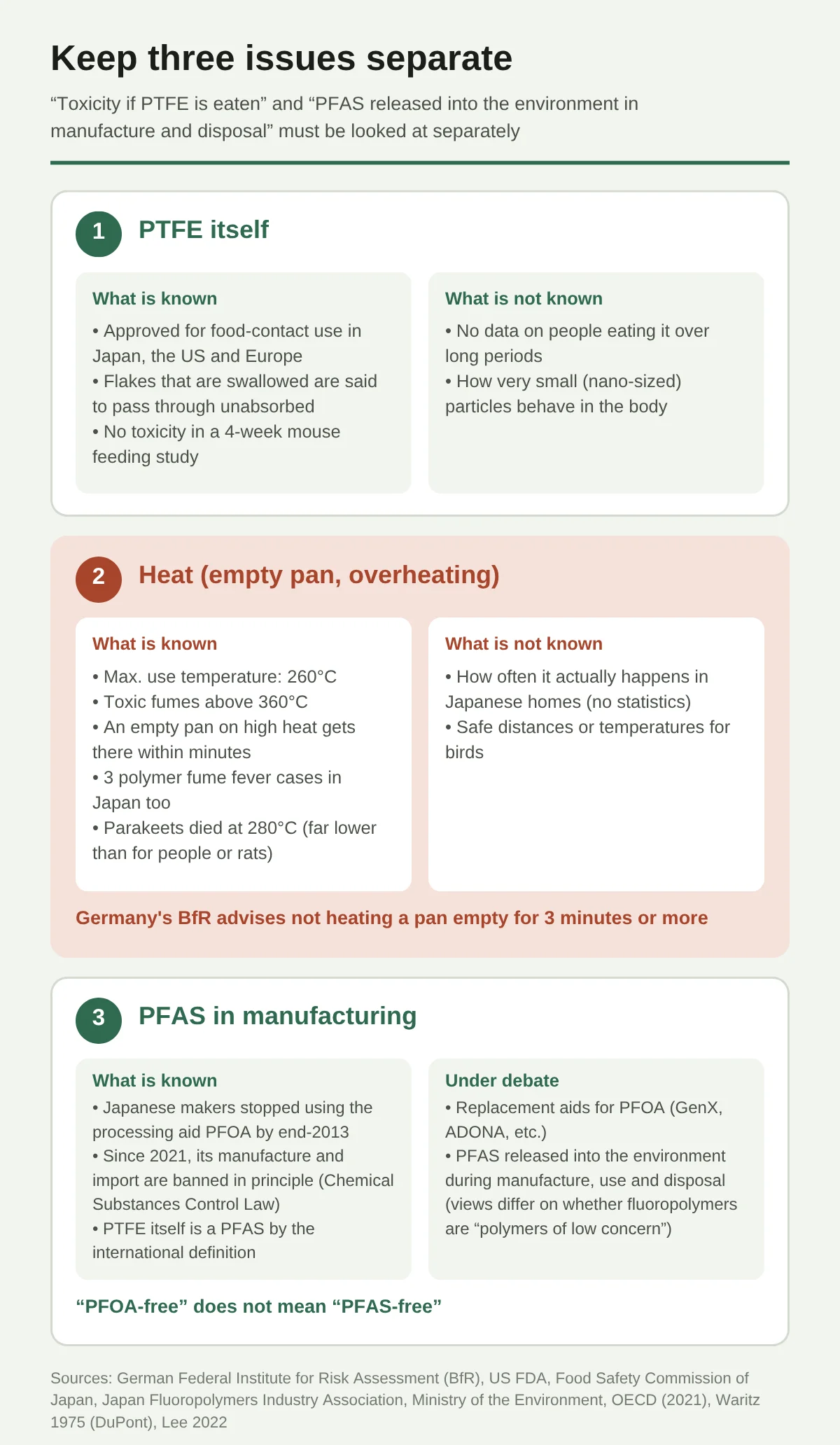
- The industry side argues that “fluoropolymers are ‘polymers of low concern’ that do not dissolve in water or enter the body, and should be treated separately from other PFAS” (the authors of the paper are affiliated with industry, such as Chemours and W. L. Gore & Associates). Conversely, there are papers saying that “PFAS are released into the environment at each stage of manufacture, use, and disposal, so they cannot be called low-concern.” “Toxicity when PTFE is eaten” and “PFAS released into the environment when it is made or discarded” need to be considered separately
- We found no Japanese rule defining the labels “PFOA-free” or “PFAS-free.” California in the US restricts claiming “free of ___” on cookware that contains PFAS
Overseas regulation today
| Country / region | Treatment of cookware |
|---|---|
| EU | Five countries put forward a proposal in 2023 to restrict PFAS broadly, and an updated proposal came out in August 2025. According to the food-packaging news outlet Food Packaging Forum, consumer nonstick cookware is targeted because “alternatives exist.” An expert committee issued a draft opinion in March 2026, and the final opinion is scheduled for the end of 2026 |
| France | A law restricting PFAS was enacted in February 2025, banning them in cosmetics, ski wax, clothing, and more from January 2026. Cookware was removed from the scope during deliberations (reportedly after demonstrations by employees of SEB, Tefal’s parent company, and others). This does not mean it was “judged safe” |
| Minnesota, US | From January 2025, sale of cookware with intentionally added PFAS is banned |
| Maine, US | From January 2026, sale of cookware with intentionally added PFAS is banned |
| California, US | From January 2024, PFAS and similar substances in cookware must be listed on the label. A bill to widen the ban was vetoed by the governor in October 2025 |
| Japan | There is no rule restricting fluoropolymer-coated cookware itself |
Is it harmful? Issue by issue
| Issue | What is known | What is not known |
|---|---|---|
| PTFE itself | Approved for food-contact use in Japan, the US, and the EU. Swallowed flakes are said not to be absorbed. No toxicity in a 4-week feeding test in mice | Data on people eating it over a long period. How very small (nano-sized) particles move in the body |
| Overheating an empty pan | Toxic vapor above 360°C. An empty pan reaches that temperature in a few minutes. Cases of polymer fume fever in Japan, too | How often it actually happens in Japanese homes (no statistics) |
| Birds | Parakeets die at a much lower temperature (280°C) than humans or rats | A guide to safe distances or temperatures |
| Transfer into food | Products from before the phase-out released trace amounts of PFOA. Current products were not detected in German testing. Microplastics come off scratches | Effects on the body of eaten microplastics. Transfer amounts of the new processing aids |
| Long-term use | Some studies find more PFAS in the blood and breast milk of users, and some find less | No study has examined whether continued use increases disease |
PTFE itself: said not to be absorbed by the body
- US: Approved for food-contact use under federal regulation (21 CFR 177.1550). For coatings, there is an upper limit on the amount that leaches out when boiled in water, alcohol, or an oil substitute
- EU: Tetrafluoroethylene, the raw material of PTFE, is on the authorized list in the regulation on plastics in contact with food (10/2011)
- Japan: It is on the positive list (list of substances permitted for use) for utensils and containers/packaging under the Food Sanitation Act, as a “polymer whose main monomer is a fluorine-substituted ethylene”
On peeled flakes, the German BfR says that “PTFE does not react, so it is not digested and passes straight out of the body; there is no health concern,” and the US FDA says that “large polymerized PFAS molecules are not absorbed by the body when eaten” (the fact sheet of the Food Safety Commission of Japan says the same). In a test in which small PTFE particles were fed to mice for 4 weeks, no toxicity was seen and no particles were found in the blood (Lee 2022).
However, there are no data on people eating it over a long period. There is also a study in which high concentrations of PTFE particles applied to human intestinal cells in a test tube produced oxidative stress and inflammatory responses (how this relates to amounts actually eaten is not known).
What comes off when an empty pan is heated?
The biggest problem with fluoropolymer coating is heating an empty pan, or overheating.
- According to the Japan Fluoropolymer Industry Association, in ordinary cooking the pan is at about 150–190°C, and the upper service temperature of PTFE is 260°C. If you heat an empty pan on a gas stove with no temperature control, it reaches the melting point of fluoropolymer (327°C) in 3–4 minutes on medium heat and about 2 minutes on high heat
- The German BfR says that “above 360°C, toxic vapor is released. Even without visible smoke, toxic substances enter the air,” and recommends never heating an empty pan for more than 3 minutes. South Korea’s Ministry of Food and Drug Safety also warns that “heating an empty pan for 2 minutes brings it to 380–390°C”
- As the temperature rises, highly toxic substances come off: first very fine particles (ultrafine particles), and at higher temperatures tetrafluoroethylene, hexafluoropropylene, perfluoroisobutene (PFIB), carbonyl fluoride, and others (Waritz 1975, a paper by DuPont researchers)
Japanese household gas stoves have a “cooking oil overheating prevention device” that lowers or shuts off the flame when the pan bottom reaches about 250°C. Since October 2008, it has been mandatory on every burner of a household gas stove (Ministry of Economy, Trade and Industry; NITE). It stops the stove at a temperature close to the upper service limit of PTFE, but older stoves, portable stoves, and commercial stoves may not have it, and it may not work if the bottom of the pan is dented.
Polymer fume fever: cases in Japan, too
Breathing the smoke of overheated fluoropolymer can cause polymer fume fever (popularly “Teflon flu”). The symptoms are flu-like, such as chills, fever, cough, and shortness of breath, and in most cases they go away on their own in 1–2 days (review by Greenberg 2015).
Three home cases have been reported in Japanese medical journals.
| Report | Circumstances | Course |
|---|---|---|
| 2006 (Handa City Hospital) | A 30-year-old man. He breathed smoke after the water had completely evaporated from a fluoropolymer-coated pot | Findings of interstitial pneumonia. Recovered in a few days without special treatment |
| 2006 (Toho University) | A 59-year-old man. He fell asleep while making soba and left the frying pan on the heat for about 4 hours | Pulmonary edema. Quickly improved with oxygen and medication |
| 2012 (Nerima Hikarigaoka Hospital) | A 29-year-old man. He breathed a large amount of vapor from a fluoropolymer-coated pot | Shadows in both lungs. Improved greatly after 2 days in the hospital |
US poison control centers were reported to have recorded more than 260 suspected cases of polymer fume fever in 2023 (not all are from frying pans; we could not confirm the original statistics). For deaths, there is a report of a worker heating PTFE at a factory in Taiwan. We found no paper reporting a death from home cooking.
It is also known that smoking with fluoropolymer spray or powder on your hands can cause the illness, because the cigarette’s fire breaks down the resin.
If you keep birds, take special care
Because of how their respiratory system works (air sacs), birds are far more sensitive than humans to toxins in the air.
- In DuPont’s tests, when exposed for 4 hours to smoke from a heated PTFE-coated frying pan, parakeets died at 280°C and quail at 330°C (rats at 425–450°C)
- In one case, five cockatiels died within 30 minutes from the smoke of a frying pan that was accidentally overheated, and the owner got polymer fume fever (1975)
- A university aviary also reported that the bulb of a heat lamp was coated with PTFE and 80–90% of the chicks died (2012)
Chemours, which holds the Teflon trademark, also recommends keeping birds out of the kitchen, not walking away from a pan being heated, not preheating an empty pan on high heat, and ventilating.
Does it transfer into food during cooking?
As written above, peeled flakes are said to pass through without being absorbed.
As for microplastics, a study at an Australian university estimated that thousands to millions of particles could come off a damaged fluoropolymer coating during cooking (Luo 2022). The figure “about 9,100 particles per scratch” comes from the university’s press release and is not a count of particles that actually entered food. In a study in the UK and elsewhere, using plastic or fluoropolymer cookware increased the number of particles in food, and cooking one meal a day was estimated at about 2,400–5,000 particles a year (Cole 2024). How these eaten particles affect the body is not known. We cover microplastics overall in our microplastics database.
Whether PFAS such as PFOA transfer gives different results depending on the era.
| Study | Subject | Result |
|---|---|---|
| US FDA (2005) | Cookware from the era when PFOA was used | Trace amounts (µg/kg level) of PFOA remained |
| US university (2007) | 4 brands of commercial frying pans from the same era | At ordinary cooking temperatures (surface 179–233°C), 7–337 ng of PFOA per pan was released into the air. Some brands decreased with each use, and others did not |
| UK government laboratory (2007) | 26 products | No release of fluorine compounds was found even after heating at 250°C for 30 minutes |
| Germany (2015) | “PFOA-free” frying pans | With ordinary use (below 230°C), a total of 4.75 ng per hour of PFOA and others was released into the air. With an empty pan on the heat (370°C), it rose sharply, to a maximum of 12,190 ng |
| South Korean national agency (2018) | 312 samples including frying pans, baking tools, and grease-proof paper | Examined transfer into food simulants and judged it “safe” |
| Turkey (2022) | 35 commercial products | PFOA detected in 6 products. More at higher temperatures, and decreased with each use |
| German university (2024) | 18 cookware products (measured when heated at 250°C) | None of the PFAS tested were detected in any of the 5 frying pans. They were detected in 1 baking sheet and 1 baking mat |
There is also a 2005 measurement in which PFOA was “not detected,” but that was done by DuPont researchers.
What about using it for years?
We found no study that examined whether continued use of fluoropolymer-coated cookware increases disease. What we found were studies comparing the amount of PFAS in the blood or breast milk of users, and the results are not consistent.
- In South Korean children, in breast milk in South Korea and Jordan, and in adults in Malaysia, some PFAS were higher in people who use nonstick cookware
- On the other hand, in a national survey in South Korea (about 1,900 adults), people who used “badly damaged Teflon cookware” had less PFOA in their blood
All of these are surveys in which people were asked how they use cookware, and it is not known whether the products were from the era when PFOA was used.
Compared with PFAS from food and water
The PFOA that Japanese people take in from food is estimated at 0.066–0.75 ng per kg of body weight per day. This is far below the TDI of 20 ng set by the Food Safety Commission of Japan, which says that “with an ordinary diet, there is no situation in which a significant health effect would occur.”
The main routes of PFAS intake are said to be food (fish and so on) and drinking water. In estimates for North America and Europe, the PFOA that consumers take in from products they use was a small share of the total, and within that, the main sources were water-repellent sprays, treated carpets, and coated food containers (Trudel 2008). We found no measurement comparing the amount that enters from frying pans with diet in the same units.
Who funded the research, and from what position
The basic data on toxicity by temperature and the lethal temperatures for birds (1975, 1991), and the 2005 measurement saying “PFOA was not detected,” are studies by DuPont researchers. On the other hand, the 2003 survey that measured empty-pan temperatures was by an environmental group (EWG) that takes a position opposed to DuPont, and it has not been peer-reviewed as a paper. In this article, we try to write down where each one comes from.
Is there a product “proven to have no problem for the body”?
No. This is because there is no system under which the government or a public agency certifies that “this product has no problem for the human body” for frying pans.
What can be checked goes only as far as the following.
| What can be checked | What it means |
|---|---|
| Conforms to the Food Sanitation Act standards | Utensils sold in Japan must conform to the positive list (list of substances permitted for use) and the standards for the amount that leaches out |
| “Surface treatment” on the label | If it says “ふっ素樹脂塗膜加工” (fluoropolymer coating), it is fluoropolymer. You cannot tell from product names like “diamond” or “marble” |
| “PFOA-free” label | It means the processing aid PFOA was not used. This is the norm for domestic products today. It does not change the fact that PTFE itself is a PFAS |
| Temperature and heat settings in the instruction manual | If you follow conditions such as no heating an empty pan and medium heat or below, the “heat” problem seen above is easy to avoid |
In other words, rather than “choosing a product proven to be free of harm,” what you can do now is learn what is in it from the label and stay within the temperatures in the instruction manual. If you do not want PFAS in your home, you would choose from the “alternative materials” below.
Groundwater in Settsu City, Osaka
We introduce this as a fact about Osaka Prefecture, the local area of Urayomi, which writes this article.
In groundwater around Daikin Industries’ Yodogawa Plant (Settsu City), which made fluoropolymer, the Ministry of the Environment’s fiscal 2019 nationwide survey found a combined PFOS and PFOA level of 1,855.6 ng/L, the highest in the country in that survey. In Osaka Prefecture’s July 2025 survey as well, results were 110–9,000 ng/L in waterways and 120–35,000 ng/L in groundwater, and all 8 sites exceeded the guideline value (50 ng/L).
- The plant stopped using PFOA in October 2012 and pumps up and treats the groundwater. Since November 2023 it has been building an underground wall (cutoff wall) along the site boundary, and about 20% was complete as of the end of August 2025
- Osaka Prefecture explains that the city has confirmed that “Settsu City’s groundwater is not used for drinking water, and the raw water for tap water is below the water supply standard”
- We found no blood tests of residents by a public agency. Blood measurements that residents carried out on their own initiative (2023, about 1,200 people) have been published as a paper, and the median PFOA among ordinary residents was 5.0 ng/mL (Kanetani 2025. The measurement methods differ, so it cannot simply be compared with the values in the Ministry of the Environment’s nationwide survey)
Apart from the side of people who use frying pans, what was released into the environment around the factories that make it is one of the major problems of PFAS.
Precautions when using fluoropolymer coating
We summarize the main points from manufacturers’ instruction manuals, the Japan Fluoropolymer Industry Association, the BfR, and the cautions under the Household Goods Quality Labeling Act.
- Do not heat an empty pan. Even when preheating with oil, do not heat on high heat for long (BfR: do not heat empty for more than 3 minutes)
- Medium heat or below. Do not let the oil temperature reach 200°C or more, as in deep-frying
- Do not leave while heating. Run the exhaust fan
- Keep birds out of the kitchen (do not keep them in a room with the same air)
- Do not scrub hard with metal spatulas or scouring pads. Do not use hard metal objects to remove burnt-on food
- Do not pour water on an empty pan after heating to cool it suddenly (a cause of warping and damage to the coating)
- The industry association does not recommend fluoropolymer coating on the outside of a frying pan, because the flame hits it and the temperature goes above the melting point
When the coating starts to peel, food sticks more easily and the underlying aluminum or other metal is exposed. As a guide to the life of a frying pan, an article by Zwilling Japan gives about 1–3 years for fluoropolymer coating and about 1–2 years for ceramic coating (this varies greatly with use).
Disposal (in Sakai City)
In Sakai City, frying pans and pots can be put out as “small metal items” (once a month). The conditions are that the longest side is roughly 30 cm or less (the handle is not counted in the length) and that at least 80% of the weight is metal. Items over 30 cm are “bulky waste (small non-burnable items).” There is no rule to separate fluoropolymer-coated items. For other municipalities, check each one’s separation rules.
Alternative materials and how to choose
Materials that do not use fluoropolymer also have things that leach out and cautions of their own. “Contains no PFAS” does not mean “nothing leaches out.”
| Material | PFAS | Nonstick quality | Weight | Care | What leaches out / cautions |
|---|---|---|---|---|---|
| Iron (nitrided, hammered) | None | Resists sticking once oil has seasoned it | Medium | Rusts, so dry after use | Iron transfers into food (more with acidic dishes and longer cooking) |
| Cast iron (skillet) | None | Resists sticking once oil has seasoned it | Heavy | Rusts, so dry after use | Iron transfers |
| Stainless steel (multi-ply) | None | Sticks easily (needs preheating and oil) | Medium to heavy | Durable | Nickel and chromium come out (more when new, with acidic dishes, and over long times) |
| Enameled cast iron | None | Can stick | Heavy | Watch for chipping and sudden temperature changes | The government has standards for lead and cadmium in the glaze |
| Ceramic coating | The maker says none used | Good (at first) | Light | Weak to sudden temperature changes and high heat | Studies show small titanium and silicon particles come out |
| Glassy layer fused to steel (WMF) | No PTFE in the maker’s description | Fair | Heavy | Metal spatulas and dishwasher can be used (maker) | Leaching test results are not published |
For aluminum pots, see our article on aluminum products and food.
Iron
When you cook in an iron frying pan or pot, iron transfers into the food. In a US study, in about 90% of 20 dishes, the iron content was higher when cooked in an iron pan (Brittin 1986). It is higher with sour foods, foods with a lot of liquid, and foods cooked a long time. If you have been told not to take in too much iron, talk with your doctor.
Iron rusts easily, so dry it after use. Nitrided iron (Riverlight “Kiwame”) is, according to the maker, iron made rust-resistant that does not need burning off after purchase.
A thick cast-iron skillet is heavy but suits searing and oven cooking. Lodge says it is made of only iron and vegetable oil and does not use PFAS.
Stainless steel
Stainless steel has no coating, so there is nothing to peel. However, nickel and chromium leach out. In a study at Oregon State University in the US, simmering tomato sauce for 6 hours increased nickel up to 26-fold and chromium 7-fold. The amounts were highest when the pot was new, fell with each use, and settled around the 6th use (Kamerud 2013. The conditions were a longer time than home cooking).
Under the Household Goods Quality Labeling Act, stainless steel pots must state proportions such as “ステンレス鋼(クロム○%、ニッケル○%)” (stainless steel (chromium ○%, nickel ○%)), so you can tell from the label whether it contains nickel. Health Canada advises people with a nickel allergy not to use cookware containing nickel.
Enamel
Enamel is a glassy glaze baked onto iron or another metal, a material that resists acids and salt. The Food Sanitation Act sets standards for the amount of lead and cadmium that can leach out of the glaze. If it chips and the metal underneath is exposed, it will rust, so avoid heating it empty and strong impacts.
Ceramic coating
Ceramic coating is a coating of a liquid made from sand (silicon) baked hard, used in place of fluoropolymer. GreenPan says it does not use PFAS, lead, or cadmium in its own coating, “Thermolon.”
There are cautions as well.
- Small particles of titanium and silicon come out, as confirmed by a Slovenian study (Golja 2016) and a study by the US FDA and the National Institute of Standards and Technology (Addo Ntim 2018). They increase when the coating is scratched. We found no study examining the effect on the human body
- Even if it says “ceramic,” if the label says “ふっ素樹脂塗膜加工” (fluoropolymer coating), it is fluoropolymer
- Some examples of coating technology (patents) use materials containing a small amount of fluorine, so each product needs to be checked
- The guide to lifespan is about 1–2 years (Zwilling Japan article). It is said to be weak to sudden temperature changes and high heat
WMF Silargan and Fusiontec
It is often called “WMF Silargan,” but Silargan is a material of the German brand “Silit,” which is in the same group as WMF. The material of the same kind made by WMF itself is “Fusiontec,” which is what the Japanese WMF official site currently sells (checked October 2, 2026).
- Both are made by melting about 30 kinds of natural minerals at high temperature to make a glassy material and baking it onto a steel sheet (maker’s description). On Japanese labels it is written “焼付け塗装(ガラス、セラミック融合被覆)” (baked-on paint (glass, ceramic fusion coating))
- Metal spatulas and dishwashers can be used, and the warranty is 10 years in Japan (30 years in Germany)
- It is heavy; a 24 cm frying pan weighs about 1.9 kg
- The maker describes the surface as “nickel-free,” but on Japanese frying pans the rim is labeled “クロムめっき・ニッケルめっき” (chrome plating, nickel plating). Leaching test results are not published
For Silargan products, we found overseas mail-order (personal import) listings on Rakuten Ichiba. What is easy to obtain as a genuine product in Japan is Fusiontec.
Summary
| What you want to know | Answer |
|---|---|
| What is Teflon? | A trademark of Chemours. The substance is PTFE. The Japanese label is “ふっ素樹脂塗膜加工” (fluoropolymer coating) |
| Since when? | Discovered by accident in 1938. Applying it to frying pans was conceived around 1954 and it spread in the 1960s |
| Diamond and marble coat? | The domestic products we checked were all labeled “ふっ素樹脂塗膜加工” (fluoropolymer coating) |
| PFOA? | A processing aid used in making it. Domestic makers stopped using it by the end of 2013, and it has been banned in principle since 2021 |
| Fluoropolymer coating today? | PFOA is not used. However, PTFE itself is also a type of PFAS |
| If you eat flakes? | Said to pass out without being absorbed. No data on long-term eating |
| If you overheat an empty pan? | Toxic vapor above 360°C. Polymer fume fever, bird deaths |
| Does it transfer into food? | Current products were not detected in German testing. Microplastics come off scratches, but the effect is unknown |
| If you keep using it? | No study has looked at the link with disease |
| A “proven” product? | None. Check by the label and the instruction manual |
| Alternative materials? | Iron, stainless steel, enamel, ceramic, and so on. All have something that leaches out |
| Products featured | Material | Where to buy |
|---|---|---|
| WMF Fusiontec Mineral Frying Pan 24 cm | Glassy layer fused to steel | See on Rakuten (スマートキッチン) PR See on Amazon.co.jp PR See on Yahoo! Shopping PR |
| GreenPan Venice Pro | Ceramic coating | See on Rakuten (グリーンパン公式) PR See on Amazon.co.jp PR See on Yahoo! Shopping PR 【グリーンパン】公式サイトはこちら  PR PR |
| Riverlight Kiwame JAPAN 26 cm | Nitrided iron | See on Rakuten (リバーライト オフィシャルショップ) PR See on Amazon.co.jp PR See on Yahoo! Shopping PR |
| Lodge Skillet 10 1/4 inch | Cast iron | See on Rakuten (ナチュラム) PR See on Amazon.co.jp PR See on Yahoo! Shopping PR |
| Vita Craft Pro Frying Pan 24 cm | 5-ply stainless steel | See on Rakuten (リビングート) PR See on Amazon.co.jp PR See on Yahoo! Shopping PR |
| Staub Pico Cocotte Round 20 cm | Enameled cast iron | See on Rakuten (ZWILLING 公式) PR See on Amazon.co.jp PR See on Yahoo! Shopping PR ツヴィリング【ZWILLING】  PR PR |
Sources
Public agencies and laws
- Food Safety Commission of Japan, “Fact Sheet: Fluoropolymers” (2012); “Summary of the PFAS Risk Assessment” and “Q&A on the PFAS Risk Assessment” (2024)
- Consumer Affairs Agency, “Miscellaneous Industrial Goods Quality Labeling Regulations (13: Pots and Pans)”; Food Sanitation Act positive list for utensils and containers/packaging (Appended Table 1)
- Ministry of the Environment, “Frequently Asked Questions on PFAS”; “Nationwide Survey on the Status of PFOS and PFOA” (published June 2020)
- Osaka Prefecture, “Water Quality Survey Results on Organic Fluorine Compounds (PFOA, etc.)” (August 2021 [Reiwa 3], July 2025 [Reiwa 7])
- Ministry of Economy, Trade and Industry and NITE (National Institute of Technology and Evaluation), materials on the cooking-oil overheating prevention device for gas stoves
- National Institute of Health Sciences (MHLW Health and Labour Sciences Research), survey of fluoropolymer-coated products (fiscal 2006–2007)
- Sakai City, “How to Separate and Put Out Household Waste”
- German Federal Institute for Risk Assessment (BfR), “Q&A on cookware with PTFE nonstick coating” (2018)
- US FDA, “Authorized Uses of PFAS in Food Contact Applications”; 21 CFR 177.1550
- US EPA, “2010/2015 PFOA Stewardship Program”; settlement with DuPont (2005); toxicity assessment of GenX (2021, revised 2023)
- European Chemicals Agency (ECHA), announcements of the PFAS restriction proposal (2023, 2025, 2026); EFSA’s assessment of PFAS (2020)
- International Agency for Research on Cancer (IARC), Monographs Vol. 135 Q&A (2023)
- France Law No. 2025-188 (2025); Minnesota statute 116.943; Maine Department of Environmental Protection; California Attorney General’s AB1200 enforcement advisory
- US Patent and Trademark Office (TEFLON trademark records); US Patent 2,230,654
Papers
- Waritz RS. Environ Health Perspect 1975 (temperature and toxicity; lethal temperatures for birds. DuPont)
- Greenberg MI, Vearrier D. Clin Toxicol 2015 (review of fume fever)
- Son M et al. 2006 (poisoning research), Toyama K et al. 2006 (Journal of the Japanese Respiratory Society), Shimizu T et al. 2012 (BMJ Case Rep)
- Blandford TB et al. 1975 (Vet Rec), Shuster KA et al. 2012 (Comp Med)
- Lee S et al. 2022 (Polymers, oral study in mice)
- Luo Y et al. 2022, Cole M et al. 2024 (Sci Total Environ, microplastics)
- Begley TH et al. 2005, Bradley EL et al. 2007, Toptancı İ et al. 2022, Wolf N et al. 2024 (Food Addit Contam and others)
- Sinclair E et al. 2007 (Environ Sci Technol), Schlummer M et al. 2015 (Chemosphere), Choi H et al. 2018
- Lee JH et al. 2017, Kang H et al. 2016 and 2018, Ramli MR et al. 2020, Al-sheyab NA et al. 2015 (use and PFAS in the body)
- Trudel D et al. 2008 (Risk Anal), Henry BJ et al. 2018, Lohmann R et al. 2020 (are fluoropolymers “low concern”?)
- Kanetani et al. 2025 (Ind Health, blood measurements of Settsu City residents)
- Kamerud KL et al. 2013 (J Agric Food Chem, stainless steel), Brittin HC et al. 1986 (iron), Golja V et al. 2016, Addo Ntim S et al. 2018 (ceramic coating)
Industry groups and manufacturers
- Japan Fluoropolymer Industry Association, “Fluoropolymer Product Handling Manual (11th revised edition)” (2021)
- Mitsui Chemours Fluoroproducts, “Discovery and Innovation of Teflon™” and “History”; Chemours (safety; caution regarding birds)
- Tefal (instruction manuals, history); Iris Ohyama and Cainz (product page labels); Zwilling Japan (frying pan lifespan)
- WMF (official sites in Japan and Germany), GreenPan, Riverlight, Lodge
Related articles and databases
- Does aluminum leach from aluminum pans and foil? How it is made, why it is used, what happens when it builds up in the body, and how to choose alternative pans
- Are Lard and Butter Bad for You? 16 Plant Oils and Animal Fats (Beef Tallow, Fish Oil) Compared by Fatty Acids, and Which to Use Every Day
- Are Microwave Ovens Bad for You? History, How They Work, Use Around the World, Safety, Nutrition (vs. Boiling and Stir-Frying), the “Microwave Cover” Claim, and How to Use and Choose One
- What are surfactants? Types, history, rules in Japan and abroad, effects on the body, and what the “strength rankings” really are
- マイクロプラスチックの少ない塩は?(マイクロプラスチック データベース)
- 添加物データベース