
Does aluminum leach from aluminum pans and foil? How it is made, why it is used, what happens when it builds up in the body, and how to choose alternative pans

PR This article contains affiliate links to Rakuten Ichiba, Amazon, and A8.net (“See on Rakuten”, etc.). What is written is based on public-agency materials and papers, regardless of whether there is advertising. The “See on Amazon.co.jp” and “See on Yahoo! Shopping” links are also affiliate links.
Yukihira pans (Japanese hammered saucepans), kettles, aluminum foil, foil cups in lunch boxes, canned drinks. There are many aluminum products in the kitchen.
At the same time, you often hear that “cooking in an aluminum pan makes aluminum leach out,” that “foil-baked food is bad for you,” and that “aluminum causes Alzheimer’s disease.”
This article checks, against materials from national governments and international organizations and against papers:
- How aluminum products are made
- Why aluminum is used for pans and kettles
- Whether aluminum leaches out when you keep using aluminum pans and yukihira pans
- Whether it leaches out of aluminum foil
- What happens to aluminum that enters the body, and what effects it has when it builds up
- Other entry routes: tap water, cans, the food additive alum, antacids, and so on
- What pans and containers to use if you want to limit aluminum
Conclusion
- Aluminum is made by extracting alumina from an ore called bauxite and then electrolyzing it. In Japan, smelters withdrew because of soaring electricity costs, and the last electrolysis plant stopped in 2014. All new aluminum is now imported
- Aluminum is used for pans because it conducts heat well (about 3 times as well as iron) and is light (about one third the weight of iron). A thin oxide film forms on the surface and prevents rust, but it is weak against acids, alkalis, and salt. For this reason, the national labeling rules require aluminum pans to carry the notes “avoid use with acidic or alkaline foods” and “do not store food in the pan”
- Aluminum does leach from aluminum pans. The amount varies greatly with the contents and the time. In a summary by national institutes and others, the average after 30 minutes of boiling was 0.08 µg/g in water, 1.0 µg/g in miso soup, 8.0 µg/g in vinegar, and 11.7 µg/g in konjac cooking liquid (alkaline). Alumite-treated (anodized) pans leach far less than untreated pans
- Aluminum also leaches from aluminum foil with acid, salt, alkali, and heat. With ponzu or the pickling liquid from umeboshi, it was about 100 times the amount with tap water. On the other hand, in a test that boiled commercial foods in aluminum-foil pans as directed on the label, the amounts were very small
- The aluminum that gets in from everyday cookware is estimated to be much less than from the diet as a whole (even assuming all home cooking with heat is done in aluminum pans, 0.57 mg per day for an adult). The biggest entry route in the Japanese diet was alum (a food additive) used in leavening agents and the like. In 2018 a cap was set on the amount used in sweets and bread, and the amount children take in from processed foods fell to 30% or less of the earlier level (1.80 mg per day → 0.50 mg)
- Of the aluminum taken in by mouth, about 0.1% is absorbed. Most leaves in urine, but some stays in bone and elsewhere for a long time
- The health effects that have been clearly confirmed are in people with reduced kidney function, especially those on dialysis (encephalopathy, bone disease, anemia). On Alzheimer’s disease, both international bodies and Japan’s Food Safety Commission say there is “not sufficient evidence of a causal relationship with aluminum from the diet”
- The main public advice for people who want to limit aluminum is “do not cook or store sour or salty foods in uncoated aluminum containers or foil” (the German Federal Institute for Risk Assessment). The alternative materials (iron, enamel, stainless steel, glass) each have things that leach from them and points to watch
Items featured in this article
| Item | When to use it | Where in this article |
|---|---|---|
| Alumite (anodized) yukihira pan (Taniguchi Metal) | When you want to keep aluminum’s lightness and heat conduction but have a treated pan | Does aluminum leach from aluminum pots and yukihira pans? |
| Stainless steel yukihira pan (Yoshikawa, 21Cr) | When you want a yukihira pan that is not aluminum (a steel type with no nickel added as a main component) | Stainless steel |
| Noda Horo milk pan and storage container | When cooking or storing sour or salty foods | Enamel (horo) |
| ZWILLING official shop (STAUB enameled cast-iron pots, etc.) | When looking for a heavy pot for stewing | Enamel (horo) |
| Riverlight Kiwame JAPAN (iron frying pan) | When looking for a non-aluminum frying pan for stir-frying and pan-frying | Iron |
| HARIO NETSHOP (heat-resistant glassware) | When looking for heat-resistant glass pots and storage containers with visible contents | Heat-resistant glass |
| Cook-Para cooking sheet | When baking sour or salty foods, in place of foil | Does aluminum leach from aluminum foil? |
| Rumford baking powder (aluminum-free) | When baking at home | Alum (food additive) |
Aluminum products in the kitchen
Aluminum products that touch food and drink include the following.
| Product | Surface treatment | Where in this article |
|---|---|---|
| Yukihira pans, saucepans, two-handled pots, stockpots | None (bare metal) / alumite / fluoropolymer coating | Aluminum pots and yukihira pans |
| Kettles | None / alumite | Same as above |
| Aluminum foil, foil cups, disposable aluminum-foil pots and trays | Usually none (some foils have a silicone coating) | Aluminum foil |
| Aluminum beverage cans | Inside coated with resin | Aluminum cans |
| Lunch boxes, camping pots | Mostly alumite | Aluminum pots and yukihira pans |
| (Not a product, but) the food additives alum and aluminum lakes | n/a | Alum (food additive) |
How is aluminum made?
From bauxite to alumina, then electrolysis
Aluminum is abundant in the Earth’s crust, but it is bound tightly to oxygen, so it is never found as a metal. According to the Japan Aluminium Association (an industry group), it is made in two stages.
- The Bayer process (1887): the reddish-brown ore bauxite is crushed, mixed with caustic soda and the like, and heated under pressure, so that the alumina component dissolves out. Impurities are removed to take out aluminum hydroxide, which is fired at about 1,000°C to make white alumina (aluminum oxide)
- The Hall–Héroult process (1886): alumina is mixed into molten cryolite and the like and electrolyzed at about 1,000°C. The molten aluminum collects at the bottom of the furnace
As a rough guide, about 4 tons of bauxite gives about 2 tons of alumina and 1 ton of aluminum (Japan Aluminium Association).
Electrolysis uses a great deal of electricity. According to statistics from the International Aluminium Institute (an industry group), it takes about 13,900 kWh per ton of aluminum on the world average (2025).
Japan imports all of it; recycling is thriving
Japanese smelting peaked at about 1.2 million tons in 1977, but two oil shocks raised electricity prices and plants kept withdrawing. Electrolysis at the last plant, Nippon Light Metal’s Kambara works (Shizuoka City), ended on March 31, 2014 (the company’s announcement). Newly made aluminum (virgin ingot) is now 100% imported.
On the other hand, the energy for recycled ingot, made by melting used aluminum, is about 3% of that for virgin ingot (a Japan Aluminium Association survey). The recycling rate for aluminum beverage cans was 94.7% in fiscal 2025, of which 73.3% went back into cans in Japan (CAN to CAN) (Aluminum Can Recycling Association; the recycling rate also includes used cans exported overseas).
Aluminum foil: rolled two sheets at a time at the end
Aluminum foil is made by rolling a thick plate repeatedly to make it thin. In the last step, two sheets are stacked and rolled together, then separated into single sheets afterward.
The side that touched the rolls is shiny; the side where aluminum touched aluminum has fine unevenness and is not shiny. The Fukui Prefecture Consumer Center says “the difference between the shiny and dull sides comes from the manufacturing process and there is no need to tell them apart” (follow the label for products with a non-stick treatment). Household foil is about 11–12 µm thick (0.011–0.012 mm).
Pots and kettles: pressing, casting, hammering
Pots and kettles are made by pressing a plate in a press (deep drawing), pressing it against a form with a spatula while spinning it (spinning), pouring molten aluminum into a mold (casting), or hammering it into shape (hammered work). The fine dents on a yukihira pan’s surface (tsuchime, hammer marks) are traces of hammered work.
Alumite: a deliberately thickened surface film
Alumite is made by putting aluminum in a bath of sulfuric acid or oxalic acid, making it the positive electrode, and passing current to artificially grow the surface oxide film thicker. In the last step, hot water or steam closes the film’s fine pores (sealing).
The technology was born at RIKEN in Japan; a patent was filed in 1923, and in 1929 a patent was granted for the method of sealing pores with steam (RIKEN). It is not plated with another metal; it is the aluminum’s own surface, oxidized.
The oxide film that aluminum naturally wears is very thin, 4–11 nm (nanometers), as measured in German research. On household goods, only products with a film at least as thick as set by the Japanese Industrial Standards (JIS) may be labeled “alumite” (Consumer Affairs Agency).
Why is aluminum used in cookware?
| Material | Heat conduction (thermal conductivity, W/(m·K)) | Weight (specific gravity) |
|---|---|---|
| Copper | 398 | 8.9 |
| Aluminum | 237 | 2.7 |
| Iron | 80.3 | 7.8 |
| Stainless steel | 16 | (about the same as iron) |
| Glass (the same glassy material as the surface of enamel) | 1.03 | n/a |
Thermal conductivity is from the Japan Society of Mechanical Engineers, “Heat Transfer Engineering Data, 5th ed.”; specific gravity is from the Japan Aluminium Association. These are values for pure metals; pans made of alloys are lower.
Aluminum is used for pots and kettles mainly for these three reasons.
- It conducts heat well: about 3 times iron and a dozen or more times stainless steel. Water boils quickly and the whole pan warms easily
- It is light: about one third of iron or stainless steel. Suited to one-handed yukihira pans and kettles
- The material is cheap: at international prices (ingot) in August 2026, aluminum was $3,251 per ton and copper $14,326 (World Bank). This is not a comparison of pan prices, but aluminum is less than a quarter of copper
The oxide film has limits
The oxide film that forms on aluminum’s surface prevents rust in ordinary environments. However, it is weak against acids, alkalis, and salt, and aluminum leaches out from there.
For this reason, the Household Goods Quality Labeling Act (Consumer Affairs Agency) specifies the following labeling.
- Aluminum pans: “a note to avoid use with acidic or alkaline foods” and “a note not to store food in the pan”
- Aluminum foil: “a note that acids and salt may cause discoloration or corrosion” and “a note that direct flame may cause it to melt”
At the same time, the Food Sanitation Act’s standards for utensils have no standard for the amount of aluminum that leaches out. Glass, ceramics, and enamel have standards for lead and cadmium leaching, but there is no separate standard for aluminum pots or foil under the current rules.
What is a yukihira pan?
“Yukihira” originally meant an earthenware pot with a handle, a spout, and a lid, a utensil for cooking rice porridge. It is said to have been made from the end of the Tenmei era (1781–89) in the Edo period and to have spread in place of the iron small pots used before (World Encyclopedia).
The best-known theory of the name’s origin ties it to the old story that Ariwara no Yukihira had sea women boil salt at Suma in the Heian period, but there is also a theory that it comes from “yugehira” (a word for how the steam looked). Today a one-handled pan with a spout, made by hammering aluminum or copper, is also called by the same name (Nihon Daihyakka Zensho).
The instruction manual of an aluminum yukihira pan maker (Hokuriku Aluminium) says the following.
- Avoid use with acidic things such as vinegar, and with alkaline things such as baking soda used to remove harshness (aku), as much as possible. Wash right after use
- Do not store food in the pan; move it to another container
- Blackening on the inside and white specks are “harmless to the human body,” but white specks are the beginning of corrosion
- At the start of use and for upkeep, boiling rice-rinsing water (rice bran, in the manual) for 10–15 minutes forms a film on the surface so that blackening and corrosion are less likely
Does aluminum leach from aluminum pots and yukihira pans?
Yes, it does. The amount depends greatly on “what you put in (acid, alkali, salt),” “temperature,” and “time.”
Researchers at the National Institute of Health Sciences and elsewhere summarized their results on aluminum pans (alumite, thick plate) in a study for the Ministry of Health, Labour and Welfare (MHLW) (Kawamura et al. 2016; the water and acetic acid tests used 13 pans). Average leaching after 30 minutes of boiling was as follows.
- Water gave 0.08 µg/g, and miso soup and spinach cooking liquid gave 1.0 µg/g
- Vinegar (pH 3.1) gave 8.0 µg/g, and konjac cooking liquid (pH 10.4, alkaline) gave 11.7 µg/g, which are higher
- With 1% salt water alone, almost nothing leached out. Salt becomes a problem together with acid (next section)
Alumite pans leach less. But more leaches when acid and salt combine
A study at Tottori University and elsewhere (Matsushima et al. 1990) compared leaching when boiling for 10 minutes in an untreated thick-plate aluminum pan and an alumite pan (both were first soaked in acid to strip the surface film before testing).
| Contents (boiled 10 minutes) | Untreated thick-plate aluminum pan | Alumite pan |
|---|---|---|
| Distilled water | 0.82 µg/mL | 0.009 µg/mL |
| Distilled water + 2% salt | 4.37 | 0.024 |
| 0.4% acetic acid (about like a vinegared dish) | 77.9 | 3.80 |
| 0.4% acetic acid + 2% salt | 75.8 | 6.64 |
| 4% acetic acid + 2% salt | 69.9 | 17.5 |
Source: Matsushima et al., “Effects of salt, acetic acid and citric acid on the leaching of aluminum from aluminum cooking utensils,” Jpn. J. Hyg. 45:964-970 (1990), Tables 3 and 4.
In the same group’s 1988 study, when 4% acetic acid was boiled for 10 minutes, leaching from the alumite pan was 1.42% of that from the thick-plate aluminum pan. The authors concluded that “alumite treatment is effective in preventing leaching, but with acid and salt, heating clearly increases it.”
New pans and well-used pans
Study results differ.
- The first few uses give more: with an aluminum espresso maker (moka pot), the aluminum concentration of the coffee was 0.564 mg/L the first time and 0.133 mg/L the third time. However, after washing in a dishwasher it rose to 0.795 mg/L (a laboratory in Hesse, Germany; Stahl et al. 2017)
- No big change with number of uses: in a test that used a 100-yen aluminum yukihira pan 25 times, there was no significant difference by number of uses up to 25. With a sour dish (sushi vinegar) there was a slight increase from the 20th use on, and with alkaline and neutral dishes there was a tendency to decrease with use (Nakahira et al. 2013, Shiga Junior College)
- Boil water before use: in a French study, boiling water in the pan before use cut leaching into acidic liquid by up to about 60-fold (Karbouj et al. 2009). The “boil rice-rinsing water” upkeep that makers recommend is also care to build a film on the surface
- South Korea’s Ministry of Food and Drug Safety says to “boil water in a newly bought aluminum pan before use” and that “it is advisable to replace an aluminum pan that has discolored from long use” (as translated in overseas information from the National Institute of Health Sciences)
Overseas assessment: do not keep acidic food hot or stored in uncoated aluminum containers
Germany’s Federal Institute for Risk Assessment (BfR) reported that in a test where sour foods (tomato, applesauce, sauerkraut juice) were kept warm for 2 hours in serving trays of aluminum with no surface treatment, 2 to 6 times the Council of Europe’s guide value (5 mg per kg of food; not a legal standard) leached out (2017).
On aluminum pans, BfR says: “If coated, they may be used. If not, avoid cooking or storing for long, as far as possible, foods high in acid or salt, such as applesauce, tomato puree, rhubarb, and salted herring.”
Compared with the whole diet
In an estimate by the National Institute of Health Sciences and others, even assuming all home cooking with heat is done in aluminum pans, the aluminum entering from utensils is 0.277–0.570 mg per person per day (3–6% of the international tolerable amount). The authors write that “because stainless pans and microwave cooking are also used, the real figure is even lower.”
Compared with the whole Japanese diet (about 2.5 mg per day for an adult, later section), it is a fraction.
If you will keep using aluminum pans, choose one with a treatment, and move sour or salty foods to another container once cooking is done. This is what public agencies and instruction manuals have in common.
Does aluminum leach from aluminum foil?
Yes, it does. As with pans, it increases with acid, salt, alkali, and heat.
In a study by the National Institute of Hygienic Sciences (now the National Institute of Health Sciences) (Takeda et al. 1998), small pieces of foil were soaked in the liquid part of foods at 95°C for 30 minutes, and the aluminum that leached out was measured.
- Tap water gave 0.12 µg/cm², but ponzu gave 12.00, umeboshi pickling liquid 10.80–12.00, and shirataki cooking liquid (alkaline) 87.80–107.4 µg/cm²
- Even at 40°C for 4 hours, imagining a summer lunch box, umeboshi pickling liquid stayed high at 9.46–10.67 µg/cm²
- On the other hand, grain vinegar was low at 0.19, and the authors think proteins and amino acids in the food greatly suppressed leaching (when peptone was added to 4% acetic acid, leaching fell to 0.3%)
- Adding 5% salt to 4% acetic acid raised leaching about 5-fold
In baked dishes
- In a test where commercial foods in aluminum-foil pots (11 kinds, such as nabeyaki udon) were boiled for 5 minutes as labeled, the result was under 0.2 µg per 1 g of food. Baking a frozen gratin’s foil tray in a toaster for 15 minutes gave 0.03 µg/g or less (Takeda et al. 1999)
- In the same study, baking salmon fillet with lemon on a foil tray gave 3.14 µg/g, and covering it further with foil as a lid raised it to 11.0 µg/g
- In a Turkish study, wrapping meat in foil and baking increased aluminum concentration by 76–378%, and the higher the temperature, the more it increased (Turhan 2006). In a Czech study, marinated fish wrapped in foil and baked at 220°C for 40 minutes gave 41.86 mg/kg in salmon and 49.34 mg/kg in mackerel (Dordevic et al. 2019)
The study claiming “one meal cooked in foil equals a week’s worth”
The study from the United Arab Emirates (Bassioni et al. 2012) is often cited as the source of the claim that “cooking with aluminum foil gives a large amount of aluminum in one meal.” It produces figures as high as “537 mg per person.”
However, this figure is calculated from the loss in the foil’s weight after small pieces of foil were submerged in a liquid containing citric acid, salt, and spices and boiled for 2 hours, then scaled up to a whole large sheet of foil. It is not a value measured in cooked food. The paper writes the international tolerable amount as “per day,” but it is actually a “per week” value. I found no public-agency document that examined this paper by name.
Foil can develop holes
The Fukuoka City Institute for Hygiene and the Environment tested after receiving a report that “a foil cup holding pickles in a lunch box got a hole.” A foil cup holding red pickled ginger leaked within 4 hours, and the hole grew larger by 24 hours.
Food authorities in Finland and Canada caution that covering a dish in a metal container with aluminum foil can make the foil corrode, acting like a battery, so that holes form and aluminum leaches into the food.
BfR’s advice
Germany’s BfR advises not wrapping sour or salty foods in aluminum foil (cut apples, tomatoes, rhubarb, salted herring, marinated meat, cheese, and so on; per the German original). When grilling meat on an aluminum dish, it says to add salt and spices after cooking.
A common substitute for foil is the cooking sheet, paper treated with silicone resin. It contains no aluminum, so acid and salt do not make aluminum leach out. However, it has an upper heat limit and cannot be used over a direct flame or under a grill.
For storing sour or salty foods, moving them to glass or enamel containers is the method that manufacturers’ instruction manuals also recommend (Enamel (horo)).
Food additives, tap water, cans, and antacids: other sources
Alum (food additive)
The biggest source of aluminum in the Japanese diet was not pans or foil but food additives.
The main one is alum (aluminum potassium sulfate and aluminum ammonium sulfate). According to the MHLW, it is used as follows.
| Use | Main foods |
|---|---|
| The acid component of leavening agents (baking powder, etc.) | Some sweet breads (melon pan, etc.), sponge cake, doughnuts, steamed cakes, wheat-flour manju |
| Color fixing | Pickled eggplant, pickled shiso seeds |
| Preventing loss of shape | Octopus, squid, jellyfish, sea urchin |
| Preventing cooked foods from falling apart | Simmered potatoes, beans, burdock, lotus root, chestnuts |
In addition, aluminum is also contained in the coloring aluminum lakes (tar dyes bound to aluminum to make them less soluble in water; see the food coloring article).
How to spot it on the label: when used for color fixing or to prevent loss of shape, it is written as “ミョウバン” (alum), “焼ミョウバン” (burnt alum), “硫酸アルミニウムカリウム” (aluminum potassium sulfate), and so on. However, when used as a leavening agent, it can be written together as “膨脹剤” (leavening agent) or “ベーキングパウダー” (baking powder), so the label does not tell you whether it contains aluminum. The MHLW says “leavening agents may not contain aluminum.” According to the MHLW, most bread is leavened with baker’s yeast and does not use leavening agents.
Children’s intake exceeded the limit → regulated in 2018
In an MHLW survey for fiscal 2011–12, average intakes in every age group were below the international tolerable amount (PTWI). However, among children aged 1–6, the top 5% who ate a lot of aluminum-rich foods exceeded the tolerable amount (101%). The main cause was alum used as the leavening agent in sweets and bread.
At the time, some products were high in aluminum: cake doughnuts 258 mg/kg, tempura flour 222 mg/kg, steamed manju 172 mg/kg, sweet bread 156 mg/kg, and so on (cited in the Food Safety Commission’s assessment).
In 2013 the government asked industry to reduce use, and in November 2018 it limited the use of alum in confectionery, fresh confectionery, and bread to “0.1 g or less per 1 kg, as aluminum” (before that, the only rule was “must not be used in miso,” with no cap on the amount).
In the FY2020–21 re-survey, the amount children take in from processed foods fell from 1.80 mg to 0.50 mg per day, and even for children who ate a lot (the top 1%), it was 28% of the tolerable amount.
However, foods outside the cap still include some with high amounts: dried harusame (starch noodles) 273 mg/kg and salted eggplant 51 mg/kg.
From 2014 the EU has revised its rules to allow aluminum sulfates such as alum only in a very few foods, such as “candied cherries” (Commission Regulation 380/2012).
If you bake at home, there are baking powders that contain no aluminum.
Tap water
Japan’s tap water standard is 0.2 mg/L or less of aluminum, with a target value of 0.1 mg/L or less. This is not a value set from health effects; it is a value to keep the water from turning cloudy white or taking on color (a 2003 review by the Health Sciences Council).
Water treatment plants use polyaluminum chloride (PAC) and aluminum sulfate to settle out turbidity. The World Health Organization (WHO) estimates that if the water is at 0.1 mg/L, aluminum from tap water is about 4% of the whole diet.
Aluminum cans
Aluminum beverage cans are coated on the inside with resin and baked (the manufacturing process of the Aluminum Can Recycling Association). Germany’s BfR explains that “aluminum dissolves in acid and salt, so the inside of beverage cans is coated to keep aluminum from moving into the food.”
The Food Safety Commission’s assessment estimates that there is no leaching from cans, because aluminum did not increase in canned beverages stored at room temperature.
Antacids (stomach medicine)
Some medicines that neutralize stomach acid contain aluminum, such as aluminum hydroxide. According to the European Food Safety Authority (EFSA), one dose of an antacid may contain 104–208 mg of aluminum, which equals many weeks of the diet.
However, aluminum hydroxide is poorly absorbed, with an absorption rate of 0.01% or less (U.S. Agency for Toxic Substances and Disease Registry, ATSDR). Absorption does increase together with citric acid (orange juice, etc.). Cautions for people with reduced kidney function are explained in the next section.
What happens to aluminum in the body?
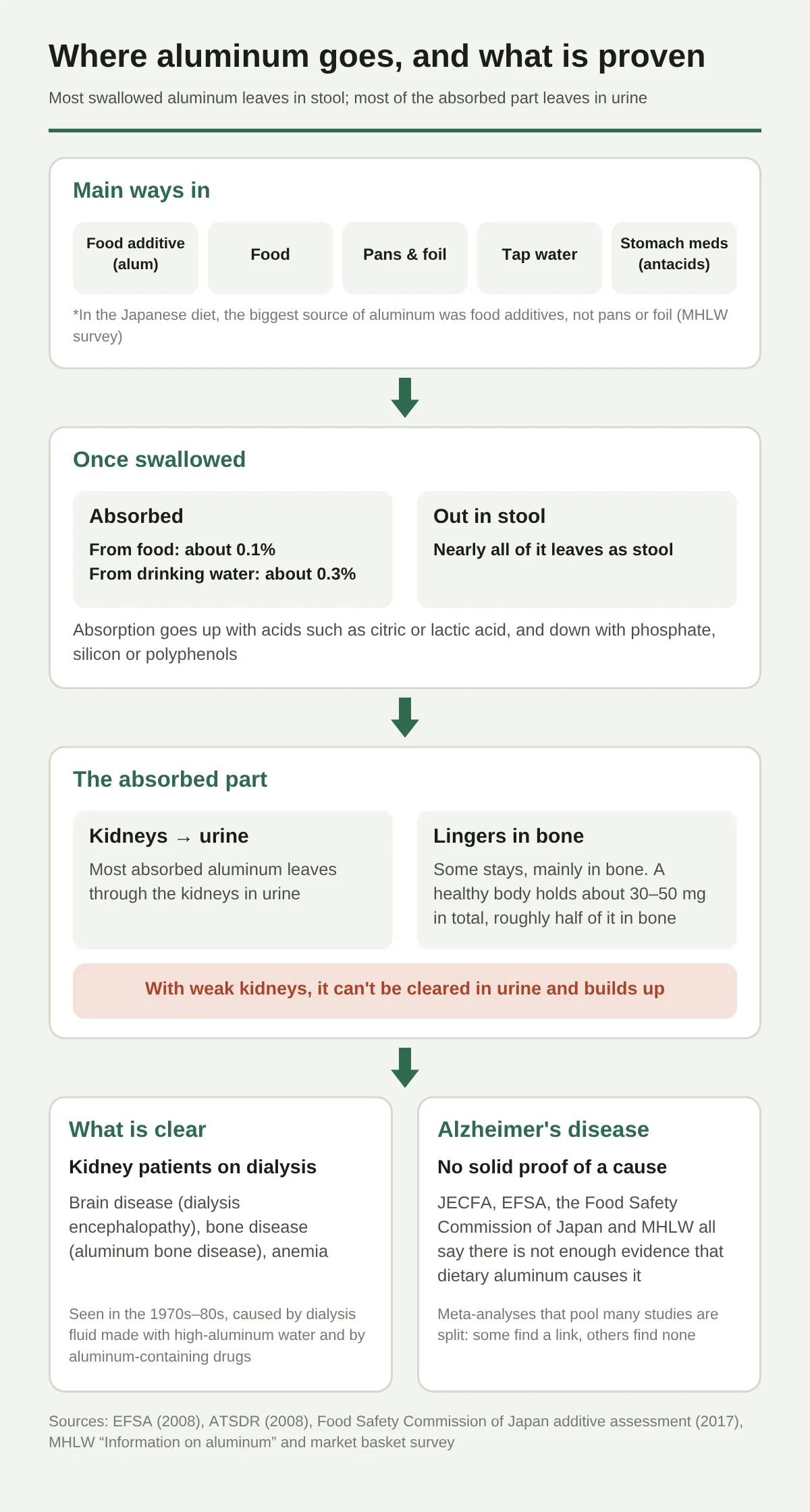
- About 0.1% is absorbed from food and about 0.3% from drinking water (EFSA). Most leaves in the stool
- Absorption increases with acids such as citric acid and lactic acid, and decreases with phosphate, silicon, and polyphenols
- Most of the absorbed aluminum leaves through the kidneys into urine
- Some stays in the body and accumulates especially in bone. It also enters the brain and reaches the fetus through the placenta
- The total amount of aluminum in a healthy person’s body is about 30–50 mg, and about half is in bone (ATSDR)
- What stays in the body decreases very slowly. In a study that followed one person for 10 years, the time for the whole-body amount to fall by half was estimated at about 50 years (Priest 2004; data from one person)
- When kidney function is reduced, aluminum cannot be removed in urine and accumulates more easily
How much is acceptable: limits by agency
| Agency (year) | Amount allowed per week (per kg body weight) | Basis |
|---|---|---|
| FAO/WHO Joint Expert Committee on Food Additives, JECFA (2011) | 2 mg (provisional tolerable weekly intake, PTWI) | One hundredth of the dose (30 mg per kg body weight per day) that caused no kidney effects or reduced grip strength in offspring in a rat study with aluminum citrate in the diet |
| Japan’s Food Safety Commission (2017) | 2.1 mg (tolerable weekly intake, TWI) | One hundredth of the dose with no effect on offspring body weight or kidneys in the same study |
| European Food Safety Authority, EFSA (2008) | 1 mg (TWI) | Based on effects on neurodevelopment, testes, and so on in mouse, rat, and dog studies |
| U.S. Agency for Toxic Substances and Disease Registry, ATSDR (2008) | 1 mg per day (MRL) | Mouse neurodevelopment and grip strength study |
For a 50 kg person, that is 100 mg per week by the JECFA value and 50 mg by the EFSA value. Because aluminum accumulates in the body, limits are set per week rather than per day.
How much is eaten in Japan
In an MHLW survey for fiscal 2011–12, the whole diet gave adults 2.53 mg per day (about 17.7 mg per week, 15.1% of the tolerable amount) and children aged 1–6 gave 1.97 mg per day (43.1%). After the 2018 regulation, the amount from processed foods fell for adults from 2.16 mg to 1.08 mg per day.
The Food Safety Commission estimated the total for the Japanese population, including utensils (assuming everything is cooked in aluminum) and tap water (assuming water at the upper limit of the standard), at 0.69 mg per kg body weight per week (1.2 mg for children).
What are the effects when it accumulates?
What is clear: kidney disease and dialysis
The harm of aluminum has been clearly confirmed in people with poor kidney function who are on dialysis.
In the 1970s and 80s, dialysis fluid made with aluminum-rich water, and aluminum-containing drugs to lower phosphorus, caused a brain disease (dialysis encephalopathy), a bone disease (aluminum bone disease), and anemia. In a British study, patients whose dialysis water was treated by reverse osmosis did not develop encephalopathy (Davison et al. 1982).
The Japanese Society for Dialysis Therapy’s standard for dialysis water is 0.01 mg/L of aluminum (one twentieth of the tap water standard). Also, many aluminum-containing stomach medicines (sucralfate, dried aluminum hydroxide gel, and others) say in the package insert “do not give to patients receiving dialysis”.
The Food Safety Commission summarizes dialysis encephalopathy as “caused by taking large amounts of aluminum by routes other than the mouth.”
International guidelines for people with kidney disease (KDIGO 2017) ask to avoid long-term use of aluminum-containing drugs and aluminum contamination of dialysis fluid. They make no recommendation about pans or tableware. In Taiwan, a small trial in which 42 patients with kidney failure switched kitchenware from aluminum to stainless steel reported that blood aluminum fell below that of the control group after 3 months (Lin et al. 1997). People with kidney disease should consult their doctor about diet and kitchenware.
Alzheimer’s disease: insufficient evidence of causation
The theory that “aluminum causes Alzheimer’s disease” spread in the 1960s and 70s.
- In a French study following 1,925 older adults for 15 years (PAQUID), people who took in 0.1 mg or more of aluminum per day from drinking water had 2.8 times the risk of Alzheimer’s disease. However, the highest-intake group was small, at 13 people, and aluminum from food was not considered
- Pooled analyses (meta-analyses) are also split, one finding an association (odds ratio 1.71, Wang et al. 2016) and another finding none for occupational exposure (1.00, Virk et al. 2015)
On that basis, JECFA, EFSA, Japan’s Food Safety Commission, and the MHLW all say there is “not sufficient evidence of a causal relationship between aluminum from the diet and Alzheimer’s disease”. The MHLW writes that there was once information suggesting a link between Alzheimer’s disease and aluminum, but that there is currently no evidence proving such a causal relationship.
A review partly funded by an aluminum industry group (Willhite et al. 2014) also concludes there is “no consistent evidence of an association,” but because of the conflict of interest, this article does not use it as a basis.
Babies: infant formula and intravenous feeding of premature infants
- Infant formula also contains aluminum. Measurements of 30 UK products found about 0.1–0.43 mg per liter, and about 0.66–0.76 mg for soy-based (Chuchu et al. 2013). In EFSA’s estimate, the average for a 3-month-old baby was up to 0.6 mg/kg body weight/week with cow’s-milk-based formula and 0.75 with soy-based (EFSA’s tolerable amount is 1 mg), and 0.9–1.1 mg for heavy feeders. Breastfed babies were under 0.07 mg. I found no public data on infant formula in Japan
- Caution is needed in cases where aluminum enters directly by intravenous feeding in premature infants whose kidneys are immature. A British trial saw effects on development and bone, and the U.S. Food and Drug Administration (FDA) limits intravenous nutrition solutions to 25 µg per liter or less
Antiperspirants and breast cancer
On the theory that “aluminum in antiperspirants causes breast cancer,” the U.S. National Cancer Institute says there is “no scientific evidence,” and the EU’s Scientific Committee on Consumer Safety says “epidemiological studies do not support this hypothesis.”
What should people who want to limit aluminum use?
For people with kidney disease, people who prepare food for babies, and others who want to limit aluminum, the only public agency I found that gives specific advice on cookware was Germany’s BfR. It has three points.
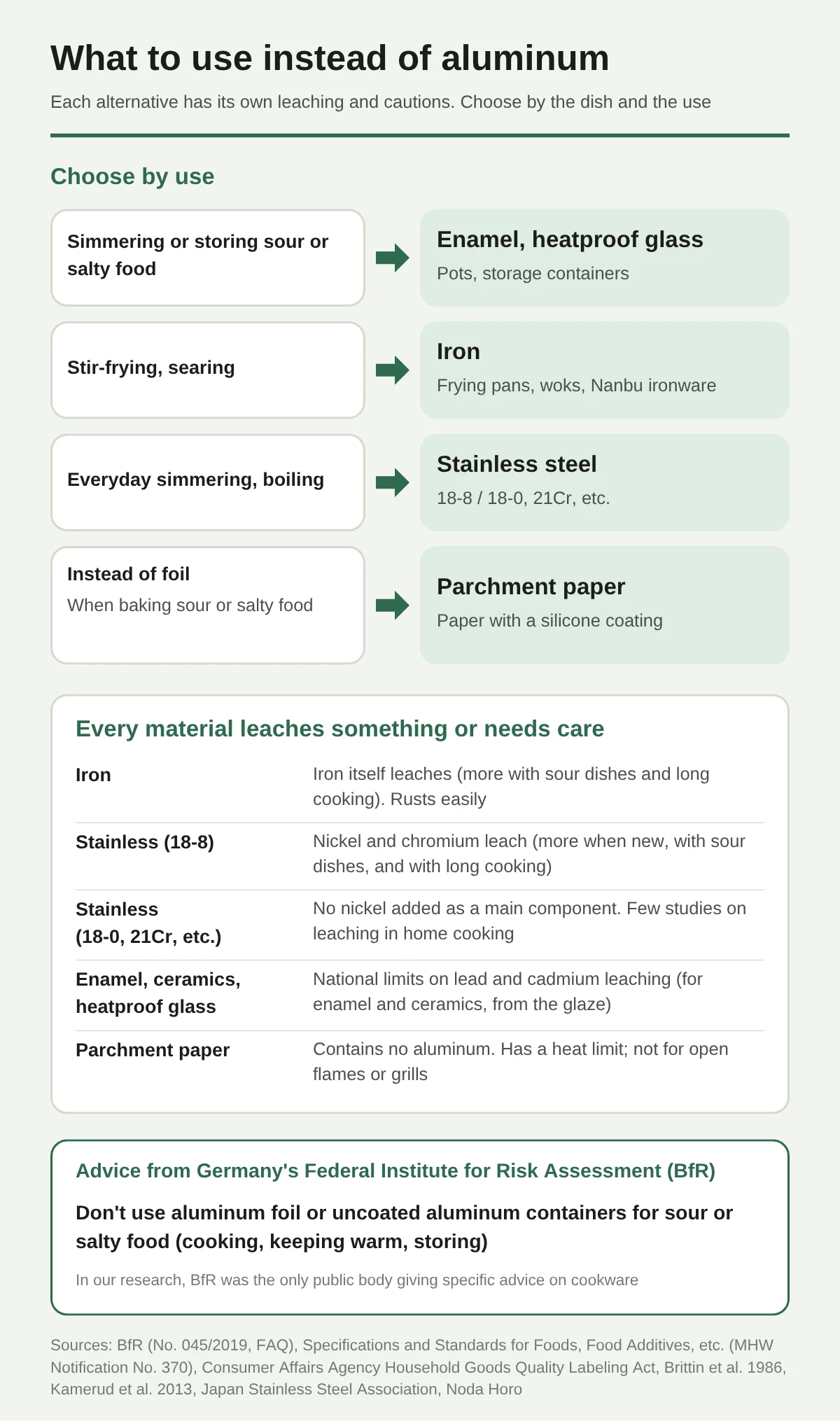
- For sour or salty foods, do not use aluminum foil or aluminum containers with no surface treatment (for cooking, keeping warm, or storing)
- For grilling, prefer reusable dishes such as stainless steel (ceramic is also an option)
- Do not concentrate on particular foods, products, or brands
The KDIGO guideline for kidney disease and BfR’s advice on infants concern drugs, dialysis fluid, and infant formula, and do not mention pans or tableware.
The alternative materials also each have things that leach from them and points to watch. It is less that one is “safe” and more that you choose by dish and way of use.
| Material | Good points | Points to watch for that material | Suited to |
|---|---|---|---|
| Iron (frying pans, woks, Nambu ironware) | Withstands high heat. Iron moves into the food | Iron itself leaches (more with sour dishes and long cooking). Rusts easily. People told to limit iron should consult their doctor | Stir-frying, pan-frying, deep-frying |
| Enamel (horo) | Glassy surface. The only pan that does not need the “do not store food in the pan” label (labeling rules) | National standards for lead and cadmium in the glaze. Rusts if chipped. Weak against dry-heating and impact | Stewing, sour dishes, storing make-ahead food |
| Stainless steel (18-8) | Rust-resistant. The material BfR named in place of grill dishes | Nickel and chromium leach (more when new, with sour dishes, and with long cooking) | Everyday simmering and boiling |
| Stainless steel (18-0, 21Cr, etc.) | No nickel added as a main component. Magnetic and suited to induction (IH) | Little research on leaching in home cooking | An option for people concerned about nickel |
| Heat-resistant glass | Contents are visible. Some are made for microwave and oven | Breaks with sudden temperature change. Use direct-flame types on low heat | Storage, microwave, oven |
| Ceramics and clay pots (donabe) | Keep heat well | Lead and cadmium in the glaze (many violations among imported ceramic tableware) | Hot pot dishes and cooking rice (use items made for cooking over heat) |
| Fluoropolymer coating (often over an aluminum base) | Non-stick | Decomposition gases from dry-heating and overheating (BfR: do not heat empty for more than 3 minutes). The base shows when the coating peels | Low-to-medium-heat pan-frying |
Iron
Cooking in an iron frying pan or pot, iron moves into the food. In a U.S. study, with about 90% of 20 kinds of food, the iron pan gave significantly more iron. The more sour, watery, or long-cooked the food, the more (Brittin et al. 1986). In Japan’s food composition tables as well, iron in 100 g of dried hijiki is 6.2 mg when made in a stainless steel kettle and 58.0 mg when made in an iron kettle, a large difference (the difference is the kettle used in manufacturing).
The “Dietary Reference Intakes for Japanese (2025 edition)” sets no tolerable upper intake level for iron, but says that “iron intake well above the recommended amount should be avoided, except when the aim is treating anemia and the like.” People who have been told to limit iron (hemochromatosis and others) should consult their doctor.
A maker of Nambu ironware (Iwachu) explains to season with oil before use, to heat the pot after washing to drive off moisture, and that frequent cooking of salty miso soup can make the coating on the inside peel. It is not suited to simmering sour dishes for a long time or to storing food left in it.
Enamel (horo)
Enamel is made by baking a glassy glaze onto iron or another metal. The maker (Noda Horo) explains that it is “strong against acid and salt.” Under the Household Goods Quality Labeling Act, only iron enamel pans are exempt from having to write the caution “do not store food in the pan.”
The point to watch is the lead and cadmium that the glaze may contain. The Food Sanitation Act has standards for the amount that leaches, and for cooking-with-heat items (capacity under 3 L) they are set at lead 0.4 µg/mL and cadmium 0.07 µg/mL or less. If it chips and the iron underneath shows, it rusts from there (the maker explains that “no harmful substances are produced”). Avoid dry-heating, strong impact, and metal scrubbers.
For a heavy pot for stewing, there are also enameled cast-iron pots (STAUB and others).
Stainless steel
Stainless steel is rust-resistant and durable, and BfR also names it in place of grill dishes.
On the other hand, nickel and chromium leach out. In a study at Oregon State University in the U.S., boiling tomato sauce for 6 hours raised nickel up to 26-fold and chromium up to 7-fold. New pans gave more; with repeated cooking it fell and settled from about the sixth use on (Kamerud et al. 2013; conditions of 2–20 hours, longer than home cooking).
Stainless steel comes in 18-8 (SUS304 and others), which contains nickel, and 18-0 (SUS430) and 21Cr (SUS443J1 and others), which have no nickel added as a main component (Japan Stainless Steel Association). Under the Household Goods Quality Labeling Act, stainless pans must state the proportions of chromium and nickel, so you can tell them apart by the label.
Heat-resistant glass
Heat-resistant glass lets you see the contents and can be used in the microwave, in the oven, and over a direct flame (for direct-flame types). Under the Household Goods Quality Labeling Act, a use category such as “direct flame,” “oven,” or “microwave” must be stated, so use it as labeled. Glass also has standards for lead and cadmium leaching (for cooking-with-heat items, lead 0.5 µg/mL and cadmium 0.05 µg/mL or less).
Clay pots, copper pots, and nonstick frying pans
- Clay pots and ceramics: there are national standards for lead and cadmium in the glaze. In the MHLW’s import food violation cases (fiscal 2024–26), no violations were found for clay pots, but lead violations were common in imported ceramic tableware (decorative plates and the like). For food, use items sold as “for cooking over heat” or “tableware”
- Copper pots: under the Food Sanitation Act, surfaces that touch food in principle must be plated with tin, silver, or the like. Uncoated copper leaches a lot of copper when it touches sour things
- Fluoropolymer coating: products often have an aluminum base. BfR advises not heating them empty for more than 3 minutes. PFOA, which was used in making the raw material, was also in principle banned from manufacture and import in Japan in 2021. However, “PFOA-free” does not mean the same as “PFAS (organofluorine compounds)-free”
Tips for using aluminum products (from public agencies and instruction manuals)
| Situation | What to do | Basis |
|---|---|---|
| You made something sour or salty in an aluminum pan | Move it to another container when cooking is done | Household Goods Quality Labeling Act labeling, makers’ instruction manuals, BfR |
| You bought a new aluminum pan | Boil water or rice-rinsing water before use | Makers’ instruction manuals, South Korea’s Ministry of Food and Drug Safety |
| Care of aluminum pans | Do not use metal scrubbers or abrasive powder. Check the manual for dishwashers (leaching rose after an aluminum moka pot went through a dishwasher) | Household Goods Quality Labeling Act, Stahl et al. 2017 |
| Wrapping in foil | Do not wrap sour or salty foods such as cut apples, tomatoes, marinated meat, and cheese. Add salt and spices after baking | BfR |
| Lunch boxes | Do not put umeboshi, red pickled ginger, and the like in foil cups (a case where a hole formed) | Fukuoka City Institute for Hygiene and the Environment |
| Covering a dish in a metal container | Use plastic wrap or a lid instead of aluminum foil | Food authorities of Finland and Canada |
| Old pans | Replace pans that are discolored, have holes, or have deep scratches | Health Canada, South Korea’s Ministry of Food and Drug Safety |
Summary
| What was checked | What was found |
|---|---|
| How aluminum is made | Bauxite → alumina (Bayer process) → electrolysis (Hall–Héroult process). Japan’s smelting ended in 2014 and all new ingot is imported. Energy for recycled ingot is about 3% of that for virgin ingot |
| Why it is used for pans | Conducts heat well (about 3 times iron), is light (about one third of iron), and the material is cheap. The oxide film is weak against acid, alkali, and salt |
| Whether it leaches from aluminum pans and yukihira pans | It leaches. Little with water and miso soup; much with vinegar and alkaline cooking liquids. Alumite treatment greatly reduces it, but it increases when acid and salt combine |
| Whether it leaches from aluminum foil | It leaches. Much with ponzu, umeboshi pickling liquid, and alkaline cooking liquids. Suppressed by proteins and the like in the food, and very little with commercial foods in foil pots |
| Within the whole diet | From utensils, at most 0.57 mg per day for an adult (assuming everything is in aluminum pans). The biggest source is alum in leavening agents and the like; with the 2018 regulation, children’s intake from processed foods fell from 1.80 mg to 0.50 mg per day |
| Once in the body | About 0.1% is absorbed. Most leaves in urine, but some stays in bone and elsewhere for a long time |
| Effects when it accumulates | What is clear is encephalopathy, bone disease, and anemia in dialysis patients. For Alzheimer’s disease, there is not sufficient evidence of causation |
| For people who want to limit it | Do not use foil or untreated aluminum containers for sour or salty foods (BfR). The alternative materials each have points to watch too |
Items featured in this article:
| Item | Why it was chosen | Link |
|---|---|---|
| Taniguchi Metal Wa no Shokunin Ginpa yukihira pan 18 cm | An alumite-treated aluminum yukihira pan (maker’s own store, free shipping) | See on Rakuten PR See on Amazon.co.jp PR See on Yahoo! Shopping PR |
| Yoshikawa Ajiichi stainless yukihira pan 18 cm | 21Cr stainless steel (a steel type with no nickel added as a main component), maker’s official store | See on Rakuten PR See on Amazon.co.jp PR See on Yahoo! Shopping PR |
| Noda Horo Luke milk pan 15 cm | An enamel one-handled pan, works with induction | See on Rakuten PR See on Amazon.co.jp PR See on Yahoo! Shopping PR |
| Noda Horo Rectangle Deep M | For storing sour or salty foods | See on Rakuten PR See on Amazon.co.jp PR See on Yahoo! Shopping PR |
| Riverlight Kiwame JAPAN 26 cm | An iron frying pan for stir-frying and pan-frying | See on Rakuten PR See on Amazon.co.jp PR See on Yahoo! Shopping PR |
| Cook-Para cooking sheet L | In place of foil when baking sour or salty foods | See on Rakuten PR See on Amazon.co.jp PR See on Yahoo! Shopping PR |
| Rumford baking powder 113 g | A baking powder whose acid component is not alum | See on Rakuten PR See on Amazon.co.jp PR See on Yahoo! Shopping PR |
| ZWILLING official (STAUB, etc.) | Enameled cast-iron stewing pots | ツヴィリング【ZWILLING】  |
| HARIO NETSHOP | Heat-resistant glass storage containers and cookware | 【HARIO NETSHOP】  |
Related articles: the vinegar article (types of vinegar and amounts of acetic acid), the tomato ketchup article, the food coloring article (aluminum lakes), the salt intake article
Sources
Japanese public agencies and laws
- MHLW “Information on aluminum,” “Results of the fiscal 2011–12 market basket survey of aluminum intake” (2013), “Results of the fiscal 2020–21 market basket survey of aluminum intake,” Shokuankisei Notices 0701 No. 1 and No. 2 (2013), Shokushoku Notice 1130 No. 2 (2018, Public Notice No. 407)
- Food Safety Commission of Japan, additive assessment report “Aluminum ammonium sulfate, aluminum potassium sulfate” (2017), “Food Safety” No. 55 (2018), fact sheet “Fluoropolymers” (2012)
- Consumer Affairs Agency, Household Goods Quality Labeling Act, “Pans,” “Aluminum foil for meals, table, or kitchen use,” “Borosilicate glass or glass-ceramic utensils,” positive list system for food utensils and containers/packaging
- Standards and specifications for foods and additives (MHLW Public Notice No. 370 of 1959), Part III Utensils, containers and packaging
- Ministry of the Environment, water quality standard items and values, “Outline of review for the revision of water quality standards” (2003)
- MHLW “Dietary Reference Intakes for Japanese (2025 edition)”
- MEXT, Standard Tables of Food Composition in Japan (8th revised edition), 2023 supplement
- Fukui Prefecture Consumer Center, purchase test “Aluminum foil” (fiscal 2021); Fukuoka City Institute for Hygiene and the Environment, Message No. 17 (2002)
- National Institute of Health Sciences, “Consumer information on food containers and packaging”
- RIKEN, “Research on anodic oxide film that gave birth to ‘alumite’”
- Japanese Society for Dialysis Therapy, “2016 edition, Water quality standards for dialysate”
- Package inserts for Alusalmin Fine Granules and Malfa Suspension Compound Granules
Overseas public agencies
- JECFA 74th report (WHO Technical Report Series 966, 2011)
- EFSA “Safety of aluminium from dietary intake” EFSA Journal (2008) 754
- BfR Opinion No. 007/2017 (untreated aluminum serving trays), No. 045/2019 (reducing aluminum intake), FAQ “Aluminium in Lebensmitteln und verbrauchernahen Produkten”
- ATSDR Toxicological Profile for Aluminum (2008)
- WHO “Aluminium in Drinking-water” (2003)
- Health Canada “The safe use of cookware and bakeware”
- Commission Regulation (EU) No 380/2012
- U.S. National Cancer Institute “Antiperspirants/Deodorants and Breast Cancer,” EU Scientific Committee on Consumer Safety SCCS/1613/19 (2020)
- KDIGO 2017 CKD-MBD Guideline Update
- 21 CFR 201.323 (FDA)
Papers
- Kawamura Y, et al. “Estimated aluminum intake from aluminum utensils and food packaging in Japan,” J. Food Hyg. Soc. Japan 23:1-8 (2016)
- Takeda Y, et al. J. Food Hyg. Soc. Japan 39:178-183, 39:266-271 (1998), 40:172-177 (1999)
- Matsushima F, et al. Jpn. J. Hyg. 43:969-978 (1988), 45:964-970 (1990)
- Nakahira M, et al. “Leaching of aluminum from pans by number of uses,” Bulletin of Shiga Junior College 38 (2013)
- Stahl T, et al. Environ Sci Eur 2017 (Parts II and III)
- Sander S, et al. PLoS ONE 2018;13:e0200778
- Karbouj R, et al. Food Chem Toxicol 2009
- Turhan S. Meat Sci 2006;74:644-647
- Dordevic D, et al. Food Sci Nutr 2019;7:3349-3360
- Bassioni G, et al. Int J Electrochem Sci 2012;7:4498-4509
- Rondeau V, et al. Am J Epidemiol 2009;169:489-496
- Wang Z, et al. Neurosci Lett 2016;610:200-206; Virk SA, Eslick GD. J Occup Environ Med 2015;57:893-896
- Davison AM, et al. Lancet 1982;2:785-787
- Priest ND. J Environ Monit 2004
- Chuchu N, et al. BMC Pediatr 2013;13:162; Bishop NJ, et al. N Engl J Med 1997;336:1557-1561
- Lin JL, et al. Am J Kidney Dis 1997;30:653-658
- Brittin HC, Nossaman CE. J Am Diet Assoc 1986;86:897-901
- Kamerud KL, et al. J Agric Food Chem 2013;61:9495-9501
- Willhite CC, et al. Crit Rev Toxicol 2014 (partly funded by the International Aluminium Institute and others. Not used as a basis in the text)
Industry groups and makers (cited as “an industry group’s explanation” and “a maker’s explanation”)
- Japan Aluminium Association, “What is aluminum,” aluminum foil FAQ, LCI report
- International Aluminium Institute, primary aluminum smelting energy intensity (2025)
- Aluminum Can Recycling Association, “Fiscal 2025 recycling rate for aluminum beverage cans,” “How aluminum cans are made”
- Nippon Light Metal, “On the end of aluminum electrolysis operations” (2014)
- Hokuriku Aluminium instruction manual and FAQ, Endo Shoji FAQ, Noda Horo “About enamel” and “Care and FAQ,” Iwachu FAQ, Japan Stainless Steel Association “Overview of stainless steel”
Related articles and databases
- Is Vinegar Good for You? Rice, Pure Rice, Grain, Black, and Apple Cider Vinegar Compared, and the “Acetic Acid for Blood Pressure and Visceral Fat” Research Checked
- What Is Tomato Ketchup? The JAS “Special Grade,” How It Differs from Tomato Sauce, and Whether Lycopene Absorption Changes with Heat and Oil
- Are Food Colorings (Red No. 102, Yellow No. 4) Bad for You? Cancer Assessments and Whether They Are Banned Abroad, Checked Against Rules in Japan and Overseas
- Where Does “Too Much Salt” Begin? Checking Japan’s Salt Intake Trend, Target Amounts, and the Links to High Blood Pressure and Stomach Cancer Against National Surveys and Studies
- Are Microwave Ovens Bad for You? History, How They Work, Use Around the World, Safety, Nutrition (vs. Boiling and Stir-Frying), the “Microwave Cover” Claim, and How to Use and Choose One
- Are Teflon (Fluoropolymer) Nonstick Pans Harmful? History, Types, How PFAS Rules Have Changed, Overheating and Food Transfer, and How to Choose Alternative Materials