
What Is Tomato Ketchup? The JAS “Special Grade,” How It Differs from Tomato Sauce, and Whether Lycopene Absorption Changes with Heat and Oil

PR This article contains affiliate links to Rakuten Ichiba (“See on Rakuten”). What is written here is based on official sources and published studies, whether or not there is an ad. The “See on Amazon.co.jp” and “See on Yahoo! Shopping” links are also affiliate links.
Tomato ketchup is a must-have for omurice and Napolitan spaghetti. The label has words such as “特級” (tokkyu, special grade), “トマトケチャップ” (tomato ketchup), “糖類(砂糖・ぶどう糖果糖液糖、ぶどう糖)” (sugars (sugar, glucose-fructose syrup, glucose)), and “酸化防止剤(V.C)” (antioxidant (V.C)).
You also often hear that “ketchup is full of lycopene,” that “you get more lycopene from cooked tomatoes,” and that “lycopene prevents prostate cancer.”
This article checks the following against national standards, laws, and published studies.
- What can be called “tomato ketchup,” and how it differs from tomato sauce, chili sauce, and tomato puree
- How the JAS grades “special grade” (特級) and “standard” (標準) differ
- The sweetening ingredients (sugar, glucose-fructose syrup), and the amounts of salt and sugars
- What the labels “antioxidant (vitamin C)” and “V.C” mean
- Whether lycopene absorption changes with heat or oil (human trials)
- How much is known about lycopene and prostate cancer and heart disease, and how countries and international bodies assess it
Summary
- Under the Food Labeling Standards, “tomato ketchup” is defined as concentrated tomato with salt, spices, vinegar, sugars, and onion or garlic added, with soluble solids (the share of dissolved components, measured with a Brix refractometer) of 25% or more. A food that does not meet the definition cannot be called “tomato ketchup.” A seasoning below 25% falls in the “tomato sauce” range
- In the JAS standard (JAS 1419), “special grade” means soluble solids of 30% or more and “standard” means 25% or more. Both allow only seven ingredients: concentrated tomato, onion, garlic, salt, spices, brewed vinegar, and sugars. Whether to have a product graded under JAS is up to the company
- According to the food composition tables, 100 g of ketchup has 3.1 g of salt equivalent and 22.7 g of sugars (available carbohydrate). One tablespoon (about 17 g) has about 0.5 g of salt and about 3.9 g of sugars
- Human trials have repeatedly shown that blood lycopene rises more easily when you eat cooked, concentrated tomato products with oil than when you eat raw tomatoes (however, all of them are small trials of a few to a few dozen people, and a rise in blood levels does not prove that it prevents disease)
- For prostate cancer, pooled observational studies mostly find that “people who eat more lycopene have a slightly lower risk,” but pooled randomized controlled trials of lycopene show no clear difference in prostate cancer incidence or PSA. The World Cancer Research Fund (WCRF) downgraded its 2007 rating of “probable” to “limited evidence, no conclusion” in 2014. In 2005 the US FDA did not allow claims about “lycopene itself,” saying there is no credible evidence
- Foods with Function Claims include notifications using lycopene, but they are not approved by the government. In the EU, every submitted health claim for lycopene has been rejected
What is covered in this article
| For people who | What is covered | Where |
|---|---|---|
| Want to try a ketchup sweetened only with sugar and containing garlic | U-SIDE Tomato Ketchup (300 g) | How to read the ingredient list |
| Want to compare with an organic JAS ketchup that uses no additives | Hikari Shokuhin Organic Tomato Ketchup (300 g) | How to read the ingredient list |
| Want to decide the salt and sugar themselves and add only the tomato flavor | Alce Nero Organic Tomato Puree (200 g x 3) | Salt and sugar amounts |
Conditions for calling a product “tomato ketchup”
The definition in the Food Labeling Standards
The definition of tomato ketchup is written in Appended Table 3 of the national “Food Labeling Standards” (Cabinet Office Order).
- Concentrated tomato seasoned with salt, spices, vinegar, sugars, and onion or garlic, with soluble solids of 25% or more
- Or the same with acidulants (including citrus juice), seasoning (amino acids, etc.), thickening polysaccharides, and the like added, with soluble solids of 25% or more
“Concentrated tomato” is tomato juice (tomatoes crushed and pressed, or strained, with the skin and seeds removed) that has been concentrated, with soluble solids of 8% or more excluding salt.
“Tomato ketchup” is also listed in Appended Table 5 of the same standards. This means that a food that does not meet the definition may not use this name (Article 3).
What are soluble solids?
Soluble solids are the share of components dissolved in a liquid (mainly sugars, acids, and salt). The JAS standard defines it as the value read on a sugar refractometer at 20°C, expressed as a percentage. This is the same method as the so-called “sugar content (Brix).”
Tomato puree and tomato paste are separated by “salt-free soluble solids,” which is the value with the salt portion subtracted.
Differences among tomato products
Lining up the definitions in the Food Labeling Standards and JAS 1419 gives the following.
| Name | What it is (key points of the definition) | Concentration standard |
|---|---|---|
| Tomato juice | Pressed tomato juice, or that with salt added. Juice made by diluting concentrated tomato is labeled “(from concentrated tomato)” | Salt-free soluble solids 4.5% or more (JAS) |
| Tomato puree | Concentrated tomato (including that with a small amount of salt, spices, vegetables, lemon, or pH adjuster added) | Salt-free soluble solids less than 24% |
| Tomato paste | Same as above | Salt-free soluble solids 24% or more |
| Tomato ketchup | Concentrated tomato + salt, spices, vinegar, sugars, onion or garlic | Soluble solids 25% or more |
| Tomato sauce | Concentrated tomato (chopped tomato may be added) + salt, spices. Vinegar, sugar, oil, sake, vegetables, and so on may also be added | Soluble solids 8% or more and less than 25% |
| Chili sauce | Tomatoes peeled and chopped with the seeds left in, concentrated, with salt, spices, vinegar, and sugars added | Soluble solids 25% or more (30% or more in JAS) |
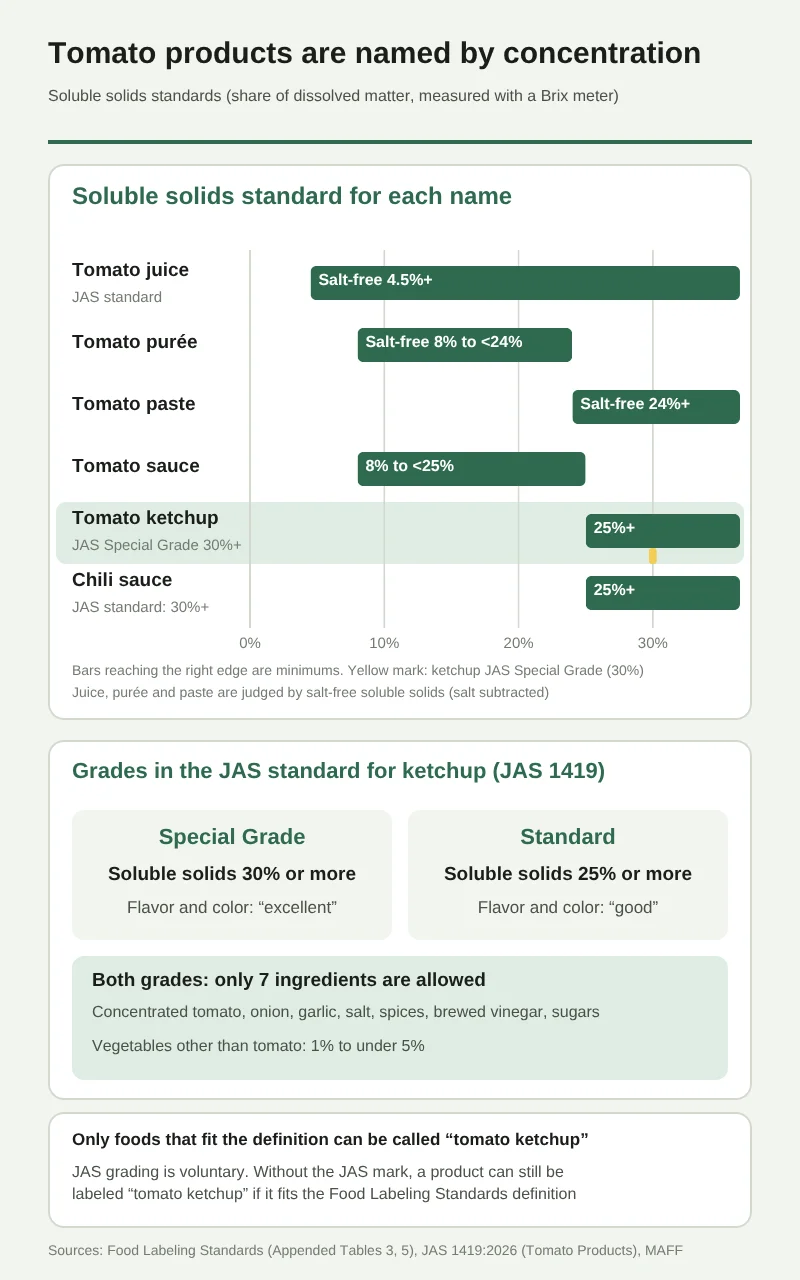
(Food Labeling Standards, Appended Table 3; JAS 1419:2026)
The boundary between ketchup and tomato sauce is 25% soluble solids. Ketchup and chili sauce are both 25% or more, but chili sauce differs in that it uses tomatoes with the seeds left in.
Note that “chili sauce” here is the name of a tomato product. The food composition tables also list chili sauce (tomato products) and chili pepper sauce (a hot sauce made from chili peppers, in the pungent seasonings category that includes Tabasco sauce) as separate foods.
The JAS “special grade” and “standard”
The JAS (Japanese Agricultural Standards) for “tomato products” (JAS 1419) was established in 1979, and the latest revision is February 16, 2026 (in force April 1). Ketchup has two grades, “special grade” and “standard.”
| Item | Special grade | Standard |
|---|---|---|
| Quality | Excellent flavor and color, with no off-taste or off-smell. Fine, even particles with moderate viscosity | Good flavor and color, with no off-taste or off-smell. Fine, even particles with moderate viscosity |
| Soluble solids | 30% or more | 25% or more |
| Share of vegetables other than tomato | 1% or more and less than 5% (common to both) | |
| Ingredients that may be used | Only seven: concentrated tomato, onion, garlic, salt, spices, brewed vinegar, and sugars (common to both) | |
| Additives | Only those that meet the Codex General Standard for Food Additives. The amounts used are recorded, and consumers are told that the standard is met (common to both) |
(JAS 1419:2026, Table 4)
- The difference between special grade and standard is the concentration (soluble solids) and the rating of flavor and color
- The ingredients that may be used are the same seven for both grades. The definition in the Food Labeling Standards also allows acidulants, seasoning (amino acids, etc.), and thickening polysaccharides, but JAS does not allow these ingredients
- JAS also sets a standard for the lycopene in the concentrated tomato used: at least 70 mg/kg when converted to 4.5% soluble solids excluding salt (7 x 10 mg/kg). Tomatoes low in lycopene cannot be used for JAS ketchup
JAS grading is a system that companies choose whether to join. Even a ketchup without the JAS mark or the “special grade” label can be called “tomato ketchup” if it meets the definition in the Food Labeling Standards. The absence of a grade label does not by itself mean lower quality.
How to read the ingredient list
In order of weight; tomato may be written as “tomato”
The ingredient list (原材料名) is written in descending order of weight used (Food Labeling Standards, Article 3). For ketchup, tomato juice and concentrated tomato may be written as “トマト” (tomato) (Appended Table 4). Even if the label says “tomato,” that does not mean raw tomatoes were simply boiled.
The sweetener: sugar or glucose-fructose syrup?
Ketchup may be sweetened with sugar, glucose-fructose syrup (isomerized sugar), or glucose. Comparing the ingredient lists on the manufacturers’ official pages gives the following.
| U-SIDE Tomato Ketchup | Hikari Shokuhin Organic Tomato Ketchup | Kagome Tomato Ketchup | |
|---|---|---|---|
| Ingredient list (原材料名) | Tomatoes, sugar, brewed vinegar (contains apple), onion, salt, spices, garlic / antioxidant (vitamin C) | Organic tomatoes, sugars (organic sugar, malt syrup), organic brewed vinegar (organic rice vinegar, organic apple vinegar), salt, organic onion, organic garlic, spices | Tomatoes (imported, or domestic (less than 5%)), sugars (sugar, glucose-fructose syrup, glucose), brewed vinegar, salt, onion, spices |
| Sweetening ingredients | Sugar | Organic sugar, malt syrup | Sugar, glucose-fructose syrup, glucose |
| Additives (after the “/”) | Antioxidant (vitamin C) | None | None |
| Garlic | Yes | Yes | No |
| Per 100 g (labeled values) | 136 kcal, carbohydrate 31.8 g, salt equivalent 3.0 g (estimated) | 122 kcal, carbohydrate 28.7 g, sodium 1.1 g (about 2.8 g when converted to salt equivalent) | 118 kcal, carbohydrate 27.9 g, salt equivalent 3.3 g, lycopene 18 mg |
(U-SIDE and Kagome are from each company’s official page; Hikari Shokuhin is from the product page on Rakuten Ichiba “Rakuten 24.” Checked October 1, 2026. Salt equivalent is converted from sodium x 2.54)
- Writing “糖類(砂糖・ぶどう糖果糖液糖、ぶどう糖)” (sugars (sugar, glucose-fructose syrup, glucose)), that is, grouping ingredients of the same kind under the group name “糖類” (sugars) and listing the contents in parentheses, is permitted by the Food Labeling Standards
- Glucose-fructose syrup, fructose-glucose syrup, and high-fructose syrup may also be written together as “isomerized sugar.” How it is made and how the names differ are covered in detail in the article on isomerized sugar
- No public agency has judged any one sweetening ingredient to be good or bad for health. For fructose itself, see the article on fructose in fruit, and for labeling rules on sweeteners, see the article on sweeteners
If you choose from the label text alone, looking at three things, as in the table above, makes the differences clearer: what comes after the “/” (additives), the sweetening ingredients, and whether garlic is included.
Salt and sugar amounts
Comparing with the food composition tables
Using the Ministry of Education, Culture, Sports, Science and Technology (MEXT) “Standard Tables of Food Composition in Japan (8th Revised Edition), 2023 Supplement,” we compared the salt equivalent and sugars per 100 g of tomato products and other condiments.
| Per 100 g | Energy | Salt equivalent | Sugars (available carbohydrate, monosaccharide equivalent) | Dietary fiber | Potassium |
|---|---|---|---|---|---|
| Tomato (red tomato, raw) | 20 kcal | 0 g | 3.1 g | 1.0 g | 210 mg |
| Tomato puree | 44 kcal | 0 g | 5.2 g (estimated) | 1.8 g | 490 mg |
| Tomato paste | 94 kcal | 0.1 g | 13.5 g (estimated) | 4.7 g | 1,100 mg |
| Tomato sauce | 41 kcal | 0.6 g | 5.3 g (estimated) | 1.1 g | 340 mg |
| Tomato ketchup | 116 kcal | 3.1 g | 22.7 g | 1.7 g | 380 mg |
| Chili sauce | 112 kcal | 3.0 g | not measured | 1.9 g | 500 mg |
| Chuno sauce | 129 kcal | 5.8 g | 26.9 g | 1.0 g | 210 mg |
| Worcestershire sauce | 117 kcal | 8.5 g | 24.1 g | 0.5 g | 190 mg |
| Mayonnaise (whole-egg type) | 668 kcal | 1.9 g | 2.1 g | (0) | 13 mg |
(MEXT, “Standard Tables of Food Composition in Japan (8th Revised Edition), 2023 Supplement,” version updated March 27, 2026. Values in parentheses are estimates)
- Ketchup has 3.1 g of salt per 100 g, much more than tomato puree (0 g) or tomato sauce (0.6 g), but less than Worcestershire sauce (8.5 g) or chuno sauce (5.8 g)
- Its 22.7 g of sugars is about 7 times that of raw tomato (3.1 g). This is because the tomato is concentrated and sugars are added
What the sugars in ketchup are made of
In the carbohydrate tables of the food composition tables, the sugars in 100 g of ketchup are 12.3 g of glucose, 8.5 g of fructose, 1.3 g of sucrose (the component of table sugar), and so on. Raw tomato has 1.4 g of glucose and 1.6 g of fructose, with very little sucrose.
The tables do not say which sweetening ingredients were used in the ketchup that was analyzed. Because the sweetening ingredients differ by product, this breakdown does not apply to every product.
In one tablespoon
According to the remarks in the food composition tables, 100 mL of ketchup weighs 115 g. One tablespoon (15 mL) is about 17 g, which gives
- Salt equivalent: about 0.5 g
- Sugars: about 3.9 g
- Energy: about 20 kcal
The Dietary Reference Intakes for Japanese (2025 edition) set the target for salt at less than 7.5 g a day for men aged 18 and over and less than 6.5 g for women. One tablespoon is a little under one-tenth of the target for women.
If you want to decide the salt yourself
If you want to decide the amount of salt and sugar yourself, one way is to use tomato puree with no added salt and season it yourself. According to the food composition tables, tomato puree has 0 g of salt and 5.2 g of sugars (estimated) per 100 g.
What “antioxidant (vitamin C)” and “V.C” mean
The label on U-SIDE’s ketchup says “酸化防止剤(V.C)” (antioxidant (V.C)), and the official page says “酸化防止剤(ビタミンC)” (antioxidant (vitamin C)).
- Under the Food Labeling Standards, additives are written by substance name after the “/” and so on. “Antioxidant” is one of the additives for which the purpose name must be written together with the substance name (Appended Table 6). That is why it takes the form “antioxidant (vitamin C)”
- Vitamin C is an alternative name for the additive “L-ascorbic acid,” which is designated in the Enforcement Regulation of the Food Sanitation Act
- In the Consumer Affairs Agency’s list of “abbreviated names,” L-ascorbic acid may be written as “ascorbic acid” or “V.C,” and sodium L-ascorbate, calcium L-ascorbate, ascorbic acid esters, and so on may also be written as “vitamin C” or “V.C.” In other words, the label “V.C” alone does not tell you whether it is ascorbic acid itself or its sodium salt or the like
Antioxidants are used to prevent color and flavor from changing on contact with air. What they contain is vitamin C-type substances, but when used for this purpose they are labeled as additives. In the EU as well, ascorbic acid is permitted as E300 and so on. How each additive is treated in Japan and overseas is summarized in the additives database.
Does lycopene absorption change with heat and oil?
What is lycopene?
Lycopene is the pigment that gives tomatoes their red color, and belongs to the carotenoids. It does not dissolve well in water but dissolves easily in oil.
Japan’s food composition tables have no entry for lycopene. According to US Department of Agriculture (USDA) food data, the amounts per 100 g are as follows.
The more a tomato product has been boiled down to reduce its water, the more lycopene it has per 100 g. Among Japanese products, Kagome’s tomato ketchup is labeled at 18 mg per 100 g (official page). One tablespoon (about 17 g) has about 3 mg.
What human trials have shown
The stories that “you get more lycopene from cooked tomatoes” and that “absorption is better when eaten with oil” come from trials in which people ate the foods and their blood levels were measured. The main ones are listed below.
| Trial (year) | Participants | What was compared | Result |
|---|---|---|---|
| Stahl et al. (1992) | Not stated in the abstract | Tomato juice cooked for 1 hour with 1% corn oil / uncooked tomato juice | Serum lycopene rose only when people drank the cooked juice |
| Gärtner et al. (1997) | Not stated in the abstract | Tomato paste / raw tomatoes (both 23 mg of lycopene, 15 g of corn oil) | With the paste, the peak blood lycopene was 2.5 times and the total amount (area under the curve) 3.8 times as high |
| Porrini et al. (1998) | 10 women | Tomato puree / raw tomatoes (both 16.5 mg of lycopene) | Blood lycopene was higher with the puree, both after a single serving and after 7 days |
| Fielding et al. (2005) | 23 people | 470 g of chopped tomato cooked with 25 mL of olive oil / cooked without oil (5 days) | With oil, trans-lycopene rose 82%. Without oil, trans-lycopene did not change |
| Unlu et al. (2005) | 11 people | Salsa with 150 g of avocado added / without | With avocado, lycopene absorption was 4.4 times as high |
| Brown et al. (2004) | 7 people | A salad with cherry tomatoes and other vegetables, with dressing containing no oil, 6 g of oil, or 28 g of oil | With the no-oil dressing, almost no lycopene or other carotenoids were absorbed, and more oil meant more absorption |
| Unlu et al. (2007) | 12 people | Tomato sauce heated to be rich in cis-lycopene / sauce rich in trans-lycopene | More was absorbed from the cis-rich sauce |
(From the abstract of each paper)
- Heating and concentrating are thought to break the tomato cell walls and make the lycopene easier to release. Fielding et al. explain that processing breaks down the cell tissue and makes lycopene more available
- Because lycopene dissolves in oil, trials with avocado, olive oil, and dressing have confirmed that eating it together with oil increases absorption
- Heating changes some of the lycopene from the trans form to the cis form. Human blood and tissues contain mostly the cis form, and one trial found that a sauce rich in the cis form was absorbed more easily
Ketchup is made by heating and concentrating tomatoes, so it counts as one of these “processed tomatoes.” However, ketchup itself contains almost no oil (0.2 g of fat in the food composition tables). Eating it with dishes that use oil, such as omelets or stir-fries, comes closer to the conditions of the trials above.
Things to keep in mind
- All of the trials are small trials of a few to a few dozen people, and what they measure is “the amount of lycopene in the blood.” A rise in blood levels does not prove that it prevents disease
Research on lycopene and prostate cancer
Pooled observational studies: mostly “slightly lower risk among people who eat more”
Several pooled analyses (meta-analyses) have gathered observational studies that asked people about their diets and followed them for years.
| Pooled analysis (year) | Studies gathered | Main result |
|---|---|---|
| Chen J et al. (2013) | 11 cohort studies and 6 nested case-control studies | For raw tomato, cooked tomato, lycopene intake, and serum lycopene alike, there was no statistically clear difference between the high and low groups (odds ratio for lycopene intake 0.93, 95% confidence interval 0.86 to 1.01) |
| Chen P et al. (2015) | 26 studies, about 560,000 people | Overall, a trend of “the more eaten, the lower the risk” (P=0.078). When one Chinese study was excluded, or only high-quality studies were used, a clear association appeared. Lower risk in people with high blood lycopene |
| Wang et al. (2015) | 34 studies | 0.86 times for people with higher lycopene intake, 0.81 times for those with higher blood levels. No association was seen with advanced prostate cancer |
| Rowles et al. (2017) | 42 studies, about 690,000 people, 43,851 prostate cancer cases | 0.88 times for both intake and blood levels. 1% lower for every 2 mg/day increase in lycopene. No association with advanced cancer |
(From the abstract of each paper)
A study that followed about 47,000 US male health professionals (Giovannucci et al., 2002) found 0.84 times in the group with the highest lycopene intake, and 0.77 times for men who ate tomato sauce twice a week or more compared with those who ate it less than once a month. A 2014 report from the same study (Zu et al., about 50,000 men) found 0.72 times for life-threatening prostate cancer.
Observational studies cannot completely rule out that “people who eat a lot of tomatoes” also live differently in other ways. Also, many of them are Western studies.
Pooled randomized controlled trials: no clear difference
Pooled analyses of trials that split people into a group taking lycopene and a group not taking it (randomized controlled trials) found the following.
- Ilic et al. (2012): 8 trials. It could not be said that the number of people diagnosed with benign prostatic hyperplasia or prostate cancer went down in the groups taking lycopene (prostate cancer: relative risk 0.92, 95% confidence interval 0.66 to 1.29). With few studies of varying quality, they concluded that it “can neither be recommended nor ruled out”
- Sadeghian et al. (2021): 6 trials in patients with non-metastatic prostate cancer. Overall, PSA (a blood test value for prostate cancer) did not go down. It did go down when limited to people whose PSA was high to begin with
- Sharifi-Zahabi et al. (2022): 6 trials. With lycopene or tomato extract, there was no clear difference in PSA
Assessments by international bodies and overseas
- World Cancer Research Fund (WCRF) and American Institute for Cancer Research: In its 2007 report, WCRF rated “foods containing lycopene” as “probably” lowering the risk of prostate cancer. In its 2014 prostate cancer report, after adding newer studies, it judged the evidence to be limited and downgraded the rating to “limited – no conclusion.” WCRF explains that it did not decide there is no association, but that differences in diagnosis and classification may be making the association hard to see
- US Food and Drug Administration (FDA): In 2005, for the claim that “eating one-half to one cup of tomatoes or tomato sauce a week may reduce the risk of prostate cancer,” the FDA said it would exercise enforcement discretion on the condition that a qualifier is attached saying “very limited and preliminary research” and “little scientific evidence supports this claim.” On the other hand, it said that there is no credible evidence to support a claim for lycopene itself (as a food component or supplement) and prostate cancer. The petitioner was an organization called the “Lycopene Health Claim Coalition,” made up of the ketchup maker H.J. Heinz, a lycopene ingredient company (LycoRed), and others. The claim that was accepted covers “tomatoes” and “tomato sauce,” and does not include other tomato products such as ketchup
Research on lycopene and heart disease and stroke
Observational studies: fewer strokes among people with high blood lycopene
- Cheng et al. (2019): A pooled analysis of 25 studies. In the group with the highest lycopene intake or blood level, stroke was 0.74 times and cardiovascular disease 0.86 times. In the group with high blood levels, death was 0.63 times. There was no association with myocardial infarction
- Li et al. (2014): 7 prospective studies (about 116,000 people). Stroke was 0.81 times with lycopene overall. However, the association was clear for blood lycopene, but not clear for intake from the diet. As one reason, the authors point to the difficulty of measuring dietary intake accurately, for example that the dietary questionnaire in one study did not include ketchup or lycopene supplements
- Aune et al. (2018): People with higher intake or blood levels of vitamin C, carotenoids (including lycopene), and vitamin E tended to have less cardiovascular disease, cancer, and death. The authors regard these as markers of eating a lot of fruit and vegetables, and say this supports advice to eat fruit and vegetables but does not support the use of antioxidant supplements
Intervention trials: mixed results
- Ried et al. (2011): 12 studies. Limited to trials of 25 mg or more of lycopene a day, LDL cholesterol fell by about 10 mg/dL. There was no difference at smaller amounts
- Cheng et al. (2017): 21 trials. In trials where people ate tomatoes, LDL cholesterol fell by 0.22 mmol/L and the ability of blood vessels to dilate (FMD) improved. In lycopene trials, systolic blood pressure fell
- Tierney et al. (2020): 43 studies. The amounts of lycopene (1.44 to 75 mg a day) and the ways of taking it varied, and pooled together there was no difference in blood pressure or cholesterol
A 2021 study that pooled the pooled studies (Li N et al., an umbrella review) organized the relationships between tomatoes or lycopene and death, prostate cancer, stroke, and so on, and found that the quality of the evidence (GRADE) was mostly “low” or “very low.”
How much would you get from ketchup?
To get the “25 mg or more a day” of lycopene that made a difference in Ried et al.’s pooled analysis from Kagome tomato ketchup alone (labeled value 18 mg per 100 g), you would need about 140 g. The salt equivalent would then be about 4.6 g (calculated from the labeled 3.3 g per 100 g), which is about 70% of the target for women (less than 6.5 g). Ketchup is a seasoning, not a food to use in large amounts to get lycopene.
Japanese research and ties to companies
- Odai et al. (2019): A study in which 481 residents of Kuriyama, Hokkaido, drank salt-free tomato juice as much as they liked for one year. In 94 untreated people with borderline high blood pressure, blood pressure fell from 141.2 to 137.0 mmHg, and in 125 untreated people with dyslipidemia, LDL cholesterol fell from 155.0 to 149.9 mg/dL. It is a before-and-after comparison with no comparison group (control group). The paper states that research funding was received from Kikkoman (the tomato juice used was a product of Nihon Del Monte)
- Inoue et al. (2021): A pooled analysis of 12 trials (781 people) finding that lycopene raised HDL cholesterol (no difference in triglycerides). Four of the five authors belong to Kagome’s research division
- Yoshida et al. (2026): A pooled analysis finding that foods containing lycopene improved the function of the blood vessel lining (FMD). Funded by Kagome; three of the authors are Kagome employees and are also authors of one of the pooled trials. The paper itself says it is a small pooled analysis in which the statistical difference disappears if one trial is removed
Lycopene in Foods with Function Claims
Japan: a notification system, not government approval
Foods with Function Claims are a system in which a company submits its scientific evidence to the Consumer Affairs Agency and labels the function on its own responsibility. It differs from Foods for Specified Health Uses (FOSHU, “tokuho”), where the government reviews and approves each product individually.
In the Consumer Affairs Agency’s notification data (obtained September 30, 2026, excluding withdrawn notifications), there are 27 notifications with lycopene as the functional ingredient. The first was in 2015, and 11 use lycopene alone as the ingredient. The claims are mainly about LDL cholesterol in the blood and helping protect the skin from ultraviolet stimulation.
This article does not quote the claims in the notifications or the advertising copy of products. The number of notifications per ingredient, and the differences in how Japan and the EU treat them, are summarized on the lycopene page of Urayomi’s supplement ingredient database.
EU: every submitted claim has been rejected
In 2011, the European Food Safety Authority (EFSA) evaluated claims for lycopene such as “protects DNA, proteins, and lipids from oxidative damage,” “protects the skin from UV damage,” “contributes to normal heart function,” and “maintains normal vision,” and concluded that a cause-and-effect relationship between lycopene intake and these effects has not been established. In the EU register of health claims, no claim for lycopene has been authorized.
Differences between Japan and overseas
| Japan | EU | US | |
|---|---|---|---|
| Health claims for lycopene | Notified as Foods with Function Claims (27; LDL cholesterol, UV and skin, etc.). Not government approval | EFSA did not accept a causal relationship, and claims are rejected (2011) | Claims linking lycopene itself and prostate cancer are not allowed, because there is “no credible evidence” (2005) |
| Claims on tomatoes and prostate cancer | ― | ― | Accepted for tomatoes and tomato sauce with qualifiers such as “little evidence” (2005). Ketchup is not covered |
The World Cancer Research Fund (WCRF), an international research organization, rates the relationship between foods containing lycopene and prostate cancer as “limited – no conclusion” (2014).
Points to check on the back label
- Name: If it says “トマトケチャップ” (tomato ketchup), it meets the definition, including soluble solids of 25% or more. If it says “トマトソース” (tomato sauce), it is in a thinner range than ketchup (8% or more and less than 25%)
- JAS mark and grade: “Special grade” is soluble solids of 30% or more, with only seven ingredients: tomato, onion, garlic, salt, spices, brewed vinegar, and sugars. Even without the mark, a product is ketchup if it meets the definition
- Sweetening ingredients: “砂糖” (sugar), or “糖類(砂糖・ぶどう糖果糖液糖…)” (sugars (sugar, glucose-fructose syrup, …))
- After the “/”: Whether there are antioxidants (vitamin C, V.C), acidulants, seasoning (amino acids, etc.), or thickening polysaccharides
- Salt equivalent in the nutrition facts: Often around 3 g per 100 g. One tablespoon is about 17 g
- Lycopene labeling: Some products show it, but a large amount does not show a health benefit
Summary
| Point | What is known | Strength of evidence / source |
|---|---|---|
| Definition of ketchup | Concentrated tomato + salt, spices, vinegar, sugars, onion or garlic, soluble solids 25% or more. Cannot be called ketchup outside the definition | Law (Food Labeling Standards) |
| Special grade and standard | Special grade 30% or more, standard 25% or more. Only seven ingredients for both. Grading is optional | JAS 1419:2026 |
| Differences from tomato sauce and puree | Sauce is 8% or more and less than 25%. Puree and paste are divided at 24% salt-free soluble solids | Law and JAS |
| Salt and sugars | 3.1 g of salt and 22.7 g of sugars per 100 g. About 0.5 g of salt per tablespoon | Food composition tables |
| Antioxidant (V.C) | Vitamin C (L-ascorbic acid) types. The purpose name must be written with it. “V.C” alone does not tell you the kind of salt | Law and Consumer Affairs Agency notice |
| Lycopene absorption | Blood levels rise more easily with cooked, concentrated tomato and with oil | Small human trials (about 7 to 23 people) |
| Prostate cancer | Observational studies mostly show “slightly lower,” but randomized controlled trials show no difference. WCRF: “no conclusion” | Meta-analyses and international bodies |
| Heart disease and stroke | Fewer strokes among people with high blood lycopene. Intervention trials are mixed. Evidence quality is mostly low | Meta-analyses and umbrella review |
| Foods with Function Claims | 27 notifications. Not government approval. Claims rejected in the EU | Consumer Affairs Agency notification data and EFSA |
Products introduced in this article:
| Why chosen | Where to buy | |
|---|---|---|
| U-SIDE Tomato Ketchup 300 g | Sweetened only with sugar, contains garlic. The only additive is the antioxidant (vitamin C) | See on Rakuten (プロフーズ) PR See on Amazon.co.jp PR See on Yahoo! Shopping PR |
| Hikari Shokuhin Organic Tomato Ketchup 300 g | Organic JAS. No additives listed in the ingredient list | See on Rakuten (楽天24) PR See on Amazon.co.jp PR See on Yahoo! Shopping PR |
| Alce Nero Organic Tomato Puree 200 g x 3 | The only ingredient is organic tomatoes. 0 g of salt, so you can season it yourself | See on Rakuten (楽天24) PR See on Amazon.co.jp PR See on Yahoo! Shopping PR |
(Checked on October 1, 2026 on the Rakuten Ichiba product pages. Prices and shipping may change.)
Related: Article on isomerized sugar (how glucose-fructose syrup is made and named) / Article on sweeteners / Article on fructose in fruit / Additives database
Sources
- Consumer Affairs Agency, “Food Labeling Standards” (Cabinet Office Order No. 10 of 2015), Article 3 and Appended Tables 3, 4, 5, and 6 (e-Gov Law Search). https://laws.e-gov.go.jp/
- MAFF, “Japanese Agricultural Standard for Tomato Products, JAS 1419:2026” (MAFF Notice No. 165, February 16, 2026 [Reiwa 8]). https://www.maff.go.jp/j/jas/jas_kikaku/
- MAFF, “Benefits of obtaining certification” (JAS system). https://www.maff.go.jp/j/jas/jas_certification_benefits.html
- MEXT, “Standard Tables of Food Composition in Japan (8th Revised Edition), 2023 Supplement” (updated March 27, 2026). https://www.mext.go.jp/a_menu/syokuhinseibun/mext_00001.html
- Consumer Affairs Agency, “On the Food Labeling Standards,” Attachment, Additives 1-1, List of abbreviated names and category names. https://www.hokeniryo.metro.tokyo.lg.jp/shokuhin/hyouji/files/tsuuchi-additives.pdf
- Enforcement Regulation of the Food Sanitation Act, Appended Table 1 (e-Gov Law Search). https://laws.e-gov.go.jp/
- MHLW, “Dietary Reference Intakes for Japanese (2025 edition)” (sodium), and the commentary on the Kenko Choju Net site. https://www.tyojyu.or.jp/net/kenkou-tyoju/eiyouso/mineral-na.html
- U.S. Department of Agriculture, FoodData Central (SR Legacy, 2019). https://fdc.nal.usda.gov/
- World Cancer Research Fund / American Institute for Cancer Research (2014) Continuous Update Project Report: Diet, Nutrition, Physical Activity, and Prostate Cancer. https://www.wcrf.org/wp-content/uploads/2024/10/prostate-cancer-report.pdf
- World Cancer Research Fund, “Latest research on tomatoes, lycopene & prostate cancer.” https://www.wcrf.org/about-us/news-and-blogs/latest-research-on-tomatoes-lycopene-prostate-cancer/
- U.S. FDA (2005) Qualified Health Claims: Letter Regarding Tomatoes and Prostate Cancer (Lycopene Health Claim Coalition) (Docket No. 2004Q-0201). http://wayback.archive-it.org/7993/20171114183649/https://www.fda.gov/Food/IngredientsPackagingLabeling/LabelingNutrition/ucm072767.htm
- EFSA NDA Panel (2011) Scientific Opinion on the substantiation of health claims related to lycopene. EFSA Journal 9(4):2031. https://www.efsa.europa.eu/en/efsajournal/pub/2031
- Consumer Affairs Agency, “Notification information on Foods with Function Claims” (CSV obtained September 30, 2026, tallied). https://www.fld.caa.go.jp/caaks/cssc01/
- Kagome, “Kagome Tomato Ketchup” product information. https://www.kagome.co.jp/products/food/A2803/
- U-SIDE, “Tomato Ketchup 300 g.” https://u-side.net/products-item/tomato-ketchup-150
- Stahl W, Sies H (1992) J Nutr. https://pubmed.ncbi.nlm.nih.gov/1432255/
- Gärtner C et al. (1997) Am J Clin Nutr. https://pubmed.ncbi.nlm.nih.gov/9209178/
- Porrini M et al. (1998) Br J Nutr. https://pubmed.ncbi.nlm.nih.gov/9924277/
- Brown MJ et al. (2004) Am J Clin Nutr. https://pubmed.ncbi.nlm.nih.gov/15277161/
- Unlu NZ et al. (2005) J Nutr. https://pubmed.ncbi.nlm.nih.gov/15735074/
- Fielding JM et al. (2005) Asia Pac J Clin Nutr. https://pubmed.ncbi.nlm.nih.gov/15927929/
- Unlu NZ et al. (2007) Br J Nutr. https://pubmed.ncbi.nlm.nih.gov/17391568/
- Chen J et al. (2013) J Nutr Sci Vitaminol. https://pubmed.ncbi.nlm.nih.gov/23883692/
- Chen P et al. (2015) Medicine. https://pubmed.ncbi.nlm.nih.gov/26287411/
- Wang Y et al. (2015) PLoS One. https://pubmed.ncbi.nlm.nih.gov/26372549/
- Rowles JL et al. (2017) Prostate Cancer Prostatic Dis. https://pubmed.ncbi.nlm.nih.gov/28440323/
- Giovannucci E et al. (2002) J Natl Cancer Inst. https://pubmed.ncbi.nlm.nih.gov/11880478/
- Zu K et al. (2014) J Natl Cancer Inst. https://pubmed.ncbi.nlm.nih.gov/24463248/
- Ilic D, Misso M (2012) Maturitas. https://pubmed.ncbi.nlm.nih.gov/22633187/
- Sadeghian M et al. (2021) Nutr Cancer. https://pubmed.ncbi.nlm.nih.gov/33355018/
- Sharifi-Zahabi E et al. (2022) Complement Ther Med. https://pubmed.ncbi.nlm.nih.gov/35031434/
- Cheng HM et al. (2019) Crit Rev Food Sci Nutr. https://pubmed.ncbi.nlm.nih.gov/28799780/
- Li X, Xu J (2014) Sci Rep. https://pubmed.ncbi.nlm.nih.gov/24848940/
- Aune D et al. (2018) Am J Clin Nutr. https://pubmed.ncbi.nlm.nih.gov/30475962/
- Ried K, Fakler P (2011) Maturitas. https://pubmed.ncbi.nlm.nih.gov/21163596/
- Cheng HM et al. (2017) Atherosclerosis. https://pubmed.ncbi.nlm.nih.gov/28129549/
- Tierney AC et al. (2020) Adv Nutr. https://pubmed.ncbi.nlm.nih.gov/32652029/
- Li N et al. (2021) Food Chem. https://pubmed.ncbi.nlm.nih.gov/33131949/
- Odai T et al. (2019) Food Sci Nutr. https://pubmed.ncbi.nlm.nih.gov/31367355/
- Inoue T et al. (2021) J Food Sci. https://pubmed.ncbi.nlm.nih.gov/34268742/
- Yoshida K et al. (2026) Nutrients. https://pubmed.ncbi.nlm.nih.gov/42588128/
Related articles and databases
- What Is “果糖ぶどう糖液糖” (High-Fructose Corn Syrup)? Is It Worse for You Than Sugar? How It Differs From Sugar, and Corn and Genetic Modification
- Are Artificial Sweeteners Bad for You? Aspartame and Cancer, What “Zero Calorie” and “Zero Sugars” Really Mean, and Japanese vs. Overseas Rules
- Does Fruit Fructose Make You Gain Weight? How It Differs from the Fructose in “果糖ぶどう糖液糖” (High-Fructose Corn Syrup), and a Comparison of Sugar and Fiber in 22 Fruits
- Is Caramel Color Dangerous? The Carcinogen Claim About “4-MEI” and the Four Types, Checked Against Japan, EU, and US Assessments
- Does aluminum leach from aluminum pans and foil? How it is made, why it is used, what happens when it builds up in the body, and how to choose alternative pans
- What Is the Difference Between Mustard and Karashi? Seed Types, Why Mixing with Water Makes It Hot, and the Ingredients and Allergen Labeling of Dijon, Whole-Grain, and Japanese Karashi