
What Is the Difference Between Mustard and Karashi? Seed Types, Why Mixing with Water Makes It Hot, and the Ingredients and Allergen Labeling of Dijon, Whole-Grain, and Japanese Karashi

PR This article contains affiliate links to Rakuten Ichiba (“See on Rakuten”). What is written here is based on documents from public agencies and on studies, regardless of whether there are ads. The “See on Amazon.co.jp” and “See on Yahoo! Shopping” links are also affiliate links.
Japanese karashi on oden, yellow mustard on a hot dog, whole-grain mustard served with sausages, Dijon mustard in a dressing. All of them are in the “karashi” family, but they differ quite a lot in heat, in color, and in the ingredient list on the back label.
You also often see questions such as “What is the difference between Japanese karashi and mustard?”, “Why isn’t karashi powder hot until you mix it with water?”, and “Is it true that it isn’t hot if you mix it with boiling water?”
In this article, we check the following against studies, laws, documents from public agencies, and the ingredient lists given by the manufacturers:
- What kinds of seeds does karashi (mustard) come from (white, brown, black)?
- Where does the heat come from? Why does it get hot when you mix it with water? What happens if you mix it with boiling water or vinegar?
- How do Japanese karashi, yellow mustard, Dijon mustard, and whole-grain mustard differ in how they are made and in their ingredients?
- How do the allergen labeling rules for karashi (mustard) differ in Japan, the EU, Canada, and the US?
Conclusions
- Mustard seeds come mainly in three kinds: white mustard (Sinapis alba), brown mustard (Brassica juncea), and black mustard (Brassica nigra). Japanese karashi is made from the seeds of the strongly pungent brown type (the oriental type)
- The seeds themselves and the powder are hardly hot. When water is added, the enzyme “myrosinase” in the seed breaks down the non-pungent compounds (sinigrin and sinalbin) and makes the pungent compounds. In brown and black mustard this is allyl isothiocyanate (volatile, and it hits the nose); in white mustard it is 4-hydroxybenzyl isothiocyanate (not volatile, and the heat is mild)
- Myrosinase is an enzyme that is weak against heat and acid. The enzyme of white mustard was not active after 10 minutes of heating at 70°C (an experimental result). It has also been reported that the white mustard enzyme almost stops working at pH 4.5. The manufacturer’s instructions are to dissolve it in lukewarm water of about 40°C and leave it for 4 to 5 minutes
- Under French law, “Dijon mustard” must be made only from black or brown seeds, with the seed coat removed, and “old-fashioned (whole-grain) mustard” is coarsely ground with the coat. The ingredient lists of products in Japan range from just “からし (karashi, mustard)” for powdered karashi to tube products containing salt, starch, vegetable oil, sorbitol, acidulant, flavoring, and more
- Mustard is subject to mandatory allergen labeling in the EU, the UK, Switzerland, and Canada, but not in Japan (9 mandatory and 19 recommended items) or the US (9 items). It accounted for 6% of the causes of food allergy in a survey of French children, while in Japan’s 2023 national survey it was 1 case out of 6,033 (the survey methods differ, so the numbers cannot be compared directly)
What This Article Features
| For people who | What we feature | Why we chose it (ingredients, etc.) | Where |
|---|---|---|---|
| Want to mix from powder and check the heat of Japanese karashi | 山清 有機 鬼からし (Yamasei Organic Oni-Karashi) (30 g) | The ingredient list (原材料名) is only “有機からし(カナダ産)” (organic karashi, from Canada) | Japanese karashi and tube karashi paste |
| Want to compare with a Dijon mustard without additives | ビオスター 有機ディジョンマスタード (Biostar Organic Dijon Mustard) (200 g) | The ingredient list has three items: organic mustard, organic brewed vinegar, and salt | Dijon mustard |
| Want to try a whole-grain mustard made without sugar | ビオスター 有機粒マスタード (Biostar Organic Whole-Grain Mustard) (200 g) | The ingredient list has three items: organic mustard, organic brewed vinegar, and salt | Whole-grain mustard |
| Want to buy at a nearby roadside station (Osaka) | 月のアムリタ 粒マスタード (Tsuki no Amrita Whole-Grain Mustard) (in-store only) | Mustard seeds, three kinds of vinegar, and salt. No sugar or additives listed | Whole-grain mustard |
There Are Three Kinds of Mustard Seeds
White, Brown, and Black
Mustard is the seed of a plant in the Brassica family. S&B Foods also explains karashi as “the powdered seeds of karashi-na (mustard greens) of the Brassica family.” The seeds used in cooking are mainly these three kinds (Health Canada assessment, review by Lietzow et al., 2021).
| White mustard | Brown mustard (mustard greens) | Black mustard | |
|---|---|---|---|
| Scientific name | Sinapis alba | Brassica juncea | Brassica nigra |
| Other names | Yellow mustard, Western karashi | Oriental mustard, the source of Japanese karashi | Black mustard |
| Seed color | Pale straw yellow | Brown (as the English name says) | Blackish reddish brown |
| Source of the heat | Sinalbin | Sinigrin | Sinigrin |
| Pungent compound formed | 4-hydroxybenzyl isothiocyanate | Allyl isothiocyanate | Allyl isothiocyanate |
| Heat | Mild | Strong | Stronger than white or brown, and a little bitter |
| Main uses | American-style yellow mustard, pickles and sausages | Japanese karashi, Dijon mustard | Dijon mustard (one of the seeds allowed by law) |
- Black mustard pods burst open easily and are hard to harvest by machine, so it came to be used less in the US and Europe. Brown mustard plants are tall and their pods do not burst easily, so they are said to be easier to harvest by machine (Lietzow et al., 2021)
- Brown mustard is thought to be a species that arose from a natural cross between black mustard and a relative of turnip and napa cabbage (Brassica rapa). This is the relationship called “U’s Triangle,” shown in 1935 by the botanist Woo Jang-choon (born in Korea; his paper was published under the Japanese name “U Nagaharu”), and it has been supported by later genetic studies
- In Japan, mustard greens are also used as a leafy vegetable. The Food Composition Tables list the alternative names of “karashi-na” as “ha-garashi” and “na-garashi”
Where Is It Grown?
- In 2019, world production of mustard seed was over 32% in Nepal, 25% in Russia, and 21% in Canada (Lietzow et al., 2021)
- Health Canada says that Canada accounts for about 35% of world production and about 50% of exports (an assessment from around 2010)
- Many ingredient lists of products sold in Japan also say “からし(カナダ)” (karashi, Canada), and both S&B Foods’ powdered karashi and its tube Japanese karashi use karashi from Canada
Japanese Karashi and Western Karashi
In Japan, a strongly pungent “wa-garashi (Japanese karashi)” and a mild “yo-garashi (Western karashi)” are sometimes called separately. S&B Foods describes Japanese karashi as having “the strong heat of old Japan,” and Western karashi as having “a mild heat that came from Europe and America.”
It has been used in Japan since long ago. The “Engishiki,” which compiled the ceremonies and systems of the early Heian period, lists “芥子 (karashi)” as one of the crops paid as tax (S&B Foods’ explanation).
Why Mixing with Water Makes It Hot
Inside the Seed, They Are in “Separate Rooms”
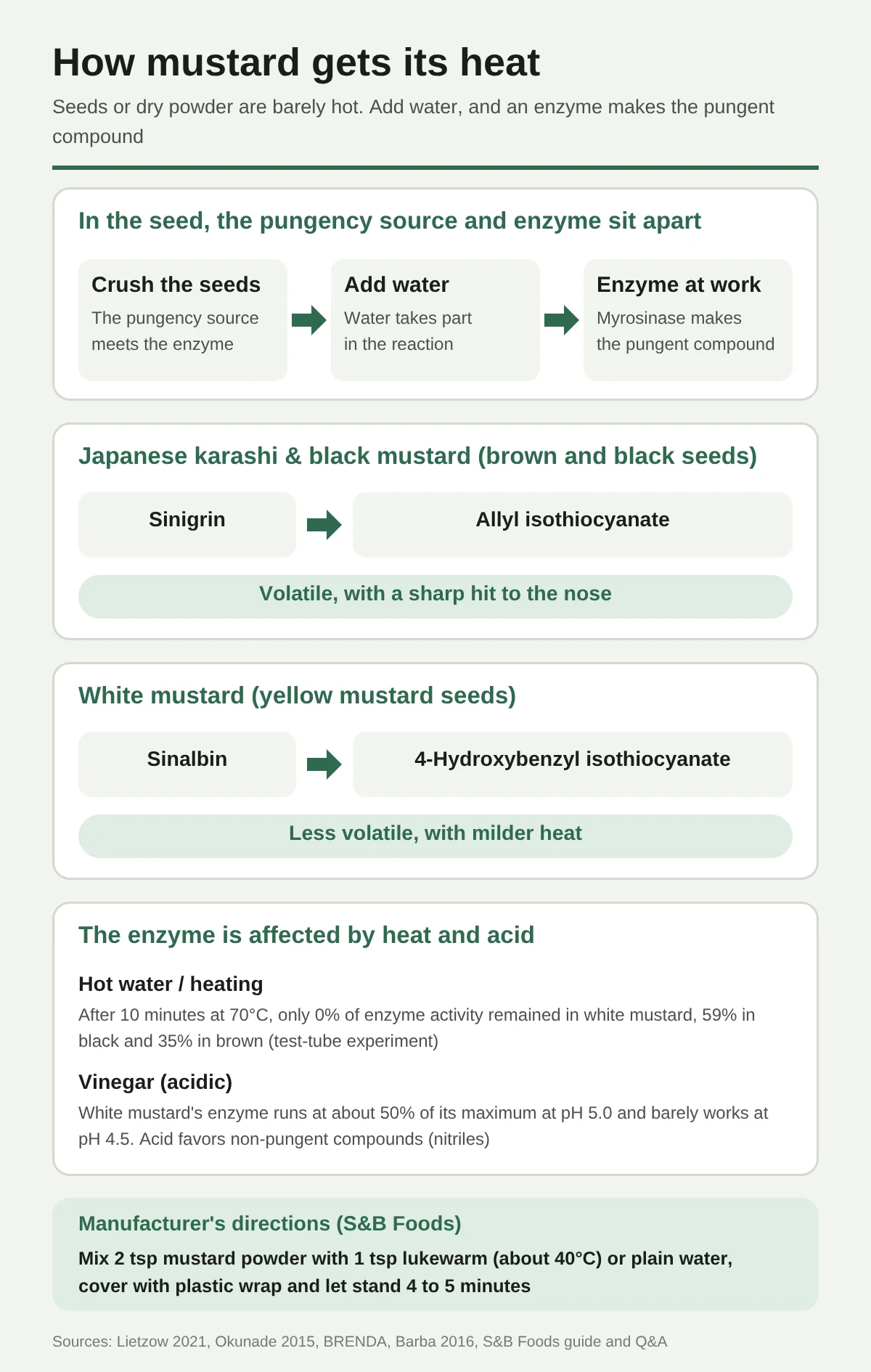
Mustard seeds are not very hot even if you bite them as they are or lick the powder. Inside the seed, the compounds that are the source of the heat (a group of compounds called glucosinolates) and the enzyme that breaks them down, “myrosinase,” are kept in separate cells, or in separate places inside a cell.
When the seed is crushed the two meet, and when water is added, myrosinase works and makes the pungent compound. Water is itself an ingredient of this reaction (Lietzow et al., 2021; Barba et al., 2016).
- Japanese karashi and black mustard: sinigrin → allyl isothiocyanate (allyl mustard oil). It is volatile (turns into gas easily), so it gives a sharp stimulation that hits the nose
- White mustard: sinalbin → 4-hydroxybenzyl isothiocyanate (benzyl mustard oil). It is not volatile, so the heat of white mustard is milder (S&B Foods’ explanation). This compound breaks down easily in water, and over time it turns into non-pungent compounds (Choubdar et al., 2010, and others)
The reaction goes on even with just humid air. In an experiment that put mustard powder in a humid container, the higher the humidity and temperature, the more allyl isothiocyanate came out, and the faster (Dai et al., 2014).
There is research comparing how heat is perceived with the amount of the compound. In a study of commercial mustards from several brands (from mild to extra hot), the products with more allyl isothiocyanate had a stronger heat that people felt and that lasted longer (Eib et al., 2020).
Allyl isothiocyanate belongs to the same group of compounds as the heat of wasabi and horseradish. In 2004, experiments with animal cells showed that it stimulates a receptor on nerves called “TRPA1” (called ANKTM1 at the time of publication), which is felt as a pain-like stimulation (Jordt et al., 2004). The heat of chili peppers (capsaicin) works by a different mechanism (explained in the chili article).
Bitter Right After Mixing
S&B Foods explains that right after you dissolve karashi powder you may notice bitterness, that this is because the bitter compound sinigrin is still there, and that over time it changes into the pungent compound (allyl mustard oil).
Mixing with Boiling Water or Vinegar Makes It Less Hot
Myrosinase is an enzyme, so it is affected by heat and acid.
| Condition | What is known | Source |
|---|---|---|
| Lukewarm water | One report says the myrosinase of white mustard seed worked best at 60°C | Lietzow et al. (2021) (citing a study by Van Eylen et al.) |
| Hot water, heating | After 10 minutes of heating at 70°C, only 0% of the enzyme activity remained for white mustard, 59% for black mustard, and 35% for brown | Okunade et al. (2015) (test-tube experiment) |
| Vinegar (acid) | The myrosinase of white mustard is at its maximum of about 50% at pH 5.0 and hardly works at pH 4.5 | BRENDA (enzyme database) |
| Vinegar (acid) | In acid conditions, it becomes easier to form a non-pungent compound called “nitrile” instead of the pungent isothiocyanate | Barba et al. (2016) |
The manufacturer’s instructions are to dissolve 2 teaspoons of karashi powder in lukewarm water of about 40°C or 1 teaspoon of water, cover it with plastic wrap, and leave it for 4 to 5 minutes. It also dissolves in plain water, but they say that using lukewarm water makes the heat come out more easily (S&B Foods).
(Most of the experiments we looked at here were done in test tubes, with the enzyme extracted or under set conditions. They are not the same as the temperature and time when you mix it in a kitchen.)
Differences Among Japanese Karashi, Yellow, Dijon, and Whole-Grain
In the Food Composition Tables (8th revised, 2023 Supplement), the salt equivalent per 100 g of karashi powder is 0.1 g, but it is 7.4 g for prepared karashi, 3.0 g for prepared mustard, and 4.1 g for whole-grain mustard. Converted to 5 g, that is about 0.4 g for prepared karashi and about 0.2 g for whole-grain mustard (calculated from the values in the Tables). Salt intake is covered in the article on salt intake.
Comparing How They Are Made and Their Ingredients
| Type | Main seed | How it is made | Examples of ingredient lists (manufacturers’ official and sales pages, checked October 2026) |
|---|---|---|---|
| Karashi powder (Japanese karashi) | Brown (oriental type) | Seeds are ground to a powder. Mix with water before use | S&B Foods “漬物やおでんに合う辛さひきたつ和からし” (Japanese karashi with a heat that suits pickles and oden): mustard / S&B Foods “からし 35g” (can): mustard (Canada) / coloring (turmeric) |
| Tube prepared karashi | Brown type | Sold already mixed. Ingredients for storage and texture are often added | S&B Foods “本生和からし” (Honnama Wa-Karashi): mustard (Canada), salt, dextrin, corn oil, starch / sorbitol, acidulant, flavoring, thickener (xanthan), antioxidant (vitamin C) |
| Yellow mustard (American style) | White mustard | White mustard mixed with vinegar and spices, often colored yellow with turmeric | S&B Foods “マスタード(スクイズパック)” (Mustard, squeeze pack): mustard, brewed vinegar, salt, paprika, garlic / coloring (turmeric), thickener (xanthan) |
| Dijon mustard | Only black or brown (French law) | Seed coats are removed, ground, and mixed with vinegar, wine, etc. | MAILLE “ディジョンマスタード” (Dijon Mustard) (S&B Foods): mustard, brewed vinegar, salt / acidulant, antioxidant (sulfites) / Biostar “有機ディジョンマスタード” (Organic Dijon Mustard): organic mustard, organic brewed vinegar, salt |
| Whole-grain mustard (old-fashioned) | Only black or brown (French law) | Coarsely ground with the coat (not sieved) | MAILLE “種入りマスタード” (Seeded Mustard) (S&B Foods): brewed vinegar, mustard, salt, white wine, sugar / flavoring, acidulant, antioxidant (sulfites) / Tsuki no Amrita “粒マスタード” (Whole-Grain Mustard): mustard seeds, vinegar, white wine vinegar, sherry vinegar, salt |
- In Japanese ingredient lists, it is written “からし (karashi),” “マスタード (mustard),” or “マスタードシード (mustard seed)” regardless of the kind of seed. You cannot tell from the ingredient list which seed is used
- Ingredients are listed in order of weight used, from the most. In MAILLE’s “種入りマスタード,” brewed vinegar comes first, and in Tsuki no Amrita’s whole-grain mustard, mustard seeds come first
- “酸化防止剤(亜硫酸塩) (antioxidant (sulfites))” is a food additive also used in wine and dried fruit, and in the EU it is subject to allergen labeling (when it exceeds 10 mg per kg) (Additives database)
- For “香料 (flavoring)” see the article on flavorings, and for sweet ingredients such as “ソルビット (sorbitol)” see the article on sweeteners
Japanese Karashi and Tube Karashi Paste
Karashi powder often has just “からし” (karashi) in its ingredient list, and you add water and mix it yourself. Tube karashi paste is ready to use, but in exchange it has added salt, starch, dextrin, vegetable oil, sorbitol, acidulant, flavoring, thickener, and the like.
Even among products called “karashi powder,” some use a coloring (turmeric) to make the color uniform and some are just karashi. A yellow color is not always “the color of karashi,” so checking the ingredient list is the sure way.
The “prepared karashi” in the Tables is a value that includes both Japanese-style and Western-style.
Dijon Mustard
France has a decree that sets how the names of mustard may be used (Decree No. 2000-658 of July 6, 2000). In it, the conditions for calling a mustard “Dijon mustard (moutarde de Dijon)” are as follows.
| Condition | Content |
|---|---|
| Seeds | Only seeds of black mustard or brown mustard (white mustard may not be used). Seeds that have not had their oil pressed out |
| Coat | The coat is removed by sieving. The remaining coat is up to 2% of the weight of the product |
| Richness of content | Solids from the seed 22% or more, fat from the seed 8% or more |
| Mixing liquid | Vinegar (fermented vinegar, wine vinegar, alcohol vinegar, cider vinegar), juice of unripe grapes (verjuice), grape juice, wine. Water is up to three quarters of the total liquid |
| Aroma | Natural flavorings may be used, but mustard-flavored ones (such as allyl isothiocyanate) may not be added. Adding grain flour or coat is also prohibited |
The conditions of this decree concern the seeds, coat, content, and liquid, and “made in the town of Dijon” is not among the conditions. It also says that mustard legally made in other EU countries may be sold in France. S&B Foods likewise explains that Dijon mustard is made by the “traditional Dijon method,” and that only products meeting detailed standards are called that.
In a study using brown seeds, even when made from the same seeds, with the Dijon-style process that removes the coat and makes it smooth, the amounts of sinigrin and the pungent compounds (isothiocyanates) changed more with processing than with the method that leaves the grains (Cools et al., 2018, abstract).
Whole-Grain Mustard
Whole-grain mustard is made by coarsely crushing the seeds with the coat, without making them fine. In the French decree, “old-fashioned mustard (moutarde à l’ancienne)” is only black or brown seeds, coarsely ground without sieving, with solids from the seed of 18% or more and fat of 5% or more.
S&B Foods explains that the seed coat has almost none of the enzyme that is the source of the heat, so whole-grain mustard (old type) that uses the coat has a milder flavor.
The ingredient lists of whole-grain mustards sold in Japan differ quite a lot by product.
- Tsuki no Amrita (Regasalt Co., Ltd., Nihonbashi, Naniwa Ward, Osaka)’s whole-grain mustard has an ingredient list of five items: “mustard seeds, vinegar, white wine vinegar, sherry vinegar, salt.” No sugar or additives are listed. The content is “1 jar” with no gram amount shown, and we could not find a mail-order sale by the maker. It is sold in-store at Michi-no-Eki Izumi Yama-ai no Sato (Izumi City, Osaka)
- MAILLE’s “種入りマスタード” (Seeded Mustard) has brewed vinegar, mustard, salt, white wine, and sugar, plus flavoring, acidulant, and antioxidant (sulfites)
- S&B Foods’ tube “つぶ入りマスタード” (Mustard with Grains) has mustard, concentrated apple juice, brewed vinegar, corn oil, salt, and honey, plus sorbitol, acidulant, and thickener
Yellow Mustard
The American-style yellow mustard used on hot dogs is said to be mostly white mustard seed mixed with vinegar and spices and colored with turmeric (Lietzow et al., 2021). The Health Canada assessment also says that white mustard seed is larger than brown, much less hot, and the main ingredient of North American-style mustard. The pungent compound of white mustard is not volatile, so the heat that hits the nose is not strong.
Among products sold in Japan, the ingredient list of S&B Foods’ “マスタード(スクイズパック)” (Mustard, squeeze pack) has mustard, brewed vinegar, salt, paprika, and garlic, plus a coloring (turmeric) and a thickener (xanthan).
Mustard Allergy
What Kind of Allergy Is It?
Mustard allergy is a food allergy in which the body’s immune system reacts to proteins in mustard seed. It is separate from the irritation caused by the pungent compound (allyl isothiocyanate).
- The main causative proteins are “Sin a 1” of white mustard and “Bra j 1” of brown mustard. Both are a type called “2S albumin” and are very similar in shape, so a person who reacts to one kind of mustard is likely to react to other kinds as well (Health Canada assessment)
- Sin a 1 is a protein that resists heat and is hard to break down even with digestive enzymes (such as trypsin). Mustard allergens are said to resist heat and processing (Health Canada assessment; Løvik et al., 2005)
- The amounts that caused symptoms were very small. In a trial in French children, there were cases with symptoms at 40 mg of mustard condiment (equivalent to 13.5 mg of mustard seed and about 0.8 mg of protein) (Morisset et al., 2003, as introduced in the Health Canada assessment)
- A reaction in a skin test or blood test does not always mean symptoms from actually eating it. In France, when 30 people aged 3 to 20 who reacted to mustard were given a challenge by eating it, 7 (23%) had symptoms. The authors say that removal should not be advised on the basis of tests alone and that a challenge by eating is needed to confirm (Morisset et al., 2003)
- In a study in Spain of 38 mostly adult people with mustard allergy, 10.5% had experienced systemic anaphylaxis, and 97.4% also reacted to mugwort pollen. Many also reacted (were sensitized) to other Brassica plants, nuts, beans, and fruits of the rose family, and the authors propose a “mustard-mugwort syndrome” (Figueroa et al., 2005)
Numbers by Country and Survey
How common mustard allergy is differs greatly by country and by survey method.
| Country or region | Survey | Result |
|---|---|---|
| France | 544 children with food allergy confirmed by a challenge by eating (Rancé et al., 1999) | 6% of causes were mustard, 4th after egg, peanut, and milk |
| France | Background statement in a research paper (Morisset et al., 2003) | 1.1% of food allergy in children |
| German-speaking countries | Registry of anaphylaxis (severe allergic reaction) (Worm et al., 2016) | Mustard is a “rare cause” |
| US | Case report of anaphylaxis in a child under 2 (Katz et al., 2026) | Points out that it is a cause not well known in the US and that there is no labeling requirement |
| Japan | 6,033 cases of immediate-type food allergy seen at medical institutions in 2023 (Consumer Affairs Agency, fiscal 2024 report) | Mustard was 1 case |
(The French studies targeted children who came to specialist allergy facilities, and the numbers are not shares of the whole country. The Japanese survey consists of cases that were reported by cooperating doctors, of people who developed symptoms within 60 minutes of eating and were seen by a doctor.)
Labeling Rules Differ by Country
| Country or region | Labeling of mustard | Rule |
|---|---|---|
| EU | Mandatory | One of the 14 items in Annex II of the Food Information Regulation (1169/2011): “mustard and products thereof.” In the ingredient list, it is emphasized in a way that sets it apart from the rest, such as bold type |
| UK | Mandatory | The same 14 items as the EU |
| Switzerland | Mandatory | One of the 14 items |
| Canada | Mandatory | One of the 11 “priority allergens.” A regulatory amendment was published in February 2011, giving businesses an 18-month preparation period, and applies from 2012. Health Canada decided to add it after a public consultation in 2008 and a scientific assessment |
| US | Not covered | The major allergens are the 9 items of milk, egg, fish, crustacean shellfish, tree nuts, wheat, peanuts, soybeans, and sesame (sesame from January 2023) |
| Japan | Not covered | Not in either the 9 mandatory “specified ingredients” (shrimp, crab, walnuts, wheat, buckwheat, egg, milk, peanuts, cashew nuts) or the 19 recommended “items equivalent to specified ingredients” (as of April 2026) |
| Australia and New Zealand, South Korea, China | Not covered | According to a survey commissioned by the Consumer Affairs Agency (fiscal 2023) |
What to Watch for on Japanese Labels
In Japan, mustard is not subject to allergen labeling, so it does not appear in the “allergens” field of the label. For example, on the sales page of the organic Dijon mustard introduced above, only “wheat” is listed as an allergen.
In addition, under Japan’s Food Labeling Standards, if the total weight of spices is 2% or less of all ingredients, they may be written together as “香辛料 (spices)” or “混合香辛料 (mixed spices)”. The Consumer Affairs Agency’s Q&A gives an example of mustard (0.3%) in a retort curry being grouped into “other spices.” In the “spices” of curry, sauces, dressings, sausages, and the like, mustard may be included without being named.
For people with mustard allergy, in addition to checking whether “からし” or “マスタード” is in the ingredient list, the sure way is to ask the manufacturer about products that say “香辛料.” As foods that may contain mustard, an overseas review lists barbecue sauce, curry sauce, ketchup, mayonnaise, dressings, processed meats such as sausages, and flour for coating fried foods.
Summary
| Point | What is known | Strength of evidence |
|---|---|---|
| Seed types | Three kinds: white mustard, brown (mustard greens), and black mustard. Japanese karashi is the brown type | Review, manufacturer’s explanation, Health Canada |
| Mechanism of the heat | When water gets in, myrosinase works: sinigrin → allyl isothiocyanate (sharp), sinalbin → 4-hydroxybenzyl isothiocyanate (mild) | Review, experimental papers |
| Boiling water and vinegar | The enzyme works less well with heat and acid. The manufacturer’s instructions are to dissolve in lukewarm water of about 40°C and leave for 4 to 5 minutes | Test-tube experiments, enzyme database, manufacturer’s instructions |
| Dijon and whole-grain | Under French decree, Dijon is only black or brown seeds with the coat removed, and old-fashioned (whole-grain) is coarsely ground with the coat | Law |
| Ingredient list | Karashi powder may be just “からし.” Tubes have salt, starch, oil, sorbitol, acidulant, flavoring, etc. Some Dijon contains sulfites | Manufacturers’ official labels |
| Salt | Per 100 g: karashi powder 0.1 g, prepared karashi 7.4 g, prepared mustard 3.0 g, whole-grain mustard 4.1 g | Food Composition Tables |
| Allergen labeling | Mandatory in the EU, UK, Switzerland, and Canada; not covered in Japan or the US. In Japan it may be written together as “香辛料” | Laws, Consumer Affairs Agency documents |
| How common | 6% of causes in a French children’s study. 1 case out of 6,033 in Japan’s 2023 national survey | Observational study, national survey (methods differ and cannot be compared) |
Products featured:
| Product | Why we chose it | Rakuten Ichiba |
|---|---|---|
| 山清 有機 鬼からし 30g (Yamasei Organic Oni-Karashi, 30 g) | The ingredient list is only organic karashi. You can mix it yourself and check the heat | See on Rakuten (ナチュルネスパ) PR See on Amazon.co.jp PR See on Yahoo! Shopping PR |
| ビオスター 有機ディジョンマスタード 200g (Biostar Organic Dijon Mustard, 200 g) | Three items: organic mustard, organic brewed vinegar, and salt. No sulfites listed | See on Rakuten (楽天24) PR See on Amazon.co.jp PR See on Yahoo! Shopping PR |
| ビオスター 有機粒マスタード 200g (Biostar Organic Whole-Grain Mustard, 200 g) | Three items: organic mustard, organic brewed vinegar, and salt. No sugar listed | See on Rakuten (楽天24) PR See on Amazon.co.jp PR See on Yahoo! Shopping PR |
| 月のアムリタ 粒マスタード (Tsuki no Amrita Whole-Grain Mustard) | Mustard seeds, three kinds of vinegar, and salt. No sugar or additives listed | Not sold by mail order (in-store at Michi-no-Eki Izumi Yama-ai no Sato) |
(Prices and ingredients were checked on the sales pages on October 1, 2026. They may change.)
Mustards line up on the same shelf as “hot condiments,” but the heat and the contents differ by the kind of seed, how it is mixed, and the liquid added. Check the ingredient list on the back label to see what is in it.
Sources
- Lietzow J (2021) Biologically Active Compounds in Mustard Seeds: A Toxicological Perspective. Foods. https://pubmed.ncbi.nlm.nih.gov/34574199/
- Health Canada (around 2010, archived) Mustard: A Priority Food Allergen in Canada – A Systematic Review. https://www.canada.ca/en/health-canada/services/food-nutrition/reports-publications/food-labelling/mustard-priority-food-allergen-canada-systematic-review.html
- Health Canada “Food Allergen Labelling” https://www.canada.ca/en/health-canada/services/food-nutrition/food-labelling/allergen-labelling.html
- Barba FJ et al. (2016) Bioavailability of Glucosinolates and Their Breakdown Products: Impact of Processing. Front Nutr. https://pubmed.ncbi.nlm.nih.gov/27579302/
- Okunade OA et al. (2015) Thermal and pressure stability of myrosinase enzymes from black mustard, brown mustard and yellow mustard seeds. Food Chem. https://pubmed.ncbi.nlm.nih.gov/25977054/
- Choubdar N et al. (2010) Supercritical fluid chromatography of myrosinase reaction products in ground yellow mustard seed oil. J Food Sci. https://pubmed.ncbi.nlm.nih.gov/20546392/
- Dai R, Lim LT (2014) Release of allyl isothiocyanate from mustard seed meal powder. J Food Sci. https://pubmed.ncbi.nlm.nih.gov/24313968/
- Eib S et al. (2020) Relationship between mustard pungency and allyl-isothiocyanate content. J Food Sci. https://pubmed.ncbi.nlm.nih.gov/32844444/
- Cools K, Terry LA (2018) The effect of processing on the glucosinolate profile in mustard seed. Food Chem. https://pubmed.ncbi.nlm.nih.gov/29478552/
- Jordt SE et al. (2004) Mustard oils and cannabinoids excite sensory nerve fibres through the TRP channel ANKTM1. Nature. https://pubmed.ncbi.nlm.nih.gov/14712238/
- BRENDA Enzyme Database “EC 3.2.1.147 thioglucosidase (Sinapis alba)” https://www.brenda-enzymes.org/enzyme.php?ecno=3.2.1.147
- Xue JY et al. (2020) Maternal Inheritance of U’s Triangle and Evolutionary Process of Brassica Mitochondrial Genomes. Front Plant Sci. https://pubmed.ncbi.nlm.nih.gov/32595682/
- Décret n° 2000-658 du 6 juillet 2000 relatif aux dénominations des moutardes (French decree, Journal Officiel, July 14, 2000). FAOLEX https://faolex.fao.org/docs/pdf/Fra20682.pdf
- MEXT, “Standard Tables of Food Composition in Japan (2020 Edition (Eighth Revised)), 2023 Supplement” https://www.mext.go.jp/a_menu/syokuhinseibun/mext_00001.html
- S&B Foods, “Spice & Herb Search: Mustard / Karashi” https://www.sbfoods.co.jp/sbsoken/jiten/search/detail/00043.html , Customer Center Q&A (00346, 00348, 00349), Customer Center newsletter “What is karashi made from?”, and each product page (ingredient list)
- Rancé F et al. (1999) Food hypersensitivity in children: clinical aspects and distribution of allergens. Pediatr Allergy Immunol. https://pubmed.ncbi.nlm.nih.gov/10410915/
- Morisset M et al. (2003) Prospective study of mustard allergy: first study with double-blind placebo-controlled food challenge trials (24 cases). Allergy. https://pubmed.ncbi.nlm.nih.gov/12708976/
- Figueroa J et al. (2005) Mustard allergy confirmed by double-blind placebo-controlled food challenges. Allergy. https://pubmed.ncbi.nlm.nih.gov/15575930/
- Løvik M et al. (2005) Mustard – an important food allergen? (in Norwegian). Tidsskr Nor Laegeforen. https://pubmed.ncbi.nlm.nih.gov/15776067/
- Worm M et al. (2016) Food-induced anaphylaxis – data from the anaphylaxis registry (in German). https://pubmed.ncbi.nlm.nih.gov/27255298/
- Katz et al. (2026) Mustard-Induced Anaphylaxis in a 23-Month-Old Male. Cureus. https://pubmed.ncbi.nlm.nih.gov/42732437/
- Consumer Affairs Agency, “Fiscal 2024 Report of the Research Project on Food Labeling Related to Food Allergies (Nationwide Survey of Health Damage Caused by Immediate-Type Food Allergy)” (September 2024) https://www.caa.go.jp/policies/policy/food_labeling/food_sanitation/allergy/
- Consumer Affairs Agency, “Information on Food Allergy Labeling” (cashew nuts added to the specified ingredients in April 2026) https://www.caa.go.jp/policies/policy/food_labeling/food_sanitation/allergy/
- Consumer Affairs Agency commissioned survey, “Report of the Survey on Food Allergy Labeling Items in Other Countries” (fiscal 2023, Mitsubishi UFJ Research & Consulting)
- Consumer Affairs Agency, “Food Labeling Standards Q&A,” Processing-64 (revised March 28, 2025)
- Regulation (EU) No 1169/2011 on the provision of food information to consumers, Article 21, Annex II. https://eur-lex.europa.eu/eli/reg/2011/1169/oj/eng
- U.S. Food and Drug Administration (FDA), “Food Allergies” https://www.fda.gov/food/food-labeling-nutrition/food-allergies
- UK Food Standards Agency (FSA), “Allergen guidance for food businesses” https://www.food.gov.uk/business-guidance/allergen-guidance-for-food-businesses
- Rakuten Ichiba, やさしいくらし ナチュルネスパ, “山清 鬼からし(粉からし)有機JAS認定” (Yamasei Oni-Karashi, karashi powder, organic JAS certified); Rakuten 24, “ビオスター 有機ディジョンマスタード(200g)” and “ビオスター 有機粒マスタード(200g)” sales pages (checked October 1, 2026)
Related articles and databases
- Is Vinegar Good for You? Rice, Pure Rice, Grain, Black, and Apple Cider Vinegar Compared, and the “Acetic Acid for Blood Pressure and Visceral Fat” Research Checked
- Are Flavorings Bad for You? What “香料” (Flavoring) Contains, Why It Is Written as One Word, and Japanese vs. Overseas Rules
- What Is Tomato Ketchup? The JAS “Special Grade,” How It Differs from Tomato Sauce, and Whether Lycopene Absorption Changes with Heat and Oil
- Are Artificial Sweeteners Bad for You? Aspartame and Cancer, What “Zero Calorie” and “Zero Sugars” Really Mean, and Japanese vs. Overseas Rules