
Are Flavorings Bad for You? What “香料” (Flavoring) Contains, Why It Is Written as One Word, and Japanese vs. Overseas Rules

Juice, gum, ice cream, snack foods, instant noodles, bread. Turn over the package and there is a good chance you will see “香料” (flavoring).
But it does not say whether the aroma comes from lemon, whether it was made chemically, or how many components are in it.
This article uses materials from government and overseas public agencies to sort out:
- Why it is enough to write just “香料” (the labeling rule)
- What types of flavorings exist in Japan, and how their safety is checked
- How the meaning of “天然香料” (natural flavoring) and “natural flavor” differs in Japan, the EU, and the US
- Flavorings that can no longer be used overseas, and aroma components that call for care
Conclusion: “香料” is a label that can be written as one word whatever it contains
- However many components are used, the rule lets a flavoring be written as just “香料” (a group name). Chemically made ones and ones taken from plants and the like are all the same “香料”
- Flavorings are used in very small amounts, so internationally a flavoring-specific assessment method is used, checking safety from a component’s structure and an estimate of intake
- The meaning of “natural” differs greatly by country. In Japan, the word “天然” (natural) cannot be used in additive labeling. The EU has strict conditions for writing “natural … flavouring,” and the US “natural flavor” has a fairly broad meaning
- Overseas, reviews continue: the EU is phasing out “smoke flavorings,” which add a smoky aroma, and the US has revoked authorization for 7 synthetic flavorings
Types of flavorings and how they appear on the back label
| Type | What it is | Examples | How it appears on the back label |
|---|---|---|---|
| Chemically made flavorings, etc. (designated food additives) | Flavorings designated as groups (18 classes) such as “esters” and “aldehydes,” plus flavorings designated one by one | Vanillin, ethyl acetate, etc. | 香料 |
| Natural flavorings (天然香料) | Substances taken from animals and plants to add aroma. The amounts are thought to be very small | Vanilla flavoring, crab flavoring, etc. | 香料, or the source substance plus 香料, as in “バニラ香料” (vanilla flavoring) |
(From the Ministry of Health, Labour and Welfare (MHLW), “Food Additives.” Besides these, additives usable in Japan also include the categories “existing food additives” and “general food additives.”)
What to know about the labeling rules
- “香料” is a group name. You do not have to list each component used, and even a flavoring blending dozens of components needs only the two characters “香料.” The system is the same as for 調味料(アミノ酸等) (seasoning (amino acids, etc.)), emulsifiers, pH adjusters, and so on
- The word “天然” (natural) cannot be used in additive labeling. Under the national rule, when a natural flavoring is labeled, the source substance name is followed by “香料,” as in “バニラ香料,” and “天然” or similar words cannot be used
- Flavorings have no mandatory allergen labeling. The Consumer Affairs Agency explains that, because there is little knowledge of flavorings made from eggs, milk, and the like actually causing food allergies, labeling is not required at present. However, labeling is required when an allergen-causing ingredient is used in the non-aroma part (the “carrier” such as the liquid that dissolves the flavoring)
- Many flavorings carry a usage standard of “not to be used for purposes other than flavoring.” They cannot be used for purposes other than adding aroma (such as in place of a preservative or sweetener)
How is the safety of flavorings checked?
Compared with other additives, flavorings are characterized by very small amounts used and a very large number of types. For that reason, the international assessment body (JECFA), the EU, and Japan’s Food Safety Commission (FSCJ) use a flavoring-specific assessment method.
- First, check that it does not damage genes (genotoxicity). If a concern cannot be ruled out, the assessment does not go on to the next step
- Sort the component into a toxicity group (Class I to III) from its chemical structure
- Check whether the estimated intake is below that group’s “amount at or below which there is no health concern”
| Group | Amount at or below which no concern is considered to exist (per person per day) |
|---|---|
| Class I (structures easily broken down in the body into harmless substances) | 1,800 µg (1.8 mg) |
| Class II (intermediate) | 540 µg |
| Class III (structures that may show toxicity) | 90 µg |
(From the FSCJ, “Guideline for Health Effects Assessment of Flavorings.”)
In Japan, intake is estimated on the assumption that “the amount used in one year is eaten evenly by 10% of the population” (the MSDI method). In addition to this, JECFA also calculates an estimate assuming “a person who eats a certain food once every day” (the SPET method), and assesses using the higher of the two. This is so that people who eat mostly particular products, or flavorings in foods eaten by only some people, are not missed. Japan’s guideline also says that using the SPET method is desirable to align with international methods, but because the SPET method is based on Western eating habits, Japan currently estimates with the MSDI method.
Making flavorings used overseas usable in Japan too
Among flavorings widely used in Europe and the US and confirmed safe by JECFA, there were those that could not be used in Japan (54 internationally widely used flavorings). For these, the government has checked safety without waiting for applications from companies, and has been making them usable one after another.
Differences between Japan and overseas
Differences in the meaning of “natural”
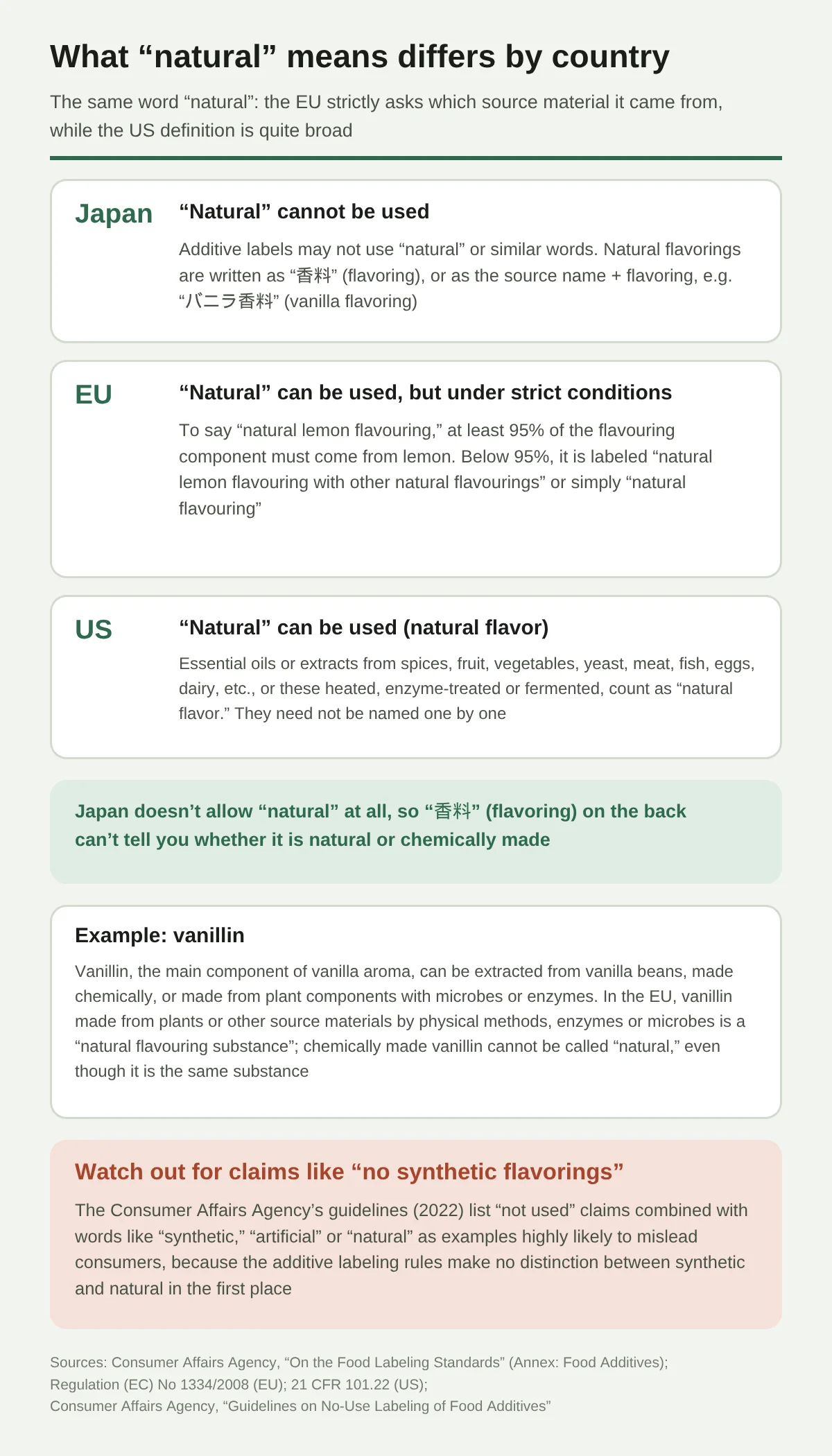
| Japan | EU | US | |
|---|---|---|---|
| Can “natural” be used on the label? | No (“天然” and similar words are not allowed in additive labeling) | Yes, but with strict conditions | Yes (natural flavor) |
| Conditions | ― | To write “natural lemon flavouring,” 95% or more of the aroma component must come from lemon. If under 95%, write “natural lemon flavouring with other natural flavourings” or simply “natural flavouring” | “Natural flavor” if it is an essential oil or extract taken from spices, fruits, vegetables, yeast, meat, fish, eggs, milk, and the like, or a product made by heating, enzymatic breakdown, or fermentation of them. Each need not be named one by one |
Even for the same “natural,” the EU strictly asks “which raw material it came from,” while the US is fairly broad. Japan cannot write “天然” at all, so from the two characters “香料” on the back label, you cannot tell whether it is natural or chemically made.
Example of vanillin: Vanillin, the main aroma component of vanilla, is taken from vanilla beans, but it can also be made chemically, or made from plant components with microorganisms or enzymes. In the EU, vanillin made from plant and similar materials by physical methods, enzymes, or microorganisms becomes a “natural flavouring substance,” while chemically made vanillin cannot be called “natural” even though it is the same substance.
EU: phasing out “smoke flavorings,” the smoky aroma
“Smoke flavorings,” made by collecting and purifying the smoke of burning wood, have long been used to add a smoked flavor. In the EU, they were originally positioned as a healthier method than traditional smoking.
Of the 10 products the EU had authorized, 2 expired in January 2024 because companies did not apply for renewal. For the remaining 8, EFSA (the European Food Safety Authority) assessed in November 2023 that “a genotoxicity concern cannot be ruled out.” Following this, in 2024 the EU removed all 10 from the authorization list. For the 8 whose renewal had been applied for, the following transition periods were set.
| Food | Deadline for placing foods with the 8 smoke flavorings on the market |
|---|---|
| Soups, sauces, snack foods, etc. (everything except the 4 below) | Until July 1, 2026 (already ended) |
| Cheese, meat, processed seafood, fish roe | Until July 1, 2029 |
Note: foods placed on the market by the deadline may be sold until their best-before or use-by date.
The German Federal Institute for Risk Assessment (BfR) also considers that the genotoxic substances EFSA raised can also form in traditional smoking.
EU: limits on components naturally present in plants
For components naturally present in flavorings and aromatic ingredients (spices, herbs, and the like) that may burden the body, the EU features:
- A ban on adding them to food as such (15 substances including coumarin, estragole, pulegone, safrole, and methyleugenol)
- For 11 of those substances, limits set for each food on the amount that enters food from flavorings, spices, and the like
(EU Regulation 1334/2008, Annex III.)
| Component | Mainly found in | Examples of limits (per kg of food) |
|---|---|---|
| Coumarin | Cinnamon (especially cassia) | Traditional and seasonal bakery ware labeled as containing cinnamon 50 mg, breakfast cereals 20 mg, other bakery ware 15 mg, desserts 5 mg |
| Pulegone | Peppermint and others | Mint confectionery 250 mg, chewing gum 350 mg, mint-flavored soft drinks 20 mg |
| Estragole | Basil, fennel, tarragon, and others | Dairy products, processed fruits and vegetables, and fish products 50 mg; soft drinks 10 mg |
| Safrole | Nutmeg and others | Processed meat and fish 15 mg, soups and sauces 25 mg, soft drinks 1 mg |
Coumarin is a component known to burden the liver when taken in excess.
- In 2004, EFSA set coumarin’s tolerable daily intake (TDI) at 0.1 mg per kg of body weight. Researchers at Germany’s Federal Institute for Risk Assessment (BfR) confirmed that data from people who used coumarin as a medicine give the same value, and also pointed out that some people are susceptible to effects on the liver
- The same study says that people who eat a lot of cassia (a type of cinnamon) may take in an amount of coumarin that reaches the TDI (a survey during the German Christmas season)
- In a survey by the Tokyo Metropolitan Institute of Public Health (2008), 11 to 6,700 µg per gram was found in commercially sold cinnamon powder and sticks, and coumarin was detected in 9 of 10 cinnamon-containing confectionery products. The amount varies greatly with the type of cinnamon
- Overseas, there is a report of a person who developed liver injury after drinking water with cinnamon boiled in it for a long time for weight loss, after increasing the amount (a single case report; recovered after stopping cinnamon)
In Japan, coumarin itself is not among the substances the government has confirmed can be used as a flavoring (it is not found among individually designated additives, the list of flavorings designated as classes (March 2024 edition), or existing food additives). On the other hand, cinnamon, which contains coumarin, can be used as a food, and tonka bean can be used as a source of natural flavorings (the list of source substances for natural flavorings), and no limit on the amount of coumarin in food has been set (as far as Urayomi (ウラヨミ) has checked).
The US has not permitted foods to which coumarin has been added since 1954. This covers not only coumarin itself but also cases where it is added as tonka bean or its extracts (21 CFR 189.130).
US: authorization revoked for 7 synthetic flavorings (2018)
In October 2018, the US FDA (Food and Drug Administration), in response to a petition from citizen groups and others, revoked authorization for 7 synthetic flavorings (benzophenone, ethyl acrylate, methyleugenol, myrcene, pulegone, pyridine, and styrene).
- For 6 of them, it revoked them in accordance with the legal provision (the Delaney Clause) that “additives that cause cancer in humans or animals are not permitted,” because cancer occurred in tests feeding large amounts to animals. Styrene was revoked because industry no longer used it
- However, the FDA judged that there is no public health risk under normal use, and explains that the revocation is purely a legal measure
- It also says that these components are naturally present in foods and in natural flavorings, and that the treatment of such “natural flavors” is unchanged
In the US, it is also a feature that many flavorings widely used are those an expert panel of the industry body (FEMA) has judged “generally recognized as safe (GRAS).”
EU: flavorings with insufficient data removed
In the EU, flavorings for which no data confirming safety were submitted are sometimes removed from the authorization list. In 2024, 8 substances were removed.
Are “flavorings bad for you”?
Few cases of problems from eating
In public agencies’ assessments, for flavorings used within the set rules, there is no health concern at normal ways of eating. The US revocation of synthetic flavorings was also a legal measure taken after the FDA itself said there is “no risk under normal use.”
Diacetyl: the problem was factory workers who “breathed it in”
Diacetyl, a butter-aroma component, is known in the US for causing an incurable lung disease (bronchiolitis obliterans) in people working at microwave popcorn and flavoring factories.
- The cause was breathing in the vapor for a long time at the factories. In 2016, the US National Institute for Occupational Safety and Health (NIOSH) recommended keeping workplace air concentrations at or below 5 ppb as an 8-hour average
- The US FDA considers diacetyl and other flavoring components “generally recognized as safe (GRAS)” when eaten. The CDC also explains that the problem is not eating but workers breathing in contaminated air
It is an example showing that “safe to eat” and “safe to breathe in” are separate matters.
Things to be careful about
- Too much cinnamon: if you eat sweets that use a lot of cinnamon, or take cinnamon supplements in large amounts every day, you need to be careful about coumarin (using the EU’s approach to limits as a reference)
- Some people get a rash from aroma components: some aroma components cause a rash (contact dermatitis) on contact. Contact allergy to cinnamon, and lip inflammation from the aroma component (anethole) in spearmint-flavored toothpaste, have been reported (all as case reports). The problems center on things that touch the skin or mucous membranes of the mouth directly, such as cosmetics, daily-use products, and toothpaste, rather than food → Article on transdermal toxins and daily-use products
Be careful with “no flavoring” and “natural flavoring” labels
- “天然香料使用” (natural flavoring used) and “合成香料不使用” (synthetic flavoring not used): the Consumer Affairs Agency’s “Guidelines on ‘Not Used’ Labeling of Food Additives” (2022) lists labels that write “not used” together with the words “synthetic,” “artificial,” or “natural” as examples with a high risk of misleading consumers. This is because the additive labeling rules originally make no distinction between synthetic and natural
- “香料不使用” (flavoring not used): the same guideline also lists, as examples that may mislead, labels that write “〇〇不使用” while using an ingredient that does the same job. If the flavor is added with strongly aromatic extracts and the like, the surest way is to look at the ingredient list (原材料名) on the back label too
How Urayomi (ウラヨミ) approaches this
To sum up so far:
- Flavorings are used in very small amounts and their safety is checked internationally with a flavoring-specific method. The public agencies’ assessment is that there is no health concern at normal ways of eating
- On the other hand, from the two characters “香料,” you cannot tell what is in it and how much. Under Japanese labeling you also cannot tell whether it is natural or chemically made
- Overseas, reviews continue, such as the ban on smoke flavorings, the revocation of synthetic flavorings, and limits on plant-derived components
Urayomi does not write flavorings off uniformly as “dangerous.” Instead, on product pages we list whether “香料” is shown exactly as on the back label, and where the manufacturer discloses what is in the flavoring (such as “バニラ香料” or “レモン果汁”), we introduce that as well.
Back-label checkpoints
- Look for “香料” in the additives section: however many components, it is written with these two characters
- If “〇〇香料” is written, you can tell the source substance: the source substance name of a natural flavoring, such as “バニラ香料” or “レモン香料,” is sometimes written
- Look at the ingredient list (原材料名) too: ingredients that are sources of aroma, such as fruit juice, extracts, and spices, are sometimes written
- If you want to know what is in the aroma, ask the manufacturer: the Consumer Affairs Agency also advises asking the labeling responsible party about the contents of additives written with a group name
- Be careful not to overeat cinnamon-heavy sweets and supplements
Related reading
- Flavorings carried over from ingredients may not be labeled → Article on carryover
- Rules for “no additives” and “not used” labels (the guideline’s 10 types) → Article on the rules for “無添加” labels
- Overseas rules for each additive → Additive database
Sources
- MHLW, “Food Additives” (designated additives, existing additives, natural flavorings, general food additives, 18 classes of flavorings)
- Consumer Affairs Agency, “On the Food Labeling Standards” (Appendix: Additives: labeling of natural flavorings, ban on “natural” labeling) / “Appendix: Allergens” (allergen labeling for flavorings, April 2026 edition)
- Consumer Affairs Agency, “Handy Facts on Food Additive Labeling” (group names)
- Consumer Affairs Agency, “Designation of Internationally Widely Used Additives”
- Japan Food Chemical Research Foundation, “Standards for Use and Preservation of Each Food Additive” (November 2024)
- FSCJ, “Guideline for Health Effects Assessment of Flavorings” (Food Safety 2016)
- Consumer Affairs Agency, “Guidelines on ‘Not Used’ Labeling of Food Additives” (March 2022)
- Tokyo Metropolitan Institute of Public Health, “Analytical Method and Survey of Coumarin in Cinnamon-Containing Foods” (Annual Report No. 59, 2008)
- MHLW, “On the List of the 18 Flavoring Items Designated as Classes or Derivatives” (March 15, 2024, Notification Kensei-shoku-ki-hatsu 0315 No. 6) / Enforcement Regulation of the Food Sanitation Act, Appended Table 1 / Japan Food Chemical Research Foundation, “List of Source Substances for Natural Flavorings”
- 21 CFR 189.130 (Coumarin)
- Abraham K, et al. Toxicology and risk assessment of coumarin: focus on human data. Mol Nutr Food Res 2010 (PMID 20024932)
- Yesukumar et al. Probable Cinnamon-Induced Mixed Hepatocellular-Cholestatic Liver Injury (2025, PMID 41158894)
- Contact allergy to cinnamon: case report (PMID 18538070) / Cheilitis caused by contact allergy to anethole in spearmint flavored toothpaste (PMID 17034478)
- Regulation (EC) No 1334/2008 (Article 16, Annex III)
- European Commission “Smoke flavouring renewals – existing” (updated August 2024) / Commission Implementing Regulation (EU) 2024/2067
- U.S. FDA “FDA Removes 7 Synthetic Flavoring Substances from Food Additives List” (October 2018)
- 21 CFR 101.22 (definition and labeling of natural flavor / artificial flavor)
- CDC/NIOSH “Flavorings and Lung Disease” / “Criteria for a Recommended Standard: Occupational Exposure to Diacetyl and 2,3-Pentanedione” (2016)
- AGRINFO “EU withdraws eight flavourings” (2024)
This article does not assert the safety or danger of any particular food or additive. If you have a food allergy, please check the contents of flavorings with the manufacturer and consult your doctor.
Related articles and databases
- Are Artificial Sweeteners Bad for You? Aspartame and Cancer, What “Zero Calorie” and “Zero Sugars” Really Mean, and Japanese vs. Overseas Rules
- Are preservatives bad for you? Types such as sorbic acid, what “preservative-free” hides, and how Japanese and overseas rules differ
- Are Food Colorings (Red No. 102, Yellow No. 4) Bad for You? Cancer Assessments and Whether They Are Banned Abroad, Checked Against Rules in Japan and Overseas
- What is carryover? How it differs from processing aids, and the additives that are not listed on labels even on “additive-free” foods
- What Is the Difference Between Mustard and Karashi? Seed Types, Why Mixing with Water Makes It Hot, and the Ingredients and Allergen Labeling of Dijon, Whole-Grain, and Japanese Karashi
- Are Chili Peppers Good for You? How Capsaicin Makes Food Hot, the Scoville Scale, and What the Research Says About “Living Longer,” “Losing Weight,” and “Bad for the Stomach”
- Were “無添加” (Additive-Free) Labels Banned? Reading the Consumer Affairs Agency Guideline’s 10 Types from the Back Label
- Why Did “No Chemical Seasoning” Disappear? Is Yeast Extract a Chemical Seasoning? How to Read Umami Seasonings and Hydrolyzed Protein
- Are “transdermal toxins” (経皮毒) a myth or real? Do ingredients in shampoo and detergent enter through the skin, and what labels leave out
- Is the Color Fixer (Sodium Nitrite) Bad for You? Cancer Evaluations, Why Ham Is Red, and How Japanese and Overseas Rules Differ
- 添加物データベース