
Are Chili Peppers Good for You? How Capsaicin Makes Food Hot, the Scoville Scale, and What the Research Says About “Living Longer,” “Losing Weight,” and “Bad for the Stomach”

PR This article contains affiliate links to Rakuten Ichiba and A8.net (“See on Rakuten” and the button for the shichimi shop). The “See on the official shop” button for Yuzukarin is a regular link, not an ad. What is written here is based on official sources and published studies, whether or not there is an ad. The “See on Amazon.co.jp” and “See on Yahoo! Shopping” links are also affiliate links.
Ichimi (plain ground chili), shichimi (seven-spice chili blend), yuzu kosho, doubanjiang (chili bean paste), kimchi, Tabasco. Chili peppers are one of the most familiar spices on the everyday table.
There are many stories about them.
- A study from overseas that said “people who eat a lot of chili live longer” made the news
- “Capsaicin burns fat” and “it raises metabolism so you lose weight”
- “Spicy food is bad for the stomach” and “it causes stomach cancer”
- High school students who ate an extremely hot snack were taken to the hospital
This article checks the following against official sources and papers:
- How chili peppers make us feel “hot” (capsaicin and TRPV1)
- The Scoville scale of heat, and how hot different varieties and products are
- Studies from China, Italy, and the US on spicy food and mortality, and the analyses that pool them (meta-analyses)
- The link with stomach cancer and stomach trouble, and why the study results disagree
- What weight and energy-expenditure trials have shown
- Health harms from extremely hot foods, and how Japan, Germany, Denmark, and others handle them
- How yuzu kosho (a condiment of yuzu citrus and chili) is made, and how to read its ingredient list
Conclusion
- The source of the heat is capsaicin. It binds not to the taste receptors on the tongue but to TRPV1, a sensor for heat and pain (activated by heat above 43°C), so we feel “hot” and “painful.” The strength of heat is expressed in Scoville heat units, ranging from 10 or less for mild paprika powder to an average of 2,693,000 for “Pepper X,” the Guinness World Record holder, a spread of roughly 270,000 times
- In follow-up studies in China (about 490,000 people), Italy (about 23,000), and the US (about 16,000), people who ate chili or spicy food more often had 10 to 20% fewer deaths during follow-up (0.87 to 0.88 times in an analysis pooling four studies). But all of them are observational studies that asked about eating frequency once, and the authors themselves write that causation cannot be inferred. We cannot go as far as saying “eating chili makes you live longer”
- For stomach cancer, results differ by type of study. An analysis of “case-control studies,” which ask people with and without stomach cancer to recall their past diets, found about 1.5 to 2 times higher risk among frequent eaters. In contrast, a Chinese prospective study that followed 510,000 people for 10 years found no increase, and the trend toward lower risk disappeared once the first 3 years were excluded. The National Cancer Center Japan lists H. pylori infection, smoking, and salt as the main causes of stomach cancer
- Weight trials are mostly small and short. In an analysis of 15 trials in overweight people (762 people), the weight difference was 0.51 kg on average. The increase in energy expenditure was only a few to a few dozen kcal per day, and the authors of a main review received funding from a research institute supported by the spice giant McCormick. We cannot say “chili makes you lose weight”
- On the other hand, extremely hot foods have caused harm. In 2024, 14 high school students in Tokyo were taken to hospital by ambulance, and in 2023 a 14-year-old in the US died after eating an extremely hot chip (the autopsy also found a heart condition). Germany’s Federal Institute for Risk Assessment (BfR) warns that 0.5 to 1 mg of capsaicinoids causes mild discomfort and around 170 mg causes severe symptoms. There is no legal upper limit for capsaicin in food (EU and Germany; in Japan, none was found in what we checked)
- The “kosho” in yuzu kosho means chili. The basic ingredients are three: yuzu, chili, and salt, and some commercial products add flavoring, colorants, thickeners, and the like. The salt content is high, about 13 to 16 g per 100 g
Products featured in this article
The article introduces the following products where they fit the discussion.
| For people who… | Product featured | Where |
|---|---|---|
| Want yuzu kosho whose ingredients are only “yuzu, chili, and salt” | Yuzukarin (柚子辛凛, Sakai City, official shop), Yuzukosho Ao-Oni (Umajimura Agricultural Cooperative, Rakuten Ichiba) | Comparing the ingredients |
| Want an ichimi whose only ingredient is chili | 国産一味唐からし (Domestic Ichimi Togarashi; S&B Foods, Rakuten Ichiba), 京かける七味 (Kyo-kakeru Shichimi; Ochanoko Saisai, A8.net) | Ichimi and shichimi ingredients |
| Want a chili-containing seasoning without additives | 有機トウバンジャン (Organic Tobanjan; Kaze to Hikari, Rakuten Ichiba) | Seasonings that contain chili |
Why chili is hot: capsaicin and TRPV1
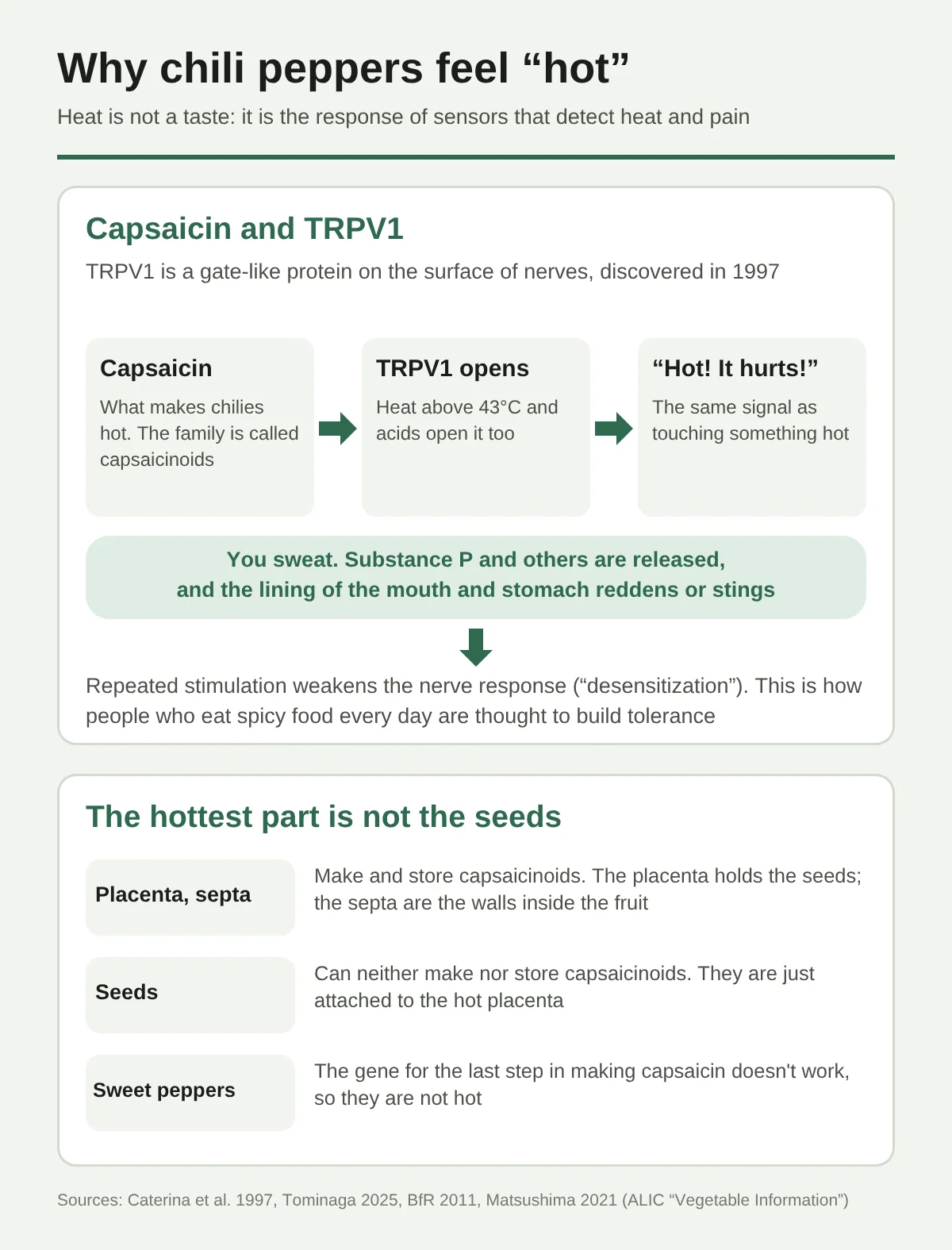
Heat is not a “taste” but “hotness and pain”
The source of chili’s heat is capsaicin and its relatives (such as dihydrocapsaicin), together called capsaicinoids. Capsaicin is usually the most abundant, making up two-thirds to three-quarters of the total (BfR 2011; Agriculture & Livestock Industries Corporation “Vegetable Information” 2021).
The sensor that receives capsaicin was discovered in 1997 by a US research group (Caterina et al., Nature). It is now called TRPV1.
- TRPV1 is a gate-like protein on the surface of nerves that also opens with heat above 43°C and with acid (Tominaga 2025 review)
- In other words, capsaicin makes the nerves send the same signal as touching something hot. That is why spicy food feels “hot” and “painful” and makes us sweat
- The stimulated nerves release substances such as substance P, and the lining of the mouth and stomach turns red or stings. With repeated exposure, the nerves respond less, called “desensitization.” This is how people who eat spicy food every day become more tolerant of heat (BfR 2011)
TRPV1 senses heat, so it is also involved in regulating body temperature. When pharmaceutical companies developed drugs that block TRPV1 as painkillers, a side effect of high fever of 39 to 40°C in trials became a problem (Tominaga 2025).
The hottest part is not the seeds but the “placenta and septum”
It is sometimes said that “the seeds are the hottest part of a chili,” but according to an explanation by Kenichi Matsushima of Shinshu University (Agriculture & Livestock Industries Corporation “Vegetable Information,” June 2021 issue), this is not accurate.
- Capsaicinoids are made and stored in the partitions dividing the hollow inside the fruit (the septum) and the part the seeds attach to (the placenta)
- The seeds themselves can neither make nor store capsaicinoids. They are simply attached to the hot placenta
- When seeds are removed from a dried chili, the placenta and septum come off with them, so the heat weakens. That may be why people came to think “the seeds are hot,” writes Matsushima
To tone down the heat, removing the whitish inner part along with the seeds weakens it (BfR 2011 also writes that removing the placenta lowers the concentration).
Bell peppers and shishito are chilies too
The genus Capsicum has five cultivated species (Matsushima 2021).
| Species (scientific name) | Flower color, etc. | Main varieties |
|---|---|---|
| annuum (C. annuum) | White flowers. The most widely grown in the world | Most Japanese chilies (such as takanotsume), shishito, bell peppers, paprika, jalapeño |
| frutescens (C. frutescens) | Greenish-white flowers. Japanese name kidachi-togarashi | Island chilies of Okinawa and elsewhere, the Tabasco variety used for Tabasco sauce |
| chinense (C. chinense) | Greenish-white flowers. Many very hot varieties | Habanero, Bhut Jolokia, Carolina Reaper |
| baccatum (C. baccatum) | Green spots on the petals. Mainly South America | Aji amarillo |
| pubescens (C. pubescens) | Purple flowers, black seeds. Native to the high Andes | Rocoto |
- Bell peppers and paprika do not become hot because the gene for the last step in making capsaicin does not work
- Shishito are usually not hot, but occasionally a hot one turns up. Research by Matsushima and colleagues has found that fruits with fewer seeds, due to stress during growing and similar causes, can become hot
A unit of heat: the Scoville scale
Originally “how many times it must be diluted until it no longer burns”
The strength of heat is expressed in Scoville heat units (SHU). The original method was to dilute a chili extract in sugar water until people could no longer feel heat, and the dilution factor was the rating. Today the amount of capsaicinoids is measured by machine (liquid chromatography and the like), and the usual conversion is 1 mg/kg capsaicin ≈ 16 Scoville units (BfR 2011).
(Figure sources: Table 1 of the German Federal Institute for Risk Assessment BfR “Too hot isn’t healthy” 2011, Janssens 2013, González-Zamora 2013, Guinness World Records announcement of October 2023)
| Heat guide | Scoville units | Source |
|---|---|---|
| Sweet paprika powder | 0–10 | BfR 2011 |
| Tabasco sauce | 1,600–5,000 | BfR 2011 |
| Fresh green jalapeño | 2,500–8,000 | BfR 2011 |
| Chili powder | 30,000–50,000 | BfR 2011 |
| Red chili used in a weight trial | 39,050 | Janssens 2013 |
| Naga (Bhut Jolokia) | 1,001,304 | Cited in González-Zamora 2013 |
| Carolina Reaper | Average about 1.64 million | Guinness World Records (announcement of Pepper X, 2023) |
| Pepper X | Average 2,693,000 | Guinness World Records (October 2023) |
| Pure capsaicin | 16,000,000 | BfR 2011 |
Even the same variety varies a lot in heat
A Scoville rating is not a single fixed number for a variety.
- A US university bought 100 each of jalapeño, habanero, and Bhut Jolokia peppers from 10 suppliers and measured them one by one. Jalapeños varied greatly even within the same supplier, and habaneros differed greatly between suppliers (Sweat 2016)
- A study that dried and measured chilies grown in Mexico found 280,572 Scoville units for jalapeño (González-Zamora 2013). That is orders of magnitude above the guide for fresh jalapeño (up to about 8,000). Drying removes water and raises the amount per weight, and the growing location and temperature also matter
- BfR says that, besides variety, the concentration also changes with soil, light, water, and growing method (BfR 2011)
It is best to treat a figure like “XX0,000 Scoville” on a label or in advertising as a rough guide that depends on how and what was measured.
Ichimi and shichimi ingredients
Ichimi togarashi is basically made with chili only. For example, the ingredient list (原材料名) of S&B Foods’ “Domestic Ichimi Togarashi” is “赤唐辛子” (red chili), and the country of origin of the ingredient is “国産” (domestic) (as shown in the official Rakuten Ichiba shop).
Shichimi togarashi is chili blended with sansho (Japanese pepper), sesame, chinpi (dried tangerine peel), aonori (green laver), and so on. The combination differs by shop and product, so the ingredient list tells you what is inside.
Spicy food and mortality: studies from China, Italy, and the US
Three large follow-up studies
The story that “people who eat chili live longer” comes from “prospective cohort studies,” in which many people were asked about their eating habits and then followed for years.
| Study | Participants | Follow-up | Comparison | Hazard ratio for all-cause death (95% CI) |
|---|---|---|---|---|
| China Kadoorie Biobank (China, Lv 2015) | 487,375 people aged 30 to 79 (enrolled 2004–08) | Median 7.2 years | Spicy food “less than 1 day a week” vs “6 to 7 days a week” | 0.86 (0.82–0.90) |
| Moli-sani Study (Italy, Bonaccio 2019) | 22,811 people aged 35 and over (enrolled 2005–10) | Median 8.2 years | Chili “almost never” vs “more than 4 times a week” | 0.77 (0.66–0.90) |
| NHANES III (US, Chopan 2017) | 16,179 people aged 18 and over (surveyed 1988–94) | Median 18.9 years | Red chili “not eaten” vs “eaten at least once a month” | 0.87 (0.77–0.97) |
The hazard ratio shows how many times as large the share of deaths during the compared period was. A ratio of 0.86 means 14% fewer deaths among frequent eaters.
By cause of death, the results do not line up.
- China: among people who ate spicy food almost daily, deaths were fewer from cancer (0.92), ischemic heart disease (0.78), and respiratory disease (0.71), with no clear difference for cerebrovascular disease (0.96)
- Italy: among people who ate chili more than 4 times a week, deaths were fewer from cardiovascular disease (0.66), ischemic heart disease (0.56), and cerebrovascular disease (0.39)
- US: deaths from heart disease and stroke differed in the same direction, but the differences were not statistically clear
Pooling the four studies
Two analyses (meta-analyses) pooled these three plus an Iranian study (which did not distinguish black pepper from chili), four studies and about 565,000 people in all.
- Ofori-Asenso 2021 (Angiology): all-cause death 0.88 (0.86–0.90), death from heart disease 0.82. Cerebrovascular disease was 0.79, not a clear difference
- Yang 2023 (International Journal for Vitamin and Nutrition Research): all-cause death 0.87 (0.85–0.90), cardiovascular disease 0.89, cancer 0.92
On the numbers alone, every study points the same way: fewer deaths among frequent eaters.
Why we still cannot say “eating chili makes you live longer”
All of these are observational studies. The authors of the Chinese study write in their conclusion that, because it is observational, “causality cannot be inferred” (Lv 2015). There are four main reasons.
- Frequent eaters differ in other ways too: in the Chinese study, people who ate spicy food often were more likely to be men, younger, higher-income, and regular smokers and drinkers, and less likely to have had conditions such as stomach ulcers (Chan 2021). The studies adjusted for age, smoking, and so on, but each author writes that the influence of unmeasured factors (residual confounding) cannot be removed
- People who are ill avoid spicy food: if unwell people cut back on spicy food, deaths among “non-eaters” look more numerous (reverse causation). The Chinese study excluded people with cancer, heart disease, and stroke at the start, and says the results hardly changed when deaths in the first 2 years were excluded
- Asked only once: every study asked about eating frequency just once at the start, so later changes are unknown. Many did not ask about amounts (how many grams), so there is no way to know “how much is enough”
- Few studies: only four studies were pooled, and none included Japanese people. The authors of Yang 2023 also say that randomized controlled trials are needed to confirm the relationship
Yang 2023 writes in its conclusion that chili “may be a food that helps extend lifespan,” but the limitations section of the same paper lists the same points as 1 to 4 above.
A 2011 document compiled by the Food Safety Commission of Japan (FSCJ) summarized that, although it is popularly said that chili (capsaicin) “burns body fat,” “boosts metabolism,” and “suppresses cancer,” no reliable human data on these effects could be found (citing information from the National Institute of Health and Nutrition; this document predates the mortality studies).
Stomach cancer and stomach trouble: the studies disagree
Case-control studies say “more”
The saying that “spicy food is bad for the stomach” is also connected to stomach cancer research.
Analyses pooling “case-control studies,” which compare people with and without stomach cancer by asking them to recall past diets, have repeatedly found more stomach cancer among frequent chili eaters.
| Pooled analysis | Number of studies | Result (odds ratio, 95% CI) |
|---|---|---|
| Du 2021 | 13 case-control studies (3,095 stomach cancer cases) | Medium to high frequency 1.96 (1.59–2.42). The relationship with amount is not a straight line: 2.28 for “eats a lot,” and 0.72, no difference, for “medium” |
| Luo 2021 | 16 studies (8,337 stomach cancer cases) | Highest vs lowest group 1.51 (1.02–2.00). Results differ by region: Mexico 2.05, Asia 1.92, other regions 0.48 |
| Chen 2017 | 39 case-control studies (12 on stomach cancer) | Stomach cancer 2.16 (1.26–3.71). Large variation between studies |
| Pabalan 2014 | 10 case-control papers | 0.55 for low intake, 1.94 for medium to high |
In a Mexican study, people who consumed 90 to 250 mg of capsaicin a day (roughly 9 to 25 jalapeños) tended to have more stomach cancer (López-Carrillo 2003, odds ratio 1.71, with a confidence interval of 0.76–3.88 that spans 1). The study says the effect of chili was seen regardless of H. pylori (Helicobacter pylori) infection.
In the large prospective study: “no increase”
Case-control studies, however, have a weakness. People who developed stomach cancer may more easily recall their diet from a time when their stomach was unwell, so recall bias is likely.
China’s China Kadoorie Biobank asked about eating habits before anyone developed cancer and followed 510,000 people for about 10 years (Chan 2021).
- 3,350 stomach cancers were found, and the hazard ratio for people who ate spicy food every day was 0.89 (relative to people who almost never ate it), so no increase
- However, this difference disappeared once the first 3 years were excluded. The authors raise the possibility that people with stomach symptoms were avoiding spicy food (reverse causation)
- The authors write that, among earlier case-control studies, only three, in Mexico and Korea, measured amounts properly, adjusted for confounding enough, and had over 200 stomach cancer cases. They also say that H. pylori infection was not measured in this study either, so its influence may remain
(Figure sources: Lv 2015, Bonaccio 2019, Chopan 2017, Ofori-Asenso 2021, Yang 2023, Du 2021, Luo 2021, Chen 2017, Chan 2021. The confidence interval for CKB stomach cancer is not shown in the figure)
The main causes of stomach cancer are H. pylori, smoking, and salt
The National Cancer Center Japan lists H. pylori infection and smoking as causes of stomach cancer, and reports that salt and high-salt foods also raise the risk. It has also been established that eradicating H. pylori definitely lowers the risk of stomach cancer (the risk does not fall to zero, so endoscopy after eradication remains important).
The relationship between chili and H. pylori has not been settled by research.
- In a Mexican study (López-Carrillo 2012), stomach cancer was more common (odds ratio 3.41) among people who ate chili at medium to high levels, were infected with the more toxic type of H. pylori (CagA-positive), and carried a particular type of inflammation-related gene, while no association was seen in people not infected with H. pylori
- In a pooled analysis (Pabalan 2014), even among people infected with H. pylori, the ratio was 0.60 for low intake and 1.69 for medium to high intake
The international body JECFA said as of 2009 that epidemiological studies showing a link between chili and stomach cancer were “quite limited” (according to the FSCJ 2011 document). A 2022 study that pooled the pooled analyses (an umbrella review, Ao 2022) also lists “positive associations” with stomach, esophageal, and gallbladder cancers, but says that the overall effect on health is unclear and the quality of evidence is not high.
Heartburn and stomach pain
The link with stomach discomfort is, in some ways, clearer than with cancer.
- Germany’s BfR (2024) cites research that people with functional dyspepsia (persistent stomach fullness or pain despite normal tests) or reflux esophagitis feel abdominal pain and heartburn more readily after capsaicin than healthy people do. There is also research that people with diarrhea-type irritable bowel syndrome are more likely to have symptoms after meals when chili is involved
- On the other hand, a review of diet for reflux disease (Fox 2023) says spicy food is among the foods patients often say “make symptoms worse,” but there is no solid evidence linking it to reflux confirmed by testing. It also writes that large meal size and high calories have better evidence
If you get stomach pain or heartburn from spicy food, there is no reason to force yourself to eat it.
Does chili make you lose weight? Trials on weight and energy expenditure
Pooled trials show small effects at best
Capsaicin is explained as stimulating the sympathetic nervous system and raising the body’s heat production. So does it really make you lose weight? Pooled analyses of human trials show the following.
| Pooled analysis | Content | Result |
|---|---|---|
| Zhang 2023 | 15 randomized controlled trials in overweight and obese people, 762 people | Weight −0.51 kg, BMI −0.25, waist −1.12 cm. The authors call it a “quite modest effect” |
| Irandoost 2021 | 13 placebo-controlled trials | Resting energy expenditure +34 kcal/day (15.95–52.03). The authors call it a “moderate improvement” and say more high-quality studies are needed |
| Zsiborás 2018 | 9 trials | Energy expenditure +58.6 kcal/day. No difference in people with BMI under 25 |
| Whiting 2014 | 8 trials, 191 people | Taken before a meal, energy intake at that meal −74 kcal (large variation between trials) |
| Ludy 2026 | 24 randomized controlled trials | In single-meal trials, no statistical difference in post-meal heat production. No difference in energy expenditure in 3 long-term trials either |
The increase in energy expenditure is at most a few dozen kcal a day. Many trials were small, lasting hours to weeks and involving dozens of people, and many gave a fixed dose in capsules or the like, so it is unclear whether the same thing happens with ordinary cooking.
Trial funding
Some trials and reviews in this field involve funding connected to spice makers.
- Two authors of the Ludy 2026 review received funding as members of the scientific advisory board of the McCormick Science Institute (MSI), supported by the US spice giant McCormick. The review was written at MSI’s request and published in an MSI-sponsored special issue. It also states that the trials the review is based on (Ludy et al., Janssens et al.) were funded by MSI
- The Janssens 2013 trial found that 2.56 mg of capsaicin per meal (1.03 g of red chili) kept energy expenditure from falling during 25% energy restriction. It was a short trial in which 15 people spent 36 hours each in a respiratory metabolic chamber, and the chili used was McCormick’s
Funding does not mean the results are wrong. But when you see advertising that reads as “chili makes you lose weight,” it is worth checking the number of participants, the duration, and the funding of the trial.
A Chinese observational study (Shi 2017, about 13,000 people, median 9 years) also found fewer people becoming overweight or obese among those who ate a lot of chili (0.73 times for people eating over 50 g a day), but this too is an observational study and does not show causation.
Health harms from extremely hot foods
2024: 14 high school students taken to hospital in Tokyo
On July 16, 2024, at a metropolitan high school in Tokyo, 14 of the 15 students who ate extremely hot potato chips were taken to hospital by ambulance. According to Tokyo Metropolitan Government materials, the main symptoms on arrival were headache, abdominal pain, and vomiting, with 2 moderate cases and 12 mild cases (Tokyo Metropolitan Government Bureau of Public Health “On the verification of cases of suspected abnormal clusters”).
- The product was “18-kin Curry Chips” (“18禁 カレーチップス”) made by Isoyama Shoji of Ibaraki Prefecture, eaten with Bhut Jolokia powder sprinkled on it
- The product site and package carried warnings such as “Do not eat if under 18” and “People with high blood pressure, poor health, or weak stomachs must never eat this”
- The seller posted an apology on its official site the next day
2023: a 14-year-old dies in the US
On September 1, 2023, a 14-year-old boy in Massachusetts died after eating the “One Chip Challenge,” an extremely hot chip made with Carolina Reaper. According to the autopsy results published in May 2024, the cause of death was “cardiopulmonary arrest in the setting of recent ingestion of food containing high amounts of capsaicin,” and he also had an enlarged heart and a congenital heart condition (CBS News). The seller pulled the product from stores.
In Germany (a Berlin hospital), a case was also reported in which a 13-year-old with a ventricular assist device, taking a drug that makes blood less likely to clot, had gastrointestinal bleeding after eating an extremely hot chip and needed a blood transfusion (Kelm 2025).
The German BfR assessment: at what amount do symptoms appear?
The German Federal Institute for Risk Assessment (BfR) issued assessments of extremely hot foods in 2011 and 2024.
| Content | |
|---|---|
| 2011 assessment | Said there were no acute health effects within the range of traditional spicy dishes, and estimated the heat adults have tolerated in one meal at up to 5 mg of capsaicin per kg of body weight (300 mg for 60 kg). For sauces with more than 100 mg of capsaicin per kg, it recommended labeling and child-resistant lids, and for those with more than 6,000 mg per kg, it recommended checking individually whether they can be called safe food |
| 2024 assessment | Noted studies in which 0.5 to 1 mg of capsaicinoids caused mild symptoms such as stomach burning and heartburn, and expected clear health harm at around 170 mg. Symptoms may occur at amounts in between, but data are insufficient to set the amount at which symptoms begin |
| Poisoning in children | Inquiries to German poison information centers: 73 from 2021 to October 2023, and 32 from November 2023 to March 2024. Mostly children and young people, with nausea, vomiting, abdominal pain, cold sweats, and palpitations after one or two chips or less |
BfR says that eating a single chip in a short time, as with extremely hot chips, can produce a stronger reaction than the same amount mixed into a dish and eaten over time.
For reference, in the Mexican study’s conversion, one jalapeño contains roughly 10 mg of capsaicin (López-Carrillo 2003).
Differences in treatment between Japan and elsewhere
| Treatment of extremely hot foods and capsaicin | |
|---|---|
| Japan | Chili is a food “spice.” When a heat-producing component extracted from chili and the like is added, it is labeled as the existing food additive “spice extract” (“香辛料抽出物”; see the Additives Database). No upper limit on capsaicin in food was found in what we checked. For the 2024 high school case, we also did not find any warning documents from the national or local government this time |
| EU and Germany | There is no legal upper limit for capsaicinoids in food. Capsaicin is listed in the EU flavoring regulation (1334/2008) as a “substance that must not be added as such to food” (BfR 2024). BfR recommends labeling and measures for children |
| Denmark | In June 2024, it recalled three Korean extremely hot instant noodles as posing a “risk of acute poisoning.” In July it recalculated, resumed sales of two, and kept recalling the hottest one (NBC News) |
| US | After the 2023 death, the seller pulled the product from stores (CBS News) |
Videos and games of “pushing heat to the limit” are also spreading in Japan. If you have extremely hot sauces or snacks at home, BfR urges that you keep them out of the reach of small children.
Yuzu kosho and other yuzu-and-chili condiments
“Kosho” means chili
According to the Ministry of Agriculture, Forestry and Fisheries (MAFF) “Uchi no Kyodo Ryori” (our local dishes), yuzu kosho is a condiment widely used in Kyushu. Its origins are debated, and the area around Mt. Hiko in Fukuoka Prefecture is considered one candidate.
- The name contains “kosho” (pepper), but ordinary pepper (black or white pepper) is not used. This is because in Kyushu, chili is called “kosho”
- Green chili is generally used, but red chili is sometimes used. The MAFF page explains that green is generally hotter and red more fragrant, and that people sometimes choose by preference
- The season for green chili (around July to September) overlaps with the season for green yuzu before it turns yellow, so some households make it then, divide it into portions, freeze it, and use it all year
How it is made
The method on the MAFF page (recipe provided by the Faculty of Nutritional Sciences, Nakamura Gakuen University) goes like this.
- Remove the stems from green chilies (“ao-kosho”), wash them, and wipe off the water
- Peel green yuzu cleanly and chop the peel coarsely
- Blend the green chilies and yuzu peel together in a blender, add salt, and mix well
The page says that the amount of salt matters. More salt allows longer storage and keeps the chilies’ green color, but the yuzu aroma fades. With too little, the color fades quickly. It says that mixed in the right amount and refrigerated, it keeps its pretty green color until the next season.
The amount of salt differs by household and region. The salt equivalent of commercial products is about 13 to 16 g per 100 g, as in the table below.
Capsaicin also irritates the skin and the mucous membranes of the eyes (BfR 2011). When chopping green chilies or blending them, wear rubber gloves and take care not to rub your eyes afterward.
Comparing the ingredients
The basic ingredients of yuzu kosho are three: yuzu, chili, and salt. Some commercial products add other ingredients and additives.
| Yuzukarin (柚子辛凛) | Yuzukosho Ao-Oni (Umajimura Agricultural Cooperative) | A typical tube or jar example (S&B Foods “Yuzu Kosho” 40 g) | |
|---|---|---|---|
| Ingredient list (原材料名) | ゆず(高知県産)、唐辛子、食塩 (yuzu (from Kochi Prefecture), chili, salt) | ゆず、唐辛子、塩 (yuzu, chili, salt) | ゆず加工品(ゆず(国産))、青唐辛子加工品、食塩/ソルビット、セルロース、酒精、香料、増粘剤(キサンタン)、クチナシ色素 (processed yuzu (yuzu (domestic)), processed green chili, salt / sorbitol, cellulose, alcohol, flavoring, thickener (xanthan), gardenia pigment) |
| Salt equivalent (per 100 g) | 12.9 g | 16 g | ― |
| Contents | 35 g (jar) | 52 g (jar) | 40 g |
| Name and making | Processed yuzu product. A Sakai City company makes it at a factory in Takaishi, Osaka Prefecture | Yuzu chili. Made by the agricultural cooperative of Umaji Village, Kochi Prefecture | ― |
(Yuzukarin from the label, Umajimura from the official Rakuten Ichiba shop, S&B Foods from the official page. Checked September 30 to October 1, 2026)
- In Yuzukarin’s ingredient list, the first one listed (the largest amount) is yuzu. The label does not say whether the chili is green or red
- In the S&B Foods example, sorbitol (for sweetness and moisture retention), cellulose, alcohol (酒精), flavoring, a thickener, and gardenia pigment (a colorant) are added to yuzu, green chili, and salt. All are additives approved for use in Japan
- Yuzu kosho is a condiment used a little at a time, but it is high in salt. Daily salt intake is covered in the salt intake article
Seasonings that contain chili
Chili is also in many seasonings, such as doubanjiang and yakiniku sauce. The strength of heat differs by product, but the ingredient list shows what else is in it besides chili.
- Doubanjiang: Sichuan (China) doubanjiang is generally made from fava beans and chili. Kaze to Hikari’s “Organic Tobanjan” has eight ingredients, organic sugar, organic chili, organic soybeans, organic wheat, salt, organic shiitake, organic soy sauce (醤), and kombu, with no additives listed. It uses soybeans and wheat rather than fava beans, and sugar is the largest ingredient (see the doubanjiang article for details)
- Salt-based sauce mix: Nitonya’s “Yakiniku Za Punch Shio-dare no Moto” has five ingredients, sun-dried salt, fried garlic, pepper, chili, and roasted garlic, with no additives listed. However, its salt equivalent is 71.1 g per 100 g, so most of the contents is salt
- Lumped-together spices: Spices such as chili can be written together as “香辛料” (spices) if they total 2% or less of all ingredients (see “Curry powder and spices” in the Ingredients Dictionary). When the label says only “香辛料,” the label does not tell you whether chili is included
Summary
| Topic | What is known | Strength of research |
|---|---|---|
| Why it is hot | Capsaicin binds to TRPV1, a heat and pain sensor. The hottest part is not the seeds but the placenta and septum | Mechanism confirmed by experiments |
| Unit of heat | Scoville ratings run from 10 or less for mild paprika powder to an average of about 2.69 million for Pepper X. Even the same variety differs greatly | Measured values (large variation) |
| Mortality | All-cause death 0.77 to 0.88 times among frequent eaters. But causation has not been shown | 4 observational studies and their pooling |
| Stomach cancer | About 1.5 to 2 times in pooled case-control studies, no increase in a prospective study of 510,000 people. Main causes are H. pylori, smoking, and salt | Differs by type of study |
| Stomach trouble | People with functional dyspepsia or reflux esophagitis feel abdominal pain and heartburn more readily | Small trials |
| Weight | Small effects at best, such as −0.51 kg weight in pooled analyses. Some studies have industry funding | Small, short trials |
| Extremely hot foods | Mild symptoms at 0.5–1 mg, severe symptoms at around 170 mg (BfR). There are cases of death and ambulance transport. No legal upper limit | Official assessments and case reports |
| Yuzu kosho | “Kosho” means chili. Basically yuzu, chili, and salt. Salt is 13 to 16 g per 100 g | MAFF and labels |
Products featured: Comparing the ingredients (Yuzukarin, Yuzukosho Ao-Oni), Ichimi and shichimi ingredients (Domestic Ichimi Togarashi, Kyo-kakeru Shichimi), Seasonings that contain chili (Organic Tobanjan)
Chili is a spice that broadens the flavor of cooking. What current research lets us say is that it is neither something to force down in hopes of “living longer” or “losing weight,” nor something to avoid out of fear of “stomach cancer.” If it hurts your stomach, cut back, take care with amount and manner of eating extremely hot foods, and keep them out of the reach of children.
Sources
- Food Safety Commission of Japan (FSCJ), “Candidate topics for food health impact assessments to be conducted on the Commission’s own initiative in fiscal 2011 (draft)” (excerpt; materials of the 1st Planning Expert Committee, 2011) https://www.fsc.go.jp/sonota/hazard/hyoka_14.pdf
- National Cancer Center Japan, Cancer Information Service, “Stomach Cancer: Prevention and Screening” (updated January 2026) https://ganjoho.jp/public/cancer/stomach/prevention_screening.html
- Ministry of Agriculture, Forestry and Fisheries (MAFF), “Uchi no Kyodo Ryori: Yuzu Gosho, Fukuoka Prefecture” https://www.maff.go.jp/j/keikaku/syokubunka/k_ryouri/search_menu/menu/yuzu_gosyo_fukuoka.html
- Kenichi Matsushima, “Capsicum species of the world and their functionality,” Agriculture & Livestock Industries Corporation, Vegetable Information (June 2021 issue) https://www.alic.go.jp/content/001192329.pdf
- German Federal Institute for Risk Assessment (BfR). Too hot isn’t healthy – foods with very high capsaicin concentrations can damage health. BfR Opinion No. 053/2011 (2011) https://www.bfr.bund.de/cm/349/too-hot-isnt-healthy-foods-with-very-high-capsaicin-concentrations-can-damage-health.pdf
- Bundesinstitut für Risikobewertung (BfR). Hohe Capsaicin-Gehalte können gesundheitliche Risiken bergen. Stellungnahme 027/2024 (2024) https://www.bfr.bund.de/cm/343/hohe-capsaicin-gehalte-koennen-gesundheitliche-risiken-bergen.pdf
- Caterina MJ et al. (1997) The capsaicin receptor: a heat-activated ion channel in the pain pathway. Nature. https://pubmed.ncbi.nlm.nih.gov/9349813/
- Tominaga M (2025) TRPV1 and thermosensitivity. J Physiol Sci. https://pubmed.ncbi.nlm.nih.gov/39933439/
- Lv J et al. (2015) Consumption of spicy foods and total and cause specific mortality: population based cohort study. BMJ. https://pubmed.ncbi.nlm.nih.gov/26242395/
- Bonaccio M et al. (2019) Chili Pepper Consumption and Mortality in Italian Adults. J Am Coll Cardiol. https://pubmed.ncbi.nlm.nih.gov/31856971/
- Chopan M, Littenberg B (2017) The Association of Hot Red Chili Pepper Consumption and Mortality: A Large Population-Based Cohort Study. PLoS One. https://pubmed.ncbi.nlm.nih.gov/28068423/
- Ofori-Asenso R et al. (2021) Association of Spicy Chilli Food Consumption With Cardiovascular and All-Cause Mortality: A Meta-Analysis of Prospective Cohort Studies. Angiology. https://pubmed.ncbi.nlm.nih.gov/33657876/
- Yang L et al. (2023) Chili pepper intake and all-cause and disease-specific mortality. Int J Vitam Nutr Res. https://pubmed.ncbi.nlm.nih.gov/35038885/
- Chan WC et al. (2021) Spicy food consumption and risk of gastrointestinal-tract cancers: findings from the China Kadoorie Biobank. Int J Epidemiol. https://pubmed.ncbi.nlm.nih.gov/33484129/
- Du Y et al. (2021) Chili Consumption and Risk of Gastric Cancer: A Meta-Analysis. Nutr Cancer. https://pubmed.ncbi.nlm.nih.gov/32241189/
- Luo L et al. (2021) The correlation between chili pepper consumption and gastric cancer risk: A meta-analysis. Asia Pac J Clin Nutr. https://pubmed.ncbi.nlm.nih.gov/33787049/
- Chen YH et al. (2017) High Spicy Food Intake and Risk of Cancer: A Meta-analysis of Case–control Studies. Chin Med J. https://pubmed.ncbi.nlm.nih.gov/28875961/
- Pabalan N et al. (2014) The impact of capsaicin intake on risk of developing gastric cancers: a meta-analysis. J Gastrointest Cancer. https://pubmed.ncbi.nlm.nih.gov/24756832/
- López-Carrillo L et al. (2003) Capsaicin consumption, Helicobacter pylori positivity and gastric cancer in Mexico. Int J Cancer. https://pubmed.ncbi.nlm.nih.gov/12800206/
- López-Carrillo L et al. (2012) Capsaicin consumption, Helicobacter pylori CagA status and IL1B-31C>T genotypes: a host and environment interaction in gastric cancer. Food Chem Toxicol. https://pubmed.ncbi.nlm.nih.gov/22414649/
- Ao Z et al. (2022) Spicy Food and Chili Peppers and Multiple Health Outcomes: Umbrella Review. Mol Nutr Food Res. https://pubmed.ncbi.nlm.nih.gov/36111960/
- Fox M, Gyawali CP (2023) Dietary factors involved in GERD management. Best Pract Res Clin Gastroenterol. https://pubmed.ncbi.nlm.nih.gov/37094911/
- Zhang W et al. (2023) The effects of capsaicin intake on weight loss among overweight and obese subjects: a systematic review and meta-analysis of randomised controlled trials. Br J Nutr. https://pubmed.ncbi.nlm.nih.gov/36938807/
- Irandoost P et al. (2021) The effect of Capsaicinoids or Capsinoids in red pepper on thermogenesis in healthy adults: A systematic review and meta-analysis. Phytother Res. https://pubmed.ncbi.nlm.nih.gov/33063385/
- Zsiborás C et al. (2018) Capsaicin and capsiate could be appropriate agents for treatment of obesity: A meta-analysis of human studies. Crit Rev Food Sci Nutr. https://pubmed.ncbi.nlm.nih.gov/28001433/
- Whiting S et al. (2014) Could capsaicinoids help to support weight management? A systematic review and meta-analysis of energy intake data. Appetite. https://pubmed.ncbi.nlm.nih.gov/24246368/
- Ludy MJ et al. (2026) Attenuation of Adaptive Thermogenesis by a Culinary Dose of Red Pepper During 24-Hour Negative Energy Balance. Nutr Rev. https://pubmed.ncbi.nlm.nih.gov/42186269/
- Janssens PL et al. (2013) Acute effects of capsaicin on energy expenditure and fat oxidation in negative energy balance. PLoS One. https://pubmed.ncbi.nlm.nih.gov/23844093/
- Shi Z et al. (2017) Chilli consumption and the incidence of overweight and obesity in a Chinese adult population. Int J Obes. https://pubmed.ncbi.nlm.nih.gov/28360431/
- González-Zamora A et al. (2013) Characterization of different Capsicum varieties by evaluation of their capsaicinoids content by high performance liquid chromatography, determination of pungency and effect of high temperature. Molecules. https://pubmed.ncbi.nlm.nih.gov/24184818/
- Sweat KG et al. (2016) Variability in capsaicinoid content and Scoville heat ratings of commercially grown Jalapeño, Habanero and Bhut Jolokia peppers. Food Chem. https://pubmed.ncbi.nlm.nih.gov/27211688/
- Kelm M et al. (2025) Hot Chip Challenge: Acute Gastrointestinal Bleeding in a Pediatric Patient on Left Ventricular Assist Device. Thorac Cardiovasc Surg Rep. https://pubmed.ncbi.nlm.nih.gov/41333796/
- Guinness World Records, “Pepper X dethrones Carolina Reaper as world’s hottest chilli pepper” (October 2023) https://www.guinnessworldrecords.com/news/2023/10/pepper-x-dethrones-carolina-reaper-as-worlds-hottest-chilli-pepper-759706
- CBS News, ““One Chip Challenge” led to Massachusetts teen’s death, autopsy finds” (May 2024) https://www.cbsnews.com/news/spicy-one-chip-challenge-harris-wolobah-death-autopsy/
- NBC News, “Denmark turns the heat back on, partially lifting recall on Korean spicy ramen” (July 2024) https://www.nbcnews.com/news/asian-america/denmark-spicy-korean-ramen-recall-partially-lifted-rcna162277
- Tokyo Metropolitan Government Bureau of Public Health, “On the verification of cases of suspected abnormal clusters” (March 2025) https://www.hokeniryo.metro.tokyo.lg.jp/documents/d/hokeniryo/2025-03-25-120827-076
- Bengoshi JP News, “14 high school students rushed to hospital after eating an extremely hot snack 200 times hotter than Tabasco…” (July 27, 2024) https://www.ben54.jp/news/1355
- Yuzukarin official online shop, “Yuzukarin 35 g” https://yuzuko.thebase.in/items/13158474
- Rakuten Ichiba, Umajimura Agricultural Cooperative Yuzu Shop (official), “Yuzu Kosho Ao-Oni 52 g”; S&B Foods official Rakuten Ichiba shop, “Domestic Ichimi Togarashi 10 g” sales pages (checked October 1, 2026)
- S&B Foods, “Yuzu Kosho” https://www.sbfoods.co.jp/products/detail/17638.html
Related articles and databases
- What Is Doubanjiang? How Sichuan’s Pixian Doubanjiang Differs from Japanese and Taiwanese Versions, with Salt, Mold Toxin, and Histamine Checked Against Official Sources
- Where Does “Too Much Salt” Begin? Checking Japan’s Salt Intake Trend, Target Amounts, and the Links to High Blood Pressure and Stomach Cancer Against National Surveys and Studies
- Are Flavorings Bad for You? What “香料” (Flavoring) Contains, Why It Is Written as One Word, and Japanese vs. Overseas Rules
- Is Vinegar Good for You? Rice, Pure Rice, Grain, Black, and Apple Cider Vinegar Compared, and the “Acetic Acid for Blood Pressure and Visceral Fat” Research Checked