
What Is Doubanjiang? How Sichuan’s Pixian Doubanjiang Differs from Japanese and Taiwanese Versions, with Salt, Mold Toxin, and Histamine Checked Against Official Sources

PR This article contains affiliate links to Rakuten Ichiba (“See on Rakuten”). What is written here is based on official sources and published studies, whether or not there is an ad. The “See on Amazon.co.jp” and “See on Yahoo! Shopping” links are also affiliate links.
Doubanjiang (トウバンジャン, chili bean paste) is a must-have for mapo tofu and twice-cooked pork (hui guo rou). Stores carry many kinds: “Pixian doubanjiang” from Sichuan, China, doubanjiang from Japanese makers, and doubanjiang made in Taiwan.
You often hear things like the following.
- “Authentic doubanjiang is made only from broad beans and chili peppers”
- “Doubanjiang is very high in salt”
- “It is a fermented food, so I worry about the mold toxin (aflatoxin)”
- “Fermentation produces histamine”
This article checks the following against official sources and papers.
- What doubanjiang is, and how Sichuan’s Pixian doubanjiang is defined in Chinese standards
- How the ingredients differ in doubanjiang sold in Japan and Taiwan
- How it differs from tianmianjiang (sweet bean sauce), gochujang, and XO sauce
- How much salt it has
- How the mold toxin standards differ between Japan and China, and whether there have been violations at import
- What research shows about histamine and other substances produced by fermentation
Summary
- Under China’s geographical indication standard (a system that protects the name of a place of origin), GB/T 20560-2006, Sichuan’s Pixian doubanjiang is defined as having red chili peppers and broad beans as the main ingredients, and salt and wheat flour as secondary ingredients. The broad bean koji is fermented for at least 6 months, then combined with the chili peppers and aged for at least 3 months through stirring, sun exposure, and exposure to night dew. A product that does not meet the standard cannot be called “Pixian Douban”
- Doubanjiang sold in Japan and Taiwan has varied ingredients. In examples from Japanese makers, some use Chinese soybean miso and sugar in addition to broad beans. The Taiwanese “Organic Doubanjiang” (トウバンジャン, Kaze to Hikari) introduced in this article uses soybeans and wheat rather than broad beans, and sugar is the largest ingredient. This is not a matter of which is right; the methods and ingredients simply differ
- In the food composition tables, “doubanjiang” has 17.8 g of salt equivalent per 100 g, more than koikuchi soy sauce (14.5 g). One teaspoon (about 5.7 g) has about 1.0 g (calculated from the numbers in the tables). However, it varies by product, and one product in Japan had 13.5 g
- For the mold toxin aflatoxin, a food with total aflatoxin above 10 µg/kg violates Japan’s Food Sanitation Act. China sets aflatoxin B1 in fermented pastes (jiang) such as doubanjiang at 5.0 µg/kg or less. In the cases of import violations published by the Ministry of Health, Labour and Welfare (MHLW) (fiscal 2002 through September 2026), the aflatoxin violations in doubanjiang were two cases from Taiwan in fiscal 2015 (18 to 29 µg/kg)
- For biogenic amines such as histamine produced by fermentation, a survey of 406 commercial products in China found a median histamine of 15 to 23 mg per kg. Research has reported that fermenting with less salt tends to increase biogenic amines. However, we found no studies of the health of people who eat doubanjiang within the scope we checked
What is covered in this article
The article introduces the following items, matched to each point (they are Rakuten Ichiba links).
| For people who | What is covered | Where |
|---|---|---|
| Want a doubanjiang with no additives listed and organic ingredients | Organic Doubanjiang (Kaze to Hikari, made in Taiwan). Eight ingredients, no additives listed. The beans are soybeans, and the largest ingredient is sugar | Ingredients of doubanjiang sold in Japan and Taiwan |
| Want to compare one with the same combination of ingredients as Sichuan’s Pixian doubanjiang | Pixian Doubanjiang (Sanmei Bussan, made in China). Four ingredients: chili peppers, broad beans, salt, and wheat flour | Ingredients of doubanjiang sold in Japan and Taiwan |
| Want to measure the salt when using it | Measuring spoon set of 3: tablespoon, teaspoon, and 1/2 teaspoon (Pearl Metal, made in Japan) | Salt: about 1 g per teaspoon |
What is doubanjiang?
Doubanjiang is a spicy Chinese seasoning made by fermenting chili peppers and beans with salt. In Japan’s food composition tables (MEXT, “Standard Tables of Food Composition in Japan (8th Revised Edition), 2023 Supplement”), it is listed as “トウバンジャン” in the “pungent seasonings” category.
“Jiang” (醤) means a miso-like seasoning made by fermenting beans or grains. Besides doubanjiang, many seasonings have “jiang” in the name, such as tianmianjiang, douchi jiang, and gochujang.
Sichuan’s Pixian doubanjiang has its method set by a standard
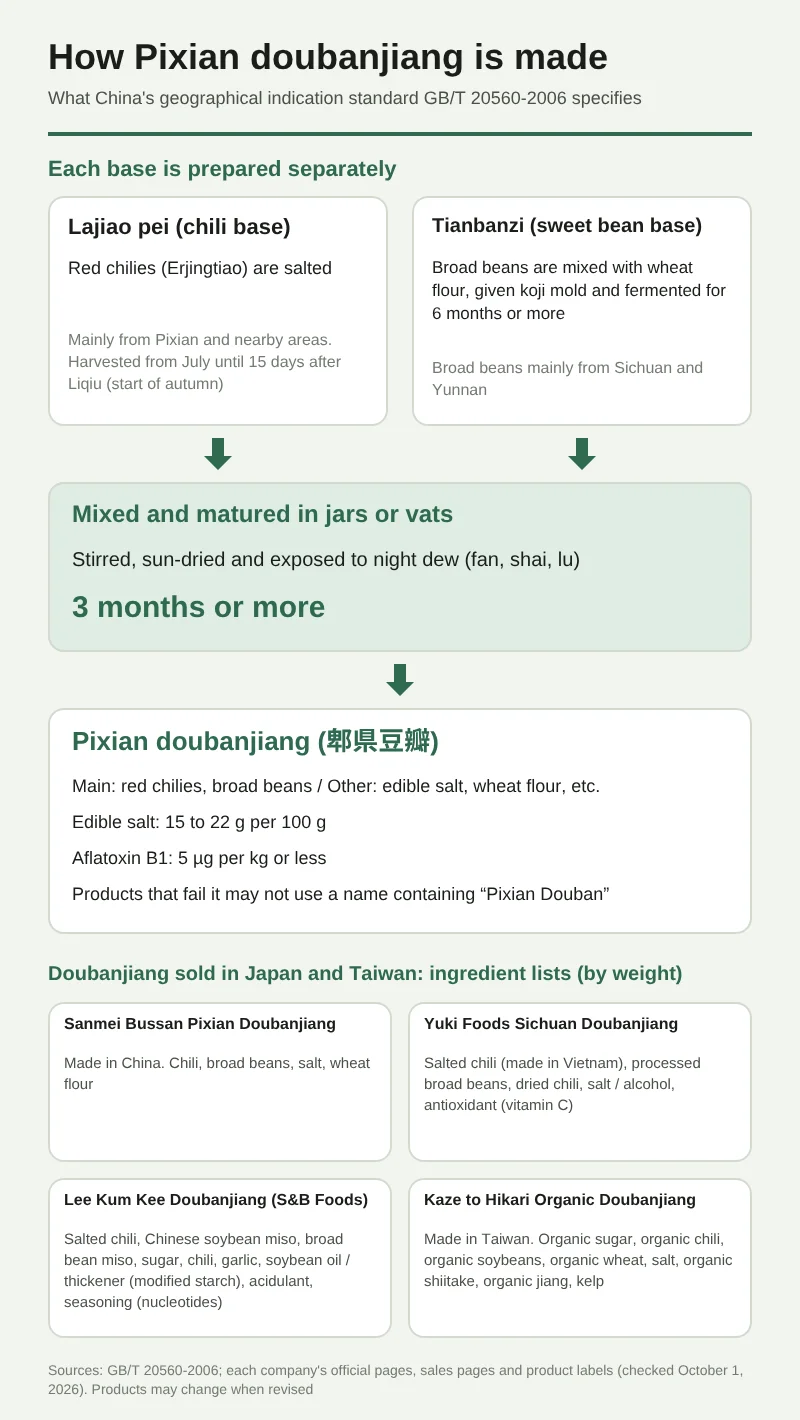
“Pixian Douban,” made in Pixian (now Pidu District), Chengdu, Sichuan, China, is protected as a geographical indication (a system in which the state protects the name of a product whose quality is tied to its place of origin). The national standard GB/T 20560-2006 “Product of Geographical Indication: Pixian Douban” (issued September 18, 2006, in force February 1, 2007, by the then General Administration of Quality Supervision, Inspection and Quarantine and the Standardization Administration) sets the place of origin, ingredients, and method.
The main contents of the standard are as follows.
| Item | Rule in GB/T 20560-2006 |
|---|---|
| Place of origin | The administrative area of Pixian, Chengdu, Sichuan |
| Definition | Made by the traditional method in the standard, with red chili peppers and broad beans as the main ingredients and edible salt, wheat flour, and the like as secondary ingredients |
| Red chili peppers | Mainly a variety called “erjingtiao” (二荊条) grown in Pixian and nearby Shuangliu, Renshou, Zhongjiang, Santai, Yanting, and elsewhere. Harvested from July until 15 days after the start of autumn |
| Broad beans | Mainly grown in Sichuan and Yunnan |
| Water | Groundwater of Pixian |
| Method | Red chili peppers are salted to make “lajiao pei” (the chili base). Broad beans are mixed with wheat flour, inoculated with koji mold (rice koji mold), and fermented for at least 6 months to make “tianban zi” (the sweet broad bean base). The two are mixed, put in a jar or trough, and aged for at least 3 months through stirring, sun exposure, and exposure to night dew (turn, dry, and dew) |
| Edible salt | 15 to 22 g per 100 g |
| Amino acid nitrogen (a guide to umami) | Per 100 g: special grade 0.25 g or more, first grade 0.20 g or more, second grade 0.18 g or more |
| Total acid | 2.0 g or less per 100 g |
| Aflatoxin B1 | 5 µg or less per kg |
| Name | Products that do not meet the standard cannot use a name that includes “Pixian Douban” |
(From the text of GB/T 20560-2006. The standard has Amendment No. 1, and its contents could not be confirmed this time)
- Papers also explain that Pixian doubanjiang is generally aged for 12 to 18 months, and longer ones for 24 months or more (from a study of umami peptides in doubanjiang made in Pixian). The sun-and-dew exposure (“shai lu”) is explained as producing a distinctive flavor, because day-night temperature changes affect the koji mold and enzymes
- “Pixian Douban” is also on the list of Chinese names protected under the geographical indications agreement between the EU and China, concluded in 2020 (in force March 1, 2021), as “Pixian Dou Ban (郫県豆瓣)”
Ingredients of doubanjiang sold in Japan and Taiwan
We lined up the ingredient lists of doubanjiang sold in Japan from the makers’ official pages and sales pages. Ingredients are listed in descending order of weight (Food Labeling Standards).
| Product | Country | Ingredient list (原材料名) | Beans | Sugar | Additives listed |
|---|---|---|---|---|---|
| Pixian standard (for reference) | China | Red chili peppers and broad beans as main ingredients; edible salt, wheat flour, and the like as secondary ingredients | Broad beans | Not among the standard’s ingredients | The standard follows China’s additive standard (GB 2760) |
| Pixian Doubanjiang (Sanmei Bussan) | China | Chili peppers, broad beans, salt, wheat flour | Broad beans | None | None |
| Sichuan Doubanjiang (Youki Foods) | Japanese maker (country of manufacture not stated on the page) | Salted chili peppers (made in Vietnam), processed broad beans, dried chili peppers, salt | Broad beans | None | Alcohol (shusei), antioxidant (vitamin C) |
| Lee Kum Kee Doubanjiang (S&B Foods) | Sold by S&B Foods (country of manufacture not stated on the page) | Salted chili peppers, Chinese soybean miso, broad bean miso, sugar, chili peppers, garlic, soybean oil | Soybeans and broad beans | Yes (4th) | Thickener (modified starch), acidulant, seasoning (nucleic acids) |
| Organic Doubanjiang (Kaze to Hikari) | Taiwan | Organic sugar, organic chili peppers, organic soybeans, organic wheat, salt, organic shiitake, organic jiang (organic soybeans, organic wheat, organic sugar, salt), kelp | Soybeans | The largest | None |
(Youki Foods and S&B Foods were checked on the makers’ official pages on October 1, 2026. Pixian Doubanjiang is from the Rakuten Ichiba sales page, and Organic Doubanjiang is from the product label. These may change when products are revised)
What the table shows is as follows.
- A product made with only broad beans and chili peppers (plus salt and wheat flour) has the same combination as the Pixian standard. The Chinese-made Pixian Doubanjiang is an example. However, the sales page does not show whether it is a product certified under the geographical indication
- Doubanjiang from Japanese makers also includes one with only broad beans (Youki Foods) and one combining Chinese soybean miso, broad bean miso, and sugar (Lee Kum Kee). Youki Foods also has a commercial-use “Sichuan Doubanjiang (without beans)” that uses no beans
- The Taiwanese Organic Doubanjiang uses soybeans and wheat rather than broad beans, and also contains shiitake, kelp, and jiang (a fermented seasoning of soybeans and wheat). Because organic sugar comes first in the ingredient list, sugar is the largest ingredient by weight. The ingredients show that, though it has the same name “doubanjiang,” it is made as a sweet-tasting seasoning
- In Japan, there is no ingredient standard for doubanjiang (nothing like a JAS standard). The reliable way to know what is in it is to check the ingredient list on the back label (article on the rules for “additive-free” labeling)
Soybeans, wheat, and sugar are also summarized on the “soybeans,” “sugar,” and “spices” pages of the ingredient dictionary.
How it differs from other Chinese and Korean jiang
We compared seasonings with similar names using the food composition tables, dictionaries, and makers’ labels.
| Name | What kind of seasoning | Main ingredients | Salt equivalent (per 100 g) |
|---|---|---|---|
| Doubanjiang (トウバンジャン) | A spicy miso from Sichuan, China. In the composition tables, it is in the pungent seasonings category | Chili peppers, broad beans (soybeans in some products), salt | 17.8 g (composition tables) |
| Tianmianjiang (甜麺醤) | Listed in the composition tables under the alternative name “Chinese sweet miso.” Used in the sauce for twice-cooked pork and Peking duck | The Japanese example (Lee Kum Kee) has Chinese soybean miso, sugar, sesame paste, soy sauce, and caramel color | 7.3 g (composition tables) |
| Gochujang | A sweet and spicy chili miso of the Korean Peninsula. Became a Codex (international food standard) standard in 2020 | Glutinous rice, rice koji (or soybean miso and malt powder), chili peppers, salt (from dictionary descriptions) | Not listed in the composition tables |
| XO sauce | A Chinese seasoning created around the 1980s in Hong Kong | Dried scallops, dried shrimp, Chinese ham (Jinhua ham), chili peppers, soybean oil, and so on (from dictionary descriptions) | Not listed in the composition tables |
| Rayu (chili oil) | Oil with the heat of chili peppers and the like infused | The composition tables calculate it with a blend of 8 parts sesame oil to 2 parts corn oil | 0 g (composition tables) |
(The composition tables are the “Standard Tables of Food Composition in Japan (8th Revised Edition), 2023 Supplement.” The descriptions of gochujang and XO sauce are from Digital Daijisen, Nihon Daihyakka Zensho, Mypaedia, and others; the Codex adoption is from an announcement by Korea’s Ministry of Agriculture, Food and Rural Affairs)
- Doubanjiang and gochujang are both fermented seasonings that use chili peppers, but doubanjiang is centered on beans (broad beans), while gochujang is centered on grains such as glutinous rice and is sweet
- Tianmianjiang is a sweet miso with no heat. It is used together with doubanjiang in mapo tofu and twice-cooked pork
- XO sauce is less a fermented seasoning than a seasoning of dried seafood and meat finished in oil
- The chili pepper’s pungent compound capsaicin is covered in the article on chili peppers and capsaicin
(Sources: MEXT, “Standard Tables of Food Composition in Japan (8th Revised Edition), 2023 Supplement”; GB/T 20560-2006)
Salt: about 1 g per teaspoon
In the food composition tables, “doubanjiang” has 7,000 mg of sodium and 17.8 g of salt equivalent per 100 g. The tables also give a conversion of “100 mL = 113 g,” so calculating from that gives the following.
| Amount | Weight (calculated) | Salt equivalent (calculated) |
|---|---|---|
| 1/2 teaspoon (2.5 mL) | about 2.8 g | about 0.5 g |
| 1 teaspoon (5 mL) | about 5.7 g | about 1.0 g |
| 1 tablespoon (15 mL) | about 17 g | about 3.0 g |
- Salt varies by product. The label on Youki Foods’ Sichuan Doubanjiang says 13.5 g per 100 g. The Pixian standard sets a range for “edible salt” of 15 to 22 g per 100 g. The reliable way is to look at the nutrition facts on the product you buy
- The target for salt equivalent in the Dietary Reference Intakes for Japanese (2025 edition) for people aged 18 and over is less than 7.5 g a day for men and less than 6.5 g for women. One tablespoon of doubanjiang (about 3.0 g) is close to half of the target for women. Salt amounts are covered in detail in the article on salt intake
- In mapo tofu and similar dishes, soy sauce, tianmianjiang, chicken stock powder, and so on also carry salt in addition to doubanjiang. The salt of the whole dish has to be considered as the total of the recipe
One caution. The salt in doubanjiang is not only for taste; it also plays the role of keeping unwanted bacteria from growing during fermentation. As we will see later, research has reported that fermenting with less salt tends to increase histamine and the like. “Making a reduced-salt doubanjiang” is itself a research topic.
Mold toxin (aflatoxin): standards and violations
What is aflatoxin?
Aflatoxin is a toxin made by molds such as Aspergillus flavus (a mold toxin). There are types such as B1, B2, G1, and G2.
- IARC (the International Agency for Research on Cancer) classifies aflatoxin in Group 1 (carcinogenic to humans)
- In its 2009 evaluation, the Food Safety Commission of Japan (FSCJ) judged aflatoxin to be a genotoxic carcinogen (a type that damages genes, for which no “safe up to here” amount can be set). In most human studies, a link between aflatoxin B1 and liver cancer has been pointed out, and it has been suggested that the risk is higher with hepatitis B virus infection
- For that reason, no tolerable daily intake has been set, and intake from food “should be as low as reasonably achievable” (the 1997 evaluation by JECFA, the FAO/WHO Joint Expert Committee on Food Additives, takes the same view)
Standards in Japan and China
| Standard | |
|---|---|
| Japan | Since 1971, food in which aflatoxin is detected has been treated as a violation of the Food Sanitation Act. Since a 2011 notice (Shokuan-hatsu 0331 No. 5), it is a violation if total aflatoxin in food (the sum of B1, B2, G1, and G2) exceeds 10 µg/kg (aflatoxin M1 in milk is separate, at 0.5 µg/kg) |
| China | The national food safety standard GB 2761-2017 sets aflatoxin B1 at 5.0 µg/kg or less for fermented jiang (酿造酱) and soy sauce. The Pixian standard GB/T 20560-2006 also sets B1 at 5 µg/kg or less |
Japan’s limit is “the sum of four types” and China’s is “B1 only,” so the numbers cannot be compared directly.
Why aflatoxin is an issue for doubanjiang
- Papers explain that traditional doubanjiang is fermented in open containers outdoors, so poor storage of the ingredients could expose it to contamination by aflatoxin-producing molds (a 2023 study on the safety of lactic acid bacteria and yeasts isolated from Sichuan doubanjiang)
- The chili pepper ingredient is also a target of mold toxin surveys. In a 2023 survey of 318 foods collected in Sichuan Province in 2022, aflatoxin was detected in 75.0% of chili powder, with B1 ranging from not detected up to 52.60 µg/kg. B1 exceeded China’s standard in 0.4% of all samples and the EU’s standard in 4.3%
Measured values
(Sources: MHLW notices and import violation cases, GB 2761-2017, GB/T 20560-2006, the table in the review by Nazhand et al. 2020, Zeng et al. 2022)
- In a study of commercial doubanjiang in China (summarized in a review table), aflatoxin B1 was detected in 34% (the table gives the percentage positive), with a mean of 4.78 µg/kg and a range of 1.26 to 16.41 µg/kg (measured with ELISA, a simple method)
- In another study that measured Pixian doubanjiang (2022), B1 in the sample was 3.4 µg/kg, below China’s standard of 5.0 µg/kg
Cases that violated the standard at import into Japan
The MHLW publishes foods that violated the Food Sanitation Act at import inspection as “Cases of Food Sanitation Act Violations in Imported Foods.” We obtained all of the published lists (Excel) from fiscal 2002 (Heisei 14) through September 2026 and searched for rows containing “豆板” (doubanban), “トウバン” (touban), and “豆瓣” (douban) (October 1, 2026).
| Fiscal year | Product name | Country of production | Violation | Cause as stated | Measure |
|---|---|---|---|---|---|
| FY2015 | Processed chili pepper product: doubanjiang (SALTED CHILLI PASTE) | Taiwan | Total aflatoxin 18 µg/kg and 29 µg/kg | Inadequate humidity control and pre-testing | Destroyed |
| FY2015 | Doubanjiang from the same manufacturer (a different import) | Taiwan | Total aflatoxin 21, 22, and 25 µg/kg | Same as above | Destroyed |
| FY2020 | Hot pot sauce and doubanjiang seasoning (3 products) | China | Sorbic acid, a preservative, used in the doubanjiang ingredient (a use not covered under Japan’s usage standards) | Not stated | Destroyed, shipped back, etc. |
| FY2021 | Beef tallow hot pot base | China | Potassium sorbate used in the doubanjiang ingredient (not covered) | Lack of awareness of the Food Sanitation Act | Destroyed |
| FY2022 | Hot pot sauce (2 products) | China | Potassium sorbate used in the doubanjiang ingredient (not covered) | Mix-up with products for other countries | Shipped back, etc. |
- The aflatoxin violations in doubanjiang itself in this period were only two cases from one Taiwanese manufacturer in fiscal 2015. Both exceeded Japan’s standard of 10 µg/kg and were destroyed
- The others are cases in which a preservative (sorbic acid) was used in the doubanjiang ingredient of Chinese hot pot bases and similar products. In Japan, sorbic acid may be used only in set foods and amounts, and this use was outside them (for preservatives, see the article on preservatives; for sorbic acid, see the additives database)
- Violation cases are records of specific imported lots found in inspection, and the list does not show product names (brands). Also, inspection does not cover every import, so “fewer violations” does not mean “no contamination”
Biogenic amines such as histamine produced by fermentation
What are biogenic amines?
“Biogenic amines” such as histamine, tyramine, and putrescine are substances made from amino acids, the building blocks of protein, by the action of bacterial enzymes. Fermented foods contain them to some degree.
- In Japan, histamine is an issue mainly in red-fleshed fish such as tuna and their processed products. If fish is left at room temperature, bacteria make histamine, and eating it causes allergy-like symptoms such as hives (histamine food poisoning). Once formed, histamine is not broken down by ordinary cooking (from FSCJ materials)
- In its 2011 opinion, the EU’s EFSA (European Food Safety Authority), working from limited data, said that 50 mg of histamine per meal showed no adverse health effects in healthy people. For people with histamine intolerance, it said the amount should be kept below detectable levels. For tyramine, it gave 600 mg per meal for healthy people, and 50 mg or 6 mg for people taking drugs called MAO inhibitors
- A 2024 review of biogenic amines says that sensitivity differs from person to person, and that alcohol and some medicines also change the effects
Values measured in doubanjiang
| Study | What was examined | Result |
|---|---|---|
| Survey of 406 Pixian doubanjiang products (2026) | Heavy metals and 6 biogenic amines in commercial products | Median histamine: 22.794 mg/kg for unbranded products, 15.386 mg/kg for branded products. All but spermidine were within the reference upper limits. Spermidine exceeded the reference upper limit in 34.0% of branded products and 32.5% of unbranded ones |
| 27 traditional doubanjiang products in China (2021) | Biogenic amines in commercial products | All within the range considered safe |
| Fermentation trial with different salt levels (2026) | Fermented at 12%, 9%, and 6% salt | At 6% salt, acids and free amino acids increased, and total biogenic amines built up to 1456.95 mg/kg |
| Fermentation trial of low-salt Pixian douban (2025) | Fermented for 35 days at 6% and 15% salt | In the 6% salt group without added bacteria, tyramine was 45.28 mg per 100 g. In the 6% salt group with added bacteria and the 15% salt group, every detected biogenic amine was below 6 mg per 100 g |
- Calculating from the median histamine in the 406-product survey (22.794 mg/kg), 1 tablespoon of doubanjiang (about 17 g) has about 0.4 mg of histamine. That is roughly 1/130 of the 50 mg per meal at which EFSA saw no adverse effects in healthy people (this is only a calculation from the median, and the values for individual products are not known)
- The reduced-salt fermentation trials all used samples made in the laboratory, not values from commercial products. Still, several studies point in the same direction: fermenting with less salt tends to increase biogenic amines. Researchers are looking at methods that suppress biogenic amines by adding lactic acid bacteria and the like as starters (the seed for fermentation)
- Within the scope we checked, we found no studies that followed the health of people who ate doubanjiang (human observational studies or trials). What is written here comes from studies that measured food components and from fermentation trials
Summary
| Point | What we found | Type of source |
|---|---|---|
| What authentic doubanjiang is | Pixian douban has red chili peppers and broad beans as main ingredients and salt and wheat flour as secondary ingredients. At least 6 months of broad bean koji plus at least 3 months of aging. Cannot be called by that name if it does not meet the standard | China’s national standard (GB/T 20560-2006), the EU-China agreement |
| Doubanjiang in Japan and Taiwan | Some use only broad beans, and some combine soybean miso and sugar. Organic Doubanjiang (Kaze to Hikari) uses soybeans and wheat, and sugar is the largest ingredient | Makers’ official pages and product labels |
| Differences from other jiang | Tianmianjiang is a sweet miso (7.3 g of salt), gochujang is centered on grains such as glutinous rice, and XO sauce is a seasoning of dried seafood and meat | Food composition tables, dictionaries |
| Salt | 17.8 g per 100 g in the composition tables. About 1.0 g per teaspoon and about 3.0 g per tablespoon (calculated). Differs by product | Food composition tables |
| Mold toxin | Japan: total aflatoxin 10 µg/kg. China: B1 of 5.0 µg/kg for fermented jiang. Import violations: two Taiwanese cases in fiscal 2015 | National notices and standards, MHLW violation cases, papers |
| Histamine and others | Median histamine in commercial products is 15 to 23 mg/kg. Tends to increase with reduced-salt fermentation. No studies of human health found | Component surveys and fermentation trials, EFSA opinion |
Here is a recap of the items introduced.
| Item | Why chosen | Rakuten Ichiba |
|---|---|---|
| Organic Doubanjiang (Kaze to Hikari) 180 g | Made in Taiwan. Eight ingredients with no additives listed. Uses soybeans and wheat, and sugar is the largest ingredient | See on Rakuten (むぎごころ) PR See on Amazon.co.jp PR See on Yahoo! Shopping PR |
| Pixian Doubanjiang (Sanmei Bussan) 250 g | Made in China. Four ingredients: chili peppers, broad beans, salt, and wheat flour, the same combination as the Pixian standard | See on Rakuten (耀盛號) PR See on Amazon.co.jp PR See on Yahoo! Shopping PR |
| Measuring Spoon Set of 3 (Pearl Metal) | Lets you use the guide of about 1 g of salt per teaspoon as it is. Made in Japan | See on Rakuten (パール金属公式) PR See on Amazon.co.jp PR See on Yahoo! Shopping PR |
(Checked on the Rakuten Ichiba sales pages on October 1, 2026. Prices and shipping may change.)
“Authentic doubanjiang is made from broad beans and chili peppers” is a fact according to the standard for Sichuan’s Pixian douban. On the other hand, doubanjiang sold in Japan and Taiwan includes products that use soybeans or sugar, so the ingredients vary even under the same name. Depending on whether you put the most weight on heat, sweetness, or salt, the reliable way to choose is to look at the ingredient list and nutrition facts on the back label.
Sources
- MEXT, “Standard Tables of Food Composition in Japan (8th Revised Edition), 2023 Supplement,” Chapter 2 Main Tables (Excel) https://www.mext.go.jp/a_menu/syokuhinseibun/mext_00001.html
- General Administration of Quality Supervision, Inspection and Quarantine and Standardization Administration, “GB/T 20560-2006 Product of Geographical Indication: Pixian Douban” (2006), excerpt of the text http://www.jin001.cn/tiaoweipin/738.html , bibliographic record http://down.foodmate.net/standard/sort/3/11431.html
- Agreement between the European Union and the Government of the People’s Republic of China on cooperation on, and protection of, geographical indications. Official Journal of the European Union L 407 (December 3, 2020) https://eur-lex.europa.eu/legal-content/EN/TXT/?uri=CELEX:22020A1203(01)
- China national food safety standard “GB 2761-2017 Maximum Levels of Mycotoxins in Foods” (2017), provision database of Foodmate http://2761.foodmate.net/
- MHLW, “On the Handling of Aflatoxin M1 in Milk” (Shokuan-hatsu 0723 No. 1, 2015; it records the content of Shokuan-hatsu 0331 No. 5 of 2011) https://www.mhlw.go.jp/file/06-Seisakujouhou-11130500-Shokuhinanzenbu/20150723-1.pdf
- Pharmaceutical Affairs and Food Sanitation Council, Food Sanitation Subcommittee material, “Deliberation process for setting component standards for aflatoxin in food” (2009) https://www.mhlw.go.jp/shingi/2009/06/dl/s0602-3a.pdf
- MHLW, “Cases of Food Sanitation Act Violations in Imported Foods” (fiscal 2002 through September 2026) https://www.mhlw.go.jp/stf/seisakunitsuite/bunya/kenkou_iryou/shokuhin/yunyu_kanshi/ihan/index.html , https://www.mhlw.go.jp/stf/seisakunitsuite/bunya/0000158961.html
- Food Safety Commission of Japan, 35th Planning Subcommittee material, “Histamine” (2010) https://www.fsc.go.jp/sonota/hazard/hyoka_62.pdf
- EFSA Panel on Biological Hazards (2011) Scientific Opinion on risk based control of biogenic amine formation in fermented foods. EFSA Journal 9(10):2393 https://www.efsa.europa.eu/en/efsajournal/pub/2393
- Japan Foundation for Aging and Health, Kenko Choju Net, “Functions of sodium (salt) and the daily intake” (target values in the Dietary Reference Intakes for Japanese, 2025 edition) https://www.tyojyu.or.jp/net/kenkou-tyoju/eiyouso/mineral-na.html
- Youki Foods, “Sichuan Doubanjiang 130 g” https://youki.co.jp/goods/goods-detail/?386
- S&B Foods, “Lee Kum Kee Doubanjiang 90 g” and “Lee Kum Kee Tianmianjiang” https://www.sbfoods.co.jp/products/detail/11384.html https://www.sbfoods.co.jp/products/detail/11395.html
- Kaze to Hikari, “New release: Organic Taiwanese Chinese seasonings” (2024) https://kazetohikari.jp/2024/08/09/%ef%bc%bc%e6%96%b0%e7%99%ba%e5%a3%b2%ef%bc%8f%e3%80%80%e3%82%aa%e3%83%bc%e3%82%ac%e3%83%8b%e3%83%83%e3%82%af%e5%8f%b0%e6%b9%be%e4%b8%ad%e8%8f%af%e8%aa%bf%e5%91%b3%e6%96%99/
- Kotobank, “XO sauce” and “Gochujang” (Digital Daijisen, Nihon Daihyakka Zensho, Mypaedia, and others) https://kotobank.jp/word/XO%E9%86%A4-445209 https://kotobank.jp/word/コチュジャン
- Korea Ministry of Agriculture, Food and Rural Affairs, “Spiciness of Korean Food, in Global Standards” https://www.mafra.go.kr/bbs/english/25/325621/artclView.do
- Nazhand A et al. (2020) Characteristics, Occurrence, Detection and Detoxification of Aflatoxins in Foods and Feeds. Foods. https://pubmed.ncbi.nlm.nih.gov/32443392/
- Zeng et al. (2022) Determination of aflatoxin B1 in Pixian Douban based on aptamer magnetic solid-phase extraction. RSC Adv. https://pubmed.ncbi.nlm.nih.gov/35865604/
- Zhao et al. (2023) Food aflatoxin exposure assessment in Sichuan Province, China. Mycotoxin Res. https://pubmed.ncbi.nlm.nih.gov/37322297/
- Feng et al. (2023) Safety evaluation and application of lactic acid bacteria and yeast strains isolated from Sichuan broad bean paste. Food Sci Nutr. https://pubmed.ncbi.nlm.nih.gov/36789042/
- Wen et al. (2026) Risk assessment of heavy metals and biogenic amines in branded versus non-branded Pixian Doubanjiang. J Hazard Mater. https://pubmed.ncbi.nlm.nih.gov/42001752/
- Liu C et al. (2021) Evaluation and prediction of the biogenic amines in Chinese traditional broad bean paste. J Food Sci Technol. https://pubmed.ncbi.nlm.nih.gov/34194109/
- Liao et al. (2026) Insights into the salt-dependent mechanisms of physicochemical changes, microbial succession, and biogenic amine formation during Doubanjiang fermentation. Food Chem. https://pubmed.ncbi.nlm.nih.gov/42034087/
- Yang et al. (2021) Physicochemical, flavor and microbial dynamic changes during low-salt doubanjiang (broad bean paste) fermentation. Food Chem. https://pubmed.ncbi.nlm.nih.gov/33652296/
- Enhancement of Quality and Safety of Low-Salt Pixian Douban Fermentation with Paenibacillus polymyxa M17 27-6 (2025). Foods. https://pubmed.ncbi.nlm.nih.gov/41464907/
- Discovery and Validation of Novel Umami Peptides from Traditional Broad Bean Paste (Doubanjiang). Foods (MDPI)
- Saha et al. (2024) A review of biogenic amines in fermented foods: Occurrence and health effects. Heliyon. https://pubmed.ncbi.nlm.nih.gov/38304783/
- Rakuten Ichiba sales pages for “Organic Doubanjiang” from オーガニック 健康生活 むぎごころ, “Pixian Doubanjiang” from 横浜中華街・耀盛號, and “Measuring Spoon Set of 3 CC-1045” from the Pearl Metal official online store (checked October 1, 2026)
Related articles and databases
- Were “無添加” (Additive-Free) Labels Banned? Reading the Consumer Affairs Agency Guideline’s 10 Types from the Back Label
- Are preservatives bad for you? Types such as sorbic acid, what “preservative-free” hides, and how Japanese and overseas rules differ
- Why Did “No Chemical Seasoning” Disappear? Is Yeast Extract a Chemical Seasoning? How to Read Umami Seasonings and Hydrolyzed Protein
- Is Vinegar Good for You? Rice, Pure Rice, Grain, Black, and Apple Cider Vinegar Compared, and the “Acetic Acid for Blood Pressure and Visceral Fat” Research Checked
- Are Chili Peppers Good for You? How Capsaicin Makes Food Hot, the Scoville Scale, and What the Research Says About “Living Longer,” “Losing Weight,” and “Bad for the Stomach”