
Were “無添加” (Additive-Free) Labels Banned? Reading the Consumer Affairs Agency Guideline’s 10 Types from the Back Label

PR This article contains advertisements. The “See on Rakuten Books” and “See on Amazon” links are affiliate links to Rakuten Ichiba and Amazon. What is written here is based on materials from public agencies such as the Consumer Affairs Agency, whether or not there is an ad. The “See on Amazon.co.jp” and “See on Yahoo! Shopping” links are also affiliate links.
“無添加” (additive-free), “保存料不使用” (no preservatives), “着色料無添加” (no colorants). For labels like these, so common on food packages, there has been a national guideline since March 2022: the Consumer Affairs Agency’s “Guidelines on ‘Not Used’ Labeling of Food Additives.”
The guideline divides potentially misleading “無添加” and “不使用” (not used) labels into 10 types. This article introduces the 10 types one by one, together with the Agency’s examples. When you see the word “無添加,” you will know where to look on the back label.
Conclusion: “無添加” has not been banned. But what matters is “what” and “instead of what”
- The guideline does not uniformly prohibit “無添加” and “不使用” labels. The Consumer Affairs Agency’s awareness leaflet also states this clearly
- The yardstick is Article 9 of the Food Labeling Standards (what must not be labeled). The guideline shows labels with a high risk of falling under Article 9 in 10 types
- The period for businesses to review their labels ran until the end of March 2024
- The central idea behind the 10 types is that the following are misleading: labels that do not make clear what has not been used, labels that replace something with something that does the same job without making that clear, and labels that give “additive-free, so safe or tasty” as the reason
- Which additives are used is, as before, written in the ingredient list (原材料名, the grouped label) on the back. The Consumer Affairs Agency also urges people to check the grouped label carefully when buying
Were “無添加” labels banned?
You sometimes hear that “無添加 labeling was banned,” but it was not banned.
- The Consumer Affairs Agency issued the guideline on March 30, 2022. The period for businesses to review their labels ran until the end of March 2024
- The guideline is not a new regulation. It is a guide for businesses to check themselves, showing labels with a high risk of falling under Article 9 of the Food Labeling Standards (what must not be labeled) in 10 types
- The Consumer Affairs Agency’s awareness leaflet also says the guideline does not uniformly prohibit “無添加” and “不使用” labels. Examples of labels that make clear what has not been used are given in the “These are fine” examples below
What the guideline is
Why it was made
Food additives have their safety assessed by the Food Safety Commission of Japan, and their specifications and standards of use are set by the Food Sanitation Act. How they are labeled is also set by the Food Labeling Standards.
On the other hand, there were no special rules for labels saying “no additives used.” “無添加” and “不使用” were labels that businesses added voluntarily.
At the Consumer Affairs Agency’s study group, the following problems were pointed out:
- The materials that show how to interpret Article 9 of the Food Labeling Standards, which sets what must not be labeled (the Food Labeling Standards Q&A), were not comprehensive and were ambiguous
- “無添加” labels are written on the front of the package, more prominent than the mandatory labeling, so the grouped label that should be read is not being used
The Consumer Affairs Agency’s surveys also produced the following results.
| Survey item (Consumer Affairs Agency consumer attitude survey) | Result |
|---|---|
| Know that food additives are approved by the government after safety assessment and the like | 36.3% (fiscal 2019) |
| Always buy, or choose among the same kind, foods with labels such as “無添加” | 51.2% (fiscal 2017, 10,000 people) |
| Of those, people who gave “seems safe and good for health” as the reason | 72.9% |
| On seeing “〇〇無添加” (no ___), get the impression that no additives are used at all, or fewer than in other products | 54.3% combined |
In response, a study group was set up in March 2021, and the guideline was compiled from hearings with consumers and businesses and from actual labels (March 30, 2022). The guideline also draws in part on the thinking of an international guideline on food claims (the Codex “General Guidelines on Claims”).
Its standing
- The guideline is not a new regulation. It is a yardstick (benchmark) for businesses to check themselves on whether a label falls under the existing Article 9 of the Food Labeling Standards
- It covers labels on the containers and packaging of general processed foods that say additives are not used
- Whether a label actually falls under Article 9 is judged as a whole, case by case, from the nature of the product, the knowledge of ordinary consumers, the way of labeling, and so on
- Because switching packaging materials takes time, it asked businesses to review labels within about two years (until the end of March 2024). It accepts that products made in this period may circulate with their pre-review labels
List of the 10 types
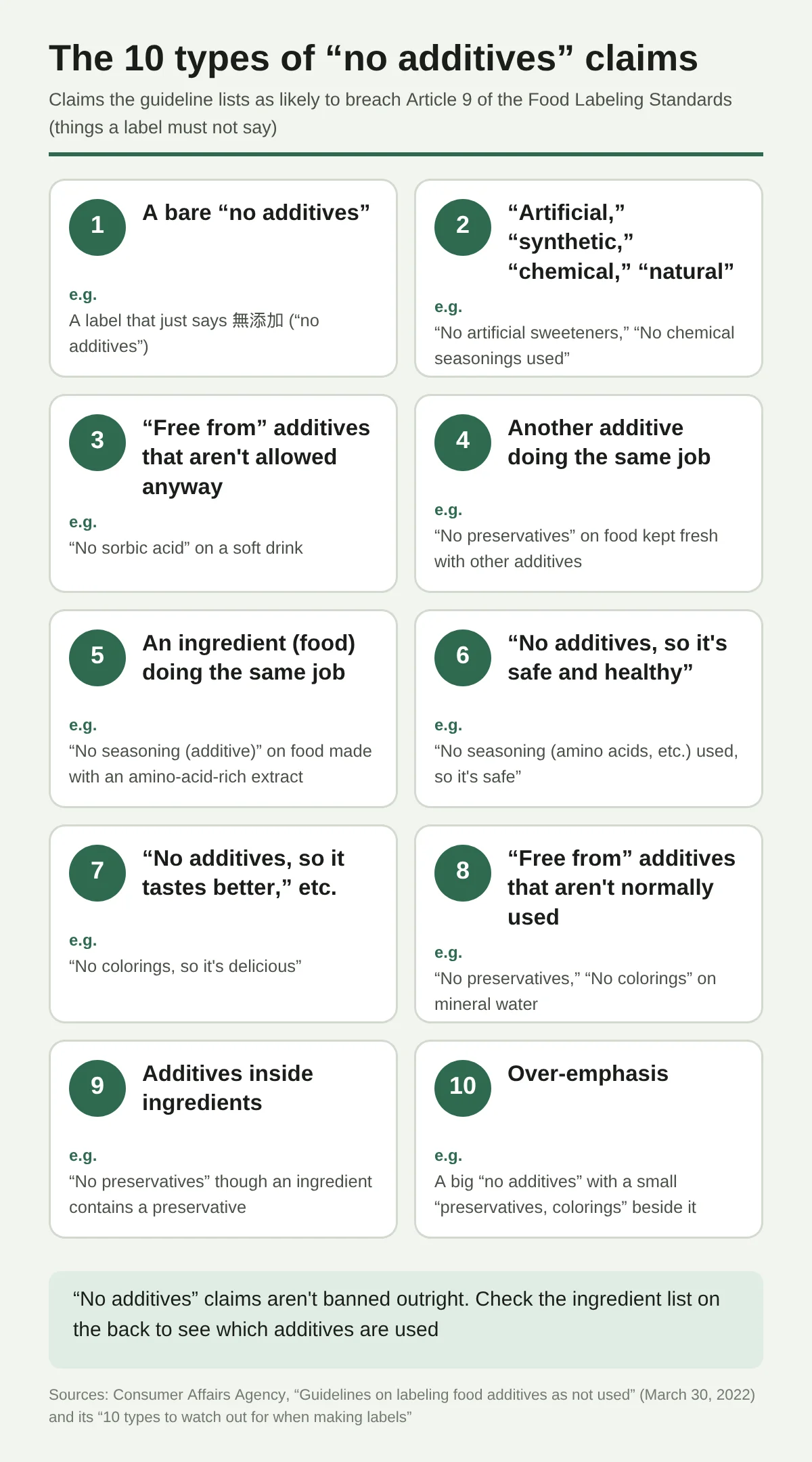
| Type | What kind of label | Consumer Affairs Agency example | Detailed article |
|---|---|---|---|
| 1 Plain “無添加” labels | “無添加” where it is unclear what has not been added | A label that says only “無添加” | ― |
| 2 Labels using terms not defined in the Food Labeling Standards | Used with words such as “artificial,” “synthetic,” “chemical,” “natural” | “人工甘味料不使用” (no artificial sweeteners), “化学調味料は使用していません” (no chemical seasonings used) | Article on umami seasonings, Article on sweeteners |
| 3 Labels on foods for which the use of the additive is not permitted by law | Claiming “not used” for an additive that could not be used anyway | “ソルビン酸不使用” (no sorbic acid) on a soft drink, “香料無添加” (no flavoring) on mayonnaise | Article on flavorings |
| 4 Labels on foods using additives with the same or a similar function | Another additive with the same function is used | “保存料不使用” (no preservatives) on a food using an additive other than a preservative to extend shelf life | Article on preservatives, Article on colorants |
| 5 Labels on foods using ingredients with the same or a similar function | Replaced with an ingredient (food) with the same function | A statement that no seasoning additive is used, on a food using an extract containing amino acids | Article on umami seasonings |
| 6 Labels linked to health or safety | “Additive-free, so good for you and safe” | “調味料(アミノ酸等)は使用していないので、安全です” (no seasoning (amino acids, etc.) is used, so it is safe) | ― |
| 7 Labels linked to something other than health or safety | Giving a reason whose causal link cannot be explained, such as “additive-free, so tasty” | “着色料不使用だからおいしい” (tasty because no colorants are used) | ― |
| 8 Labels on foods in which additive use is not expected | Claiming “not used” for an additive not normally used | “保存料不使用” and “着色料不使用” on mineral water | ― |
| 9 Labels on foods in which additives are used as processing aids or carry-over (or in which non-use cannot be confirmed) | “Not used” without checking additives within the ingredients | “保存料不使用” while a preservative is used in part of the ingredients; “自社の製造工程においては、食品添加物は使用しておりません” (no food additives are used in our own manufacturing process) | Article on carryover |
| 10 Overly emphasized labels | Made so prominent that it gets in the way of looking at the grouped label | A large “無添加” with a small “保存料、着色料” next to it, on a food using additives other than preservatives and colorants | ― |
Note: the “Consumer Affairs Agency examples” are from the guideline text and the Agency’s material “10 Types to Watch for When Preparing Labels.”
Points for each type
Type 1: Plain “無添加”
When “無添加” is shown without saying what, consumers have to guess what has not been added. The guideline’s thinking is that if the guess differs from what the business intended, it may mislead people about the contents.
Type 2: “Artificial,” “synthetic,” “chemical,” “natural”
Under the Food Sanitation Act, additives include both chemically synthesized and natural ones, and both are permitted. The Food Labeling Standards also require, in principle, that all of them be labeled without distinguishing between the two, and the words “人工” (artificial) and “合成” (synthetic) were deleted from the standards in July 2020.
Because some people have a good or bad impression of such words, the guideline says that using them together with “無添加” or “不使用” may mislead people into thinking a product is better than it is. “化学調味料” (chemical seasoning) was also once used in JAS standards but was deleted in 1989 (Heisei 1), and it is a word that has never been used in the Food Labeling Standards. Details are in the article on umami seasonings.
Type 3: “Not used” for an additive that could not be used anyway
If you write “not used” for an additive that cannot be used under law, people who do not know the rule may read it as better than products without the “not used” label.
- Sorbic acid, a preservative, cannot be used in soft drinks (it would violate the usage standard)
- According to the Consumer Affairs Agency’s material, mayonnaise cannot use additives other than seasonings (amino acids, etc.), acidulants, and spice extracts. For that reason, “香料無添加” (no flavoring) is given as an example of this type
Type 4: Another additive with the same function
This is when a label says “〇〇不使用” (no ___) while using a different additive that does the same or a similar job as ___.
- “保存料不使用” on a food that uses an additive other than a preservative to extend shelf life (in the Consumer Affairs Agency’s material, glycine used in rice balls)
- A statement that no colorant from the designated additives (such as tar dyes) is used, on a food using a colorant from the existing additives (a category mostly of additives taken from plants and the like)
The difference between preservatives and shelf-life extenders is covered in the article on preservatives, and the categories of colorants in the article on colorants.
Type 5: An ingredient (food) with the same function
This is the case where the replacement is not an additive but an ingredient (food). The guideline says that if consumers do not notice that something has been replaced with a thing that cannot be called scientifically the same as the original food, such as a single extracted component, they may be misled.
The Consumer Affairs Agency’s example is the case of labeling “調味料(アミノ酸等)無添加” (no seasoning (amino acids, etc.)) on a white dashi (a light-colored soup stock) that uses yeast extract whose main component is amino acids. The guideline treats as the problem that the label does not clearly show the ingredient used as the replacement. Details are in the article on umami seasonings.
Type 6: “Additive-free, so safe or good for the body”
Food additives are permitted by the government only when, after a safety assessment, they pose no risk of harming human health. For that reason, the guideline says it is difficult for a business to scientifically verify health or safety on its own and link it to “無添加,” and that this may mislead people.
Type 7: “Additive-free, so tasty” and the like
Reasons other than health and safety are also covered. The guideline gives the following three examples:
- Giving “not used” as the reason for tastiness (when a causal link between tastiness and non-use cannot be explained)
- Labeling “保存料不使用なので、お早めにお召し上がりください” (no preservatives, so please eat soon) without mentioning “after opening” (gives the impression that it must be eaten sooner than the date label, and may contradict the date label)
- Giving “着色料不使用” (no colorants) as the reason for discoloration (when the relationship between discoloration and the role of colorants cannot be explained)
Type 8: “Not used” for an additive that is not normally used
If you write “not used” for an additive that is not normally used in the same kind of product, people who care about that additive may read it as better than products without the label. The guideline’s examples are preservatives and colorants in mineral water, and “着色料不使用” (no colorants) on foods that normally use no colorants and have their natural color.
Type 9: Additives within ingredients
For additive labeling, it is necessary to trace back and check the manufacturing and processing stage of the ingredients.
- “保存料不使用” on the finished product while a preservative is used in part of the ingredients
- Because it cannot be confirmed that no additives were used at the ingredient stage, “無添加” with the qualification “limited to our own manufacturing process”
Both are examples with a high risk of misleading. The mechanism of unlabeled additives is covered in the article on carryover.
Type 10: Overemphasis
Even if a label is true, writing it all over the package, or using extremely large letters or conspicuous colors compared with the grouped label, so that it gets in the way of looking at the grouped label, may give the impression that no other additives are used either. The guideline adds that when combined with the other types, it may strengthen that misunderstanding.
Examples of “These are fine”
The Consumer Affairs Agency’s awareness leaflet also shows examples of labels that are easy to understand.
| Label | Condition |
|---|---|
| “保存料無添加 保存効果を持たせるために酸化防止剤を使用しています” (No preservatives added. Antioxidant is used to give a preservative effect.) | When an antioxidant is used to give a preservative effect, say so |
| “甘味料不使用” (no sweeteners) | When no sweeteners, and no ingredients or additives with a function similar to sweeteners (such as licorice extract), are used |
| “着色料無添加” (no colorants added) | When no colorants, and no ingredients (such as cranberry extract) or additives with a function similar to colorants, are used |
The leaflet also has a speech bubble saying that it is easy to understand if it states “what is additive-free” and “what is used.”
Back-label checkpoints
- When you see “無添加,” look for “what?”: a “無添加” with no object written is an example of Type 1
- When you see “〇〇不使用,” look for something with the same function: for preservatives, shelf-life extenders and antioxidants; for 調味料(アミノ酸等) (seasoning (amino acids, etc.)), yeast extract, hydrolyzed protein, and so on (Types 4 and 5)
- “無添加” combined with “人工,” “合成,” “化学,” or “天然” uses words that are not in the standards (Type 2)
- For “so it’s safe” or “so it’s tasty,” consider whether the reason holds up (Types 6 and 7)
- Think about whether the additive is normally used in that food in the first place: “not used” for something that cannot be used, or is not used, makes no difference from other products (Types 3 and 8)
- In the end, look at the ingredient list (原材料名) in the grouped label: additives used are written after the “/”. Additives within ingredients may not be written (Type 9)
How Urayomi (ウラヨミ) approaches this
Urayomi takes the guideline to be not for getting rid of “無添加” but for getting people to read the ingredient list (原材料名) on the back.
On Urayomi’s product pages, we write things separately as follows:
- A “〇〇不使用” that the manufacturer shows is quoted as is, as the manufacturer’s label
- Things that Urayomi has looked at in the ingredient list and confirmed are not written are listed as “not found in the ingredient list (原材料名に見当たらないもの)”. This does not mean “not contained” (because, as in Type 9, there can be additives that are not labeled)
- We do not write “additive-free, so safe” or “good for the body” (Type 6)
Articles on each topic
- Why did “化学調味料無添加” (no chemical seasonings) disappear? (Types 2 and 5) → Article on umami seasonings
- “保存料不使用” and shelf-life extenders (Type 4) → Article on preservatives
- Categories of colorants and overseas rules (Type 4) → Article on colorants
- “Artificial sweeteners” and “zero” labels (Type 2) → Article on sweeteners
- What is in “香料” (flavoring) (Type 3) → Article on flavorings
- Additives not written on the label (Type 9) → Article on carryover
- “無塩せき” (no nitrite added) on ham, and color-fixing agents → Article on color-fixing agents
- Overseas rules for each additive → Additive database
Note that this guideline is about food labeling. “無添加” on daily-use products such as shampoo and detergent is not covered. Labeling of daily-use products is covered in the article on transdermal toxins and daily-use products.
If you want to check the labeling rules all the way through, from ingredient list to additives to allergens, the official textbook for the Food Labeling Certification exam brings it together.
Sources
- Consumer Affairs Agency, “Guidelines on ‘Not Used’ Labeling of Food Additives” (March 30, 2022)
- Consumer Affairs Agency, “10 Types to Watch for When Preparing Labels” (July 2022)
- Consumer Affairs Agency, “Guidelines on ‘Not Used’ Labeling of Food Additives” awareness leaflet and poster (November 2022)
- Consumer Affairs Agency, “Review of Discussions on ‘Not Used’ Labeling of Food Additives” (materials of the Study Group on Guidelines for ‘Not Used’ Labeling of Food Additives, March 2021; includes excerpts from the consumer attitude surveys [fiscal 2017 to 2019])
- Consumer Affairs Agency, “Study Group on Guidelines for ‘Not Used’ Labeling of Food Additives” (March 2021 to March 2022)
This article explains labeling rules. It does not judge the safety or danger of any particular food or additive, nor does it judge whether the label of any particular product falls under the guideline.
Related articles and databases
- Why Did “No Chemical Seasoning” Disappear? Is Yeast Extract a Chemical Seasoning? How to Read Umami Seasonings and Hydrolyzed Protein
- What is carryover? How it differs from processing aids, and the additives that are not listed on labels even on “additive-free” foods
- Are preservatives bad for you? Types such as sorbic acid, what “preservative-free” hides, and how Japanese and overseas rules differ
- Are Food Colorings (Red No. 102, Yellow No. 4) Bad for You? Cancer Assessments and Whether They Are Banned Abroad, Checked Against Rules in Japan and Overseas
- Are Artificial Sweeteners Bad for You? Aspartame and Cancer, What “Zero Calorie” and “Zero Sugars” Really Mean, and Japanese vs. Overseas Rules
- Are Flavorings Bad for You? What “香料” (Flavoring) Contains, Why It Is Written as One Word, and Japanese vs. Overseas Rules
- What Is Monosodium Glutamate (Umami Seasoning)? Checking the Claims About Petroleum, GMOs, Intake Limits, and a "Damaged Sense of Taste"
- What Is Doubanjiang? How Sichuan’s Pixian Doubanjiang Differs from Japanese and Taiwanese Versions, with Salt, Mold Toxin, and Histamine Checked Against Official Sources
- Is Sesame Good for You? Checking Sesamin Research, Allergen Labeling, and Pesticide Residues in Imported Sesame Against Government Data and Studies
- Is Vinegar Good for You? Rice, Pure Rice, Grain, Black, and Apple Cider Vinegar Compared, and the “Acetic Acid for Blood Pressure and Visceral Fat” Research Checked
- What Is the Rice Polishing Ratio? How Sake Is Made, Flat Polishing, and Yeast: Reading the Words on the Label from Government Sources
- Is Caramel Color Dangerous? The Carcinogen Claim About “4-MEI” and the Four Types, Checked Against Japan, EU, and US Assessments
- What is spelt wheat? Does gluten make holes in the gut? Checking “leaky gut” and pesticides in imported wheat against papers and national data
- Comparing 5 additive-conscious grocery delivery services: trial sets, ongoing costs, and additive standards (2026)